IJIRT 143293 INTERNATIONAL JOURNAL OF INNOVATIVE RESEARCH IN TECHNOLOGY 66
HOUSING QUALITY EVALUATION TOOLS - A
COMPARATIVE STUDY
Ar. Rajan Chandra Sinha1, Dr. Satyaki Sarkar2
1
Assistant professor, Department of Architecture, Birla Institute of Technology, Mesra. Ranchi.
2
Associate professor, Department of Architecture, Birla Institute of Technology, Mesra. Ranchi.
Abstract- The development of housing quality
evaluation tools is relatively a recent phenomenon. It has been, through recent researches, established that the quality of housing has profound impact upon health, safety, sustainability and enhancing the overall quality of life. But the effectiveness of the tools developed has been a matter of continuous debate often challenging its universality. Going by the old adage ‘what gets measured, gets managed’, this study tries to conduct a comparative study of the existing housing quality evaluation tools based upon their suitability for different housing typology, aim and scope of the tool, selection of criteria for quality assessment and the methodology adopted therein. The tools selected for study include Design Quality Indicator (DQI), Housing Quality Indicators (HQI), Building for Life, Sheffield Care Environment Assessment Matrix (SCEAM), Building Research Establishment Environmental Assessment Method (BREEAM), Post-occupancy Review of Buildings and their Engineering (PROBE), Leadership in Energy Environmental Design (LEED) and Green Rating for Integrated Habitat Assessment (GRIHA). The paper establishes that the evaluator needs to establish the objectives of evaluation that can serve as a basis for identifying the indicators for establishing housing quality.
Index terms- BREEAM, DQI, GRIHA, Housing
evaluation tools, Housing Quality, HQI, LEED, PROBE.
I. INTRODUCTION
France, after the end of World War II, initiated housing quality assessment system. This practice was soon adopted by most European and American countries. Most of the developed countries have formulated their own evaluation systems according to their state of development with respect to assessment of residential building. The aim of these existing evaluation tools is to either achieve a suitable standard of residential units in which public money
has to be invested or to enable builders to incorporate these standards in their projects to avail the soft financing. As the prospective buyers belong to different economic section, a common evaluation tool, so developed, may not address their perception of quality in an affordable manner. The information about the attributes, which enhance the quality of living environment from the users’ socio-economic perspective, would be of great relevance for construction sector of developing countries. Such an approach would enable the following purposes: i) guide the prospective buyer in their choice of suitable habitation based on their budget by introducing a rating scale for upcoming projects linked with the cost (this rating system can be similar to the one adopted in stock market and can be undertaken by independent agencies), ii) help architects to select the most appropriate of several design alternative at the preconstruction stage based of clients perception of quality and iii) determine price dependent ‘fair’ quality in housing market. Thus, this paper attempts to undertake a comparative analysis of the existing housing quality evaluation tools.
II. ANALYSIS OF EXISTING DESIGN QUALITY EVALUATION TOOLS
IJIRT 143293 INTERNATIONAL JOURNAL OF INNOVATIVE RESEARCH IN TECHNOLOGY 67
In the present study the tools selected for analysis include Design Quality Indicator (DQI), Housing Quality Indicators (HQI), Building for Life, Sheffield Care Environment Assessment Matrix (SCEAM), Building Research Establishment Environmental Assessment Method (BREEAM), Post-occupancy Review of Buildings and their Engineering (PROBE), Leadership in Energy Environmental Design (LEED) and Green Rating for Integrated Habitat Assessment (GRIHA). These tools form the basis for comparative study due to their frequent citations in academic papers and acceptability in practice.
A. Design Quality Indicator
A new approach of performance assessment started taking shape across UK construction industry during the final years of the twentieth century. This aspiration was taken to new height by Rethinking Construction trough the development of Design Quality Indicator (DQI) (Egan, 1998). This is the most comprehensive method for assessing the design and construction of new buildings (Construction Industry Council (CIC), 2010). It comprises of ‘general’ Design Quality Indicator (DQI) for assessing all building types and a ‘specific’ one for evaluation of schools (http://www.dqi.org.uk, 2009), along with two subsets: the Achieving Excellence Design Evaluation Toolkit (AEDET) which focuses on hospitals, and the Design Excellence Evolution Process (DEEP) which is exclusively for military housing.
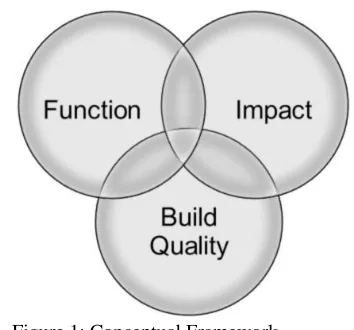
The tool of DQI uses the elements of conceptual Framework, data-gathering tool and weighting mechanism in its assessment process. The conceptual framework incorporates the Vitrivian ideology of utilitas, firmitas and venustas as function, impact and build quality respectively, and argues that higher the degree of overlapping between the attributes the better will be the design quality of the building.
The concept is represented as follows (Figure 1):
Figure 1: Conceptual Framework Source: Gann et al., 2003
The overlapping quality of the attributes justifies this arrangement as it signifies the extent of interaction between the three aspects. Gann et al. (2003) cite the case of lighting in a building; lighting serves the functional quality in terms of the lux (lumens per square metre) required for given tasks as well as providing a sense of happiness which can be perceived as its impact. Thus, the purpose of lighting is to provide the suitability for purpose and of creating the ambience which results in happiness and thus have an impact on design quality. Moreover, amongst others, Veitch and Newsham (2000) have shown that compatibility of purpose is the incorporation of accepted standards and these standards are generally achieved. Thus, how to add amenity to function is more significant than the overlapping nature.
IJIRT 143293 INTERNATIONAL JOURNAL OF INNOVATIVE RESEARCH IN TECHNOLOGY 68
which has been established by various stakeholders of the building (Markus, 2003). Individual respondents’ views on particular attributes in each section of design quality are weighted using a simple formula. As the DQI is effectively a questionnaire for individuals to complete, the weighting reflects their personal priorities and reflects the extent to which the design fulfils his or her aspiration. However, it is argued that the designs that additionally provide a sense of place and real well-being for the users should be reserved for maximum weighting (Giddings and Holness, 1996).
The tool does not provide realistic and objective measures of what is acceptable to meet aspirations. An absolute measure of the design quality of a building cannot be provided by DQI, but still it can be used to gauge the subjective qualities perceived by different stakeholders in the design process and performance of building thereafter. However, the DQI and the version for schools in particular have been substantially criticised by practitioners as symptomatic of the wider culture of benchmarking and targets, and for encouraging superficial responses (http://www.architectsjournal.co.uk/does-the-dqi-process-work/5205841.article, no date). In spite of DQI being hailed as a landmark in the assessment process it is not suitable as the basis of the Design Quality Evaluation Tool for three reasons. First, tools to assess the mid design quality have been developed and the significance of DQI is only limited to completing another generalised questionnaire. Secondly, the significance of a hierarchy of assessment is ignored in the conceptual framework. The mandatory requirements should be extended to incorporate the fitness for purpose and amenity attributes can be added to fitness for purpose. Each level is more difficult to achieve than the previous one, and this should be reflected in the weighting. Finally, with the DQI, the weighting itself is derived from individual respondents’ views, some of which are barely related to design quality (Eley, 2004); whereas the objective of this research is to establish a shared framework, against which proposals can be assessed and progressed.
A1. DQI Achieving Excellence Design Evaluation Toolkit (AEDET)
This tool is used for assessing the design of healthcare buildings from initial proposals through to
post-project evaluation. It was developed by the NHS Estates Centre of Healthcare Architecture and Design. It offers support for developing specifications and evaluating the design of healthcare building proposals. The set of evaluation criteria has been created from a number of sources, which include: the Patient Journey Model; Better by Design; the NHS Design Quality Portfolio technical and user criteria; the PFI Design Development Protocol; and the Model Design Quality Specification. The toolkit is for non-financial assessments and it includes a series of key questions supported by lists of related issues that need to be considered. The questions are answered by giving a numerical score (between one and six) into an Excel spreadsheet. The scores are automatically averaged from the answers in each of the ten sections and entered into a table and a radar chart. AEDET is clearly derived from the DQI and therefore is the subject of similar deficiencies (http://www.shine-network.org.uk/?p=module_articles &aid=122, no date).
A2. DQI Design Excellence Evaluation Process (DEEP)
IJIRT 143293 INTERNATIONAL JOURNAL OF INNOVATIVE RESEARCH IN TECHNOLOGY 69
the DQI process is not appropriate for the competitive dialogue phase of PFI projects.
B. Housing Quality Indicators (HQI)
These were developed by Duffy, Eley, Giffone and Worthington (DEGW) on behalf of the former Department of Transport, Local Government and the Regions (and then the Office of the Deputy Prime Minister) and the Housing Corporation (now the Homes and Communities Agency). The indicators were designed to assess the quality of a housing project in order to ensure that public funding achieves the best value for money (http://www.homesandcommunities.co.uk/hqi, 2009). The system allows an assessment of quality of housing in three main categories:
o Location
o Design
o Performance (DETR, 1997)
These three categories generate ten quality indicators that give the most useful information about the strengths and weaknesses of a scheme. The quality evaluation derived from using the system does not provide a direct association with financial value, nor does it not set out standards. Most of the indicators used for the assessment by the tool are based on the building regulations, as well as other mandatory or recommended standards. For example, the size of the properties are established from the ‘Design of Lifetime Homes’; and their closeness to amenities and how they fit in with the locality are taken from ‘Secured by Design Principles’ (http://www. homesandcommunities.co.uk/hqi, 2009).
The HQI was devised to assess housing for the general population. HQI merely sets a benchmark for what it considers as quality housing and thus can be regarded as quality assurance tool rather than an evaluation tool. Franklin (2001) points out that design quality assessment using this tool is merely related to standards and measurement. She adds that unless attempts are made to engage with more interpretative issues, appraisals of housing design will continue to be limited to mechanistic and
deterministic formulations, which have led to so many failures in the past.
C. Building for Life (BfL)
Initiated in 2001 by the Commission for Architecture and the Built Environment (CABE), Building for Life uses a comprehensive, evidence-based system for assessment of urban design quality for homes and their neighbourhoods against the 20 Building for Life criteria (CABE, 2005a).
The document sets out its 20 questions under the following headings:
o environment and the community
o character
o streets, parking and pedestrianisation
o design and construction (CABE, 2008)
The framework allows anyone to undertake an informal assessment, but formal assessments can only be carried out by an accredited Building for Life assessor
(http://webarchive.nationalarchives.gov.uk/20110107 165544/http:/ www.buildingforlife.org/assessments, 2009). The criteria essentially provide a framework to assist planners and developers to review the quality of proposed residential developments and ensure that a proposal is adopting best practice. Each question is supported by examples of good practice and national planning policies, demonstrating that the principles behind the questions are deliverable and enforceable. The tool discusses the standards which should be achieved. Projects are awarded an overall score out of 20 and accordingly graded as ‘very good’, ‘good’, ‘average’ or ‘poor’ (Housing Corporation, 2008a).
IJIRT 143293 INTERNATIONAL JOURNAL OF INNOVATIVE RESEARCH IN TECHNOLOGY 70
buildings (CABE, 2008). In addition, it is aimed at assessing the quality of a finished product and is not suitable for assessment for quality at the design stage (http://www.designcouncil.org.uk/
Documents/Documents/Publications/CABE/deliverin g-great-places-to-live. pdf, 2009).
D. Sheffield Care Environment Assessment Matrix (SCEAM)
This matrix was developed as part of the Design in Caring Environments (DICE) Project by the University of Sheffield. It aims to evaluate the building from the point of view of the people living in it and to aggregate a large number of building features into a set of numeric scores (Parker et al., 2004). The SCEAM matrix (Barnes et al., 2002) was devised specifically to explore the relationship between physical environment and quality of life in such a way as to facilitate building appraisal to support building audit and facilities management. The assessment is more of a performance evaluation as the matrix used is based on assessing individual building features to identify the areas of improvement (Parker et al., 2004). The matrix is fundamentally a questionnaire which evaluates the physical aspects of the building and environment against the requirements of the users. It also helps to identify the problem areas a scheme by comparing the responses given by the users against a theoretical ideal building (Torrington, 2004).
SCEAM is not suitable as the basis of an architectural design quality evaluation. Even though the assessment tool does empower users and highlights the non-performing design elements, the quality of the responses is critically dependent on resident and staff perceptions. Therefore, the matrix is not as much about evaluating and developing designs but really about completing the questionnaire for an occupied building.
E. Building Research Establishment Environmental Assessment Method (BREEAM)
This is the most commonly used environmental assessment tool in the UK. The BREEAM rating system was launched in the UK in 1990 by the Building Research Establishment (BRE), in collaboration with private developers (http://www.breeam.org, no date). The assessment method uses a credit-based system to produce a
rating of environmental performance of ‘pass’, ‘good’, ‘very good’, ‘excellent’ and ‘outstanding’ . The system helps to apply environmental criteria against which building performance can be checked. Some have argued that the scoring process is not suitable and suggested that the assessment certificate should reflect both the score and the rating (Starrs, 2010).
The BRE has now introduced a number of more specialised assessment methods, including BREEAM for schools, industrial buildings, warehousing and retail buildings. They also offer a ‘bespoke BREEAM’ for developments that do not fit into any other category, such as mixed-use developments. In addition, a ‘sustainability checklist’ for larger developments has been devised that is intended to be used by developers and local authorities (Brownhill and Rao, 2002). As this is an exclusively environmental tool, it does not cover the range of issues required for a comprehensive design quality evaluation.
F. Post-occupancy Review of Buildings and their Engineering (PROBE)
This review was launched in 2002 to survey and assess technical and energy performance and social aspects (such as comfort, satisfaction, productivity, perceived environment control, lighting, noise and light) (BRI, 2001) in a comprehensive, systematic and affordable way. The PROBE system uses a questionnaire for end users which include technical performance and energy performance indicators. As the name suggests, the review takes place after construction and not during the design process (Castro-Lacouture and Ramkrishnan, 2008).
G. Leadership in Energy and Environmental Design (LEED)
IJIRT 143293 INTERNATIONAL JOURNAL OF INNOVATIVE RESEARCH IN TECHNOLOGY 71
designed to be used throughout the design and construction phase, with a certificate awarded on building completion (Saunders, 2008). It is limited to energy and environmental aspects.
H. Green Rating for Integrated Habitat Assessment (GRIHA)
With an overall objective to reduce resource consumption, reduce greenhouse gas emissions and enhance the use of renewable and recycled resources by the building sector, TERI and the Ministry of New and Renewable Energy, Government of India, developed India’s own rating system known as Green Rating for Integrated Habitat Assessment (GRIHA). This tool, by its qualitative and quantitative
IJIRT 143293 INTERNATIONAL JOURNAL OF INNOVATIVE RESEARCH IN TECHNOLOGY 72
A summary of all the tools is shown in Table 1.
Table 1: Summary and critique of existing design quality evaluation tools
DQI HQI BfL SCEAM PROBE BREEAM LEED GRIHA
1)Developed by Construction Industry Council (CIC) DEGW on behalf of former Department of Transport, Local Government and the Regions and the Housing Corporation
CABE in association with the Home builders Federation, the civic Trust and design for Homes DICE Project by University of Sheffield Research project 1995–2002, Funded by Building Services Journal and DETR Building Research Establishment (BRE)
Developed by US
Green Building Council for UK
Department of
Energy
TERI and the Ministry of New and Renewable Energy
DQI, HQI, BfL, BREEAM, LEED and GRIHA are the evaluation tools developed by government agencies whereas SCEAM and PROBE are the evaluation tools developed for a research project.
The intention behind the development of tools is to get ideas from the stakeholders, especially from users, for the assessment of quality. Getting stakeholders ideas is necessary to achieve information regarding quality enhancement, however transferring those information to design process as knowledge for design teams can be underlined as missing part of the tools.
2) When was the tool developed Launched as an online toolkit in 2003
In 1998 a workable set of indicators were developed. The tool was edited in 2008 and re-edited in 2010
Founded in 2001 and last updated in 2008
Started August 1999: completed March 2003 Research project 1995–2002 First launched in 1990 Launched in 1998 Launched in 2007
The evaluation of energy and environmental aspects of buildings started taking shape during 1990’s, but the evaluation of design and planning aspects gained momentum in 2000’s
3) Type of building
Specifically Educational Buildings, but can be used for all
Housing Schemes focussing upon affordable
Specifically initiated for housing projects.
Extra care housing
All types of buildings (residential to
commercial)
All types of buildings (residential to commercial)
All types of buildings (residential to commercial)
All types of buildings (residential to
IJIRT 143293 INTERNATIONAL JOURNAL OF INNOVATIVE RESEARCH IN TECHNOLOGY 73
building type housing.
HQI, BfL and SCEAM are used exclusively for housing, whereas, DQI, PROBE, BREEAM, LEED and GRIHA can be used for a wide variety of buildings
4) Aim of the tool
Design quality assessment.
Assessment of design and planning related aspects
Assessment of design and planning related aspects Assessment of design features for elderly person Post occupancy evaluation to improve upon future projects.
Sets the standard for best practice for sustainability Green building certification system. Green building certification system.
DQI, HQI, BfL and SCEAM aim to assess architectural design and planning related quality. LEED, BREEAM and GRIHA try to set the standards for certification of green buildings, while PROBE aims to assess the performance of building after construction.
Scope of the tool Achieve the best building possible based on quality. Measurement and assessment of potential and existing house schemes based quality Measurement and assessment of potential and existing house schemes based quality Provide better physical and psychological environment
Enhance the quality of future projects Achieve Energy efficiency and sustainability Accelerate the adoption of green building practices Accelerate the adoption of green building practices
DQI, HQI, BfL and SCEAM assess the architectural design and planning related quality. LEED, BREEAM and GRIHA certify the buildings based on energy usage and sustainability , while PROBE assess the performance of building post construction.
5) Main Criteria Functionality Build Quality Impact Location Site Unit External environment
Environment and the community
character
Streets, Parking and Pedestrian movement Design and construction
Building features
Technical and energy performance Social aspects Management Health and Wellbeing Energy Transport Water Materials Landuse and ecology Pollution Innovation Sustainable sites Water efficiency Energy and Atmosphere Materials and resources Indoor environmental qualities Site selection and site planning Conservation and efficient utilization of resources Building operation and
IJIRT 143293 INTERNATIONAL JOURNAL OF INNOVATIVE RESEARCH IN TECHNOLOGY 74
Location and linkages Awareness and Education Innovation in design Regional Priority
Innovation
The fundamental aspects of design quality described by Vitrivius as utilitas, firmitas and venustas has been interpreted in contemporary framework as function, build quality and impact respectively. These were extended to include ecological approaches like sustainability, health, wellbeing and preserving resources for assessment of quality.
6)Methodology Structured workshop, online form and
questionnaires
Stand alone forms
Stand alone forms
Stand alone forms
Stand alone forms
Stand alone forms
Online certification
Checklist
IJIRT 143293 INTERNATIONAL JOURNAL OF INNOVATIVE RESEARCH IN TECHNOLOGY 75
III. CONCLUSION
Housing quality is crucial to the wellbeing of the people. Achieving quality in housing projects is a complex task as it involves participation of several stakeholders having an array of individual preferences. It is therefore required to have a flexible system for criteria selection under different building types. Absence of universally accepted process makes the task of evaluation of housing quality a difficult proposition. The evaluator needs to establish the objectives of evaluation that can serve as a basis for identifying the indicators for establishing housing quality. Assessment tools must put out not only assessment scores but must also provide methodologies about transferring the data to be used as knowledge within the design process by design teams.
REFERENCES
[1]. Barnes, S. and Design in Caring Environments Study Group, ‘The design of caring environments and the quality of life of older people’, Ageing and Society, 22(6), pp. 775–789. 2002.
[2]. Brownhill, D. and Rao, S., A Sustainability Checklist for Developments: A Common Framework for Developers and Local Authorities. Watford: BRE. 2002.
[3]. Building Research and Information (BRI) ‘Special issue on Post-occupancy Evaluation’, Building Research and Information’, 29 (2), 2001, pp.158-163.
[4]. CABE (2005a) Evaluating housing proposals step by step. [Online]. Available at:
http://webarchive.nationalarchives.gov.uk/2 0110107165544/http://www.buildingforlife. org /publications/evaluating-housing-proposals
[5]. CABE (2008) Delivering great places to live: 20 questions you need to answer.
[Online]. Available at:
http://webarchive.nationalarchives.gov.
uk/20110107165544/http://www .buildingforlife.org/publications
[6]. Castro-Lacouture, D. and Ramkrishnan, K. ‘Fuzzy logic methods for measuring building quality’, Journal of Quality, 15(2), 2008, pp. 117–129.
[7]. Construction Industry Council (CIC) 2010. Design Quality Indicators for schools.
[Online]. Available at:
www.cic.org.uk/services/
DQIforSchoolsresearchpublication.pdf
[8]. Egan, J., Rethinking Construction, The Report of the Construction Task Force. London: Department of Trade and Industry. 1998.
[9]. Eley, J., ‘Design Quality in Buildings’, Building Research and Information, 32(3), 2004, pp. 255-260.
[10]. Franklin B J,Discourses of Design: Perspectives on the Meaning of Housing Quality and ‘Good’ Housing Design, Housing, Theory and Society 18: 2001, pp. 79-92.
[11]. Gann, D.M., Salter A.J., Whyte J.K., Design Quality Indicator As a Tool For Thinking, Building Research & Information 31(5), 2003, pp. 318–333.
[12]. Giddings, B. and Holness, A., ‘Quality Assessment of Architectural Design and the Use of Design Award Schemes’, Environments byDesign, 1(1), 1996, pp. 53-68.
[13]. Housing Corporation Achieving Building for Life. London: Housing Corporation. 2008a
IJIRT 143293 INTERNATIONAL JOURNAL OF INNOVATIVE RESEARCH IN TECHNOLOGY 76
[15]. MacDonald, M., Defining And Rating Commercial Building Performance, Oak Ridge National Laboratary Energy Division, 2000.
[16]. Markus, T.A. ‘Lessons from the Design Quality Indicator’, Building Research and Information, 31(5), 2003, pp. 399–405.
[17]. Parker, C., Barnes, S., McKee, K., Morgan, K., Torrington, J. and Tregenza, P ‘Quality of life and building design in residential and nursing homes for older people’, Ageing and Society, 24(6), 2004, pp. 941–962.
[18]. Saunders, T., A discussion document comparing international Environmental Assessment Methods for Buildings. 2008.[Online]. Available at: http://www.dgbc.nl/images/uploads/rapport _vergelijking.pdf
[19]. Starrs, M., BREEAM 2008 vs. LEED 2009 – introduction. 2010 [Online]. Available at:
http://www.melstarrs.com/elemental/2010/0 1/18/breeam-2008-vs-leed-2009
introduction.
[20]. Torrington, J., Upgrading Buildings for Older People. London: RIBA Enterprises. 2004
[21]. Veitch, J.A. and Newsham, G.R., ‘Exercised control, lighting choices, and energy use: An office simulation experiment’, Journal of Experimental Psychology, 20(3), 2000, pp. 219–237.
[22]. Vitruvius, The Ten Books On Architecture-Book 1. , Sevki Vanlı Mimarlık Vakfı Yayınları, Ankara, 1993.