Licensed under Creative Common Page 786
http://ijecm.co.uk/
ISSN 2348 0386
THE INFLUENCE OF COMPENSATION AND MOTIVATION
TOWARDS THE PERFORMANCE MEDIATED BY
ORGANIZATIONAL COMMITMENT: STUDY ON HR & GA
EMPLOYEES IN PT. GAJAH TUNGGAL TBK, INDONESIA
Orpen Rinto
Magister Program of Human Resource Management, Esa Unggul University, Jakarta, Indonesia [email protected]
Tantri Yanuar Rahmat Syah
Magister Program of Human Resource Management, Esa Unggul University, Jakarta, Indonesia
Abstract
Job Performance is one of the factors that need to be improved for the development of the
organization so employees can achieve maximum work productivity. Employees who have good
performance will tend to be more motivated and committed to work well. High level of
performance will reduce absences and employee resignation while the low performance level
will increase the number of absences and employee resignation. The purpose of this study is to
know motivation and organizational commitment as a consequence of the value of the
compensation and employee performance. The study was conducted in PT Gajah Tunggal Tbk.
Respondents in this study are as many as 160 employees. This data is then analyzed with
Structural Equation Modeling (SEM). The result showed that compensation has an influence on
organizational commitment, motivation has an influence on organizational commitment, and
compensation has an influence on the performance, motivation has an influence on
performance and organizational commitment has an influence on performance.
Licensed under Creative Common Page 787 INTRODUCTION
In the globalization era, the indicator of running an enterprise is the quality of human resources in performing their jobs. Therefore, organizations need to pay attention to the performance of their employees, that the quality of the performance is determined by the compensation and motivation. Employee performance is important for an organization because it will encourage the employees to be willing to work well with superiors or with fellow workers. In addition to performance, organizational commitment and motivation are important because it will affect the success or failure of an organization.
Organizational commitment is self-dedication to an organization and it does not just occur in individual employees. There are contributions from other elements that make the value of organizational commitment higher or lower. In this case, the organization and employees are elements that need to work together to create a high organizational commitment. One of the factors of organizational commitment is the motivation to work.
Motivation is one of the efforts to improve employee performance; achievement of performance will be low if there is no motivation. Conversely, if the employee has a high motivation to work, the level of employee performance will be high too, so that the organizational commitment will be higher too. Work motivation of a person is usually demonstrated by the involvement of an employee in a continuous job.
The level of motivation, organizational commitment can be measured by looking at the number of worker replacements in a certain period. Employees with high performance normally will be more focused to finish their work, so work motivation and strong commitment will emerge. This study focuses on HR & GA staff in PT Gajah Tunggal Tbk, which is one of the multinational companies in Indonesia. PT Gajah Tunggal Tbk has the potential of human resources in diverse capacities. On the other hand, companies also have to run a social function internally and externally to ensure the welfare of its members which also have an impact on the company's survival. Most agencies and organizations seek to improve quality of service and performance in terms of products, services, internal and operational. The purpose of the business or organization is to ensure a firm and stable work environment by promoting good performance, to achieve higher goals (Bolman, 1997).
Licensed under Creative Common Page 788 and motivate the workers in the work environment and lead to organizational commitment. In organizational commitment, workers want to stay with the organization and are willing to engage in achieving organizational goals (Bozlagan, Dogan, and Daoudov, 2010). As a consequence, workers are all committed job satisfaction and do not want to leave the organization; thus, reducing absences of workers and the level of turnover in the organization (Ismail, 2012).
Halepota (2005) and Abonam (2011) stated in their studies that motivation is very important for the organization to perform its function; the absence of motivation of employees will not bring a good impact for the company "their performance will be less efficient". This was evident in Ghana where in a couple of times, workers were disturbed by a number of industrial unrest. Research has shown that there is a positive relationship between compensation and organizational commitment. Thus, organizational compensation is a strategy in human resources management to enhance organizational commitment among workers (Ahmad, Toh, and Bujang, 2013).
Low, Rusli and Abdullah (2016) stated that there is a relationship between financial compensation and organizational commitment among the employees in the organization. Financial compensation can be viewed as the strategy in human resources management to attract, retain and motivate the workers within their work environment. Employee performance involves quality and quantity of output, the presence in the workplace, accommodating and helpful in and timeliness of output. Results of a study conducted by Yang (2008) on the performance confirm that organizations can use direct bonus and reward employees based on employees’ performance results Yang, (2008). Bartol and Martin (1998) also consider
motivation as a powerful tool that reinforces the behavior and trigger a tendency to continue. In other words, the motivation is the internal drive to meet the needs of discontent and in achieving certain goals. In general, the performance of employees depends on a large number of factors, such as motivation, assessment, job satisfaction, training and development and so on, to affect the significant level of organizational performance.
By looking at the background of the above problems those are the importance of compensation, job motivation, organizational commitment and performance for the development of the organization. Therefore, this study entitles "The Influence of Compensation and
Motivation towards Performance Mediated by Organizational Commitment".
Research Questions
From identification and the limitation of the problem above, research problems can be formulated as follows.
Licensed under Creative Common Page 789 2. Is there any relationship between motivation and organizational commitment?
3. Is there any relationship between the compensation and performance? 4. Is there any relationship between motivation and performance?
5. Is there any relationship between the organizational commitment towards performance?
Research Objectives
Based on the research questions, this study aims to:
1. Determine the relationship between compensation and organizational commitment; 2. Determine the relationship between motivation and organizational commitment; 3. Determine the relationship between compensation and performance;
4. Determine the relationship between motivation and performance;
5. Determine the relationship between organizational commitment and performance.
LITERATURE REVIEW
Compensation
Mondy and Noe (1993) claimed that compensation can be divided into two types, namely financial compensation and non-financial compensation. Financial compensation consists of direct financial compensation and indirect financial compensation. Direct financial compensation consists of salaries, wages, bonuses and commissions. While Michael and Harold (1993) divide the compensation in three forms, namely the material, social, and activity. Forms of material compensation is not only in money, such as salaries, bonuses, and commissions, but all forms of physical reinforcement, such as parking facilities, telephone and comfortable office room, as well as various forms of allowances e.g. pensions, health insurance. Sofyandi (2008) also states compensation is a form of costs to be incurred by the company in the hope that the company will earn rewards in the form of work achievement of employees. Meanwhile, according to Hasibuan (2009), compensation is all the income in the form of money or goods directly or indirectly received by employees as a reward for services rendered to the company.
Motivation
According Abonam (2011), in his study said that motivations drive the organization; the absence of motivation of employees will not bring a good impact for the company "their performance will
be less efficient". Kreitner (1995), Buford, Bedeian and Linder (1995), Higgins (1994) all cited in
Licensed under Creative Common Page 790 each of them. Bartol and Martin (1998) in their research state and assume that motivation is powerful tool to reinforce behavior and trigger a tendency to pursue. In other words, the motivation is the internal drive to meet the unsatisfied needs and achieve a certain goal.
Sukanto and Handoko (2000) stated that motivation is the state in the individual who encourages the desire of individuals to undertake certain activities in order to achieve a goal (Yuli 2005). According to Martoyo (2000), motivation is something that raises the performance or morale boost. Meanwhile, according to Gitosudarmo and Mulyono (2001) motivation is a factor that encourages a person to perform an act or activity, and therefore the motivation is often interpreted as factors driving someone’s behavior.
Samsudin (2005) in his study stated sense of motivation as a process of influencing or encouraging from the outside against a person or work group in order for them to implement something that has been set. Motivation can also be interpreted as a driving force and is intended as an insistence to satisfy and sustain life. Samsudin (2005) also defines motivation as behavior that is aimed at the target. Motivation relates to the level of effort done by someone in pursuit of one goal, motivation is also related to job satisfaction and job performance.
And the opinion of Robbins and Judge (2007) stated motivation as a process that explains the intensity, direction and persistence of effort to achieve a goal. Siagian (2002) named definition of motivation as the impetus for a person to contribute as much as possible for the sake of the success of the organization achieve its goals. With the understanding of organizational goals achievement means also the achievement of the personal goal of the members of the organization.
Lubis (2011) stated motivation is a process that begins with the definition of physiological or psychological impulse that drives behavior or drives intended for intensive purposes. Motivation is also associated with the subjective reactions that occur throughout the process. Motivation is an important concept for the behavior of accountants for organizational effectiveness depends on the people who make up as employees expect to be formed. Managers and accountants behavioral should motivate people toward the expected performance in order to meet organizational goals.
Organizational Commitment
Licensed under Creative Common Page 791 that can be used to assess the tendency of employees to survive as a member of the organization.
Employee commitment is regarded as a level for the identification and joined in the company or a reluctance to leave the company (Greenberg and Baron, 2003). It can be concluded that organizational commitment is a willingness to be involved in the organization or company in order to achieve its objectives. Hunt and Morgan (1994) suggested that employees have a high organizational commitment when, first, they have trust, accept the goals and values of the organization, then. Second is the desire to work towards the achievement of organizational goals and have a strong desire to remain a member of the organization.
Organizational commitment is multidimensional in nature. Allen and Meyer (2000) has developed and built a model of a universal commitment. Model organizational commitment can be subdivided into three components, namely a commitment; affective, continuance and normative commitment. Affective, continuance and normative component of individual, attitude of commitment both conceptually and empirically separated from one another. Allen and Meyer (2000) had further broad the perspective of the model of organizational commitment. Allen and Meyer (2000) defined organizational commitment as "a psychological state concerned on how people feel about the involvement of their organization and the desire to continue to remain
within the organization". Affective commitment is defined as "the desire of employees to be
emotionally attached to the identification with and involvement in the organization". If an
employee does not feel a sense of belonging to the organization, then they tend to have little desire to emotionally in organization. Meanwhile, commitment is defined as "awareness or
recognition of employee benefits to continue to remain in the organization".
Performance
Performance by Mathis and Jackson (2002), stating what is done and not done by employees and how much influence they contribute to the organization, which includes the quantity of output, quality of output, the period of output, attendance at work and a cooperative attitude, Employee performance is seen to have a strong influence on the success of the performance. Rusdarti’s study (2009) found that the ability of the employee's performance is the aspect that
Licensed under Creative Common Page 792 HYPOTHESIS DEVELOPMENT
According to Kee et. al. (2016), to determine the relationship between financial compensation and organizational commitment among the employees in the organization, financial compensation can be viewed as a strategy in human resources management to attract, retain and motivate the workers within their job. Organizational commitment is the desire of workers to stay working with the organization and willing to be involved in achieving organizational goals (Bozlagan, Dogan, and Daoudov, 2010). Workers who are satisfied with their job had a lower intention to leave the organization; thus reducing absences of workers and the level of turnover in the organization (Ismail, 2012). Research shows that there is a positive relationship between compensation and organizational commitment. Thus, the organization provides financial compensation as a strategy in human resources management to enhance organizational commitment among workers Ahmad, Toh, and Bujang, (2013). Based on the above literature, hypotheses that can be formed are as follows.
H1: high compensation will increase organizational commitment
While Choong and Wong,(2011) in his study examined the relationship between motivation and organizational commitment of academics in Malaysia Private University. The study aims to assess the available literature and eventually build a conceptual framework and hypotheses. By examining and confirming the relationship between motivation and organizational commitment, it will provide support for the administrator to have a better understanding on the behavior and attitudes of academics. Eventually, it will lead to an increase in the commitment of academics and forming attitudes academic staff leads to increased productivity, creativity, innovation and overall organizational performance. It will produce higher quality and competitive graduates with a talented workforce that will meet the demands of workers and attract more foreign students to register their studies in Malaysia. While, the study of the relationship between motivation and organizational commitment had been conducted over the last few years Warsi, Fatima and Sahibzada,(2009). Warsi, Fatima and Sahibzada, (2009) showed that motivation is very positive effect associated with organizational commitment among the employees of the private sector of Pakistan. The result is in line with Tella, Ayeni and Popoola (2007). In order to improve performance, motivation and performance, leaders must give them a challenging task with additional responsibilities and authority. This will improve their performance in the organization. Based on the above literature a hypothesis can be form as follows.
Licensed under Creative Common Page 793 Rizal et. al. (2014) said that the people do what they do to achieve the goal, they work, look for salaries and benefits. There are many types of gifts, for example: salary increases, employee benefits or preferred job assignment. All kinds of such compensations is controlled by the organization. Gibson (1996)divides the two types of benefit in the form of extrinsic and intrinsic rewards. Robbins split extrinsic rewards are as follows; (i) Direct Compensation; (ii) indirect compensation; (iii) non-prize money. Compensation as a bonus based on the amount of profit the company or business profit unit, or a mixture of the two bonuses for connecting the unit to the performance. Gibson et al, (1996)showed a positive effect of the compensation and employee performance. While research Murty and Hudiwinarsih (2012) states that there is a link compensation with employee performance for the company, the employee is a resource which is needed to achieve the objectives of the company, whereas for employees who have a variety of needs, the company is one place that can satisfy needs. Based on the above literature hypotheses that can be formed is as follows.
H3: High Compensation will improve performance
The theory of motivation is a view that can be used as a reference to provide motivation to the people or certain groups within a business unit. Motivation can cause a person to behave well. Therefore, high employee motivation is directly correlated with the company's performance. An employee who is motivated will be energetic and vibrant in the tasks assigned to him. On the oter hand, employees who have little motivation will often display a sense of discomfort and dissatisfaction with the job. As a result, their performance become poor and companies objectives will not be achieved. Marjani (2005) said that there is a positive relationship between motivation and performance of employees. In that study, results found that the high motivation of employees working conditions associated with the tendency of the achievement of performance highly motivated personnel. Employees who have a high motivation, they will try to do as much as possible the objectives set by the company.
Bartol and Martin (1998) stated that motivation is a powerful tool that reinforces the behavior and trigger a tendency to continue. In other words, the motivation is the internal drive to meet the needs of discontent and in achieving certain goals. It is also a procedure that is initiated through physiological or psychological needs that stimulate the performance set by a goal.
Licensed under Creative Common Page 794 Samad (2011). Based on the research, theory and empirical description mentioned, a high level of organizational commitment affects and improves employee performance. While the study of Grant (2008) conducted on employee motivation; the motivation insists the results such as productivity, performance and persistence. As cited in Grant, 2008), motivated employees are more oriented to the autonomy and freedom and more independent than the less motivated employees leads to slow progression opportunities.
According to Lubis (2011), motivation is a process that is initiated with the definition of physiological or psychological impulse that drives behavior or encouragement for intensive purposes. Motivation is also associated with the subjective reactions that occur throughout the process. Motivation is an important concept for the behavior and should motivate people towards a better performance in order to meet organizational goals. Based on the things that have been mentioned above, the proposed hypothesis is as follows.
H4: High motivation can increase employee performance
The level of commitment between the company's commitment to the employees and employees to the company is mostly required because this commitment will create a professional work environment. Individual who satisfied with his work tends to meet the commitment and creates a loyalty to the organization, which it eventually leads to the employees having a sense of dependence and responsibility to the organization. Someone who has a low organizational commitment tends to do a way that can influence the performance of the organization, like a high turnover rate, lags in work, complaints and even strikes. Wright (1992) added that the higher individual commitment to his work the higher the performance will be achieved. The higher the organizational commitment from the employees is the better the performance of individual employee.
In the study of organizational commitment, in Shanghai, Beijing, Tianjin, examined about how employers can hire newcomers and maintain the old ones then can remain to motivate their employees in improving their performance (Kanter, 1989). The study of relationship between organizational commitment of employees and the performance of their duties through organizational learning, and how the organization's ability to learn from the Chinese construction company, affect the relationship between organizational commitment and performance. The concern of the study is the employee performance within organizational commitment as a predictor of behavior (Mowday et al., 1982), and examines the implementation of the learning culture of the company that can lead to an increase of performance.
Licensed under Creative Common Page 795 study showed that commitment organizational positively related to performance, but there is no relationship between organizational commitment and job achievement. Lee and olshfski (2002) studied that the behavior of organizational commitment of firefighters in New York and their study is guided to believe that the organizational commitment offers considerable promise in describing the positive behavior.
Organizational commitment and performance in the UK health services unit found that commitments have an important role specifically with performance. The study found that both affective and normative organizational commitments have a good impact on performance statistically. Based on the things mentioned above, the proposed hypothesis is:
H5: High organizational commitment can affect performance
From the description above can be described the research model as follows:
H3 H1
H5
H2
H4
Figure 1. Research Model
RESEARCH METHOD
Population and Sampling Techniques
Population is defined as all parts of the research subjects (Arikunto, 2010). The population of this research was all permanent employees at the staff level who are working at PT. Gajah Tunggal Tbk. Samples are some of the populations that have relatively similar characteristics and are considered to represent the population. The sampling method used by the researcher was purposive sampling method. This method was used based on the consideration that the subjects of purposive sampling are regarded as having strong linkage with known population, (Tongco, 2007). Based on the analysis tool, Structural Equation Model (SEM), the determination
Compensation
Motivation
Performance
Organizational
Licensed under Creative Common Page 796 of the minimum sample size should be representative. According to Hair, et al. (2008), it should have a number of samples as many as five times of the number of questions being analyzed. As many as 160 respondents were obtained from the method of data analysis. In this research, the method was Structural Equation Modeling (SEM) technique. Guidelines on determining the sample size of SEM are as follows: (1) when parameter estimation applies maximum likelihood estimation method, the suggested sample size is between 100 and 200 and the minimum size is 30; (2) it is 5 to 10 times of the number of parameters in the model; (3) it equals 5 to 10 times of the number of manifest variables (indicators) of the entire latent variable. This research involved 31 indicators so it referred to the third rule in which it required the minimum sample size of 5x31 or as many as 155. Yet, this research took 160 respondents as the research subject because the researcher wants to have backup answers from 5 respondents to replace the missing or corrupted data of respondents.
Measurement
Measurement of each variable of research is conducted by Kaiser-Meyer-Olkin Measure of Sampling Adequacy and Bartllet's test of Sphericity. Bartllet's test of Sphericity is conducted to test whether there is a correlation among the variables. Expected MSA (Measure of Sampling Adequacy) value is a minimum of 0.500 (Malhotra, 2004). Compensation scale of 9 workers are valid, motivation scale of 5 workers are valid, organizational commitment scale of 12 workers are valid, performance scale of 5 workers are valid. The reliability value of a questionnaire is indicated that it has sufficient level of reliability if the Cronbach Alpha coefficient is greater than or equal to 0.500, the above table shows the Cronbach Alpha coefficient has a good reliability which is above 0.500 so that it can be said that variable compensation, motivation, organizational commitment and job stress can be trusted as data collection tool in the study.
RESULTS AND DISCUSSION
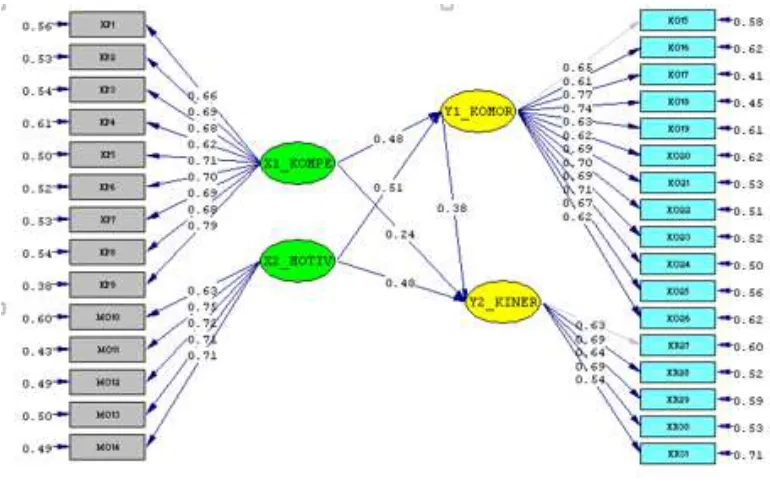
Licensed under Creative Common Page 797 Figure 2. Path Diagram Standarlized Solution
Figure 3. Path Diagram T-Value
Licensed under Creative Common Page 798 Table 1. Hypothesis Testing Research Model
Hypothesis Hypothesis statement T-Value Information
H1
High compensation will increase
organizational commitment 5.67
The data support the hypothesis
H2
High motivation can increase
organizational commitment 5.85
The data support hypothesis
H3 High compensation can improve performance
2.64
The data support hypothesis
H4 High motivation can improve performance 4.41 The data support hypothesis H5
High organizational commitment can
improve performance 2.74
The data support hypothesis
Discussion
In the test result of first hypothesis (H1), it is found that the analysis results support the
hypothesis H1 that high compensation will increase organizational commitment amounted to
5.67. It shows that the performance of an employee is affected by compensation. Compensation is an important factor because many researchers consider compensation as the main determinant of employee satisfaction. Anoki (2010) stated that compensation influences employee performance positively. The study suggests that the compensation will improve employee performance.
In the second hypothesis results (H2), it is found that the analysis results support the
hypothesis H2 that high work motivation will improve the performance about 5.85. It suggests
Licensed under Creative Common Page 799 On the results of testing the third hypothesis (H3 it was found that the H3 analysis results support
the hypothesis that high levels of compensation can raise the level of performance. It shows that the performance is influenced by compensation. High compensation can raise the level of performance, and in contrast the low value of the compensation cannot improve performance. This result is in line with research of Tessema and Soeters (2006) that compensation significantly affects employee performance.
On the fourth hypothesis result (H4), it was found that the analysis results support the
hypothesis H4that high level of motivation can improve performance by 4.41. It shows that
performance is affected by motivation. A high level of motivation can improve performance, and conversely, low level of motivation can decrease performance. In organization environment, being involved in work will improve performance. The results show that high commitment or motivation in organization affects the performance of employees, and it is supported by Samad (2011).
On the fifth result (H5), it was found that the analysis results do not support the
hypothesis H5 stating that high level of organizational commitment can improve the performance
of 2.74. This result shows that it is affected by organizational commitment. High level of organizational commitment can raise the level of performance, and low level of organizational commitment cannot increase performance. The study interpreted the relationship between organizational commitment of employees and the performance of their duties through organizational learning, and how the ability to learn about organization from China construction company affects the relationship between organizational commitment and performance (Mowday et al., 1982), and examined the implementation of the learning culture within the company that can lead to performance improvement.
Licensed under Creative Common Page 800 MANAGERIAL IMPLICATIONS
This study aims to determine the influence of compensation and motivation towards the performance mediated by organizational commitment. The number of salary which is customized with the level of office employees also gives contribution. Although the salary scale has not been adjusted to the performance, but over the increase of job level also increases the job responsibilities. Another factor is the punctuality of salary payment coupled with the incentives and bonuses policy that make employees feel secure for financial condition of each month and even retirement age. The things that become an indicator of awarding compensation is relative, determining the amount of compensation is based on the minimum wage limit from government policy and external consistency applied. Human resource manager is required to constantly monitor and adjust to the external compensation currently applied. That is important in terms of morale and competent employees that will not stop and keep following the government regulations.
Compensation in terms of goods are given to employees who have a good performance and achievement in their work. One of the financial policies of PT. Gajah Tunggal Tbk is that every employee who has a good performance and never missed a period of one year will get a bonus hikes and THR above the standard. By using the theory of justice in the employee payroll system is expected that it can improve the performance of an employee.
CONCLUSION
The results of this study are expected to be useful for policy in compensation and motivation in PT. Gajah Tunggal Tbk, which supports the development of performance in PT. Gajah Tunggal Tbk. Based on the study, the researchers conclude that:
1. Compensation significantly affects organizational commitment at PT. Gajah Tunggal Tbk. The better the compensation practices PT. Gajah Tunggal Tbk, the more improve the performance of the employees. The compensation practices in PT. Gajah Tunggal Tbk are fairly well. Overall of direct financial compensation forms, financial compensation directly or non-financial compensation, has been running and fulfills the requirements compensation criteria of compensation theory;
2. Motivation influences organizational commitment on HR & GA staff in PT. Gajah Tunggal Tbk. High level motivation can raise the level of performance;
Licensed under Creative Common Page 801 4. Organizational commitment affects the performance of the of HR & GA staff in PT. Gajah
Tunggal Tbk. Although both work and responsibility increase over the time for HR & GA staff in PT. Gajah Tunggal Tbk, it cannot decrease the performance of employees; 5. The excellent performance is affected by compensation and organizational commitment
of HR & GA staff in PT. Gajah Tunggal Tbk.
RESEARCH LIMITATIONS
Limitations of the study refers to several drawbacks:
1. The study was only conducted in PT. Gajah Tunggal Tbk;
2. The subject of this research is only permanent HR & GA staff in PT. Gajah Tunggal Tbk; 3. This study only discusses topic of compensation, motivation and performance mediated
by organizational commitment;
4. Incidentally respondents in answering a list of questions (questionnaire) and convenient working conditions that make respondents are quite comfortable answering a list of questions (questionnaire) asked to them.
SUGGESTIONS
Based on mentioned above, some suggestions are expected by company that can increase the value of compensation for employees related to the performance, achievements and competencies by using theory of justice. This thing will impact on increasing the performance of the employees. Increasing motivation in corporate environments should be improved in order to create harmony in work so employees will feel the organizational commitment. However, it cannot be separated from the company's role in implementing an equal compensation system for all employees.
In organization, a leader should be able to give support and spirit for his/her employees. The employees will be motivated, appreciated and can be more professional that it will certainly affect the organization. Furthermore, an employee has to demonstrate high performance, has a good cooperation with superiors or with fellow colleagues, has high discipline and sense of responsibility. Based on the study that has been done, there are some researchers’ notes:
1. The results show that the compensation practices are fairly well in PT Gajah Tunggal Tbk. Especially for indirect financial compensation (health insurance, vacation, excursion, retired);
Licensed under Creative Common Page 802 running well. Management should continually evaluate and implement the program properly in accordance with the needs of employees and organizations;
3. The management company is expected to periodically make a base pay standard of averages employees industry in order toget a standard of employee expected salary.
At last, it is recommended for future research to add other variables for research development. Hopefully, this research can be used to provide optimal benefit for object of the following research and also this study can be a comparison in subsequent studies and it is better to take data on the more extensive object research.
REFERENCES
Abonam, N.D. (2011).The Role of Motivation on Employee Performance in the Public Sector: A Case Study of the University for Development Studies, WA Campus. Thesis, Institute of Distance Learning, Kwame Nkrumah University of Science and Technology, in Partial Fulfillment of the Requirement for the Degree Bachelor of Arts.
Ahmad, Toh, & Bujang, (2016). Relationship between Financial Compensation and Organizational Commitment among Malaysian Bank Workers.Asian Business Research, 1(1).
Ahmad, Toh, & Bujang. (2013).Relationship between types of benefit (leave, loan and retirement plan) and employees retention.International Journal of Education and Research, 1(8), 31-44.
Allen, N.J., & Meyer, J.P. (2000). The Measurement and Antecedents of Affective, Continuance and Normative Commitment to the Organization. Journal of Occupational Psychology,63,118.
Allen, N.J., Meyer, J.P., & Smith, C.A. (1993). Commitment to Organizations and Occupations: Extension and Test of a Three Component Conceptualization. Journal of Applied Psychology.
Anoki, H. D. (2010). Pengaruh Kompensasi Terhadap Kinerja Karyawan PT. Slamet. Langgeng Purbalingga Dengan Motivasi Sebagai Variabel Intervening, Unpublished Thesis, Magister of Management, Undip, Semarang,
Bartol, K. M., & Martin, D. C. (1998). Management: International Edition.
Bolman, L. G. & Deal, T. E. (1997). Reframing organizations: Artistry, Choice and Leadership. San Francisco, CA: Jossey-Bass Inc., Publishers.
Bozlagan, Dogan, & Daoudov.(2010).Organizational Commitment And Case Study On The Union Of Municipalities Of Marmara. Regional and Sectoral Economic Studies,10(2).
Bozlagan, Dogan, & Daoudov. (2010).Relationship between Financial Compensation and Organizational Commitment among Malaysian Bank Workers. Asian Business Research, 1(1).
Brandt, Krawczyk,& Kalinowski. (2008).Impact of Organizational Commitment and Employee Performance on the Employee Satisfaction. International Journal of Learning, Teaching and Educational Research, 1(1), 84-92.
Buford, J. A., Jr., Bedeian, A. G., & Lindner, J. R. (1995). Management in Extension (3rd ed.). Columbus, Ohio: Ohio State University Extension.
Choong & Wong, (2011).Organizational Commitment: An Empirical Investigation on the Academician of Malaysian Private Universities. Business and Economics Research Journal, 3(2), 51-64.
Gibson, J., John, M. I., & Donnely. (1996). Organisasi dan Manajemen. Jakarta: Erlangga Gitosudarmo, I., & Mulyono, A. (2001). Prinsip Dasar Managemen. Edisi 3. Jogjakarta: BPFE Grant, J. (2008). Green Marketing.Strategic Direction, 24(6), 25-27,
Greenberg& Baron. (2003). Behaviour Organizations. Prentice Hall: Upper Saddle River NJ.
Halepota (2005). Effective Motivation of Paraprofessional Staff in Academic Libraries In Nigeria.Library Philosophy and Practice.
Licensed under Creative Common Page 803
Higgins, J. M. (1994). The management challenge (2nd ed.). New York: Macmillan.
Hunt, S. D., & Morgan, R. M. (1994). The Commitment Trust The relationship of Marketing. Journal of Marketing, 58(3).
Ismail, N. H. (2012). Teaching Quality and Performance Among Experienced Teachers in Malaysia. Australian JournalofTeacherEducation,37(11).
Ismail. (2012). The Effect Of Employees' Organizational Justice Perceptions On Their Organizational Commitment: A University Sample. International Journal Of Business And Management Studies, 4(2).
Kanter, R. M. (1989).The New Managerial Works. Harvad Business Review
Kee, L. B., Rusli, B. Ahmad., & Siti, M. A. (2016). Relationship between Financial Compensation and Organizational Commitment among Malaysian Bank Workers. Asian Business Research, 1(1).
Kreitner, R. (1995). Management (6th ed.). Boston: Houghton Mifflin Company.
Lee, S. H. & Olshfski, D. (2002). Employee Commitment and Firefighters: It’s My Job. Public Administration Review, 62(S1), 108-114.
Lindner, J. R. (1998). Understanding Employee Motivation.Journal of Extension, 36(3).
Low, Rusli,& Abdullah. (2016).Effect of Compensation Factors on Employee Satisfaction- A Study of Doctor‟s Dissatisfaction in Punjab. International Journal of Human Resource Studies, 3(1).
Lubis. (2011).Implication of Human Attitude Factors toward Information Security Awareness in Malaysia Public University. International Conference on Innovation and Management, Kuala Lumpur, Malaysia, July 12-15.
Malhotra, N. K. (2004). Riset Pemasaran:Pendekatan Terapan. Jakarta: Indeks Kelompok Gramedia. Mangkunegara, A. P. (2005). Sumber Daya Manusia Perusahaan. Bandung: Remaja. Rosdakarya.
Marjani. (2005). Hubungan Motivasi Kerja dengan Kinerja Pegawai pada Unit. Pelakasaan Teknnis Dinas PerhubunganPropinsi DKI Jakarta. PPs Institut. Pertanian Bogor.
Martoyo, S. (2002). Manajemen Sumber Daya Manusia. Jogjakarta: BPFE.
Mathis, R., &Jackson, W. (2002). Manajemen Sumber Daya Manusia, (Edisi ke 1). Yogyakarta: Salemba Empat Michael & Harold. (1993).Impact of Compensation on Employee Performance (Empirical Evidence from Banking Sector of Pakistan. International Journal of Business and Social Science, 5(2).
Mondy & Noe. (1993). Human Resource Management. Sixth Edition. USA: Allyn & Bacon Inc.
Mowday, R. T., Porter, L. W., & Steer, R. N (1982). The Commitment-Trust of The Relationship. Journal of Marketing, 58(3).
Murty, Hudiwinarsih. (2012). Pengaruh Kompensasi, Motivasi, dan Komitmen. Organisasional Terhadap Kinerja Karyawan Bagian Akuntansi (Studi. Kasus pada Perusahaan Manufaktur Di Surabaya). The Indonesian Accounting Review, 2. STIE Perbanas. Surabaya.
Rashid, M.Z.A., Sambasivan, M.,& Johari, J. (2003) The Influence of Corporate Culture and Organisational Commitment on Performance. Journal of Management Development, 22, 708-728.
Rizal, M., Syafiie, M., Djumahir, I.,& Mintarti, R. (2014). Effect of Compensation on Motivation, Organizational Commitment and Employee Performance Studies at Local Revenue Management in Kendari City. International Journal of Business and Management Invention, 3, 64-79
Robbins, S. P. & Judge, T. A. (2007). Organizational Behavior. (13th ed). London: Pearson International Edition. Rusdarti (2009), Effect of the School Principal’s Management, Academic Supervision.
Samad, A. (2011).Corporate Governance and Agency Costs, in Kose John, Anil K. Makhija (ed.) International Corporate Governance (Advances in Financial Economics, Volume 14) Emerald Group Publishing Limited, 109 - 130. Samsudin, S. (2005). Management Sumber Daya Manusia. Bandung: Pustaka Setia.
Sekaran, U. (2004). Research Methods for Business: A Skill Building Approach. 4th edition. New York: John Wiley and Sons.
Siagian, S. P. (2002). Fungsi-Fungsi Manajerial. Jakarta: Bumi Aksara.
Licensed under Creative Common Page 804
Somers, M. J., & Birnbaum, D. (1998). Work-related commitment and job performance: it's also the nature of the performance that counts. Journal of Organizational Behavior, 19(6), 621-634.
Sukanto &Handoko. (2000).Impact of Employee Motivation on Employee Performance.European Journal of Business and Management,6(23).
Tella, A., Ayeni, C. O., &Popoola, S. O. (2007). Work Motivation, Job Satisfaction, and Organisational Commitment of Library Personnel in Academic and Research Libraries in Oyo State, Nigeria. Library Philosophy and Practice, 9(2). Tessema, M. T., &Soeters, J. L. (2006). Challenges and prospects of HRM in developing countries: testing the HRM– performance link in the Eritrean civil service. International Journal of Human Resource Management, 17(1), 86-105. Tongco, M. D. C. (2007). Purposive sampling as a tool for informant selection. Ethnobotany Research and applications, 5, 147-158.
Warsi, Fatima, & Sahibzada. (2009), Intrinsic Motivation Ans Organizational Commitment In The Malaysian Private Higher Education Institutions: An Empirical Study. Journal of Arts, Science & Commerce.
Wright, W. F. (1992). Mood Effects on Subjective Probability Assessment. Organizational. Behavior and Human Decision Processes,52, 276-291.
Yang, (2008).Relationship between Financial Compensation and Organizational Commitment among Malaysian Bank Workers. Asian Business Research, 1(1).