Early Explorations Of EEG As A Method For
Interactive Evolutionary Design Of 3-Dimensional
Objects
Chew Lin Hou, James Mountstephens, Jason Teo
Faculty of Computing and Informatics of Universiti Malaysia Sabah, Kota Kinabalu, Malaysia Email: [email protected],[email protected], [email protected]
ABSTRACT: Automatic generation of art has aided artists in creating novel 2-dimensional artforms in a field known as evolutionary art. The development of technology on 3D printing has attracted people of different fields to designing 3D shapes for art display, an architecture design, a prototype or even an aiding tool. However, current automatic generation algorithms have focused primarily on 2D art only and have not successfully crossed the realm into 3D. This paper introduces an automatic method for generation of 3D artforms using electroencephalogram (EEG). Interactive evolutionary computing (IEC) is the typical method used to evolve art, however, IEC is often reported to cause significant fatigue among its users due to its repetitive and time-consuming characteristics. With the combination of brain-computer interface (BCI) and IEC, the hope is to speed up the interactive process, hence reducing user fatigue and at the same time be able to produce promising solutions. The proposed approach focuses on understanding human emotions in order to identify user preferences of the 3D shapes automatically and further evolve the selected artform. The use of a nature-inspired shape generation formula, called the Gielis supershape, is used as the encoding for generation of 3D art and is shown to be able to bring forth large varieties of shapes during the automatic evolutionary optimization process.
Keywords: brain-computer interface; human-machine interaction; electroencephalogram; 3D printing; evolutionary optimization; evolutionary design.
1
I
NTRODUCTIONAutomatic generation of static, pleasing 3-dimensional (3D) objects aims to reduce the human effort in designing such objects and also aims to aid humans in generating more diverse and creative solutions. The typical method of achieving this is through interactive evolution computation (IEC), where IEC refers to the use of biologically-inspired algorithms for computer-generated designs, where selection of desired solutions are interactively guided by the user. The main drawback of IEC is that it causes the user to become fatigue due to the time-consuming and repetitive nature. IEC with interactive user-guided feedback requires the user to sit at a computer, look at the video display terminal (VDT) which would subsequently cause visual fatigue after long-term viewing [1], in addition to the physical movements required to click and move the mouse through a large number of intermediate designs that is highly time-consuming. Such a repetitive and monotonous work would cause users to fatigue [2]. There are numerous studies that have attempted to use different approaches to minimize the fatigue caused in IEC though most of these approaches hampers its full potential in terms of harnessing the optimization power of evolutionary algorithms, ranging from interval-based evaluation [3], to solution clustering [4] and evolutionary parameter reduction [5]. However, all of these methods still rely on the requirement of the human user to physically move and control the mouse as the method of input selection. Pallez et al. [6] presented the eye-tracking evolutionary algorithm (E-TEA) using stimulation of eye-tracker with mouse, however this approach did not yield any significant result. Here we propose a real-time EEG-based system for optimizing 3D shapes based on the user’s brain feedback. The traditional way of physical mouse-based interaction of the user with the interactive evolutionary design system will be replaced with a thought-based control system. The user’s brainwaves are detected, captured and interpreted in the form of electroencephalogram (EEG). The use of learning machine algorithms such as linear discriminant analysis (LDA) will be used to identify the user’s emotions based on the EEG signals detected. Then, a genetic algorithm will be used to evolve 3D
shapes based on the 3D shapes that have been classified as resulting in a positive emotion from the user. Through the combination of BCI and IEC, we believe such a system will greatly reduce the time required to complete the interactive selection process and at the same time reduce the fatigue levels of the user. This should allow for a less demanding environment for the designer when using such an interactive evolutionary design system and hence lead to more optimal and desirable design output solutions from the computer-aided design system. At the end, the optimum design will be displayed to user and the user will be asked to rate the displayed design. The generated design is ready to print using Fused Deposition Modeling (FDM) machines, which is a type of 3D printer, to physically realize the evolved object and could further be displayed as a 3D art piece.
2
L
ITERATURE REVIEW3
P
ROPOSEDM
ETHODSThe basic structure of the developed system is presented in Fig. 1whichincludes several essential processes in this study. The processes is run in real-time where it includes EEG signals acquisition, emotion classification to identify positively, neutrally and negatively responding emotions, a heuristic search algorithm to control the parameter for next 3D shape, finally displaying the stimuli and then repeats the cycle. At the end of the experiment, an optimized supershape design will be displayed to user for further rating.
The experiment consists of 2 major parts, training and testing, as shown in Fig. 2. In the training phase, users were asked to rate the supershapes on the scale of 1-9 for arousal. The main purpose of training is to train the emotion classifier.
In real-time testing, users were asked to view the supershapes generated for 5 seconds each without any physical interaction. Both parts consisted of 30 supershapes each.
3-dimensional stimuli, supershapes model
Some supershapes as shown in Fig. 3 were used as stimuli in this study. Formation of supershapes is through a geometric equation called the Gielis superformula [9] with spherical
products. The superformula in (1) was introduced by Gielis [9] where he found that the forms of plants and living organisms could be modelled by a single, simple geometric equations. The modification of parameters to the superformula allows
generation of various elegantly simple naturally-looking polygonal 3D shapes.
(1)
It is possible to extend the superformula to higher dimension rather than 2D using spherical product through multiplying additional superformulas. For example, a 3D supershape is generated using the multiplication of two superformulas, and to forms a 3D supershape. The points of the 3D shape with radii, and , using the spherical product in (2), (3) and (4) are as follows:
( ) × × × (2)
( ) × × × (3)
(4)
In the training phase, the 8 parameters (m1, n11, n12, n13, m2, n21, n22, n23) of the supershapes are generated randomly within a range of 1-20 where we found that in the range of 1-20 produces more promising solution. The emotional contents of the 3D shapes were measured on the 1-9 scale for arousal to identify positively and negatively responding emotions. The arousal scale is further categorized into positively, neutrally and negatively responding emotions, where arousal 1 to 3 represents negatively responding emotions, 4 to 6 represents neutrally responding emotions and lastly 7 to 9 represents positively responding emotions. In the testing phase, the 1st 10 supershapes will be generated at random within a range of 1-20, however, the next 20 will be generated through the heuristic search algorithm with 10 per process and this will be discussed further in this paper.
3.1 Emotion Classification
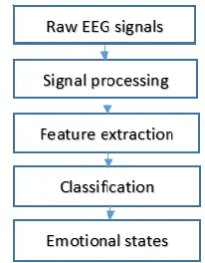
Emotion plays an important role in human to human interaction in our daily lives as we attempt to understand each other when interacting. The emotion recognition implementation in machines enable machines to understand and aid humans. In this study, there are several essential steps required in recognition of emotion using raw EEG signals as shown in Fig. 4. Those steps include acquisition of raw EEG signals, signal processing, feature extraction, and emotion classification.
Fig. 4. Emotion classification algorithm Fig. 2. The experiment process
Fig. 1. Basic framework for the system
3.2.1 Data Acquisition
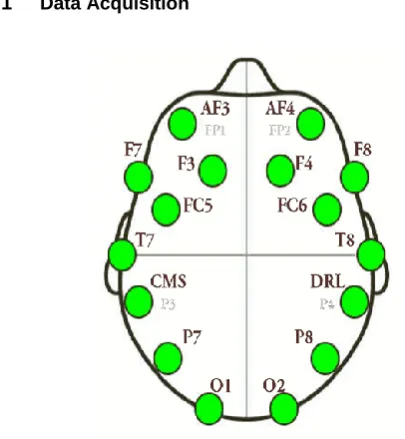
The acquisition of EEG signals is through the use of the low-cost wireless Emotiv Epoc neuroheadset with 14 electrodes (AF3, F3, F7, FC5, T7, P7, O1, O2, P8, T8, FC6, F8, F4 and AF4) and 2 references (CMS and DRL) as shown in Fig. 5. The placement of the electrodes on the scalp is based on the international 10-20 convention. EEG signals are collected with sampling rate of 128 Hz.
3.2.2 Feature Selection
In our experiment, although we collected the signals of all 14 electrodes signals, however, there are only 2 electrodes, F3 and F4 [10] electrode signals which are located at the frontal regions of the brain that will be used in this study. The brain signals of the frontal regions are reported to plays important roles in emotions [11, 12, 13].
3.2.3 Signals Preprocessing
Detection of packet lost is applied, then the nearest neighbor interpolation (NNI) [14] is used to predict and replace the lost packets. A 4th order zero-phase Butterworth band-pass filter is used to remove the noises and direct current (DC) offset with a cut off frequency of 0.5 Hz – 60 Hz [15], according to the Nyquist sampling theorem, where the maximum frequency that is represented in the discrete data is half of the sample rate [16].
3.2.4 Feature Extraction
Different frequency bands extracted from the EEG signals have essentially been used in many aspects to determine the human brain state in many studies [2, 10, 11, 13, 15, 17]. In this study, the interesting signals extracted from EEG signals were the alpha, beta and gamma band frequencies, where higher frequencies are related to high cognitive process [17]. Discrete wavelet packet transform (DWPT) is used in this study for its efficiency in frequency band localization [18]. A Daubechies 4 discrete wavelet (db4) [19] is used in this study. Commonly, db4, a Daubechies 8 discrete wavelet (db8), Symlet order 8 wavelet (sym8), and Coiflets 5 wavelet (coif5) are used in decomposition of EEG signals. The decision of using db4 is based on [20], where db4 had outstanding
performance in classifying emotions with different features especially entropy, over other wavelet functions.
3.2.5 Classification
In this study, linear discriminant analysis (LDA) with the default setting in Matlab will be used to classify positively, neutrally and negatively responding emotions. The study is focused on the alpha, beta and gamma band frequencies and also entropy log energy, where different features are tested.
3.2 Heuristic Search
This algorithm is used to generate the supershapes’ parameters of the next generation. In our experiment, a total of 30 supershapes will be generated, and it is divided into 3 parts with every part consisting of 10 superhapes. In the 1st part, the supershapes parameters (m1, n11, n12, n13, m2, n21, n22, n23) is generated randomly in between 1-20 using the float data type. Then the supershapes are displayed to user with 5 seconds each. After the displaying of supershapes and obtaining emotions from emotion classifier, then the supershapes parameter for the next generation is selected. The selection is based on the emotion obtained from emotion classifier and the top 5 that is classified as positively responding or even neutrally responding will be selected to generate the next generation of supershapes. However, the negatively labelled supershapes will not be selected. If the positively and neutrally responded supershapes is insufficient to make the next generation, a random number will be generated to produce another supershapes parameter and make it to 5. A list of different combinations of parameters of the supershapes is created, e.g., a supershape with parameter P is further separated into P11 and P12 and is further combined with another P21 and P22 to form a series of different combinations. The number of combinations in the list is calculated using the permutation calculation as shown in (5), where n is number of supershapes parameter to generate the current list for the next generation, which is 5 and r is 2. The previous supershapes parameters to generate the current list will not be included in the current list, and so n is deducted. is constantly 85.
(5)
From the list generated, a total of 10 supershapes parameters is selected randomly out of the generated list. Then the same process repeats.
3.3 Subjects
4 right-handed healthy male subjects with the age range of 24-27 (mean = 25.75) were selected to participate in this study. The subjects were given a brief introduction of the research scope and purpose prior to the experiment.
4
R
ESULTSnegatively responding emotions which applies to all the subjects.
TABLE 1 NUMBER RATING OF EACH EMOTION
Subject No. Positive No. Neutral No. Negative
Subject
1 11 13 6
Subject
2 9 17 4
Subject
3 3 20 7
Subject
4 6 18 6
Table II shows the classification accuracy for emotion
recognition using different features, focusing on alpha, beta and gamma band frequencies of F3 and F4.
TABLE 2 CLASSIFICATION OF EMOTION
Rank Feature F3/F4 Classification
1 Entropy log energy difference
left/right alpha 55.6%
2 Entropy log energy difference
left/right beta 55.6%
3 Entropy log energy difference
left/right alpha and gamma 52.8%
4 Entropy log energy alpha and
gamma 52.8%
5 Entropy log energy difference
left/right gamma 50%
6 Entropy log energy alpha 50%
7 alpha 50%
8 alpha and beta 47.2%
9 Entropy log energy alpha, beta
and gamma 47.2%
10 Entropy log energy gamma 44.4%
11 Entropy log energy difference
left/right alpha, beta and gamma 44.4%
12 gamma 44.4%
13 Entropy log energy beta 38.8%
14 beta 33.3%
15 alpha, beta and gamma 27.7%
The difference in entropy value for F3 and F4 could achieve at least 44.4% to a maximum 55.6% of accuracy. Higher neutral frequency and lower positively and negatively responding frequencies in the training dataset leads to insufficient information to do the training to the sufficient level of accuracy required. Further refinement on classification will need be investigated in future to increase the accuracy. 3 of the subjects were satisfied towards the selected design at the end
of the testing and 1 of the subject reported the selected design is not the desired design. The design is then printed using FDM machine as shown in Fig. 6.
5
C
ONCLUSION ANDF
UTUREW
ORKSThis paper described the process and methods on development of an automatic generation approach for 3D artforms using EEG. The Gielis superformula is used as 3D shape generation encoding. Several essential steps are used to recognize and understand the human’s preference emotions. The identified responding emotions were used to evolve the supershapes and real-time testing were conducted. In the future, the system will be further investigated using different machine learning algorithms and introducing much complex supershapes into the system. Different techniques of signal processing and wavelet functions will also be tested.
A
CKNOWLEDGMENTThis project is supported through the research grant ref: FRGS/2/2013/ICT02/UMS/02/1 from the Ministry of Education, Malaysia.
R
EFERENCES[1] D.S.C. Lam, W. Cheuk, A.T.S. Leung, D.S.P. Fan, H.M. Cheng, S.J. Chew, "Eye care when using video display terminals", Hong Kong Medical Journal, vol.5, no. 3, pp.255-257, September 1999.
[2] A. Craig, Y. Tran, N. Wijesuriya, H. Nguyen, “Regional brain wave activity changes associated with fatigue”. Psychophysiology 2012; vol. 49, pp. 574-82, 2012.
[3] R. Kamalian, Y. Zhong, H. Takagi, A.M. Agogino, “Reduced human fatigue interactive evolutionary computation for micromachine design”, International Conference on Machine Learning and Cybernetics, vol. 9, pp. 5666-5671, 2005.
[4] D. Gong and J. Yuan, “Large population size IGA with individuals’ fitness not assigned by user.”, Applied Soft Computing, vol. 11, no. 1, pp. 936-945, 2011.
[5] M. Lee and S., Cho “Interactive differential evolution for image enhancement application in smart phone.”, IEEE Congress on Evolutionary Computation 2012, pp. 1-6, 2012.
[6] D. Pallez, P. Collard, T. Baccino, and L. Dumercy, “Eye-Tracking Evolutionary Algorithm to minimize user fatigue in IEC applied to Interactive One-Max problem”, 2007
Conference on Genetic and EvolutionaryC, pp. 2883– 2886. ACM, 2007.
[7] T. Basa, C.K. Go, and W. Lee, “Using physiological signals to evolve art”, Proceedings of the 2006 International Conference on Applications of Evolutionary Computing, vol. 3907, pp. 633-641, 2006.
[8] N.B. Shamlo and S. Makeig, “Mind-Mirror: EEG guided Image Evolution”, Human-Computer Interaction, Part II, HCII 2009, LNCS 5611, pp. 569-578, 2009.
[9] J. Gielis, "A generic geometric transformation that unifies a wide range of natural and abstract shapes", American Journal of Botany, vol. 90, no. 3, pp. 333-338, 2003.
[10] K. Luangrat, Y. Punsawad, and Y. Wongsawat, "On the development of EEG based emotion classification," in Biomedical Engineering International Conference (BMEiCON), pp. 1-4, 2012.
[11] X.W. Wang, D. Nie, and B.L. Lu, "EEG-based emotion recognition using frequency domain features and support vector machine", Lecture Notes in Computer Science, Neural Information Processing, vol. 7062, pp. 734–743, 2011.
[12] LA. Schmidt and LJ. Trainor,"Frontal Brain Electrical Activity (EEG) Distinguishes Valence and Intensity of Musical Emotions", Cognition and Emotion vol.15, issue. 4, pp. 487–500, 2001.
[13] Y. Liu, O. Sourina, and M.K. Nguyen, “Real-time EEG-based Human Emotion Recognition and Visualization”, Conference on CyberWorlds of IEEE Computer Society, pp. 262-269, 2010.
[14] D. Garcia, “Robust smoothing of gridded data in one and higher dimensions with missing values”, Computational Statistics & Data Analysis, vol. 54, pp. 1167-1178, 2010.
[15] M. Murugappan, S.B. Murugappan, C. Gerard, “Wireless EEG Signals based Neuromarketing System using Fast Fourier Transform (FFT)”, 2014 IEEE 10th International Colloquium on Signal Processing & its Applications (CSPA2014), 2014.
[16] A.J. Jerri, “The Shannon sampling theorem - its various extensions and applications: a tutorial review,” Proc. IEEE, vol. 65, pp. 1565–96, 1977.
[17] M. Li and B.L. Lu, "Emotion classification based on gamma-band EEG", Conference on Proceedings of IEEE Eng. Medicine Biology Society, Vol. 1, pp. 1223–1226, 2009.
[18] M.K. Wali, M. Murugappan, Ahmad Badlishah, “Wavelet packet transform based driver distraction level classification using EEG”, Mathematical Problems in Engineeing, vol. 2013, Article ID 297587, 10 pages, 2013. doi:10.1155/2013/297587.
[19] T.S. Rached and A. Perkusich, “Emotion Recognition Based on Computer Interface Systems, Brain-Computer Interface Systems”, Recent Progress and Future Prospects, Reza Fazel-Rezai (Ed.), ISBN: 978-953-51-1134-4, InTech, 2013, DOI: 10.5772/56227.