Review Article
ISSN 2277-3657
Available online at
www.ijpras.comVolume 1, issue 4 (2012),20-28
International Journal of Pharmaceutical Research &
Allied Sciences
20
Floating Drug Delivery System
Bhalla.Neetika1*, Goswami .Manish 1
1Akal College of Pharmacy, Department of Pharmaceutics, Mastuana Sahib, Sangrur, Punjab, India.
*Email: [email protected]
Subject: Pharmaceutics
Abstract
Controlled release (CR) dosage forms have been extensively used to improve therapy with several important drugs. Incorporation of the drug in a controlled release gastroretentive dosage forms (CR-GRDF) which can remain in the gastric region for several hours would significantly prolong the gastric residence time of drugs and improve bioavailability, reduce drug waste, and enhance the solubility of drugs that are less soluble in high pH environment. Several approaches are currently utilized in the prolongation of the GRT, including floating drug delivery systems (FDDS), swelling and expanding systems, polymeric bioadhesive systems, high-density systems, modified-shape systems and other delayed gastric emptying devices. In this review, current & recently developments of Stomach Specific FDDS are discussed that helps to overcome physiological adversities like short gastric residence times and unpredictable gastric emptying times
Keywords:
Floating drug delivery systems, gastric residence time, effervescent, noneffervescent.__________________________________________________________________________________________
Introduction
Oral drug delivery is the most desirable and preferred method of administering therapeutics agent for their systemic effect. The high level of patient compliance in taking oral dosage forms is due to the ease of administration, patient compliance, flexibility in formulation and handling of these forms. This system has been of limited success. Oral dosage forms have proved to be successful in achieving a plethora of controlled release objectives ranging from immediate release to site specific delivery (Garg et al., 2003; Patel et al.,2006, Ahmed et al., 2002).. An although tremendous advances have been seen in oral controlled drug delivery system during last two decades.1 Oral formulations are being developed into different types, such as controlled release, delayed release, fast dissolving and taste masking formulations (Appaji, 2001) and other delivery technologies are being tried to deliver already existing and new drug molecules, oral formulations still control more than 60% of the market inability to restrain and localize the DDS within the desired regions of the GIT (Rouge et al., 1996; Hajeri and Amiji, 2002).This approach has several physiological difficulties such as inability to restrain and locate the controlled drug delivery system within the desired region of the
gastrointestinal tract (GIT) due to variable gastric emptying and motility2
.
Gastro-Retentive Drug Delivery Systems
Gastroretentive systems can remain in the gastric region for several hours and hence significantly prolong the gastric residence time of drugs. Prolonged gastric retention improves bioavailability, reduces drug waste, and improves solubility for drugs that are less soluble in a high pH environment. It has applications also for local drug delivery to the stomach and proximal small intestines. Slowed motility of the gastrointestinal tract by concomitant administration of drugs or pharmaceutical excipients also increase gastric retention of drug3.
Approaches to Gastro-Retentive Drug
Delivery Systems
Available online at
www.ijpras.com
21
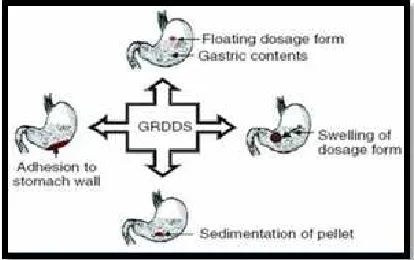
Based on these approaches, floating drug deliverysystems seems to be the promising delivery systems for control release of drugs (Vedha hari b.n.et al, 2010, Drs Jose Gutierrz Rocca et al, 2003). These efforts resulted in GRDFs that were designed, in large part, based on the following approaches. (Figure 1)
Figure1 Different approaches of gastric retention
Floating Drug Delivery System:
DEFINITION
Floating Oral Drug Delivery System (FDDS) are retained in the stomach and are useful for drugs that are poorly soluble or unstable in intestinal fluids. Floating drug delivery system (FDDS) have a bulk density less than gastric fluids and so remain buoyant in the stomach
without affecting the gastric emptying rate for a prolonged period of time (Yie W. Chein et al, 1992). While the system is floating on the gastric contents, the drug is released slowly at the desired rate from the system. After release of drug, the residual system is emptied from the stomach. This results in an increased GRT and a better control ofluctuations in plasma drug concentration6.
Basic GIT Physiology
Anatomically the stomach is divided in to three regions Fundus, Body and Antrum (pylorus). The design and evaluation of FDDS is based on anatomy and physiology of GIT. The stomach is J shaped dilated portion of the alimentary tract situated in the epigastric, umbilical and left hypochondriac regions of abdominal cavity (Washington et al., 2001) .The Gastrointestinal tract is essentially a tube about nine metres long that runs through the middle of the body from the mouth to the anus and includes the throat (pharynx), oesophagus, stomach, small intestine (consisting of the duodenum, jejunum and ileum) and large intestine (consisting of the cecum, appendix, colon and rectum) (Bannister, 1995). The
wall of the gastrointestinal tract has the same general structure throughout most of its length from the oesophagus to the anus, with some local variations for each region (Figure 2). The stomach is an organ with a capacity for storage and mixing7 .The average length of the stomach is about 0.2 meter and the apparent absorbing surface area is about 0.1 sq. meter8.
The proximal part made of fundus and body acts as a reservoir for undigested materials, where as the antrum is the main site for mixing motions and acts as a pump for gastric emp-tying by propelling actions (Yie W. Chein et al, 1992, Sanjay Garg et al, 2003).
Figure 2
Human Stomach
Process of Gastric Emptying
Gastric emptying occurs in both the fasting and fed states. During the fasting state an interdigestive series of electrical events take place which cycle both through stomach and intestine every 2-3 hrs, which is called as interdigestive myloelectric cycle or migrating myloelectric cycle (MMC) which is further divided in to four phases9, 10. After the ingestion of a mixed meal, the pattern of contractions changes from fasted to that of fed state which is also termed as digestive motility pattern11 (Figure3) (Vedha hari b.n.et al, 2010).
1. Phase 1-(Basic phase)-last from 30-60 minutes with rare contractions.
2. Phase 2-(Preburst phase)-last for 20-40 minutes with intermittent action potential and contrac-tions.
3. Phase 3-(Burst phase) - last for 10-20 minutes which includes intense and regular contractions for short period.
Figure 3 Gastrointestinal motility
Advantages oF FDDS 13-15
1. Floating dosage forms such as tablets or capsules will remains in the solution for prolonged time even at the alkaline pH of the intestine.
2. FDDS are advantageous for drugs meant for local action in the stomach eg: Antacids
3. FDDS dosage forms are advantageous in case of vigorous intestinal movement and in diarrhea to keep the drug in floating condition in stomach to get a relatively better response.
4. Acidic substance like aspirin causes irritation on the stomach wall when come in contact with it hence; HBS/FDDS formulations may be useful for the administration of aspirin and other similar drugs.
5. The FDDS are advantageous for drugs absorbed through the stomach eg: Ferrous salts, Antacids
Disadvantages oF FDDS17, 18
1. Floating systems are not feasible for those drugs that have solubility or stability problems in gastric fluids.
2. Drugs such as Nifedipine, which is well absorbed along the entire GI tract and which undergo sig-nificant first-pass metabolism, may not be suitable candidates for FDDS since the slow gastric empty-ing may lead to reduced systemic bioavailability. Also there are limitations to the applicability of FDDS for drugs that are irritant to gastric mucosa.
3. One of the disadvantages of floating
that they require a sufficiently high level of fluids in the stomach, so that the drug dosages form float therein and work efficiently.
Available online at
www.ijpras.com
3 Gastrointestinal motility patterns
1. Floating dosage forms such as tablets or capsules will remains in the solution for prolonged time even at the alkaline pH of the intestine.
2. FDDS are advantageous for drugs meant for local action in the stomach eg: Antacids
3. FDDS dosage forms are advantageous in case of vigorous intestinal movement and in diarrhea to keep the drug in floating condition in stomach to
4. Acidic substance like aspirin causes irritation on n come in contact with it hence; HBS/FDDS formulations may be useful for the administration of aspirin and other similar
5. The FDDS are advantageous for drugs absorbed ach eg: Ferrous salts, Antacids.
1. Floating systems are not feasible for those drugs that have solubility or stability problems in gastric
2. Drugs such as Nifedipine, which is well absorbed along the entire GI tract and which pass metabolism, may not be suitable candidates for FDDS since the slow ing may lead to reduced systemic bioavailability. Also there are limitations to the applicability of FDDS for drugs that are irritant to
3. One of the disadvantages of floating systems is that they require a sufficiently high level of fluids in the stomach, so that the drug dosages form float
Limitations OF FDDS19, 20
They require a sufficiently high level of fluids in the stomach for the drug del
float therein and to work efficiently. Floating systems are not feasible for those drugs that have solubility or stability problems in gastric fluid. Drugs such as Nifedipine, which is well absorbed along the entire GI tract and which un
significant first- pass metabolism, may not be desirable candidates for FDDS since the slow gastric emptying may lead to reduced systemic bioavailability. Also there are limitations to the applicability of FDDS for drugs that are irritant to gastric mucosa.
Classification of Floating Drug Delivery
Systems
A. Single Unit Floating Dosage Systems
Non-effervescent Systems ( balanced systems)
Effervescent Systems (Gas-generating Systems)
B. Multiple Unit Floating Dosage Systems
Non-effervescent Systems ( balanced systems)
Effervescent Systems (Gas-generating Systems) Hollow Microspheres
C. Raft Forming Systems
A. Single Unit Floating Dosage
I Non-effervescent Systems ( balanced systems)
These are single-unit dosage forms, containing one or more gel-forming hydrophilic polymers. Hydroxypropylmethylcellulose (HPMC) is the most commonly used excipient; although
ethylcellulose (HEC), hydroxypropylcellulose (HPC), sodium carboxymethyl
agar, carrageen or alginic acid are also used. The polymer is mixed with drug and usually administered in a gelatin capsule. The capsule rapidly dissolves in the gastric fluid, and hydration and swelling of the surface polymers produces floating mass21, 22. Drug release is controlled by the formation of a hydrated boundary at the surface. Continuous erosion of the surface allows water penetration to the inner layers, maintaining surface hydration and buoyancy23. Incorporation of fatty excepients gives low-density formulations and reduced penetration of water, reducing the erosion. Effective drug delivery depends on the balance of drug loading and the effect of polymer on its release profile 24.
22
They require a sufficiently high level of fluids in the stomach for the drug delivery buoyancy, to float therein and to work efficiently. Floating systems are not feasible for those drugs that have solubility or stability problems in gastric fluid. Drugs such as Nifedipine, which is well absorbed along the entire GI tract and which undergoes pass metabolism, may not be desirable candidates for FDDS since the slow gastric emptying may lead to reduced systemic bioavailability. Also there are limitations to the applicability of FDDS for drugs that are irritant toClassification of Floating Drug Delivery
A. Single Unit Floating Dosage Systems
effervescent Systems (Hydro dynamically
generating Systems)
B. Multiple Unit Floating Dosage Systems
effervescent Systems (Hydro dynamically
generating Systems)
A. Single Unit Floating Dosage
effervescent Systems (Hydro dynamically
Available online at
www.ijpras.com
23
II. Gas-generating systemsFloatability can also be achieved by generation of gas bubbles. Carbon dioxide (co2) can be generated in situ by incorporation of carbonates or bicarbonates, which react with acid, either the natural gastric acid or co-formulated as citric or tartaric acid25,26. The optimal stoichiometric ratio of citric acid and sodium bicarbonate for gas generation is reported to be 0.76:1.Gastric floating drug delivery system (GFDDS) offers numerous advantages over other gastric retention systems27, 28. These systems have a bulk density lower than gastric fluids and thus remain buoyant in the stomach without affecting the gastric emptying rate for a prolonged period of time29. While the system is floating on the gastric contents, the drug is released slowly at desired rate from the stomach30, 56
.
B. Multi –Unit Dosage Forms:
The purpose for designing multiple-unit dosage form is to develop a formulation which has all the advantages of a single-unit form and also devoid the above mentioned disadvantages of single-unit formulations. In pursuit of this endeavor many multiple-unit floatable dosage forms have been designed31. Microspheres with high loading capacity can be formulated using various polymers such as albumin, gelatin, starch, polymethacrylate, polyacrylamine, and polyalkylcyanoacrylate. Spherical polymeric microsponges, are referred as “microballoons,” have been prepared32. Microspheres have a characteristic internal hollow structure and show an excellent in vitro floatability. In Carbon dioxide–generating multiple-unit oral formulations several devices with features that extend, unfold, or are inflated by carbon dioxide generated in the devices after administration have been described in the recent patent literature. These dosage forms are excluded from the passage of the pyloric sphincter if a diameter of ~12 to 18 mm in their expanded state is exceeded33.
C. Raft Forming Systems:
Raft forming systems have received much attention for the delivery of antacids and drug delivery for gastrointestinal infections and disorders. The mechanism involved in the raft formation includes the formation of viscous cohesive gel in contact with gastric fluids,wherein each portion of the liquid swells forming a continuous layer called a raft. This raft floats on gastric fluids because of low bulk density created by the formation of CO2. Usually, the system contains a gel forming agent and alkaline bicarbonates or carbonates responsible for the formation of CO2 to make the system less dense and float on the gastric fluids 34an antacid raft forming floating system. The system contains a
gel forming agent (e.g. alginic bicarbonate, calcium carbonate, mannitol and a sweetener. These ingredients were granulated, and citric acid was added to the granules. The formulation produces effervescence and aerates the raft formed, making it float acid), sodium bicarbonate and acid neutralizer, which forms a foaming sodium alginate gel (raft) when in contact with gastric fluids. The raft thus formed floats on the gastric fluids and prevents the reflux of the gastric contents (i.e. gastric acid) into the esophagus by acting as a barrier between the stomach and esophagus. A patent assigned to Reckitt and Colman Products Ltd., describes a raft forming formulation for the treatment of helicobacter pylori (H. Pylori) infections in the GIT35.
Factors Affecting the Floating and Floating
Time
1. Density: - Floating is a function of dosage form buoyancy that is dependent on the density.
2. Shape of dosage form: - Tetrahedron and ring shaped devices with flexural modules of 48 and 22.5 kilo pounds per square inch (KSI) are reported to have better floating, 90% to 100% retention at 24 hours compared with other shapes36.
3.Concomitant drug administration:
-Anticholinergics like atropine and propantheline,opiates like codeine and prokinetic agents like metoclopramide and cisapride; can affect floating time.
4. Fed or unfed state: - Under fasting conditions, the GI motility is characterized by periods of strong motor activity or the migrating myoelectric complex (MMC) that occurs every 1.5 to 2 hours37.
5.Nature of meal: - Feeding of indigestible polymers or fatty acid salts can change the motility pattern of the stomach to a fed state, thus decreasing the gastric emptying rate and prolonging drug release38.
6.Caloric content and feeding frequency: - Floating can be increased by four to 10 hours with a meal that is high in proteins and fats. The floating can increase by over 400 minutes when successive meals are given compared with a single meal due to the low frequency of MMC.
7. Age: - Elderly people, especially those over 70, have a significantly longer; floating39. Disease condition such as diabetes and crohn’s disease etc also affect drug delivery.
Available online at
www.ijpras.com
24
Evaluation of Floating Drug Delivery SystemsVarious parameters that need to be evaluated in gastroretentive formulations include floating duration, dissolution profiles, specific gravity, content uniformity, hardness, and friability in case of solid dosage forms45. In the case of multiparticulate drug delivery systems, differential scanning calorimetry (DSC), particle size analysis, flow properties, surface morphology, and mechanical properties are also performed.
A. In Vitro Methods
1) Floating lag time and floating time:
The test for floating time measurement is usually performed in stimulated gastric fluid or
0.1 N HCl maintained at 37 0C. It is determined by using USP dissolution apparatus containing 900 ml of 0.1 N HCl as dissolution medium at 37 0C. The time taken by the dosage form to float is termed as floating lag time and the time for which the dosage form floats is termed as the floating or flotation time. The system to check continuous floating behaviour contains a stainless steel basket connected to a metal string and suspended from a Sartorius electronic balance46.A lotus- spread sheet could automatically pick up the reading on the balances. Test medium used in floating kinetics measurements was 900 ml simulated gastric fluid (pH 1.2) maintained at 37°C, data was collected at 30 sec interval; baseline was recorded and subtracted from each measurement. Dissolution basket had a holder at the bottom to measure the downward force.
2) Dissolution study
Gohel et al proposed a more relevant in vitro dissolution method to evaluate a floating drug delivery system (for tablet dosage form). A 100-mL glass beaker was modified by adding a side arm at the bottom of the beaker so that the beaker can hold 70 ml of 0.1 mole.lit-1 HCl dissolutionmedium and allow collection of samples. A burette was mounted above the beaker to deliver the dissolution medium at a flow rate of 2 ml/min to mimic gastric acid secretion rate. The performance of the modified dissolution apparatus was compared with USP dissolution Apparatus 2 (Paddle). The problem of adherence of the tablet to the shaft of the paddle was observed with the USP dissolution apparatus47. The tablet did not stick to the agitating device in the proposed dissolution method. The drug release followed zero-order kinetics in the proposed method. The proposed test may show good in vitro-in vivo correlation svitro-ince an attempt is made to mimic the in vivo conditions such as gastric
volume, gastric emptying, and gastric acid secretion rate48.
3) Swelling index:
An in vitro measuring apparatus has been conceived to determine the real floating capabilities of buoyant dosage forms as a function of time. It operates by measuring the force equivalent to the force F required to keep the object totally submerged in the fluid49.This force determines the resultant weight of the object when immersed and may be used to quantify its floating or no floating capabilities49. The magnitude and direction of the force and the resultant weight corresponds to the vectorial sum of buoyancy (F bouy) and gravity (F
grav) forces acting on the object as shown in the equation
F = F buoy – F grav
F = d f gV – d s gV = (d f - d s) gV
F = (df – M / V) gV
in which F is the total vertical force (resultant weight of the object), g is acceleration due to gravity, d f is the fluid density, d s is the object density, M is the object mass, and V is the volume of the object . By convention, a positive resultant weight signifies that the force F is exerted upward and that the object is able to float, whereas a negative resultant weight means that the force F acts downward and that the object sinks 50, 51.
B. In vivo method
1) X-Ray method
X-Ray is a very popular evaluation parameter for floating dosage form now a day.54 It helps to locate dosage form in the g.i.t. and by which one can predict and correlate the gastric emptying time and the passage of dosage form in the GIT. Here the inclusion of a radio-opaque material into a solid dosage form enables it to be visualized by Xrays51.
2) gamma-Scintigraphy
Available online at
www.ijpras.com
25
3) GastroscopyIt comprises of peroral endoscopy, used with a fibereoptic and video systems. It is suggested that gastroscopy may be used to inspect visually the effect of prolonged stay in stomach milieu on the FDDS. Alternatively, FDDS may be drawn out of the stomach for more detailed evaluation53, 54.
4) Ultrasonography
Ultrasonic waves reflected substantially different acoustic impedances across interface enable the imaging of some abdominal organs57. Most DFs do not have sharp acoustic mismatches across their interface with the physiological milieu. Therefore, Ultrasonography is not routinely used for the evaluation of FDDS. The characterization included assessment of intragastric location of the hydrogels, solvent penetration into the gel and interactions between gastric wall and FDDS during peristalsis55.
Conclusion
Drug absorption in the gastrointestinal tract is a highly variable procedure and prolonging gastric
retention of the dosage form extends the time for drug absorption. FDDS promises to be a potential approach for gastric retention. Dosage forms with a prolonged GRT will bring about new and important therapeutic options. The currently available polymer-mediated Noneffervescent and effervescent FDDS, designed on the basis of delayed gastric emptying and buoyancy principles, appear to be a very much effective approach to the modulation of controlled oral drug delivery. Number of commercial products and patents issued in this field are the evidence of it. The FDDS become an additional advantage for drugs that are absorbed primarily in the upper part of GI tract, i.e., the stomach, duodenum, and jejunum. Some of the unresolved, critical issues like the quantitative efficiency of floating delivery systems in the fasted and fed states, role of buoyancy in enhancing GRT of FDDS and more than that formulation of an ideal dosage form to be given locally to eradicate H.Pylori, responsible for gastric ulcers worldwide. Due to the complexity of pharmacokinetic and pharmacodynamic parameters, in vivo studies are required to establish the optimal dosage form for a specific drug.
Table 1: Salient Features of Upper Gastrointestinal Tract12:
P – Passive diffusion C – Aqueous channel transport A – Active transport F – Facilitated transport I – Ion-pair transport E – Entero-or pinocytosis CM – Carrier mediated transport
Drugs Used In the Formulations of Stomach Specific
Table 2: List of drugs explored in floating dosage forms41 Section Length (m) Transit time
(h)
pH Microbial
count
Absorbing surface area (m2)
Absorption pathway
Stomach 0.2 Variable 1-4 <103 0.1 P, C, A
Small Intestine
6-10 3 ± 1 5-7.5 103 – 1010 120-200 P, C, A, F, I, E, CM
Types of dosage
forms Drugs explored in floating dosage forms
Microspheres Aspirin, Griseofulvin, P-nitro aniline, Ibuprofen, Ketoprofen, Terfenadine, Tranilast. Granules Diclofenac sodium, Indomethacin, Prednisolone.
Films Cinnarizine, Drug delivery device.
Capsules Chlordiazepoxide HCl, Diazepam, Furocemide, L-Dopa and Benserazide, Misoprostol, Nicardipine, Propranolol HCl, Ursodeoxychoric acid.
Available online at
www.ijpras.com
26
MARKETED PRODUCTSTable3: Some of the marketed gastro-retentive floating formulations42
“Cite this article”
.N. Bhalla, M. Goswami, “Floating Drug Delivery System” Int. J. of Pharm. Res. & All. Sci.2012; Volume 1, Issue 4,20-28
References
1. Ansel HC, Allen LV, Popovich NG. Pharmaceutical Dosage Forms and Drug Delivery Systems. Philadelphia, Lippincott Williams and Wilkins Chapter -3, 2003:23-31.
2. Streubel A, Siepmann J, Bodmeier R. Gastroretentive drug delivery system. Expert Opin Drug Deliv 2006; 3(2): 217-33.
3. Wilson C.G, Washington N., Physiological Pharmaceutics: Biological Barriers to Drug Absorption, Horwood Ellis, Chichester, 1989; 47-70.
4. Rouge N, Buri P, Doelker E. Drug absorption sites in the gastrointestinal tract and dosage forms for site specific delivery. Int J Pharm. 1996; 136:117-139.
5. Sharma S, Garg S. Gastroretentive drug delivery system in drug delivery oral, Business Brief : Pharmatech 2003 :160-166.
6. El-Kamel, A.H., Sokar, M.S., Al Gamal, S.S., Naggar. Preparation and evaluation of ketoprofen floating oral delivery system. Int J Pharm. 2001; 220, 13-21.
7. Tortora GJ and Derrickson B. Principles of Anatomy and Physiology. 11th ed. John Wiley and Sons, Inc. 2006:895 - 948. 8. Bannister LH, Alimentary system, in:
Williams PL, Gray’s Anatomy. 38th ed, New York: Churchill Livingstone, New York, 1995:1683-1812
9. Groning R, Heun G. Oral dosage forms with controlled gastrointestinal transit. Drug Dev Ind Pharm. 1984; 10: 527-539.
10. Wilson CG, Washington N. The stomach: its role in oral drug delivery. In: Rubinstein MH, ed. Phsiological Pharmaceutical: Biological Barrier to Drug Absorption. Chichester, UK: Ellis Horwood; 1989:47-70. 11. Rubinstein, D.R. Friend, Specific delivery to gastrointestinal tract, in: A.J.Domb (Ed.), Polymeric site specific pharmacotherapy, Wiley, Chichester, 1994:282-283.
12. Bechgaard H., Ladefoged K. Distribution of pellets in the gastrointestinal tract: The influence on transit time exerted by density or diameter of pellets. J.Pharm. Pharmacol. 1978; 30:690-692.
Product Content Manufacturer Type of formulation
Madopar® Levodopa(100 mg), Benserazide(25 mg)
Roche products, USA. Floating, CR capsule.
Valrelease® Diazepam (15 mg) Hoffmann-LaRoche, USA.
Floating capsule.
Liquid Gaviscon® Al-hydroxide(95 mg), Mg carbonate(358 mg)
GlaxoSmithKline, India.
Effervescent floating liquid alginate preparation Topalkan® Al-Mg antacid Pierre Fabre Drug,
France.
Floating liquid alginate preparation
Almagate FlotCoat® Al-Mg antacid - Floating dosage form
Available online at
www.ijpras.com
27
13. http://www.pharmabiz.com, Basak S,Chronicle Specials, Floatable Gastroretentives: Emerging Potentials, Mar-2006.
14. Deshpande A.A., Shah N.H., Rhodes C.T., Malick W.,Development of a novel controlled release system for gastric retention, Pharm. Res. 1997; 14: 815-819.
15. Joseph N.H. Laxmi S., Jayakrishnan A. A floating type oral dosage from for piroxicam based on hollow.
16. Thanoo B.C, Sunny M.C. and Jayakrishnan A., Oral sustained-release drug delivery systems using polycarbonate microspheres capable of floating on the gastric fluid, J.Pharm. Pharmacol. 1993,45,21-24.
17. Kawashinia Y, Niwa T. Takcuchi H. Hino T, Itoh Y. Hallow microspheres for use as a floating controlled drug delivery system in the stomach. J.Pharm.Sci.1992; 81(2): 135-140.
18. Joseph N.H. Laxmi S., Jayakrishnan A. A floating type oral dosage from for piroxicam based on hollow microspheres: in vitro and in vivo evaluation in rabbits. J. Cont. Rel. 2002; 79:71-79.
19. Atyabi F.,Sharma H.L., Mohammad H. AH. and Fell J. T., Controlled drug release from coated floating ion exchange resin beads. Journal of Controlled Release.1996;42: 25-28.
20. El-Kamel A.H., Sokar M.S, Algamal S.S, Naggar V.F.Preparation and evaluation of ketoprofen floating oral drug delivery system. Int. J. Pharm. 2001; 220:13-21. 21. Menon A, Ritschel W.A., Sakr A.
Development and evaluation of a monolithic floating dosage form furosemide. J Pharm Sci. 1994; 83:239-245.
22. Oth M, Franz M, Timmermans J, Moes A. The bilayer floating capsule: a stomach directed drug delivery system for misoprostal. Pharm Res. 1992; 9:298-302. 23. Gohel M.C., Mehta P.R.., Dissolutiontech.
2004, 11(4), 22-25.
24. Karande A.D., Yeole P.G. Comparative Assessment of Different Dissolution Apparatus for Floating Drug Delivery Systems. Dissolutiontech.2006; 13(1):20-23. 25. Ichikawa M., Watanabe S, Miyake Y. A new
multiple unit oral floating dosage system. I: Prepration and in vitro evaluation of floating
and sustained-release kinetics. J. Pharm.Sci. 2001; 80:1062-1066.
26. Baumgartner S, Kristel J, Vreer F, Vodopivec P, Zorko B. Optimisation of floating matrix tablets and evaluation of their gastric residence time. Int J Pharm. 2000; 195:125-135.
27. Klausner EA, Lavy E, Friedman M, Hoffman A.Expandable gastroretentive dosage forms. J Control Release. 2003; 90:143-162. 28. Singh B.N., Kim K.H., Floating drug
delivery systems: an approach to oral controlled drug delivery via gastric retention. J Control Rel 2000; 63:235-9.
29. Yang L., Esharghi J., Fassihi R. A new intra gastric delivery system for the treatment of helicobacter pylori associated gastric ulcers: in vitro evaluation. J. Cont. Rel. 1999; 57:215- 222.
30. Bodmeier, R., 1999b. Floating or pulsatile drug delivery systems based on coated effervescent cores. Int. J. Pharm. 187, 175-184.
31. Ingani, H.M., Timmermans, J., Moës, A.J., Conception and in vivo investigation of peroral sustained release floating dosage forms with enhanced gastrointestinal transit. Int. J. Pharm. 1987; 35: 157-164.
32. Sakr F.M., A programmable drug delivery system for oral administration International Journal of Pharmaceutics, Volume, 1999: 184(1):131-139.
33. Vyas S.P and Khar R.K. Targetted and controlled Drug Delivery Novel carrier system1st Ed., CBS Publishers and distributors, New Delhi, 2002; 196-217. 34. Jain N.K., Progress in Controlled and Novel
Drug Delivery Systems, 1st Ed. CBS Publishers and Distributors, New Delhi, 2004; 84-85.
35. Iannuccelli V., Coppi G., Bernabei M.T. and Cameroni R., Air compartment multiple-unit system for prolonged gastric residence. Part I. Formulation study, Int.J.Pharm. 1998; 174: 47- 54.
36. Ichikawa M, Watanabe S, Miyake Y. A new multiple unit oral floating dosage system. I: Prepration and in vitro evaluation of floating and sustained-release kinetics. J Pharm Sci. 1991; 8:1062-1066.
Available online at
www.ijpras.com
28
tablets. Chung Kao Yao Li Hsuesh Pao.1992; 13:527-531.
38. Rouge N., Cole E.T., Doelker E., Buri P. Buoyancy and drug release patterns of floating mini tablets containing piretanide and atenolol as model drugs. Pharm. Dev. Technol. 1998; 3:73-84.
39. Cheuh H.R., Zia H., Rhodes C.T. Optimization of Sotalol floating and bioadhesive extended release tablet formulation. Drug Dev. Ind. Pharm. 1995; 21:1725-1747.
40. Nur A.O., Zhang J.S.. Captopril floating and/or bioadhesive tablets: design and release kinetics.Drug Dev Ind Pharm. 2000; 26:965-969.
41. Gustafson J.H., Weissman L., Weinfeld R.T. Clinical bioavailability evaluation of a controlled release formulation of diazepam. J. Pharmacokinet. Biopharm. 1981; 9:679-691.
42. Simoni P., Cerre C., Cipolla A., et al. Bioavailabilty study of a new sinking, enteric coated ursodeoxycholic acid formulation. Pharmacol. Res. 1995; 31:115-119.
43. Karande A.D., Yeole P.G. Comparative Assessment of Different Dissolution Apparatus for Floating Drug Delivery Systems. Dissolutiontech.2006; 13(1):20-23. 44. Gohel M.C., Mehta P.R.., Dissolutiontech.
2004, 11(4), 22-25.
45. Timmermanns J. and Moes A. (1990). How well do floating dosages forms float? Int.J.Pharm.1987; 62(3): 207 – 216.
46. Chen G.L., Hao W.H., In vitro performance of floating sustained release capsules of verapamil. Drug Dev Ind Pharm.1998; 24:1067-1072.
47. Moursy N.M., Afifi N.N., Ghorab D.M., El-Saharty Y.Formulation and evaluation of
sustained release floating capsules of Nicardipine hydrochloride. Pharmazie. 2003; 58:38-43.
48. http://www.pharmabiz.com, Basak S, Chronicle Specials, Floatable Gastroretentives: Emerging Potentials, Mar-2006.
49. Ritschel W A. Targeting in the gastrointestinal tract: new approaches, methods find. Exp. Clin. Pharmacol. 1991; 13:313-336.
50. Talukder R, Fassihi R. Gastroretentive drug delivery system: A Mini Review. Drug Dev Ind Pharm 2004; 30(10):1019-1028.
51. Klausner EA, Lavy E, Stepensky D, Friedman M, Hoffman A. Novel gastroretentive dosage form: evaluation of gastroretentivity and its effect on riboflavin absorption in dogs. Pharm. Res.2002; 19:1516-1523.
52. Fell J., Digenis C.G. Imaging and behavior of solid oral dosage forms in vivo. Int.J.Pharm.1984; 22(1):1-5.
53. Gansbeke, B.V., Timmermans J., Schoutens A and Moes A.J. Intragastric positioning of two concurrently ingested pharmaceutical matrix dosage forms, Nucl Med Biol.1991;18:711-718.
54. Jao, F., Edgren, D E. and Wong, P S. (2000). Gastric retention dosage form havin multiple layers. Int Application WO0038650.July, 2006.
55. Hendee, W. R. In Textbook of Diagnostic Imaging II, 2nd Ed., W B Saunders, Philadelphia, 1999; 1:1-6.