Original Research Article
Discernment, apropos on dispensation of hospital waste
among paramedics: a descriptive study
Swati Agrawal
1*, Vrinda Saxena
2, Swapnil Jain
1, Vijayta Sharva
1INTRODUCTION
India is one of the most populated and rapidly growing countries in the world and is the source of humongous amounts of waste every year, including municipal solid waste, hazardous waste, biomedical waste or e-waste. As per the Central Pollution Control Board (CPCB), the average solid waste generated in India ranges from 0.21 to 0.5 kg per capita per day. Healthcare is one of the largest sector in India both in terms of revenue and employment. With growing healthcare, there is a requirement of management of bio-medical waste.1
The term “biomedical waste” has been defined as “any waste that is generated during diagnosis, treatment or immunisation of human beings or animals, or in the research activities pertaining to or in the production or testing of biologicals and includes categories” mentioned in schedule I of the Government of India’s Biomedical Waste Rules 1998.2,3 Bio-medical waste (BMW) although comprises a small proportion of total waste generated (around 1%) but needs special handling and treatment due to its highly toxic contents, and it is highly infectious and can pose a severe threat to human health.1
ABSTRACT
Background: India is one of the most populated and rapidly growing countries in the world and is the source of humongous amounts of waste every year, including municipal solid waste, hazardous waste, biomedical waste or e-waste. Healthcare is one of the largest sectors in India both in terms of revenue and employment. With growing healthcare, there is a requirement of management of bio-medical waste. This study is conducted to assess discernment, apropos on dispensation of hospital waste by paramedics.
Methods: A cross-sectional study was conducted to assess the discernment and apropos of paramedical staff in 3 private hospitals regarding disposal of waste in Bhopal city and convenience sampling was used. A total of 204 individuals were approached for the study. The collected data analysed by using SPSS 21.0 and Descriptive analysis was done.
Results: Total 204 paramedical staff participated in the study out of which 125 (61.2%) were males and 79 (38.7%) were males. It showed that there was limited level of knowledge, attitude and practices among class 3 workers i.e., attenders as compared to nurses and technicians.
Conclusions: Study concluded that there is lack of knowledge about waste management which leads to improper waste disposal and pointed out that class 3 workers have less knowledge as compared to class 1 and class 2 workers. The technicians and nurses comparatively were having better knowledge and attitude, and also practiced waste management better than the attenders.
Keywords: Biomedical waste, Hospital waste management, Waste disposal
1
Department of Public Health Dentistry, Peoples Dental Academy, Bhopal, Madhya Pradesh, India
2Department of Public Health Dentistry,Government Dental College, Indore, Madhya Pradesh, India
Received: 11 September 2019 Accepted: 15 October 2019
*Correspondence: Dr. Swati Agrawal,
E-mail: [email protected]
Copyright: © the author(s), publisher and licensee Medip Academy. This is an open-access article distributed under the terms of the Creative Commons Attribution Non-Commercial License, which permits unrestricted non-commercial use, distribution, and reproduction in any medium, provided the original work is properly cited.
According to WHO, SEARO, the 11 South-East Asian countries together produce some 350,000 tons of health care waste per year, close to 1000 tons a day which is both hazardous and nonhazardous. The total bio-medical waste generated in India is approximately 519.7 (2016) and 501 (2015) tons per day (TPD) or from over 187,486 healthcare facilities (HCF). An estimated 483.3 (2016) and 486 (2015) tons per day of this biomedical waste is treated in India daily. The average quantity of hospital solid waste produced in India ranges from 1.5 to 2.2 kg/day/bed.1
The generators of biomedical waste i.e., doctors, nurses; technicians, etc., (medical and paramedical personnel) should come forward and take over the mantle of segregation. The segregation should be done in accordance to the Biomedical Waste (management and handling) rule of 1998. Optimal waste management is at best, a moving target. Waste-handling is left to lower-level workers who operate without any training, guidance, and supervision .Usually attenders are responsible for spearheading the waste management initiatives. therefore, this study is conducted to assess the discernment, apropos on dispensation of hospital waste by paramedics. Persistent user friendly approach and logistic support is important in the implementation of rules and regulations concerning the medical practice other than the core mandate they are assigned to and Proper management of waste should be addressed with 2Ds i.e., dignity and duty and not by any means of pressure.4.
METHODS
A questionnaire based cross — sectional survey was conducted to assess the discernment and apropos of paramedical staff in 3 private hospitals regarding disposal of waste in Bhopal City from Feb 1st 2019 to March 20th 2019. Convenience sampling method was applied in the study. A total of 204 individuals were approached for the study. The ethical clearance was obtained from Institutional Ethical Clearence Committe prior to the start
of the study. Verbal consent was obtained from the head of the concerned departments and the study participants. The participants who were not present at the day of administration of questionnaire and not willing to participate were under exclusion criteria of the study.
The study is based on the information received from the interview schedule. A predesigned, pretested and prevalidated questionnaire was used and modified with the help of experts according to the need of the study. The questionnaires were framed to interrogate personnel related to health care settings Such as technicinas/lab technicians, nurses and attenders. Time acquired per person for filling the entire questionnaire varied from 5 to 7 minutes. It was validated on 20 people, Cronbach’s Alpha was 0.805, so the standard of questionnaire was made according to paramedical staff.
The collected data from 204 paramedical staff were entered and analysed by using SPSS 21.0. Frequency, proportions were calculated and reported. The main motive behind the study was to comprehend mundane activities in hospital waste management, to recommend training if required by any department of the hospital. Also it emphasised on enlightening suggestions for rectifying waste management techniques.
RESULTS
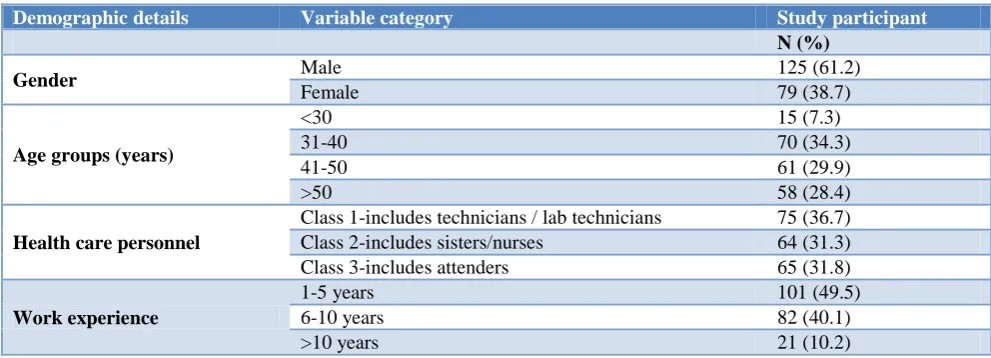
The study was conducted among paramedical staff of three colleges in Bhopal City. Total 204 paramedical staff participated in the study out of which 125 (61.2%) were males and 79 (38.7%) were males. Regarding age 70 respondents were in age group between 31-40 years of age. Health care personnel were divided into three classes according to their designations. 75 workers are Class 1 workers including lab technicians/technicians, 64 workers were class 2 includes nurses and 65 workers were class 3 include attenders working in medical and dental colleges. Amongst them 82 were having work experience of 6-10 years (Table 1).
Table 1: Socio-demographic details of the study population (n=204).
Demographic details Variable category Study participant
N (%)
Gender Male 125 (61.2)
Female 79 (38.7)
Age groups (years)
<30 15 (7.3)
31-40 70 (34.3)
41-50 61 (29.9)
>50 58 (28.4)
Health care personnel
Class 1-includes technicians / lab technicians 75 (36.7) Class 2-includes sisters/nurses 64 (31.3) Class 3-includes attenders 65 (31.8)
Work experience
1-5 years 101 (49.5)
6-10 years 82 (40.1)
Table 2: Positive response of class 1, 2 and 3 workers regarding bio-medical waste management.
Questions Class 1
(n=75)
Class 2 (n=64)
Class3
(n=65) P value
N (%) N (%) N (%)
Knowledge
Q1) Do you know hospital waste
causes health hazards? 73 (97.3) 62 (96.9) 57 (87.7) 0.028* Q2) Do you have coloured dustbins
for waste disposal in your hospital/college?
73 (97.3) 60 (93.8) 59 (90.8) 0.255
Q3) Do you know how to recycle
different types of waste? 61 (81.3) 56 (87.5) 51 (78.5) 0.387 Q4) Does your department have
biomedical waste chart? 68 (90.7) 64 (100) 59 (90.8) 0.042*
Attitude
Q5) Do you feel a need to use two
gloves for segregation of waste 68 (90.7) 56 (87.5) 41 (63.1) 0.001* Q6) Do you feel a need to use detail
and floor cleaners for cleaning departments/hospital
75 (100) 64 (100) 59 (90.8) 0.001*
Practice
Q7) Do you colour code the waste
for disposal? 75 (100) 56 (87.5) 59 (90.8) 0.010 Q8) Do you use gloves for
segregation of waste? 75 (100) 48 (75) 43 (66.2) 0.001* Q9) Do you wash your hands after
segregation of waste? 61 (81.3) 56 (87.5) 51 (78.5) 0.387 Q10) Do you keep used and unused
instruments together? 29 (38.7) 6 (9.41) 11 (16.9) 0.001* Q11) Is the infection waste labeled
with the biohazard symbol? 75 (100) 64 (100) 56 (86.2) 0.001* Q12) Do you segregate the waste
chair side? 68 (90.7) 40 (62.5) 46 (70.8) 0.001*
*statistically significant.
Figure 1: Knowledge, attitude and practices of paramedical staff.
The first part of questionnaire for this study was to assess the knowledge of workers regarding the disposal of biomedical waste. Out of 204 participants, 97.3% of class 1 workers know that hospital waste causes health hazards.
97.3% agreed that they use coloured dustbins for disposal of waste. 87.5% class 3 workers know how to recycle hospital waste and 100% class 2 workers have knowledge about biomedical waste chart they have in their
0 50 100 150 200 250
Q1 Q2 Q3 Q4 Q5 Q6 Q7 Q8 Q9 Q10 Q11 Q12
Per
ce
n
ta
g
e
Questions
departments. The attitude of workers towards the use of two gloves for segregation of waste and need to use Dettol/floor cleaners for cleaning departments and hospitals found to be positive and when compared between 3 groups, the values are found statistically significant. The lab technicians/technicians (90.7%) have a better attitude towards a need to use two gloves for separation of waste. Out of 204 workers majority (198) feel that Dettol/floor cleaners should be used for cleaning. In the questions related to practice, 100% class 1 workers use colour codes for disposal of waste and use gloves for segregation of waste. Among all only 87.5% class 2 workers wash their hands after segregation of waste and only 38.7% class1 , 9.41% class 2 and 16.9% class 3 workers keep used and unused instrument. Separately 100% class 1 and class 2 workers labelled waste disposal with biohazard symbol and only 90.7% class 1 workers segregate the waste chair side. (Table 2, Figure 1).
DISCUSSION
Biomedical waste management and handling is an important adjunct to the successful medical and healthcare. It is our social, moral and legal obligation that we pay attention to each and every aspect of medical waste right from minimisation to final disposal.5
The present study was conducted in private dental and medical colleges of Bhopal City. It showed that there was limited level of knowledge, attitude and practices among class 3 workers i.e., attenders as compared to nurses and technicians.
The results of the study are in accordance with previous study. In a study conducted in medical college hospital, Bangalore rural Knowledge about biomedical waste management rules among the technically qualified personnel like the doctors, nurses, and laboratory staff was satisfactory but was limited among the attenders and housekeeping staff6.This was similar to the findings from other studies.7-9 In Gujarat, it was found that technicians and nurses were aware of risk of health hazards whereas attenders had very limited knowledge about it.8 Knowledge about colour coding of containers, and waste segregation was also found to be better among technician’s and nurses as compared to that of the other staff.8 In Bangalore, Majority (96.1%) were aware of the colour coding for waste segregation but they did not have any clear idea of what should be disposed in which bin.6 In the present study they were not very clear as to what should go in each coloured bin.
In present study nurses and technicians practice segregation of infectious and non-infectious waste at chair side as compared to attenders as in a study conducted in a Palestinian hospital in the West Bank showed that there was insufficient separation between hazardous and non-hazardous wastes and there was an absence of necessary rules and regulations for the collection of waste materials from the hospital wards.10
Assessment of medical waste management practice in the northern part of Jordanshowed that there are no defined methods for the handling and disposal of these wastes. Moreover, there were no specific regulations or guidelines for segregation or classification of these wastes.11
Lack of awareness, appropriate policy and laws, and willingness have been responsible for the improper management of medical waste in Dhaka City.12 Study by Gurubacharya revealed that 46% of the nurses and Lab Technicians had correct knowledge regarding universal precautions.13
CONCLUSION
The study concluded that there is lack of knowledge about waste management which leads to improper waste disposal. This study pointed out that class 3 workers have less knowledge as compared to class 1 and class 2 workers. The technicians and nurses comparatively were having better knowledge and attitude, and also practiced waste management better than the attenders. Regular training of all class 1, 2 and 3 workers should be done and system of monitoring should be evolved.
Following recommendations are proposed (i) monthly training sessions should be conducted for health care workers in institutions for strict implementation of biomedical waste management rules (ii) every alternate year , certificate programmes should be organised and it should be made compulsory for healthcare facilities to get their healthcare workers trained (iii) in every 5 year, exam should be conducted for health care workers and salary increment should be done according to their performances (iv) they should trained about health related hazard due to improper waste disposal (v) rules should be made for on rotation supervision for collecting and disposing waste from the site.
If we will introduce incentive based training for health care workers, participation will increased and more workers will enrol for training.
Funding: No funding sources Conflict of interest: None declared
Ethical approval: The study was approved by the Institutional Ethics Committee
REFERENCES
1. The Associated Chambers Of Commerce And Industry Of India. Unearthing The Growth Curve And Necessities Of Bio Medical Waste Management In India, March 2018. Available at www.assocham.org. Accessed on 4th September 2019.
Available at http://envfor.nic.in/legis/hsm/biomed. html. Accessed on 4th September 2019.
3. Government of India, Ministry of Health and Family Welfare (MoHFW). National Guidelines on Hospital Waste Management Based upon the Bio-Medical Waste (Management and Handling) Rules, 1998. New Delhi: MoHFW; 2002.
4. National Health System Resource Centre, Technical Support Institution with National Health Mission, Ministry of Health & Family Welfare, Government of India. Implementation Guidelines for Management of Healthcare Waste in Health Care Facilities as per Bio Medical Waste Management Rules, 2016. Available at http://cpcb.nic.in. Accessed on 4th September 2019.
5. Lahiri KK, Jena, Kapila K. Issues in Management of Biomedical Waste in Laboratory Medicine. Journal of ISHWM. 2006;5(1).
6. Madhukumar S, Ramesh G. Study About Awareness And Practices About Health Care Wastes Management Among Hospital Staff In a Medical College Hospital, Bangalore. Int J Basic Med Sci. 2012;3(1).
7. Mathur V, Dwivedi S, Hassan MA, Misra RP. Knowledge, attitude, and practices about biomedical waste management among healthcare personnel: A cross-sectional study. Indian J Community Med. 2011;36:143-5.
8. Pandit NB, Mehta HK, Kartha GP, Choudhary SK. Management of bio-medical waste: Awareness and practices in a district of Gujarat. Indian J Public Health. 2005;49:245-7.
9. Saini S, Nagarajan SS, Sarma RK. Knowledge; Attitude and Practices of Bio-Medical Waste Management Amongst Staff of a Tertiary Level Hospital in India. J Acad Hosp Adm. 2005;17:2. 10. Al-Khatib IA, Khatib RA. Assessment of medical
waste management in a Palestinian hospital. Eastern Mediterranean Health J. 2006;12:359-71.
11. Bdour A, Altrabsheh B, Hadadin N, Al-Shareif M. Assessment of medical wastes management practice: a case study of the northern part of Jordan. Waste Management. 2007;27:746-59.
12. Hassan MM, Ahmed SA, Rahman KA, Biswas TK. Pattern of medical waste management: existing scenario in Dhaka City, Bangladesh. BMC Public Health. 2008;8:36.
13. Gurubacharya DL, Mathura KC, Karki DB. Knowledge, attitude and practices among health care workers on needle stick injuries in Health Care Settings. Kathmandu Univ Med J. 2003;1(2)91-4.