1401 | P a g e
WIRELESS SENSOR INTERNETWORKING REDEEMED
MODE SELECTION MODEL FOR THE OPPORTUNITY
ROUTING PROTOCOL
Madhavi Komatireddy
1, Mysolla Shireesha
2, T.Madhu
31
Department of Science and Technology,JNTU Hyderabad,
2
Department of Science &
Technology, JNTU Hyderabad,
3
Swami RamanandaTirtha Institute of Science and technology, Nalgonda,
ABSTRACT
Energy savings due to optimization of sensor nodes are equipped with non-rechargeable battery power limited,
the fact that wireless sensor networks design (WSN) routing protocol is a major concern. In this paper, we have
one-dimensional (1-D) to the network lifeline network data relay, reduce energy consumption and maximize
approach. Principle of opportunistic routing, sensor nodes is based on the difference between the network to
optimize energy efficiency principle decision after multihop relay, distance to both the sink and the other in
terms of residual energy. In particular, opportunistic routing (ENS_OR) through an energy-saving algorithm to
transmit data to ensure the lowest power cost and relatively low residual energy is designed to protect the
nodes. Extensive simulations and actual results of the test bench ENS_OR other existing WSN routing schemes
proposed solution com-pared to energy saving and wireless connectivity that can improve network performance
in the show.
However, exploitation of these routing protocols to treat or reduce the power consumption for selection from
the list of forwarding appropriate, and not to optimize the design of energy efficient protocols for wireless
networks. In this project, we have 1-D line up efficient routing algorithm proposed energy to the network, ie,
opportunistic routing through energy savings (Ensor). Indeed, energy saving and maximize the lifetime of the
network to achieve optimal transmission distance Ensor, opportunistic routing based on the principle of the
selection of relay nodes that the equivalent power node (EEN), a new concept adopted. A selected set ENS_OR
forwarder and virtual optimum transmission distance and the level of residual energy, the priority nodes. Eens
are close and higher than the residual energy that took the lead promoter of nodes can be selected as a
candidate.
Keywords: EAX, ETX, ExOR, GeRaF, HARBINGER, MORE, OAPF, opportunistic routing,
1402 | P a g e
I.
INTRODUCTION
The front frame (MFR) approach so far via neighbor next sponsor node network opts for 1-D line has been
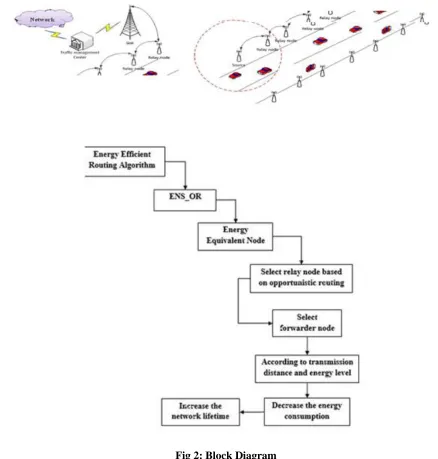
considered, and ultimately less delay multihop, results in low FIG 1: System Architecture power consumption. Another
approach, based on the total energy consumption for the two goals of optimization, ie the selection of the route
and aims to reduce the bit al-location. Geographic random forwarding (AfRSG), and efficient QoS-aware
geographic opportunistic routing (EQGOR), they take advantage of the broadcast nature of the wireless
medium, and to participate in the transmis-sion of packet transmission could hear that allow many residents.
1403 | P a g e
II.OPPORTUNISTICROUTINGMECHANI
SM:
WSN is relatively high in a number of sensor nodes, the data transmission starts between different numbers of
nodes, while also playing an important role in how they are deployed. It ensures proper coordination between
source and destination networks. In many cases, direct communication between the source and the destination is
not possible. Before the identification of candidate packets, the source node or the coordinator must choose the
best route between origin and destination. Method of Coordination (Zhong et al., 2006), to send packets from
one node to another candidate select the best relay node. To select the best node, and airtime costs are
considered, the present method of coordinating three main categories, namely, the token, the network is divided
into coding (ET Che-Jung al., 2011). In the following section, these three categories are discussed.
A.TIMER BASED:
Timer- based coordination methods (Rust et al., 2011) from the sensor to select the best relay node is used. The
first data packet is transmitted.
The node with the highest priority in the first slot re-sponds. If the answer is no, then the next highest priority
node responds in the next time slot. Month node priority result of response time slots and all high priority nodes
are not responding. Once a node responds when it is selected as the next relay packets to the destination it is the
same continuum. Based coordinate system-Timer is easy to implement and require no control package. The
main drawback of the candidate nodes, the waiting time is high and also the candidate to be included in the
packet header. The reaction of some other overhear lymph nodes can not be transmitted because duplicate.
B.TOKEN BASED
In this method (Che-Jung et al., 2011) coordination based on packet repetition time is the main drawback of the
method is absent. In the end, it comes down to the source, in this method, the tokens are generated in the
destination node (near fountain) low priority nodes (destination near) high priority nodes are passed. The only
candidate who can transmit symbol node packages. About which pack-ages have been received and have not
been received, the details (acknowledgment) tokens are included. The main advantage of this method is that no
duplicate transmissions. However, a large number of control packets to be exchanged. The source and
destination are close together when such coordination method can not be used in this way.
C.NETWORK CODING
Network coding is introduced (in 2011 by Jung et al.) Among nodes without overloading coordination
oppor-tunistically to avoid duplicate transmission. Here Intra-coding is integrated with the flow. What are sent by the
sender to encode and decode the packet is divided into lots. A lot packages called native packages are original
without programming. The sender of this by generating a linear combination encodes random current batch. The
en-coded packet is transmitted to the sender of the candidate nodes and finally reaches the destination. The
target for the current batch receives adequate linear combination only when encoded and decoded packets. The
1404 | P a g e
coordination. Wireless devices that has a high computational overhead, and will not be shown on network
encryption in real time.
D.PATH BASED FORWARDING
Or select main objectives of the SET forward protocol and how to assign priority for them is also included.
Set the path forward based forwarding method can be determined through. In order to find the best source
node to all nodes forwarder analyzing the distribution ratio is set. On a path method (Haitao et al., 2009)
source node and the next hop based on the average number of hops the probability dis-tribution ratio is
calculated. With the help of this analysis, the source node transmits packets of the default path.
FIG 3: Path based opportunistic packet forwarding
III.OPPORTUNISTIC ROUTING PROTO-COLS
In this section, xor, you opportunists any deviation from the route (DE) (Zhong et al., 2006), Mac-independent
Opportunistic Routing (more) different types of protocol opportunistic routing, color (conscious coding
opportu-nistic routing), ARQ Intra-Hybrid Based -cluster relay (precursor) is geographically aware discussed. Exor: (.
2009 Haitao et al) Exor is a combination of routing and MAC protocol and multi-hop wireless networks, such as
the protocol for transferring large increases unicast per-formance. Once a node has a packet to send transmits to
all nodes that are listening.
Exor has received the packet that is closest to the destina-tion among all active nodes determines which node.
MAC protocol also guarantees them a package only. Exor (San-jit and Robert, 2004) compared to the normal
traditional routing to reduce the number of transmissions to improve performance also takes advantage of the
broadcast. Des-tination (D) Schematic view of the method, the message can send it through multiple paths. This
1405 | P a g e
Fig 4: Illustration of opportunistic packet forwarding in ExOR
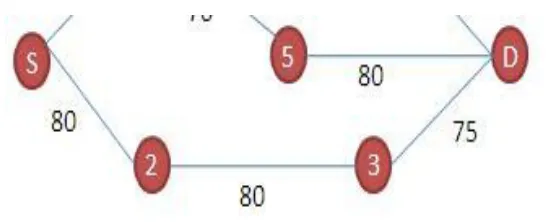
ETX values are calculated as the inverse of the distribu-tion ratio. 1, 2, 3, 4, 5 are intermediate nodes between
the source and destination. The source S wants to transmit packets to the destination node D ETX value shown
in Table 5, as a promoter of the next node 1 or node 2 can choose. 2 ETX value less than 1 (ie, the ratio of
superior delivery), but since it was selected as the destination for the next promoter. The transmission order of
S> node2-> node3-> D will be. Set, a promoter can be selected, from which the next hop for a particular sender
in forwarding candidates set. Next: A candidate next hop. The next al-bum will be determined by the carrier
package. Foreign ETX = 1 / ETX delivering value. Recognizing issue that will have the difficult task ahead of
them, they must send the packet nodes agree that it is guaranteed. MAC proto-col based on time intervals
priority node reserves gaps. A node hears a packet and if it is to carry forward the list to see if the checks. If so,
then the node assumes the sender is in the order of priority.
IV.OPPORTUNISTIC ANY PATH FOR-WARDING (OAPF)
OSPF (Zhang et al., 2006) instead of broadcast transmis-sions on the side to reduce the number of hops to select
some good hops. A metric used to determine the next hop candidate instead of ETX (any count expected path) is
EAX. In this protocol, a node in the calculation of the value of EAX, any possible link is considered to be
de-livering the next-hop paths. EAX also a candidate for delivery of packets between nodes to help determine the
contribution. Unlike the performance without affecting negatively Exor set forward to reduce the number of
can-didates because OAPF mainly used. EAX value packages for the distribution of aid to determine the
1406 | P a g e
As illustrated in Figure consider a network with five nodes. 5. A source (s) of the many paths through the
des-tination (D) wants to send a message. The network node protocol in at least the value of EAX is selected as the
next promoter. EAX values are calculated using the fol-lowing relationship:
Fig 5: Illustration of opportunistic packet forwarding in OAPF
The delivery ratios between various nodes are mentioned in the Fig. 5 and the value shows in Source (S) wants
to transmit the data to the destination. It has two next hop possibilities are A and C.S selects the next hop which
has the least EAX value and transmits the packet to C. Then C in turn transmits to D. Path: S->C->D. The data
packet is then transmitted to the node having the lower EAX value. This process continues till the data packet
reaches the des-tination. Thus during the data transmission using OAPF is more optimistic than EXOR or
traditional routing because while calculating the EAX value the probability of all the individual paths from a
particular sender to the destina-tion are considered. But the major drawback is that net-work state information
has to be maintained.
V.IMAC-INDEPENDENT OPPORTUNISTIC ROUTING (MORE)
Opportunistic routing uses the broadcast nature of wire-less networks is the best. A packet is sent to the
trans-mission destination via different paths to reach the des-tination is expected to double packages. This eliminates
most of encoding packets. Therefore the selection of the next hop node, a node does not need coordination. As
the name suggests, this protocol does not depend on the char-acteristics of the MAC layer. Schematic of this
method are shown in Fig. 6.
“A” two-component “D” has been sent. “A „B‟ B „and‟ C „for these packets. That is, one of the two packages, the node P2 cause” C “. Node” B “has received two packages. If B and C both approach uses more than coding,
code Package node B to D occur if P1 send packages and had already received from C to D sent as P1 + P2 may
1407 | P a g e
in a packet to be sent, the sender of the package in the current batch is a linear combination randomly coded
transmis-sions packages.
From the same batch are native AI packages “s node and disturbances is chosen by random coefficients “, where
package + C + ... + ANPN A2P2 A1P1 = coded. The code vector which includes sending packets for each data
pack-et is a header. The package code vector must be used by the receiver to decode the information. This
album closer (metric ETX) are themselves at their destination is a list of nodes it includes a list of freight. The
list of nodes with small ETX is such that a node has high priority. Lots of sending packets to the destination are
accepted as long as the batch packet transmission is coded.
This is the first batch of the packet received from the node that is independent of linear intermediate node, the
in-coming packet is said to be innovative. Innovative and non-innovative shopping package single intermediate
node discards the packet. This prevents duplicate packets are sent. The node has heard from the same batch and
transmitting coded packet is a random linear combina-tion. CJ C = Σj AJ “, as it is generated. Destination batch
after receiving new packet receiver node, using the IP (ie, native packet is received) decoded whole batch =” PI
and
CI is a package original, where “Σi Ai Ai -1 CI = vector i1 whose code is a coded packet ..,
AIK. As soon as the lot decoded destination is transferred to the next batch to allow you to send an
acknowledgment to the sender .Ex or some disadvantages such as the use of space under the coordination node
and more time con-suming. These issues and more are addressed. A multicast packet, the same package to be
sent too many nodes or even the Ex, have some problems with phase coordination node. This is overcome
1408 | P a g e
in MORE and it also reduces the number of re- transmis-sions by encoding the packets. MORE has less
computa-tion compared to the other protocols. It consumes more memory at nodes and it requires more
information (code vector) carried in the header of the packet finally leads to high system complexity. CAOR
(Coding Aware Oppor-tunistic Routing): CAOR (Yan et al., 2008) takes advan-tage of coding; the number of
transmissions and duplicate transmissions are further reduced than other techniques. In this routing both
network coding and opportunistic routing techniques are done. Forwarder set includes all the possible next hop
candidates. The conditions that need to be satisfied for forward set selections are, it should be a direct
neighboring node to the sender and it should be closer to the destination which may be calculated in terms of the
ETX and then all the nodes in the forwarder set should be able to hear each other. While sending a packet the
sender also includes the list of nodes in forwarder sets which are ranked based on their distances to the
desti-nation. In best forwarder selection, the main problem in CAOR (Lin et al., 2008) is in deciding which forwarder
has the maximum coding opportunities. A node is said to have more coding opportunities by the number of
packets it can send in a single transmission.
VI.CONCLUSION
I WSN consists mainly applied to route selection tech-nique used is based on the architecture and system
re-sources.WSN communications nodes or group between nodes, either communication patterns node.
And node communication group communication nodes may play an important role in the way. (. Zhong et al,
2006) uses the broadcast nature of opportunistic routing communication; Established selection optimistic and
have had good coordination between the other relay nodes. The optimistic path for data communication use.
Nodes based sensor system resources and increases the lifetime of the network that supports both distributed
and hierarchical WSN. For dynamic routing for WSN, flexible, reliable and provides an optimistic solution.
REFERENCES
1.Agnius, L., V. Arunas and K. Egidijus, 2010. A Survey of Wireless Sensor Network Interconnection to
External Networks. Springer Science, Business Media B.V., DOI: 10.1007/978-90-481-3662-9_7.
2.Chachulski, S., M. Jennings, S. Katti and D. Katabi, 2007. Trading structure for randomness in wireless
op-portunistic routing. Proceedings of the Conference on Ap-plications, Technologies, Architectures and Protocols
for Computer Communications, pp: 169-80.
3.Che-Jung, H., L. Huey-Ing and K.G. Winston, 2011. Opportunistic routing-A review and the challenges
ahead. Comp. Netw., 55(15): 3592-3603.
4.Haitao, L., Z. Baoxian, T. Hussein, S. Xiaojun and M. Jian, 2009. Opportunistic routing for wireless ad hoc
and sensor networks: Present and future directions. IEEE Commun. Mag., 47(12): 103-109.
5.Lin, Y., B. Li and B. Liang, 2008. Code OR: Opportu-nistic routing in wireless mesh networks with
segmented network coding. Proceedings of the IEEE International Conference on Network Protocols (ICNP).
1409 | P a g e
6.Luk, C.P., W.C. Lau and O.C. Yue, 2008. An analysis of opportunistic routing in wireless mesh network.
Proceed-ings of the IEEE International Conference on Communi-cations (ICC).
7.Beijing, China. Sanjit, B. and M. Robert, 2004. Op-portunistic routing in multi-hop wireless networks.
SIG-COMM Comput. Commun. Rev., 34(1): 69-74.
8.Yan, Y., Z. Baoxian, H.T. Mouftah and M. Jian, 2008. Practical coding-aware opportunistic routing
mechanism for wireless mesh networks. Proceeding of IEEE Interna-tional Conference on Communications, pp:
2871-2876.
9.Zhao, B., R.I. Seshadri and M.C. Valenti, 2004. Geo-graphic Random Forwarding with Hybrid-ARQ for ad
hoc networks with rapid sleep cycles. Proceeding of IEEE Military Communication Conference (GLOBECOM
„04), pp: 3047-3052.
10.Zhong, Z., J. Wang, S. Nelakuditi and L. Guor-Huar, 2006. On selection of candidates for opportunistic
any-path forwarding. ACM SIGMOBILE Mob. Comp. Com-mun. Rev., 10(4): 1-2.
11.Zorzi, M. and R.R. Rao, 2003. Geographic random forwarding (GeRaF) for ad hoc and sensor networks:
Multihop performance. IEEE T. Mobile Comput., 2(4): 337-348.
Madhavi Komatireddy M.Tech(CSE) from Swami Ramananda Tirtha Institute of Science
and Technology, JNTUH and B. Tech CSE from Swami Ramananda Tirtha Institute of
Science and Technology, JNTUH. She has more than 8 years of experience and guided UG
& PG students, currently she is working as Asst Prof at SRTIST Engineering College. Her
research areas include, Computer Networks, Cloud computing, Network Security, Software
Engineering.
Mysolla Shireesha M.Tech(CSE) from Swami Ramananda Tirtha Institute of Science and
Technology, JNTU B.Tech IT from Sri vishveshwaraiah institute Of Technology And
Science Engineering College. She has more than 8 years of experience has guided UG & PG
students, currently she is working as Asst Prof at SRTIST Engineering College. Her research
areas include Software Engineering, Computer Networks, Cloud computing, Design
Analysis of Algorithms, .
T.Madhu is working as a Associate Professor in Swami RamanandaTirtha Institute of