O R I G I N A L R E S E A R C H
Evaluation of Serum Level of FGF23 and
1,25(OH)
2
D
3
in Primary Hyperparathyroidism
Patients Before and After Parathyroidectomy
This article was published in the following Dove Press journal: International Journal of General Medicine
Solmaz Hassani1
Mozhgan Afkhamizadeh 1
Ali Teimouri 2
Mona Najaf Najafi 3
Leila Vazifeh Mostaan 4
Masoud Mohebbi 1
1Metabolic Syndrome Research Center,
Mashhad University of Medical Sciences, Mashhad, Iran;2Student Research
Committee, Mashhad University of Medical Sciences, Mashhad, Iran;3Clinical
Research Development Unit, Imam Reza Hospital, Mashhad University of Medical Sciences, Mashhad, Iran;4Cancer
Research Center, Mashhad University of Medical Sciences, Mashhad, Iran
Purpose:Parathyroid hormone (PTH) andfibroblast growth factor 23 (FGF23) play critical roles in phosphate homeostasis. To the best of our knowledge, there are limited data on the
impact of FGF23 and PTH on serum calcium, 1,25(OH)2D3, and phosphate in patients with
primary hyperparathyroidism (PHPT). We examined these parameters and their correlations in PHPT patients before and after parathyroidectomy (PTX).
Patients and Methods: In this prospective cohort study, 29 PHPT patients who met the
inclusion criteria were selected. The patient’s blood samples were taken three times: before
the operation, 24 h after the operation, and 1 week after the operation. The concentrations of
serum calcium, FGF23, 1,25(OH)2D3, phosphate, PTH, and alkaline phosphatase were
measured in a referral laboratory at each of the three steps. Moreover, 25(OH)D was primarily measured just before the surgery.
Results:Of 29 patients included in this study with a mean age of 52.37±12.3 years, majority
were females (75.8%). Serum FGF23 and 1,25(OH)2D3levels were high before PTX and
decreased after the operation; however, the difference was not statistically significant. FGF23
levels were significantly correlated with 1,25(OH)2D3at each of the three steps (r=0.964,
P <0.01; r=0.985, P <0.0; and r=0.976, P <0.05). The variations in calcium, phosphate,
creatinine, and PTH were preoperatively and postoperatively significant.
Conclusion:Although 1,25(OH)2D3and FGF23 levels were preoperatively higher in PHPT,
their variations were not meaningful. There was a statistically direct significant relationship
between 1,25(OH)2D3and FGF23 preoperatively and postoperatively; however, the
correla-tions between FGF23 and calcium, phosphate, and PTH were not significant.
Keywords:vitamin D, parathyroid glands, surgery, parathyroid hormone,fibroblast growth factor 23, endocrine disease
Introduction
The occurrence of hypercalcemia can mainly be attributed to primary hyperpar-athyroidism (PHPT)1as PHPT is characterized by hypercalcemia with an elevated or inappropriate parathyroid hormone (PTH) level.1The prevalence rate of PHPT is 0.1–1% with an incidence rate of 25–30 cases per 100.000 persons worldwide.1,2 PHPT appears in the early postmenopausal years more remarkably.1
About 80% of multiglandular and PHPT diseases are attributed to solitary benign adenoma. Moreover, 4-gland parathyroid hyperplasia accounts for about 15–20% of PHPT cases. Furthermore, parathyroid carcinoma is a rare factor leading to PTPH and accounts for about 1% of PHPT cases.3 Only 5–10% of all PHPT
Correspondence: Masoud Mohebbi Emam Reza Hospital, Mashhad 9137913316, Iran
Tel +98-9155123712 Fax +98-5138022370 Email [email protected]
International Journal of General Medicine
Dove
press
open access to scientific and medical research
Open Access Full Text Article
International Journal of General Medicine downloaded from https://www.dovepress.com/ by 118.70.13.36 on 27-Aug-2020
cases are heredity, and the other are caused by some mutations, including hyperparathyroid jaw-tumor syn-drome (HPT-JT), multiple endocrine neoplasia types 1, 2a, and 4 (MEN 1, MEN 2a, and MEN 4, respectively), neonatal severe primary hyperparathyroidism (NSHPT), familial isolated hyperparathyroidism (FIHP), and familial hypocalciuric hypercalcemia (FHH).1
There are risk factors (namely low physical activity, low calcium intake, hypertension, high body weight, lithium therapy, loop diuretic usage, and external radiation on neck), which are associated with developing PHPT.4–7 According to the clinical manifestations of PHPT, there are two types of PHPT: asymptomatic PHPT, and sympto-matic PHPT (accounting for a small portion of PHPH cases, <20%).8
The most frequently observed signs and symptoms in symptomatic PHPT are nephrolithiasis, decreased renal function, peptic ulcer disease, pancreatitis, fragility frac-tures, bone pain, skeletal deformities, osteitis fibrosa cystica (OFC), hyperreflexia, proximal muscle weakness, and mental status changes.1
Asymptomatic Hyperparathyroidism also arouses a large number of PHPT cases (>80%). This disorder is recognized with an elevation of serum calcium levels in biochemical evaluations.8 In this regard, parathyroidect-omy (PTX) is known as a treatment for PHPT.1
Fibroblast growth factor 23 (FGF23), mainly secreted by osteoblasts and osteocytes, controls phosphate hemos-tasis and vitamin D metabolism.9The role of FGF23 in the kidney is αKlotho-dependent.9 When FGF23 attaches to the fibroblast growth factor receptor (FGFR) at the prox-imal convoluted renal tubules, sodium-phosphate co-transport protein (NPt2a) is down-regulated, and 1a-hydroxylase enzyme is inhibited. Consequently, FGF23 suppresses phosphate reabsorption from urine and decreases the active metabolite of vitamin D (1,25(OH)2
D).10 At the distal convoluted renal tubules, FGF23 up-regulates the sodium-chloride co-transporter (NCC) and the epithelial calcium channel transient receptor potential vanilloid-5 (TRPV5), leading to an increase in the reab-sorption of sodium and calcium from urine.10
The regulation mechanism of FGF23 contains three main regulators, including 1,25(OH)2D, PTH, and
phosphate,11 the most important of which is 1,25(OH)2
D as it increases the secretion of FGF23.11 The function of phosphate levels in regulating FGF23 is unknown yet.11 According to some animal studies, phosphate increases FGF23 levels; however, FGF23 levels of high-phosphate
or low-phosphate diets were variable in human studies.11,12
Patients with PHPT displayed a high FGF23 level, while those with chronic kidney disease (CKD) under-going parathyroidectomy showed a decrease in FGF23 level. Accordingly, PTH may increase FGF23 level.13,14 In contrast, hypoparathyroidism patients showed an increase in FGF23 level despite the low concentrations of PTH.15 According to these controversial findings, the effects of PTH on FGF23 may depend on mineral status and vitamin D level.11
The present study aimed to evaluate the relationships between PTH, 1,25(OH)2D3, and FGF23 levels in PHPT
patients and the correlations between FGF23, calcium, and phosphate after PTX operation.
Patients and Methods
The present prospective cohort study was conducted from April 2018 to April 2019 on patients with PHPT com-plaints, who referred to Department of Endocrinology, Imam Reza Hospital, Mashhad, Iran.
With regard to the inclusion criteria of this study (ie, candidate for PTX), 29 patients with PHPT were evaluated. Afterward, the patients undergoing asymptomatic pri-mary hyperparathyroidism were selected based on the fol-lowing criteria: serum calcium levels 1 mg/dl above the upper limit of the normal range (>11.5 mg/dl), below 50 years old, glomerular filtration rate (eGFR) < 60 mL/min, a history of fracture fragility, and T-score <2.5 SD.16 The exclusion criteria were as follows: being unwilling to con-tinue the study, experiencing unsuccessful PTX, using Estrogen and Progestin, and taking vitamin D supplements.17 Factors such as serum phosphate, 1,25(OH)2D3, calcium
vitamin D, alkaline phosphatase (ALP), PTH, urea, creati-nine (Cr), FGF23, and 24-hour urine for calcium werefirst checked in the same laboratory. Furthermore, the patients’ serum phosphate, calcium, 1,25(OH)2D3, ALP, PTH, Cr, and
FGF23 were checked 24 hours and 7 days after PTX.
Sample Size
Considering the limited number of patients, all PHPT patients, who were candidates for PTX and referred to Department of Endocrinology, Imam Reza Hospital, Mashhad, Iran, were included in the study.
Ethical Considerations
After explaining the objectives of the study to the patients, they were asked to submit their written informed consent to
International Journal of General Medicine downloaded from https://www.dovepress.com/ by 118.70.13.36 on 27-Aug-2020
participate in the study. The patients’information remained confidential and was recorded in the form of codes.
This study was conducted following the Declaration of Helsinki and was approved by the vice-chancellor and ethics committee of research at Mashhad University of Medical Sciences (IR.MUMS.MEDICAL.REC.1398.069).
Statistical Analysis
The statistical Stata software (Release 12) was employed for the data analysis. In this study, P < 0.05 was considered as the significance level.
Descriptive statistics, including mean and standard deviation, were used to describe the data. Kolmogorov– Smirnov (K-S) test was used to compare a sample with a reference probability distribution. Moreover, the Pearson correlation coefficient and Spearman’s rank correlation coefficient were utilized to measure the rank correlation. Moreover, Friedman test was used to detect differences in the data before and after PTX. The means were also compared using Wilcoxon signed-rank test.
Results
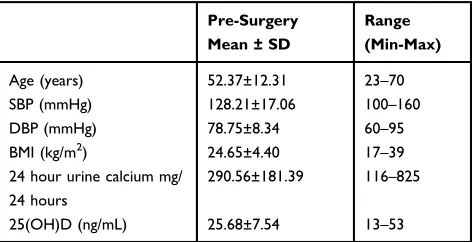
In this study, there were 29 patients who met the inclusion criteria. In terms of gender and age, there were seven males (24.14%) patients with the age range of 52.3±12.3 years, four patients (13.79%) with 24-hour urine for cal-cium >400 mg/24 hours, and 12 patients (41.38%) with a history of nephrolithiasis (Table 1).
All the patients underwent parathyroid MIBI scans and parathyroid ultrasonography. According to MIBI scan, 26 patients (89.65%) had an adenoma; however, with regard to parathyroid ultrasonography, 16 patients (55.17%) had an adenoma. According to the post-operation pathology report, 27 patients (93.10%) had an adenoma, one patient
(3.44%) had hypertrophic parathyroid, and one patient (3.44%) had reactivated follicular lymphadenopathy.
Moreover, six patients (20.68%) underwent bone mineral density (BMD) using dual-energy X-ray absorp-tiometry (DXA) at distal one-third radius, five patients (83%) showed osteoporosis, and one patient (17%) exhib-ited normal BMD.
Furthermore, 19 patients (65.51%) underwent BMD using DXA at both femoral and lumbar spines, among whom there were nine patients (47.36%) with osteoporosis at both sites, one patient (5.26%) with osteopenia at both sites, two patients (10.52%) with osteoporosis at femoral site and osteopenia at lumbar site, one patient (5.26%) with osteopenia at femoral site and osteoporosis at lumbar site, and four patients (21.05%) with normal BMD at both sites.
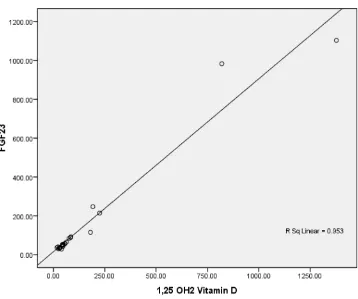
The correlation coefficients of FGF23 and 1,25(OH)2D3 were 0.962 before PTX with a p-value of
<0.0001, 0.951 and 0.962 a day and a week after PTX with the same p-value, respectively. As shown inTable 2, the results reveal a strong correlation between FGF23 and 1,25(OH)2D3 at pre-PTX, one day after PTX and one
week after PTX stages (p < 0.0001) (Figures 1–3). As presented inTable 2, the correlation coefficients of FGF23 and PTH, serum calcium levels, and PTH were significant in pre-PTX, a day after PTX, and a week after PTX stages (p> 0.05).
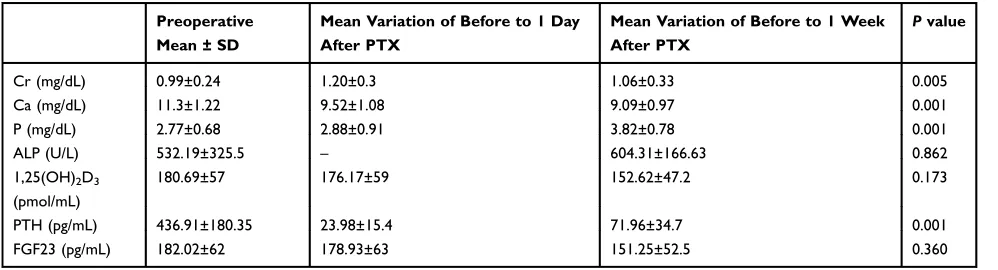
As expected and shown in Table 3, there were a statistically significant increase in phosphate levels and a statistically significant decrease in serum calcium levels after PTX (p< 0.05).
As shown inTable 3, thefluctuations of 1,25(OH)2D3,
FGF23, Cr, and ALP levels were not statistically signifi -cant (p> 0.05).
According toTable 3, the concentration of serum PTH before PTX was 436.91 pg/mL and decreased by 23.98 pg/ mL one day after PTX and raised once more by 71.96 pg/ mL one week after PTX. In this regard, the variations were significant (P=0.001).
Discussion
According to the findings of the present study, there is a statistically significant positive relationship between 1,25(OH)2D3and FGF23 preoperatively and postoperatively.
Using different methods and approaches, a large num-ber of studies have investigated the effect of PHPT on FGF23 levels. For example, Kobayashi et al studied the association between serum FGF23 levels in PHPT patients.18 In their study, FGF-23 significantly increased
Table 1Pre-Parathyroidectomy Characteristics of Patients with Primary Hyperparathyroidism
Pre-Surgery Mean ± SD
Range (Min-Max)
Age (years) 52.37±12.31 23–70
SBP (mmHg) 128.21±17.06 100–160
DBP (mmHg) 78.75±8.34 60–95
BMI (kg/m2) 24.65±4.40 17–39
24 hour urine calcium mg/ 24 hours
290.56±181.39 116–825
25(OH)D (ng/mL) 25.68±7.54 13–53
Abbreviations:SD, standard deviation; SBP, systolic blood pressure; DBP, diastolic blood pressure; BMI, body mass index.
International Journal of General Medicine downloaded from https://www.dovepress.com/ by 118.70.13.36 on 27-Aug-2020
in PHPT patients, in comparison to 18 PTX patients and the control group; however, postoperative FGF-23 levels declined significantly, in comparison to the preoperative levels.18 In the present study, post-PTX FGF-23 levels declined in comparison to pre-PTX; however, the varia-tions were not statistically significant.
Witteveen et al investigated the relationship between FGF23 and PTH in PHPT patients and the euparathyroid patients undergoing successful PTX. They found out that FGF23 was considerably higher in PHPT patients, com-pared to the euparathyroid patients. Moreover, a significant
relationship between PTH and FGF23 levels was also reported in their study.9
Yamashita et al noticed a significantly higher plasma FGF23 level in the PHPT patients, compared to the control group. They observed no variation in post-PTX FGF23 levels, while the calcium levels were normalized.19
They observed a positive correlation of FGF23 with PTH and serum calcium and a negative correlation of FGF23 with 1,25(OH)2D3.19 Unlike the study of
Yamashita et al, in our study, FGF23 correlated positively with 1,25(OH)2D3.
Table 2Correlation Between FGF23 and Other Variables at Preoperative and Postoperative Stages
Preoperative A Day After PTX A Week After PTX
Correlation Coefficient
Pvalue Correlation Coefficient
Pvalue Correlation Coefficient
Pvalue
1,25(OH)2D3(pmol/mL) 0.962 0.001 0.951 0.001 0.962 0.001
PTH (pg/mL) 0.203 0.299 −0.160 0.406 0.203 0.299
Ca (mg/dL) 0.173 0.379 0.220 0.251 0.173 0.379
P (mg/dL) −0.325 0.09 −0.14 0.470 −0.325 0.09
Cr (mg/dL) −0.129 0.512 −0.045 0.816 −0.129 0.512
Notes:The results of Spearman correlation (p-value) are presented.
Abbreviations:PTX, parathyroidectomy; PTH, parathyroid hormone; Ca, calcium; P, phosphate; Cr, creatinine.
Figure 1Correlation between serum FGF23 and 1,25(OH)2D3levels before parathyroidectomy.
International Journal of General Medicine downloaded from https://www.dovepress.com/ by 118.70.13.36 on 27-Aug-2020
Figure 2Correlation between serum FGF23 and 1,25(OH)2D3levels a day after parathyroidectomy.
Figure 3Correlation between serum FGF23 and 1,25(OH)2D3levels a week after parathyroidectomy.
International Journal of General Medicine downloaded from https://www.dovepress.com/ by 118.70.13.36 on 27-Aug-2020
Tebben et al found the similarity between FGF23 levels one day and six weeks after PTX and reported no signifi -cant correlation between FGF23 levels and serum calcium, phosphate, 25(OH)2D, and PTH levels in the post-PTX
and pre-PTX stages.20
This study has potential limitations include, absence of healthy patients as a control group, the insufficient sample size due to the rarity of PHPT disease, and a short follow up period.
Conclusion
According to the findings, although 1,25(OH)2D3 and
FGF23 levels were preoperatively higher in PHPT, their variations were not statistically significant. Moreover, there was a positive and significant correlation between 1,25(OH)2D3 and FGF23 preoperatively and
postopera-tively. The correlations between FGF23 and calcium, phosphate, and PTH were not significant; however, the variations of these parameters were significant.
Acknowledgments
This research was funded by the Mashhad University of Medical Sciences (MUMS).
Disclosure
The authors report no conflicts of interest in this work.
References
1. Silva BC, Cusano NE, Bilezikian JP. Primary hyperparathyroidism. Best Pract Res Clin Endocrinol Metab. 2018;32(5):593–607. doi:10.1016/j.beem.2018.09.004
2. Madkhali T, Alhefdhi A, Chen H, Elfenbein D. Primary hyperparathyroidism. Ulus Cerrahi Derg. 2016;32(1):58–66. doi:10.5152/UCD.2015.3032
3. Khan AA, Hanley DA, Rizzoli R, et al. Primary hyperparathyroid-ism: review and recommendations on evaluation, diagnosis, and management. A Canadian and international consensus. Osteoporos Int.2017;28(1):1–19. doi:10.1007/s00198-016-3716-2
4. Paik JM, Curhan GC, Taylor EN. Calcium intake and risk of primary hyperparathyroidism in women: prospective cohort study. BMJ.
2012;345:e6390. doi:10.1136/bmj.e6390
5. Boehm BO, Rosinger S, Belyi D, Dietrich JW. The parathyroid as a target for radiation damage.N Engl J Med.2011;365(7):676–678. doi:10.1056/NEJMc1104982
6. Vaidya A, Curhan GC, Paik JM, Kronenberg H, Taylor EN. Hypertension, antihypertensive medications, and risk of incident pri-mary hyperparathyroidism. J Clin Endocrinol Metab. 2015;100 (6):2396–2404. doi:10.1210/jc.2015-1619
7. Szalat A, Mazeh H, Freund HR. Lithium-associated hyperparathyr-oidism: report of four cases and review of the literature. Eur J Endocrinol.2009;160(2):317–323. doi:10.1530/EJE-08-0620 8. Suliburk JW, Perrier ND. Primary hyperparathyroidism.Oncologist.
2007;12(6):644–653. doi:10.1634/theoncologist.12-6-644
9. Witteveen JE, van Lierop AH, Papapoulos SE, Hamdy NAT. Increased circulating levels of FGF23: an adaptive response in pri-mary hyperparathyroidism? Eur J Endocrinol. 2012;166(1):55–60. doi:10.1530/EJE-11-0523
10. Erben RG. Physiological actions offibroblast growth factor-23.Front Endocrinol (Lausanne).2018;9:267. doi:10.3389/fendo.2018.00267 11. Martin A, David V, Quarles LD. Regulation and function of the
FGF23/klotho endocrine pathways. Physiol Rev. 2012;92 (1):131–155. doi:10.1152/physrev.00002.2011
12. Perwad F, Azam N, Zhang MYH, Yamashita T, Tenenhouse HS, Portale AA. Dietary and serum phosphorus regulatefibroblast growth factor 23 expression and 1,25-dihydroxyvitamin D metabolism in mice. Endocrinology.2005;146(12):5358–5364. doi:10.1210/en.2005-0777 13. Sato T, Tominaga Y, Ueki T, et al. Total parathyroidectomy reduces
elevated circulatingfibroblast growth factor 23 in advanced second-ary hyperparathyroidism. Am J Kidney Dis. 2004;44(3):481–487. doi:10.1016/S0272-6386(04)00817-0
14. Kawata T, Imanishi Y, Kobayashi K, et al. Parathyroid hormone regulates fibroblast growth factor-23 in a mouse model of primary hyperparathyroidism. J Am Soc Nephrol. 2007;18(10):2683–2688. doi:10.1681/ASN.2006070783
15. Gupta A, Winer K, Econs MJ, Marx SJ, Collins MT. FGF-23 is elevated by chronic hyperphosphatemia.J Clin Endocrinol Metab.
2004;89(9):4489–4492. doi:10.1210/jc.2004-0724
16. McDow AD, Sippel RS. Should symptoms be considered an indica-tion for parathyroidectomy in primary hyperparathyroidism? Clin Med Insights Endocrinol Diabetes. 2018;11:1179551418785135. doi:10.1177/1179551418785135
Table 3Variations After Parathyroidectomy
Preoperative Mean ± SD
Mean Variation of Before to 1 Day After PTX
Mean Variation of Before to 1 Week After PTX
Pvalue
Cr (mg/dL) 0.99±0.24 1.20±0.3 1.06±0.33 0.005
Ca (mg/dL) 11.3±1.22 9.52±1.08 9.09±0.97 0.001
P (mg/dL) 2.77±0.68 2.88±0.91 3.82±0.78 0.001
ALP (U/L) 532.19±325.5 – 604.31±166.63 0.862
1,25(OH)2D3
(pmol/mL)
180.69±57 176.17±59 152.62±47.2 0.173
PTH (pg/mL) 436.91±180.35 23.98±15.4 71.96±34.7 0.001
FGF23 (pg/mL) 182.02±62 178.93±63 151.25±52.5 0.360
Notes:Friedman test and Wilcoxon signed-rank tests were used to compare means (P-value).
Abbreviations:SD, standard deviation; PTX, parathyroidectomy; Cr, creatinine; Ca, calcium; P, phosphate; ALP, alkaline phosphatase; PTH, parathyroid hormone; FGF23, fibroblast growth factor 23.
International Journal of General Medicine downloaded from https://www.dovepress.com/ by 118.70.13.36 on 27-Aug-2020
17. Ix JH, Chonchol M, Laughlin GA, Shlipak MG, Whooley MA. Relation of sex and estrogen therapy to serum fibroblast growth factor 23, serum phosphorus, and urine phosphorus: the heart and soul study.Am J Kidney Dis. 2011;58(5):737–745. doi:10.1053/j. ajkd.2011.06.011
18. Kobayashi K, Imanishi Y, Miyauchi A, et al. Regulation of plasma
fibroblast growth factor 23 by calcium in primary hyperparathyroidism. Eur J Endocrinol. 2006;154(1):93–99. doi:10.1530/eje.1.02053
19. Yamashita H, Yamashita T, Miyamoto M, et al. Fibroblast growth factor (FGF)-23 in patients with primary hyperparathyroidism.Eur J Endocrinol.2004;151(1):55–60. doi:10.1530/eje.0.1510055 20. Tebben PJ, Singh RJ, Clarke BL, Kumar R. Fibroblast growth factor
23, parathyroid hormone, and 1alpha,25-dihydroxyvitamin D in sur-gically treated primary hyperparathyroidism. Mayo Clin Proc.
2004;79(12):1508–1513. doi:10.4065/79.12.1508
International Journal of General Medicine
Dove
press
Publish your work in this journal
The International Journal of General Medicine is an international, peer-reviewed open-access journal that focuses on general and internal medicine, pathogenesis, epidemiology, diagnosis, moni-toring and treatment protocols. The journal is characterized by the rapid reporting of reviews, original research and clinical studies
across all disease areas. The manuscript management system is completely online and includes a very quick and fair peer-review system, which is all easy to use. Visit http://www.dovepress.com/ testimonials.php to read real quotes from published authors.
Submit your manuscript here:https://www.dovepress.com/international-journal-of-general-medicine-journal
International Journal of General Medicine downloaded from https://www.dovepress.com/ by 118.70.13.36 on 27-Aug-2020