INVOLVEMENT OF A MESOCORTICOLIMBIC SUBCIRCUIT IN THE REINSTATEMENT OF DRUG CONTEXT-INDUCED COCAINE-SEEKING
BEHAVIOR IN RATS
Heather Celine Lasseter
A dissertation submitted to the faculty of the University of North Carolina at Chapel Hill in partial fulfillment of the requirements for the degree of Doctor of Philosophy in the
Department of Psychology (Behavioral Neuroscience).
Chapel Hill 2011
Approved By:
Advisor: Rita A. Fuchs Lokensgard, Ph.D.
ii ABSTRACT
HEATHER C. LASSETER: Involvement of a mesocorticolimbic subcircuit in the reinstatement of drug context-induced cocaine-seeking behavior in rats
(Under the direction of Rita A. Fuchs Lokensgard)
The orbitofrontal cortex (OFC) and basolateral amygdala (BLA) control the ability of cocaine-paired environmental contexts to elicit relapse in addicts and cocaine-seeking behavior in laboratory animals. Whether these brain regions interact within a single neural circuitry or work independently to control this behavior remains to be ascertained. Given that extensive anatomical connections exist between the OFC and BLA, it was postulated that serial information processing occurs between these brain regions. To test this hypothesis, Experiment 1 utilized a functional disconnection procedure to disrupt communication between the OFC and BLA. Rats received microinfusions of the
GABAA/B agonists, baclofen+muscimol (BM) or vehicle (VEH) unilaterally into the OFC plus the contralateral or ipsilateral BLA immediately before tests for cocaine-seeking behavior (responding on a previously cocaine-paired lever) in the cocaine-paired context or an alternate context (extinction context). Exposure to the previously cocaine-paired context, but not the extinction context, reinstated extinguished cocaine-seeking behavior. BM treatment in the OFC plus the contralateral or ipsilateral BLA attenuated this
iii
antagonist, SCH23390, or VEH was administered bilaterally into the OFC before testing. Intra-OFC SCH23390 treatment dose-dependently attenuated drug context-induced cocaine seeking relative to VEH, implicating dopamine D1 receptors in drug context-induced motivation for cocaine. The ventral tegmental area (VTA) provides the sole source of dopamine to the OFC. Therefore, Experiment 3 assessed whether dopamine input from the VTA to the OFC critically regulates interactions between the OFC and BLA. SCH23390 or VEH was administered unilaterally into the OFC plus BM or VEH into the contralateral or ipsilateral BLA before testing. The SCH23390/BM manipulation attenuated drug context-induced cocaine seeking relative to VEH. Together, these
iv
ACKNOWLEDGEMENTS
First and foremost, I would like to express immense gratitude to my adviser, Dr. Rita Fuchs Lokensgard, for providing invaluable help and guidance throughout my graduate training at UNC. Her encouragement, words of wisdom, and careful readings of my manuscripts have enabled me to become a better scientist, more critical thinker, and a stronger writer. I would also like to thank the additional members of my doctoral dissertation committee, Dr. Regina Carelli, Dr. Andrea Hussong, Dr. Don Lysle, and Dr. Todd Thiele, for their excellent advice and insight on this project.
The past and present members of Dr. Fuchs’ lab – Dr. Amy Arguello, Dr. Donna Ramirez, Dr. Xiaohu (Tiger) Xie, Audrey Wells, Jessica Eaddy, Shelly Su, Trey
Newsome, and Andrew Reittinger – provided exceptional technical assistance as well as strong intellectual guidance and moral support. I feel especially indebted to Audrey and Tiger whose constant encouragement and generous help never went unnoticed.
v
TABLE OF CONTENTS
Page
LIST OF TABLES………...viii
LIST OF FIGURES…….…………...………..………..ix
LIST OF ILLUSTRATIONS………..xi
LIST OF ABBREVIATIONS……….………..……...…..………xii
CHAPTER 1 I. GENERAL INTRODUCTION………...…..…………..……….1
1.1 Background and Significance of the Problem ……….……….1
1.2 Animal Models of Cocaine Addiction and Relapse……….….…….2
1.3 Evaluation of the Contextual Extinction-Reinstatement Model..………..4
1.4 Anatomical Connectivity of the OFC and BLA………...6
1.5 Involvement of the OFC and BLA in Drug Addiction…...……...…….…….7
1.6 Interactions between the OFC and BLA in Reward-related Behaviors...9
1.7 Contribution of Mesocorticolimbic Dopaminergic Neurotransmission to Reward-related Behaviors………..………..…………11
1.8 Overview of the Experiments…………...……….………13
vi
2.1 Introduction…..………..……….…...…15
2.2 Methods……….………...……….…….17
2.3 Results…………...……….……….……...24
2.4 Discussion………...……….……….……….30
III. DOPAMINE D1-LIKE RECEPTOR SIMULATION IN THE ORBITOFRONTAL CORTEX IS CRITICAL FOR DRUG CONTEXT-INDUCED COCAINE-SEEKING BEHAVIOR...……….42
3.1 Introduction……….………...…42
3.2 Methods………...…….……..……….………...44
3.3 Results…….………...……….………...52
3.4 Discussion………..……….………...58
IV. A MESOCORTICOLIMBIC CIRCUITRY CONSISTING OF THE VENTRAL TEGMENTAL AREA, ORBITOFRONTAL CORTEX, AND BASOLATERAL AMYGALA REGULATES THE MOTIVATIONAL EFFECTS OF A DRUG-PAIRED CONTEXT ON COCAINE-SEEKING BEHAVIOR……….69
4.1 Introduction………...………..……….………69
4.2 Methods.….…….………...………...………..……….……..…72
4.3 Results……….………….…..…78
4.4 Discussion……….……….81
V. GENERAL DISCUSSION……….……….………..94
5.1 Summary of Experimental Findings……….……….………..94
5.2 Effects of Dopamine Receptor Stimulation in the OFC.………..…….…97
vii
5.4 Contribution of a Corticomesal Projection to Drug
Context-induced Cocaine-Seeking Behaviors……….101 5.5 Contribution of BLA Dopamine Afferents to Drug
Context-induced Cocaine-Seeking Behavior………..……….…………103 5.6 The Emerging Mesocorticolimbic Neural Circuitry of
Drug Context-induced Cocaine-seeking Behavior………..………105 5.7 Neuroadaptations in the Drug Context-induced Relapse
Circuitry………..….108
5.8 Conclusions………..112
viii
LIST OF TABLES Table
ix
LIST OF FIGURES Figure
2.1 Schematic representation of the timeline for the drug context-induced reinstatement experiments and
food-maintained instrumental experiments………36 2.2 Schematic representation of the functional disconnection
procedure………37 2.3 Schematic and photographic representation of injection
cannula placements………..………..38 2.4 Bilateral inhibition of intrahemispheric or interhemispheric
connections between the OFC and BLA similarly attenuate drug context-induced reinstatement of cocaine-seeking
behavior……...…..39 2.5 Bilateral inhibition of intrahemispheric or interhemispheric
connections between the OFC and BLA does not alter general
motor activity……...…..40 2.6 Bilateral inhibition of intrahemispheric or interhemispheric
connections between the OFC and BLA fails to alter
food-reinforced instrumental behavior ...………41 3.1 Schematic representation of the timeline for the drug
context-induced reinstatement experiments and
food-maintained instrumental experiments……….………..64 3.2 Schematic and photographic representation of injection
cannula placements.…………..……….65 3.3 SCH23390 administration dose-dependently attenuates
drug context-induced reinstatement of cocaine-seeking behavior when administered bilaterally into the OFC but
not the overlying MC anatomical control brain region……….……...…..66 3.4 SCH23390 administration into the OFC does not alter
general motor activity………...……….67 3.5 SCH23390 administration into the OFC does not alter
x
context-induced reinstatement experiment………..….….……….…...…90 4.2 Schematic representation of the modified functional
disconnection procedure ……….….….…..…...…...91 4.3 Schematic and photographic representation of injection
cannula placements.……….……….…….………92 .
4.4 Bilateral disruption of intrahemispheric or interhemispheric communication within a VTA-OFC-BLA circuit similarly
xi
LIST OF ILLUSTRATIONS Illustration
1. Potential Interactions within the VTA-OFC-BLA Neural
Circuit……….…...…87 2. Potential Interactions by the VTA-OFC-BLA Neural Circuit with
the NA and MDT………...88 3. Potential contribution of 5-HT2c Receptor-mediated Signaling
to Drug Context-induced Cocaine-seeking Behavior………99 4. Potential contribution of a Corticomesal Projection to Drug
Context-induced Cocaine-seeking Behavior…………..………..101 5. Potential contribution of a Mesolimbic Projection to Drug
Context-induced Cocaine-seeking Behavior………....103 6. Emerging Neural Circuitry Underlying Drug Context-induced
xii
LIST OF ABBREVIATIONS
5-HT2c serotonin receptor 2c ANOVA analysis of variance AP anterior-posterior BLA basolateral amygdala BM baclofen+muscimol COC CTX cocaine-paired context CS conditioned stimuli DA dopamine
DH dorsal hippocampus
dlCPu dorsal lateral caudate putamen DV dorsal-ventral
EXT CTX extinction context FR1 fixed ratio 1
GABA gamma-aminobutyric acid i.p. intraperitoneal
i.v. intravenous
LH lateral hypothalamus LS lateral septum
MC primary and secondary motor cortices MDT mediodorsal thalamus
xiii NMDA N-methyl-D-aspartic acid OFC orbitofrontal cortex PFC prefrontal cortex
SEM standard error of the mean VEH vehicle
CHAPTER 1
GENERAL INTRODUCTION Background and Significance of the Problem
Cocaine addiction remains a prominent public health and social issue in the United States, with approximately 22.3 million people classified as having substance abuse or dependence problems according to the 2007 National Survey on Drug Use and Health (NIDA). Although dependence on alcohol accounted for the vast majority of such problems, cocaine represented the second most abused illicit drug, with 1.6 million individuals classified as abusing or being dependent on cocaine. In this same year, 808,000 individuals – including both current and former cocaine users – reported receiving treatment for cocaine abuse and dependence from hospitals, rehabilitation centers, and mental health centers. However, only 2.4 million out of the 6.9 million people specified as needing treatment for illicit drug use actually obtained medical or social support from such specialty treatment facilities (Substance Abuse and Mental Health Service Administration 2009). In addition to the adverse health consequences of cocaine abuse, cocaine addiction affects non-users by contributing to the high economic cost of addiction incurred by the United States each year, a figure approaching $193 billion dollars (National Drug Intelligence Center 2011).
2
observed in former drug users, even after individuals have completed detoxification and rehabilitation programs. Remarkably, relapsing persists even when individuals
experience diminished drug-induced euphoria, are faced with adverse consequences (i.e., health risks, incarceration, and family problems), or express a desire to cease drug-taking activities (Volkow and Fowler, 2000). Chronic drug users typically develop an inability to control drug seeking, which becomes compulsive or impulsive in nature (American Psychiatric Association, 1994). Evidence suggests that the transition from recreational drug use to drug addiction may be related to either neural sensitivity predisposing one to drug addiction or neural plasticity resulting from prolonged drug exposure and/or drug-related learning experiences (Franklin et al., 2002; Volkow et al., 2002).
Importantly, re-exposure to environmental contexts in which cocaine use
previously occurred can produce powerful drug craving and seeking, thereby potentiating relapse in abstinent drug users (O'Brien et al., 1992; Childress et al., 1993; Foltin and Haney, 2000; Rohsenow et al., 2000; Franklin et al., 2009) and facilitating the
3
Animal Models of Cocaine Addiction and Relapse
The development of preclinical animal models of addiction has been informed by the understanding that relapse to drug taking is facilitated by a form of Pavlovian
conditioning in cocaine users. Over the course of chronic drug use, both discrete, response-contingent cues (i.e. drug-taking paraphernalia) and contextual stimuli (i.e. environments in which drug use typically occurred) are repeatedly paired with the rewarding effects of the drug. These cues can subsequently acquire conditioned rewarding, conditioned reinforcing, and/or incentive motivational properties through associative learning properties that are based on the temporal relationship and
contingency between the presentation of these stimuli and the delivery of the primary reward. In laboratory animals, conditioned rewarding and conditioned reinforcing properties are demonstrated, respectively, by either an attraction to the drug-paired stimuli (i.e. approach or orienting towards the stimulus) or the ability of stimulus
presentations to maintain instrumental responding (Newlin, 1992). Conversely, incentive
motivation for drug is thought to manifest as an increase in instrumental responding in
order to obtain drug, even when the primary reinforcer is not delivered (Markou et al., 1993). Because re-exposure to drug-associated environmental contexts can precipitate relapse in humans by eliciting powerful drug-craving and drug-seeking behaviors, several
in vivo animal models have been developed to assess the neural mechanisms by which
conditioned stimuli elicit cocaine-seeking behavior.
4
intravenous cocaine reinforcement in an operant conditioning chamber where drug infusions are either explicitly paired with the presentation of a response-contingent conditioned stimulus (CS) or they are administered while the animal is passively exposed to a distinct environmental context (drug-paired context). As a result, these stimuli acquire the ability to elicit cocaine-seeking behavior even in the absence of drug
reinforcement (Fuchs et al. 2005; Crombag et al. 2008). After animals reach an arbitrary acquisition criterion, responding is extinguished either in the absence of the response-contingent CS or in an environmental context (extinction context) that is distinctly different from the drug-paired context. During extinction training, instrumental
responses are not reinforced with cocaine infusions, and this typically results in a rapid decline in lever responding. Once responding has declined to a preset, arbitrary
extinction criterion, animals are given reinstatement test sessions. These test sessions consist of re-exposure to either the cocaine-paired context or the response-contingent CS in the absence of cocaine reinforcement. During the test, the increase, or reinstatement, of responding is thought to reflect the ability of the context or CS to produce motivation to seek cocaine.
Evaluation of the Contextual Extinction-Reinstatement Model
Both the CS-based and context-based extinction-reinstatement models have excellent translational value for examining the neural underpinnings of human drug addiction. These paradigms possess strong face and predictive validity as models of cue-induced drug relapse because, similar to humans, the animals control cocaine
5
reinstatement model confers distinct advantages over the CS-based extinction-reinstatement model. First, in the contextual model, subjects are passively exposed to the cocaine-paired contextual cues, which results in uniform cue exposure across subjects during training and reinstatement testing. Second, passive cue presentation mirrors the human condition in that relapse to drug taking is typically precipitated by inadvertent exposure to cocaine-paired cues. Third, responding during the reinstatement test session provides an index of drug context-induced incentive motivation for the drug rather than
conditioned reinforcement (i.e. where responding for cue presentation is the end goal)
given the lack of an explicit, response-contingent cue (Fuchs et al., 2008b). However, it is difficult to ascertain whether the context acts as an occasion setter that predicts the reinforcement of instrumental responses or as a weakly associated Pavlovian CS (Crombag et al., 2008).
6
may underlie drug seeking following extinction training versus drug-free abstinence periods given that extinction training is an active learning process that induces
neuroplasticity (Self and Nestler 1998; Self et al. 2004). However, it should be noted that some extinction experience may be accrued by abstinent drug users whenever cocaine is not available despite the presence of drug-related conditioned stimuli. Moreover, extinction training is necessary to isolate the influence of the cocaine-paired context on instrumental responding and disambiguate it from other factors that contribute to drug seeking, such as stress. Thus, while there are some limitations to the extinction-reinstatement model, it remains a powerful tool for exploring the neurobiological
mechanisms of cue-induced drug relapse, a research endeavor that may prove critical for developing effective anti-relapse pharmacotherapies.
Anatomical Connectivity of the OFC and BLA
The OFC and BLA represent integral parts of the mesocorticolimbic neural circuitry that directs context-induced cocaine-seeking behavior in animal models of drug relapse (Neisewander et al., 2000; Kantak et al., 2002; Fuchs et al., 2005; Crombag et al., 2008; Fuchs et al., 2008b; Zavala et al., 2008; Lasseter et al., 2009; Mashhoon et al., 2010). Both the OFC and BLA receive integrated multi-sensory input from higher level sensory cortices and share direct and indirect (i.e. via the thalamus) outputs to several key elements of the neural circuitry proposed to mediate drug context-induced
7
Price, 1992; Brog et al., 1993; Haber et al., 1995; O'Donnell and Grace, 1995; Groenewegen et al., 1996; Pikkarainen et al., 1999; Bossert et al., 2004; Fuchs et al., 2005; Bossert et al., 2007). Most notably, the OFC and BLA share robust reciprocal projections, which provide for significant information sharing between these brain regions (Kretek and Price, 1977). Based on this pattern of anatomical connectivity, both the OFC and BLA are well-positioned to integrate and process information from sensory regions in order to generate outcome expectancies that guide behavioral responses, including drug context-induced cocaine seeking (Price, 1986; Carmichael and Price, 1995b; Carmichael and Price, 1995a; McDannald et al., 2004). In addition, dopaminergic projections from the VTA to areas of the mesocorticolimbic neural circuitry may
contribute to the ability of drug-paired cues to elicit drug-seeking behavior (Kiyatkin et al., 1993; Martin-Fardon et al., 2000). In particular, the VTA sends dense,
topographically organized projections to cortical layers V and VI of the OFC that contain the densest population of dopamine D1-like receptors (Berger et al., 1991; Dunnett and Robbins, 1992; Frankle et al., 2006; Reynolds et al., 2006; Sesack and Grace, 2010). Thus, intra-OFC dopamine signaling may regulate interactions between the OFC and BLA that direct drug context-induced cocaine seeking.
Involvement of the OFC and BLA in Drug Addiction
8
positively correlated with self-reports of cocaine craving (Grant et al., 1996; Childress et al., 1999; London et al., 1999; Duncan et al., 2007). Similarly, in cocaine-experienced rats, re-exposure to a cocaine-paired context elicits enhanced expression of the activity-dependent immediate-early genes (IEGs) c-fos, zif-268, BDNF, and arc in the OFC and BLA, relative to IEG expression observed in yoked controls exposed to a saline-paired context or cocaine-experienced rats exposed to a non-drug saline-paired context (Neisewander et al., 2000; Hamlin et al., 2008; Hearing et al., 2008b; Hearing et al., 2008a). Furthermore, temporary bilateral functional inactivation of the OFC or BLA prevents drug-paired conditioned cues or environmental contexts from eliciting the reinstatement of cocaine-seeking behavior (See et al., 2001a; Kantak et al., 2002; McLaughlin and See, 2003; See et al., 2003; Fuchs et al., 2004; Fuchs et al., 2005; Lasseter et al., 2009).
In human cocaine users, addictive behaviors may either prompt or be facilitated by structural, physiological, and functional abnormalities in the frontal cortex. Cocaine users typically display abnormalities in frontal cortical regions, including decreased gray matter density in the OFC and anterior cingulate as well as diminished baseline blood glucose metabolism in the frontal cortex, which can be proportional to drug use (Volkow et al., 1991; Volkow and Fowler, 2000; Bolla et al., 2003b; Matochik et al., 2003a). Consistent with the idea that hypofrontality either predisposes one to cocaine addiction or results from chronic cocaine use, OFC damage in drug-naïve individuals produces
behavioral impairments similar to those observed in cocaine addicts, including
9
either the OFC or BLA produces compulsive drug context-induced cocaine-seeking behaviors in animal models of drug relapse. Prolonged loss of output from the OFC caused by fiber-sparing NMDA lesions enhances drug context-induced cocaine-seeking behavior (Lasseter et al., 2009). Similarly, BLA lesions increase motivation for cocaine following exposure to non-contingent presentations of a previously cocaine-paired CS and produce enduring deficits in response inhibition under extinction conditions (Fuchs and See, 2002). In summary, the OFC and BLA critically contribute to maintaining and updating the motivational representation of drug-paired environmental stimuli.
Therefore, exploring how the OFC and BLA interact to regulate drug craving and drug seeking is important for enhancing our understanding of relapse behaviors.
Interactions Between the OFC and BLA in Reward-related Behaviors
Converging lines of evidence suggest that interactions between the OFC and BLA may be critical for mediating goal-directed behaviors. As noted above, the OFC and BLA share dense, topographically-organized intrahemispheric and interhemispheric anatomical projections (Krettek and Price, 1977a; McDonald, 1991; Carmichael and Price, 1995a; Ghashghaei and Barbas, 2002). In addition to monosynaptic connections, information between the OFC and BLA can also be relayed through the mediodorsal thalamus (MDT), which provides an anatomical substrate for extensive functional interactions between the OFC and BLA (Demeter et al., 1990; Cavada et al., 2000; Ghashghaei and Barbas, 2002; Macey et al., 2003; Miyashita et al., 2007). Interestingly, amygdalocortical and amygdalothalamic pathways to the OFC involve distinct
10
pathways may convey functionally distinct information (McDonald, 1991; Macey et al., 2003; Miyashita et al., 2007).
In accordance with this anatomical evidence, behavioral studies indicate that interactions between the OFC and are critical for processing the incentive motivational properties of reward-predictive cues and then using this information to guide behavioral responding. Monkeys with unilateral lesions of the OFC plus the contralateral BLA, which functionally disconnect these brain regions, are unable to update their behavioral responses when the motivational value of reward-predictive cues changes (Baxter et al., 2000; Izquierdo et al., 2004). Similarly, crossed neural inactivation of the OFC plus the contralateral BLA in rats produces inflexible behavioral responding on an odor reversal task (Churchwell et al., 2009). While electrophysiological studies have confirmed that intrahemispheric interactions between the OFC and BLA promote behavioral flexibility during reward reversal tasks, putative interhemispheric interactions have not been
similarly explored (Saddoris et al., 2005). Interestingly, however, contralateral OFC plus BLA lesions - which disrupt intrahemispheric interactions between these brain regions - only transiently disrupt performance on a reinforcer devaluation task, which contrasts with the enduring behavioral deficits observed followed either bilateral OFC or BLA lesions (Baxter et al., 2000; Izquierdo and Murray, 2010). Thus, at least in the reinforcer devaluation task, recovery of function may occur following the permanent disruption of intrahemispheric interactions, perhaps through the strengthening of intact
11
exhibit functional interdependence with respect to drug context-induced cocaine-seeking behavior has yet to be determined.
Contribution of Mesocorticolimbic Dopaminergic Neurotransmission to Reward-related Behaviors
The mesocorticolimbic dopamine system is comprised of dopamine neurons whose cell bodies are located in the VTA of the midbrain (Oades and Halliday, 1987). These dopamine neurons project to various brain regions that contribute to drug context-induced cocaine-seeking behaviors, including the PFC, NA, BLA, and DH (Oades and Halliday, 1987; Sesack and Pickel, 1990; Frankle et al., 2006). Importantly, the VTA provides the sole source of dopamine to the OFC (Berger et al., 1991; Dunnett and Robbins, 1992; Frankle et al., 2006; Reynolds et al., 2006; Sesack and Grace, 2010). Dopamine neurotransmission in the OFC critically contributes to higher executive functions, including working memory, decision-making, behavioral flexibility, and reward-related processing (Ragozzino et al., 1999; Cetin et al., 2004; Dalley et al., 2004; Kheramin et al., 2004; Walker et al., 2009; Winter et al., 2009). As a result, blocking dopamine D1-like receptor stimulation in the OFC produces behavioral impairments, including inflexible responding during changing reward contingencies (Winter et al., 2009),
reduced sensitivity for conditioned reinforcement on a progressive ratio schedule of food reinforcement (Cetin et al., 2004), and inability to update the motivational significance of reward-related stimuli under reversal conditions (Calaminus and Hauber, 2008).
12
from updating the value of a CS during a Pavlovian over-expectation task (Takahishi et al., 2010).
Dopamine receptor stimulation in the OFC and elsewhere may be necessary for a cocaine-paired context to elicit motivation for cocaine. Consistent with this, exposure to drug-paired conditioned stimuli reliably enhances dopamine release in terminal regions of the mesocorticolimbic dopamine system concomitant with the expression of drug-seeking behaviors in animals (Di Chiara and Imperato, 1988; Kiyatkin et al., 1993; Weiss et al., 2000; Di Ciano et al., 2001; Phillips et al., 2003; Schiffer et al., 2009). Furthermore, dopamine D1-like receptor antagonism in the PFC, BLA, and NA impairs CS-induced drug seeking (Alleweireldt et al., 2005; Sun and Rebec, 2005; Berglind et al., 2006; Schmidt and Pierce, 2006; Mashhoon et al., 2009; Fricks-Gleason and Marshall, 2010). Similarly, dysregulation of the prefrontal cortical dopamine system may contribute to the compulsive and impulsive drug-seeking behaviors observed in former cocaine addicts. For instance, abstinent cocaine users exhibit significant decreases in dopamine D2
13
reinforcement (Capriles et al., 2003). While systemic blockade of dopamine D1-like receptors has been shown to impair drug context-induced cocaine seeking (Caggiula et al., 2001; Crombag et al., 2002; Liu and Weiss, 2002; Bossert et al., 2009), no study to date has established the precise contribution of dopamine D1-like receptor stimulation in the OFC to drug context-induced motivation for cocaine.
Overview of the Experiments
The overarching goal for the experiments in this dissertation was to enhance our understanding of the mesocorticolimbic neural circuitry that contributes to drug context-induced cocaine seeking, specifically by exploring whether dopaminergic input from the VTA to the OFC, via the stimulation of dopamine D1-like receptors, critically regulates putative OFC-BLA interactions that control this behavior. The experiments assessed drug context-induced incentive motivation for cocaine using the context-based
extinction-reinstatement model of addiction (Fuchs et al., 2008a). To this end, rats were trained to self-administer cocaine in a distinct environmental context followed by
cocaine-14
CHAPTER 2
INTERACTIONS BETWEEN THE ORBITOFRONTAL CORTEX AND BASOLATERAL AMYGDALA IN THE REGULATION OF DRUG
CONTEXT-INDUCED REINSTATEMENT OF COCAINE-SEEKING BEHAVIOR
INTRODUCTION
Extensive evidence suggests that the lateral orbitofrontal cortex (OFC) and basolateral amygdala (BLA) regulate drug context-induced cocaine-seeking behavior. In cocaine users, exposure to cocaine-paired stimuli elicits enhanced neural activity in the OFC and BLA and this is positively correlated with self-reports of cocaine craving (Grant et al., 1996; Childress et al., 1999; London et al., 1999; Duncan et al., 2007). Similarly, in cocaine-experienced rats, re-exposure to drug-paired contexts elicits neural activation in the OFC and BLA concomitant with drug-seeking behavior (Neisewander et al., 2000; Hamlin et al., 2008; Hearing et al., 2008b; Hearing et al., 2008a). Moreover, the
functional integrity of the OFC and BLA is necessary for drug context-induced
reinstatement of cocaine seeking (See et al., 2001a; Kantak et al., 2002; McLaughlin and See, 2003; See et al., 2003; Fuchs et al., 2004; Fuchs et al., 2005; Lasseter et al., 2009).
16
Saddoris et al., 2005; Stalnaker et al., 2007a; Churchwell et al., 2009). In fact, it has been postulated that maladaptive drug-seeking behaviors may reflect cocaine-induced
neurophysiological abnormalities in an orbitofrontal-amygdala circuit (Stalnaker et al., 2007b). However, no study to date has investigated whether the OFC and BLA
functionally interact to direct drug context-induced cocaine seeking or, alternatively, control this behavior independently, via parallel circuitries.
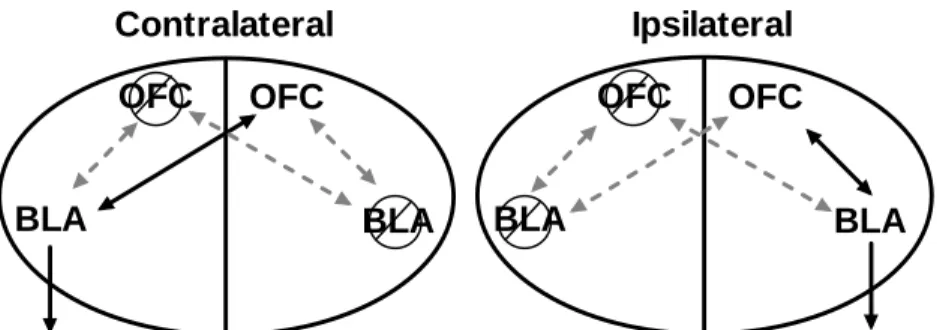
Experiment 1 employed a functional disconnection procedure to explore whether the OFC and BLA exhibit sequential information processing to regulate drug context-induced reinstatement of cocaine-seeking behavior. Given that dense intra- and inter-hemispheric connections exist between the OFC and BLA (Cavada et al., 2000; Ghashghaei and Barbas, 2002), the functional significance of interactions by both ipsilateral and contralateral projections was investigated. To bilaterally disrupt
intrahemispheric neural communication between the OFC and BLA, baclofen+muscimol (BM) – a GABA agonist cocktail that suppresses neural activity in cell bodies without affecting fibers of passage (Martin and Ghez, 1999) – was infused unilaterally into the OFC plus into the contralateral BLA immediately before assessing drug context-induced cocaine-seeking behavior. To bilaterally disrupt interhemispheric communication
between the OFC and BLA, additional groups received BM infusions unilaterally into the OFC plus the ipsilateral BLA. Because unilateral manipulation of either brain region may alter drug context-induced cocaine seeking, functional interdependence between the OFC and BLA was predicted to manifest as a superadditive effect following either the
17
verified that unilateral BLA inactivation fails to impair drug context-induced cocaine seeking (Fuchs et al., 2007). Thus, to test for a superadditive effect, a separate control group received unilateral manipulations of the OFC. Given the pattern of neural connectivity between the OFC and BLA described above, we predicted that both the intrahemispheric and interhemispheric manipulation would produce a greater impairment in drug context-induced cocaine seeking relative to unilateral functional inactivation of the OFC, but that such manipulations would not alter general motor activity or food-reinforced instrumental behavior.
METHODS Animals
Male Sprague-Dawley rats (n = 53; 250-300 g; Charles River, Wilmington, MA, USA) were housed individually in a climate-controlled vivarium on reversed light-dark cycle. Rats received 20-25 g of rat chow per day with water available ad libitum. Animal housing and treatment protocols followed the Guide for the Care and Use of Laboratory
Animals (Institute of Laboratory Animal Resources on Life Sciences, 1996) and were
approved by the Institutional Animal Care and Use Committee of the University of North Carolina at Chapel Hill.
Food training
18
Active lever responses resulted in the delivery of one food pellet only; inactive lever responses had no programmed consequences. During food training, contextual stimuli subsequently used for cocaine conditioning were not present.
Surgery
Forty-eight h after food training, all rats were fully anesthetized using ketamine
hydrochloride and xylazine (66.6 and 1.33 mg/kg, i.p., respectively). Chronic indwelling jugular catheters were constructed in house and were surgically implanted into the right jugular vein of a subset of rats (n=35), as described previously (Fuchs et al., 2007). All rats (n=53) were stereotaxically implanted with stainless-steel guide cannulae (26 gauge; Plastics One) aimed dorsal to the left or right BLA (-2.7 mm AP, +/-5.2 mm ML, -6.7 mm DV, relative to bregma) and/or the left or right OFC (+3.5 mm AP, +/3.0 mm ML, -3.4 DV) using standard procedures. Stainless steel screws and cranioplastic cement secured the guide cannulae to the skull. Stylets (Plastics One) and Tygon caps sealed the guide cannulae and catheter, respectively. To extend catheter patency, the catheters were flushed daily with an antibiotic solution of cefazolin (10.0 mg/ml; Schein
19 Cocaine self-administration training
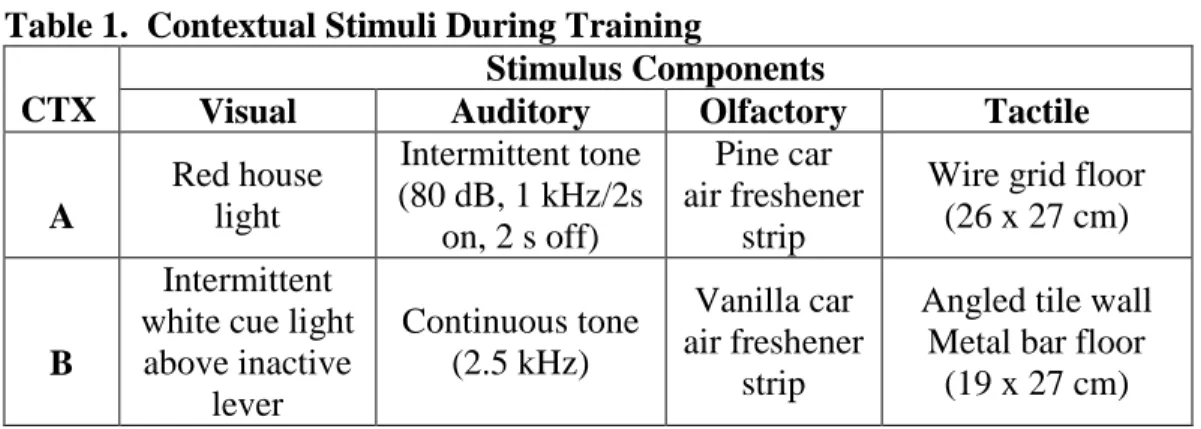
Cocaine self-administration and extinction training sessions were conducted in operant conditioning chambers configured to one of two unique environmental contexts (Table 1: Context A, Context B) that differed along visual, auditory, tactile, and olfactory
modalities, as described previously (Fuchs et al., 2005; Fuchs et al., 2007; Fuchs et al., 2008a). Rats had no exposure to these contextual stimuli prior to cocaine
self-administration training; these stimuli were presented throughout each session independent of responding.
The rats were randomly assigned to receive daily 2h cocaine self-administration training sessions in Context A or B during their dark cycle (Table 2). Context A consisted of a continuous red houselight (0.4 fc brightness) on the wall opposite the levers, an intermittent pure tone (80 dB, 1 kHz, 2 sec on, 2 sec off), a pine-scented air freshener strip (4.5 x 2 cm, Car Freshener Corp, Watertown, NY, USA), and wire mesh flooring (26 X 27 cm). Context B consisted of an intermittent white stimulus light above the left lever (1.2 fc brightness, 2 sec on, 4 sec off), a continuous pure tone (75 dB, 2.5 kHz), a vanilla-scented air freshener strip (4.5 x 2 cm, Sopus Products, Moorpark, CA, USA), and ceramic tile bisecting the chamber (19 cm X 27 cm). Rats had no exposure to these contextual stimuli prior to cocaine self-administration training and these stimuli were presented throughout each cocaine self-administration training session independent of responding.
Responses on one (active) lever were reinforced under an FR1 schedule of cocaine reinforcement (cocaine hydrochloride; 0.15 mg/infusion, equivalent to ~0.50
20
followed each 2s infusion during which lever responses were recorded, but had no programmed consequences. Responses on the other (inactive) lever were recorded but had no programmed consequences. Training continued until the rats obtained ≥ 10 cocaine infusions/session on at least 10 training days (i.e., acquisition criterion). Table 1. Contextual Stimuli During Training
CTX
Stimulus Components
Visual Auditory Olfactory Tactile
A
Red house light
Intermittent tone (80 dB, 1 kHz/2s
on, 2 s off)
Pine car air freshener
strip
Wire grid floor (26 x 27 cm)
B
Intermittent white cue light above inactive lever Continuous tone (2.5 kHz) Vanilla car air freshener strip
Angled tile wall Metal bar floor
(19 x 27 cm)
Table 2. Context Counterbalancing During Training Self-administration Extinction Test Days Context A Context B Context A or B (cocaine-paired)
Context B Context A Context B or A (cocaine-paired)
Extinction Training
21
the rats reached the extinction criterion (≤ 25 active lever presses/session during two consecutive sessions).
Reinstatement Testing
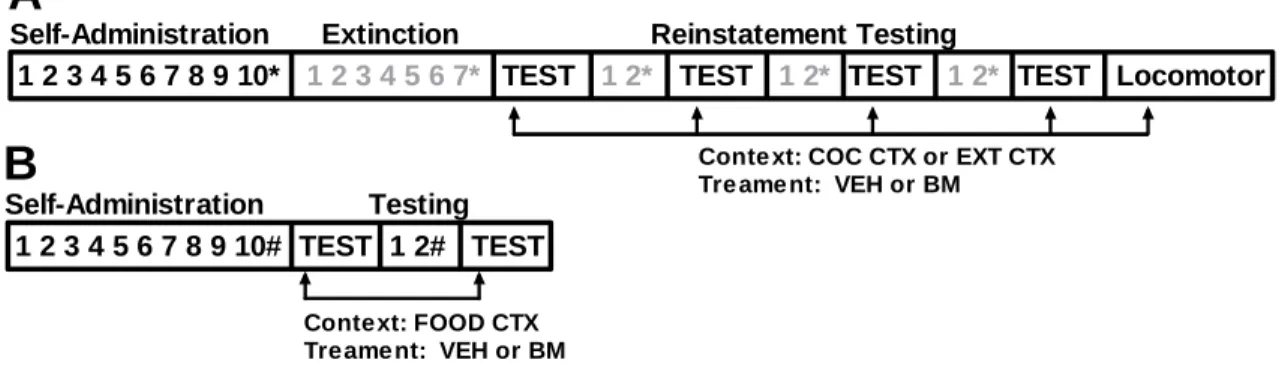
After the rats reached the extinction criterion, cocaine seeking was assessed in the cocaine-paired and extinction contexts during four test sessions (Fig 2.1). Immediately prior to testing, rats received microinfusions of the GABAB/GABAA agonist cocktail baclofen+muscimol (BM; 1.0/0.1 mM; 0.5 µl/hemisphere, respectively; pH ~7.0) phosphate buffered saline vehicle (VEH; 0.5 µl/hemisphere) either (a) unilaterally into the OFC plus contralateral BLA, (b) unilaterally into the OFC plus ipsilateral BLA, or (c) unilaterally into the OFC alone. This BM dose was selected based on previous findings that administration of this dose into the OFC or BLA impairs drug context-induced cocaine-seeking behavior in a brain-region specific manner (Fuchs et al., 2007; Lasseter et al., 2009). The infusions were delivered over 2 min, and the injection cannulae were left in place for 1 min before and 1 min after the infusion. During the test sessions, lever responding had no programmed consequences. Session length was 1 h to allow for repeated testing without significant extinction learning. Both the order of testing in the two contexts and the order of intracranial treatments (BM, VEH) were counterbalanced based on mean active lever responding during the last three self-administration training days. Subjects received additional extinction sessions in the extinction context between test sessions until they re-obtained the extinction criterion (see above).
22
Intracranial manipulations can produce motor deficits that impair instrumental
performance during the reinstatement tests. Hence, the effects of BM and VEH treatment on general locomotor activity and food-reinforced instrumental behavior were examined.
Locomotor Activity
Locomotor activity was assessed during two 1h test sessions held 5 days apart, starting 48 h after the last reinstatement test session. Locomotor activity was measured in novel Plexiglas chambers (42 x 20 x 20 cm) equipped with an array of eight photodetectors and light sources. Prior to testing, rats received intracranial microinfusions of BM or VEH using the infusion procedures and treatment order applied in the reinstatement
experiment. A computerized activity system (San Diego Instruments, San Diego, CA) recorded the number of consecutive photobeams interrupted by rats moving in the activity chamber.
Food-Reinforced Instrumental Responding
23
intracranial treatments was counterbalanced across the two test sessions based on mean active lever responding during the last two training sessions. During the training and test sessions, active lever presses were reinforced with food pellets (45 mg, Purina) under an FR1 schedule with a 20s timeout period. Inactive lever presses were recorded, but had no programmed consequences. Between the test sessions, rats received a minimum of two additional food self-administration training sessions to re-establish baseline responding.
Histology
After the last experimental session, rats were overdosed using ketamine hydrochloride and xylazine (66.6 and 1.3 mg/kg i.v. or 199.8 and 3.9 mg/kg i.p., respectively,
depending on catheter patency). The brains were dissected out, stored in 10%
formaldehyde solution, and then sectioned at a thickness of 75 µm using a vibratome. The sections were stained using cresyl violet (Kodak, Rochester, NY, USA). Cannula placements were verified using light microscopy and were mapped onto schematics from the rat brain atlas (Paxinos and Watson, 1997).
Data analysis
Only data from rats with correct cannula placements were included in the data analysis. Potential pre-existing differences between the treatment groups in (a) lever responses and cocaine intake during the last three days of self-administration training, (b) lever
24
order (BM first, VEH first) as between-subjects factors and time (day) as the within-subjects factor, where appropriate. The effects of BM and VEH infusions on (a) lever responses during the contextual reinstatement test sessions, (b) the number of photobeam breaks during the locomotor activity tests, and (c) food-reinforced instrumental
responding were assessed using mixed factors ANOVAs with surgery condition (ipsilateral, contralateral) as the between-subjects factor and treatment (BM, VEH), testing context (cocaine-paired context, extinction context), time (20-min intervals), and/or lever (active, inactive) as within-subjects factors, when appropriate. Because the variables OFC hemisphere (left, right) and BLA hemisphere (left, right) are not
orthogonal, the hemispheric laterality of significant effects was analyzed separately for the contralateral, ipsilateral, and unilateral surgery groups using planned t-tests.
Significant main and interaction effects were investigated using simple main effects tests or Tukey post hoc tests. Alpha was set at 0.05.
RESULTS Histology
25
correctly located within the target brain regions of the contralateral (right OFC/left BLA, n=6; left OFC/right BLA, n=4), ipsilateral (right OFC/BLA, n=6; left OFC/BLA, n=4), and unilateral groups (right OFC, n=5; left OFC, n=4). For the remaining food-trained rats (n=15), the cannula tract was correctly located within the target brain regions of the contralateral (right OFC/left BLA, n=4; left OFC/right BLA, n=4) and ipsilateral groups (right OFC/BLA, n=4; left OFC/BLA, n=3).
Self-Administration Responding
The groups with cannulae aimed at the contralateral or ipsilateral OFC plus BLA or unilaterally at the OFC exhibited stable active lever responding for cocaine reinforcement over the last three days of self-administration training, with a within-subjects variability of <10% in daily cocaine intake. There was no difference between these groups in active lever responding (all day and surgery type main effects and interactions, all Fs ≤ 1.02, p ≥ 0.41) or inactive lever responding (all day and surgery type main and interaction effects, all Fs ≤ 1.14, p ≥ 0.34) during the last three days of self-administration training.
Collapsed across groups, the mean active and inactive lever responding ± SEM was 42.92 ± 3.13 and 4.42 ± 1.72, respectively, while the mean cocaine intake ± SEM was
26 Extinction Responding
27
(all ts<1.90, p > 0.10). Similarly, there was no difference between the groups in the mean number of days ± SEM needed to re-obtain the extinction criterion between reinstatement test sessions (2.1 ± 0.06). Hence, it is unlikely that pre-existing differences accounted for group differences in reinstatement responding during the subsequent test sessions.
Effects of OFC-BLA functional inactivation on drug context-induced reinstatement of
cocaine-seeking behavior
28
was administered for either the OFC (t(18) = 0.29, p = 0.78) or the BLA (t(18) = 0.66, p = 0.52)
Following VEH pretreatment, the contralateral and ipsilateral OFC/BLA-cannulated groups exhibited a slight increase in inactive lever responding upon exposure to the previously cocaine-paired context relative to responding in the extinction context (Fig 2.4D-E; context main effect, F(1,18) = 8.49, p = 0.009). BM pretreatment impaired inactive lever responding relative to VEH pretreatment in a context-specific manner following administration into either the contralateral OFC/BLA or the ipsilateral OFC/BLA (treatment X context interaction, F(1,18) = 10.08, p = 0.005; treatment main effect, F(1,18) = 10.83, p = 0.004; only statistically significant effects are reported).
Specifically, independent of surgery condition, BM pretreatment attenuated inactive lever responding relative to VEH pretreatment in the cocaine-paired context (Tukey test, p < 0.05) but not in the extinction context. The effect of BM pretreatment on inactive lever responding in the cocaine-paired context was independent of the particular hemisphere into which BM was administered for either the OFC (t(18) = 0.64, p = 0.53) or the BLA (t(18) = 0.29, p = 0.77).
Effects of unilateral OFC functional inactivation on drug context-induced
reinstatement of cocaine-seeking behavior
29
unilaterally into the OFC did not alter active lever responding relative to VEH pretreatment in either context (treatment X context interaction, F(1,8) = 0.07, p = 0.80; treatment main effect, F(1,8) = 0.01, p = 0.91). Exposure to the cocaine-paired context did not alter responding on the inactive lever relative to responding in the extinction context (Fig 2.4F; context, F(1,8) = 2.07, p = 0.19), and BM pretreatment administered unilaterally into the OFC did not alter inactive lever responding relative to VEH pretreatment in either context (treatment X context interaction, F(1,8) = 1.43, p = 0.266; treatment main effect, F(1,8) = 2.49, p = 0.15).
Locomotor Activity
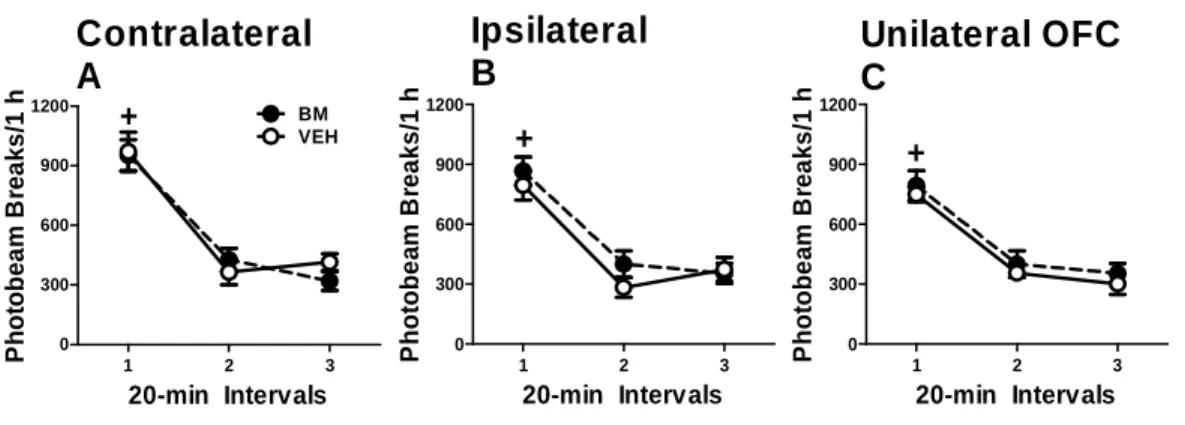
BM pretreatment failed to alter locomotor activity relative to VEH pretreatment in the contralateral OFC/BLA-cannulated, ipsilateral OFC/BLA-cannulated, and unilateral OFC-cannulated groups (Fig 2.5A-C). In all groups, the number of photobeam breaks decreased at a similar rate over the three 20-min intervals of the locomotor test session as the groups habituated to the novel context (all time main effects, all Fs ≥ 45.77, p = 0.0001; interval 1 > intervals 2-3; Tukey test, p < 0.01). In addition, BM pretreatment did not alter the number of photobeam breaks relative to VEH pretreatment (all treatment main effects and interactions, all Fs≤ 0.11, p ≥ 0.07).
Food-reinforced Instrumental Behavior
30
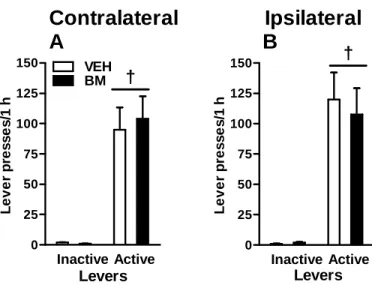
active lever responding than inactive lever responding (lever main effect, F(1,13) = 110.33,
p = 0.0001). Furthermore, BM pretreatment administered unilaterally into the OFC plus
the contralateral or ipsilateral BLA did not alter food-reinforced responding alone or as a function of surgery condition or lever (treatment main effect and all treatment
interactions, all Fs < 0.46, p > 0.51).
DISCUSSION
Experiments in Chapter 1 explored putative functionally significant interactions between the OFC and BLA in drug context-induced cocaine-seeking behavior. To this end, the effects of unilateral functional inactivation of the BLA plus the contralateral or ipsilateral OFC were assessed on the expression of cocaine seeking elicited by re-exposure to a drug-paired environmental context. Contralateral or ipsilateral
31
instrumental behavior (Fig 2.6A-B). In addition, previous findings from our lab and from other investigators have demonstrated that bilateral functional inactivation of the OFC and BLA fails to alter cocaine-primed reinstatement of cocaine seeking (Lasseter and Fuchs, unpublished observation; Grimm and See, 2000). Overall, these findings indicate that neural activity in both the OFC and BLA is necessary for using the memory or motivational significance of cocaine-associated environmental stimuli to guide goal-directed behavior. Such results are consistent with previous research indicating that the OFC and BLA are integral parts of the mesocorticolimbic neural circuitry known to direct cue and context-induced cocaine-seeking behavior in the reinstatement and renewal animal models of drug relapse (Grimm and See, 2000; Neisewander et al., 2000; See et al., 2001a; Kantak et al., 2002; McLaughlin and See, 2003; Fuchs et al., 2004; Fuchs et al., 2005; Atkins et al., 2008; Crombag et al., 2008; Fuchs et al., 2008a; Hamlin et al., 2008; Zavala et al., 2008; Lasseter et al., 2009). Moreover, the present study
significantly extends this line of research by suggesting that the OFC and BLA co-regulate drug context-induced cocaine seeking via sequential information processing or by providing necessary input to a common downstream target within a neural circuit.
context-32
induced cocaine seeking and sucrose-conditioned place preference (Everitt et al., 1991; Fuchs et al., 2007), even though these manipulations are capable of disrupting some forms of conditioned learning and reward processing (LaBar and LeDoux, 1996; Izquierdo et al., 2004; Markham et al., 2010). Thus, one possible interpretation of the current findings is that the ipsilateral and contralateral OFC plus BLA manipulations crossed the threshold of neural inactivation sufficient to disrupt drug context-induced cocaine seeking independent of functional connectivity between the OFC and BLA. However, given that unilateral functional inactivation of either the OFC or BLA failed to alter the motivational significance of the cocaine-paired environmental context, it is unlikely that additive effects of these manipulations accounted for the robust effects of both the contralateral and ipsilateral OFC plus BLA inactivation observed in the current study, even if we are dealing with a nonlinear system.
A more likely possibility is that functionally significant interactions between the OFC and BLA may be necessary for the control of drug context-induced cocaine-seeking behavior. Given that the magnitude of impairment in context-induced cocaine seeking was similar following ipsilateral and contralateral neural inactivation of the OFC and BLA, the ability of the cocaine-paired context to elicit cocaine seeking may rely equally on the functional integrity of intrahemispheric and interhemispheric connections between the OFC and BLA, which were bilaterally disrupted by the contralateral and ipsilateral BM manipulations, respectively. This explanation is supported by considerable
33
Additional connections between the OFC and BLA are relayed through the MDT, providing an anatomical substrate for extensive functional interactions between the OFC and BLA (Demeter et al., 1990; Cavada et al., 2000; Ghashghaei and Barbas, 2002; Macey et al., 2003; Miyashita et al., 2007). Interestingly, amygdalocortical and amygdalothalamic pathways to the OFC involve distinct subpopulations of neurons within the OFC and BLA, indicating that these parallel pathways may convey functionally distinct information between the OFC and the BLA (McDonald, 1991; Macey et al., 2003; Miyashita et al., 2007).
The explanation that communication between the OFC and BLA subserves drug-seeking behaviors is further supported by evidence that functional interdependence exists between these brain regions in the regulation of various goal-directed behaviors.
Highlighting the importance of intrahemispheric communication between the OFC and BLA, previous studies have demonstrated that contralateral – although not ipsilateral – OFC and BLA neural inactivation disrupts performance on an odor reward-reversal task (Churchwell et al., 2009), while contralateral OFC plus BLA lesions disrupt affective processing as evidenced by attenuated reinforcer devaluation effects and impaired object reversal learning (Baxter et al., 2000; Izquierdo et al., 2004). Furthermore,
electrophysiological studies have confirmed that intrahemispheric interactions between the OFC and BLA promote behavioral flexibility on an odor discrimination task, although putative interhemispheric interactions have not been similarly explored
(Saddoris et al., 2005). Interestingly, however, contralateral OFC and BLA lesions only transiently disrupt performance on a reinforcer devaluation task in contrast to the
34
2004; Izquierdo and Murray, 2007; Izquierdo and Murray, 2010). Thus, at least in the reinforcer devaluation task, recovery of function may occur after permanently disrupting intrahemispheric interactions between the OFC and BLA due to the strengthening of interhemispheric functional connectivity between brain regions that had been left intact, which underscores the importance of both pathways.
In conclusion, results from the current study provide important evidence that
interactions between the OFC and BLA are necessary for the expression of drug context-induced motivation for cocaine. This form of cocaine-seeking behavior may depend on intrahemispheric and interhemispheric information processing by the OFC and BLA via direct reciprocal anatomical projections or via the convergence of requisite information from both of these brain regions onto a third brain region within the circuitry. As noted above, one particular region the OFC and BLA may interact with to direct cocaine-seeking behavior is the MDT given that the MDT makes similar contributions to conditioned behaviors as the OFC and BLA (Aggleton and Mishkin, 1983; Gaffan and Murray, 1990; Corbit et al., 2003). Moreover, a crossed-disconnection procedure
indicated that the OFC and BLA interact with the MDT in the regulation of reward-based decision making (Izquierdo and Murray, 2010). In addition, the OFC and BLA send afferents to several elements of the neural circuitry that mediate context-induced reinstatement of drug-seeking behavior, including the nucleus accumbens (NA), DH, PFC, and VTA (Christie et al., 1987; McDonald, 1991; Ray and Price, 1992; Brog et al., 1993; Haber et al., 1995; O'Donnell and Grace, 1995; Groenewegen et al., 1996;
35
well as between the BLA and PFC, are necessary for drug context-induced cocaine-seeking behavior (Fuchs et al., 2007). Furthermore, interactions between the BLA and NA may be necessary for this behavior given that communication between these brain regions promotes responding for sucrose- and cocaine-paired conditioned stimuli (Schoenbaum et al., 2002; Ambroggi et al., 2008; Di Ciano, 2008) and is critical for the expression of sucrose-conditioned place preference (Everitt et al., 1991). Finally, dopamine input from the VTA may regulate OFC-BLA interactions in context-induced cocaine-seeking behavior given that dopamine D1-like receptor antagonism in either the OFC or BLA is sufficient to impair the acquisition and expression of cue-induced cocaine seeking and decreases the break point under a progressive ratio schedule for food
36
1 2 3 4 5 6 7 8 9 10* 1 2 3 4 5 6 7* TEST 1 2* TEST 1 2* TEST 1 2* TEST Locomotor Self-Administration Extinction Reinstatement Testing
1 2 3 4 5 6 7 8 9 10# TEST 1 2# TEST Self-Administration Testing
Conte xt: COC CTX or EXT CTX Tre ame nt: VEH or BM
Context: FOOD CTX Treame nt: VEH or BM
A
B
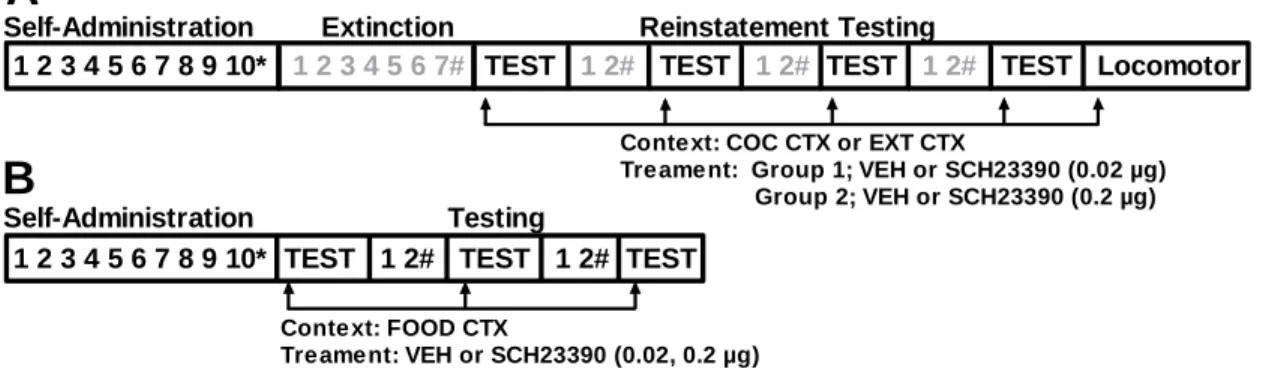
Fig 2.1 Schematic representation of the timeline for the drug context-induced
reinstatement experiments (A) and the food-maintained instrumental control experiments (B). Arrows on the schematics identify sessions in which VEH or BM was administered immediately prior to testing. The order of drug treatment (BM, VEH) and the order of exposure to the two testing contexts during reinstatement testing (cocaine-paired context, COC CTX; extinction context, EXT CTX) were counterbalanced, where appropriate.
37
BLA BLA
OFC OFC
BLA BLA
OFC OFC
Ipsilateral Contralateral
Fig 2.2 Schematic representation of the functional disconnection procedure. Following the contralateral manipulation, putative intrahemispheric processing by the OFC and BLA was expected to be disrupted bilaterally, while interhemispheric processing by the OFC and BLA was expected to be spared in one hemisphere. Following the ipsilateral manipulation, putative interhemispheric processing was expected to be disrupted bilaterally, while intrahemispheric processing by the OFC and BLA was expected to be spared in one hemisphere. Solid lines represent communication that is preserved between two intact brain regions. Dotted lines represent communication that is transiently
38
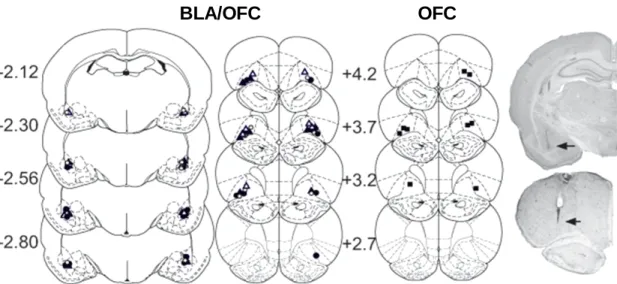
BLA/OFC OFC
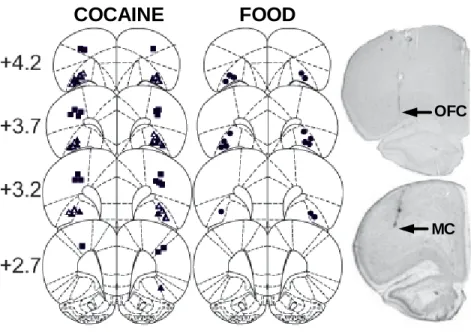
Fig 2.3 Schematic and photographic representation of injection cannula placements. The
arrows on the photomicrographs identify the most ventral point of the infusion cannula
tracts on representative cresyl violet-stained brain sections. The symbols on the
schematics (Paxinos and Watson, 1997) represent the most ventral point of the infusion cannula tracts for rats that received unilateral microinfusions into the OFC plus the contralateral BLA (cocaine self-administration: closed circles, food-maintained responding: open circles) or the ipsilateral BLA (cocaine self-administration: filled
triangles, food-maintained responding: open triangles), or a unilateral microinfusion into
39 EXT COC 0 15 30 45 60 75
*
Context † VEH BM A c ti v e l e v e r p re s s e s /1 h EXT COC 0 15 30 45 60 75*
Context † A c ti v e l e v e r p re s s e s /1 h EXT COC 0 15 30 45 60 75*
Context A c ti v e l e v e r p re s s e s /1 h EXT COC 0 15 30 Context*
† In a c ti v e l e v e r p re s s e s /1 h EXT COC 0 15 30 Context*
† In a c ti v e l e v e r p re s s e s /1 h EXT COC 0 15 30 Context In a c ti v e l e v e r p re s s e s /1 hContralateral Ipsilateral Unilateral OFC
D E F A B C
40 0 300 600 900 1200
1 2 3
+ BM
VEH
20-min Intervals
P h o to b e a m B re a k s /1 h 0 300 600 900 1200
1 2 3
+
20-min Intervals
P h o to b e a m B re a k s /1 h 0 300 600 900 1200
1 2 3
+
20-min Intervals
P h o to b e a m B re a k s /1 h Contralateral A Ipsilateral B Unilateral OFC C
Fig 2.5 Bilateral inhibition of intrahemispheric or interhemispheric connections between the BLA and OFC does not alter general motor activity. Photobeam breaks (mean/1h + SEM) were triggered by the movement of subjects in a novel context during a 1-h
41 Inactive Active 0 25 50 75 100 125 150 VEH BM Levers L e v e r p re s s e s /1 h Inactive Active 0 25 50 75 100 125 150 Levers L e v e r p re s s e s /1 h
Contralateral Ipsilateral
A B
† †
CHAPTER 3
DOPAMINE D1-LIKE RECEPTOR SIMULATION IN THE ORBITOFRONTAL CORTEX IS CRITICAL FOR DRUG CONTEXT-INDUCED COCAINE-SEEKING
BEHAVIOR
INTRODUCTION
Extensive evidence suggests that the lateral OFC represents an integral part of the mesocorticolimbic neural circuitry that regulates the reinstatement of drug context-induced cocaine-seeking behaviors. Exposure to cocaine-paired conditioned stimuli elicits hyperactivity in the OFC of former cocaine users concomitant with increases in cocaine craving (Grant et al., 1996; Childress et al., 1999; London et al., 1999; Duncan et al., 2007). Similarly, cocaine-experienced rats exhibit enhanced neural activation in the OFC following exposure to a cocaine-paired context relative to exposure to an non-drug paired context (Neisewander et al., 2000; Hamlin et al., 2008; Hearing et al., 2008b; Hearing et al., 2008a). While prolonged loss of output from the OFC actually enhances drug context-induced cocaine-seeking behaviors, neural inactivation of the OFC prevents drug-paired cues or contexts from eliciting cocaine-seeking (Fuchs et al., 2004; Lasseter et al., 2009). Results from experiments in Chapter 2 established that interactions between the OFC and BLA regulate the motivational effects of a drug-paired context on
43
Evidence suggests that dopaminergic neurotransmission in the OFC may be
necessary for a drug-paired context to produce cocaine-seeking behavior. The VTA sends dense dopaminergic projections to regions of the OFC that are rich in dopamine D1 receptors (Berger et al., 1991; Dunnett and Robbins, 1992; Frankle et al., 2006; Reynolds et al., 2006; Sesack and Grace, 2010). In fact, D1 receptors are significantly more
44
Moreover, no study to date has assessed whether dopaminergic neurotransmission in the OFC is critical for a cocaine-paired context to elicit cocaine-seeking behavior.
Thus, experiments in Chapter 3 were designed to evaluate the hypothesis that dopamine regulates drug context-induced cocaine seeking via the stimulation of
dopamine D1 receptors in the OFC. To this end, rats received bilateral microinfusions of the highly selective dopamine D1-like receptor antagonist SCH23390 or VEH into the OFC immediately before re-exposure to a cocaine-paired or non-cocaine-paired context. Rats in an anatomical control experiment received similar treatment into the primary and secondary motor cortices (MC, anatomical control brain region) that are dorsally adjacent to the OFC. To discriminate between impairments in motivation versus motor
performance, we also assessed the effects of intra-OFC SCH23390 treatment on
locomotor behavior and on food-reinforced instrumental behavior. Overall, we predicted that SCH23390 treatment administered into the OFC, but not the MC, would
dose-dependently attenuate drug context-induced cocaine seeking relative to VEH treatment without altering motor performance in the control experiments.
METHODS Animals
Male Sprague-Dawley rats (n = 27, 250-300 g; Charles River, Wilmington, MA, USA) were housed individually in a climate-controlled vivarium on reversed light-dark cycle. Rats received 20-25 g of rat chow per day with water available ad libitum. Animal housing and treatment protocols followed the Guide for the Care and Use of Laboratory
45
approved by the Institutional Animal Care and Use Committee of the University of North Carolina at Chapel Hill
Food training
To expedite cocaine self-administration training, all rats (n = 27) were trained to lever press under a continuous schedule of food reinforcement (45 mg pellets; Noyes,
Lancaster, NH, USA) in sound-attenuated operant conditioning chambers (26 x 27 x 27 cm high; Coulbourn Instruments, Allentown, PA, USA) during a 16-h overnight session. Two levers were present in the chamber, located on either side of a wall-mounted food tray. Each response on one lever (active lever) resulted in the delivery of one food pellet only; responses on the other lever (inactive lever) had no programmed consequences. During food training, contextual stimuli subsequently used for cocaine conditioning were not present.
Surgery
Forty-eight h after food training, all rats were fully anesthetized using ketamine
hydrochloride and xylazine (66.6 and 1.33 mg/kg, i.p., respectively). Chronic indwelling jugular catheters were constructed in house and were surgically implanted into the right jugular vein of a subset of rats (n= 19), as described previously (Fuchs et al., 2007). All rats were stereotaxically implanted with stainless-steel guide cannulae (26 gauge; Plastics One) aimed bilaterally at the OFC (+3.5 mm AP, +/-3.0 mm ML, -3.4 DV) or the MC anatomical control region (+3.5 mm AP, +/-3.0 mm ML, -1.4 DV) using standard
46
the skull. Stylets (Plastics One) and Tygon caps sealed the guide cannulae and catheter, respectively. To extend catheter patency, the catheters were flushed daily with an
antibiotic solution of cefazolin (10.0 mg/ml; Schein Pharmaceuticals, Albuquerque, NM, USA) and heparinized saline (70 U/ml; Baxter Health Care Corp, Deerfield, IL, USA), as described previously (Fuchs et al., 2007). Rats were given a 5-day post-operative
recovery period before the start of the experiment. Catheter patency was evaluated periodically using propofol (1mg/0.1ml, i.v. Eli Abbott Lab, North Chicago, IL, USA), which produces a rapid loss of muscle tone only when administered intravenously.
Cocaine self-administration training
47 Extinction Training
After meeting the acquisition criterion, rats received daily 2h extinction training sessions in the context (Context A or B) that distinctly differed from the cocaine
self-administration training context. Lever presses were recorded, but had no programmed consequences. Extinction training consisted of a minimum of 7 sessions plus additional sessions, as needed, until the rats reached the extinction criterion (≤ 25 active lever presses/session during two consecutive sessions). Immediately prior to the behavioral session on extinction day 4, rats were acclimated to the intracranial infusion procedure. To this end, injection cannulae (33 Ga, Plastics One) were inserted into the rats’ guide cannulae to a depth of 2 mm below the tip of the guide cannulae in the OFC-cannulated and MC-cannulated groups. Injection cannulae were left in place for 4 minutes but no drug was infused.
Reinstatement Testing
After the rats reached the extinction criterion, cocaine-seeking behavior was assessed in the cocaine-paired and extinction contexts during four test sessions (Fig 3.1A).
Immediately prior to testing, rats received bilateral microinfusions of the dopamine D1-like receptor antagonist, SCH23390 (OFC: 0.02 or 0.2 ug/0.5 ul per hemisphere; MC: 0.2 ug/0.5 ul per hemisphere), or phosphate-buffered saline VEH (OFC or MC: 0.5
48
cannulae were left in place for 1 min before and 1 min after the infusion. Immediately after the infusions procedure, rats were placed into the cocaine-paired or extinction context to assess lever responding, although lever responding had no programmed consequences. Session length was 1 h to allow for repeated testing without significant extinction learning occurring. The order of testing in the two contexts (cocaine-paired context, extinction context) and the order of intracranial treatments (0.02 µg or 0.2µg SCH23390; VEH) were counterbalanced based on mean active lever responding during the last three cocaine self-administration training days. Subjects received additional extinction training sessions in the extinction context between test sessions until they re-obtained the extinction criterion (see above).
Locomotor activity and food-reinforced instrumental behavior
Intracranial manipulations can produce non-specific motor deficits that impair instrumental performance. Hence, the effects of intra-OFC SCH23390 and VEH
treatment on general locomotor activity and food-reinforced instrumental behavior were examined.
Locomotor Activity