237
Development of Czech Software for Managing of Cattle Breeding
Iveta Novotná
1, Petr Smolik
21University of South Bohemia in the Czech Budejovice, Faculty of Agriculture, Studentská 13, 370 05, České
Budějovice, Czech Republic 2
AGROSOFT Tábor s.r.o., Údolní 2930, 390 02 Tábor
Abstract
Cattle breeding, a traditional sector of agricultural production, is currently recording a very intensive development caused by the effort of farmers to maximize production and especially their profit. Rapid implementation of new technologies, that help to achieve this goal, cannot be reliably carried out without the use of modern computer and transmission technology controlled by a quality control program. Absence of a similar system on our market led the company Agrosoft to develop a system sorting according to register designed for all types of farming, regardless of the amount of housed animals. The product was created in a Czech company, respects traditional local customs and his undisputable contribution is the subsequent connection to superior organizations operating in the Czech Republic. Complexity of this newly developed product is brought almost to perfection and allows producers to work with the files of needed information fundamentally anywhere and anytime. The new software improves and accelerates the managing work in breeding companies and consequently helps to improve the quality of final products to increase their profitability.
Keywords: cattle breeding, computer, management, software.
1. Introduction
Cattle breeding are in our conditions an irreplaceable branch of livestock production. But it also belongs due to the investment requirements, workload, material costs and organizational complexity to the most demanding sector of farm animal breeding. Requirements for a higher economic effectiveness lead cattle breeders and experts to seek solutions in modern technologies, techniques, of breeding organization, operating procedures, optimal formulation of rations, detailed veterinary surveillance and to selective breeding. The efforts of all breeders are aimed to achieve the biological and economic targets and the optimal increase in the profitability of farming while respecting the specific needs of the animals. For this purpose it is necessary to collect process and analyze a large amount of input data resulting
* Ing. Iveta Novotná; Phone: +420 602 191 728; e-mail: [email protected]
from measurements of selected physiological parameters, e.g. the size of the yield, conductivity and temperature of milk, feed utilization, motion activity or bodyweight. These precise and timely data is necessary to process continuously, to sort them, analyze and present to breeders through a quality software system [1-3]. Monitoring and evaluation of those indicators can deepen our understanding of ethology and animal requirements, which will be used especially for securing animal welfare [4, 5]. The need for a thorough and consistent analysis of the data led to the creation of various programs addressing this issue. However, despite all efforts we did not manage to achieve a comprehensive solution in any program.
238 Systems imported from abroad are technologically relatively perfect but not handling the issue of cattle breeding comprehensively. They usually lack for domestic farmers very essential link to a superior organization, accounting and economic systems and it is very complicated to implement technological elements incurred under development in the Czech Republic [6]. This fact was determined from the information channels [7, 8] or by monitoring of such systems at domestic breeders (GEA - DairyPlan, ALPRO - DeLaval).
2. Materials and methods
Our effort is to develop and promote a Czech product for managing livestock, which will respect the Czech practices, the organization of production and the link on stable technology, and a superior organization - ČMSCH, Ministry of Agriculture, etc.
We solve the set target under the state task name, the registration number QJ1210144. Name of the project is "Development of a new information system and applied technological and organizational innovation of control systems in breeding dairy cattle of farmers for strengthening competitiveness and improving the quality of animal products and animal welfare" with the partial aim of solution: "To process analytically, design and program a comprehensive system of zootechnical evidence". At the project solution are involved Agrosoft Tabor Ltd., University of South Bohemia in České Budějovice - Faculty of Agriculture, ZD Krasna Hora nad Vltavou Inc. and Farmtec Inc.
The development of the control system was initiated in two directions. The first was to find the optimal technical solution and programming means, the other was to process analytically and to assemble optimal algorithms of the issue.
The core of the system is designed as a cloud application. It uses proven advanced technologies such as SQL, HTML5, Linux. The main interface for the user access to the system is a web application. This application is primarily used to check the current status of cattle, display and print output configurations, update the data and analyze historical and current data. The web application is compatible across the operating systems. It enables users to access easily to the system both from the computer (desktop PC or notebook) with
Windows, Linux or MAC, and from Smartphone or tablet with Android. There is not necessary to install anything at terminal device, modern web browser with support for HTML5 is sufficient. For work in stables a mobile application is added to web application. The mobile application presents the user current data and allows updating the existing status. Individual operating units are controlled electronically by computer technology. This computer collects data from the individual technological units of operation, processes them, and based on their evaluation carries out the interventions. The technological computer is connected to a data cloud application, where obtains data for controlling of technological processes and passes back information about the current status. In the cloud application, this data is further processed, analyzed, archived and presented to the user.
3. Results and discussion
For illustration, we will describe the above-described technical solution for practical use of climate monitor. There are sensors for measuring different values, such as CO2, methane, ammonia, moisture, temperature, cooling value (kata-thermometer) or light intensity installed in the stable. Measured values from sensors are collected at regular intervals in a computer technology that is placed in technical background of the stable. Based on measured values the technological computer determines and sets the required intensity of ventilation, lighting, wetting etc. The user has an opportunity to view the actual measured data, eventually set the desired values on the control panel of climate monitor directly in the stable. Via these web or mobile applications it is then possible to manage and monitor the microclimate in the stables completely, including historical values, from anywhere.
Chosen technologies and solutions bring a range of benefits to users. The system can be operated simultaneously by several users and each of them receives always up to date information. Once acquired data enter to the whole system and therefore it is not necessary to enter them repeatedly.
239 server and the user only connects it easily, without being forced to perform any other intervention. This eliminates the program updates performed by the user, which has its pitfalls in downloading new versions, in playback of existing ones, in data migration etc. All dates are stored securely in the data centre and regularly backed up automatically. The program is built on the proven algorithms of previous program Agrosoft Scot, and elaborates on the issue of cattle breeding to the details with much higher user convenience. We have created it in cooperation with important farmers, breeders, veterinarians and other experts in cattle breeding and reflected the experience of many users of the program Agrosoft Scot. Last but not the least contributor is the Faculty of Agriculture, University of South Bohemia in České Budějovice.
The system is set up to be usable by small farmers with a few animals or by factory farms with thousands of animals. The initial deployment of the system will accelerate automatic completion data taken from the UE, Plemdat, Agrosoft Scot, etc. In its complexity processes all the data needed to manage the herd, from basic data collection carried out by computer technology at stables or
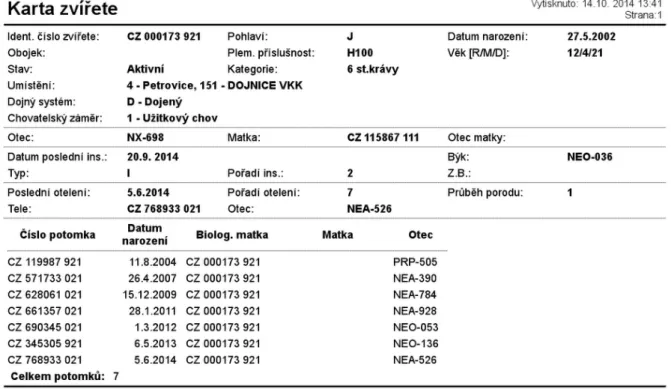
automatically by reading the parlor gates, through adding data from the mobile applications, to detailed data processing via the web interface. The program solves the problems of animal births, movements, sales, purchases and transports or organization of pasture. It is also enabled to input and monitor data of provenance, organization, production, reproduction, breeding and veterinary. It mediates the monitoring and evaluation of individual pieces or entire herds, and the whole organizational structure of the company. It communicates with superior central systems - Plemdat (performance control) or Central Registry. It presents statistics of turnover for the physical movement of herd with monitoring of pieces, weights, prices, feeding days, weight gains - total and average. It evaluates an overview of milk production and its comparison with historical reality and existing plan. It offers monitoring of young cattle including selection of categories and growth plan for first insemination of heifers. Additionally, this program allows comprehensive monitoring of reproduction of dairy cows including setting of work plans, which can be set weekly, for ten days, monthly, as well as annually.
240
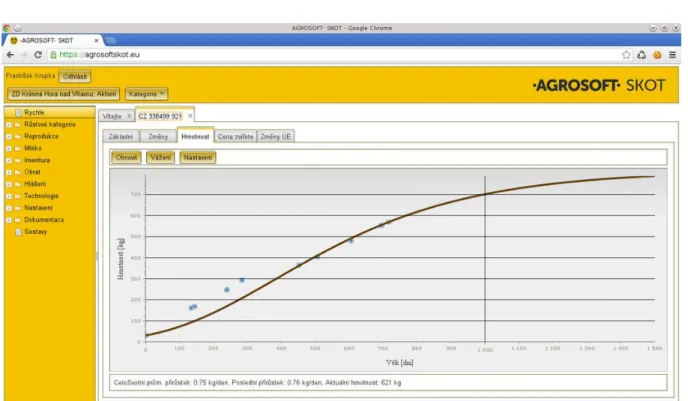
Figure 2. Web applications - animal growth curve
4. Conclusions
This software is constantly being evolved and all the time thoroughly tested in agricultural cooperatives Krasna Hora nad Vltavou Inc. and Opařany. Experience and comments from this testing are immediately incorporated. ZD Krásná Hora has the following production units: Krásná Hora (with the division of dairy cows, young cattle and meat cows), Petrovice and Haklovy Dvory. The system is entered by approximately 12 people simultaneously, and each of them inserts changes in its section. These are then processed and evaluated centrally. In this solution, we focused on the optimal processing and data transferring in the frame of the developed system. Testing the system in Opařany continues the longstanding cooperation. The original program Agrosoft Scot was created just in this company. Here we have focused on the work of individual zootechnicians, defining the data needed for them, and the calculation of herd turnover and its processing for communication with the accounting system.
Both companies have the system running reliably for more than a year as a master control system of cattle, including regular data transmission to the UE and superior accounting system.
Since August this year, the system is deployed to manage beef cattle farming in Bertín, Ltd. Here is
the system connected with the mobile application and focused on detailed monitoring of beef cattle reproduction.
Our new software exceeds existing software equipment thanks to its complexity, technical solution as well as user convenience.
Resulting comprehensive set of data and quality software accelerates and improves the system of cattle management, which is reflected in a better welfare, higher quality of products and increased profitability of farming.
Acknowledgements
This article is based on data acquired during the project NAZV QJ1210144.
References
1. Bouška, J., Doležal, O., Jílek, F., a Kudrna, V. et al.:
Chov dojeného skotu. Profi Press, Praha, 2006, s. 186,
ISBN 80-86726-16-9.
2. Smutný, L., Šoch, M., a Novák, P.: Individuální péče o dojnici formou elektrického sledování a vyhodnocování zootechnických údajů. In: Sborník z konference „Ochrana zvířat a welfare 2002“ Brno: Veterinární a farmaceutická univerzita Brno. 2002, s. 217-218.
241
4. Webster, J.: Welfare – životní pohoda zvířat aneb střízlivé kázání o ráji. Nadace na ochranu zvířat, Praha, 1999, 264 s.
5. Smutný, L.: Počítač pomocníkem při chovu
hospodářských zvířat. Náš chov. 2000, č. 11.
6. Podlahová, Š., Smutný, L.: FARMSOFT – moderní prostředek pro každodenní práci zootechnika. Farmtec – Výběr březen 2012, příloha I.
7. Anonym 1, Pcskot [online]. 2012 [cit. 2014-10-20]. Verze pro dojený skot. Dostupné z
www:<http://www.pcskot.cz/index.php/pc-skot-dojeny-skot>.
8. Anonym 2, Lukrom-milk [online]. 2013 [cit. 2014-10-20]. Management software. Dostupné z