The Asian Journal of Technology Management Vol. 9 No. 1 (2016): 52-57
*Corresponding author. Email: [email protected]
Received: June 26th 2016; Revised: Sept 7th 2016; Accepted: Sept 19th 2016
Steps in Designing Queue and Interview Process using Information System:
A Case of Re-registration of New Students in Universitas Negeri Makassar
Ansari Saleh Ahmar1*, Rusli2 and Abdul Rahman2
1Departement of Statistics, Universitas Negeri Makassar, Indonesia
2 Departement of Mathematics, Universitas Negeri Makassar, Indonesia
Abstract. Universitas Negeri Makassar (UNM) have a number of prospective students is quite a lot. Based on data released by
the BAPSI UNM (2015) that the data student candidates of UNM who passed the selection with SNMPTN SBMPTN selection as 3,791 people. If the prospective graduate students interviewed are normally it will take a long time and will certainly make students uncomfortable. Therefore it is necessary design an information systems to solving this problem. This research aim to develop an information system to facilitate the process queue. The method used in this research is to use the three stages in the Software Development Life Cycle method namely Initiation Phase, Development/Acquisition Phase, and Implementation Phase. This information system development using PHP and CodeIgniter as a its framework. This design results will be obtained an queues and interviews information system that can be used to manage the queue and interview data. By implementing this system, it potentially reduce time to wait and the process of managing results of interviews can be obtained directly without a process of inputting interview repeat if done manually.
Keywords: Information system, interview, queue, re-registration of new student, Universitas Negeri Makassar.
1. Introduction
Universitas Negeri Makassar is one of the largest public universities in South Sulawesi, Indonesia. As one of the universities, of course, services in the field of education is one of the main objectives. This is consistent with its vision of UNM as a center of education, assessment, and development of science education, science, technology, and art-minded and entrepreneurial education to produce graduates who excel professionally. To achieve this vision would require that his name UNM students through the selection process. In Indonesia, to become a student at a state university in question must follow the selection. The type of selection is divided into three main selection SNMPTN, SBMPTN, and Locally (SBMPTN, 2016).
The first step to become a student after the selection is passed the re-registration process, this is done with the hope prospective students who pass can be immediately
recorded its willingness to become a candidate student. At the time of re-registration sometimes there are students who do not come. Prospective students who passed the selection path SNMPTN many as , 2.308 people and that through SBMPTN many as 1.483 people, bringing the total of students who have passed as many as 3.791 people (BAPSI UNM, 2015).
work process step procedure, which was performed manually will be replaced by the system. Beneficiaries of such technology is the basis for applied of management information system (SIM). SIM application of the re-enrollment of these students can be a solution to overcome the existing problems. It is in line with the opinion Ajoye(2014), that the implementation of systems, services and information can significantly improve the quality of user satisfaction.
2. Literature Study
2.1. Information System
O'Brien and Marakas (Anggadini, 2013), the information system is a combination of
people, hardware, software, network
communications, data sources, procedures and policies are well organized to store, organize again, store, and disseminate information an organization. Sutabri (2005) said that the information system is a system within an organization reconcile the needs of daily transaction processing that supports managerial functions of the organization in reconcile activities of an organization to be able to provide certain outside parties with the necessary reports. Correspondingly, Muhyuzir (2001) said that the information system is data collected, classified and processed in such a way that it becomes a unity of related information and support each other so that it becomes a valuable information for those who receive. Nowduri (2011) said that Information systems can be categorized into three types: transactional processing systems (TPS), management information systems (MIS), and expert systems.
2.2. Database Management System
According to Othman, Nor Dhalia, Norain Z., & Hafuzudin (2015) stated that the data is colled in one logical, centralized location and manage the database management system (DBMS) by insulting the data is from uncontroller access. In short, a DBMS is a database program. Technically speaking, it is a software system that uses a standard method of cataloging, retrieving, and running queries on data. The DBMS manages
incoming data, organizes it, and provides ways for the data to be modified or extracted by users or other programs (Christensson, 2006). Figure 1 below show the main components of a DBMS and their interaction.
Figure 1. Main components of a database
management system (DBMS) and their interaction.
3. Method
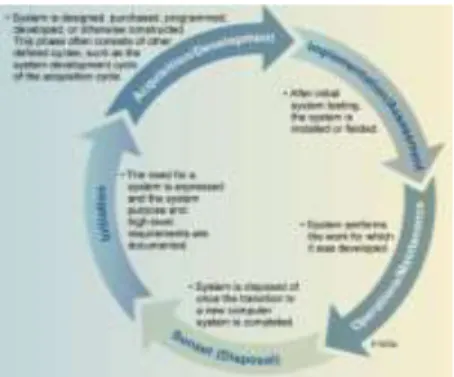
The method used in this research is to use the first three stages in the Software Development Life Cycle (SDLC) method is Initiation Phase, Development/ Acquisition Phase, and Implementation Phase. Flow of the SDLC can see in figure 2 below.
Figure 2. The System Development Life Cycle
(Radack, 2009)
4. Design and Implementation
4.1. Relation and Action Design
In the design of a management information system will be explained about the design of the database in the form of Entity Relation (ER) diagram and use case diagram. As for the ER-Diagram is presented in Figure 3.
Figure 3. ER-Diagram
ER-Diagram above shows that there are six entities, namely Admin, consumen, Queue, Call, Interview, Interviewer. Admin entity is used to store data admin. Consumen entity used to store data for new students. Queue entity used to store data queue happens. Call entity used to store data queue has been invoked and the data queue will be called. Interview entity used to store data from interviews. And Interviewer entitiy userd to used to store interviewer data. The design of this information system using the Unified Modeling Language (UML). The results described in terms of its design use case diagram can be see in figure 4 dan figure 5 below.
Figure 4. Use Case of Admin
An explanation of the Use Case Admin above, namely: Admin must first login. Then the admin can do the set initial of
applications, add interviewer, delete
interviewer, edit interviewer, import data from canditate of students, and takes and look at results of interviews that have been conducted.
Figure 5. Use Case of Interviewer
An explanation of the Use Case Interviewer above, namely: Admin must first login. Then the interviewer can conduct the call queue, search the data using a queue number, conducting interviews, and comparing data from interviews with the basic data.
4.2. Interface Design
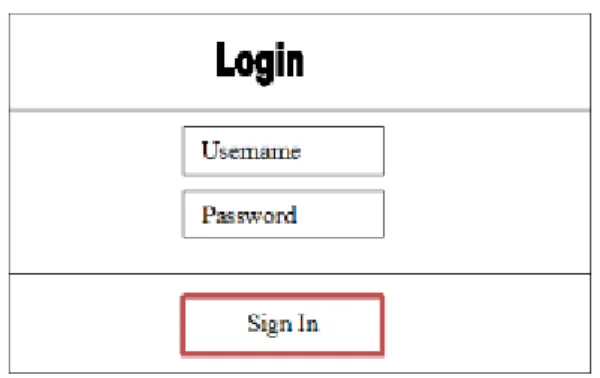
Interface design is an important to design in information system based on computer (Sridevi, 2014). Bakar & Long (2013) said that the design of the interface is user appeal. The design of the display design to login and display of main screen in the information system Queue and Interview can be seen in Figure 6 and Figure 7.
Figure 7. Design of Display
4.3. Implementation
Implementation of information systems using PHP: Hypertext Preprocessor (PHP) programming language with CodeIgniter framework, using a MySQL database and Apache webserver (Ahmar, 2012; Ahmar 2013). Below results of the implementation of the application:
1) Login Form
This form is used by the admin and interviewers to login. This form contains fields such as username and password. Number queue table has been set based on code of the faculty. For example the faculty of Mathematics using code A, then for the first queue table named A1 and the case for other faculties. Below the display of the login form (Figure 8).
Figure 8. Login Form
2). Queue Form
This form can be used if the interviewer has logged in the system. This form contains the name of the interviewer, the table number, the queue number being served, the remaining number of queues, queue information, call key, and redial key queues. We can design of queue form in figure 9.
Figure 9. Queue Form
3). Interview Form
As in queue form, this form can be used if the interviewer has logged in the system. This form contains the name of the interviewer, table numbers, form input queue registration number and percentage of the amount that was served. We can design of interview form in figure 10.
Figure 10. Interview Form
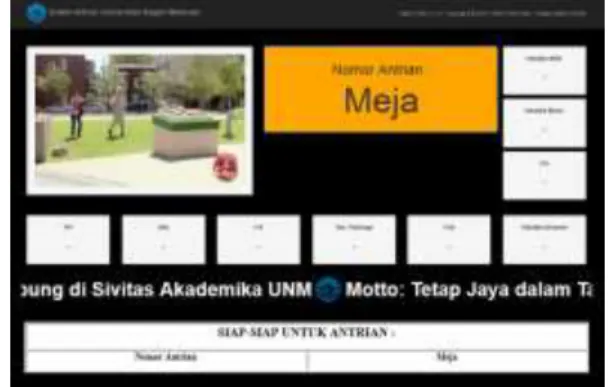
4). Display Layer
This feature is used to look at the queue number that is running on each table queue and queue while being served. In this feature there are features that run in the scroll of information that is useful to provide information related to student admission. And there are also features information queues to be served and was allowed to get ready. In addition to these features, there are also video feature. This feature contains the funny video in hopes of reducing the boredom of participants at the waiting queue. Display layer can be seen in figure 11 below.
6. Conclusion
Based on the analysis and design, it could be concluded that by using this queuing system will change the working pattern of the queue process that was originally done manually which is then done using a computerized system. The existence of this system will also reduce the buildup of queues at the interview so that consumers will feel comfortable. By implementing this system, it potentially reduce time to wait and the process of managing results of interviews can be obtained directly without a process of inputting interview repeat if done manually. Given this research are expected service satisfaction can be improved and can make an image Universitas Negeri Makassar for the better in the future so that Universitas Negeri Makassar could be a World Class University.
References
Ahmar, A. S. (2012). Panduan sistem informasi
akademik sekolah berbasis web.
Yogyakarta: Lokomedia.
Ahmar, A. S. (2013). Modifikasi CMS Template
Lokomedia. Yogyakarta: Garudhawaca.
Ajoye, M. B. M. (2014). information systems user
satisfaction: a survey of the
postgraduateschool portal, university of
ibadan, nigeria. Library Philosophy and
Practice (e-journal). 1192. Available at
http://digitalcommons.unl.edu/libphilprac/ 1192.
Anggadini, S. D. (2013). Analisis sistem
informasi manajemen berbasis
komputer dalam proses pengambilan keputusan. Majalah Ilmiah UNIKOM,
11(2).
Bakar, Z.A. & Long, P. (2013). A study of visual appeal interfaces based on subjective
preferences. Proceeding of the
International Conference on Artificial Intelligence in Computer Science and ICT(AICS 2013), 25 -26 November 2013, Langkawi,
Malaysia. Available at:
https://worldconferences.net/procee dings/aics2013/toc/papers_aics2013
/A023%20-%20ZURIANA%20ABU%20BAKA
R%20-%20%20A%20STUDY%20OF%20 VISUAL%20APPEAL%20INTERF ACES%20BASED%20ON%20SUBJ ECTIVE%20PREFERENCES.pdf (Accessed: 16 September 2016). BAPSI UNM. (2016). Universitas Negeri
Makassar dalam Angka. Makassar:
Universitas Negeri Makassar.
Christensson, P. (2006). DBMS Definition.
Avialable at
http://techterms.com/definition/db ms. [accessed 01 June 2016].
Muhyuzir, T. D. (2001). Analisa perancangan
sistem pengolahan data. Jakarta,
Indonesia: Elex Media Komputindo.
Nowduri, S. (2011). Management
information systems and business decision making: review, analysis, and
recommendations. Journal of
Management & Marketing Research. 7,
1-8.
Othman, Z., Nor Dhalia, M., Norain Z., A. M., & Hafuzudin, A. (2015). Management of information and
infrastructure of indigenous
community at royal belum state park
using geographical information
system : a conceptual design. The Asian Journal of Technology Management,
8(1), 47-55.
Radack, S. (2009). The System Development
Lifecycle (SDLC) . Available at
http://csrc.nist.gov/publications/nist bul/april2009_system-development-life-cycle.pdf. [accessed 02 June 2016].
SBMPTN. (2016). Laman Resmi SBMPTN
2016 Seleksi Bersama Masuk Perguruan
Tinggi Negeri Tahun 2016. Available at
http://sbmptn.ac.id/?mid=13 [accessed 12 September 2016].
Sridevi, S. (2014). User interface design.
International Journal of Computer Science
and Information Technology Research. 2(2),
415-426.
Sutabri, T. (2005). Sistem informasi manajemen.
Yogyakarta, Indonesia: Andi