European Journal of Physical Education and Sport Science
ISSN: 2501 - 1235 ISSN-L: 2501 - 1235 Available on-line at: www.oapub.org/edu
doi: 10.5281/zenodo.1285460 Volume 4 │ Issue 7 │ 2018
MODEL OF EDUCATION-DEVELOPMENT OF
SOCIAL ABILITY OF CHILDREN OF AGE 4-6 YEARS
Valbona Puma
Sports University of Tirana, Albania
Abstract:
The childhood years represent one of the most important stages in the human development. The purpose of the study is to test the efficiency of this social model-education through a gymnastic program for preschool children. For the realization of our study, have selected 60 children from four Tirana’s preschools city, that seems to be the bigger city, center of economic, social, administrative, culture, academic, industrial, medial of Albania, with purpose to have a big representation of all social-economics layers. The children are separated in two equal groups. In the experiment group will be implemented the education program with basic gymnastics elements, which will last twelve weeks, twice a week for an hour. . Control group, will follow a free program by using preschool infrastructure under educators supervision. After program intervention, in the social skills indicators of experiment group seems an improvement of results, while positive or negative changes in control group are inconsiderable to influence in final result. This is reflected in results of t-test between both groups. Based on results, were found significant changes between genders in experiment groups first phases questionnaire. They were noticed in social interaction, (t=-3.61, p=0.001); in social action (t=-7.71, p=.000), social independence (t=4.49, p=0.000); selfish/blast (t=-3.97, p=0.001); attention problems (t=-3.87, p=0.001); antisocial/aggressive (t=-3.40, p=0.003); general behavior problems (t=-2.53, p= 0.019).
Keywords: children, gymnastics, social ability
1. Introduction
“The children have their needs to move and to do exercises. They should exercise everyday to coordinate limbs and body muscles to move in the best way their body. This is one of the reasons why physical activity represents an essential part of the children' education program. Through this activity, children have all the possibilities to discover and recognize themselves, to develop constantly moving skills which are inseparably connected with their child world and which creating their personality are valid for the present and future. The children learn from their life experience and curious nature, so they appear in school with a very considerable training and experience formed in theirs families or friends. [27]. All types of children have their special methods to learn. An effective learning process has to be adapted individual characteristics and to be built over what the children knows and need to learn. Is also important to understand the way how the child learns. Children learn through the moving fields’ interaction with the other fields which are: knowledge, social and emotional. In this way, physical education through moving experience focused in moving skills contributes in children full development [57].
Pedagogical sciences that handle the movement, consider it as a very important education tool. In this point of view, education and in particular the movement at preschool ages draws attention of many specialists and scholars, based on the pedagogical masterpiece to build and develop learning process in a creative way .
Preschool age, without doubt, is one of the most important periods that need a special attention. The curiosity of the child in this age is a really treasure, which allows to discover in few years the entire world around him. The child pays attention in details, in which adults do not recognize them. He joins looking, hearing and touching things.
In this period children needs more than ever to move and play, because his mental development is directly connected with “his motor development”. When his “motor development” is not normal, there cannot be an intellectual development, affective and social. In this point of view, we think to explore in actual motor abilities and social level of the children in the age 4-6 years old. Based on our confirmations, we think also that this study will serve to improve the movement field in the preschool children, considering that the education and “motor skills” as a very important factor in movement development to create opportunities to practice social skills connected with childhood world, talent and their entertainment potential, which are valid to build their personalities in the present and future. Combination of theoretical with practical character and study conclusions will serve the teachers of physical education which works with preschool ages.
2. Hypothesis
2. Including the characteristics of biological age and the perception form of the experimental program there are no many significant statistical changes in the social skills between genders.
This study object was the impacts supervision of gymnastic program to improve the social skills in preschool children. The purpopse of the study is to test the efficiency of this social model-education through a gymnastic program for preschool children. In addition of traditional methods of education and their possibilities to realize them in practice this study aims to attract attention of educators in the new models of social education adjusting this with preschool children interests.
Parent sensitization in physical activities role is an important factor in the children development. Inclusion of responsible authorities aim that gymnastic may be an integral part of preschool education system.
3. Theoretical Treatments
Development is very complex and universal process, when the development fields must pass from a simple stage to the most complicated one and to integrate with each other [58]. It is a product of social-emotional, cognitive and biological fields. The growth refers to quantitative changes which are comparable with a rate.
Growth and development is general process of organism maturity that advance in a progressive way from conception moment to adult age. All the educators or fields specialists which works with preschool children must know and understand their typically changes since birth to eight years old, atypical changes, also to understand the benefits that come from educators interventions. [14].
Growth and development are represented by many physic, psychic, social, emotive and cultural factors that in general are genetic factors. Some of this growth and development indicators from one side are very connected with each other and with genetic factors, and from the other side they are connected with external factors too. Children development theories help us to understand them better and to know what are the best ways in which they can learn and the relations with development factories.
4. Methodology
For the realization of our study, have selected 60 children from four Tirana’s preschools city, that seems to be the bigger city, center of economic, social, administrative, culture, academic, industrial, medial of Albania, with purpose to have a big representation of all social-economics layers. The children are separated in two equal groups.
In the experiment group will be implemented the education program with basic gymnastics elements, which will last twelve weeks, twice a week for an hour.
twelve weeks program, data will recollect. Control group, will follow a free program by using preschool infrastructure under educators supervision.
Recognize in details social ability, allows defining which is the clearest and the most efficient methodology in skills evaluation for this age. In contemporary literature about the social abilities control are defined a diversity control models which are very believable. To do the right tests choice we aren’t based just on contemporary study of experiment age that we are examining, but we are based also on some essential, important, believable, validity and objective criteria. Based on methodological criteria for test selection, we have select PKBS (Merrell) which is adapted for preschool children behavior for which we think that have done a very good evaluation.
In this study, dependent variables are social skills while the independent variables are the participation in the gymnastic program and gender.
Collected data, in the beginning, middle and in the end of tests and questionnaires were under a statistical processing by IBM SPSS package, version number 22. T- test is used to see if there are significant changes between control and experiment group skills along the tests phases. This test is used also to see the differences between dependent and independent variables. F criteria is used to tell the importance of dependent and independent variables relation. Pearson’s Product-Moment coefficients are used to evaluate all the relations between dependent variables.
5. Results
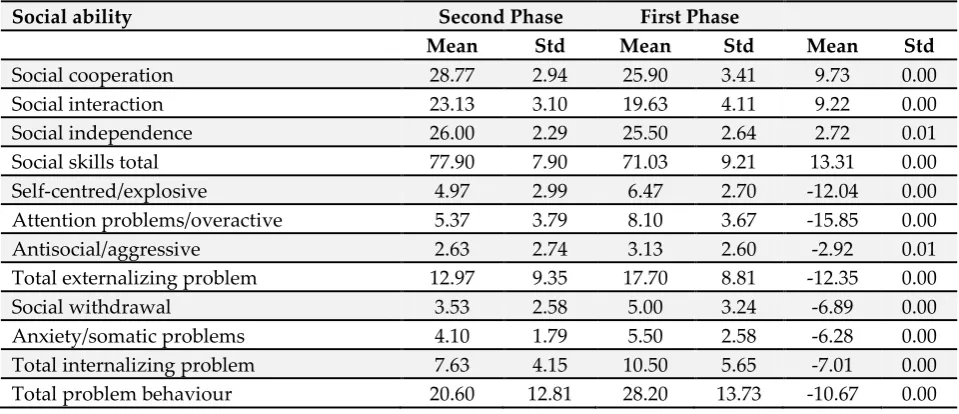
Table 1: Changes in social skills after the intervention program in the experiment group
Social ability Second Phase First Phase
Mean Std Mean Std Mean Std
Social cooperation 28.77 2.94 25.90 3.41 9.73 0.00
Social interaction 23.13 3.10 19.63 4.11 9.22 0.00
Social independence 26.00 2.29 25.50 2.64 2.72 0.01
Social skills total 77.90 7.90 71.03 9.21 13.31 0.00 Self-centred/explosive 4.97 2.99 6.47 2.70 -12.04 0.00 Attention problems/overactive 5.37 3.79 8.10 3.67 -15.85 0.00 Antisocial/aggressive 2.63 2.74 3.13 2.60 -2.92 0.01 Total externalizing problem 12.97 9.35 17.70 8.81 -12.35 0.00
Social withdrawal 3.53 2.58 5.00 3.24 -6.89 0.00
Table 2: Difference in social ability in control group
Social Ability Second Phase First Phase
Mean Std Mean Std T-test p
Social cooperation 27.83 4.58 27.17 3.93 1.62 0.12
Social interaction 22.60 3.36 23.20 3.62 -2.83 0.01
Social independence 26.40 2.57 26.00 2.82 2.35 0.03
Social skills total 76.83 9.27 76.37 8.97 0.98 0.34
Self-centred/explosive 7.47 5.70 7.53 4.16 -0.09 0.93 Attention problems/overactive 7.30 4.37 7.50 3.59 -0.44 0.67 Antisocial/aggressive 5.23 6.11 5.33 6.00 -0.90 0.38 Total externalizing problem 20.00 15.44 20.37 13.02 -0.33 0.74
Social withdrawal 5.77 5.35 6.17 5.12 -1.75 0.09
6. Analysis and Discussions
Achieved results from informative statistical processing (IBM SPSS , 22 -th version) for measured data in each subject, we confirm again the hypothesis at the beginning of this
study that movement activity modeling in this age in function of education and movement develope skills is in the right way.
In case of the achieved results from subjects in which gymnastic program with simple elements was applied for 12 weeks, the changes are significant.
Based on statistical processing results in the table number 1, 2 it seems a difference between first and second phases result in all tests of experiment group, while in the control group just in interaction and independence social.
Before the program implementation, as per control and experiment children group, the results of behavior degree questionnaire did not have any significant statistical change.
In the end of twelve weeks program, there are significant differences between groups in all their indicators. In social behavior indicators results seems a growing up trend and a trend that comes down in children social problems in the experiment group indicators. In the control group have changes in results of social behavior and social problems, which are not presented in final result.
In the first phases test (before of gymnastic program intervention) the results of control group subjects are better in social interaction, social intervention and social independence, while experiment groups results are better in social problems indicators (lower points).
After program intervention, in the social skills indicators of experiment group seems an improvement of results, while positive or negative changes in control group are inconsiderable to influence in final result. This is reflected in results of t-test between both groups.
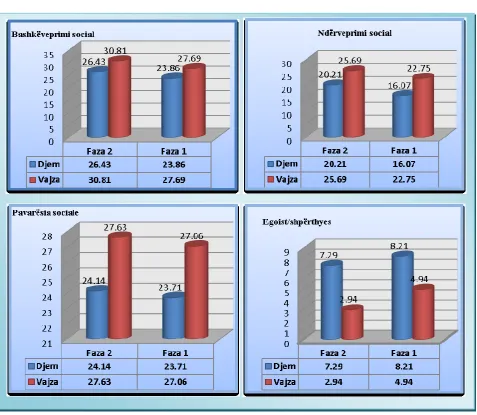
Based on results, significant changes between genders in experiment groups first phases questionnaire. They were noticed in social interaction, (t=-3.61, p=0.001); in social action (t=-7.71, p=.000), social independence (t=4.49, p=0.000); selfish/blast (t=-3.97, p=0.001); attention problems (t=-3.87, p=0.001); antisocial/aggressive (t=-3.40, p=0.003); general behavior problems (t=-2.53, p= 0.019).
It seems significant changes in all behavior indicators between first and second phase’s questionnaire in both genders (boys and girls). There is a considerable improvement in the second phase’s results, which are reflected in significant statistical changes between both genders.
The girls had an improvement in all social behavior indicators, while boys had an improvement in behavior problems indicators. Girls were appreciated better than boys in all behavior degrees. Except in social attraction and anxiety, boys had a better evaluation.
7. Conclusions
Through this study we think to offer some rational solutions with movement and social character, using a variety tools that gymnastic contains accompained by some educational and entertainment methods.
Results evidenced significant statistical improvements of experiment groups in social skills indicators.
Results evidenced significant statistical improvements of experiment groups in reducing problematic behaviors.
Intervention program with gymnastic elements has affected also in boys behavior. Results of statistical processing showed that there was a significant decrease in evaluation of social problems indicators of subjects in risk. Also in these subjects were evidenced good evaluations on social behavior indicators.
References
1. A.A.V.V. (1975). Ginnastica e giochi, Fratelli Fabri, Milano, 45-52.
2. Ackland, T. R., Elliott, B., & Bloomfield, J. (2009). Applied anatomy and biomechanics in sport. 2nd ed. Champaign, IL: Human Kinetics.
3. Alpert, B., Field, T., Goldstein, S., & Perry, S. (1990). Aerobics enhances cardiovascular fitness and agility in preschoolers. Health Psychol, 9, 48–56.
4. American Coaching Effectiveness Program., & United States gymnastics Federation. (1992). Rookie coaches Gymnastics guide. Human kinetics, Champaign, IIIinois.
5. Astrand, P.O. and Rodahl, K. (1986) Textbook of work physiology:Physiological bases of exercise. 3rd Edition, McGraw-Hill, New York.
6. Bandura, A. (1977). Social Learning Theory. New York: General Learning Press. 7. Bandura, A. (2006). Psychological modeling: conflicting theories. New Brunswick, N.J:
Aldine,Transaction, P.45
8. Bar-Or, O., & Rowland, T. (2004). Pediatric exercise medicine: from physiologic principles to health. Champaign, IL : Human Kinetics, P. 35.
9. Berk, L. (2002). Infants, children, and adolescents. Boston, MA: Allyn & Bacon.
10.Beunen, G., & Thomis, M. (2000). Muscular strength development in children and adolescents Pediatric Exercise Science, 12, 174-197.
11.Bös, K., Worth, A., Opper, E., Oberger, J., Romahn, N., Wagner ,M., Jekauc, D., Mess, F., &Woll, A. (2009). Motorik-Modul: Eine Studie zur motorischen Leistungsfähigkeit und Körrperlich-Sportlichen Aktivität von Kindern und Jugendlichen in Deutschland. Nomos Verlag.
12.Bott, J. (1995). Rhythmic Gymnastics The Skills of the Game . Crowood Press.
14.Bredekamp, S., & Copple, C. (1997). Developmentally appropriate practice in early childhood programs. Washington, DC: National Association for the Education of YoungChildren.
15.Burton, A.W., & Miller, D.E. (1998). Movement skill assessment. Champaign, IL: Human Kinetics,P. 43-367.
16.Bushnell, I. W. R., Sai, F., & Mullin, J. T. (1989). Neonatal recognition of the mother’ s face. British Journal of Developmental Psychology, 7, 3–15
17.Cooper, P., Trnka, M., & Frederick, B. (1989). Teaching Basic Gymnastics: a coeducational approach. New York :Macmillan.
18.DeCasper, A.J., & Fifer, W.P. (1980). Of human bonding: newborns prefer their mothers' voice. Science, 208, 1174-11176.
19.Denham SA, Blair KA, DeMulder E, Levitas J, Sawyer K, Auerbach-Major S, et al.(
2003) Preschool emotional competence: pathway to social competence? Child Dev. 74:238-256. [PubMed]
20.Dietrich Harre ed. Principles of Sports (Sportverlag Berlin, 1982), p. 151 17 Hardayal Singh, Science of Sports Training, p. 165 18 Ibid., p. 166
21.Duncan, J., McLeod, P., & Phillips, L.H. (2005). Measuring the mind: speed, control, and age. Oxford University Press. P. 125.
22.Everke, J. (2009). Die CoMIK-Studie Cognition and motor activty in Kindergarten.Entwicklung und Evaluation eines Bewegungsförderungs programms zur Verbesserung motorricher undkognitiver Fähigkeiten bei Kindergartenkindern.
23.Faigenbaum, A., Westcott, W., LaRosa Loud, R., & Long, C. (1999). The effects of different resistance-training protocols on muscular strength and endurance development in children. Pediatrics, 104(1), e5.
24.Fischer, K.W.,&Bidell, T. R. (1998).Dynamic development of psychological structures in action and thought. In W. Damon (Ed.), Handbook of child psychology: 45.Vol.1: Theoretical models of human development. (pp. 467–561). New York: Wiley. 25.Gallahue, D., & Ozmun, J. (2006). Understanding motor development, Infants,
children, Adolescents,Adults. (6th ed.) McGraw-Hill. ( P. 248 -270).
26.Gorus, E., De Raedt, R., Lambert, M., Lemper, J., & Mets, T. (2008). Reaction times and performance variability in normal aging, mild cognitive impairment, and Alzheimer's disease. Journal of Geriatric Psychiatry and Neurology, 21(3), 204-219. 27.Hardayal Singh, Science of Sports Training, p.164 13 Kalb, Introduction inti
General Theory and Methodoes of Training- The Performance Factor coordination Tëchnique, p. 15.
28.Harrell, J., Pearce, P., Markland, E., Wilson, K., Bradley, C., & McMurray, R. (2003). Assessing physical activity in adolescents: common activities of children in 6th -8th grades. J Am Acad Nurse Prac,15, 170–178.
29.Hartas, D. (2006). Dyslexia in the Early Years: A Practical Guide to Teaching and Learning.Taylor& Francis, P. 8.
30.Hay DF, Payne A, Chadwick A.( 2004) Peer relations in childhood. J Child
31.Johnston, J., & Nahmad-Williams, L. (2009). Early childhood studies. New York : Pearson Longman.
32.Kambas, A., Fatouros, J., Aggeloussis, N., Gourgoulis,V., & Taxildaris, K. (2003). Effect of age and sex on the coordination abilities in childhood. Inquiries in Sport & PhysicalEducation, 1(2), 152 – 158.
33.Karai Theodhor.( 2005). Psikologjia e zhvillimit1,Tiranë, 45-51. 34.Karai Theodhor.(2006). Psikologjia e zhvillimit 2,Tiranë, 78-82.
35.Kashihara, K., & Nakahara. Y. (2005). Short-term effect of physical exercise at lactate threshold on choice reaction time. Perceptual and Motor Skills, 100 (2), 275-281.
36.Kostelnik, M., Stein, L., Whiren, A., & Soderman, A. (1988). Guiding children’s social development. Cincinnati, OH: South-Western PublishingCo.
37.Kostić, R., Miletić, Đ., Jocić, D., & Uzunović, S. (2003). The influence of dance structures on the motor abilities of preschool children. Facta Universitatis, Series Physical Educationand Sport, 1(9), 83-90.
38.LaFreniere P, Masataka N, Butovskaya M, Chen Q, Dessen MA, Atwanger K, et al. (2002).Cross-cultural analysis of Social Competence and Behavior Problems in Preschoolers. Early Education & Development. 13, 201–219.
39.Leste, A., & Rust, J. (1990). Effects of dance on anxiety. American Journal of Dance Therapy,12, 19–26.
40.Malina, R.M., Bouchard, C., & Bar-Or. (2004). Growth, Maturation, and Physical Activity. 2nd edition. Champaign, IL: Human Kinetics, P. 215-220.
41.Marion, M. (2003). Guidance of young children. Columbus, OH: Merrill Prentice Hall.
42.Merrell, Kenneth W.(1994).Preschool and Kindergarten Behavior Scales. Test Manual. Miller, E. N., Fujioka, T. A., Chapman, L., & Chapman, J. (1995).
Hemispheric asymmetries of function in patients with major affective disorders. Journal of Psychiatric Research, 29, 173–183.
43.Moretti, R., Torre, P., Antonello, R. M., De Masi, R., & Cazzato, G. (2001). Complex cognitive disruption in frontal dementia related to motor neuron disease. Perceptual and Motor Skills, 92, 1213–1229
44.Najaka SS, Gottfredson DC, Wilson DB. (2001). A meta-analytic inquiry into the
relationship between selected risk factors and problem behavior. Prev Sci. 2:257– 271. [PubMed]
45.Pařízkov{, J. & Hills, AP. (2000). Childhood Obesity: Prevention and Treatment. CRC Press Inc, P. 133.
46.Piaget, J. (1962). Play, dreams and imitation in childhood. New York: W.W. Norton. 47.Pruitt, D. (Ed.; 1998). Your child: Emotional, behavioral, and cognitive development
from birththrough preadolescence. New York, NY: Harper Collins.
48.Raikes, H. (1996). A secure base for babies: Applying attachment concepts to the infant care setting. Young Children, 51 (5), 59-67.
50.Robert N. Singer, Motor Leaming and Human Përformance (New York: Macmillan Publishing Co., Inc., 1978), p. 236
51.Sanders, S. (1992). Designing preschool movement programs. Champaign, IL: Human Kinetics.
52.Schmidt, R.A., & Wrisberg, C.A. (2008). Motor learning and performance: a situation-based learning approach. 4th Human Kinetics, P. 160-184
53.Sigelman, C.K., & Rider, E.A. (2009). Life-Span Human. Development. 6th. Belmont, CA: Wadsworth. Cengage Learning.
54.Singer, D.G., Golinkoff, R.M., & Hirsh-Pasek, K. (2006). Play: how play motivates and enhances children's cognitive and social-emotional growth. Oxford University Press US,P. 7
55.Skinner, R. A., & Piek, J. P. (2001). Psychosocial implications of poor motor coordination in children and adolescents. Human Movement Science,20,73-94.
56.Stager, J.M., & Tanner, D.A. (2005). Swimming. 2ed. Wiley-Blackwell, P. 42.
57.Zachopoulou E., Liukkonen J., Pickup I., & Tsangaridou N. Eds. ( 2010). Early Steps Physical Education Curriculum: Theory and Practice for Children under 8 Champaign, IL: Human Kinetics.
58.Živčić, K., Višić, B.T., & Sentderdi,T. (2008). Changes in some of the motor abilities of preschool children (age four).
59.Wardle, J. (1995) Parental influences on children’s diets. Proceedings of the Nutrition Society , 54, 747–758.Google Scholar
Creative Commons licensing terms