www.iosrjournals.org
Resource-Diversity Tolerant: Resource Allocation in the Cloud
Infrastructure Services
1
Mr.Surya Bahadur,
2S. Ramachandra
1
Assistant Professor Department of Computer Science and Engineering Madanapalle Institute of Technology & Science Madanapalle
2
PG Student Department of Computer Science and Engineering Madanapalle Institute of Technology & Science Madanapalle
Abstract: The cloud offers data processing, data centers to process and preserve the transactional data of the clients. Dynamic capacity provisioning is promising approach for reducing energy consumption by dynamically changing number of progressive machines for contest resource condition .In processing the persistence management the data store is identified as more a power consuming process. We can reduce the power consumptions through on-demand allocation and activation of the machines as per the requests. Through there are many recent studies, but they cannot tolerate the variations in the available infrastructures and the requirements found in fabrications. Especially the fabrication systems (production data centers) all vm's may not have same capabilities ,similarly all requests are not same in the amount of resource requirements, when the priorities by availability and the requirements are not properly managed , the delay in allocation is increased,idealness of the Vm's is increased and subsequently effects the power utilizations. We propose an efficient and dynamic resource allocation mechanism based on genetic algorithm, that exactly matches the resource requirements to the capacity inferred Vm's. This mechanism reduces the energy utilization and latency. This mechanism reduces the energy utilization, latency and also finds risks from attacker.
Keywords: cloud computing, risk assessment, workload classification, resource matching.
I. Introduction
Data centers have lately increased important quality as expenditure-effective level of hosting big-standard service applications. While ample information centers use by liquidate superior gown over an ample of organization and receive enormous energy costs in status of power organization and air-cooled[6]. For example, it has reported that power-related expenses account for something like 12 percent of in general data
center disbursement [1]. For huge companies like Google, a 3 percent reduction in energy cost can translate to
over a million dollars in cost savings [1]. Recently, there is large investing on rising information of right energy efficiency. The content of this technique is to impulsive modifying to organization of information center to trim strength body process piece of gathering the service level of objectives (SLOs) of work. The situation of employment planning in information centers [9]. Project planning hold is a main concern in information center environments for several causes: (a) a customer may require to instantaneously measure up a request to meet flow on need and therefore requires the assets request to the content as early as possible. (b) Level for lesser-priority of pro-longed planning delay can cause to starvation. Production information centers have huge amount of different assets requests with diverse assets condition, period of time, precedency and performance. In particular, it has reported the variations of resource condition and period of time for several states of magnitude. Even so, scheming heterogeneousness-aware DCP strategy can be ambitious because it requires an exact classification of both workload and machine heterogeneities [4]. We propose Harmony: Heterogeneity-AwareResourceMONitoring and management system[10] that is capable of performing DCP in heterogeneous data centers is provided a theoretical bound on the size of each task class to achieve an efficient tradeoff between planning delay and energy consumption, and evaluated the effect of resource over-provisioning on solution quality. The DCP framework is to achieve both high usage of performance and ration of strength [5]. We propose an algorithm for reducing risks from attacker in order to reduce delay and allocation of time for machines.
II. Related Work:
Characterizing workload in fabrication clouds has established to a great extent in recent years, as both scheduler design and capacity upgrade require a careful understanding of the workload distinctiveness in conditions of appearance time, necessities, and period. So, the aim must be recognize the workload composition in manufacture clouds, relatively by means of effort of work classification meant for resource allotment as well as
capability conditioning[2].They further assume that each job can be programmed on some engine, which is not all the time the container to the most excellent of our information; no earlier effort has functional task categorization to active capability provisioning difficulty in various information centers[3]. The characterization can be done with The K-means clustering algorithm essentially tries to minimize the following similarity score:
Score =
Where,
„||xi - vj||‟ is the Euclidean distance between xi and vj. „ci‟ is the number of data points in ith cluster.
„c‟ is the number of cluster centers. Algorithm:
Genetic Algorithm (GA):
STEP1: create the early population of those with production programs of algorithms Longest Cloudlet to Fastest Processor (LCFP), Smallest Cloudlet to Fastest Processor (SCFP) and 8 arbitrary agendas using average waiting
time for task:
STEP 2: calculate the condition of all individuals with Task waiting in the queue:
STEP3: while termination condition not met do
oChoose fitter entities for duplicate with lowest amount implementation time.
oIntersect among entities by two point crossover.
oChange entities by straightforward change operator.
oEstimate the fitness of the customized entities having significant fitness.
oProduce a novel population. End while
a)
LCFP (Longest Cloudlet to Fastest Processor)Sort the cloudlets in descending arrange of measurement lengthwise
1.
arrange the processors in descending order of dispensation supremacy consumption of resource on machine at timePlot the cloudlets from arranged catalog as arranged catalog of processors on one to one map base.
b)
SCFP (Smallest Cloudlet to Fastest Processor)1.
arrange the cloudlets in ascending order of length with Total performance utility2.
arrange the processors in descending order of dispensation supremacy with mechanism switching cost overtimePlot the cloudlets from arranged catalog as arranged catalog of processors on one to one map base.
a.System Architecture:
b.Experimental Results: 4.1. Home Page Screen
The following screen shot is showing home page of resource diversity tolerant :resource allocation in the cloud infrastructures.
Fig4.1Home page
4.2 User Registration Page Screen
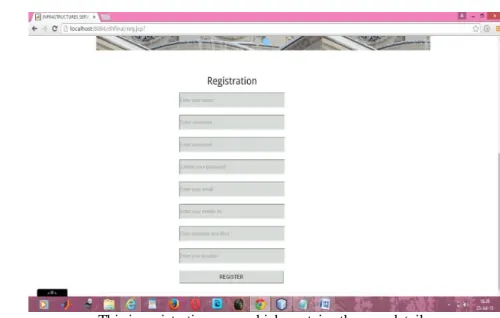
This is registration page which contains the user details.
4.3 Admin Login Page
Fig 4.3 Admin login page
After the user enter his details then the admin must be accept and give permission to use cloud so he will login as above screen.
4.4 User Login Page
Fig 4.4 User login page
4.5 User Selecting Heterogenous Systems
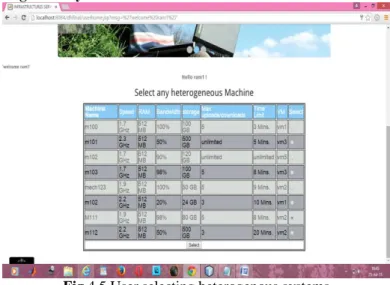
Fig 4.5 User selecting heterogenous systems
The user can select the vm machine among available resources and click select to choose machine and resources.
4.6 User Uploading Page
Fig 4.6 User uploading page Then the user can upload files here.
4.7 User Down Loading File Pages
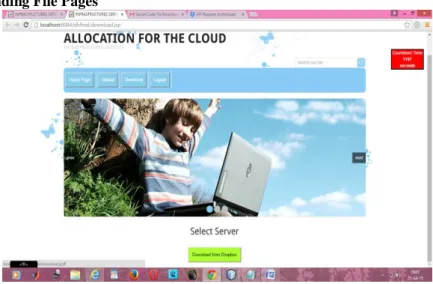
Fig 4.7 User downloading file page If user want to down load file then he has to select the server as above.
4.8 Risk Assessment Graph
Fig: 4.8 Risk assessment graph
This is the final risk assessment graph which shows highly attacked by attacker.
III. Future Enhancement:
In future, we consider the capacity of machine which require larger than available resources .So, we want to estimate the arrival machine capacities before going to allocation of resources.
IV. Conclusion:
In this paper, Resource distribution for the cloud infrastructures services has be converted into a hopeful explanation for sinking power utilization in information centers in current years. Though, presented effort on this topic has not mentioned a solution dispute, which is the variousity of workloads and physical machines. In this paper, we first make available for classification of mutually workload and machine heterogeneity and diversify the machine if it is attacked by attacker.We provide diversification of vm machines one to another which is not affected by attacker in order to reduce delay and power consumption of machines.
References
[1]. Googleclusterdata - traces of google workloads, http://code.google.com/p/googleclusterdata/.
[2]. R. Boutaba, L. Cheng, and Q. Zhang. “On cloud computational models and the heterogeneity challenge,” J. Internet Services and Applications vol.3, pp.77-86, 2012.
[3]. Y. Chen, A. Das, W. Qin, A. Sivasubramaniam, Q. Wang, and N. Gautam.” Managing server energy and operational costs in hosting centers,” In ACM SIGMETRICS Performance Evaluation Review, volume 33, 2005.
[4]. G. Jung, M. A. Hiltunen, K. R. Joshi, R. D. Schlichting, and C. Pu. “Mistral: Dynamically managing power, performance, and adaptation cost in cloud infrastructures,”. In IEEE ICDCS, 2010.
[5]. M. Lin, A. Wierman, L. Andrew, and E. Thereska. “Dynamic rightsizing for power-proportional data centers,” In IEEE INFOCOM, 2011.
[6]. A. K. Mishra, J. L. Hellerstein, W. Cirne, and C. R. Das. “Towards characterizing cloud backend workloads: insights from Google compute clusters,” SIGMETRICS Perform. Eval. Rev., 37, March 2010.
[7]. C. D. Patel and A. J. Shah1. “Cost model for planning, development and operation of a data center,”. Technical Report HPL -2005- 107(R.1), HP Laboratories Palo Alto, 2005.
[8]. C. Reiss, A. Tumanov, G. Ganger, R. Katz, and M. Kozuch. “Heterogeneity and dynamicity of clouds at scale: Google trace Analysis,”. In ACM Symposium on Cloud Comp., 2012.
[9]. S. Ren et al. “Provably-efficient job scheduling for energy and fairness in geographically distributed data centers,”. In ICDCS 2012. [10]. Q. Zhang, M. F. Zhani, R. Boutaba, and J. L. Hellerstein. “HARMONY: dynamic heterogeneity-aware resource provisioning in the
cloud,”. In IEEE ICDCS, 2013.
[11]. Q. Zhang, M. F. Zhani, Q. Zhu, S. Zhang, R. Boutaba, and J. L. Hellerstein. Dynamic energy-aware capacity provisioning for cloud computing environments,”. In ACM International Conference on Autonomic Computing (ICAC), 2012.