Technology (IJRASET)
A Video Fusion Using Wavelet Transformation
Techniques
Tamanpreet Kaur1, Er.Vinod Kumar2
Guru Kashi University, Talwandi Sabo
Abstract: Image processing techniques mainly focus upon enhancing the quality of an image or a set of images and to derive the maximum information from them. Image Fusion is such a technique of producing a superior quality image from a set of available images. Image fusion is the process that fuses the information from multiple images of the same size. The image fusion results generate new images that contain the contents and most desirable information and characteristics of each input image. A lot of research is being done in this field encompassing areas of Computer Vision, Automatic object detection, Image processing, parallel and distributed processing, Robotics and remote sensing. Sometimes, pictures are clicked using ‘Auto-focus’ function, in which background or foreground may blur. These pictures don’t convey complete information. So image fusion helps to retrieve more information from such images. Another category of images is that in which one picture is taken in more light and the other one of the same scene taken in the dark. So in that case as well the information of the scene is not complete. The solution of this problem is also ‘Image Fusion’. This thesis reports a detailed study performed over some image fusion algorithms regarding their implementation. The techniques used for image fusion are Discrete Wavelet Transform and Principal component analysis. A hybrid method for image fusion has been developed, here Discrete Wavelet Transform and Principal Component Analysis techniques are combined. The results are calculated using different quality metrics. From the values of parameter it has been observed that DWT when combined with PCA gives best results.
Keyword: PSNR, DWT, MSE, PCA, Image Fusion etc.
I.INTRODUCTION
Video fusion is the process of combining information from two or more image and videos of a scene into a single composite video that is more informative and is more suitable for the purpose of human or machine perception or for further processing tasks. The aim of video fusion is to reduce unwanted amount of data, uncertainty and minimize redundancy in the output fused video while maximizing relevant information particular to an application or task.[1] For the given same set of input image and videos different fused image and videos may be created depending on the specific application and depending upon the relevant information according to the specific application. There are several benefits in using video fusion like decreased uncertainty, wider spatial and temporal coverage, increased robustness, and improved reliability of system performance. [2]
II. VIDEO FUSION PROCESS
In video fusion process relevant information from the source image and videos from different views are combined into a single video using the fusion rules. The video resulting from
the fusion contains most of the information from all the source image and videos.[3] In a brief explanation of video fusion process, source image and videos are decomposed to source transforms and the fused transform is produced with source transforms based on fusion rule. The simplest fusion rule is choosing the one with larger magnitude. The fused video is composed through the fused transform .The applications differ from one another in using the fusion rules. The image and videos of the same modality taken at the same time but from different places or under different conditions are fused together to generate a single video with information content from both the image and videos. Such type of fusion is called as multi-view video fusion which is used in this study.[4]
III. WAVELET BASED VIDEO FUSION
Technology (IJRASET)
regularly being proposed to overcome the problems that have been noticed in the standard techniques. As multi resolution analysis has become one of the most popular methods in video processing, the wavelet transform method has become one of the useful tool for video fusion. It has been found that wavelet-based fusion techniques outperform the standard fusion techniques in spectral and spatial quality particularly in minimizing color distortion [7, 10-11]. Layouts that combine the standard methods such as PCA HIS Brovey method with wavelet transforms produce superior results than either standard methods or simple wavelet-based methods alone. However, the tradeoff is cost and higher complexity .
Figure1. Wavelet Based Fusion[5]
IV. STATIONARY WAVELET TRANSFORM
The SWT algorithm is very simple and is close to the DWT one. The SWT is a wavelet transform algorithm which is designed to overcome the lack of translation invariance of the Discrete Wavelet Transform. The SWT is the translation invariant DWT transform. The SWT transform is based on no decimation .It applies the DWT and omit both down sampling in the forward up sampling in the inverse transform. As, DWT basic computational step is a convolution followed by decimation. The decimation retains even indexed elements. But the decimation could be carried out by choosing odd indexed elements in place of even indexed elements . This choice concerns every step of the decomposition process, so at every level we chose odd or even. If we perform all the different possible decompositions of the original signal, we have 2J different decompositions, for a given maximum level J. Let us denote by j = 1 or 0 the choice of odd or even indexed elements at step j. Every decomposition is labeled by a sequence of 0's and 1's: = 1, J. This transform is called the decimated DWT. The SWT decomposes the 2D video into four sub-band structures as A, V, H, D namely Approximate, Vertical, Horizontal and Diagonal but without down sampling Then the approximation and detail coefficients at level 1 are both of size N, which is the signal length . The approximate sub-band is used for next level of the decomposition. The fused video is reconstructed by ISWT i.e inverse Stationary wavelet transform .As the fusion process is similar to DWT, instead of DWT here SWT transform is applied. It applies the transform at each point of video save the detailed coefficients and uses the approximation coefficient for further level of decomposition.
V.VIDEO QUALITY MATRIX
Technology (IJRASET)
subjective and quantitative evaluation will be the most fitting with a specific end goal to accomplish the best appraisal result.[8]
A.Peak Signal to Noise Ratio (PSNR)
The peak signal to noise ratio PSNR is the ratio between the maximum value of an video and the magnitude of background noise and is commonly used as a measure of quality of reconstruction in video fusion. It indicates the similarity between two image and videos. The higher value of PSNR the better is the fused video is[10]
PSNR=10 log10(Peak2/ MSE)
Where,
PSNR= peak signal to noise ratio MSE= Mean squared error
B.Normalize Absolute Error (NAE)
It is a measure of how far is the fused video from the original image and video. Large value of NAE indicates poor quality of the image and video.[11]
NAE = i=1∑mj=1∑n(|Aij-Bij|)
i=1∑mj=1∑n (Aij)
Where,
NAE= Normalize Absolute Error Aij = the original image and video
Bij=the fused video
i – pixel row index j – pixel column index m, n- No. of row and column
C. Maximum Difference (MD)
Large value of MD means that the video is of poor quality. It is obtained by measuring the distortion between the original and the fused image and video.[12]
MD=Max|Aij-Bij|,
i=1,2……m j=1,2……n
where,
MD= Maximum Difference
Aij = pixel values of the original video
Bij = pixel values of the fused video
i – pixel row index j – pixel column index m, n- No. of row and column
D. Normalized Cross Correlation (NCC)[13]
Normalized Cross-Correlation is one of the methods used for
template matching, a process used for finding incidences of a pattern or object within an image and video. It is computed by
NCC=i=1∑mj=1∑n (Aij*Bij)
Aij2
Where,
Technology (IJRASET)
Aij = the original image and video
Bij=the fused image and video
i – pixel row index j – pixel column index m, n- No. of row and column
VI. PROBLEM DEFINITION
The issue supported for the paper is "Color Video Fusion using a hybrid approach". Video Fusion is the procedure that produce new video that is more suitable for further processing tasks or the purpose of machine or human perception . The result of video fusion is a new video that holds the most desirable information and features of each of input image and video. The main application of video fusion is merging the colored low-resolution multispectral video and gray-level high-resolution panchromatic video . It has been noticed that the standard fusion methods perform well spatially but usually introduce spectral distortion which means that the difference of hue before and after the fusion process has been appeared. There occur color distortion problem when the fusion take place in the color image and videos. The redundancy and ambiguity related problem occurred in medical image and videos. When the fusion of two image and videos occurred there is human seeing and objective evaluation criteria related problems that I have studied in the book related survey. Due to fusion the Intensity, Saturation and the Hue of the color image and videos get affected.
VII. METHODOLOGY
[image:5.612.165.449.407.614.2]This paper is to actualize the fusion of different image and videos .Using MATLAB the implementation is performed. A number of facilities are available in MATLAB to manipulate image and videos. For technical computing MATLAB is a high-performance language. It combines computation, visualization and programming in an easy-to-use environment where problems along with solutions are expressed in familiar mathematical notation. For high-productivity development research and analysis such as computations ,algorithm development , Math , data visualization and analysis, scientific graphics , data acquisition, modeling, engineering graphics, simulation, , and many more . MATLAB is considered as one of the best tool. MATLAB is an user friendly system whose basic data element is an array that does not require dimensioning.. In the video fusion the following steps are followed:
Figure 2: Basic video fusion algorithms [3] Steps:
A. Take input image and videos of same size and of same scene or object taken from different sensors like visible and infra red image and videos or image and videos having different focus.
B. If the input image and videos are color, separate their RGB planes to perform 2D transforms.
C. Apply one of the different video fusion techniques.
D. Fuse the input video components by taking any of the pixels merging technique.
Technology (IJRASET)
VIII.RESULT & ANALYSISFigure 3:Video fusio processing
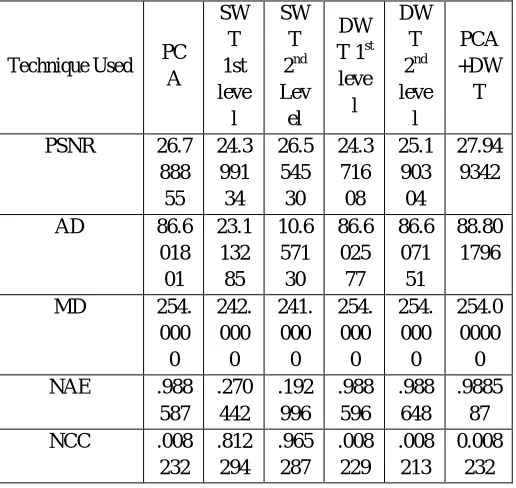
TABLE .1 . For building video various quality parametrs value
Technique Used PC A SW T 1st leve l SW T 2nd Lev el DW T 1st leve l DW T 2nd leve l PCA +DW T
PSNR 26.7 888 55 24.3 991 34 26.5 545 30 24.3 716 08 25.1 903 04 27.94 9342
AD 86.6 018 01 23.1 132 85 10.6 571 30 86.6 025 77 86.6 071 51 88.80 1796
MD 254. 000 0 242. 000 0 241. 000 0 254. 000 0 254. 000 0 254.0 0000 0 NAE .988
587 .270 442 .192 996 .988 596 .988 648 .9885 87 NCC .008
[image:6.612.179.437.444.688.2]Technology (IJRASET)
TABLE 2 .For foot video various quality parametrs value
T e c h n i q u e ’ s
PCA SWT 1st level SWT 2nd Level DWT 1st level DWT 2nd level PCA+DWT
PSNR 26.4290 26.253382 22.325582 26.216441 21.623240 28.462734 AD 100.191 -1.8649 -22.2884 100.1919 100.191 102.3917 MD 253.000 225.000 225.00000 253.000 253.00 253.0000 NAE .990118 .106236 .249962 .990119 .990119 .990118 NCC .007659 .986030 1.182001 .007658 .007658 .007659
From the study of above tables and graphs it is observed that , on the basis of different quality parameters i.e PSNR,NCC,NAE,AD and MD better video fusion results are found in case of DWT as compared to SWT for various image and videos in the database .So DWT is combined with PCA to upgrade the fusion quality .The PSNR is near to ideal Value in proposed technique ( PCA+ DWT ) as compared to other techniques . In propsed technique PSNR value is increasing and at the same time corresponding NCC value is decreasing.
Figure 4 : NCC(Normalized cross corelation ) graph of Foot video
Figure 5 - NCC(Normalized cross corelation ) graph of newspaper video
Technology (IJRASET)
IX. CONCLUSIONVideo fusion is the process that fuses the information from many image and videos of the same size. The video fusion results create new image and videos that contain the contents and most desirable information and characteristics of each input image and video. The one of the main application of video fusion is merging the gray-level high-resolution panchromatic video and the colored low-resolution multispectral image and video. Color distortion appeared when the fusion is take place in the color image and videos. There is human seeing and objective evaluation criteria related problems when the fusion of two image and videos occurred. The Intensity , Hue and Saturation of the color image and videos effected due to fusion. Video fusion is implemented to overcome the problem of color distortion.In this study multilevel SWT multilevel DWT Principle component Analysis and DWT with PCA is combined, So as to get the best results of the video fusion . The DWT coefficient can improve classification accuracy without adding new information because wavelet method can use both spectral and spatial information simultaneously. The video fusion is to creating a new video that enjoys the high-spatial resolution of image and videos and the color information of the Multispectral image and videos. To reduce the color distortion of the image and videos without destroying any factor of the image and videos like Intensity Saturation and Hue and the DWT fist level and second level technique of Video Fusion is put in use. To implement the video fusion Multilevel DWT technique PCA is combined with DWT -1st level and median filter is added to get the better results. In this research work PCA is combined with DWT 1st level based on the value of quality paramters i.e PSNR,NCC,NAE, AD and MD .
X. FUTURE WORK
In future the video fusion is executed with distinctive sorts of wavelets with their hard and delicate limit values and shows signs of improvement results. Further video fusion is actualized on the ongoing features and continuous image and videos with high resolution capture devices and gets productivity results.
REFERENCES
[1] Soma Sekhar, Dr.M.N.Giri Prasad" A Novel Approach Of Video Fusion on MR and CT Image and videos Using Wavelet Transform" IEEE ,2011.
[2] Anna Wang, Haijing Sun, and Yueyang Guan, “The Application of Wavelet Transform to Multi-modality Medical Video Fusion”, IEEE Int. Conf. on Networking, Sensing and Control (ICNSC ’06), Florida, pp270-274.
[3] B. K. Shreyamsha Kumar and M. N. S. Swamy, “Multiresolution DCT Decomposition for Multifocus Video Fusion” 26th IEEE Canadian Conference of Electrical and Computer Engineering (CCECE), 2013.
[4] Bin Yang and Shutao Li, “Pixel-level video fusion with simultaneous orthogonal matching pursuit” Elsevier, 2010.
[5] Changtao He*1, Guiqun Cao2, Fangnian Langan, “Efficient Fusion Approach for Multispectral and Panchromatic Medical Imaging” Biomedical Engineering Research March. 2013, Vol. 2 Iss. 1, Pp. 30-36.
[6] Darshana Mistry, Asim Banerjee” Discrete Wavelet Transform Using MATLAB” IJCET,2013.
[7] Deepa Kundur, Dimitrios Hatzinakos, “Toward Robust Logo Watermarking Using Multiresolution Video Fusion Principles” IEEE Transactions on Multimedia, Vol. 6, No. 1, February 2004.
[8] Firouz Abdullah Al-Wassai1, N.V. Kalyankar2, Ali A. Al-Zuky3, “The IHS Transformations Based Video Fusion” 2011.
[9] H. Jiang and Y. Tian, "Fuzzy video fusion based on modified Self-Generating Neural Network," ExpertSystems with Applications, 2011.
[10]H. Li, B.S. Manjunath And S.K. Mitra, “Multisensor Video Fusion Using Wavelet Fransform”, Graph. Models Video Process, 57(3), Pp.235-245, 1995. [11]J. H. Jang and J. B. Ra, “Pseudo-Color Video Fusion Based On Intensity-Hue-Saturation Color Space” Proceedings of IEEE International Conference on
Multisensor Fusion and Integration for Intelligent Systems Seoul, Korea, August 20 - 22, 2008.
[12]J. Wenjun Chi, Sir Michael Brady, Niall R. Moore and Julia A. Schnabel, “Fusion of Perpendicular Anisotropic MRI Sequences”, IEEE Int. Symp. on Biomedical Imaging (ISBI 2011), March 30 – April 2 2011, Chicago, pp 1455-1458.
[13]Jigar R. Patel, Jwolin M. Patel, “Medical Video Fusion Technique Using Single level and Multilevel DWT” International Journal of Engineering Research & Technology (IJERT) Vol. 3 Issue 1, ISSN: 2278-0181, January – 2014
[14]Kanaka Raju Penmetsa, V.G.Prasad Naraharisetti and N.Venkata Rao, “An Video Fusion Technique for Color Image and videos Using Dual-Tree Complex Wavelet Transform” International Journal of Engineering Research & Technology (IJERT) Vol. 1 Issue 8, ISSN: 2278-0181, October – 2012
[15]M. Chandana, S. Amutha, and Naveen Kumar, “A Hybrid Multi-focus Medical Video Fusion Based on Wavelet Transform”, International Journal of Research and Review in Computer Science (IJRRCS), August 2011 .
[16]Mirajkar Pradnya P., 2sachin D. Ruikar, “Video Fusion Based on Stationary Wavelet Transform” Mirajkar, Et Al, International Journal of Advanced Engineering Research and Studies E-Issn2249–8974.
[17]Rajenda Pandit Desale and Sarita V. Verma, “Study and Analysis of PCA, DCT & DWT based Video Fusion Techniques” IEEE International Conference on Signal Processing, Video Processing and Pattern Recognition, 2013.
[18]Rick S. Blum, “Robust Video Fusion Using A Statistical Signal Processing Approach”, Video Fusion, 6, Pp.119-128, 2005.
![Figure 2: Basic video fusion algorithms [3]](https://thumb-us.123doks.com/thumbv2/123dok_us/8577626.859863/5.612.165.449.407.614/figure-basic-video-fusion-algorithms.webp)