R E S E A R C H A R T I C L E
Open Access
Do nurses reason
‘
adaptively
’
in time limited
situations: the findings of a descriptive
regression analysis
Huiqin Yang
1*, Carl Thompson
2and Martin Bland
2Abstract
Background:Time pressure is common in acute healthcare and significantly influences clinical judgement and decision making. Despite nurses’judgements being studied since the 1960s, the empirical picture of how time pressure impacts on nurses’judgement strategies and outcomes remain undeveloped. This paper aims to assess alterations in nurses’judgement strategies and outcomes under time pressure in a simulated acute care setting. Methods:In a simulated acute care environment, ninety-seven nurses were exposed to 25 clinical scenarios under time pressured and no time pressured conditions. Scenarios were randomly sampled from a large dataset of patient cases. A reference standard (judgement correctness) was generated from the same patient case records. In 12 of the scenarios only 20 seconds per judgement was allowed, in the other 13 scenarios no time pressure existed. Percentage of correct judgments in both conditions was calculated. Logistic regression modelling (of 2,425 observations) described the relationship between information cues used and judgments made. The degree of attention paid to particular cues was captured by calculating cue relative weights. The clustering effect of nurses was countered by estimating robust standard errors. The Chow test was used to test the null hypothesis that differences in regression coefficients in time pressure and no time pressure models were zero.
Results:Compared to no time pressure, no significant difference was observed in the proportion of correct judgments when nurses were put under time pressure. However, time pressure significantly impacted on the judgment strategies employed. Whilst nurses predominantly used respiration rate to make judgements, they used fewer cues to reach their clinical judgements under time pressure. The relative weighting afforded to heart rate was much smaller in the time pressure regression model, indicating that nurses paid significantly less attention to it when making judgements under time pressure.
Conclusions:Time pressure had a significant effect on nurses’judgement strategies but not outcomes. Nurses tended to use less information to reach judgements under time pressure, but not at the expense of judgment accuracy. Findings imply that nurses are capable of using adaptive judgement strategies to cope with moderate time pressures when making clinical judgements in acute care.
Keywords:Time constraints, Clinical simulation, Judgement strategies, Judgement outcome
* Correspondence:[email protected] 1
Centre for Reviews and Dissemination, University of York, York YO10 5DD, UK Full list of author information is available at the end of the article
Background
Time pressure – a constraint placed on a decision task with an explicit deadline of time [1] - is a significant in-fluence on clinical judgement and decision making [2-4]. Time pressure is a particularly important influence on clinical practice in acute and critical care [5-7]. Nurses are not immune from such pressures; they must operate in a dynamic environment in which time pressure is very evident [8-11]. It has been reported that acute and crit-ical care nurses make a judgment every 30 seconds in an average eight hour shift [11]. Time pressure adds to the complexity of clinical judgements and as such influences the quality of the judgements of clinical professionals [12,13]. A key judgement made by nurses in this dy-namic and time constrained environment is the assess-ment of patients for increased risk of deterioration and/ or a critical event (such as cardiac or respiratory rate). Nurses who get this judgement wrong effectively prevent or delay the “rescue” [14,15] of patients by delaying ap-propriate medical interventions.
Time pressure has the potential to attenuate clinicians’ judgement performance. Gonzalez [16] illustrated that individuals making judgements in high time pressured conditions performed worse than individuals making the same judgements under low time constrained condi-tions. Hyde et al. [2] examined the judgement process of general practitioners when prescribing antidepressants and found that time significantly influenced their pre-scribing judgements. Shye et al. [3] investigated factors affecting physicians’ ordering of medical tests for low back pain; again, time constraints were an influential fac-tor. Cohen et al. [4] explored the process behind doctors’ judgements when choosing injury prevention strategies for children aged under two; time pressure limited the number of prevention strategies suggested.
Little is known of the impact of time pressure on nurses’ judgement strategies (i.e. the reasoning behind a judge-ment) and judgment performance (the outcomes that result). Simulating clinical environments and judgement challenges offers a safe means of eliciting realistic judg-ment responses without exposing patients (and nurses) to unnecessary risks. In this paper we investigate how nurses respond to time pressure when evaluating whether pa-tients are at risk of acute deterioration. Specifically, we set out to investigate whether time pressure negates nurses’ judgment performance and changes the information used in judgements in simulated acute care.
Methods
We used a university clinical simulation lab to simulate 25 clinical scenarios in which five pieces of patient infor-mation were deliberately varied: respiration rate, heart rate, body temperature, systolic blood pressure and con-sciousness (see Appendix 1). These five clinical cues
have been established as valid by a clinical guideline from the National Institute for Health and Clinical Ex-cellence (NICE) [17]. All are commonly used in clinical assessments of the risk of catastrophic deterioration in acute and critical care patients [18]. All clinical simu-lations were conducted in the clinical simulation lab in the University of York (UK). A simulated emergency room together with a computerized patient simulator (Laerdal™ SimMan, Stavanger, Norway) and a bedside vital sign monitor were properly set up. The bedside vital sign monitor with this computerised patient (Laerdal™ SimMan, Stavanger, Norway) was used to simulate and display these five cues. The simulated setting was analo-gous to the normal practice setting in the UK.
The clinical scenarios were constructed using randomly sampled data from medical emergency admissions pro-spectively collected in a Medical Admissions Unit in a provincial National Health Services (NHS) district general hospital [19]. A‘reference standard’of judgment correct-ness was generated using the same patient case records that formed the basis for each scenario. If the patient case reached any one endpoint (these included death, intensive care or high dependency unit admission, and cardiopul-monary arrest) the simulated scenario was classified as‘at risk’ of catastrophic deterioration and a ‘correct’ judge-ment would also be to classify the patient as‘at risk’.
of the start of the scenario. The task of making and re-cording the judgement for each scenario had to be com-pleted within 20 seconds, with no extension time being permitted. There were no dropouts from the sample of participants being recruited. All the participants com-pleted all of the 25 scenarios. All the scenarios were tested prior to the study and three pilot participants run through all these scenarios in order to check any infeasi-bility involved in the procedure of data collection and clinical simulation. Each participant gave written consent to participate, all participant information was anony-mised and formal ethical approval for this study was granted by the Health Sciences Research Governance Committee at the University of York (UK).
Data analysis
Logistic regression models were constructed for time pressured and non pressured conditions to describe and predict the relationship between information cues and judgments made. The effects of time pressure on nurses’ judgements were then examined by comparing the two sets of prediction models (based on observations for time pressured scenarios and those for non constrained scenarios). The hypothesis that nurses use different judg-ment strategies in time pressured and non constrained conditions was tested by comparing the regression coef-ficients associated with the independent variables (cues): heart rate, body temperature, systolic blood pressure, and consciousness. The Chow test [20,21] was used to test the null hypothesis that the difference of regression coefficients between the logistic regression models of time pressure and no time pressure was zero. This ap-proach offers a sound method of hypothesis testing on whether the regression coefficients estimated over one group of data are equal to the coefficients estimated over another [20].
Because the same participants were used for each sce-nario in these regression models, any clustering effect was adjusted for in the logistic regression models by gene-rating robust standard errors [22,23]. A clustering effect would mean that heteroskedasticity would be present: the data are independent but not identically distributed. If the clustering effect is ignored in the analysis, the confidence intervals would be too narrow (hence artificially extreme p values), increasing the chances of false positive findings [24]. We adjusted for the clustering effect of nurses using the robust estimator method (sometimes called the Huber/White/sandwich estimator method) [23] - relaxing the assumption of independence within clusters and esti-mating robust standard errors. The logistic regression models were based on 2,425 observations.
The calculation of cue relative weights provides a means of ascertaining to which degree the participants paid at-tention to a particular cue (e.g. heart rate, respiratory rate)
in their judgements [25]. Cue relative weights were calcu-lated from the regression coefficients in the time pressure and no time pressure logistic regression models. It should be noted that in a multivariate regression model where the effects of all other predictive variables are held con-stant, a particular independent variable (the information cue) with relatively large coefficient would be expected to have a relatively large effect on the prediction of judgements.
When using logistic regressions to derive cue relative weights, the confounding effect of the measurement scale on the magnitude of ‘raw’ regression coefficients should be further dealt with properly. To address this, we standardised all independent variables (cue values) prior to undertaking further analysis by converting them into z-scores with the same scale of mean and standard deviations. However, the dependent variable (whether a simulated patient was‘at risk’or not) cannot be standar-dised, thus resulting in a non-zero constant in the final logistic regression equation. Therefore, the constant was also factored into calculating the relative weights, i.e. adding up all the regression coefficients & the constant and further normalising them to 1. The percentage correct of judgments under time pressure and no time pressure stratified by task difficulty was also calculated. P < 0.05 was used as the cut-off level for statistical sig-nificance. All the analyses were conducted using the Stata 10 programme (www.Stata.com).
Results
Ninety seven participants took part in the study. There were sixty-three student nurses (mean age 28 years; stan-dard deviation (SD) 8.2)) and thirty-four experienced nurses (mean age 37 years, SD 10.0). Experienced nurses had an average of 12 years of clinical experience. 89% of student nurses and 85% of experienced nurses were female. All of the students had been educated a plenty of times for using simulation facilities in the clinical simula-tion lab. All of the experienced nurses confirmed that the simulation environment was very similar to their clinical practice setting.
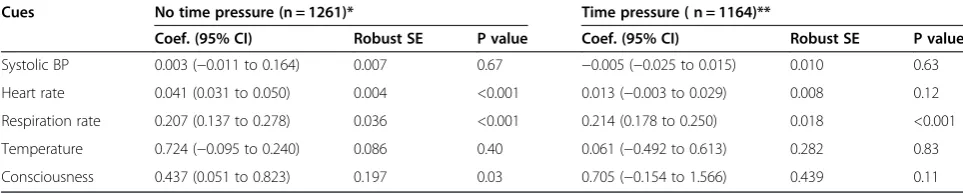
The results of logistic regression models for no time pressure and time pressure conditions are summarized in Table 1. The regression coefficient of heart rate was significantly larger in the model of no time pressure than the model of time pressure, chi2 (1) = 6.19, P = 0.01. There were no significant differences in the regression coefficients for other cues between time pressure and no time pressure models.
participants predominantly used respiration rate – associated with the highest relative weight - to make judgements for these simulated patients in terms of whether they were at risk of acute deterioration. The relative weight (0.298) of heart rate was much higher in the model of no time pressure when compared to its relative weight (0.098) in the model of time pressure, indi-cating that under time pressured situations participants paid less attention to heart rate to make judgements.
Table 3 shows that the proportions of correct judge-ments under conditions of time pressure and no time pressure stratified by task difficulty were not significantly different. To render a scenario easy or difficult, the Mo-dified Early Warning Scoring system (MEWs) [19] was utilised to convert the value of each clinical information cue to a score with a range between 0 and 3. We then calculated the total MEWs score by summing these scores from each information cue. If the scenario had a total MEWs score of greater than a clinically significant threshold of five, then this scenario was classified as at risk of acute deterioration. However, it should be noted that each scenario being classified as at risk may not be associated with a bad patient outcome and vice versa; this reflects the uncertainty of relationship between clin-ical signs and patient outcomes. Seventeen scenarios where score risk classification and patient outcome were consistent were classified as easy. Eight scenarios where score risk classification and patient outcome were incon-sistent were classified as difficult. We report on the role of task difficulty elsewhere [26].
Discussion
This exploratory study revealed that time pressure had little effect on the quality of judgement outcomes in a simulated acute care setting; a finding that contradicted results from other psychological studies [27-29] where time pressure was shown to produce a significant re-duction in the quality of judgement and decision ma-king. This finding was also inconsistent with a study with nurses [30] that showed the quality of nurses’judgements significantly deteriorated under time pressure.
One possible explanation for this contradiction was that nurses may experience increased urgency (rather than de-creased quality) in judgement in response to what was per-ceived as only‘mild’time pressure. In this study, mild time pressure was induced by using a time limit of 20 seconds– a constraint sufficient to complete the task but not gene-rous. Under such mild constraints decision makers might effectively cope with situations by executing an appropriate action within the time allowed [31] using a strategy of
accelerated information processing [31,32]. Acceleration, an increase in the speed of information processing, has been identified as a common adaptation to time pressure [27,33]. With the imposition of time constraints, partici-pants accelerate information processing in order to imple-ment a preferred strategy. This could be attributed to increased anxiety and energy arising from time pressure [32], thus leading participants to cope with judgements within time limits. This study only induced two states:‘no time pressure’and‘time pressure’. There is a need for fu-ture research to identify the effect of different states of time pressure on judgements and identify any cognitive thresh-olds, or tipping points, associated with the shift from mild to severe time constraint.
Despite no measurable change in judgement outcomes, the findings from our study show that time pressure does lead to changes in judgement strategies. This indicates that changes in judgement strategies under time pressure are not necessarily associated with changes in judgement performance, suggesting that there is more than one way of processing clinical information to reach the same judgement under the specific context of time pressure. For example, the findings from our study revealed heart Table 1 Logistic regression models of no time pressure and time pressure in acute care simulation settings
Cues No time pressure (n = 1261)* Time pressure ( n = 1164)**
Coef. (95% CI) Robust SE P value Coef. (95% CI) Robust SE P value
Systolic BP 0.003 (−0.011 to 0.164) 0.007 0.67 −0.005 (−0.025 to 0.015) 0.010 0.63
Heart rate 0.041 (0.031 to 0.050) 0.004 <0.001 0.013 (−0.003 to 0.029) 0.008 0.12
Respiration rate 0.207 (0.137 to 0.278) 0.036 <0.001 0.214 (0.178 to 0.250) 0.018 <0.001
Temperature 0.724 (−0.095 to 0.240) 0.086 0.40 0.061 (−0.492 to 0.613) 0.282 0.83
Consciousness 0.437 (0.051 to 0.823) 0.197 0.03 0.705 (−0.154 to 1.566) 0.439 0.11
*Pseudo R2 = 0.28. **Pseudo R2 = 0.50.
Table 2 Cue relative weights in logistic regression models of no time pressure and time pressure
Cues in the regression models
Cue relative weight
No time pressure Time pressure
Systolic BP 0.027 0.047
Heart rate 0.298 0.098
Respiration rate 0.551 0.587
Temperature 0.020 0.017
rate contributed less to judgements in time constrained scenarios with no discernible impact on judgement qual-ity. Of course, this picture could be due to the limited value of heart rate in predicting acute deterioration and the fact that other cues such as respiratory rate should be given more weight as they have a higher positive predic-tive value.
It is important to note that under time pressure nurses tend to use fewer clinical cues and the predominant cli-nical cue for making judgements was (appropriately) res-piration rate. This result is consistent with the findings by Svenson and Edland [34], which indicate that a greater weight is given to the most important information cue under the condition of time pressure. Moreover, the effect of time pressure on differential cue utilisation also repli-cates the findings by Wright [35] and Rothstein [29] that time pressured judges tend to change their strategies by relying on fewer cues than no-time-pressured judges.
The use of fewer cues with no loss of quality, can be explained by the notion that nurses reason adaptively: an enhanced process of information filtration and omission in time pressured conditions [31,36,37]. For example, Edland [38,39] and Laurence et al [40] showed that people under time pressure focused more on the most important attributes and were more likely to prioritise important information. More generally Herbert Simon was awarded the Nobel Prize for economics for his idea that information and other constraints will always pre-vent wholly pure rational judgement and decision ma-king – we will always operate in a boundedly rational environment [41,42]. Gigerenzer [43] describes our adaptation to this bounded, but still information-rich en-vironment by outlining“fast and frugal” reasoning stra-tegies such as the“take the best [cue and use that]” as a successful strategy for good quality judgements [43-48]. With the fast and frugal strategy, participants often do not need to sacrifice accuracy but must consider fewer alternatives with increased speed and pay most attention to the discriminating cue.
Time pressure increased the (cognitive) complexity of a critical care environment [49]. The proportional increase in activities and potential for interruptions to clinical activities [50] and the limited time for deliberation on im-perfect information cues [51] mean that more (infor-mation) is squeezed into a narrower cognitive space. As a response, time pressured nurses tend toward clinical experience based intuitive judgements instead of more
analytic, externally supported (using clinical decision support systems for example), approaches to reducing un-certainty and reaching judgements [52,53]. Our study sug-gests that for this information limited and simulated task, nurses are able to cope with a certain level of time pres-sure by employing adaptive reasoning strategies that result in considerable savings in cognitive effort without com-promising judgement accuracy. This optimistic picture though should be viewed cautiously. This was a neces-sarily simple experiment in which the amount of informa-tion, the values used, and the ways it was presented, was controlled and where we knew the predictive value of the information contained. For many (if not most) of health-care these characteristics and knowledge are often absent. Research suggests that nurses’[14,15] - like other health-care professionals [54] - adaptive responses are not always optimal.
Strengths and limitations
One of the key strengths of our study was that we used real records of the simulated cases to establish the re-ference standards, which ensured the robustness of ref-erence standards. However, this study uses a rather simple method to induce time pressure by imposing a fixed deadline on the whole group. This approach as-sumes that a fixed deadline induces the same state of time pressure for all participants, but it fails to consider the difference between individual participants in terms of the amount of time they normally take to complete a task under no time pressure. For example, a nurse who normally requires a short time to make a risk assessment in practice may feel less pressured under this fixed time frame. Further research may need to define time pres-sure from individual nurses’ perspectives. Assessing the effect of different states of time pressure (e.g. mild vs. extreme) on judgement performance also needs to be carefully examined in future research. Furthermore, a limited sample size of the participants did not allow a re-liable subgroup analysis between experienced nurses and student nurses to investigate the effect of clinical ex-perience under time pressure and no time pressure con-ditions. Further research with a larger sample size is required to investigate the assumption that clinical ex-perience may have differential effect under time con-straint situations. In addition, as our study only focused on acute care setting, our findings may not be generalizable to other settings. Future researchers should investigate Table 3 Proportion correct of judgments in acute care simulation settings
Easy scenarios Difficult scenarios
Outcomes No time pressure Time pressure No time pressure Time pressure
Mean of proportion correct (%) 88.14 89.69 40.94 39.18
whether similar findings can be replicated in other clinical settings as well as other groups of clinicians.
Implication for practice
The findings from our study have revealed that time pres-sure does not necessarily negatively impact on nurses’ judgement performance. Instead, nurses cope efficiently with (a degree of) time pressure by accelerating judgement processes without sacrificing accuracy. It suggests that nurses are capable of dealing with certain levels of time pressure, such as the mild state introduced in this study. However, it should be recognised that extreme time pres-sure could still potentially compromise nurses’judgement performance [30]. Therefore, minimising time pressure in practice is a desirable policy objective for fostering good quality nursing judgements.
Conclusions
This study has tested whether time pressure impacts on both judgement strategies and outcomes in the context of simulated acute care settings. It provides insights into nurses’ judgement performance and the strategies used when confronting time pressure in clinical environments. Time pressure exerts a significant effect on nurses’ judge-ment strategies but little impact on judgjudge-ment outcomes: nurses tend toward a more efficient use of information to reach judgements under time pressure. Findings imply that nurses are capable of usingadaptivejudgement strat-egies to cope with mild -not extreme- time constraints when making judgements in acute care settings.
Appendix 1: Acute care clinical simulation scenario
Background
Mr. Robert Wright, 63 years old and 76 kg weight, was presented to the emergency room in your hospital, ac-companied by his wife. He was generally feeling unwell, with a tender abdomen and vomited after each meal for past 2 days. He was born in England and he has been married for 38 years. He is a senior engineer in an auto-motive company. He has no food or medical allergies. There was no report of use of medications. He has no sig-nificant past medical history or history of mental illness. The details of family history are unclear. The sets of clin-ical information relating to the patient’s vital signs from the computerised patient simulator (Laerdal ™SimMan) and vital signs monitor are available to you when you assess Mr. Wright on admission. Please make your judgments for each scenario.
An example of clinical scenario information being simulated by the computerised patient simulator Laerdal™SimMan.
Systolic blood pressure 130 mmHg
Heart rate 72 beats per minute
Respiratory rate 20 breaths per minute
Temperature 36.8
Conscious level Alert
An example of the participant’s response sheet for a simulated clinical scenario.
Scenario 8 Risk (circle)
YES NO
Competing interests
The authors declare that they have no competing interests.
Authors’contributions
HY and CT were responsible for the study conception and design. HY performed the data collection. HY and MB performed the data analysis. HY was responsible for drafting the manuscript. HY, CT and MB made critical revisions to the paper for important intellectual content. HY and MB provided statistical expertise. All authors read and approved the final manuscript.
Acknowledgment
This article presents independent research funded in part by the National Institute for Health Research (NIHR) through the Leeds York Bradford Collaboration for 19 Leadership in Applied Health Research and Care. The views expressed in this publication are those of the authors and not necessarily those of the NHS, the NIHR or the Department of Health.
Author details
1Centre for Reviews and Dissemination, University of York, York YO10 5DD, UK. 2
Department of Health Sciences, University of York, York, York YO10 5DD, UK.
Received: 2 June 2013 Accepted: 23 October 2014 Published: 15 November 2014
References
1. MacGregor D:Time pressure and task adaptation: alternative perspectives on laboratory studies.InTime pressure and stress in human judgment and decision making.Edited by Svenson O, Maule AJ. New York: Plenum Press; 1993:73–82.
2. Hyde J, Calnan M, Prior L, Lewis G, Kessler D, Sharp D:A qualitative study exploring how GPs decide to prescribe antidepressants.Br J Gen Pract 2005,55:755–762.
3. Shye D, Freeborn DK, Romeo J, Eraker S:Understanding physicians’ imaging test use in low back pain care: the role of focus groups.
Int J Qual Health Care1998,10:83–91.
4. Cohen LR, Runyan CW, Downs SM, Bowling JM:Pediatric injury prevention counseling priorities.Pediatrics1997,99:704–710.
5. Goldman GM, Ravindranath TM:The contextual nature of critical care judgment.J Intensive Care Med1994,9:58–63.
6. Zimmerman O, Halpern P:Opinion survey of analgesia for abdominal pain in Israeli emergency.Israel Med Assoc J2004,6:681–685. 7. Willson H:Factors affecting the administration of analgesia to patients
following repair of a fractured hip.J Adv Nurs2000,31:1145–1154. 8. Bucknall T:The clinical landscape of critical care: nurses’decision-making.
J Adv Nurs2003,43:310–319.
9. Currey J, Botti M, Browne J:Hemodynamic team decision making in the cardiac surgical intensive care context.Heart Lung J Acute Critical Care 2003,32:181–189.
10. Bucknall T, Thomas S:Nurses’reflections on problems associated with decision-making in critical care settings.J Adv Nurs1997,25:229–237. 11. Bucknall TK:Critical care nurse’decision-making activities in the natural
clinical setting.J Clin Nurs2000,9:25–35.
13. Gerdtz MF, Bucknall TK:Why we do the things we do: applying clinical decision-making frameworks to triage practice.Accid Emerg Nurs1999,
7:50–57.
14. Aiken LH, Clarke SP, Cheung RB, Sloane DM, Silber JH:Educational levels of hospitals nurses and surgical patient mortality.J Am Med Assoc2003,
290:1617–1623.
15. Aiken LH, Clarke SP, Sloane DM, International Hospital Outcomes Research Consortium:Hospital staffing, organisation, and quality of care: cross-national findings.Int J Qual Health Care2002,14:5–13.
16. Gonzalez C:Learning to make decisions in dynamic environments: effects of time constraints and cognitive abilities.Hum Factors2004,
46:449–460.
17. National Institute for Health and Clinical Excellence:Acutely ill patients in hospital: recognition of and response to acute illness in adults in hospital, Volume 50. London: National Institute for Health and Clinical Excellence (NICE): clinical guideline; 2007:1–107.
18. Independent Healthcare Association:Guidance on comprehensive critical care for adults in independent sector acute hospitals.London: Independent Healthcare Association; 2002:1–47.
19. Subbe CP, Kruger M, Rutherford P, Gemmel L:Validation of a modified Early Warning Score in medical admissions.QJM2001,94:521–526. 20. Gould W:Can you explain Chow tests?Stata Corporation. Stata; 2002.
http://www.stata.com/support/faqs/statistics/chow-tests/.
21. Gould W:Computing the Chow statistics.http://www.stata.com/support/ faqs/statistics/computing-chow-statistic/: Stata Corporation. Stata; 1999. 22. Bland M:Cluster randomised trials in the medical literature: two
bibliometric surveys.BMC Med Res Methodol2004,4:1–6. 23. Kirkwood BR, Sterne J:Essential medical statistics.2nd edition. Oxford:
Blackwell Sciences; 2003.
24. Campbell MK, Grimshaw JM:Cluster randomised trials: time for improvement.BMJ1998,317:1171–1172.
25. Cooksey RW:Judgment analysis: theory, methods, and applications.California: Academic Press; 1996.
26. Yang H, Thompson C, Bland M:The effect of clinical experience, judgment task difficulty and time pressure on nurses’confidence calibration in a high fidelity clinical simulation.BMC Med Inform Decis Mak 2012,12:113.
27. Payne JW, Bettman JR, Johnson EJ:The adaptive decision maker.Cambridge: Cambridge University Press; 1993.
28. Payne JW, Bettman JR, Johnson EJ, Luce MF:An information processing perspective on choice.InDecision making from a cognitive perspective. New York: Academic Press; 1995.
29. Rothstein HG:The effects of time pressure on judgement on multiple cue probability learning.Organ Behav Hum Decis Process1986,37:83–92. 30. Thompson C, Dalgleish L, Bucknall T, Estabrooks CA, Hutchinson A, Fraser K,
de Vos R, Binnekade J, Barrett G, Saunders J:The effects of time pressure and experience on nurses’risk assessment decisions: a signal detection analysis.Nurs Res2008,57(5):302–311.
31. Maule AJ, Edland AC:The effects of time pressure on human judgement and decision making.InDecision making: cognitive models and explanations.London: Routledge; 1997:189–204.
32. Maule JA, Hockey RJ, Bdzola L:Effects of time pressure on decision-making under uncertainty: changes in affective state and information processing strategy.Acta Psychol2000,104:283–301.
33. Benson L, Beach LR:The effects of time constranints on the prechoice screening of decision options.Organ Behav Hum Decis Process1996,
67:222–228.
34. Svenson O, Edland A:Change of preferences under time pressure: choices and judgements.Scand J Psychol1987,31:262–270.
35. Wright P:The harassed decision maker: time pressure, distraction, and the use of evidence.J Markeing Res1974,44:429–443.
36. Hasida BZ, Shlomo JB:The effect of time pressure on risky choice behavior.Acta Psychol1981,47(2):89–104.
37. Huber O, Kunz U:Time pressure in risky decision-making: effect on risk defusing.Psychology Science2007,49:415–426.
38. Edland AC:The effects of time pressure on choices and judgements of candidates to a university programme.InTime pressure and stress in human judgement and decision making.New York: Plenum; 1993. 39. Edland A:Time pressure and the application of decision rules: choices
and judgements among multiattribute alternatives.Scand J Psychol1994,
35:281–291.
40. Laurence A, Bernadette D, Matthew L, Nicola P, Amy H:The effects of subjective time pressure and individual differences on hypotheses generation and action prioritization in police investigations.J Exp Psychol Appl2013,19:83–93.
41. Simon HA:Models of bounded rationality.Cambridge: The MIT Press; 1982. 42. Simon HA:Models of man.New York: Wiley; 1957.
43. Gigerenzer G:Fast and frugal heuristics: the tools of bounded rationality.
InBlackwell handbook of judgment and decision making.Edited by Koehler DJ, Harvey N. ; 2004:62–88.
44. Gigerenzer G, Goldstein DG:Reasoning the fast and frugal way: models of bounded rationality.Psychol Rev1996,103:650–669.
45. Gigerenzer G, Goldstein DG:Betting on one good reason: the take the best heuristics.InSimple heuristics that make us smart.Edited by Gigerenzer G, Todd PM, he ABC Research Group. Oxford: Oxford University Press; 1999:75–96.
46. Gigerenzer G, Goldstein DG:Reasoning the fast and frugal way: models of bounded rationality.Cambridge: Cambridge University Press; 2000:621–650. 47. Gigerenzer GJ, Czerlinski J, Martignon L:How good are fast and frugal
heuristics?InHeuristics and biases: the psychology of intuitive judgment. Edited by Gilovich T, Griffin D, Kahneman D. Cambridge: Cambridge University Press; 2002.
48. Gigerenzer G:Gut Feelings: The Intelligence of the Unconscious.New York: Viking Press; 2008.
49. Wilson T, Holt T, Greenhalgh T:Complexity science: complexity and clinical care.BMJ2001,323:685–688.
50. Chisholm CD, Collison EK, Nelson DR, Cordell WH:Emergency department workpalce interruptions:are emergency physicians‘interrupt-driven’and‘ Multitasking’?Acad Emerg Med2000,7:1239–1243.
51. Sintchenko V, Coiera EW:Which clinical decisions benefit from automation? a task complexity approach.Int J Med Inform2003,70:309–316.
52. Gerdtz MF, Bucknall TK:Triage nurses’clinical decision making. An observational study of urgency assessment.J Adv Nurs2001,35:550–555. 53. Estabrooks CA, Rutakumwa W, O’Leary KA, Profetto_McGrath J, Milner M,
Levers MJ, Scott-Findlay S:Sources of practice knowledge among nurses.
Qual Health Res2005,15:460–476.
54. Eddy DM:Variation in physician practice: the role of uncertainty.In Professional judgement: a reader in clinical decision making.Edited by Dowie EJ, Elstein A. Cambridge: Cambridge University Press; 1988.
doi:10.1186/1472-6947-14-96
Cite this article as:Yanget al.:Do nurses reason‘adaptively’in time
limited situations: the findings of a descriptive regression analysis.BMC Medical Informatics and Decision Making201414:96.
Submit your next manuscript to BioMed Central and take full advantage of:
• Convenient online submission
• Thorough peer review
• No space constraints or color figure charges
• Immediate publication on acceptance
• Inclusion in PubMed, CAS, Scopus and Google Scholar
• Research which is freely available for redistribution Submit your manuscript at