International Journal of Emerging Technology and Advanced Engineering
Website: www.ijetae.com (ISSN 2250-2459, Volume 2, Issue 11, November 2012)782
A Novel Approach For Enhance Security On Database Using
Proposed Algorithms
1Anjana Nigam, 2Prof. Roopali Soni
1M. Tech. Scholar (CSE) TCT, Bhopal, [email protected] 2M. Tech. Coordinator (CSE) TCT, Bhopal, [email protected]
Abstract: A new design strategy for block ciphers based on the same techniques that are used to protect block ciphers against linear cryptanalysis. Here shows a carefully designed linear structure can be surprisingly efficient in diffusing the nonlinearity of very few small nonlinear components. Based on this strategy, we developed a new small and efficient encryption/decryption algorithm. This paper examines the comparison between new encryption/decryption block cipher algorithms with the existing one . Moreover this paper presenting a relational database system based on proposed encryption schemes to preserve the integrity and confidentiality of the data. Key Word: Database, Encryption, Decryption, Security, Text, SQL, Key
I.
I
NTRODUCTIONEncrypting databases is very important because databases are one of the best targets for hackers. They prefer to get millions of confidential information all at once rather than intercepting them one at a time, and a million or more records at once is what they can get from hacking a database
.
The question even among current adopters is how effective are their deployments? With so many options available from native database encryption to column-level tokenization, the choices for obfuscating or hiding data is dizzying. And when organizations don't employ best practices with their particular choice, their costs and complexities go up and the risk of a breach may not even necessarily go down. The primary objectives of database security are to prevent unauthorized access to data, prevent unauthorized tampering or modification of data, and to insure that data remains available when needed. The concepts related to database security are multifaceted. Research in the field of database is important because there are so many reason which is databases often store data which is sensitive in nature, incorrect data or loss of data could negatively affect business operations and threats to databases like loss of integrity, loss of availability and loss of confidentiality The cryptographic technique of using keys to encrypt and store data was applied to achieve security. There were many restrictions and challenges like operations\computations on encrypted data, view-based protection, etc. This research focuses on a security solution for protection of data at rest, specifically protection of data that resides in databases.II.
P
ROPOSEDW
ORKProposed Concepts: Proposed encryption is divided into two phases. And step of each phase is described one by one. In Phase –I
1. Select Key of 128 bits as a K1
2. Select an attribute as a Plain text (PT) of 128 bits size from relation database (R). If it’s not 128 bits in size then padding will apply.
3. Divide K1 and PT into two equal parts K11, K12 for Key (K1) and PT1, PT2 for PT.
4. Apply 2 bits right circular shift on K11 and perform XOR operation with PT1. Output of this step called C1.
5. Apply 2 bits left circular shift on PT2 and perform XOR operation with K12. Output of this step called C2.
6. Divide C1 and C2 into two equal parts C11, C12 for C1 and C21, C22 for C2 and exchange position in the following way.
C11 will become C22. C12 will become C11. C21 will become C12. C22 will become C21.
7. Apply 3 bits right circular shift on C12 and perform XOR operation with C21. Output of this step called C3.
8. Apply 3 bits left circular shift on C22 and perform XOR operation with C11. Output this step called C4.
9. Apply 3 bits left circular shift on C21. Output of this step called C5.
10. Apply 3 bits right circular shift on C11 and perform XOR operation with C5. Output of this step called C6.
11. Perform XOR operation between C6 and C3. Output of this step called C7.
12. Perform XOR operation between C4 and C5. Output of this step called C8.
International Journal of Emerging Technology and Advanced Engineering
Website: www.ijetae.com (ISSN 2250-2459, Volume 2, Issue 11, November 2012)783
In Phase – II
1. Select 128 bits key as a K2
2. Select Cipher text (CP1) as a plain text (PT) of 128 bits.
3. Divide K2 and PT into two equal parts, K21, K22 for K2 and PT1, PT2 for PT of 64 bits each respectively.
4. Apply two bits right circular shift on K22 and perform XOR operation with PT1. Output of this step called C9.
5. Apply two bits left circular shift on PT2 and perform XOR operation with K21. Output of this step called C10.
6. Divide C9 and C10 into two equal parts, C91, C92 for C9 and C10,1, C10,2, for C10.
7. Exchange position of C91, C92 C10,1, C10,2, in the following way.
C91 will become C10,2,. C92 will become C91. C10,1 will become C92. C10,2 will become C10,1.
8. Apply 3 bits right circular shift on C92 and perform XOR operation with C10,1. Output of this called C11.
9. Apply 3 bits left circular shift on C10,2 and perform XOR operation with c91. Output of this step called C12.
10. Apply 3 bits left circular shift on C10,1. Output of this step called C13.
11. Apply 3 bits right circular shift on C91 and perform XOR operation with C12. Output of this step called C14.
12. Perform XOR operation between C14 and C11 Output of this step called C15.
13. Perform XOR operation between C13 and C12. Output of this step called C16.
14. Now finally combine C15, C11, C13, C16 to get 128 bits Final cipher text CP.
Algorithm Step: Decryption algorithm is also dived in two phases and step of each phase is described one by one. In Phase – I
1. Select 128 bits cipher text CP.
2. Divide CP into four equals parts CP1, CP2, CP3, CP4 of 32 bits each.
3. Perform XOR operation between CP1 and CP2. Output of this step is called CP5.
4. Perform XOR operation between CP3 and CP4. Output of this step is called CP6.
5. Perform XOR operation between CP5 and CP3. Output of this step is called CP7.
6. Apply 3 bits reverse left circular shift on CP7 and perform XOR operation with CP6. Output of this step is called CP8.
7. Apply 3 bits reverse right circular shift on CP8. Output of this step is called CP9.
8. Apply 3 bits reverse right circular shift on CP3. Output of this step is called CP10.
9. Perform XOR operation between CP2 and CP10. Output of this step is called CP11.
10. Apply 3 bits reverse left circular shift on CP11. Output of this step is called CP12.
11. Exchange position of CP8, CP12, CP10, CP9 in the following way.
CP8 will become CP12. CP9 will become CP10. CP10 will become CP9. CP9 will become CP8.
12. Combine CP12 and CP10. Output of this step is called CP13 of 64 bits.
13. Combine CP9 and CP8. Output of this step is called CP14 of 64 bits.
14. Select Key of 128 bits as a K2.
15. Divide K2 into two equal parts K21, and K22. 16. Perform XOR operation between K21 and CP14.
Output of this step called CP15.
17. Apply 2 bits reverse right circular shift on CP15. Output of this step called CP16.
18. Apply 2 bits reverse left circular shift on K22 and perform XOR operation with CP17.
19. Now combine CP17 and CP16 to get 128 bits cipher text (CP18) .
In Phase – II
1. Select cipher text (CP18) as a cipher text (CP) of 128 bits.
2. Divide CP into four equals parts CP1, CP2, CP3, CP4 of 32 bits each.
3. Perform XOR operation between CP1 and CP2. Output of this step is called CP5.
4. Perform XOR operation between CP3 and CP4. Output of this step is called CP6.
5. Perform XOR operation between CP5 and CP3. Output of this step is called CP7.
6. Apply 3 bits reverse left circular shift on CP7 and perform XOR operation with CP6. Output of this step is called CP8.
7. Apply 3 bits reverse right circular shift on CP8. Output of this step is called CP9.
8. Apply 3 bits reverse right circular shift on CP3. Output of this step is called CP10.
9. Perform XOR operation between CP2 and CP10. Output of this step is called CP11.
10. Apply 3 bits reverse left circular shift on CP11. Output of this step is called CP12.
International Journal of Emerging Technology and Advanced Engineering
Website: www.ijetae.com (ISSN 2250-2459, Volume 2, Issue 11, November 2012)784
CP8 will become CP12. CP9 will become CP10. CP10 will become CP9. CP9 will become CP8.
12. Combine CP12 and CP10. Output of this step is called CP13 of 64 bits.
13. Combine CP9 and CP8. Output of this step is called CP14 of 64 bits.
14. Select Key of 128 bits as a K1.
15. Divide K1 into two equal parts K11 and K12 of 64 bits each.
16. Perform XOR operation between K12 and CP14. Output of this step CP15.
17. Apply 2 bits reverse right circular shift on CP15. Output of this step called CP16.
18. Apply 2 bits reverse right circular shift on K11 and perform XOR operation with CP13. Output of this step called CP17.
19. Now combine CP17 and CP16 to get original plain text PT of 128 bits.
Brute force attack: Since longer symmetric keys require exponentially more work to brute force search, a sufficiently long symmetric key makes this line of attack impractical. With a key of length n bits, there are 2n possible keys. This number grows very rapidly as n increases. Moore's law suggests that computing power doubles roughly every 18 to 24 months, but even this doubling effect leaves the larger symmetric key lengths currently considered acceptable well out of reach. The large number of operations (2128) required to try all possible 128-bit keys is widely considered to be out of reach for conventional digital computing techniques for the foreseeable future [12]. Security level is the relative strength of an algorithm. An algorithm with a security level of x bits is stronger than one of y bits if x > y. The 128-bit security level is for sensitive information, and the 192-bit level is for information of higher importance [13]. Here proposed algorithm having 128 bits key length so there are 2128 possible keys. The larger number of operation (2128) required to try all possible 128-bit keys is widely considered to be out of reach for conventional digital computing techniques for the future.
III.
R
ESULTA
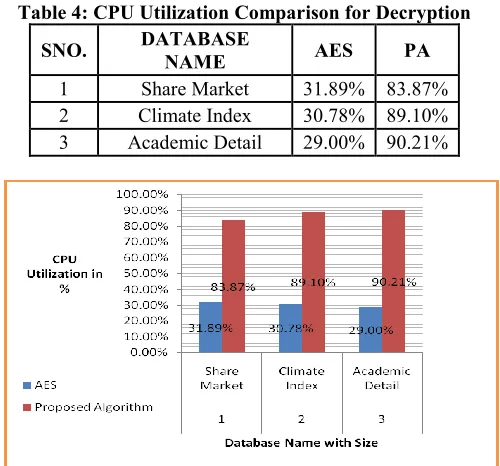
NALYSISIn the experiments, the laptop encrypts a database of different-different tuples and calculates encryption time and decryption time. Here some parameters are used for results analysis like average execution time for encrypt/decrypt the database which is shown in table 1, Average throughput which is show in table 2, CPU utilization for encryption/decryption which is shown in table 3 & 4 respectively.
All the results are approximately calculated. Here the comparison between execution time, CUP Utilization, Throughput of encrypting/decrypting database on existing cryptographic algorithm with proposed cryptography algorithm is done. During processing, the content of the database and the key are both change simultaneously. One is the number of evaluated database and the size of evaluated database, where the number of evaluated database is the number of records that are stored in the database. For the experiment calculation we have select database which is shown in table 1.
Table 1: Database name with record Size
SNO. Name of Database
Total Tusple Records
Size Of Database in
Bytes
1 Academic
Detail 709 68064
2 Climate Index 509 48480
3 Share Market 309 29690
The proposed system approximately 100 times has run. In each time, same database are respectively encrypted by AES and Proposed Algorithm (PA) by copying them. Finally a graphical representation for the table 1 is shown in graph 1 with blue line and orange line for encryption/decryption average execution time of existing system and proposed algorithm respectively. According to the graph, there is a tendency that encryption /decryption execution time for proposed system and compared existing system increases with file size. But required execution time for the encryption/decryption through Proposed System is much smaller than encryption time for compared system. Another graphical representation for the table 2 is shown in graph 1 with blue line and orange line for encryption/decryption average throughput of existing system and proposed algorithm respectively. And finally graphical representation for the table 3 & 4 is shown in graph 3 & 4 with blue line and orange line for encryption/decryption CPU utilization of existing system and proposed algorithm respectively.
International Journal of Emerging Technology and Advanced Engineering
Website: www.ijetae.com (ISSN 2250-2459, Volume 2, Issue 11, November 2012)785
SNO. DATABASE NAME AES PA 1 Share Market 0:0:11:99 0:0:1:248 2 Climate Index 0:0:12:953 0:0:2:532 3 Academic
Detail
[image:4.612.46.291.231.386.2]0:0:16:565 0:0:2:833
Table-1: Encryption Time Comparison of Existing Encryption Algorithm with Proposed Algorithm
Graph 1: Encryption/Decryption Execution Time Comparison
Decryption Time: Table2 is showing the calculated encryption results. In this table 310 to 710 number of tuples in database & execution time of compared algorithm is shown.
SNO. DATABASE NAME AES PA 1 Share Market 0:0:8:208 0:0:1:228 2 Climate Index 0:0:14:309 0:0:2:604 3 Academic
Detail 0:0:18:791 0:0:1:988 Table-1: Decryption Time Comparison of Existing
Encryption Algorithm with Proposed Algorithm
Graph 2: Average Encryption/Decryption Throughput Comparison
CPU Process Time: The CPU process time [4] is the time that a CPU is committed only to the particular process of calculations. It reflects the load of the CPU. The more CPU time is used in the encryption process, the higher is the load of the CPU. Proposed algorithm is taking large amount of time in execution then can say that CPU process time of proposed algorithm also good as compare existing algorithm. Table 3 is showing the CPU Utilization for encryption and table 4 is showing the CPU Utilization for decryption .
Table 3: CPU Utilization Comparison for Encryption SNO. DATABASE NAME AES PA
1 Share Market 29.71 86.15 2 Climate Index 32.63 88.64 3 Academic Detail 28.69 85.48
[image:4.612.322.553.231.447.2]Graph 3: CPU Utilization Comparison for Encryption CPU Utilization for Decryption:
Table 4: CPU Utilization Comparison for Decryption SNO. DATABASE NAME AES PA
1 Share Market 31.89% 83.87% 2 Climate Index 30.78% 89.10% 3 Academic Detail 29.00% 90.21%
[image:4.612.321.571.486.719.2]International Journal of Emerging Technology and Advanced Engineering
Website: www.ijetae.com (ISSN 2250-2459, Volume 2, Issue 11, November 2012)786
IV.
C
ONCLUSIONThis research is proposing a new concept and some evaluation parameter to measure the time-consuming of existing cryptographic algorithms and proposed algorithm The proposed work addresses this issue and contributes the following. some important ones like the key length, higher key length will provide higher security and on the basis of previous research and security, it is clear that presented work used 256 bit key length. It has already in that key length is 128 bits which is less secured as compare proposed key length.It proposes a new cryptography algorithm for database based on data classification methods. Furthermore illustrates a query management system over an encryption database. Finally, it analyzes the execution time and security of data storage in the new cryptography framework.
R
EFERENCES
[1] Maram Balajee “UNICODE and Colors Integration tool for Encryption and Decryption” published in International Journal on Computer Science and Engineering (IJCSE). ISSN : 0975-3397 Vol. 3 No. 3 Mar 2011
[2] A.Rathika, Parvathy Nair, M.Ramya “A High Throughput Algorithm for Data encryption” published in International Journal of Computer Applications (0975 – 8887) Volume 13– No.5, January 2011
[3] P. Wayner, Disappearing Cryptography : Information Hiding: Steganography and Watermarking. Morgan Kaufmann, 2nd edition, 2002.
[4] N. F. Johnson and S. Jajodia. Steganalysis of imges created using current steganography software. In IHW’98 – Proceedings of the International Information hiding workshop. April 1998.
[5] http://en.wikipedia.org [6] http://www.joelonsoftware.com
[7] D. R. Stinson, “Cryptography Theory and Practice” CRC Press, Inc., 2002.
[8] IEEE Transactions on Circuits and Systems for Video Technology: Special Issue on Authentication, Copyright Protection, and Information Hiding, Vol. 13, No. 8, August 2003.
[9] Nadeem.A, “A performance comparison of data encryption
algorithms," IEEE Information and
CommunicationTechnologies, 2006
[10] PachghareV.K , Eastern Economy Edition, Cryptography and Information Security
[11] Stallings.W, Cryptography and Network Security, Prentice Hall, 4th Ed, 2005.
[12] Bruce Schneier “Applied Cryptography-Protocols, Algorithms and Source code in C”.
[13] Menezes. A, Van.P, Oorschot, and Vanstone.S, ”Handbook of Applied Cryptography”, CRC Press, 1996.
[14] Yan Wang and Ming Hu “Timing evaluation of the known cryptographic algorithms “2009 International Conference on Computational Intelligence and Security 978-0-7695-3931-7/09 $26.00 © 2009 IEEE DOI 10.1109/CIS.2009.81 [15] “A Database encryption solution that is protecting against
external and internal threats and meeting regulatory requirements” published in 2004
[16] Hasan Kadhem, Toshiyuki Amagasa and Hiroyuki Kitagawa “A Novel Framework for Database Security based on Mixed Cryptography” published in Fourth International Conference on Internet and Web Applications and Services 2009 IEEE. [17] Dr. Anwar Pasha Abdul Gafoor Deshmukh and Dr.
Riyazuddin QureshiTransparent “Data Encryption- Solution for Security of Database Contents” published in (IJACSA) International Journal of Advanced Computer Science and Applications,Vol. 2, No.3, March 2011.
[18] Indrani Balasundaram and E. Ramaraj “An Authentication Scheme for Preventing SQL Injection Attack Using Hybrid Encryption (PSQLIA-HBE)” published in European Journal of Scientific Research ISSN 1450-216X Vol.53 No.3 (2011), pp.359-368
[19] Oracle Security Handbook” by Theriault and Newman; Osborne/Oracle Press, 2001.
[20] Oracle Database Administration: The Essential Reference”, Kreines and Laskey; O’Reilly, 1999.
[21] Pete Finnigan’s Oracle Security web site,
http://www.petefinnigan.com/orasec.htm
[22] Pressman, R., Software Engineering: A Practitioner'sApproach, McGraw-Hill, 2000 (Chapter 10).
[23] Sommerville, I. and Sawyer, P., Requirements Engineering, Wiley, 1997.
[24] Diaa Salama Abdul Minaam, Hatem M. Abdual-Kader, and Mohiy Mohamed Hadhoud “Evaluating the Effects of Symmetric Cryptography Algorithms on Power Consumption for Different Data Types” International Journal of Network Security, Vol.11, No.2, PP.78-87, Sept. 2010
[25]
McCarthy, Jack (April 3, 2000). "Governments
Relax Encryption Regulations". PC World.
[26]www.cisco.com/web/about/security/intelligence/nextgen_crypto.html