miguide: a wireless context driven
information system for museum visitors
Linge, N, Bates, D, Holgate, R, Parsons, DJ, Webb, P, Hay, D and Ward, D
Title
miguide: a wireless context driven information system for museum
visitors
Authors
Linge, N, Bates, D, Holgate, R, Parsons, DJ, Webb, P, Hay, D and Ward,
D
Type
Conference or Workshop Item
URL
This version is available at: http://usir.salford.ac.uk/968/
Published Date
2007
USIR is a digital collection of the research output of the University of Salford. Where copyright
permits, full text material held in the repository is made freely available online and can be read,
downloaded and copied for noncommercial private study or research purposes. Please check the
manuscript for any further copyright restrictions.
System for Museum Visitors
Nigel Linge1, David Parsons1, Duncan Bates1, Robin Holgate2, Pauline Webb2
David Hay3 and David Ward4
1 CNTR, University of Salford, Salford, Greater Manchester, M5 4WT, UK
http://www.cntr.salford.ac.uk/comms
2 Museum of Science & Industry (MOSI) 3 BT Group Archives
4 SETPOINT Greater Manchester
Abstract. The growth in wireless and mobile communications technologies of-fers many new opportunities for museums who are constantly striving to im-prove their overall visitor experience. There is considerable interest in the use of context-aware services to track visitors as they move around a museum gal-lery so that exhibit information can be delivered and personalised to the visitor. In this paper we present a visitor information system called mi-Guide that is to be deployed within a new communications gallery at the Museum of Science & Industry in Manchester. This paper also reviews previous research into con-text-driven information systems and other context-aware museum applications.
1 Introduction
Traditionally technology in museums has taken the form of audio guides, push button audio content and video display panels. More recently this has moved on to intertive exhibits, providing facilities for users to give feedback through to allowing ac-cess to content using desktop computers. The challenge for museums today is to ensure that they continue to engage and excite visitors who are increasingly exposed and immersed in today’s digital media and computer technology. Consequently mu-seums are constantly striving to improve the visitor experience, nowadays in particu-lar through the use of mobile communications technologies.
the Natural History Museum in London. Similarly throughout the wider world, there have been numerous other research-led attempts to engage with museum visitors in a context driven fashion.
At the University of Salford, the principal authors of this paper, we have a two year project in collaboration with the Museum of Science & Industry in Manchester, BT Group Archives and SETPOINT Greater Manchester. This project includes the launch of a new and innovative communications gallery which celebrates the evolution of communications and its impact on society. Within the new museum gallery a wireless based information system called mi-Guide will be deployed. Per-sonalisation of the mobile user experience is at the heart of this context driven appli-cation. This project bridges the gap between that prior research and the desire to get a real working product within a museum setting. This work was previously introduced in Linge et al [3] and the link with previous research work was established. However the focus of this paper is to extend the discussion presented there, and to launch mi-Guide as a wireless context-driven museum guide.
2 Engaging with Museum Visitors
As the world’s first industrial city Manchester has been at the forefront of many in-novations in communication including the early adoption of telegraphs and the tele-phone, the exploitation of print - especially newspapers, the expansion of radio and television and the invention of the modern programmable computer. MOSI is about to launch a new communications gallery that is designed to inform the public about this particular subject. It forms a key part of BT’s Connected Earth1 – the first web
based museum project underpinned by a series of major physical collections distrib-uted amongst a network of UK museums. The new gallery will offer visitors a jour-ney through four themed zones including face-to-face communications, recorded information and broadcasting. The gallery concludes with a future zone that is de-voted to technology convergence and the post digital world.
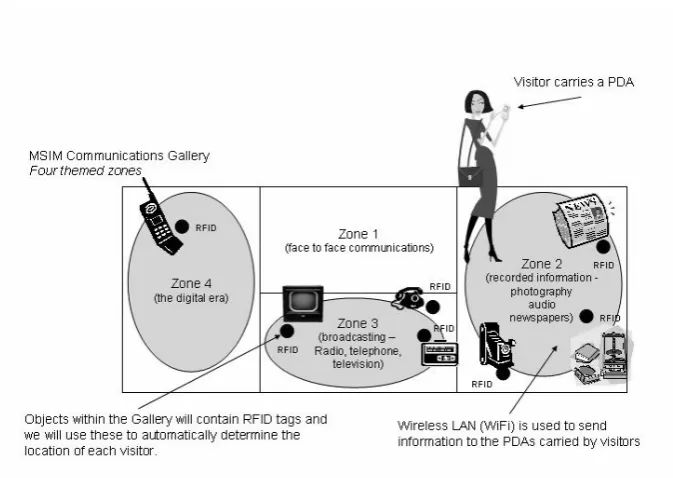
Mi-Guide is a context driven information system based on wireless communica-tions which is intended to be deployed within the new gallery. This is to enable us to create a new series of interactive educational experiences based on the user’s prox-imity to the nearest exhibit. Visitors will be provided with a handheld device, in the first instance a PDA, which is able to connect to a hybrid network comprising wire-less LAN (WiFi) and either passive or active radio frequency identification (RFID) tags. The WiFi network offers sufficient bandwidth to allow multimedia information to be delivered in real time to each PDA whilst the RFID tags placed at key locations and on selected exhibits around the gallery allow visitor location to be determined as illustrated in figure 1.
Fig. 1. The Manchester Communications Gallery – Network Infrastructure.
The ability to locate a visitor, but more importantly to track their movements through a gallery allows information to be delivered that is not only personalised to the user but also intelligently adapts to the route that the visitor has chosen to take. So, for example, going from exhibit A to exhibit C without seeing exhibit B can gen-erate a different experience than if exhibit B had been visited. This is a key piece of context for this system, here termed the exhibit history. Another important piece of context is the user’s type or user profile. So for example, knowing that one PDA is being used by a teacher allows information to be sent that will assist that teacher in conducting their task. Mi-Guide is intended to provide an enhanced visitor experi-ence for the museum allowing for additional content to be delivered using the full capabilities of multimedia. In addition it will provide an ideal vehicle through which to better engage with the visitors and to demonstrate the operation and function of communications systems.
3 Context Driven Information Systems
mobile user experience, all driven by a device that we will shortly have to re-term ‘the mobile computer’.
On top of this infrastructure, a future generation of multimedia based services is beginning to be built. A key element of these new services is the ability to determine location in the form of location based services, e.g. O2’s Streetmap service [4].
How-ever, location is just one aspect of the wider concept of context, which derives from the trend towards ubiquitous and pervasive computing. The term ‘ubiquitous com-puting’ is generally first attributed to Mark Weiser [5] who in 1991 envisaged a world in which computers would become all pervasive through mobile or embedded devices interconnected through a ubiquitous network. Clearly this vision is not yet fully real-ised but we are some of the way along the path towards that realisation.
However context suffers somewhat from being a vaguely defined concept. Ac-cording to Mari Korkea-aho [6] context can be anything from identity, spatial infor-mation, temporal inforinfor-mation, environmental inforinfor-mation, social situation, nearby resources, availability of resources, human physiological measurements, activity, schedules and agendas, and this list is by no means exhausted. Fortunately a compre-hensive review in 2000 of the most prominent work to that date was carried out by Dey and Abowd [7, 8] in which they attempted to define the terms context and con-text awareness whilst introducing their pioneering work on the concon-text toolkit. These definitions are probably the most concise and well defined and have been used throughout our work. They are as follows:
Context: ‘Context is any information that can be used to characterise the situation of an entity. An entity is a person, place or object that is considered relevant to the interaction between a user and an application, including the user and the ap-plication themselves’.
Context aware: A system is context aware if it uses context to provide relevant in-formation and / or services to the user, where relevancy depends on the user’s task’.
Dey and Abowd also proposed a hierarchy of contextual types and outlined a method of categorising context aware applications. Identity, Location, Activity, and Time are considered as the four primary context types which are then used to index and define secondary context types. For example: given a person’s current location, a secondary context type could be: where they have been or where they are going. This hierarchy obviously has applications to defining a class structure of context types that could be used in the development of context aware applications, or indeed a context ontology, as was attempted in later papers by Strang and Linnhoff-Popien [9] and Chou et al [12].
4 Context-Aware Museum Applications
across the City of Lancaster. Visitors linked with an information model of the city using hand-held context-aware tourist guides. GUIDE used a cell-based 802.11 wire-less LAN, covering the major tourist areas, to provide both positioning information and deliver static and dynamic information to the mobile devices [10].
Imogl is a mobile guide that was deployed in two Belgian museums. Luyten and Coninx [11] noted that in a museum setting, location has to be determined as prox-imity to the nearest artefact because museum artefacts, although largely static, are apt to be moved around over time. As the museums in questions both had outdoor ele-ments, GPS was used to identify objects outdoors. However, as GPS can’t be used indoors, Bluetooth was used instead. It is interesting to note that the authors identi-fied that one of the main problems with Bluetooth in a museum setting is that its communication range is too wide, suggesting IrDA as the likely best alternative.
Shih-Chun Chou et al in their 2005 paper [12] introduce us to a set of visitor-oriented services which uses a semantic web rule reasoning engine (SWRE) to iden-tify relevant sources of contextual information. This work is part of a collaboration between Carnegie Mellon University, Pittsburgh and the Institute for Information Industry in Taiwan building on top of a comprehensive piece of work called the My-Campus project [13, 14]. These services include exhibit recommendations, directions to exhibits, people locator services and a rating application to share thoughts and comments with other people. A user profile is built up at the start of the tour by get-ting visitors to fill out a questionnaire. These user and privacy preferences are then set in a semantic e-Wallet assigned to the user in order to tailor services accordingly.
Unfortunately this work is comprehensive but beyond our scope. A more useful resource is that by Raptis et al who provide a review and comparison of other mobile applications used within museum environments [15]. They also introduce a new theoretical framework of context, which given that they concur with the view that context is poorly defined seems counter-intuitive. Context is defined in four different dimensions : the system, infrastructure, domain and physical contexts. It could be argued that the first two of these relate directly to the software development cycle, whereas the latter two are variations of identity, location and activity. Nevertheless Raptis et al make a number of practical and salient points which are particularly ap-plicable to museums. For example, in respect of observed museum visitor behaviour, the most important factor affecting the interaction was felt to be the content itself and not the technology, probably best summed up by the phrase “content is king”. An-other important point made was the need to inform the user when something excep-tional has occurred and give sensible instructions. This paper also includes a com-parison of the technologies that affect the system context. It is interesting to note that of the 12 systems reviewed, 11 of them opted for IrDA as their tagging solution and that the other Imogl later moved from Bluetooth to IrDA.
5 Tagging Solutions
the PDAs require a means of detecting their proximity to the nearest exhibit. This is anticipated to be some form of tag that is detectable from the PDA. In the first ver-sion of mi-Guide this will be a passive RFID tag (Phillips I-Code 2 tags, ISO15693 standard, 13.56 MHz). The passive tags are energised from a Socket Communica-tions RFID reader which slots into the PDA. Passive tags have no power of their own and are thus dependent on the power of the energising device. As the RFID reader is designed to operate at minimal power to save drainage on the PDA battery, the tags can only be read from 6.35 cm as opposed to the maximum quoted range for these tags (1.5m). This first version of mi-Guide therefore is in keeping with a ‘scanner metaphor’, as expressed by Raptis et al.
Active tags on the other hand have their own source of power and therefore have a much greater read range. Using active tags, a device can poll for tags within a given radius and information can be pushed onto the devices, which fits with Raptis et al’s ‘remote control metaphor’. Possible active tag technologies are WiFi, Bluetooth or IrDA. These have the advantage that they are built into the Dell Axim PDAs that we use in the mi-Guide system. Apart from cost, the main disadvantage with active tags is that the read range of these tags is in fact too good. It is difficult to achieve the granularity that is required in a museum environment. In order to be able to distin-guish different exhibits accurately, a read range of the order of a metre is required, otherwise there is overlap between the tags and it is not possible to determine which is the nearest. Alternatively the reader itself would need to be able to distinguish which is the nearest tag, a purpose for which most RFID readers are not designed.
There are commercial systems that can accurately determine location to within 3-5 metres. These systems tend to be aimed at large markets such as asset management in hospitals where the large costs can be justified. Location is determined by triangula-tion of the WiFi signal strength and/or a differential time of arrival algorithm from three or more different access points using WiFi tags. An example of such a product is the Ekahau positioning engine, which is indeed used primarily in the healthcare industries [16]. Similar high-end systems are Aeroscout [17] and Wherenet [18].
In a sense the mi-Guide system is doing the opposite from most tagging systems. In most systems, the asset is mobile and its whereabouts are tracked or monitored. This is the case in hospital asset management systems, similarly back-end production systems such as those deployed in retail or manufacturing where RFID is used to keep track of the movement of goods. However, in our case the asset is static (the mu-seum exhibit) and the tracking devices (the PDAs) are mobile. In addition the pur-pose of most RFID readers is to detect every tag within its range so that assets are not missed in the tracking systems, again the opposite of our requirements.
6 The mi-Guide System Architecture
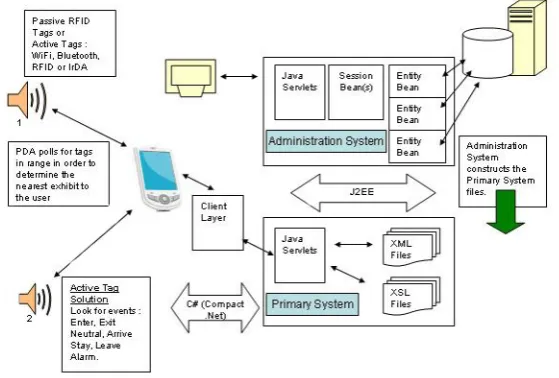
xml files and their associated xsl files. The client-side application wraps around a web browser (Pocket Internet Explorer) embedded inside the application, which is then used to access the server-side web application.
[image:8.595.160.440.251.440.2]The client is written in C# as this is better supported on the Pocket PCs that are used on the project in the form of the (Microsoft) Compact .Net Framework. For example, at the time of project commencement, there was limited support for the Java alterna-tive, J2ME (Java 2 Micro Edition). It was also clear early on in the project that it would not be possible to offer mi-Guide as a download to visitors’ personal PDAs. This was because there is insufficient standardisation of the functionality that PDAs carry such as a wireless connection (WiFi), rather instead there would need to a stan-dardised set of PDAs (Dell Axims) which would be issued to visitors by the gallery.
Fig. 2. The mi-Guide System Architecture.
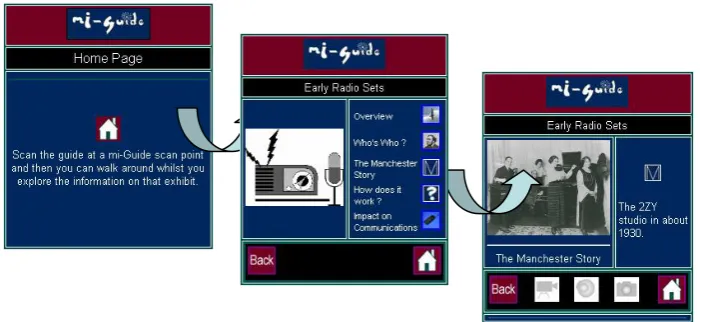
Fig. 3. mi-Guide Screen Shots.
This xml must also be ‘marked up’ according to the user’s type, e.g. adults and chil-dren, as well as more specific classifications such as teacher and pupil. In addition, the user’s progress through exhibits and any missed exhibits (exhibit history) will be recorded as part of the system’s overall context. Appropriate adaptation to this con-text will be added to the system as part of the next phase of mi-Guide.
A system administration function will also be provided that is able to maintain the information in the xml files in a user-friendly fashion. This will also allow the infor-mation delivered about an exhibit to be structured for each given user type. The al-ternative approach of constructing information from relevant database tables could result in exhibit information where the joins between the constituent information can be seen, giving the impression of a story that is ‘clunky’ and doesn’t flow. This re-lates back to one of the key findings of our previous research, which was concerned with building context into workflow process models, i.e. the requirement for addi-tional advanced workflow tasks as user expertise increases [19, 20].
The other main advantage of xml files is that they are associated with appropriate xsl stylesheets so that the xml data can be transformed into html pages for the client-side web browser. This is achieved by parsing the xml with a JDOM parser [21] and converting the data in real time to the appropriate device using an xslt transformation. As client side device information available to the web browser is fairly limited, this relies on the system knowing what devices it supports by picking up its device id and the applicable xsl file. The system currently just supports the PDAs, but it would be possible to support new types of devices in the future with only the addition of a set of device-specific xsl files.
as embedded windows media files. Therefore these will also need to be set up cor-rectly. The system administration function will be available as a later release of mi-Guide and will be accessible when the system is off-line.
7 Implementation
At the time of writing the mi-Guide application is nearing the completion of phase 1 of the implementation. This comprises the basic application which is able to act as an enhanced wireless visitor guide for the new communications gallery so that we are able to launch in Summer 2007. Phase 2 will contain the administration system, user logging and any context-aware enhancements that are deemed practical for the mu-seum environment within the time frame left on the project. Successful demonstra-tions of the phase 1 application have been carried out in the laboratory environment as well as a test to ensure that the client application swaps successfully between wire-less access points as the user roams between WiFi zones.
We are now about to move into a system testing period within the museum envi-ronment for phase 1. Beyond that we anticipate that there will be a period of the order of six months of user acceptance testing in the form of a user trial. The mi-Guide application will be offered to a limited numbers of visitors per day in order for them to evaluate the product and to identify any problems that might arise.
From our experience of the implementation process within the laboratory environ-ment, we anticipate that any problems would most likely occur in the PDAs ability to robustly connect to the wireless infrastructure. Indeed this seems to have been the case in other similar museum applications. Other anticipated issues relate to users deliberately aiming to willfully bring down the application or cause problems within the PDA environment. Finally security of or damage to the PDAs is also likely to be of concern.
However the main purpose of the system testing & user trial periods is to thor-oughly test these issues in the museum environment in order that we are able to pro-ceed with confidence at a later date to a full product. This product can then be further enhanced by context-aware features such as user tracking and tailoring of content to different types of individual.
8 Summary
Further planned developments of the mi-Guide system will expand the context gathering capability such that it is fully realised as a context-aware application. Therefore later enhancements will firstly include visitor tracking which in turn allows content to be delivered and manipulated to reflect a visitor’s journey through the gallery. Secondly the system will differentiate between users to distinguish between adults, teachers, pupils etc., and deliver information that is appropriate to them. The system will be further enhanced with the addition of a system administration function which will be needed to provide maintenance to the file systems over time.
Acknowledgements
The authors are grateful to the Engineering and Physical Sciences Research Council (EPSRC) who have funded this work as grant EP/D504686/1 within their Partner-ships for Public Engagement programme.
References
1. N.X.P., I-CODE enables museum visitors to take their memories home, March 2004. [Online] Available from : http://www.nxp.com/news/identification/articles/success/s86/ [Cited 08/02/2007]
2. Guide ID., Guide ID – your mobile information guide, © 2006. [Online] Available from : http://www.vepon.nl/NavMain.asp [Cited 08/02/2007]
3. Linge, N. et al., Context Driven Information Systems for Museum Visitors. In PGNet 2006, 7th Annual Postgraduate Symposium on The Convergence of Telecommunications, Networking & Broadcasting. 2006. Liverpool John Moores University.
4. 02 Streetmap. [Online] Available from : http://www.streetmap.co.uk/o2.htm [Cited 05/02/2007]
5. Weiser, M., The Computer for the 21st Century. Scientific American, 1991. 265(3): p. 94 -104.
6. Korkea-aho, M., Context-Aware Applications Survey. 2000, Department of Computer Science, Helsinki University of Technology. [Online] Available from : http://www.hut.fi/~mkorkeaa/doc/context-aware.html [Cited 09/02/2007]
7. Dey, A.K., Understanding and Using Context. Personal and Ubiquitous Computing, 2001. 5(1): p. 4-7.
8. Dey, A.K. and G.D. Abowd. Towards a better understanding of context and context-awareness. in CHI 2000, Conference on Human Factors in Computing Systems. 2000. The Hague, The Netherlands
9. Strang, T. and C. Linnhoff-Popien. Service Interoperability on Context Level in Ubiquitous Computing Environments. in International Conference on Advances in Infrastructure for Electronic Business, Education, Science, Medicine, and Mobile Technologies on the Inter-net. 2003. L'Aquila, Italy.
10. Cheverst, K. et al., Exploiting Context to Support Social Awareness and Social Navigation. ACM SIGGROUP Bulletin, 2000. 21(3): p. 43-48.
12. Chou, S-C. et al., Semantic Web Technologies for Context-Aware Museum Tour Guide Applications. Proceedings of the 19th International Conference on Advanced Information Networking and Applications - Volume 2, pp 709–714, 2005. IEEE Computer Society, Washington D.C., USA.
13. Miller N. et al, Context-Aware Computing using a Shared Contextual Information Service. “Hot Spots”, Pervasive 2004, April 2004, Vienna. Advances in Pervasive Computing, Aus-trian Computer Society (OCG), ISBN 3-85403-176-9.
14. Hengartner U. and Steenkiste P., Access Control to Information in Pervasive Computing Environments. Carnegie Mellon University. [Online] Available from : http://www.cs.cmu.edu/~uhengart/hotos03/index.html [Cited 09/02/2007]
15. Raptis D. et al., Context-based Design of Mobile Applications for Museums: A Survey of Existing Practices. ACM International Conference Proceeding Series; Volume 111, pp 153–160, 2005. ACM Press, New York, USA.
16. Ekahau, © 2000-2007 Ekahau, Inc. [Online] Available from http://www.ekahau.com/ [Cited 06/02/2007]
17. AeroScout Enterprise Visibility Solutions ®, [Online] Available from http://www.aeroscout.com/ [Cited 06/02/2007]
18. WhereNet, [Online] Available from http://www.wherenet.com/ [Cited 06/02/2007] 19. Bates, D., Linge, N. Ritchings, T., Chrisp T., 2003. Designing a Context-Aware Distributed
System – Asking the Key Questions. In Proceedings of the 2nd IASTED International Con-ference on Communications, Internet and Information Technology. Scottsdale, Arizona, Nov 17-19th 2003. pp 361-371.
20. Bates, D., Linge, N., Hope M., Ritchings T., 2004. A Proposed Model for a Context Aware Distributed System. In IWUC 2004, 1st International Workshop on Ubiquitous Computing, Porto, Portugal, April 13th-14th 2004, pp 180-194.