1
GRAPH PATTERN MATCHING IN YEAST DATASET
1DION TANJUNG, 2KEMAS RAHMAT SALEH W, ST., M.ENG., 3SHINTA YULIA P, ST.
1
School of Computing, Telkom University, Bandung, Indonesia 2
School of Computing, Telkom University, Bandung, Indonesia 3
School of Computing, Telkom University, Bandung, Indonesia E-mail: [email protected], [email protected],
3
ABSTRACT
Graph representation has been widely used in scientific study to analyze a pattern. Geographic maps, computer networks, chemical structures, and databases are examples of information that can be applied to graph representation. This is related to graph representation method that makes manipulation data easier.The needs and growth of information make graph representation larger. Pattern analysis need more time while searching in larger graph. Therefore we need new method to searching graph pattern in a large graph. In thisresearch , graph query language(GraphQL) algorithm is used for searching graph pattern in graph database using yeast dataset. This algorithm is used because it can search graph pattern in graph databases by reducing search space. The result obtain combination of local pruning and global pruning can reduce search space with the result of reduction ratio and running time being lower. Smaller search space make process of searching graph pattern in graph faster.
Keywords: GraphQLAlgorithm, Reduction Ratio, Running Time, Graph, Graph Pattern
1 INTRODUCTION
Nowadays, pattern analysis development can not be separated from the role of the graph. Data in multiple domains can be modeled as graphs for ease of data manipulation processes [5], like chemical compounds, geographic maps, computer networks, and databases. Graph is a collection of nodes and edges. Node is described as a point or an object, and the edge is a relation between nodes.
From the point of view of the graph pattern, the most important problem is matching graphs or subgraphs for comparing them[2]. The growing heterogeneity and size of the data that increase over time,make the existing data models, query languages and database systems do not support for the modeling and management of this data[5]. The growing of the data need to be saved in semi structured information. To deal with this problem, database using graph representation. Various studies are being done to reduce the computational cost when matching a large graph with the number of nodes above 100[2]. Computational complexity of the algorithms need to be considered when matching large graphs. Matching on large graphs
requires low computational complexity to speed up running time of the process matching. One technique used to reduce computational cost is reducing search space. Result of the graph matching are not limited to the node and edge information. Structural information and value of the entire object of interest is needed, so there is no information loss[5]. This means the ability of graph matching to return a graph or set of graphs.
2 process that should be carried out in sequence, find outthe influence of search space size to the running time in matching process, and find out the influence of the optimization phase in the running time.The limitation of this research are as follow: simple graph, undirected graph, using adjajency list to implements graph, and choose graph with more than 100 of nodes.
2 BACKGROUND
In this section we describe graph query language, graph, graph database, and GraphQL algorithm.
2.1 Graph Query Language
Graphquerylanguagehasvarious definitions. Herearesomeexamples ofdefinitions ofgraphquery language[5]:
1. Data Model
Data model in GraphQL algorithm can be described as a graph motif that has an attribute on the node or edge.
Example : Graph G{
Node v1 <year=2006>; Node v2 <name=”A”>; }
2. Graph Pattern
Graph pattern is a graph motif plus a predicate on attributes. Graph pattern is also called a graph query that used to select graphs of interest.Graphpatternis representedas follows :
P = (M,F)
M is graph motif and F is a predicate. Example :
Graph P {
Node v1 where name =”A”; Node v2 where year>2000; };
3. Graph Pattern Matching
P (M, F) same as the graph G if there is injective mapping 1 to 1, ∅: V (M) V (G) for ∀ e (u, v) ∈ E (M), (∅ (u), ∅ (v)) is an edge of G and predicate F∅ (G).Example of mapping graph pattern P on the graph G
Mapping∅:
∅(P.v1)→G.v2
∅(P.v2)→G.v1
2.2 Graph
Graph is a collection of nodes and edges. Node is described as a point or an object and the edge is described as a relation between nodes. Based on the orientation, the graph can be divided into two types: directed graph and undirected graph. Directed graph is a graph which has direction so that connectivity between nodes only in one direction. Connectivity between nodesin undirected graph can be two-way. Example: E = {{x, y}} in a directed graph indicates that the relation of the node only from nodex to y. X is the predecessor and y is the successor. If the graph is undirected, the two nodes will be interconnected. Nodex is related to nodey
and nodey is related to x. Here are some graph definitions:
1. Thesimplegraphisa graphthatdoes nothave a loop.
2. Subgraph is a part of graph that has same nodes or edges on the graph.
3. Path represent a way from a node as start point to a destination nodewhichdoes not pass throughthe nodeoredgetwice.
4. Clique in a graph is a subgraph complete which every node linked each other.
5. Matching in a graph is a set of edges which connecting nodes only one to one.
6. Graph to be perfectmatching when allnodesin a graph hasmatchingedge
7. Semi-perfect matchingis
aperfectgraphmatchingthatleaves
onenodewithoutedgedue totheoddnumber of nodes
8. The bipartite graph is a graph that can be divided into two subsets, such that no nodes are interconnected in the same set. If all nodes in a set connected to another set of nodes that called graph bipartite complete.
2.3 Graph Database
Graph database is one of the categories of NoSQL who model a database in the form of a graph. Just like the graph, node is a data or entity and edge is the relationship between nodes. Modeling graph database using functions Create, Read, Update, and Delete to manipulating data. Graph database can be represented using adjacency list or implementations to array 2D. Graph database consists of [8]:
1. Graph Storage
3 into relational databases, object-based database, and others.
2. Graph Processing Engine
Used to form a graph database and set of data processing.
2.4 GraphQL Algorithm
GraphQL algorithm is one of graph pattern matching algorithm that is able to handle small to large-sized of graph. The core of GraphQL algorithm is graph algebra for the selection process and composition. Selection for graph pattern matching and composition to generate a new graph from matched graph. Figure 1 is an example of a graph Gand figure 2 is a graph patternP. Both graph
G and graph pattern Phave labelA, B, C, and D.
2.4.1 Retrieve of feasible mates
Feasible mates Φ (u) of node u is a set of nodes of in graph G that satisfies the predicate fu in the graph patternΦ(u) = {v | v∈V (G), fu(v) = true}. From the figure 1, feasible mates each nodes is
Φ(A) = A1, A2, Φ(B) = B1, B2, B3, Φ(C) = C1, and
Φ(D) = D1, D2. The resulting product of (A) x Φ (B) x Φ (C) x Φ (D) is search space.
2.4.2 Local pruning
Search space need to be reduced for fast matched process, because matched process is checking all nodes that contained in the search space. Local pruning use light weight profile to prune the search space. One can define the profile is node labels. This process is checking profile each neighborhood from feasible mates in radius 1.
From figure 1, neighborhood of node label A in graph pattern is nodes B and D, neighborhood of node A2 with label A is nodes B3 with label B and
C1 with label C. Node A in graph pattern and node
A2 in graph have same label B from neighborhood, but node A has label D and node A2 not has label D. The conclusion is node A and node A2 is not sub-isomorphic, so node A2 is pruned from the search space. The search space after the pruning process is
Φ (A) =A1,Φ (B) =B1,B3,,Φ (C) =C1, and Φ (D) =D1.
2.4.3 Global pruning
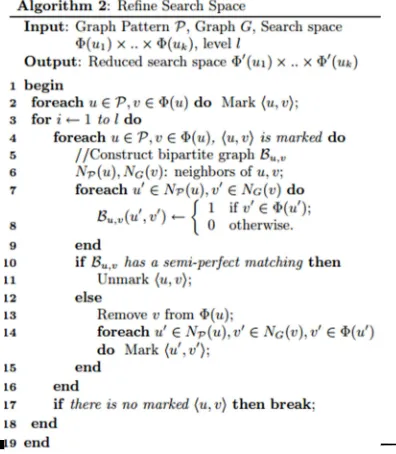
This pruning is the process of join reduction of search space. This pruning technique reduce the overall search space iteratively using the concept of pseudo isomorphism test. Node u and the feasible mates of node node u need to be checked whether sub tree of node u in Tu sub-isomorphic with the node of v in Tv. From the algorithm in figure 2, line 3-18 checking the sub-isomorphic of Tu and Tv
using Breadth First Search (BFS) algorithm until the depth of adjacent sub trees. Each sub-isomorphic sub tree is checked with radius d=1. First process is marking node u and node v from the search space to checked for semi-perfect matching. line 5-9 is construct bipartite graph Bu,v from the sub tree of marking nodes. Bipartite graph Bu,v is checked for graph semi-perfect matching to pruning nodes. Graph is semi-perfect matching if graph Bu,v is complete bipartite graph and each nodes in Bu,v is connected 1 to 1. If bipartite graph Bu,v not semi-perfect matching, node v is pruned from search space and marking node u’ and v’ for each neighborhood of node u and v. This process can be done if there is no marked node u and v.
A1
B1
A2
B3
B2 D2
C1 D1
A
D
[image:3.612.92.299.295.502.2]B C
Figure 1: Graph G
[image:3.612.322.520.522.749.2]
4 From figure 1, neighborhood of node A2 is B3 and
C1, neighborhood of node A is B and D. Each sub tree of node A2 and A is used to construct bipartite graph Ba,a2 with left sets are A sub tree and right sets are A2 sub tree. After that, bipartite graph Ba,a2 is checked for semi-perfect matching. The result of graph Ba,a2 is not semi-perfect matching because node A2 not has D label of neighborhood so neighborhood D from node A is not connected to any nodes then node A2 is pruned from search space. Next iteration, we explained to checked node
B and node B3. Neighborhood of node B is A and
D, neighborhood of node B3 has label A,C,and D. At the previous iteration, node A2 is pruned from the search space so node A in graph Bb,b3 can not connected node A2. Graph Bb,b3 is not complete graph bipartite and not semi-perfect matching, so node B3 is pruned from search space. The result of search space after global pruning process is Φ(A) =A1,Φ(B)= B1,Φ(C)=C1, and Φ(D)=D1.
2.4.4 Optimization
The goal in this optimization is finding the good search order for better running time the process matching. This optimization is modeled each Φ (U)
as nodein binary root tree andcalculate the size and the cost of the search order. Size of the tree model can be estimated by :
. . Υ i (1)
i.left is child node in left i and i.rightis child node in right i. size left and size right is be obtained from amount of nodes in Φ (U). Υis the reduction factor that can use constant reduction values [5].
Cost of the tree model can be estimated by :
. . (2)
The cost total of search order Γ can be estimated by
Γ ∈ Cost i (3)
For example,search space from local pruning is Φ (A) =A1,Φ (B) =B1,B3, ,Φ (C) =C1, and Φ (D) =D1 with the size of Φ (B) is 2 because Φ (B) have 2 nodes and other size is 1.
From figure 4, the search order is (((A⋈ " ⋈ ⋈ # . Size (A⋈ " = 1 x 2 = 2 and cost (A⋈ "
= 1 x 2 x $ = 2$. Size ((A⋈ " ⋈ 2$ 1=2$with cost is 2$x1 x $=2$2
. cost
(((A⋈ " ⋈ ⋈ # =2$2x1=2$2so the total cost
if $ 1 is 2+2$ '
2$2
=2+2(1)+2(1)2=2+2+2=6.Similary, the total cost of (((A⋈ ⋈ # ⋈ ")in figure 5is 4. Thus,
(((A⋈ ⋈ # ⋈ " is better than (((A⋈ " ⋈ ⋈ # .
2.4.5 Graph pattern matching
After optimization process, all of nodes in Φ (A)Φ,(V),Φ (C), andΦ (D)is combined to make a combination of node that matched with the graph pattern.
From figure 6, procedure boolean check(ui,v) is checking node ui whether that node can be mapped
v. Line 15 examine if node ui is neighborhood of uj
and examine if node v is an edge of node uj then return false. Procedure search(1) is examine node from first index or from Φ (A)if the first searh order is fromΦ (A) . For each node v in Φ (ui)is checked in procedure check, if the result is false then the iteration is examine the next v (line 4). If return true thennode v is replace node ui. Line 6 is checking if index of i is less then the size of graph pattern, if
[image:4.612.315.527.387.584.2]A B C D
Figure 4 : Search Order A ⋈ B ⋈ C ⋈ D
Figure 5 : Search Order A ⋈ C ⋈ D ⋈ B
1. void Search(i)
2. begin
3. foreach v ∈ Φ(ui), v is free do
4. if not Check(ui, v) then continue;
5. φ(ui) ← v;
6. if i<|V (P)| then Search(i + 1);
7. else if Fφ(G) then
8. Report φ ;
9. if not exhaustive then stop;
10. end
11. end 12.
13. boolean Check(ui, v) 14. begin
15. foreachedge e(ui,uj) ∈ E(P), j<i do
16. ifedge e (v,φ(uj)) ∉ E(G) or not Fe(e ) then
17. return false;
18. end
19. return true;
20. end
Figure 3 : Global Pruning Algorithm[5]
Figure 6: Matching Algorithm[5]
[image:4.612.98.264.641.705.2]
5 true then add I with 1 to search next index in recursive phase. If i is the size of graph pattern then check the combination result. The result of this matching algorithm is not necessarily same as the graph pattern and the results of the new graph can be duplicated. To avoid that problem, we comparing the size of the new graph and the graph pattern. For example, node YNLin the new graph has neighborhoodYAL, YOL, andYDR, NodeYNLingraph patternhas neighborhoodYAL dan
YDR. The new graph and the graph pattern in that case is not sub-isomorphic so the new graph is not the answer of the graph pattern. To avoid duplicated new graph, we checked the previous answer of the graph pattern. The answer of the graph pattern is a set of new matched graph, if new graph pattern found is similar as other result so this new graph is not counted as the answer. For example, combination of nodes
{{YAL,YNL,YDR},{YNL,YDR,YAL}} create similar graph so we choose the first combination as the answer.
3 EXPERIMENT
3.1 System design
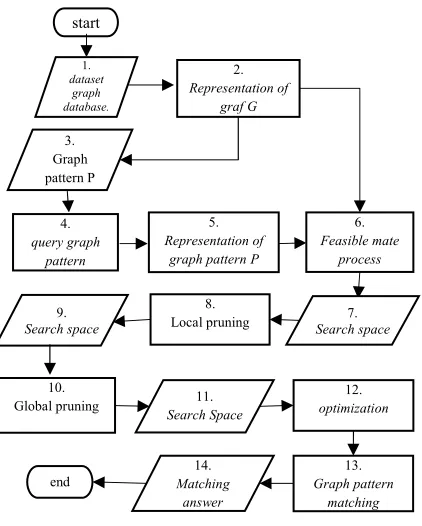
In this research, will be built a system that is used for the analysis of algorithms GraphQL. General overview of the system to be built is as follows:
From figure 7, we evaluate the performance of GraphQL algorithm on yeast dataset that consist 2361 nodes, 7182 edges, and 536 loops. This dataset was taken from http://vlado.fmf.uni-lj.si/in pajek format and we change this pajek format into excel format so our system can read this format.
This dataset is represented into simple graph G to produce more varied graph pattern. Id example of this dataset is YBR236C. Because this dataset has no label, we make label from Yeast mark(letter 1), number of kromosom(letter 2), and left-right mark(letter 3) for each id. From the example, id
YBR236Chas label YBR.Using this technique, this dataset contains more than one label so we have a lot of similar pattern from this label. This idea is to know the effectiveness of pruning process when deal with similar pattern because pruning process check from the label. Although this process is checking the node label, but the result of pattern must matching with the node id.
Graph G on system consist 2361 nodes, 13292 edges, and has no loops because we changed into simple graph. From this graph G, we searching path and cliques to determine amount of graph pattern to be tested. We choose the longest path and the largest clique to make a graph pattern. To searching all of paths contained in graph G, we using dijkstra algorithm. This algorithm is used to searching the shortest path, so we replace and added some function so this algorithm can searching all path contained in graphs. The longest path found in graph G is 22, because path length is 11 to 22 only a few are found, so we choose the longest path uses is 10. We break that path to make path with length 1 to 10. Same as path, we use Bron-Kerbosch algorithm to search all cliques contained in graph G. The largest cliques size is 9 so we break this cliques into cliques size of 1 to 9.
Graph pattern used for testing need to change into query form because system read the input of graph pattern in query form. Figure 8 is the example of query used. This query is to make graph pattern for cliques which has 3 nodes:YDR1, YNL1,and YAL1interconnected.
[image:5.612.86.297.453.716.2]Figure 8: Clique Query Figure 7: System Design
4. query graph pattern 3. Graph pattern P 1. dataset graph database. 6. Feasible mate process 8. Local pruning 10. Global pruning 14. Matching answer 12. optimization 13. Graph pattern matching 2. Representation of graf G 5. Representation of graph pattern P
9 Algorithm (Graph Algorithm Clustering) in Graph Database Compression.
[13] Tian, Y. & Patel, J. M., 2008. Tale : A tool for Approximate Large Graph Matching. [14] Ullmann, J. R., 1976. an Algorithm for
Subgraf Isomorphism.
[15] Zhang, S., Li, S. & Yang, J., 2009. GADDI : Distance Index based Subgraph Matching in Biolgical Network. ACM.
![Figure 6: Matching Algorithm[5]](https://thumb-us.123doks.com/thumbv2/123dok_us/8909469.958517/4.612.315.527.387.584/figure-matching-algorithm.webp)