COMPARATIVE ANALYSIS FOR PERFORMANCE MEASUREMENTS OF SOFTWARE TESTING BETWEEN MOBILE APPLICATIONS AND WEB
APPLICATIONS
ZAINAB HASSAN MUHAMAD
A dissertation submitted in
fulfilment of the requirements for the award of the Degree of Master of Computer Science (Software Engineering)
Faculty of Computer Science and Information Technology Universiti Tun Hussein Onn Malaysia
v
ABSTRACT
vi
ABSTRAK
Ujian perisian mempunyai peranan penting dalam bidang kejuruteraan perisian, dan merupakan asas kepada Jaminan Kualiti Perisian (SQA). Selain aplikasi web yang semakin dikenali ramai, aplikasi mudah alih juga semakin digemari ramai walaupun menimbulkan sedikit kerumitan. Dari satu sudut, isu ini menimbulkan sedikit kebimbangan untuk memastikan kebolehan prestasi kedua-dua web dan aplikasi mudah alih ini. Walaubagaimanapun, analisis perbandingan isu untuk ujian perisian antara web dan aplikasi mudah alih telah dilakukan tetapi masih belum selesai. Oleh sebab itu, kajian ini bertujuan untuk membuat ujian keberkesanan yang mampu disesuaikan untuk kedua-dua aplikasi iaitu web dan aplikasi mudah alih untuk mengesan kegagalan mungkin. Untuk mencapai matlamat ini, gambar rajah aktiviti UML telah diuji ke atas empat kajian kes iaitu untuk web dan juga untuk aplikasi mudah alih yang mana menerangkan sifat-sifat ataupun cara kerja aplikasi tersebut. Kes-kes kajian kemudiannya telah dihasilkan dengan menggunakan teknik MBT daripada perkembangan aktiviti rajah UML. Ukuran prestasi Hits per Second,
Throughput dan Memory Utilization untuk setiap kes kajian telah dinilai dengan
vii
CONTENTS
TITLE i
DECLARATION ii
DEDICATION iii ACKNOWLEDGEMENT iv ABSTRACT v
ABSTRAK vi CONTENTS vii
LIST OF TABLES xi
LIST OF FIGURES xiv
LIST OF SYMBOLS AND ABBREVIATIONS xviii
LIST OF APPENDIXES xx CHAPTER 1 INTRODUCTION 1 1.2 Research Background 1
1.3 Problem Statement 3
1.4 Research Objectives 4
1.5 Research Scope 4
1.6 Dissertation Outline 5
CHAPTER 2 LITERATURE REVIEW 7
2.1 Introduction 7
viii
2.3 Software Testing Methods 9
2.3.1 Black-box Testing 9 2.3.2 White-box Testing 9 2.3.3 Gray-box Testing 10
2.4 Mobile Application 10
2.4.1 Mobile Applications Types 11 2.4.2 Mobile Application Testing 12
2.5 Web Application 14
2.5.1 Web Applications Types 14 2.5.2 Web Applications Testing 15
2.6 Model-based Testing (MBT) 16
2.7 Unified Modelling Language 18
2.8 Activity Diagram 19
2.9 Performance Testing Measurements 20
2.10 HP LoadRunner Tool 22
2.11 Mean Square Error (MSE) 23
2.12 Related Works 23
2.13 Summary 27
CHAPTER 3 METHODOLOGY 29
3.1 Introduction 29
3.2 The Proposed Framework 29
3.3 Phase 1: Developing UML Activity Diagrams 32 3.4 Phase 2: Generating Test Cases Using MBT
Technique based on Activity Diagram
32
ix
3.4.2 Step 2: The Generation of ADG 33 3.4.3 Step 3: The Generation of Test Paths and
Validation Its Number
33
3.4.4 Step 4: The Generation of Test Cases 35 3.5 Phase 3: Evaluation of Performance Measurements 35
3.6 Phase 4: Comparative Analysis 37
3.7 Summary 38
CHAPTER 4 IMPLEMENTATION AND RESULTS ANALYSIS 39
4.1 Introduction 39
4.2 Implementation of MBT Technique of Four Case Studies: Mobile Applications and Web Applications
39
4.2.1 Implementation of MBT Technique for the Case Study 1: Inktera Books of Mobile Application
40
4.2.2 Implementation of MBT Technique for the Case Study 2: Kobo Books of Mobile Applications
57
4.2.3 Implementation of MBT Technique for the Case Study 3: Inktera of Web Applications
74
4.2.4 Implementation of MBT Technique for the Case Study 4: Kobo of Web Applications
91
4.3 Comparative Analysis 108
4.4 Summary 111
CHAPTER 5 CONCLUSIONS AND FUTURE WORK 112
5.1 Introduction 112
5.2 Objectives Achievement 112
5.2.1 To Develop UML Activity Diagrams from Four Case Studies for Web and Mobile Applications in order to Describe the Behaviour of those Applications.
x
5.2.2 To Generate Test Cases by Using the MBT Technique from Activity Diagrams
Developed in (5.2.1) for each Case Study.
113
5.2.3 To Evaluate Performance Measurements (Hits per Second, Throughput and Memory Utilization) for each Case Study by Execution Test Cases Generated in (5.2.2) by Using HP LoadRunner Tool.
114
5.2.4 To Compare and Analyse the Results Obtained in (5.2.3) based on Performance Measurements (Hits per Second, Throughput and Memory Utilization.)
114
5.3 Conclusion 115
5.4 Future Work 115
REFERENCES 117
APPENDICES 129
xi
LIST OF TABLES
2.1 Activity diagram notations. 20
2.2 Performance measurements definitions and formulas. 21 2.3 Review the comparison of testing techniques of the
related works regarding to mobile applications.
26
2.4 Review the comparison of testing techniques of the related works regarding to web applications.
27
3.1 Activity dependency table. 33
4.1 The ADT of the Case Study 1: Inktera Books of Mobile Applications.
42
4.2 The test paths of the Case Study 1: Inktera Books of Mobile Applications.
45
4.3 The test cases of the Case Study 1: Inktera Books of Mobile Applications.
46
4.4 The experimental results of the average of the Hits per Second for the Case Study 1: Inktera Books of Mobile Applications.
50
4.5 The experimental results of the average of the
Throughput for the Case Study1: Inktera Books of Mobile Applications.
53
4.6 The experimental results of the average of the Memory Utilization for the Case Study1: Inktera Books of Mobile applications.
56
4.7 The ADT of the Case Study 2: Kobo Books of Mobile Applications.
59
4.8 The test paths of the Case Study 2: Kobo Books of Mobile Applications.
62
4.9 The test cases of the Case Study 2: Kobo Books of Mobile Applications.
63
4.10 The experimental results of the average of the Hits per Second for the Case Study 2: Kobo Books of Mobile Applications.
xii
4.11 The experimental results of the average of the
Throughput for the Case Study 2: Kobo Books of Mobile Applications.
70
4.12 The experimental results of the average of the Memory Utilization for the Case Study 2: Kobo Books of Mobile Applications.
73
4.13 The ADT of the Case Study 3: Inktera of Web Applications.
76
4.14 The test paths of the Case Study 3: Inktera of Web Applications.
79
4.15 The test cases of the Case Study 3: Inktera of Web Applications.
80
4.16 The experimental results of the average of the Hits per Second for the Case Study 3: Inktera of Web
Applications.
84
4.17 The experimental results of the average of the Throughput for the Case Study 3: Inktera of Web Applications.
87
4.18 The experimental results of the average of the Memory Utilization for the Case Study 3: Inktera of Web Applications.
90
4.19 The ADT of the Case Study 4: Kobo of Web Applications.
93
4.20 The test paths of the Case Study 4: Kobo of Web Applications.
96
4.21 The test cases of the Case Study 4: Kobo of Web Applications.
97
4.22 The experimental results of the average of the Hits per Second for the Case Study 4: Kobo of Web Applications.
101
4.23 The experimental results of the average of the Throughput for the Case Study 4: Kobo of Web Applications.
104
4.24 The experimental results of the average of the Memory Utilization for the Case Study 4: Kobo of Web
Applications.
107
4.25 The comparative analysis for case studies. 108 4.26 The comparative analysis between Case Study 1 (of
mobile application) with Case Study 3 (of web application).
xiii
4.27 The comparative analysis between Case Study 2 (of mobile application) with Case Study 4 (of web application).
xiv
LIST OF FIGURES
2.1 LoadRunner components. 22
3.1 The four phases for the study. 30
3.2 Research framework. 31
3.3 TCBAD algorithm for generating the test paths. 34
3.4 The HP LoadRunner mobile recorder. 36
3.5 The HP LoadRunner web recorder. 36
3.6 HP LoadRunner 12.02 tool controller. 37
4.1 The activity diagram for the Case Study 1: Inktera Books of Mobile Applications.
41
4.2 The ADG of the Case Study 1: Inktera Books of Mobile Applications.
44
4.3 The experimental results of the averages of the Hits per Second of 19 test cases for the Case Study 1: Inktera Books of Mobile Applications.
48
4.4 The distribution diagram of the Hits per Second of TC_1 of the Sign In (the minimum value) for the Case Study 1: Inktera Books of Mobile Applications.
49
4.5 The distribution diagram of the Hits per Second of TC_ 4 of the Browse (the maximum value) for the Case Study 1: Inktera Books of Mobile Applications.
49
4.6 The experimental results of the averages of the Throughput of 19 test cases for the Case Study 1: Inktera Books of Mobile Applications.
51
4.7 The distribution diagram of the Throughput of TC_1 of the Sign In (The minimum value) for the Case Study 1: Inktera Books of Mobile Applications.
52
4.8 The distribution diagram of the Throughput of TC_ 4 of the Browse (The maximum value) for the Case Study 1: Inktera Books of Mobile Applications.
52
4.9 The experimental results of the averages of the Memory Utilization of 19 test cases for Case Study 1: Inktera
xv
Books of Mobile Applications.
4.10 The distribution diagram of the Memory Utilization of TC_1 of the Sign In (the minimum value) for the Case Study 1: Inktera Books of Mobile Applications.
55
4.11 The distribution diagram of the Memory Utilization of TC_ 4 of the Browse (the maximum value) for the Case Study 1: Inktera Books of Mobile Applications.
55
4.12 The activity diagram for the Case Study 2: Kobo Books of Mobile Applications.
58
4.13 The ADG for the Case Study 2: Kobo Books of Mobile Applications.
61
4.14 The experimental results of the averages of the Hits per Second of 21 test cases for the Case Study 2: Kobo Books of Mobile Applications.
65
4.15 The distribution diagram of the Hits per Second of TC_1 of the Sign In (the minimum value) for the Case Study 2: Kobo Books of Mobile Applications.
66
4.16 The distribution diagram of the Hits per Second of TC_6 of the Search (the maximum value) for the Case Study 2: Kobo Books of Mobile Applications.
66
4.17 The experimental results of the averages of the
Throughput of 21 test cases for the Case Study 2: Kobo Books of Mobile Applications.
68
4.18 The distribution diagram of the Throughput of TC_1 of the Sign In (the minimum value) for the Case Study 2: Kobo Books of Mobile Applications.
69
4.19 The distribution diagram of the Throughput of TC_ 6 of the Search (the maximum value) for the Case Study 2: Kobo Books of Mobile Applications.
69
4.20 The experimental results of the averages of the Memory Utilization of 21 test cases for the Case Study 2: Kobo Books of Mobile Applications.
71
4.21 The distribution diagram of the Memory Utilization of TC_1 of the Sign In (the minimum value) for the Case Study 2: Kobo Books of Mobile Applications.
72
4.22 The distribution diagram of the Memory Utilization of TC_ 6 of the Search (the maximum value) for the Case Study 2: Kobo Books of Mobile Applications.
72
4.23 The activity diagram for the Case Study 3: Inktera of Web Applications.
xvi
4.24 The ADG for the Case Study 3: Inktera of Web Applications.
78
4.25 The experimental results of the averages of the Hits per Second of 23 test cases for the Case Study 3: Inktera of Web Applications.
82
4.26 The distribution diagram of the Hits per Second of TC_1 of the Sign In (the minimum value) for the Case Study 3: Inktera of Web Applications.
83
4.27 The distribution diagram of the Hits per Second of TC_6 of the Browse (the maximum value) for the Case Study 3: Inktera of Web Applications.
83
4.28 The experimental results of the averages of the Throughput of 23 test cases for the Case Study 3: Inktera of Web Applications.
85
4.29 The distribution diagram of the Throughput of TC_1 of the Sign In (the minimum value) for the Case Study 3: Inktera of Web Applications.
86
4.30 The distribution diagram of the Throughput of TC_6 of the Browse (the maximum value) for the Case Study 3: Inktera of Web Applications.
86
4.31 The experimental results of the averages of the Memory Utilization of 23 test cases for the Case Study 3: Inktera of Web Applications.
88
4.32 The distribution diagram of the Memory Utilization of TC_1 of the Sign In (the minimum value) for the Case Study 3: Inktera of Web Applications.
89
4.33 The distribution diagram of the Memory Utilization of TC_6 of the Browse (the maximum value) for the Case Study 3: Inktera of Web Applications.
89
4.34 The activity diagram for the Case Study 4: Kobo of Web Applications.
92
4.35 The ADG for the Case Study 4: Kobo of Web Applications.
95
4.36 The experimental results of the averages of the Hits per Second of 22 test cases for the Case Study 4: Kobo of Web Applications.
99
4.37 The distribution diagram of the Hits per Second of TC_1 of the Sign In (the minimum value) for the Case Study 4: Kobo of Web Applications.
100
xvii
of the Search (the maximum value) for the Case Study 4: Kobo of Web Applications.
4.39 The experimental results of the averages of the
Throughput of 22 test cases for the Case Study 4: Kobo of Web Applications.
102
4.40 The distribution diagram of the Throughput of TC_1 of the Sign In (the minimum value) for the Case Study 4: Kobo of Web Applications.
103
4.41 The distribution diagram of the Throughput of TC_7 of the Search (the maximum value) for the Case Study 4: Kobo of Web Applications.
103
4.42 The experimental results of the averages of the Memory Utilization of 22 test cases for the Case Study 4: Kobo of Web Applications.
105
4.43 The distribution diagram of the Memory Utilization of TC_1 of the Sign In (the minimum value) for the Case Study 4: Kobo of Web Applications.
106
4.44 The distribution diagram of the Memory Utilization of TC_7 of the Search (the maximum value) for the Case Study 4: Kobo of Web Applications.
106
4.45 Comparative analysis diagram for case studies of mobile and web applications based on the MSE value of the Hits per Second.
108
4.46 Comparative analysis diagram for case studies of mobile and web applications based on the MSE value of the Throughput.
109
4.47 Comparative analysis diagram for case studies of mobile and web applications based on the MSE value of the Memory Utilization.
xviii
LIST OF SYMBOLS AND ABBREVIATIONS
SQA - Software Quality Assurance
SUT - System Under Test
SDLC - Software Development Life Cycle
GUI - Graphical User Interface
MBT - Model Based Testing
FSM - Finite State Machine
UML - Unified Modelling Language
QA - Quality Assurance
OS - Operating System
iOS - iPhone OS
GPS - Global Positioning System
HTML - Hypertext Markup Language
SQL - Structured Query Language
EDS - Event-Driven Systems
API - Application Programming Interface
I/O - Input/Output
CSS - Cascading Style Sheets
PHP - Personal Home Page
ASP - Active Server Pages
xix
WWW - World Wide Web
SBST - Search Based Software Test case generation
FBA - Flow Based Approach
SBT - Search Based Testing
UCTM - Use Case Transition Model
TPG - Test Paths Generating Tool
LTS - Labelled Transition Systems
MSC - Message Sequence Charts
OO - Object-Oriented
HTTP - Hypertext Transfer Protocol
HP - Hewlett Packard
MSE - Mean Square Error
TCBAD - Test Case Generation based on Activity Diagram
ADT - Activity Dependency Table
ADG - Activity Dependency Graph
UI - User Interface
CC - Cyclomatic Complexity
xx
LIST OF APPENDIXES
A The test cases of the Case Study 1: Inktera Books of Mobile Applications.
129
B The test cases of the Case Study 2: Kobo Books of Mobile Applications.
132
C The test cases of the Case Study 3: Inktera of Web Applications.
135
D The test cases of the Case Study 4: Kobo of Web Applications.
CHAPTER 1
INTRODUCTION
1.1 Research Background
Software testing has an important role in software engineering, and it is fundamental to Software Quality Assurance (SQA). The objective of software testing is to show the differences between the expected and actual behaviours of the system under test (SUT). The goal of software testing is to detect whether the behaviour of the system implemented has visible differences from the expected behaviour stated in the specification (Sumit & Narendra, 2014).
2
The development of the mobile application is based on Software Development Life Cycle (SDLC). Testing is essential for a software development lifecycle that impacts the popularity of any software and hardware products (Ang et al., 2014). Moreover, this trend has prompted an explosive growth in the number and variety of mobile applications being developed. Thus, developers are required to develop high quality applications in order to be competitive. On the other hand, mobile applications are usually developed in relatively small-scale projects which may not be able to support extensive and expensive manual testing. Thus, it is particularly important to develop automated testing tools for mobile applications (Yang et al., 2013). The dynamics of web applications have motivated different testing approaches to be developed and introduced by researcher’s numerous approaches to testing web applications. Naturally, the main aim of these test approaches is to discover failures in the required functionality, in order to verify the user behaviour with the Graphical User Interface (GUI) of the application (Suhaila & Wan, 2011). Similarly, under the increasing complexity and time-to-market pressures, performance validation is becoming a major issue for mobile applications. Due to the GUI intensive nature, the execution of mobile applications heavily relies on the user interactions with GUI, and few existing testing approaches are effective and automatically utilize GUI (Ang et al., 2014).
3
from researchers (Santosh & Durga, 2010). MBT is one of the most of significant techniques that have been applied to generate test cases by using UML diagrams for web applications by (Zhang et al., 2007; Ke et al., 2010; Prachet & Abhishek, 2013). Moreover, MBT has been applied to mobile applications by (Chouhan et al., 2012; Tobias & Volker, 2014; Ang et al., 2014).
Currently, UML activity diagrams support GUI modelling, automated test case generation and error diagnosis. This approach can reduce the overall test time, and can effectively detect fatal faults in mobile applications (Ang et al., 2014). In addition, the UML activity diagram is one of the most important diagrams among the thirteen diagrams. It is characterized by the high level of abstraction compared to other diagrams like sequence diagrams, class diagrams, etc. Furthermore, it is able to represent loops and concurrent activities. UML activity diagrams capture the key system behaviour. Besides this, they are used for business modelling, control and object flow modelling, complex operation modelling, etc. The main advantage of this model is its simplicity and ease of understanding the flow of logic of the system as well. For all these reasons, activity diagrams are well suited for treating system level testing of web applications (Aye & Myat, 2014).
1.2 Problem Statement
Currently, mobile applications have parallel advancement with web applications. This issue reflects the rising concerns for ensuring performance both of web and mobile applications (Maryam & Rosziati, 2014). As the growth both of web and mobile applications is rapid, this issue was interesting to some researchers (Vikas & Rajesh, 2014; Prachet & Abhishek, 2013), and they have taken into consideration web application testing. On the other hand, other researchers (Tobias & Volker, 2014; Ang et al., 2014) were focused on mobile application testing. But, the comparative analysis between web application testing and mobile application testing is an issue that has not yet been resolved. Thus, the motivation of this research is to employ an effective testing approach, which is able to adapt with both web and mobile application testing to discover failures in the required performance.
4
Test Case Generation based on Activity Diagram (TCBAD) model from the developed UML activity diagrams. In addition, performance measurements Hits per Second, Throughput and Memory Utilization for each case study were evaluated by execution of test cases that were generated by using HP LoadRunner tool. Finally, the performance measurements Hits per Second, Throughput and Memory Utilization will be compared and analysed among the case studies.
1.3 Research Objectives
The main objectives of this studyare to:
(i) Develop UML activity diagrams from four case studies for web and mobile applications in order to describe the behaviour of those applications.
(ii) Generate test cases by using the MBT technique from activity diagrams developed in (i) for each case study.
(iii) Evaluate performance measurements (Hits per Second, Throughput and Memory Utilization) for each case study by execution test cases generated in (ii) by using HP LoadRunner tool.
(iv) Compare and analyse the results obtained in (iii) based on performance measurements (Hits per Second, Throughput and Memory Utilization).
1.4 Research Scope
5
8. On the other hand, performance evaluation of mobile applications has been tested on Android 4.2.2. The four selected case studies are the following:
(i) Inktera Books is an e-book store application as an Android application allows user to register, sign in, search for e-books by author name or e-book title, browse e-books by categories, and access to own library. It is available at Google play apps.
(ii) Kobo Books is an e-book store application as an Android application allows user to register, sign in, search for e-books by author name or e-book title, browse e-books by categories, and access to own library. It is available at Google play apps.
(iii) Inktera web-based app is an online e-book store allows users to register, sign in, search for e-books by author name or e-book title, browse e-books by categories, and access to own library. It is available at https://www.inktera.com.
(iv) Kobo web-based app is an online e-book store allows user to register, sign in, search for e-books by author name or e-book title, browse e-books by categories, and access to own library. It is available at http://www.kobobooks.com.
1.5 Dissertation Outline
6
CHAPTER 2
LITERATURE REVIEW
2.1 Introduction
This chapter looks into different views of previous researchers and their conclusions through an overview of the literature relating to testing for both mobile applications and web applications. The greater part of this chapter is about critical evaluation of different methodologies used in this field so as to identify the appropriate approach for achieving the objectives of this study.
2.2 Software Testing
8
The variety of definitions of software testing found in the literature reveals the varied scope of the process, which may be constricted or broadened. On one hand, software testing is defined as an activity performed for evaluating software quality and for improving it. Hence, the goal of testing is the systematic detection of different classes of errors, which can be defined as a human action that produces an incorrect result in a minimum amount of time and with a minimum amount of effort (Myers, 2004). On the other hand, software testing is defined as a process of executing a program with the goal of finding errors. In short, testing means that one inspects the behaviour of a program on a finite set of test cases with a set of inputs, execution preconditions, and expected outcomes developed for a particular objective, such as to exercise a particular program path or to verify compliance with a specific requirement for which valued inputs always exist (IEEE, 2004).
Software testing is a technique aim at evaluating an attribute or capability of a program or product and determining that it meets its quality. Testing is a process of analysing the behaviour of the product to identify the difference between products’ performance against its specifications. It is a process to identify completeness, correctness and effectiveness of the software. Consequently, software testing is an important technique for the improvement and measurement of a software system qualification (Anju, 2014). It provides a means to reduce errors and to cut maintenance and overall software costs. It has become the most important parameter in the case of SDLC (Gaurav&Kestina, 2013).
9
2.3 Software Testing Methods
Approaches for software testing have traditionally been classified as black-box testing method and white-box testing method. However, recent works have seen an introduction of a new testing method that combines both black-box and white-box testing to produce a hybrid approach known as gray-box testing (Mohd, 2010).
2.3.1 Black-box Testing
Black-box testing is so called because the testing strategy does not require the tester to possess an internal knowledge of the SUT as a prerequisite of testing. Also known as data-driven or input/output-driven testing, the test data are derived solely from the specifications. For instance, testing process conducts without taking advantage of knowledge of the internal structure of the program (Shivani & Vidhi, 2013). Black-box testing has little or no regard for the internal logical structure of SUT, and only examines the fundamental aspects of the system. It ensures that input is properly accepted and output is correctly produced. In other words, a black-box is any device whose workings are not understood by or accessible to its user. For example, in telecommunications, a resistor connected to a phone line makes it impossible for the telephone company’s equipment to detect when a call has been answered (Mohd, 2011a).
2.3.2 White-box Testing
10
2013). This method can be used for web applications, but is rarely practical for debugging in large systems and networks. Additionally, white-box testing is considered as a security testing (Mohd, 2010).
2.3.3 Gray-box Testing
Gray-box testing is also known as hybrid testing, as testers would combine both black-box and white-box strategies to find failures that are otherwise undetected by either strategy alone. Its aim is to test a piece of software against its specification, but using some knowledge of its internal workings (Mohd & Farmeena, 2012). It is based on the internal data structures and algorithms for designing the test cases of the program more than black-box testing, but less than clear-box testing (Mohd, 2010). Gray-box testing technique is used for testing a piece of software against its specifications, but using some knowledge of its internal working as well. Gray-box testing is efficient for web application testing (Shivani & Vidhi, 2013).
The methodology used in this study, focused on the black-box testing approach. This approach is used to assess four case studies for web and mobile applications based on MBT technique by testing cases generation technique and the automated testing.
2.4 Mobile Application
11
more users, more phones and more tablets worldwide than any other mobile operating system (Pallavi & Satyaveer, 2014).
Recently, there is an enormous growth in the popularity and visibility of smartphones. Smartphones have become a vital part of daily life. Users can enjoy a countless number of native apps installed on their mobile phones (Tarkoma, 2009), such as weather forecast, dictionary, Google Map, movie player, social networking, currency converter, calculator, and games. Furthermore, a great number of mobile web applications hosted on web servers deliver web content to mobile phones and serve mobile users in a different way with native apps (Cramer et al., 2010). Indeed, it is very important to understand the types of mobile application and mobile application testing techniques, which are discussed in the following subsections.
2.4.1 Mobile Applications Types
Mobile applications fall broadly into three categories: native, web-based, and hybrid. Native applications run on a device’s OS and are required to be adapted for different devices. Web-based applications require a web browser on a mobile device. Hybrid applications are native applications and web-based applications (IBM, 2012; Masi et al., 2012).
(i) Native Application
12
(ii) Web-based Application
Mobile web-based applications reduce the workload at the client’s side very effectively, solving many issues of a mobile phone, such as battery and computing resource limitations (Siy et al., 2010). Additionally, users do not have to install any software application and pay any fee for downloading and deploying the applications. Instead, they can simply access mobile web applications by using a mobile browser. Mobile web applications are distinguished from standard websites because they are designed for a smaller handheld display and touchscreen interface. The other prominent advantage of a web application is its multi-platform support and low cost of development (IBM, 2012).
(iii) Hybrid Application
Hybrid mobile applications are also called HTML5 mobile. The hybrid approach combines native development with web technology. A hybrid application is downloaded from an app store and stored on the device. A system that combines the two approaches is designed to host the Hypertext Markup Language (HTML) resources on a web server for flexibility. But this approach eliminates any offline availability, as the content is not accessible when the device is not connected to the network (IBM, 2012). On the other hand, HTML 5 has several features that support building mobile web applications that work offline (Lubbers et al., 2010). These include support for a client-side Structured Query Language (SQL) database and for offline application and data caching. The application cache benefits the mobile application in two ways. The first is a reduction in the amount of time transferring and fetching data from the server to mobile devices and the second is enabling web applications to work as native applications, even without an internet connection (Huang et al., 2010). For the purposes of this study, the two case studies were used of hybrid application for mobile applications.
2.4.2 Mobile Application Testing
13
Android often shows failures that are specific to their development platform GUI-based testing technique (Cuixiong & Iulian, 2011). However, mobile application testing process depends on traditional approach. Its characteristics must be kept in mind when deciding which methods to use, such as functional test, performance test, usability test, security test, load/stress test, etc. (Selvam, 2011). There are several technical issues specific to mobile applications that need to be considered. Thus, mobile application testing requires special test cases and techniques because it is different from traditional ones. Therefore, it is different and more complex than desktop or web application testing (Wasserman, 2010).
Testing techniques are categorized broadly based on current research that has presented some techniques for mobile application testing in the literature. Some event-based techniques test the GUI of Android applications (Cuixiong & Iulian, 2011; Amalfitano et al., 2012). In event-based testing of Event-Driven Systems (EDS), the behaviour of the system is checked with input consisting of specific event sequences (Belli et al., 2012; Cuixiong & Iulian, 2011). Moreover, researchers have applied techniques for random testing and adaptive random testing to Android system testing (Liu et al., 2010; Chen et al., 2010). Random testing is a dynamic black-box testing technique in which the software is tested with non-correlating or unpredictable test data from the specified input domain (Chan et al., 2002).
The other approach, which is GUI-based techniques, uses the GUI to define system tests (Takala et al., 2011; Chouhan et al., 2012). During the GUI testing for mobile application, user behaviours play an important role in the key process of the GUI test case generation. Therefore, automated GUI testing requires accurate modelling of user behaviours to simulate the interactions between users and GUIs. Currently, MBT is widely investigated to enable the automation of GUI testing (Takala et al., 2011). It aims to improve the test efficiency and sufficiency, and is able to check the consistency between the specifications and implementations (Chen
et al., 2009). UML is a de facto modeling language that is used in MBT techniques,
14
diagram. Then test cases generated were used to test performance of two mobile applications case studies.
2.5 Web Application
The web application is used to refer to a program or application that is accessed through a network (Bhupendra & Shashank, 2014). A web application is an application that is invoked by a client web browser over the Internet or an Intranet. A web application allows the information processing functions to be initiated remotely from a client and executed partly on a web server, application server, and/or database server. These applications are specifically designed to be executed in a web-based environment. Web applications are playing a very important role in many business domains like retail, finance, sales, marketing and management (Imran & Roopa, 2012).
2.5.1 Web Applications Types
In general, web based applications are classified into two major categories: static web applications and dynamic web applications. The first type is based on HTML. The second type enables the end users to interact with the web application, and uses a browser (Vipin & Ajay, 2012), it illustrated as follows:
(i) Static Web Applications
15
(ii) Dynamic Web Applications
Dynamic web applications can change the web page contents dynamically while the page is running in a client's browser. This kind of websites uses server-side programming, such as PHP, ASP, JSP, etc. In order to modify page contents in real time. Dynamic web applications use client side scripting for preparing dynamic design and server-side code to handle events, manage sessions and cookies, and store and retrieve data from databases. Examples include e-commerce sites, e-book store, online form applications, e-government sites, social networking sites, etc. These websites work as software and utilities. Dynamic web applications, also called web apps, run on servers and end users access these applications through web browsers (Vipin & Ajay, 2012). For the purposes of this study, the two case studies were used of dynamic web applications.
2.5.2 Web Application Testing
In recent years, with quick expansion of the Internet and the WWW, web applications have become common. As more and more businesses rely on web applications, the value and consistency of the applications become essential. Testing is able to uncover majority of errors in software. Therefore, web applications should be carefully tested to make sure that specifications are fulfilled by the applications. Web application testing is more complex than usual programs because of their characters of distribution, heterogeneity, platform independence and concurrence (Pourya et al., 2013). It is an effective technique for revealing errors; it is used to give confidence that the implementation of a web application meets its specifications and ensures the quality of web applications. With the development and implementation of web applications in a variety of industries, testing web systems becomes more and more important and difficult (Kulvinder & Semmi, 2013). Given the wider coverage of web applications, researchers are aware that appropriate testing technique has to be developed to satisfy every functional requirement of web application. Time consuming in test case development is the fundamental part in testing. Hence, automated testing is essential to save test time..
16
(SBT) has been widely used in testing of web applications. However, despite much work on SBT, search based test data generation has not previously been applied to automate test data generation for web applications (Nadia & Mark, 2011). Another approach is MBT, which uses GUI modelling. Some researchers used FSM (Song et al., 2011) and Flow Based Approach (FBA) (Guangzhou & Shujuan, 2009). Moreover, researchers have applied MBT by using UML in web application testing. A UML-based approach that models a large as hierarchical profile use case diagrams, called Use Case Transition Model (UCTM), was proposed by Li et al. (2008). In addition, automated web application testing approach by using a tool for generating test paths from an activity diagram called TPG presented by Rosziati & Tan (2009). UML is gaining popularity due to its easy representation (Li et al., 2008; Prachet & Abhishek, 2013). UML activity diagrams capture the key system behaviour, and the UML activity diagram is well suited for the system level testing of systems (Ranjita
et al., 2013). Therefore, MBT technique based on the UML activity diagram has a
significant role in web application testing. Thus, the MBT technique used based on the UML activity diagram in this study. In order to conduct performance testing for two case studies of web applications. The MBT will be discussed in the next section.
2.6 Model-based Testing (MBT)
According to Myers (2004), the main factor influencing the cost associated with testing is the total number of test cases. Each test case requires an allocation of resources to plan, design, and execute it. Therefore, the automation of test case generation could be an interesting mechanism to reduce cost and effort of testing. In this context, MBT is a feasible approach to controlling software quality and reducing cost and effort related to testing process because test cases are generated from software models. This technique provides several benefits concerning testing process for a software organization, such as shorter schedules, lower cost and effort, better quality, capability to automatically generate many non-repetitive and useful tests, test harness to automatically run generated tests. This eases updating of test suites for changed requirements, and these different attributes make the identification and characterization of MBT approaches an important activity (Aye & Myat, 2014).
17
reduce cost and increase effectiveness and quality of testing procedure. As a result, test cases can be derived from behavioural models, which make MBT a black-box testing approach in which code is not taken into consideration, but only the functionality of the application is considered, where test cases are automatically generated from a behavioural model of SUT. This testing technique provides an effective way to find errors in applications (Nazish et al., 2014). This is a promising approach for software quality control and for reducing the costs of a test process because test cases can be generated from the software specifications (Zeng et al., 2009). This approach can be described with the three actions which are the notation used for the model, the test generation algorithm, and the tools that generate supporting infrastructure for the tests (Cartaxo et al., 2007).
Generally, MBT refers to deriving a suite of test cases from a model that represents the behaviour of a software system. By executing a set of model-based test cases, the conformance of the target system to its specification can be validated (Kim, 2013). MBT creates tests from an abstract model of the software, including formal specifications and semi-formal design descriptions (Kansomkeat et al., 2008). It relies on behaviour models based on input and expected output for test case generation in its implementation. MBT has evolved out of techniques like FSM, Labelled Transition Systems (LTS), Message Sequence Charts (MSC) and Petri nets to generate test cases for systems (Shirole & Kumar 2013). One commonly used modelling diagram for that purpose is a UML specification (Swain et al., 2010; Ke et al., 2010; Prachet & Abhishek, 2013; Tobias & Volker, 2014).
18
2.7 Unified Modelling Language
UML is one of the best modelling tools used for defining the structure of a system as well as to manage large and complex systems. UML offers a standard way to visualize a system's architecture blueprint, including elements such as activities, actors, business processes, database schemas, components, programming language statements, and reusable software components. It can be used with all processes, throughout the software development lifecycle, and across different implementation technologies. UML diagrams represent two different views of a system model which are the static view and the dynamic view. The structural view includes class diagrams and composite structure diagrams. While, the dynamic view includes sequence diagrams, activity diagrams and state machine diagrams (Bipin & Rituraj, 2014).
19
2.8 Activity Diagram
Activity diagrams are one of the important UML models used in representing the workflows of stepwise activities and actions with support for choice, iteration and concurrency. Moreover, activity diagrams can be utilized to describe the business and operational step-by-step workflows of components in a system. It shows the overall flow of control between activities as well as the activity-based relationships among objects, as it has all the characteristics that can improve the quality of the automatically generated test cases, as well as using these test cases for system, integration, and regression testing. Different sets of test cases used in those types of testing should have certain parameters or characteristics; they normally consist of a unique identifier, preconditions, a series of steps to follow, input, expected output, and sometimes post conditions (Pakinam et al., 2011a).
Activity diagram is the only design artifact which is good at describing the flow of control in an OO system. For this reason, activity diagrams are treated as one of the most important design artifacts among several UML diagrams. As UML activity diagrams capture the key system behaviour, they are well suited for the system level testing of systems. Activity diagrams are important among the 13 diagrams supported by UML. They are used for business modelling, control and object flow modelling, complex operation modelling, etc. The main advantage of this model is its simplicity and ease of understanding the flow of logic of the system (Aye & Myat, 2014).
20
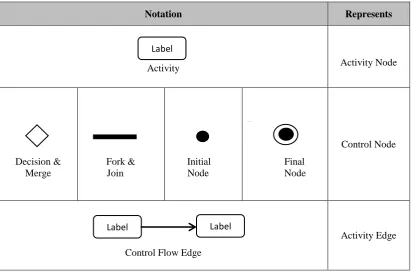
[image:37.595.114.526.161.434.2]and stepwise activities and actions of UI. The UML activity diagram notations used in this study as shown in Table 2.1.
Table 2.1: Activity diagram notations. (Shanthi & Mohan, 2012)
Notation Represents
Activity Activity Node
Decision & Merge
Fork & Join
Initial Node
Final Node
Control Node
Control Flow Edge
Activity Edge
2.9 Performance Testing Measurements
In software engineering, performance testing is in general testing performed to determine how a system performs in terms of responsiveness and stability under a particular workload. It can also serve to investigate, measure, validate or verify other quality attributes of the system, such as scalability, reliability and resource usage (Shilpa & Meenakshi, 2014).
Performance is concerned with achieving Hits per Second, throughput, and resource-utilization levels that meet the performance objectives of the project or product. Performance testing represents the superset of all of the other subcategories of performance-related testing. There are many tools that can be used to simulate the load in terms of users, connections and capture data related to Hits per Second, Throughput, and Resource utilization. Among the most important tools is HP LoadRunner (Sheetal & Joshi, 2012).
Label
21
There are various parameters based on which performance of the system is measured. They are known as performance measurements. One is Resource utilization, which is the number of resources used to serve users request. These resources can be memory, processors, I/O disk and network utilizations. To achieve better system performance, resource allocation should be done efficiently. The efficient resource utilization leads to better system performance (Kalpan & Ramakanth, 2012). Our study is focused solely on resource utilization of memory. Throughput is an important indicator for measuring server performance, which represents the throughput capacity of the server at any time. Generally, the higher the Throughput, the better the server performance will be. A Hit per Second is the number of HTTP requests per second that virtual users submit to the web servers. It can reflect whether or not the system is stable, when the number of user increases, the Hits per Second will increase accordingly (Weibiao et al., 2014).
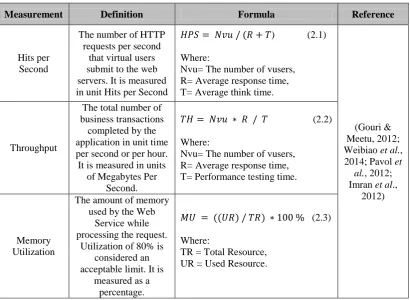
[image:38.595.115.526.429.729.2]Overall, the definitions and formulas of performance measurements that used in this study are illustrated in the Table 2.2.
Table 2.2: Performance measurements definitions and formulas.
Measurement Definition Formula Reference
Hits per Second
The number of HTTP requests per second
that virtual users submit to the web servers. It is measured in unit Hits per Second
) (2.1)
Where:
Nvu= The number of vusers, R= Average response time, T= Average think time.
(Gouri & Meetu, 2012;
Weibiao et al.,
2014; Pavol et
al., 2012;
Imran et al.,
2012) Throughput
The total number of business transactions
completed by the application in unit time per second or per hour. It is measured in units
of Megabytes Per Second.
(2.2)
Where:
Nvu= The number of vusers, R= Average response time, T= Performance testing time.
Memory Utilization
The amount of memory used by the Web
Service while processing the request.
Utilization of 80% is considered an acceptable limit. It is
measured as a percentage.
(2.3)
Where:
22
2.10 HP LoadRunner Tool
HP LoadRunner is an automated testing and performance product from Hewlett Packard (HP) for examining system behaviour and performance in actual load. The HP LoadRunner tool can simulate concurrent users, so that applications can be simulated by real life user loads while collecting information from key infrastructure components. The HP LoadRunner tool supports various environments and wide range of technologies for users to start software testing for a load testing application. It is the de-facto integrated software testing tool which is built for ease of use, and also has the powerful flexibility (Prakash & Gopala, 2012).
The HP LoadRunner tool allows users to prevent application performance problems by detecting bottlenecks. Moreover, it enables users to test web applications and mobile applications. It gives a picture of end-to-end system performance so that users can verify that new or upgraded applications meet performance requirements. It also reduces hardware and software costs by accurately predicting application scalability and capacity (Rahul & Prince, 2013).
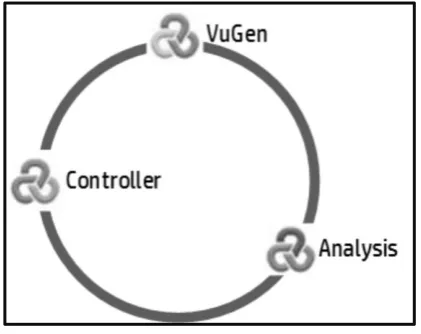
[image:39.595.232.443.538.705.2]According to Priyanka & Mansi (2014), HP LoadRunner consists of three components: Virtual user Generator (VuGen), which captures end-user business process and creates an automated performance testing script also known as a vuser script; Controller, which organizes, manages and monitors the test; Controller to execute test for various geographical area; and Analysis, which is used to generate the results graphs after execution of the test (see Figure 2.1).
23
2.11 Mean Square Error (MSE)
Mean Square Error (MSE) is the mean of the overall squared prediction errors. It takes into account the bias, or the tendency of the estimator to overestimate or underestimate the actual values, and the variability of the estimator, or the standard error. Suppose that is an estimate for a population parameter Y. The MSE of an estimator is the expected value of ( Y)2. An MSE of zero means that the estimator predicts observations of the parameter Y perfectly. Different values of MSE can be compared to determine how well different models explain a given data set. The smaller the MSE is, the closer the fit to the data. To get MSE follow the equation (Salkind, 2010):
∑
Where:
N = Number of Values. Y = Actual Value. = Estimated Value.
2.12 Related Works
Due to the lack of research on comparisons between web and mobile applications testing, some of the research related to automated testing and techniques are reviewed in this section to generate test cases for web and mobile applications. In addition to background of the work requirements for this dissertation, other related works that consist of similar efforts to demonstrate the state-of-the-art in the test case generation are also presented.
Ang et al. (2014) proposed the ADAutomation framework that can enable
automated GUI testing for smartphone applications based on UML activity diagrams, which supports user behaviour modelling, automated GUI test case generation, and post-test analysis and debugging. A tool chain based on this framework has been developed. The experimental results showed on two industrial designs. This approach can reduce the overall test time, testing efforts as well as improving test
24
adequacy. Moreover, this approach effectively detects fatal faults in complex GUI implementations to improve the quality of designs.
Tobias & Volker (2014) proposed an approach to test case generation and automated execution by using MBT to improve the testing of context-aware mobile applications by reducing test cases from design-time system models. This approach includes a four-tier process, and UML activity diagrams are enriched with context parameters and test data using a UML supporting for context-awareness modelling. By using model transformation, from the activity diagram a Petri Net representation is obtained. The Petri Net representation sample is analysing the model for parallel and cyclic structures that need to be considered when choosing adequate test coverage criteria. From the reachability tree on the Petri Net all paths from root node to leaf nodes are extracted that eventually form test cases. From the Petri Net markings in each path activity diagram elements are obtained; those irrelevant for test case execution are removed from the path. Using model-to-code transformation, from the platform-independent model, platform-specific test cases are derived apt for automated execution. This approach has been validated with a mobile context-aware application from which a set of test cases satisfying the coverage criteria has been generated and automatically executed.
117
REFERENCES
Agarwal, B., Tayal, S. and Gupta, M. (2010). Software Engineering and testing An
Introduction. Hingham, Toronto: Infinity Science Press, Jones and Bartlett’s
books. ISBN: 978-1-934015-55-1.
Amalfitano, D., Fasolino, A., Tramontana, P. and Amatucci, N. (2013). Considering Context Events in Event-based Testing of Mobile applications. Proceedings of the 2013 IEEE Sixth International Conference on Software Testing.
Verification and Validation workshops (ICSTW). March 18-22, 2013.
Luxembourg: IEEE.126-133.
Amalfitano, D., Fasolino, A., Tramontana, P., De Carmine, S. and Memon, A. (2012). Using GUI ripping for automated testing of Android applications.
Proceedings of the 27th ACM International Conference on Automated
Software Engineering. New York, NY, USA: ACM. 258– 162.
Ang, L., Zishan, Q., Mingsong, C. and Jing, L. (2014). ADAutomation: An Activity Diagram Based Automated GUI Testing Framework for Smartphone Applications. Proceedings of the Eighth IEEE International Conference on
Software Security and Reliability (SERE), June 30, 2014-July 2, 2014. San
Francisco, CA: IEEE. 68 – 77.
Anju, B. (2014). A Comparative Study of Software Testing Techniques.
International Journal of Computer Science and Mobile Computing, 3(6),
579-584.
Arora, A. & Sinha, M. (2012). Web Application Testing. International Journal of
Scientific & Engineering Research, 3(2),1-6, ISSN 2229-5518.
Aye, K. & Myat, M. (2014). An Efficient Approach for Model Based Test Path Generation. International Journal of Information and Education
118
Belli, F., Beyazit, M. and Memon, A. (2012). Testing is an Event-Centric Activity. Proceedings of the IEEE Sixth International Conference on Software
Security and Reliability Companion (SERE-C), 20-22 June 2012.
Gaithersburg, MD: IEEE. 198 - 206.
Ben (2014). Characterizing and Measuring Hits per Second for Web Applications.
Retrieved on December 12, 2014, from
http://blog.nexcess.net/2011/06/29/characterizing-and-measuring-Hits per Second-for-web-applications-2/.
Bhupendra, S. & Shashank, S. (2014). A Model For Performance Testing Of Ajax Based Web Applications. International Journal of Research in Engineering
and Technology (Ijret), 3(4), 889- 893.
Bipin, P. & Rituraj, J. (2014). Importance of Unified Modelling Language for Test Case Generation in Software Testing. International Journal of Computer
Technology & Applications., 5 (2),345-350. ISSN: 2229-6093.
Cartaxo, E., Neto, F. and Machado, P. (2007). Test Case Generation By Means Of UML Sequence Diagrams and Labeled Transition Systems. Proceedings of the ISIC. IEEE International Conference on Systems, Man and Cybernetics,
7-10 Oct. 2007. Montreal: IEEE. 1292 – 1297.
Chan, K., Chen, T. and Towey, D. (2002). Restricted random testing. Proceedings of the 7th International Conference on 7th European Conference on Software
Quality Helsinki, Finland, June 9–13, 2002, London, UK: Springer. 321–
330.
Charland, A. & Leroux, B. (2011). Mobile application development: Web vs. Native.
Magazine Communications of the ACM, 54(5), 49-53.
doi:10.1145/1941487.1941504.
Chen, M., Mishra, P. and Kalita, D. (2008). Coverage-driven automatic test generation for UML activity diagrams. Proceedings of the ACM 18th Great
Lakes symposium on VLSI (GLSVLSI). New York, NY, USA: ACM. 139–
119
Chen, M., Qin, X. and Li, X. (2006). Automatic test case generation for UML activity diagrams. Proceedings of the 2006 international workshop on
Automation of software test (AST). New York, NY, USA: ACM. 2–8.
Chen, M., Qin, X., Xu, W., Wang, L., Zhao, J. and Li, X. (2009). UML Activity Diagram-Based Automatic Test Case Generation for Java Programs. The
Computer Journal, 52(5),545–556, 2009. doi: 10.1093/comjnl/bxm057.
Chen, T., Kuo, F., Robert, G. and Tse, T. (2010). Adaptive Random Testing: The ART of test case diversity. Journal of Systems and Software archive, 83(1), 60-66. doi:10.1016/j.jss.2009.02.022.
Cheng, B., Xiaoyan, W., Xiaoxiao, H., Chen, J., (2011). Multimedia Conferencing Management Using Web Services Orchestration over Public Networks.
Journal of Convergence Information Technology (JCIT), 6(6), 361 - 375.
Chouhan, C., Shrivastava, V. and Parminder, S. (2012). Test Case Generation based on Activity Diagram for Mobile Application. International Journal of
Computer Applications, 57(23),4-9. doi: 10.5120/9436-3563.
Chouhan, C., Shrivastava, V., Parminder, S. and Soni, P. (2013). Test Case Generation on the Origin of Activity Diagram for Navigational Mobiles. International Journal of Advanced Computational Engineering and
Networking, 1(2), 32-36. ISSN (p): 2320-2106.
Cramer, H., Rost, M., Belloni, N., Bentley, F. and Chincholle, D. (2010). Research in the large. Using app stores, markets, and other wide distribution channels in Ubicomp research. Proceedings of the ACM 12th International Conference
Adjunct Papers On Ubiquitous Computing – Adjunct. New York, NY, USA:
ACM. 511-514.
Cuixiong, H. & Iulian, N. (2011). Automating GUI testing for Android applications.
In Proceedings of the ACM 6th International Workshop on Automation of
Software Test (AST '11). New York, NY, USA: ACM. 77-83.
doi:10.1145/1982595.1982612.
120
Fan, X., Shu, J., Liu, L. and Liang, Q.J. (2009). Test Case Generation from UML Subactivity and Activity Diagram. Proceedings of the IEEE 2nd International Symposium on Electronic Commerce and Security, 22-24 May
2009. Nanchang: IEEE. 244–248.
Gahran, A. (2011). What’S A Mobile App?. Retrieved on October 02, 2014, from http://www.contentious.com/2011/03/02/whats-a-mobile-app/.
Gaurav, S. & Kestina, R. (2013). Software Testing Techniques for Test Cases Generation. International Journal of Advanced Research in Computer
Science and Software Engineering, 3(9), 261-265.
Gouri, S. & Meetu, A. (2012). Software Performance Engineering. International
Journal of Research in IT & Management, 2(2),364-371. ISSN 2231-4334.
Guangzhu, J. & Shujuan, J. (2009). A Quick Testing Model of Web Performance Based on Testing Flow and its Application. Proceedings of the IEEE 6th International Conference on Web Information Systems and Applications,
18-20 Sept. 2009. Xuzhou, Jiangsu: IEEE. 57-61.
doi:10.1109/WISA.2009.16.
HP LoadRunner (2015). HP LoadRunner 12.02. Retrieved on March 01, 2015, from http://www8.hp.com/us/en/software-solutions/LoadRunner-load-testing/ index.html.
Huang, Y., Cao, J., Jin, B., Tao, X. and Lu, J. (2010). Cooperative cache consistency maintenance for pervasive internet access. Wireless Communications and
Mobile Computing, 10(3),436-450. doi:10.1002/wcm.819.
IBM (2012). Native, web or hybrid mobile-app development. IBM Software, Thought Leadership White Paper. Retrieved on September 10, 2014, from http://www.computerworld.com.au/whitepaper/371126/native-web-or-hybrid-mobile-app-development/download/.
IEEE (2004). Guide to the Software Engineering Body of Knowledge. United States of America: Angela Burgess. ISBN 0-7695-2330-7.
121
Engineering and Applications (IJCSEA), 2(3), 109-116. doi:
10.5121/ijcsea.2012.2310.
Imran, A., Gias, A.U. and Sakib, K. (2012). An Empirical Investigation of Cost-Resource Optimization for running Real-Life Applications in Open Source Cloud. Proceedings of the International Conference on High Performance
Computing and Simulation (HPCS), 2-6 July 2012. Madrid: IEEE. 718 -
723. doi:10.1109/HPCSim.2012.6267002.
Kalpan, B. & Ramakanth, K. (2012). A Survey on Performance Testing Approaches of Web Application and Importance of WAN Simulation in Performance Testing .International Journal on Computer Science and Engineering
(IJCSE), 4(5), 883-885. ISSN: 0975-3397.
Kansomkeat, S., Offutt, J., Abdurazik, A. and Baldini, A. (2008). A Comparative Evaluation Of Tests Generated From Different UML Diagrams.
Proceedings of the IEEE 9th ACIS International Conference on Software
Engineering, Artificial Intelligence, Networking, and Parallel/Distributed
Computing, 6-8 Aug. 2008. Phuket: IEEE. 867–872. doi:
10.1109/SNPD.2008.48.
Kao, Y., Lin, C., Yang, K. and Yuan, S. (2011). A Cross-Platform Runtime Environment for Mobile Widget-Based Application Proceedings of the IEEE International Conference on Cyber-Enabled Distributed Computing
and Knowledge Discovery, 10-12 Oct. 2011. Beijing: IEEE. 68 – 71.
doi:10.1109/CyberC.2011.20.
Ke, H., Xiao-Hong, L. and Zhi-Yong, F. (2010). Approach to activity diagram model driven testing for Web applications. Journal of Computer Applications, 30(9),2365-2369.
Khandai, M., Acharya, A. and Mohapatra, D.P. (2011). A Novel Approach of Test Case Generation for Concurrent Systems Using UML Sequence Diagram. Proceedings of the IEEE 3rd International Conference on Electronics
Computer Technology (ICECT), 8-10 April 2011. Kanyakumari: IEEE.157–
122
Kim, H. (2013). Hybrid Model Based Testing for Mobile Applications. International
Journal of Software Engineering and Its Applications, 7(3),223-238.
Kulvinder, S. & Semmi (2013). Finite State Machine based Testing of Web Applications. International Journal of Software and Web Sciences (IJSWS), 4(1), 41- 46. ISSN: 2279-0063.
Li, L. Miao, H. and Qian, Z. (2008). A UML-Based Approach to Testing Web Applications. Proceedings of the IEEE International Symposium on Computer Science and Computational Technology, 20-22 Dec. 2008.
Shanghai: IEEE. 397 – 401.
Liu, Z., Gao, X. and Long, X. (2010). Adaptive Random Testing of Mobile Application. Proceedings of the IEEE 2nd International Conference on
Computer Engineering and Technology, 16-18 April 2010. Washington,
DC, USA: IEEE. 297-301. doi: 10.1109/ICCET.2010.5485442.
Mario, K. & Eugene, O. (2014). Native, HTML5, or Hybrid: Understanding Your
Mobile Application Development Options. Retrieved on September 20,
2014, from: https://developer.salesforce.com/page/Native,_HTML5,_or_Hybrid:_ Understanding_Your_Mobile_Application_Development_Options.
Maryam, A. & Rosziati, I. (2014). A Comparative Study of Web Application Testing and Mobile Application Testing. Advanced Computer and Communication Engineering Technology, Lecture Notes in Electrical Engineering. Springer
International Publishing, 315, 491-500. doi:
10.1007/978-3-319-07674-4_48.
Masi, E., Cantone, G., Mastrofini, M., Calavaro, G. and Subiaco, P. (2012). Mobile apps development: A framework for technology decision making. Proceedings of International Conference on Mobile Computing,
Applications, and Services. Springer Berlin Heidelberg. 64–79. ISSN
1867-8211.
Mohd, E. & Farmeena, K. (2012). A Comparative Study of White Box, Black Box and Grey Box Testing Techniques. International Journal of Advanced
123
Mohd, E. (2010). Different Forms of Software Testing Techniques for Finding Errors. IJCSI International Journal of Computer Science Issues, 7(3),11-16. Mohd, E. (2011a). Different Approaches to Black Box Testing Technique for Finding Errors. International Journal of Software Engineering &
Application (IJSEA), 2(4),31-40.
Mohd, E. (2011b). Different Approaches to White Box testing Technique for Finding Errors. International Journal of Software Engineering &
Application (IJSEIA), 5(3), 1-13.
Myers (2004). Art of Software Testing. 3rd.Hoboken, NJ, USA: John Wiley & Sons, Incorporated.
Nadia, A. & Mark, H. (2011). Automated web application testing using search based software engineering. Proceedings of the IEEE 26th International Conference on Automated Software Engineering (ASE), 6 - 10 November
2011. Lawrence, Kansas, USA: IEEE. 3 – 12.
Nazish, R., Nadia, R., Saba, A. and Zainab, N. (2014). Model Based Testing in Web Applications. International Journal of Scientific Engineering and Research
(IJSER), 2(1),56-60.
Pakinam, N., Nagwa, L., Mohamed H. and Mohamed F. (2011a). A Proposed Test Case Generation Technique Based on Activity Diagrams. International
Journal of Engineering & Technology, 11(3),35-52.
Pakinam, N., Nagwa, L., Mohamed, H. and Mohamed, F. (2011b). Test Case Generation and Test Data Extraction Techniques. International Journal of
Electrical & Computer Sciences, 11(3),82-89.
Pallavi, R. & Satyaveer, T. (2014). Android Mobile Automation Framework.
International Journal of Engineering and Computer Science, 3(10),
8555-8560.
Pavol, T., Ondrej, V., Lukas, S. (2012). The Usage of Performance Testing for Information Systems. International Conference on Information and