ISSN: www.jatit.org E-ISSN:
OFFLINE HANDWRITTEN SIGNATURE VERIFICATION
USING BACK PROPAGATION ARTIFICIAL NEURAL
NETWORK MATCHING TECHNIQUE
1ANWAR YAHY EBRAHIM
,
2GHAZALI SULONG
1
PHD student, Department of Computing, Universiti Tecknologi Malaysia (UTM), 81310 Johor Bahru, Malaysia
2
Professor, Department of Computing,Universiti Tecknologi Malaysia (UTM),81310 Johor Bahru, Malaysia
E-mail: [email protected],[email protected]
ABSTRACT
Handwriting is a skill that is highly personal to individuals and consists of graphical marks on the surface in relation to a particular language. Signatures of the same person can vary with time and state of mind. Several studies have come up with several methods on how to detect forgeries in signatures given to the security implication of signatures to daily business and personal transactions. This paper illustrates the proposed methodology for an offline handwritten signature identification and verification system which extracts certain dynamic features derived from velocity and acceleration of the pen together with other global parameters like total time taken and number of pen-ups in order to distinguish between forged signatures and genuine signatures signed under duress. Adaptive Window Positioning technique was employed for feature extraction, which focuses on not just the meaning of the handwritten signature but also on the individuality of the writer by dividing the handwritten signatures into 13 small windows of size nxn (13x13) such that it is large enough to contain ample information about the style of the author and small enough to ensure a good identification performance. Then, a signer specific codebook approach was used to generate a separate codebook of patterns for each individual signer such that the number of classes in each codebook varies as a function of the writing sample (signer), and a 3-layered Backward Propagation Artificial Neural Network (BPANN) method was used to produce a maximal matching and preserve the efficiency of the network. The proposed method was validated using a trained GPDS data set of 2400 original signatures of 100 different signers and comparing the results with those of two different known techniques of offline handwritten signature verification systems. The findings indicate that the proposed technique had the lowest ERR value of 7.23, indicating a more improved performance when compared against the two known techniques respectively thus proving to be a more efficient and superior method for offline handwritten signature identification and verification.
Keywords: Offline Handwritten Signature, Identification, Verification, Adaptive Window Positioning,
Signer Specific Codebook, Backward Propagation Artificial Neural Network
1. INTRODUCTION
The use of handwritten signatures for authenticating documents or personal identification dates back to to ancient times and has since been increasingly used for numerous financial and business transactions [1]. The use of handwritten signature for authentication plays an important role in the everyday life of society and is applied in almost every sphere of human activity due to its relative ease of use, especially offline handwritten signatures [2]. According to [3], most financial institutions give preference to the use of the offline handwritten signature despite the fact that the
ISSN: www.jatit.org E-ISSN: a need for adequate protection of personal
signatures. Verification decision of offline
handwritten signatures usually undergoes a series of processes which include pre-processing (where the local and global features of the handwritten
signature is extracted), identification and
verification of the extracted features against a standardized database. A good verification result can be derived by matching the robust features of the sample signature against the signature of the user through appropriate techniques or classifiers [5]. However, most studies in this domain have often overlooked the impact of external influences such as duress and mind state of the signer when signing their signatures [6][7][8]. This has made it impossible to distinguish between a forged signature and a genuine signature signed under duress, for example. With the advent of highly advanced computers with unimaginable processing prowess, there is need for the development of a new technique and algorithm that can take into account some of these external factors when investigating or verifying a signature. This paper therefore attempts to address this challenge by proposing a new
method for offline handwritten signature
identification and verification through the use of a combination of techniques and methods such as
adaptive window positioning technique for
signature feature extraction, signer specific codebook for clustering and BPANN for matching. The rest of the paper is divided as follows: Section II looks at the related literature in this field, Section III discusses the methodology adopted for this study, Section IV presents and discusses the results of the study and Section V concludes the study.
2. BACKGROUND OF THE STUDY
The challenge in creating a system with the ability to recognize handwritten offline signatures and verify its authenticity has been a problem particularly in the use computer to identify forgeries beyond the convention of writing an algorithmic process [5]. This challenge involves making the computer solve the problem using a series of new steps. Past studies, in an attempt to bridge this gap have employed several techniques and methods in addressing the challenge. The issue has been complicated with the increasing role signatures play in daily financial, legal and commercial transactions, thus requiring a more secured authentication. Handwritten signatures are the most widely accepted means of personal identity authentication, which can be captured and processed as an image by digital computers [3].
ISSN: www.jatit.org E-ISSN: pattern recognition tasks [10].Thus, this paper
presents a methodology that can be used for identifying and verifying offline handwritten signatures through a series of logical steps beginning from the use of Adaptive Window
Positioning technique for signature feature
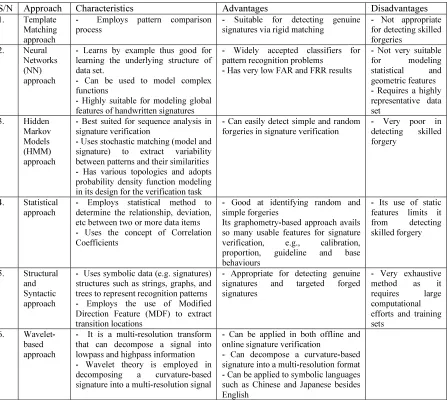
extraction, signer specific codebook approach for generating separate codebook patterns for each individual signer, and a 3-layered BPANN method for maximal matching and to preserve the efficiency of the network. Table 1 presents a list of
different offline handwritten signature
identification and verification approaches
highlighting their characteristics, advantages and disadvantages.
3. PROPOSED METHOD
This section illustrates the proposed
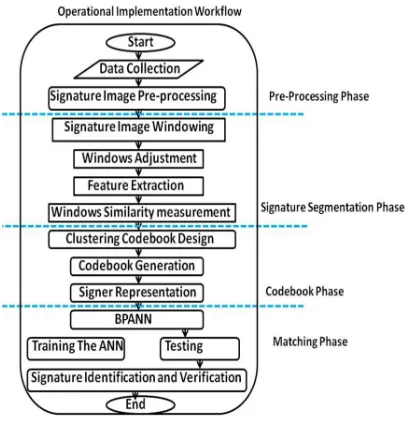
methodology used for the offline handwritten signature identification system based on BPANN matching method. The methodology has been divided into three phases namely: the pre-processing phase, codebook generation phase, and the matching phase. Details of each of these phases, together with the logical steps undergone, beginning from acquiring the signature images to
preprocessing, clustering, identification and
[image:3.595.88.292.469.692.2]verification are presented in a flowchart diagram as shown in Figure 1 and discussed below.
Figure 1: Methodology Flowchart
3.1 Preprocessing Phase
In this phase, the data is acquired and the signature image preprocessed. GPDS database was
used for collecting data because it is a standardized database of offline English signature images with a dataset of 4870 signatures from 90 different writers. Also, it enjoys wide acceptability and usage among researchers in the domain of offline handwritten
signature identification and verification
applications. The collected signature images were preprocessed in order to improve the image quality for noise-free feature extraction thus improving identification performance. A global threshold of Otsu’s algorithm was employed for the conversion into binary images of the selected signature. Adaptive window positioning technique was then used to segment the signature images into small fragments or sub images enabling the elimination of
redundancy and facilitating a meaningful
comparison of the segmented fragments. A 13x13 window size was applied to the signature images for optimum output. The main objective of this technique is to achieve optimal window positioning by tracing the ink of the handwritten signature image in the context of the drawing. Next, we extract the set of features (shape measures) from the patterns and represent the images in a feature space. Since a typical data analysis problem involves many observations as well as a good number of respective features, it is important to organize such data in a sensible way before it can be presented and analyzed by humans or machines. The aim of shape characterization is to obtain shape measures to be used as features for classification in patterns. After representing the sub-images from a set of features, we need to do a similarity measure of all the windows by comparing the sub-images (fragments) in pairs. The sub-images are compared
with the following correlation similarity
measurement:
S(X,Y)=
(1)
Where, Nij is the number of pixels of the two sub-images X and Y, with values i and j respectively, at the corresponding pixel positions. This measure will be close to 1 if the two compared sub-images are similar and in extreme case it will have a value equal to 1 indicating that the two shapes are exactly the same.
3.2 Codebook Generation Phase
ISSN: www.jatit.org E-ISSN: signer, once the primary codebook has been
generated, the next step is to represent the codebook with the set of features that allow comparing between two signature samples. Suppose for a
signature handwritten
D
, letP
Dbe the number ofclasses of primary codebook such that the primary
codebook of signature D with
P
Dclasses are givenby:
CD C 1 J PD } (2)
Where,
P D
C
represents the primary codebook:
C J = { f1,j , f2,j , f3,j ,……….f K,J } (3)
Where, K=card (CJ), card, is the cardinality of CJ
and f representing the set of feature of the pattern in the classes. To represent individual codebook, the proposed technique considers the codebook as a probability distribution. For each class of the codebook, it counts the number of elements and then computes the probability of occurrence of each pattern in the codebook. In other words, a histogram is created where each bin represents a pattern in the codebook and the frequency of the bin represents the number of elements in the class of that pattern. The histogram is normalized to convert it into a probability distribution. This is carried out for primary codebooks and hence each signature handwritten sample is represented by two distributions. In relation to that, the pseudo-code of codebook representation for each individual signer
with features is given by the following algorithm:
1. Let number Of Patterns be the total
number of elements in each codebook of individual signature.
2. Let class Elements be the number of
elements in an individual class.
3. Let Prob be the probability of
occurrence of current feature.
4. Let covMatrix be the covariance
matrix in which each row is an observation, and each column is a variable. The covariance between two random variables is defined by: Covariance(x,y) = ∑
(4)
Where,
µ
1andµ
2denote the means of Xand Y, respectively.
5. Let identity be a matrix which is
computed by the covMatrix, and the size of the identity matrix is the same as covMatrix.
6. Let determinant be the size of square
matrix, which is defied by:
, 1
determinant( )
( )
i n
n
i
S i
A
sign
A
σσ
σ
∈ =
=
∑
∏
where, A represents n×n matrix, sign is the sign function of permutation group which returns +1 for even and -1 for odd matrix respectively.
3.3 Matching Phase
In a neural network approach to the clustering, the neurons in the network are connected with a 1-D or 2-1-D structure, and they correspond to the codevectors. The feature vectors are feed to the network by finding the nearest codevector for each input vector. The best matched codevector and its neighboring vectors (according to the network structure) are updated by moving it towards the input vector. After processing the training set by a predefined number of times, the neighborhood size is shrunk and the entire process is repeated until the neighborhood shrinks to zero. This phase generates is for the NN to learn the relationship between a signature and its class (either “genuine” or “forgery”). Once this relationship has been learned, the network can be presented with test signatures that can be classified as belonging to a particular signer. In this work there is a challenge of creating a system with the ability to recognize and differentiate hand written signature and verify its authenticity not just from forgeries but also from those signed under duress. This poses a problem because we are trying to get the computer to solve a problem with a method of solution that goes outside the convention of writing an algorithmic process. The challenge involves making the computer solve the problem using a series of new steps. After a lengthy research, the only feasible solution required is using the concept of the Neurons in human brain, which is familiar with medical practitioners. Thus, the Back Propagation Artificial Neural Network algorithm has been chosen because it is probably the easiest to implement, while preserving efficiency of the network. A 3-layered BPANN consisting of an Input Layer (which holds input for the network), Output Layer (that holds the output data and also serves as an identifier for the input), and Hidden Layer (that acts as an interface between the input and output layers and serves as a propagation point for sending data from the previous layer to the next layer) was employed for this study. Training was carried out iteratively in two phases until the sum of square of the output errors reached an acceptable value. The trained data was tested against a GPDS dataset of 5400 samples. Signature verification was carried out by computing the equal error rate (ERR) and validated by
ISSN: www.jatit.org E-ISSN: comparing it with the ERR values of other offline
handwritten signature verification methods. ERR
provides a quick comparison method for
determining the accuracy of a verification system such that the lower the ERR the more accurate the system.
4. DISCUSSION OF RESULT
This section discusses the results of the proposed method as illustrated in the procedural methodology presented in section 3. Matlab and Delphi programming language was used in a Microsoft Windows operating system environment. Details of the results illustrated with diagrams and screen shots are discussed below. The validation of the proposed method’s performance is also discussed at the tail end of this section.
4.1. Pre Processing Phase
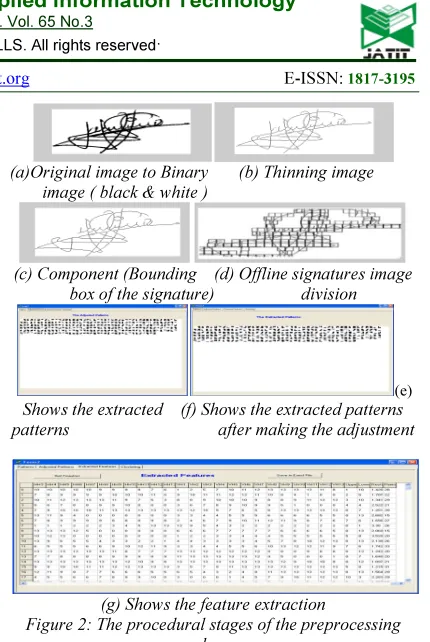
In this phase, the original signature image was scanned and converted from grayscale to binary image (Figure 2a) and then thinned out (Figure 2b) so as to remove the background noise for improved identification process. The thinned image was then bounded in a box for easy component identification (Figure 2c) after which Adaptive Window Positioning technique was used to segment the image into small window fragments of 13x13 window sizes (Figure 2d). The main objective of using the windowing technique is to trace the image trajectory by ensuring that no overlap exists. This is achieved by placing the windows over each of the identified component vertically (from top to bottom) and horizontally (from left to right), in an onward direction of the image trajectory. Next, we extract the patterns each signature image in each window (Figure 2e) and then adjust the patterns in each window by moving it to the upper left corner (Figure 2f). The pattern adjustment helps improve the accuracy of the feature extraction process which is a very vital input to the performance of the entire signature identification and verification process and makes computation much easier and with minimal error. Also, the higher the number of related features extracted, the better categorized the generated codebooks will be, implying a better identification result. The result of the feature extraction is shown in Figure 2g based on Eqn 1. as stated in Section 3 sub section A. The values shown in Figure 2g represents the frequency of patterns extracted from each window. The higher values suggest that there is a more specific pattern with the original signature in the data set, which implies that the similarity between the data set signature and the test signature is high.
(a)Original image to Binary (b) Thinning image image ( black & white )
(c) Component (Bounding (d) Offline signatures image box of the signature) division
(e)
Shows the extracted (f) Shows the extracted patterns patterns after making the adjustment
[image:5.595.300.515.76.397.2](g) Shows the feature extraction
Figure 2: The procedural stages of the preprocessing phase
4.2. Codebook Generation Phase
In this phase, classification of the extracted features are grouped into classes based on their similarity characteristics, using the similarity function stated in Eqn. (2) and (3) in Section 3 sub section B. This helps in determining the range of values for a variety of features by classifying them
based on a specific threshold magnitude.
Hierarchical clustering was used for the
classification of the extracted features such that each class length represents the authorship of signer and their respective differences. This clustering approach starts with each window as a single class and merges windows into the classes until all windows are in one cluster. The proposed technique needs to define a distance (or similarity) measure allowing comparison of two classes. Based on this study, a total of 47 classes were clustered from the many variety of features extracted as shown in Figure 3.
Figure 3: A cluster of 47 classes
ISSN: www.jatit.org E-ISSN: individual signer. The number of classes in each
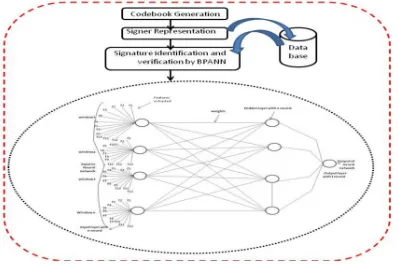
[image:6.595.91.290.204.336.2]codebook therefore varies as a function of writing sample (signer). The framework using signer specific approach is shown in Figure 4, which is a continuity of the main methodology discussed in Section 3 (Figure 1).
Figure 4: Framework For Writer Specific Approach
In this approach, a specific codebook of fragmented patterns is generated for each individual signature sample. The numbers of classes in each relevant codebook (primary codebook) are not known because it varies from sample to sample. In addition, since the number of classes for each signer is not known, this study uses the distance criterion to represent the number of clusters. For each signer the proposed technique generates the clusters from the main as well as adjacent windows. In this research, main and adjacent clusters are also termed as primary codebook. In relation to that, the pseudo-code of windows clustering to generate codebook is given in the algorithm presented in Section 3, sub section B. Once the codebook for main and adjacent windows are generated, the proposed technique sorts the classes according to the cardinality and keeps only those classes which have sufficient number of windows. Classes in each primary codebook correspond to the frequent stroke patterns occurring in the main and adjacent windows. In primary codebook, the number of patterns per class naturally depends upon the size of the signature sample but interestingly the number of classes is a signer-dependent parameter. This is illustrated in Figure 5 where the numbers of classes in primary codebooks are shown. The codebooks are generated from 30 different signers having two samples each. It can be seen that the curves representing numbers of classes in the two samples of a particular signer is more or less similar for both codebooks. This supports the idea that the number of classes is a signer-dependent attribute.
Figure 5: Number Of Primary Classes For Two Samples Of 30 Writers
As an example, primary codebook produced from the main and adjacent fragmented windows are illustrated in Figure 6. The codebook contains a number of different classes. Each class contains relatively homogeneous groups of similar patterns, which are dissimilar to elements in the other classes. These classes are separated by a class number in the codebook as illustrated in Figure 6.
Figure 6 : Signer-Specific Primary Codebook Obtained From The Main Fragmented Windows On A
Signature Sample
Once the primary codebooks are generated for each signer, the next step is to determine how to use this information to represent the codebook with the set of features that allow comparing between two signature samples. To represent each individual codebook, the proposed technique considers the codebook as a probability distribution. For each class of the codebook, it counts the number of elements and then computes the probability of occurrence of each pattern in the codebook. In other words, a histogram is created where each bin represents a pattern in the codebook and the frequency of the bin represents the number of elements in the class of that pattern. The histogram is normalized to convert it into a probability distribution. This is carried out for primary codebooks and hence each handwritten signature sample is represented by two distributions.
4.3 Matching Phase
Using a 3-layered BPANN approach
ISSN: www.jatit.org E-ISSN: inputs are propagated forward to compute the
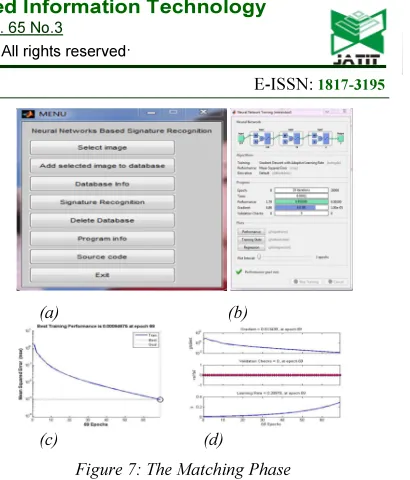
outputs for each output node. Then, each of these outputs is subtracted from its desired output, causing an error [an error for each output node]. In the second phase, each of these output errors is passed backward and the weights are fixed. These two phases are continued until the sum of square of output errors reaches an acceptable value. Each neuron is composed of two units. The First unit adds products of weights coefficients and input signals while the second unit realizes nonlinear function, called neuron activation function. Signal E is adder output signal and Y=F E is output signal of nonlinear element. Signal Y is also the neuron’s output signal. To train the neural network, we need dataset. The training data set consists of input signals X1 and X2 assigned with corresponding target (desired output) Y. The network training is an iterative process. In each iteration, the weight coefficients of nodes are modified using new data from the training dataset. Each training step starts with forcing both input signals X1 and X2 from the training dataset to the neural network. After this stage we can determine the output signal values for each neuron in each network layer. The entire process is repeated until the neighborhood size is shrunk to zero. This result generated by this phase helps the NN to learn the relationship between a signature and its class (either “genuine” or “forgery”). Once this relationship has been learned, the network can be presented with test signatures that can be classified as belonging to a particular signer. This method yields a better maximal matching result. The screen shots of the above discussed processes are illustrated in Figure 7. Figure 7a shows the menu page of the proposed signature identification and verification system based on BPANN method, while Figure 7b shows the neural network training processes for 29 iterations (epochs) with a performance of 1.79 and a gradient of 4.86. The performance of the system is measured by the Mean Squared Error (MSE) while the neural network training is measured by the gradient. Figure 7c shows that as the number of
iterations (epochs) increased to 69, the
neighborhood size came to near zero, recording a MSE value of 0.00094675, which is the best training performance value derived by the system, with a gradient of 0.013439 and a learning rate of 0.28978 (Figure 7).
(a) (b)
[image:7.595.315.520.73.313.2](c) (d)
Figure 7: The Matching Phase
However, the objective is to create a system that
can identify and distinguish between the
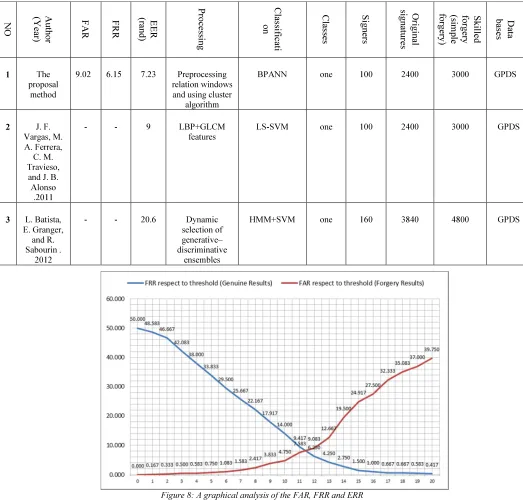
handwritten signatures and verify its authenticity not just from forgeries but also from those signed under duress. Thus, by using all 24 original and 30 forged signatures from the GPDS dataset of 5400 signature samples, we were able to determine the average deviation of feature properties for both the forged (False Acceptance Rate - FAR) and the original (False Rejection Rate - FRR) with respect to the threshold as shown in Figure 8. The FAR and FRR values obtained for the proposed method are shown in Table 2. Based on the graphical analysis (Figure 8), it was observed that a similar pattern exists for both FRR and FAR of each signer when referenced to the threshold implying that a forger cannot reproduce every aspect of original signature with same accuracy as the original signer. Also, it indicates that even though the same systematic error may be repetitively made by a particular forger, when weighed against other possible forgeries, the deviations tend to cancel themselves out. As such the properties of a feature reproduced by a forger will always vary around a given mean as the means always tend to overlap. However, for a genuine signer who may tend to produce a signature under duress, there are certain unconscious features that will always remain stable irrespective of the influencing human factors, which are almost impossible to forge.
5. VALIDATION OF RESULT
ISSN: www.jatit.org E-ISSN: signature identification and verification methods
(Table 2). FAR was used to account for all the skilled forgeries, FRR for only genuine signatures, and EER for verification. The method with the lowest EER can be considered as the most accurate technique. As shown in Table 2, with a GPDS dataset containing 5400 signature samples from 100 different signers, the EER value for the proposed was found to be 7.23, thus proving to be a more superior method than the others. Also, most studies did not compute FAR and FRR but based their judgments on only EER. EER is considered very useful for describing the general performance of a verification system but unable to provide information on how the systems performs when tuned to make stricter or more tolerant decisions. The wide margin between FAR and FRR (+-2.87) obtained for this study indicate that both FAR and FRR cannot be used to admissibly approximate EER, implying its ability to be used for describing the real world application where the focus is biased on keeping the FAR or FRR low [13].
ACKNOWLEDGMENT
We wish to acknowledge the Faculty of Computing, Universiti Tecknologi Malaysia (UTM) for their support to this research.
6. CONCLUSION
Signature signing is an act consciously carried out by the signer and as such should be associated with human behavior. Just like other areas of human activity and behavior, signatures are also influenced by a host of human factors such as the writing position, fatigue, and type of pen used, the state of mind of the signer, etc. and which may influence the final output of the signature. Thus, there is need to consider signature the human behavioral factor when authenticating signatures and in developing signature verification systems. The major assumption of this study is that firstly, the proposed signature verification algorithm was based on the assumption that certain unconscious features of the signer always remains stable irrespective of the above mentioned factors that may tend to produce variations in the signature of the same person. Secondly, the study assumed that these stable features are impossible to forge. Thus, the algorithm used for the proposed system has been developed to help identify, extract and efficiently compare these features so as to distinguish between forged and genuine signatures signed under duress. This research can be extended to include handwritten words or letters written by
an individual though for the purpose of this study. The major limitation of the study is in the use of GPDS dataset for collecting signature samples used in this study. Although GPDS database has a very wide range of signers, its binary images are very low in quality and this may affect the accuracy of the feature extraction process which is a very vital input to the performance of the entire signature identification and verification process and can also influence the minimal error accuracy. Another limitation is that the proposed algorithm is for only offline handwritten signatures.
REFERENCES:
[1] B. Miroslav, K. Petra, F. Tomislav, “Basic
on-line handwritten signature features for personal
biometric authentication”, MIPRO, 2011
Proceedings of the 34th International Convention ,Opatija, May 2011, pp. 1458-1463.
[2] S. Arora, D. Bhattacharjee, M. Nasipuri , L.
Malik , M. Kundu and D. K. Basu, “Performance comparison of SVM and ANN
for handwritten Devnagari character
recognition”, International Journal of
Computer Science Issues, vol. 7 (3), May 2010, pp. 1-10.
[3] E. Alattas, and S. Meshoul, “An effective
feature selection method for on-line signature
based authentication”, Eighth International
Conference on Fuzzy Systems and Knowledge Discovery (FSKD), Shanghai, vol. 3, July 2011, pp.1431-1436.
[4] H. B. Kekre, V. A. Bharadi, “Gabor filter
based feature vector for dynamic signature
recognition”, International Journal of
Computer Application, vol. 2 (3), May 2010, pp 74-80.
[5] Y. M. Al-Omari, S. H. S. Abdullah, and K.
Omar, “State-of-the-art in offline signature
verification system”, International Conference
on Pattern Analysis and Intelligent Robotics,
June 2011, Putrajaya, Malaysia, 2011, pp. 59-64.
[6] S. A. Daramola, T. S. Ibiyemi , “Offline
signature recognition using Hidden Markov
Model (HMM)”, International Journal of
Computer Applications, vol. 10 (2), November 2010, pp. 17-22.
[7] S. K. Shrivastava, S. Gharde, “Support vector
machine for handwritten Devanagari numeral
recognition” International Journal of
ISSN: www.jatit.org E-ISSN:
[8] D. Samuel, and I.Samuel , “Novel feature
extraction technique for off-line signature
verification system”, International Journal of
Engineering Science and Technology ,vol. 2 (7), 2010, pp. 3137-3143.
[9] Kumar, Pradeep, et al. "Hand Written
Signature Recognition & Verification Using
Neural Network." International Journal of
Advanced Research in Computer Science and Software Engineering 3.3 (2013).
[10]Deka, Manoj Kumar. "Offline Signature
Verification System Using Artificial Neural
Network." International Journal of
Engineering Research and Technology. Vol. 2. No. 4 (April-2013). ESRSA Publications, 2013.
[11]J. F. Vargas, M. A. Ferrera, C. M. Travieso,
and J. B. Alonso, "Off-line signature verification based on grey level information using texture features," Pattern Recognition, vol. 44, no. 2, p. 375–385, Feb. 2011.
[12]L. Batista, E. Granger, and R. Sabourin,
"Dynamic selection of generative–
discriminative ensembles for off-line signature verification," Pattern Recognition, vol. 45, no. 4, p. 1326–1340, Apr. 2012.
[13]Kovari, Bence Andras, and Hassan Charaf.
"Models and Algorithms in Off-Line,
Feature-Based,HandwrittenSignature Verification." A
PhD Thesis Submitted to the Faculty
ofAutomation and Applied Informatics
,University of Technologyand
ISSN: www.jatit.org E-ISSN:
Table 1: Different Offline Handwritten Signature Identification and Verification Methods
S/N Approach Characteristics Advantages Disadvantages
1. Template Matching approach
- Employs pattern comparison process
- Suitable for detecting genuine signatures via rigid matching
- Not appropriate for detecting skilled forgeries
2. Neural Networks (NN) approach
- Learns by example thus good for learning the underlying structure of data set.
- Can be used to model complex functions
- Highly suitable for modeling global features of handwritten signatures
- Widely accepted classifiers for pattern recognition problems
- Has very low FAR and FRR results
- Not very suitable
for modeling
statistical and geometric features - Requires a highly representative data set
3. Hidden Markov Models (HMM) approach
- Best suited for sequence analysis in signature verification
- Uses stochastic matching (model and signature) to extract variability between patterns and their similarities - Has various topologies and adopts probability density function modeling in its design for the verification task
- Can easily detect simple and random forgeries in signature verification
- Very poor in detecting skilled forgery
4. Statistical approach
- Employs statistical method to determine the relationship, deviation, etc between two or more data items - Uses the concept of Correlation Coefficients
- Good at identifying random and simple forgeries
Its graphometry-based approach avails so many usable features for signature verification, e.g., calibration, proportion, guideline and base behaviours
- Its use of static features limits it from detecting skilled forgery
5. Structural and Syntactic approach
- Uses symbolic data (e.g. signatures) structures such as strings, graphs, and trees to represent recognition patterns - Employs the use of Modified Direction Feature (MDF) to extract transition locations
- Appropriate for detecting genuine signatures and targeted forged signatures
- Very exhaustive method as it requires large computational efforts and training sets
6. Wavelet-based approach
- It is a multi-resolution transform that can decompose a signal into lowpass and highpass information - Wavelet theory is employed in decomposing a curvature-based signature into a multi-resolution signal
- Can be applied in both offline and online signature verification
ISSN: www.jatit.org E-ISSN:
Table 2: An Evaluation Table Comparing the Proposed Method with other previously known Methods
D
ata
b
as
e
s
S
k
il
le
d
fo
rg
er
y
(s
im
p
le
fo
rg
er
y
)
Or
ig
in
al
sig
n
at
u
res
S
ig
n
er
s
C
las
ses
C
las
si
ficat
i
o
n
P
ro
ces
si
n
g
E
E
R
(r
an
d
)
F
R
R
F
AR
A
u
th
o
r
(Y
ear
)
NO
GPDS 3000
2400 100
one BPANN
Preprocessing relation windows and using cluster
algorithm 7.23
6.15 9.02 The
proposal method
1
GPDS 3000
2400 100
one LS-SVM
LBP+GLCM features 9
- - J. F.
Vargas, M. A. Ferrera,
C. M. Travieso,
and J. B. Alonso
.2011
2
GPDS 4800
3840 160
one HMM+SVM
Dynamic selection of generative– discriminative
ensembles 20.6
- - L. Batista, E. Granger, and R. Sabourin .
2012
[image:11.595.36.559.176.676.2]3