ISSN: 1992-8645 www.jatit.org E-ISSN: 1817-3195
510
IEC 61850-BASED WLAN PEER-TO-PEER FEEDER
PROTECTION IMPROVEMENT IN SMART GRID
SUBSTATION AUTOMATION SYSTEM
1
NASSER HASAN ALI, 2 BORHANUDDIN MOHD ALI, 3 OTMAN BASIR, 4 MOHAMMAD
LUTFI OTHMAN, 5 FAZIRULHISYAM HASHIM
1
PhD Student, Department of Computer and Communication System Engineering, University Putra Malaysia
2
Prof., Department of Computer and Communication System Engineering, University Putra Malaysia
3
Prof., Department of Electrical and Computer Engineering, University of Waterloo, Canada
4
Dr., Department of Computer and Communication System Engineering, University Putra Malaysia
5
Dr., Department of Computer and Communication System Engineering, University Putra Malaysia
E-Mail: [email protected], [email protected], [email protected], [email protected],
5
ABSTRUCT
The development of a computational platform of a communication network for an automation system using the precepts of IEC 61850 has become a great trend in substation automation systems (SASs) research. Recent developments in wireless communication technologies, especially the IEEE802.11 have enabled cost-effective remote control systems with a capability of monitoring, control and protection in the real-time operating conditions of substations. The message delay and throughput in substation automation while using the WLAN and smart grid must satisfy the standard requirements specified in the IEC 61850-5. In this paper, the end-to-end (ETE) delay of IEC 61850-based messages and operating time of the over current protection using the WLAN-based communication network has been evaluated using Opnet Modeler Edition 18.0.
Keywords: IEC 61850, Substation Automation Systems (SASs), Wireless Local Area Network (WLAN)
1. INTRODUCTION
The IEC 61850 standard has been defined in cooperation with manufacturers and users to create a uniform, future-proof basis for the protection, communication and control of substations. The IEC 61850 protocol, has the advantage of worldwide acceptability for the cross-border transmission of data within electrical installations. This protocol is characterized by special features, its most important element being its data definition in the form of objects with specific name and behaviour. This allows for inter-operability between devices by different manufacturers [2]. In the IEC 61850 standard, manufacturer-user cooperation is defined for the protection, communication and control of substations to create uniform and future-proof features. This paper presents stations implementing this new
IEC 61580 standard and examples of applications for which they are deployed.
The viability and applicability of this standard (IEC 61850) as the established communication standard for the automation of substations have been excellent. Hence, achieving high speed communication for interlocking switchgears across bays (substations) is possible with IEC 61580-GOOSE. GOOSE is an acronym for the ‘generic object-oriented substation event’, a fast communication providing service, which is independent from the communication between the server (bay control unit) and client (centralized station controller).
ISSN: 1992-8645 www.jatit.org E-ISSN: 1817-3195
511 are as described in [12] – [15]. Several automation systems using WLAN have been described in [16], [17], and the implementation of the same (WLAN) in substations has also been carried out [18] – [20]. In the aforementioned papers, wireless LAN’s performances were assessed for IEC 61850 based smart grid distribution substation applications. It identifies potential smart distribution applications and presents the WLAN technology for achieving economic and technical advantages in those applications.
The work described in [21] suggested the use of Ethernet for substation automation, while neglecting the consideration of the process bus, which deals with real-time data and critical message the GOOSE(General Object-Oriented Substation Event), SMV (Sampled Measured Value), and synchronization with the network, where reference [22] uses IEC 61850 for real-time control and protection application. Reference [23] proposed two parallel networks (wired and wireless) in the process bus to enhance the phase measurement unit (PMU). Some other papers improve the protection in the substation automation system (SAS) during any CT (Current Transducer) failure [24]. Reference [25] studies different PHY and MAC enhancement in WLAN to improve its performance in real-time applications. In [26] IEC 61850 is used in the primary substation, like the grid protection, monitoring application, and renewable energy sources management. Many research works have studied the performance of the process bus at very high network load, and coherent transmission from MU (Merging Unit) and it is effect on Ethernet switch [27]. Finally [28] and other references [29]-[30] cautioned that care must be taken when considering the process bus and configurations of networks, where they found that the optimization in the process bus must be done before it can be useful. This paper describes the performance evaluation of communication in substations under different scenarios. The MU, a very important component of IEC 61850 standard, captures continuously streamed data from the process bus, thus it becomes a reservoir of large data Getting the Sampled Value (SV) message from the WLAN Merging Unit MU incurs some form of delay. Thus, this paper focuses on the performance of
the SV ETE Delay for two scenarios; using Ad-hoc Network, and secondly using the Multipoint-To-Point (Access Point) network, the influence of the Electro-Magnetic Interference (EMI), and Radio Frequency Interference (RFI) was assumed to be the Gaussian probability density function distribution . This paper is organized as follows: after this section, the process bus modelling to transmit the SV of the feeder data field is described; section 3 focuses on the process level data flow analysis, and section 4 describes the simulation and results. Finally, the conclusion is given in section 5.
2. PROCESS BUS MODELLING
TRANSMIT SV
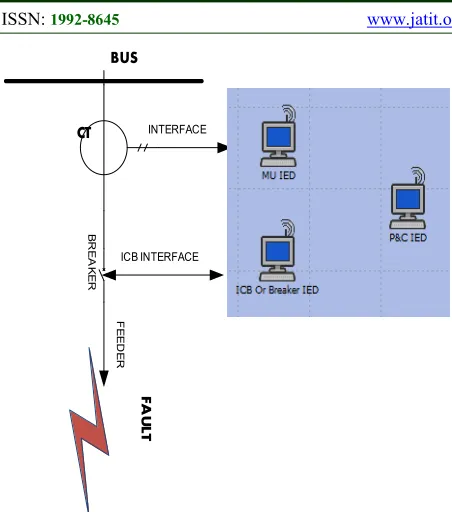
For the simulation of substation automation system (SAS), according to the IEC61850 standard, three types of intelligent electrical devices (IEDs’) should be modelled: the Merging Unit (MU), Intelligent Circuit Breaker (ICB), and the Protection and Control Unit (P&C) to verify the performance of the process bus [28].
ISSN: 1992-8645 www.jatit.org E-ISSN: 1817-3195
512 address, multicast the group address, destination address and other parameters as stipulated by the simulation requirements. The communication protocol stacks in
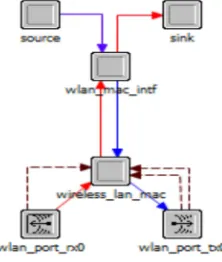
the MU, ICB and P&C are relatively simple in order to achieve the real-time communications, which only involve 3 layers: the application layer, link layer and physical layer. It can be achieved simply by using the model of WLAN_station_adv in the OPNET module as shown in Fig.1.
Fig.1. Wlan_station_adv in opnet Modeler
The raw data source module (bursty_gen) in Fig.1, allows users’ definition of the packet format, packet size, and the packet rate to be generated (that is, configuring the sample rate, start time, stop time, packet size, and address in the model.). The sink module performs three functions; the calculation of the packet transfer time, the collection of other statistical data for packets arriving at the network and subsequently destroying them to free the memory space. The wlan_mac_intf, and wireless_lan_mac modules implement the WLAN protocols and algorithms. This is the region where the incoming and outgoing packets are processed by OPNET. The wlan_port_rx0 and wlan_port_tx0 are OPNET symbols for point-to-point receiver and transmitter. The AP is modelled with the wlan_ethernet_router_adv. The features of security, quality of service, coverage, signal’s reliability and power saving of the access point (AP) architecture of WLAN place it of better advantage over the ad-hoc architecture. For these features, the access point architecture is preferable for substation automation
applications, although it is expensive as compared to the ad-hoc one. The AP in IEC 61850 based substation automation systems provides Quality of Service (QoS) guarantee, interference and collision reduction, also expandability. The wlan _ethernet_router_adv model of the wireless AP can also be connected to a wired Ethernet LAN.
3. PROCESS LEVEL DATA FLOW ANALYSIS
The flow of the SV messages is described by the following equation (1):
1
=data rate bits/sec, =number of merging unit, =length of message, =transmission frequency. The IEC 61850 standard protocol defines the packet format for Ethernet protocol but does not define for IEEE802.11. OPNET simulator enables the designer to build a packet format that is compliant with IEC61850 [26]. Figure 2 shows the raw data sample packet format designed by OPNET compliance with IEC61850.
Fig.2. Raw Data Sample Packet Format For IEC61850 [32]
[image:3.612.130.241.245.376.2] [image:3.612.328.540.432.575.2]ISSN: 1992-8645 www.jatit.org E-ISSN: 1817-3195
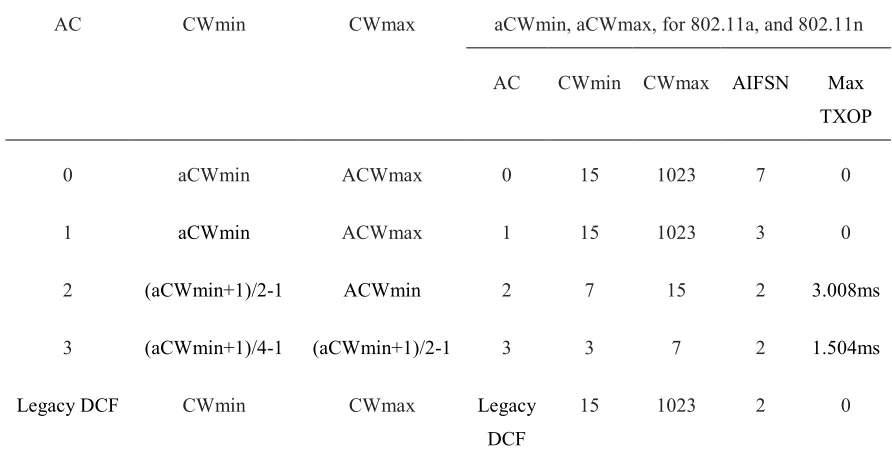
513 the Source respectively. The fragmentation and reassembly are done by the first 4 bits of the two-byte sequence control. The first three bits in the two-bytes of QoS control is used for priority tagging message in compliance with IEC 61850. IEEE802.11 supports only the best effort traffic and not real time, whereas industrial applications and automation necessitate real time response. Because automation needs QoS support such as bounded delays and jitters, (for example delay for protection in substation automation must be less than 0.003 sec and jitter less than 0.001 sec), the coordination functions (PCF), the channel access for time critical application in IEEE802.11 are ideal. Otherwise, IEEE802.11 uses the distributed coordinate function (DCF) with (CSMA/CA) for the channel access. In IEEE802.11e, the functions of the DCF and PCF with enhanced QoS-specific mechanisms are combined to form the HCF, where the HCF is made up of Enhance DCF (EDCF), which provides contention-based access and HCCA (controlled access) for contention-free access. The EDCF provides a differentiated access with 8 priorities. These priorities span from 0-the lowest priority to 7- the highest priority. The set of MSDUs with the same priority is referred to as Traffic Category (TC). EDCF defines the access category (AC) mechanism to support the priority mechanism. An AC is an enhanced variant of the DCF which contends for the transmission opportunity (TXOP) using the set of parameters such as CWmin [AC], CWmax [AC], AIFS [AC], etc. The 8 priorities are mapped to 4 AC. Table 1 shows the aCWmin, aCWmax, used by OFDM IEEE 802.11a, and
MIMO IEEE802.11n. However, the EDCA
experiences frame priority control loss when many terminals attempt to transmit a frame at a higher priority.
IEEE802.11e also supports HCCA, which accesses the channels using polling techniques. HCCA is characterized with the capacity to send frames more reliably. The access point in HCCA is contention-free (CF) and therefore, its access point polls all the terminals. The terminal with the highest frame priority is assigned a time to send its packets. During the allotted time, the terminal can forward the frame without interference to other terminals. In HCCA, the super frame consists of the contention period (CP)
and contention free period (CFP). During CFP the hybrid controls the access channel by polling the station with the QoS (QSTA) and it also initiates the control access phase (CAP) during the CP. Then, granted transmission opportunity (TXOP) is given to the polled station with period TXOP value. The time available for CAPs generation is limited and it is done to allow space for non-QoS stations. Another important feature in IEEE802.11e is associated with the QoS admission control. In this context, each station specifies the data rate and delay during the association period according to station requirements schedule polling, as the admission control may reject or accept the traffic depending on the strictness of its requirement.
ISSN: 1992-8645 www.jatit.org E-ISSN: 1817-3195
514 D= =1* 83*8bit*400Hz=0.265600 Mbps or 0.318720 Mbps in case of 480 Hz. The SV Traffic when =3 and frequency =1600 (32 sample/cycle), 50 Hz.
D= =3*83*8 bit*1600=3.187200 Mbps
4. SIMULATION WORK AND RESULTS
4.1. P2P WLAN Communication
The model of WLAN P2P communication for different IEEE802.11 technologies with different
[image:5.612.82.528.278.509.2]speeds is shown in Fig. 3. The main objective of WLAN P2P is to check out the real time SV data communication with a possible maximum sampling rate. Since the most important factor in protection is the end-to-end (ETE) delay, it is proportional to the packet length and sampling frequency and it is inversely proportional to the bit rate. In this test the packet length was fixed at 128 bytes, and the sampling frequency varied for different WLAN technologies.
Table-1 Typical Qos Parameters For IEEE802.11a, And IEEE802.11n
AC CWmin CWmax aCWmin, aCWmax, for 802.11a, and 802.11n
AC CWmin CWmax AIFSN Max
TXOP
0 aCWmin ACWmax 0 15 1023 7 0
1 aCWmin ACWmax 1 15 1023 3 0
2 (aCWmin+1)/2-1 ACWmin 2 7 15 2 3.008ms
3 (aCWmin+1)/4-1 (aCWmin+1)/2-1 3 3 7 2 1.504ms
Legacy DCF CWmin CWmax Legacy
DCF
15 1023 2 0
Table 2: IEC 61850 Messages For Smart Grid Applications In Distribution Substation
IEC61850 Message Type Implementation Smart Grid Application
Allowed Message Delay at Distribution[ms]
User Priority
Levels Publisher/Subscriber Message
GOOSE/GSE (type 1) Control Commands to trip , block, and so on; state
change
3 – 10 7
Sample values (type 4) Protection function ;& metering
10 6
Client/Server Messages Medium speed message
(type 2)
Voltage Control 50-100 4
Low speed message (type 3)
Condition Monitoring 100- 5000 2
File transfer (type 5) Data recording; event/alarm list; setting
[image:5.612.109.530.544.738.2]ISSN: 1992-8645 www.jatit.org E-ISSN: 1817-3195
515
BUS
CT
B
R
E
A
K
E
R
INTERFACE
F
E
E
D
E
R
IEEE 802 .11
Fig.3. P2P WLAN for Feeder Protection
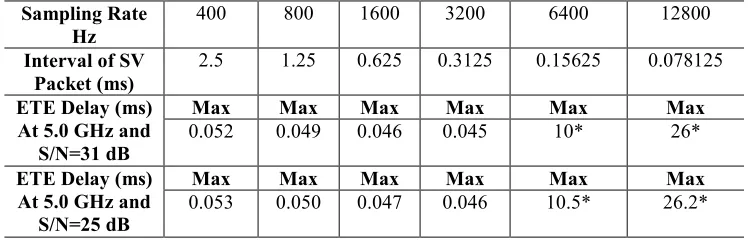
In Table 3, the average ETE delay for the SV message of less than 6400 Hz sampling rate is 0.000045 s which is much less than 0.004 s and this satisfies the requirement of the SV message communication on 54 Mbps as mentioned in IEC61850-5. It may be observed that the ETE delay does not satisfy the protection requirements at the sampling frequency of 6400 Hz due to the data rate limitation of IEEE802.11a. To study the effect of the EMI (electromagnetic interference) generated due to the power system switching events, and the RFI (radio frequency interference) caused by the use of the unlicensed frequency 2.4GHz, and 5.0 GHz ISM band, these two types of noise are the most important noise affecting the delay and the throughput performance of WLAN. The home made Gaussian noise with -100 dBm was added to the wireless link channel to study the effects of these noises on WLAN performance. This value was chosen depending on the survey done by EPRI (Electric Power Research Institute) in the United States [33]. Simulation results show very little effect on the performance due to the noise of power -100 dBm which has
lower receiver node sensitivity -95 dBm. By increasing the noise power up to -85 dBm, the throughput would decrease rapidly and the ETE delay would increase. In Table 4, using IEEE802.11n, the SV message ETE Delay is tested at two bands 2.4 GHz and 5 GHz which is less than 0.004 sec at all sampling frequencies at high S/N ratio, while the delay and throughput are highly affected at low S/N ratio. It may be noted that the enhanced QoS of IEEE802.11e was used in simulation, with the highest priority for single peer to peer protection. The figures marked * do not satisfy the time delay communication requirement given in IEC 61850-5 which must be less than 4 ms. Then, the simulation will help the designer to choose the suitable WLAN technology with appropriate packet lengths and sampling frequencies.
4.2. WLAN-based Communication for Over Current Protection
[image:6.612.90.313.86.234.2]Fig 4 (a) and Fig 4 (b) show the OPNET model for the over current feeder protection in a single unit for different scenarios. Table-3, and Table-4 observe the result with the WLAN speed of 54 Mbps using IEEE802.11a (OFDM), and high throughput IEEE802.11n, respectively. In Fig 4 (a), the Ad-hoc network is implemented. In this scenario, access point communication is not required. It is not a requirement of access point as in WLAN and it makes it less expensive. However, it is not applicable to larger networks and beset with some node association issues in some topologies, hence it is rarely applied for substation automation. We can refer to the demonstration in Fig 4 (a).
Table 3: ETE Delay For Different Sampling Frequencies Using IEEE 802.11a (OFDM) At 54 Mbps.
Sampling Rate Hz
400 800 1600 3200 6400 12800
Interval of SV Packet (ms)
2.5 1.25 0.625 0.3125 0.15625 0.078125
ETE Delay (ms) At 5.0 GHz and
S/N=31 dB
Max Max Max Max Max Max
0.052 0.049 0.046 0.045 10* 26*
ETE Delay (ms) At 5.0 GHz and
S/N=25 dB
Max Max Max Max Max Max
[image:6.612.119.493.582.702.2]ISSN: 1992-8645 www.jatit.org E-ISSN: 1817-3195
[image:7.612.122.496.115.308.2]516
Table 4: ETE Delay For Different Sampling Frequencies Using IEEE802.11n (High Throughput)
Sampling Rate Hz
400 800 1600 3200 6400 12800
Interval of SV Packet (ms)
2.5 1.25 0.625 0.3125 0.15625 0.078125
ETE Delay (ms) At 2.4 GHz and
S/N=37 dB
Max Max Max Max Max Max
0.074 0.062 0.061 0.060 0.19 0.27
ETE Delay (ms) At 2.4 GHz and
S/N=21 dB
Max Max Max Max Max Max
0.22 0.22 0.28 0.45 1.8 30*
ETE Delay (ms) At 5 GHz and
S/N=31 dB
Max Max Max Max Max Max
0.058 0.052 0.052 0.051 0.13 0.25
ETE Delay (ms) At 5 GHz and
S/N=23 dB
Max Max Max Max Max Max
0.066 0.057 0.058 0.058 0.14 0.28
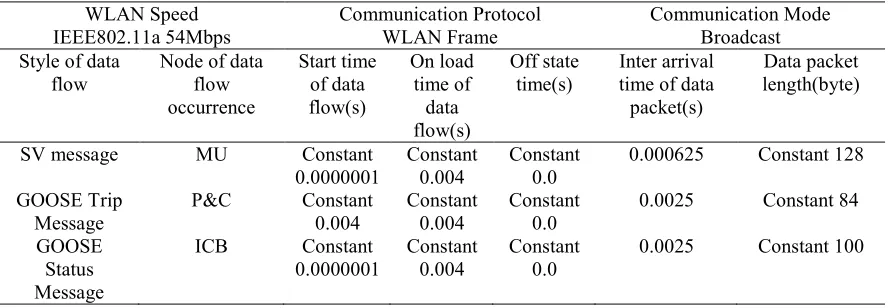
Table 5: Simulation Parameter Using OPNET
WLAN Speed Communication Protocol Communication Mode
IEEE802.11a 54Mbps WLAN Frame Broadcast
Style of data flow
Node of data flow occurrence
Start time of data flow(s)
On load time of
data flow(s)
Off state time(s)
Inter arrival time of data packet(s)
Data packet length(byte)
SV message MU Constant
0.0000001
Constant 0.004
Constant 0.0
0.000625 Constant 128
GOOSE Trip Message
P&C Constant 0.004
Constant 0.004
Constant 0.0
0.0025 Constant 84
GOOSE Status Message
ICB Constant
0.0000001
Constant 0.004
Constant 0.0
[image:7.612.85.529.348.502.2]ISSN: 1992-8645 www.jatit.org E-ISSN: 1817-3195
517
BUS
CT
B
R
E
A
K
E
R
INTERFACE
F
E
E
D
E
R
ICB INTERFACE
F
A
U
L
T
Fig. 4 (A): Ad-Hoc For Single Feeder Protection
BUS
CT
B
R
E
A
K
E
R
INTERFACE
F
E
E
D
E
R
ICB INTERFACE
F
A
U
L
T
Fig. 4 (B): WLAN Feeder Protection With AP
the MU node generates the SV data from CT at 1600Hz sampling rate, and the P&C IED node does not only receive the SV data from MU but also communicates with the circuit breaker IED node. The ICB node receives the GOOSE trip message from the P&C, and sends the status GOOSE message to the P&C IED. The simulation parameters are given in Table 5. The scenario of the data sequence among nodes in the unit is as follows:
The MU node is the SV data generator; it continuously broadcasts the SV data at 0.004 s after fault occurrence 0.0000001s, since the WLAN cannot start at 0.0 s, thus, this value is chosen near zero with 128 bytes data package. The GOOSE status message is continuously broadcast by the ICB node before the circuit breaker trips. This process may lead to the SV transmission performance slowing down ; hence the 0.004sec interval GOOSE status data broadcasting with the size of 100 bytes is used in the process bus. This evaluates the performance of the transmission of the SV data. The GOOSE trip message with the size of 84 bytes is sent by the P&C node at the 0.004s after fault occurrence and it repeatedly broadcasts 3 times in the following 0.004 sec with variable intervals (the broadcast time is 0.0 s, 0.0025s, and 0.004s in this case) as shown in Fig. 5, while Fig. 6 shows the ICB load (bits/sec). From the simulations, the ETE delay of the GOOSE trip signal is 0.00040 sec average. Since the communications between P&C and ICB come in two sides, the transmission of the GOOSE trip message is of no influence on the transmission of the SV and GOOSE status messages. In this simulation, parameters can be varied to test their effect of these parameters on the SV traffic delay. For example, we set the ICB inter arrival time of the data packet to variable and test its influence on the SV Traffic. The benefits of the increased range, better security, power saving, quality of service (QoS), roaming enhancement of AP support the case that the access points are preferred for ad-hoc networks for substation automation applications.
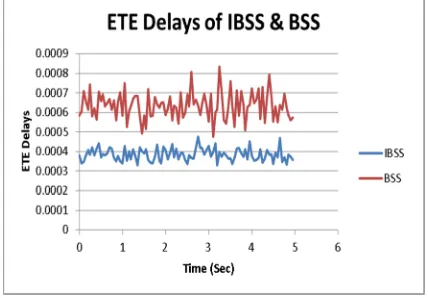
[image:8.612.90.316.72.328.2]The ETE Delay simulation scenario for Fig 4 (b), as shown in Fig. 7, is 0.00050s (minimum) and 0.00080s (maximum) which is higher than Ad-Hoc, since it is a centralized system. It must be highlighted that the AP in this scenario works as a Hub-Node since not all nodes have IP.
[image:8.612.95.306.379.578.2] [image:8.612.324.539.585.691.2]ISSN: 1992-8645 www.jatit.org E-ISSN: 1817-3195
[image:9.612.91.313.73.197.2]518
Fig. 6: GOOSE Status Packet From ICB Node
Fig. 7: ETE Delay For WLAN With AP
5. CONCLUSION
The performance of feeder over current protection using WLAN communication has been demonstrated by means of simulation using the OPNET modeler. It is demonstrated that up to 3200Hz sampling rate is accessible in the P2P WLAN with the speed of 54 Mbps using IEEE802.11a, while up to 6400Hz sampling rate is obtainable with IEEE802.11n technology, which may afford the requirements of the typical protection sampling rate (i.e. no less than 400Hz). The GOOSE messages (status and trip) have been proven not to deteriorate the transmissions of SV data in the process bus. For real-time application of over current protection, the single feeder protection using ad-hoc technology has also been simulated and compared with centralized AP. The two scenarios were observed within the requirement of the time delay over the current protection which must be less than 0.004s. Finally, the effect of EMI and RFI (radio frequency interference) which is assumed to have probability density function of Gaussian distribution has been tested for the performance
of WLAN. It is concluded that EMI essentially has little impact to the communication in a WLAN-based SASs. Also confirmed by industrial experiences [33], there is typically much less frequency interference in the 5GHZ band. Then the careful planning of the network with the aim of having the best possible coverage of the area by WLAN can reduce the number of potential problems in advance. In addition, the administrators of WLAN networks are provided with special management and monitoring software to detect and eliminate problems at an early stage. These are also the reasons why WLAN is becoming more and more accepted in the industry today. Additionally, the technological development continues to progress rapidly, like efficient antenna technology which can prevent interference largely, and many of today's industrial access points have two independent radio interfaces which can operate in the 2.4 and 5 GHz ranges. Other advanced features have been supported by WLAN to improve the speed and channel stability.
REFERENCES:
[1] S. S. (Mani) Venkata, IIT Bombay, “Smart distribution grid,” in Proc. Tutorial NPSC Conf., 2008, pp. 1–149.
[2] IEC Standard for Communication Network and Systems in Substations, IEC 61850, 2003–04, 1st Ed.
[3] The Smart Grid Interoperability Standards Roadmap Electric Power Research Institute (EPRI) Tech. Rep., Aug. 2009.
[4] M. Kanabar and T. S. Sidhu, “Performance of IEC 61850-9-2 process bus and corrective measure for digital relaying,” IEEE Trans. Power Del., vol. 26, no. 2, pp. 725–735, Apr. 2011.
[5] P. Palensky and D. Dietrich, “Demand side management: Demand response intelligent energy systems, and smart loads,” IEEE Trans. Ind. Inf., vol. 7, no. 3, pp. 381–388, Aug. 2011.
[image:9.612.90.304.233.382.2]ISSN: 1992-8645 www.jatit.org E-ISSN: 1817-3195
519 [7] G. Cena, I. C. Bertolotti, A. Valenzano, and
C. Zunino, “Evaluation of response times in industrial WLANs,” IEEE Trans. Ind. Inf., vol. 3, no. 3, pp. 191–201, Aug. 2007. [8] C.Cena, A.Valenzano, and S.Vitturi,
“Hybridwired/wireless networks for real-time communications,” IEEE Ind. Electron. Mag., vol. 2, no. 1, pp. 8–20, Mar. 2008. [9] V.C. Gungor,D. Sahin, T. Kocak, S. Ergut, C.
Buccella, C. Cecati, and G. P. Hancke, “Smart grid technologies: Communication technologies and standards,” IEEE Trans. Ind. Inf., vol. 7, no. 4, pp. 529–539, 2011. [10] P. Parikh, M. Kanabar, and T. S. Sidhu,
“Opportunities and challenges of wireless communication technologies for smart grid applications,” in Proc. IEEE PES General Meeting, Minneapolis, MN, Jul. 2010, pp. 1–7.
[11] V. C. Gungor, Lu. Bin, and G. P. Hancke, “Opportunities and challenges of wireless sensor network in smart gird,” IEEE Trans. Ind. Electron., vol. 57, no. 10, pp. 3557– 3564, Oct. 2010.
[12] “Using spread spectrum radio communication for power system protection relaying applications,” IEEE PSRC Tech. Rep., Jul. 2005.
[13] “Wireless connectivity for electric substations,” EPRI, Tech. Rep., Feb. 2008. [14] “Assessment of wireless technologies in
substation functions—Part II: Substation monitoring and management technologies,” EPRI, Tech. Rep., Mar. 2006.
[15] “Recommended practice for using wireless data communications in power system operations,” IEEE P1777 Tech. Rep., Jul. 2010.
[16] “Swift Grid,” Carlson Wireless, 2011. [Online]. Available: http://www. carlsonwireless.com
[17] “A wireless distribution area network for smart grids,” TroposGridCom, 2011. [18] K. M. Abdel-Latif, M. M. Eissa, A. S. Ali,
O. P. Malik, and M. E. Masod, “Laboratory investigation of using Wi-Fi protocol for transmission line differential protection,” IEEE Trans. Power Del., vol. 24, no. 3, pp. 1087–1094, Jul. 2009.
[19] D. R. Brown, J. A. Slater, and A. E. Emanuel, “A wireless differential protection system for air-core inductors,” IEEE Trans. Power Del., vol. 20, no. 2, pp. 579–586, Apr. 2005.
[20] F. Cleveland, “Use of wireless data communications in power system operations,” in Proc. IEEE Power Syst. Conf. Expo., 2006, pp. 631–640.
[21] T. Skeie, S. Johanessen, and C. Brunner, “Ethernet in substation automation,” IEEE Control Syst. Mag., vol. 22, no. 3, pp.43-51, Jun. 2002
[22] F. Engler, T. L. Kern, L. Andersson, B. Kruimer, G. Schimmerl, and K. Schwarz, “IED 61850 based digital communication as interface to the primary equipment,” in Proc. CIGRE, 2004, B3-205
[23] Paolo Castello, Paolo Ferrari, Alessandra Flammini, Carlo Muscas, Paolo Attilio Pegoraro, and Stefano Rinaldi " A Distributed PMU for Electrical Substations With Wireless Redundant Process Bus," in IEEE Transaction on instrumentation and measurement ,2014,
[24] Mohammed A. Haj-ahmed, Zachary P. Campbell, and Mahesh S. Illindala," Substation Automation for Replacing Faulted CTs in Distribution Feeders," in IEEE International Conference on Power Electronics, Drives and Energy Systems (PEDES),2014.
[25] Emna Charfi, Lamia Chaari, and Lotfi Kamoun," PHY/MAC Enhancements and QoS Mechanisms for Very High Throughput WLANs," in IEEE communications surveys & tutorials, vol. 15,NO.4, fourth quarter 2013.
[26] Davide Della Giustina, Paolo Ferrari,
Alessandra Flammini, Stefano Rinaldi, and Emiliano Sisinni, "Automation of Distribution Grids With IEC 61850:A First Approach Using Broadband Power Line Communication", IEEE Transactions on instrumentation and measurement, VOL. 62, NO. 9, SEPTEMBER 2013
[27] David M. E. Ingram, Pascal Schaub, Richard R. Taylor, and Duncan A. Campbell," Performance Analysis of IEC 61850 Sampled Value Process Bus Networks", IEEE Transactions on industrial informatics. VOL. 9, NO. 3, AUGUST 2013
ISSN: 1992-8645 www.jatit.org E-ISSN: 1817-3195
520 [29] L. Andersson, K. P. Brand, D. Fuechsle,
“Optimized architectures for process bus with IEC 61850-9-2,” in Proc. CIGRE, 2008, B5-101
[30] Bin Wang, Zheng Ge2, Xinzhou Dong1, Enshu Jin2, Zhiqian Bo3, "Performance of process bus communication of transient travelling wave’s data in smart distribution" in 2010 china international conference on electricity distribution. [31] NI Jiang, WANG Bin, DONG Xinzhou ,
"Travelling wave sampling data sharing solution indistribution substation based on IEC61850", in 2010 china international conference on electricity distribution. [32] Palak P. Parikh,Member,IEEE, Tarlochan
S. Sidhu, Fellow, IEEE,and A.Shami, Senior Member, IEEE, " A Comprehensive Investigation of Wireless LAN for IEC 61850–Based Smart Distribution Substation Applications", IEEE Transactions on Industrial Informatics, VOL. 9, NO. 3, Aug.2013.
[33] Y.W.Chen, Y.X.Xia, FZhou, X.Tian, L.Liu, YZhang, P.C.Wu, and Y.Zhang, “WLAN BASED INTEGRATED SUBSTATION
CONTROL SYSTEM (WISCS)”,