University of Huddersfield Repository
AlDahiyat, Mohammed Abdul Rahim
Towards an effective design of management control systems : a contingency approach
Original Citation
AlDahiyat, Mohammed Abdul Rahim (2003) Towards an effective design of management control systems : a contingency approach. Doctoral thesis, University of Huddersfield.
This version is available at http://eprints.hud.ac.uk/id/eprint/5939/
The University Repository is a digital collection of the research output of the University, available on Open Access. Copyright and Moral Rights for the items on this site are retained by the individual author and/or other copyright owners. Users may access full items free of charge; copies of full text items generally can be reproduced, displayed or performed and given to third parties in any format or medium for personal research or study, educational or notforprofit purposes without prior permission or charge, provided:
• The authors, title and full bibliographic details is credited in any copy; • A hyperlink and/or URL is included for the original metadata page; and
• The content is not changed in any way.
For more information, including our policy and submission procedure, please contact the Repository Team at: [email protected].
TOWARDS AN EFFECTIVE DESIGN OF MANAGEMENT
CONTROL SYSTEMS: A CONTINGENCY APPROACH
MOHAMMED ABDUL RAHIM AL-DAHIYAT
A thesis submitted to the University of Huddersfield
in partial fulfilment of the requirements for the degree of Doctor of Philosophy
The University of HuddersfieId
Ph. D.
ABSTRACT
Towards an Effective Design of Management Control Systems: A Contingency Approach
In an attempt to provide a better understanding of MCS design, this study has utilised the contingency theory approach to investigate the contingent relationships between perceived environmental uncertainty (PEU), business strategy, organisational structure and various attributes of MCS simultaneously. This study has also investigated the mediating effect of two structural dimensions (centralisation and formalisation) on the relationship between PEU, business strategy and MCS design. In addition, this study has investigated the implications of fit, internal consistency or coalignment between the contextual variables and MCS attributes on organisational effectiveness, thus adopting a systems approach to fit recommended in the contingency literature. This study also builds on the works of Simons (1987) and Chenhall and Morris (1986) in terms of developing a wider and comprehensive view of MCS design. Seven MCS attributes have been investigated in this study including budgetary control system practices, budgetary control system usage, cost control systems, broad scope information, managerial evaluation and rewards system, aggregation and timeliness of information.
A cross-sectional survey employing a questionnaire method of data collection was adopted. A total of 274 usable responses were received representing a response rate of 28%. For purposes of analysis, the research utilised structural equation modeling (SEM) multivariate statistical technique enabled by EQS 5.7 version software (Bentler, 1995). Thus, this study is one of the first studies in MC contingency literature to utilise SEM for validating the research constructs, controlling measurement error and for testing the structural relationships between the constructs
simultaneously.
The results of this study confirmed the multi-dimensional nature of PEU, business strategy and organisational structure and the differential effects each dimension has on MCS design. Also the results indicated that the different approaches to fit (i. e., bivariate and systems approaches) utilized in this research resulted in insightful findings relating the contingent relationships between the contextual variables and MCS attributes. In addition, the structural dimension of formalisation was found to have significant positive relationships with many of the MCS attributes and also mediated the relationship between differentiation strategy and MCS attributes of budgetary importance, cost control systems and non-financial performance measures.
ACKNOWLEDGEMENTS
In The Name Of Allah Most Gracious Most Merciful
"Who does not thank people does not thank Allah" (Prophet Mohammed peace be upon him).
First, I must acknowledge that I have been helped through the doctoral program by more people than I have room to name here. Having said that, I will single out those who have been of great help to me for completing this research.
My particular thanks go to Professor Colin Drury, my director of study, for his kindness and patience throughout the past four years. He has always been there to listen, to council and support. Above all, Professor Drury has helped me to fashion ideas into research that was both appropriate and meaningful. He encouraged me to envision a thesis that required me to stretch outside the tools and knowledge that I then possessed. His mentoring has formed me into a scholar and made me a better researcher. Without Professor Drury's guidance, mentoring, support and encouragement, this thesis would not have been completed in its current state. I am truly grateful for Professor Drury and very honored to have had him as my mentor and director of study. I would also like to acknowledge Professor Chris Cowton, my second supervisor, for his excellent comments on the research proposal, questionnaire and on the final draft of this thesis.
It is also important for me to acknowledge Dr. Darren Langdridge, from Huddersfield University Behavioural Sciences School, Professor David Smith, from Monash University Accountancy Department, Professor N. Venkatraman, from Boston University Management School, who were willing to help tutor me in utilising structural equation modeling and responding to my several inquiries in spite of the fact that they have never knew me before and regardless of their busy schedules. Their guidance and suggestions were invaluable in analysing the data statistically. Also I would like to acknowledge Professor Robert Simons, from Harvard Business School, and Professor Joseph Fisher from Indiana University Business School for their useful comments on my research proposal. The comments and references they suggested were helpful for constructing and shaping my thesis. Also I would like to acknowledge the continuous support and encouragement that I have received from Professor Eid Dahiyat, President of Mu'tah University in Jordan, not only during the time of my studies in the UK, but also while I was in Jordan. I would also like to acknowledge Mu'tah University in Jordan for sponsoring me to study MBA and PhD degrees at Huddersfield University Business School.
I am also delighted to acknowledge all the kindness and support that I have received from many members of the academic and administrative staff at Huddersfield University Business School during the period of my study in the UK. In particular, I would like to thank Professor David Smith, Dean of the Business School and Mrs Wilma Teviotdale, Head of accountancy for their kindness and support. I would like also to thank Mark Curry, the school IT technician and Christine Woodhouse, the secretary from the accountancy department who always had a smile and were willing and happy to provide their kind assistance whenever it was needed.
Last but not least, I would like to acknowledge the support I received from my family. First and foremost, my deepest appreciation and thanks go to my beloved wife and my four children, Farah, Saif-ul-deen, Abdulrahim and Rawan. Their encouragement, support, patience and sacrifices were incredible. Without them, this thesis would not have been possible. I would like also to express my sincere gratitude to my father who had made many sacrifices for me and supported me throughout my life.
Again, thanks to all of you for helping me complete this thesis.
TABLE OF CONTENTS
LIST OF TABLES
... VIII
LIST OF FIGURES
... x
CHAPTERI
INTRODUCTION
1.1 Research area of interest ... 1-2
1.2 MC contingency approach: Overview and limitations ... 1-4
1.3 Research aim and objectives
... 1-8 1.4 Research significance and contribution
... 1.9 1.5 Structure of the thesis ... 1.11
CHAPTER2
MANAGEMENT CONTROL SYSTEMS
2.1 Introduction
... 2-2
2.2 Management control: Definitions and themes ... 2.2
2.3 Types of management controls ... 2.4
2.3.1 Action, behavioural. or administration controls ... . 2-4
2.3.2 Personnel or cultural controls ... 2-5 2.3.3 Results, output or core controls ... 2-5 2.4 Notions and boundaries of management control systems
... 2-6 2.5 Developments in the management control literature
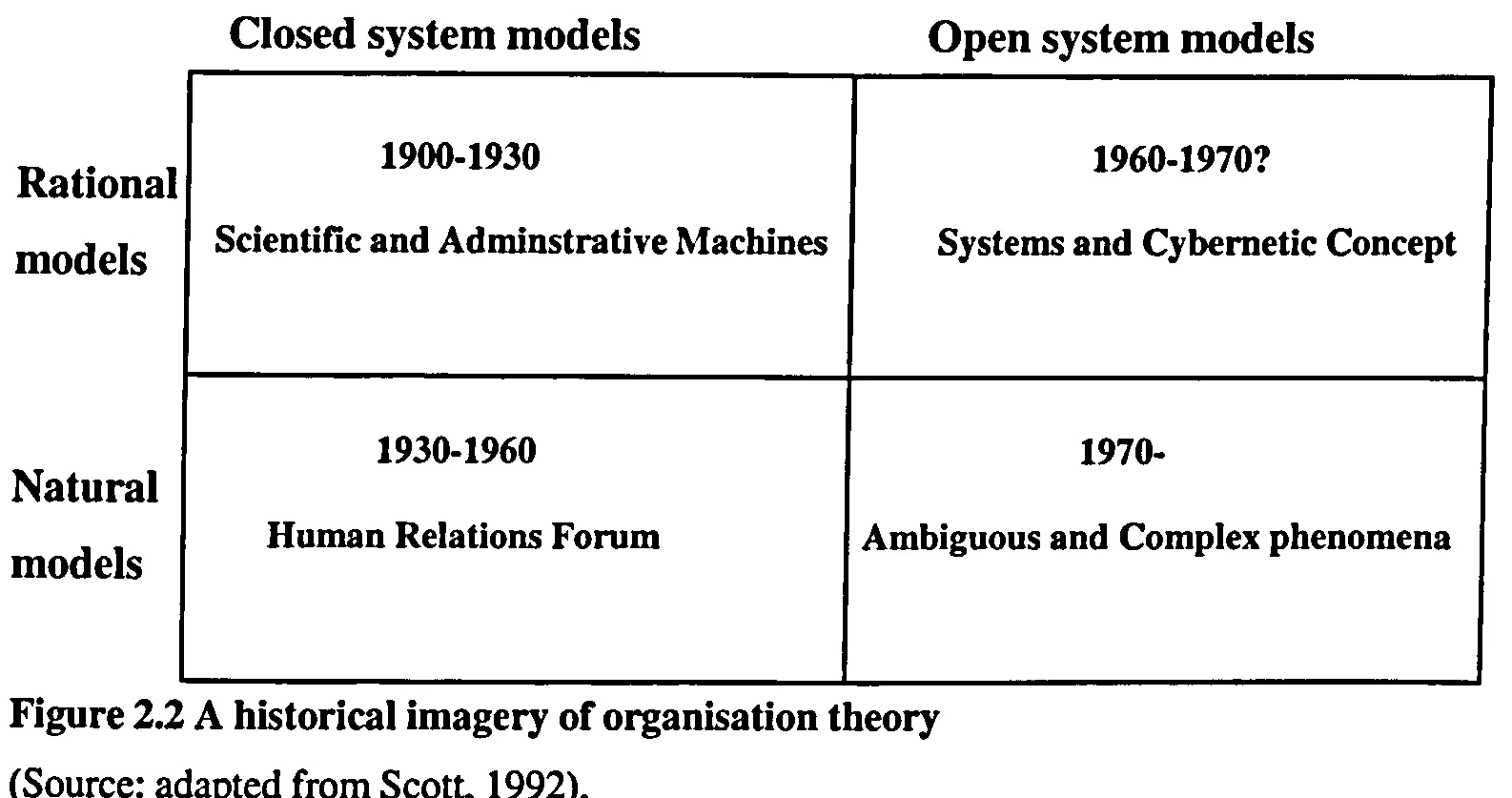
... 2-9 2.5.1 The closed-rational systems perspective ... 2-13 2.5.2 The closed-natural systems perspective ... 2-14 2.5.3 The open-rational systems perspective ... 2-17 2.5.4 The open-natural systems perspective ... 2-19
2.6 Summary
... 2-21
CHAPTER3
STRUCTURAL CONTINGENCY THEORY: THEMES, DEVELOPMENTS AND CRITICISMS
3.1 Introduction
... 3-2
3.2 Organisation structure: Definitions and concepts
... 3-3 3.3 The contingency theory and organisation structure
... 3-4
3.3.1 Technology-structure perspective ... 3-6
3.3.2 Environment-structure perspective ... 3-12
3.3.3 Size-structure perspective ... 3-18
3.4 Themes and key concepts in the contingency theory
... 3-20 3.4.1 Organisational effectiveness ... 3-20 3.4.2 The concept of fit in the contingency theory ... 3-21 3.4.2.1 The selection approach ... 3-22 3.4.2.2 The interaction approach ... 3-23 3.4.2.3 The systems approach ... 3-23
3.5 Summary
... 3-24
CHAPTER4
THE CONTINGENCY THEORY OF MANAGEMENT ACCOUNTING AND CONTROL SYSTEMS
4.1 Introduction
... 4-2
4.2 An overview of the contingency theory of management accounting
... 4-2 4.2.1 Early management accounting and control contingency studies ... 4-3 4.2.1.1 Bruns and Waterhouse (1975) ... 4-4
4.2.1.2 Waterhouse and Tiessen (1978) ... 4-5
4.2.1.3 Gordon and Miller (1976) ... 4-7
4.2.1.4 Amigoni (1978)
... 4-8
4.2.2 Synthesis of early MC contingency studies ... 4-9
4.3 General categories of the contingent variables in MC contingency literature
... 4-10
4.4 Environmental uncertainty and MCS contingency research ... 4-14 4.4.1 Gordon and Narayanan (1984) ... 4-14
4.4.2 Chenhall and Morris (1986) ... 4-15 4.4.3 Gul (1991)
... 4-17 4.4.4 Gul and Chia (1994) ... 4-18
4.4.5 Chia (1995)
... ; ... 4-19
4.5 Business strategy and MCS contingency research ... 4.20
4.5.1 Miles and Snow (1978) ... 4-22
4.5.2 Simons (1987)
... 4-25
4.5.3 Govindarajan and Gupta (1985) ... 4-29
4.5.4 Govindarajan (1988)
... 4-31 4.5.5 Govindarajan and Fisher (1990) ... 4-32
4.5.6 Chong and Chong (1997) ... 4-33
4.6 Summary
... 4-35
CHAPTER5
RESEARCH MODEL AND PROPOSITIONS
5.1 Introduction
... 5-2
5.2 Limitations of MC contingency studies ... 5.2 5.2.1 Insufficient attention given to organizational effectiveness ... .. 5-3 5.2.2 Excessive focus on bivariate models ... .. 5-3 5.2.3 Lack of consistency in identifying and measuring MCS attributes ... .. 5-4 5.2.4 Lack of methodological rigour in instrument validation and model testing .. .. 5-5 5.3 The research aim and objectives
... .. 5-6 5.4 An overview of the theoretical model developed to achieve research
objectives ... 5-7 5.5 The conceptual definitions of the variables included in the research model
... 5-9 5.6 Conceptualisation of MCS
... 5-11 5.6.1 Selection of relevant information and appropriate control mechanisms ... 5-13
5.6.2 Presentation of information ... 5.14
5.6.3 Timeliness of information ... . 5-14
5.7 Formulation of the research hypotheses and questions
... 5-14 5.7.1 Direct relationships between the contextual variables and MCS ... 5.15
5.7.1.1 PEU, strategy and budgetary practices/usage ... 5.15
5.7.1.2 PEU, strategy and cost control system usage ... 5.19
5.7.1.3 PEU, strategy and scope of information ... 5-20 5.7.1.4 PEU, strategy and managerial evaluation and rewards ... 5-21 5.7.1.5 PEU, strategy and aggregation of information ... 5-24 5.7.1.6 PEU, strategy and timeliness of information ... 5-25 5.7.1.7 Organisational structure and MCS attributes ... 5-26 5.7.2 Direct relationships between PEU, strategy and organisational structure .... 5-29 5.7.2.1 PEU and structure ... 5-29
5.7.2.2 Strategy and structure ... 5-30
5.7.2.3 PEU and strategy ... 5-31
5.7.3 MCS design and organisational effectiveness ... 5-31
5.8 Summary
... 5-32
CHAPTER6
THE RESEARCH METHODOLOGY
6.1 Introduction
... 6-2 6.2 Research methodology and paradigm
... 6-2
63 Research population and sample boundaries
... 6-5 6.4 Research sample and sampling frame
... 6-7 6.5 Data collection method
... 6-8 6.6 Questionnaire construction and pre-testing
... 6-9 6.6.1 Question types and formats ... 6-10 6.6.2 Questionnaire layout and flow ... 6-12 6.6.3 Questionnaire pre-testing procedures ... 6-14 6.7 Features of the covering letter ... 6-16 6.8 The respondents ... 6-17 6.9 Survey administration and response profile ... 6-18 6.9.1 Characteristics of responding firms ... 6-19
6.9.2 Characteristics of responding executives ... 6-21
6.10 Check for non-response bias ... 6-22 6.11 Statistical method used for data analysis ... 6.25
6.11.1 Advantages of SEM over other multivariate statistical techniques ... 6-27 6.11.2 SEM Approach: An overview ... 6-27 6.12 Summary
... 6-30
CHAPTER7
MEASUREMENT MODEL AND VALIDITY-RELIABILITY ASSESSMENT
7.1 Introduction
... 7-2
7.2 Measurement model validity-reliability assessment procedures ... 7-3
7.3 Measurement model analysis and validity of research constructs ... 7-8
7.3.1 Percieved environmental uncertainty ... 7-8
7.3.2 Business strategy ... 7-12
7.3.3 Organisational structure ... 7-16 7.3.4 Management control system attributes ... 7-19
7.3.4.1 Budgetary control practices ... 7-19
7.3.4.2 Budgetary usage ... 7-22
7.3.4.3 Cost control systems ... 7.24 7.3.4.4 Scope of information ... 7-26
7.3.4.5 Managerial evaluation and rewards systems ... 7-29 7.3.4.6 Aggregation of information ... 7-31
7.3.4.7 Timeliness of information ... 7.34
7.3.5 Organisational effectiveness ... 7-35 7.4 Summary
... 7-37
CHAPTER8
STRUCTURAL MODEL ANALYSIS AND FINDINGS
8.1 Introduction
... 8-2
8.2 Descriptive statistics and data screening
... 8.2 8.3 Structural model analysis procedures
... 8-6 8.3.1 Evaluating the structural model goodness-of-fit ... 8-7 8.3.2 Evaluating the significance of parameters estimates ... 8-7 8.3.3 Sample size and model complexity ... 8-9 8.4 Structural model analyses results/direct and indirect links with MCS ... 8-10 8.4.1 Structural model analysis of budgetary control practices ... 8-10 8.4.2 Structural model analysis of budgetary usage ... 8-16 8.4.3 Structural model analysis of cost control techniques usage ... 8-21
8.4.4 Structural model analysis of scope of information ... 8-23
8.4.5 Structural model analysis of performance evaluation and rewards ... 8-28
8.4.6 Structural model analysis of aggregation of information ... 8-32
8.4.7 Structural model analysis of timeliness of information ... 8-35
8.5 Structural model analysis results/ coalignment effect on effectiveness
... 8-37 8.6 Summary
... 8-53
CHAPTER9
CONCLUSIONS AND IMPLICATIONS
9.1 Introduction
... 9-2
9.2 Summary of major research findings ... 9.4
9.2.1 Direct/indirect relations between the contextual variables and MCS
attributes ... 9-4 9.2.2 Implications of MCS fit on organisationaI effectiveness ... 9.11 9.2.3 Implications of research findings for future research ... 9-12 9.3 Limitations and further directions for future research ... 9-16
REFERENCES
... R-1
APPENDICES
Appendix A. Research questionnaire ... A-1
Appendix B. Questionnaire covering letter ... B-1
Appendix C. Questionnaire reminder Letter ... C-1
LIST OF TABLES
Table 2.1: Summary of research areas in management control ... 2-21 Table 3.1: Categories of technology in contingency research ... ... 3-6 Table 3.2: Mechanistic and organic organisation forms ... . 3-13
Table 3.3: Comparison of integrative devices in three high-performing firms ... . 3-14
Table 4.1: The contingency variables classified by major categories ... . 4-11
Table 4.2: Chenhall and Morris' MAS characteristics ... . 4-16
Table 4.3: Schemes of business strategy classifications used in MC contingency studies 4-21
Table 4.4: Simons' ten control system attributes ... 4-26
Table 4.5: Summary of MC contingency research ... 4-37 Table 6.1: Alternative terms for the main research paradigms ... 6-3 Table 6.2: Distinguishing features of the main research paradigms ... 6-4 Table 6.3: The survey response profile ... 6-18
Table 6.4: Key characteristics of the responding firms ... 6-20 Table 6.5: Key characteristics of responding executives ... 6-21 Table 6.6: Chi-square test comparing industry type in early and late respondents ... 6-24 Table 6.7: Mann-Whitney test comparing size in early and late respondents ... 6-25 Table 6.8: Recommended values of goodness-of-fit measures ... 6-29 Table 7.1: Measures of PEU construct ... .. 7-9
Table 7.2: Exploratory factor analysis for PEU construct ... 7-10 Table 7.3: Goodness-of-fit measures used in this study ... 7-11 Table 7.4: Measures of business strategy construct ... 7-14
Table 7.5: Exploratory factor analysis for business strategy construct ... 7-15 Table 7.6: Measures of organisational structure construct ... 7-17 Table 7.7: Exploratory factor analysis for organisational structure construct ... 7-17 Table 7.8: Measures of budgetary control practices construct ... 7-20
Table 7.9: Exploratory factor analysis for budgetary practices construct ... 7-21
Table 7.10: Measures of budgetary usage construct ... 7-23
Table 7.11: Exploratory factor analysis for budgetary usage construct ... 7-23
Table 7.12: Measures of cost control systems ... 7-25
Table 7.13: Exploratory factor analysis for cost control systems ... 7-25
Table 7.14: Measures of scope of information construct ... 7-28 Table 7.15: Exploratory factor analysis for scope of information construct ... 7-28 Table 7.16: Measures of managerial evaluation and rewards system dimensions ... 7-31
Table 7.17: Measures of aggregation of information construct ... 7-32 Table 7.18: Exploratory factor analysis for aggregation of information construct ... 7-33 Table 7.19: Measures of timeliness of information construct ... 7-34 Table 7.20: Exploratory factor analysis for timeliness of information construct ... 7-35
Table 7.21: Summary of constructs, measures, sources & Cronbach a scores ... 7-39 Table 8.1: Descriptive statistics for research constructs ... 8-3 Table 8.2: Structural model results for budgetary control practices ... 8-11
Table 8.3: Structural model results for budgetary usage ... 8-17 Table 8A Structural model results for cost control systems ... 8-21 Table 8.5: Structural model results for scope of information ... 8-24
Table 8.6: Structural model results for performance evaluation and rewards ... 8-29
Table 8.7: Structural model results for aggregation of information ... 8-32 Table 8.8: Structural model results for timeliness of information ... 8-35
Table 9.1: Summary of PEU effects on MCS attributes ... . 9-5 Table 9.2: Summary of business strategy effects on MCS attributes ... . 9-7
Table 9.3: Summary of organisation structure effects on MCS attributes ... 9-10
LIST OF FIGURES
Figure 2.1: Watson's view of accounting research ... 2-11 Figure 2.2: A historical imagery of organisation theory ... 2-13 Figure 3.1: Perrow's classification of technology ... .. 3-8 Figure 3.2: Thompson's types of interdependence ... 3-11 Figure 3.3: Relationships between environment and organisational structure ... 3-17 Figure 4.1: A general MC contingency framework ... .. 4-3
Figure 4.2: Waterhouse and Tiessen's model for contingency research on MAS ... .. 4-6 Figure 4.3: A contingency model of perceived usefulness of MAS ... 4-16
Figure 5.1: The research theoretical model ... .. 5-8
Figure 7.1: Stages for constructing and validating the measurement model ... .. 7-7 Figure 7.2: Confirmatory factor analysis for PEU (two-factor model) ... 7-12
Figure 7.3: Confirmatory factor analysis for business strategy (two-factor model) ... 7-15 Figure 7.4: Confirmatory factor analysis for organisational structure (two-factor
model) ... 7-18 Figure 7.5: Confirmatory factor analysis for budgetary practices (two-factor model) .... 7-22 Figure 7.6: Confirmatory factor analysis for budgetary usage (two-factor model) ... 7-24
Figure 7.7: Confirmatory factor analysis for cost control system (two-factor model) ... 7-26
Figure 7.8: Confirmatory factor analysis for scope of information (two-factor model) ... 7-29 Figure 7.9: Confirmatory factor analysis for aggregation of inforination (one- factor
model) ... 7-33 Figure 7.10: Confirmatory factor analysis for timeliness of information (one-factor
model) ... 7-35 Figure 8.1: Coalignment model of budgetary control system practices ... 8-40 Figure 8.2: Coalignment model of budgetary usage ... 8-43
Figure 8.3: Coalignment model of cost control systems ... 8-44
Figure 8.4: Coalignment model of scope of information ... 8-46
Figure 8.5: Coalignment model of performance evaluation and rewards system ... 8-48 Figure 8.6: Coalignment model of aggregation of information ... 8-50
Figure 8.7: Coalignment model of timeliness of information ... 8-52
CHAPTER1
INTRODUCTION
1.1 Research area of interest ... 1-2
1.2 MC contingency approach: Overview and limitations ... 1-4
1.3 Research aim and objectives ... 1-8
1.4 Research significance and contribution ... 1-9
1.5 Structure of the thesis ... 1-11
CHAPTERI
Introduction
This chapter consists of five sections. The first section discusses the research area of interest
and the motivation for undertaking this study. Section 1.2 provides an overview of the
management control contingency approach and the limitations of earlier studies, while section
1.3 outlines the research aims and objectives. Section 1.4 highlights the contribution of the
current research to the extant literature of MC contingency approach, and the concluding
section describes the structure of the thesis.
1.1 Research area of interest
Since the early days of management study, the importance of control as a key element in the
process of management has been emphasised. All organisations are concerned with
channelling and integrating human efforts towards the attainment of organisational objectives.
Control is the process of getting members of the organisation to work towards achieving the
goals of the organisation. Without proper control, managers may make detrimental firm
decisions that would negatively affect organisational effectiveness. Thus, management
control (MC) is considered as a key activity for every business organisation and
organisational survival and success can be greatly affected by the manner in which control is
carried out (Camillus, 1986; Fisher, 1998).
Management accounting has a major role to play towards achieving competitive advantage
and organisational success. The role of management accounting can be enhanced by
management accountants or controllers designing effective management control systems
(MCS) that provide relevant and timely information to assist managers in co-ordinating and
controlling their business activities and meeting the challenges of their business environment.
Also MCS assists in control by helping align the interest of members of the organisation with
the goals of the organisation and by encouraging managers to make decisions that will
accomplish the organisational objectives (Drury, 2000; Fisher, 1998; Morse and Zimmerman,
1997; Camillus, 1986). In addition, Drury (2000) argues that proper design of MCS is
expected to minimise harmful and negative side effects of control such as job-related
tensions, conflicts and deterioration in relationships with managers.
Despite the importance of MCS to the success of organisations, this topical area has been
relatively less developed, understood or researched in management literature in general and
management accounting literature in particular. The lack of development and research in this
topical area has been criticised in Johnson and Kaplan's (1987, p. 205) publication "Relevance
Lost". They maintain that today's management control systems are not suited to business
operations, which are seeking to compete successfully. They stated that:
Given the radical changes in the competitive environment... it is unlikely that cost accounting and management control systems devised for the 1925 environment can still be useful sixty years later.
Many recent papers in leading management accounting journals have emphasised the need for
undertaking theoretically informed studies on both the use and design of management control
systems (Dent, 1990; Fisher, 1995 and 1998; Langfield-Smith, 1997; Chapman, 1997; Otley,
1999; Ittner and Larcker, 2001; Kald et al., 2000; Smith and Langrield-Smith, 2002;
Chenhall, 2003). More specifically, these papers called for utilising the contingency approach for its potential to advance knowledge and understanding of effective MCS design under
various organisational. settings. For instance, Fisher (1995 and 1998) argued that the
contingency approach enables researchers to develop generalisations about MCS relative to
business and organisational settings, thus, offering the potential for advancing our knowledge
of control in complex organisations. Moreover, Chastain (1979) argued that the contingency
approach enables management accountants to expand their role in management control and to
maintain their expertise as controllers.
The lack of development and knowledge on MCS design and the need for systematic
empirical research
on this topical area have provided a major motivation for undertaking
the
current study. Thus in an effort to provide better understanding
of MCS design, this study
utilises the contingency
approach
for studying MCS design.
1.2 MC contingency research: General overview and lindtations
Different approaches
have been followed by management
accounting and control researchers
towards
studying MCS design (a detailed review of these approaches
and the justification for
adopting the contingency approach in this study is provided in Chapter 2). However, the
contingency
approach,
adopted in this study, has become
the dominant approach
for studying
MCS design (Dent, 1990; Chapman, 1997; Fisher, 1998). Prior to the emergence
of the MC
contingency approach, a universalistic approach was more or less assumed based on the
assumption
that an optimal MCS design is applicable to some degree in all organisations.
In
contrast,
the contingency approach
assumes
that the appropriateness
of different management
control systems
depends
on the settings or context of the organisation,
and failure to match
MCS with the context of the organisation
is likely to lead to organisational
decline in the long
run. Simply stated, the contingency approach
maintains that organisational
performance
or
effectiveness
depends
on the level of fit or alignment between MCS and contextual factors.
Thus, 'organisational
effectiveness'
and 'fit' are two key notions or concepts that need to be
emphasised
and considered by researchers
adopting the contingency approach in order to
produce concrete research findings (a detailed review of the rationale and development
of
contingency
theory is provided in Chapter 3).
Unfortunately, the results of earlier MC research adopting a contingency approach (a detailed
review of MC contingency studies is given in Chapter 4) do not provide concrete conclusions
about the appropriate design of MCS under various contextual factors. Several academics and
researchers have argued that MC contingency studies have not been conducted in a systematic
fashion (e. g., Otley, 1989 and 1999; Dent, 1990; Chapman, 1997; Langfield-Smith, 1997;
Ittner and Larcker, 2001; Chenhall, 2003). Consequently, the contradictory and weak results
of MC contingency studies may be attributable to several limitations in their research design
and models rather than to the contingency approach it self (a detailed review of the limitations
of earlier MC contingency research is given in Chapter 5). The above researchers concluded
that addressing the limitations of earlier MC contingency research in future research would
provide more concrete and clear conclusions about the appropriateness of MCS under various
organisational settings and, thus, advance the current knowledge of this topical area. This has
provided a further motivation for the researcher to undertake the current study.
One of the major limitations of earlier MC contingency studies relates to the insufficient
attention given by these studies to the concept of organisational effectiveness which is
considered as one of the key notions of the contingency approach (Otley, 1980; Miller, 1981;
Drazin and Van de Ven, 1985; Pennings, 1992; Dent, 1990; Fisher, 1998). Unfortunately,
many of MC contingency studies have either not explicitly considered organisational
effectiveness in their models (e. g., Bruns and Waterhouse, 1975; Gordon and Narayanan,
1984; Chenhall and Morris, 1986; Sim and Teoh, 1997) or have measured effectiveness in a
questionable way. For instance, some studies (Gul, 1991; Gul and Chia, 1994) have preferred
to use the notion of managerial effectiveness rather than organisational effectiveness. It has
been argued that such a partial construct does not provide a satisfactory criterion for the
appropriateness of MCS design or reflect the effectiveness of the organisation as a whole
(Lowe and Chua, 1983). Other studies (e. g., Simons, 1987) have used only financial measures
(e. g., profits) to measure effectiveness. However, relying only on financial measures has been
widely criticised as a proxy measure of effectiveness because they tend to be short-term and
adopt a narrow focus (Miller, 1981; Langfield-Smith, 1997). Various researchers have
emphasised the importance of using a multiplicity of dimensions (financial and non-financial
measures) rather than any single dimension to measure organisational effectiveness (e. g.,
Govindarajan, 1984; Govindarajan and Fisher, 1990; Langfield-Smith, 1997).
Another key limitation of MC contingency research relates to the tendency of researchers to
use simple bivariate models to study the relationship between a single contingent variable and
a single control attribute (e. g., Govindarajan and Gupta, 1985; Simons, 1987; Gul, 1991).
These under-specified models and the 'piecemeal way' in which MC contingency research
has been undertaken has been criticised by several writers as one of the major weaknesses
that has caused such unrewarding results (e. g., Otley, 1980; Dent, 1990; Govindarajan and
Fisher, 1990; Langfield-Smith, 1997; Fisher, 1998; Chenhall, 2003). Fisher (1995 and 1998),
among many others, argues that the effects of some variables that are significant in a bivariate
analysis might fail to show significance in systematic multivariate analysis. Fisher further
contends that much of the richness and complexity of MCS design may not be uncovered if
multiple contingent factors are not examined simultaneously. Thus, the purpose of this
multivariate approach to fit is to test whether the bivariate relationships continue to be
significant in the presence of other intervening variables.
Moreover, several writers have criticised previous MC contingency studies for their focus on
narrow definitions of MCS (Dent, 1990; Otley, 1999; Fisher, 1998; Langfield-Smith, 1997).
These writers argue that the recognition of a wider definition of MCS would usefully address
the issues of choice between alternative control subsystems and assist in the interpretation of
some earlier findings. Unfortunately, the wide and different control attributes that have been
investigated individually in MC contingency research has resulted in difficulties in
comparing, contrasting and integrating the findings of these studies. For instance, several MC
contingency studies have examined accounting control systems in isolation and without
consideration for the existence of other organisational aspects contributing to the overall
organisational control such as organisational structure and culture (e. g., Simons, 1987; Sim
and Teoh, 1997). Other studies have focused on only a single aspect or attribute of accounting
control systems. For example, Gordon and Narayanan (1984) studied the dimension of scope
of information (i. e., non-financial, external and future information). Others have investigated
incentive bonus schemes (e. g., Govindarajan and Gupta, 1985), budget evaluation style (e. g., Govindarajan, 1984 and 1988), output vs. behavioural controls (e. g., Govindarajan and Fisher, 1990) and financial controls (e. g., Simons, 1987). Such variations in the attributes that
have been researched and measured have resulted in difficulties in developing a coherent
body of knowledge that provides a comprehensive view of MCS design (Merchant and Simons, 1986; Fisher, 1995; Langfield-Smith, 1997; Otley, 1999; Chenhall, 2003).
Unfortunately, the literature lacks a coherent and consistent classification for MCS, and few
attempts have been made towards achieving this task (Merchant and Simons, 1986; Fisher,
1995; Langfield-Smith, 1997; Otley, 1999; Chenhall, 2003). Otley (1999) argues that studies
addressing aspects of MCS have been part of this literature for many years. However, the
integration of these studies to provide a description of the overall management control
systems is relatively novel.
Finally, a further key limitation of earlier MC contingency
studies
that has contributed to such
unrewarding
results relates to the way researchers
defined and measured
the variables used in
their studies.
Many of the variables used in MC contingency
studies are abstract
or theoretical
constructs
that are not capable of direct measurement
such as MCS, environment
uncertainty,
competitive strategy, organisational structure and organisational effectiveness constructs
(Ittner and Larcker, 2001; Sharma,
2001). Chenhall (2003, p. 4) for instance argues that:
It is unfortunate that it is not part of MCS research tradition to spend more time on developing robust measures of the elements of MCS, particularly when there is ambiguity in the meaning of constructs.
In addition, these theoretical constructs are subject to measurement error and this has negative
implications on the significance and validity of results found (further details on this point are
provided in Chapter 7 which deals with the validity and reliability of the constructs used in
this research).
Unfortunately, none of the earlier MC contingency studies reviewed has controlled for
measurement error prior to conducting their analysis. In addition, many studies in
management accounting in general and MC in particular have not systematically
demonstrated the validity of the constructs used in their studies (Ittner and Urcker 2001;
Sharma, 2002; Smith and Langfield-Smith, 2002; Chenhall, 2003). Many of these studies
simply conduct a reliability analysis without verifying statistically the validity of these
constructs prior to aggregating the items into a single scale. Sharma (2002) for instance
argues that various aspects of these theoretical constructs (e. g., PEU) may be more important
under different economic and industrial conditions. Tbus, researchers are required to develop
and refine constructs used in their studies in order to unravel some of the contradictory results
found in MC contingency research (a detailed discussion on the validity and reliability of the
current research constructs is provided in Chapter 7).
Several recent papers in leading management accounting journals have called for greater
methodological rigour in instrument validation and model testing in management accounting
research in general and MC contingency research in particular (e. g., Hartmann and Moers,
1999; Sharma, 2002; Smith and Langfield-Smith, 2002; Ittner and Larcker, 2001; Chenhall
2003). More specifically, these papers have called for making greater use of structural
equation modeling (SEM) method in management accounting research in order to control for
measurement error and to provide simultaneous tests of measurement validity, reliability and
structural relations (further details on SEM are provided in Chapters 6,7 and 8).
Given the above limitations of earlier MC contingency research, it is imperative to reiterate
that addressing these limitations in future research has the potential to advance the current
knowledge and understanding of MCS design by providing clearer and more concrete
conclusions (Dent, 1990; Chapman, 1997; Langfield-Smith, 1997; Otley, 1999; Ittner and
L.
arcker, 2001; Smith and Langfield-Smith, 2002; Chenhall, 2003).
1.3 Research Aim and Objectives
Based on the above discussion, the general aim of this research is to advance the current knowledge of the influence of various contextual variables on the design of effective MCS.
This is achieved by extending earlier MC contingency research and addressing its major limitations by:
1. Incorporating organisational effectiveness as a variable within the research model (presented in Chapter 5) and measuring effectiveness using multidimensional (financial
and non-financial) measures;
2. Adopting a multivariate approach of fit by examining the relationship between multiple
contingent variables and multiple control variables simultaneously;
3. Developing and adopting a wider and comprehensive definition of MCS; and
4. Providing greater methodological rigour in constructs validation and model testing
through utilising structural equation modeling (SEM).
More specifically, the current research aims to achieve the following research objectives:
1. To examine the direct relationships between the three contextual/contingent variables of-
a) environmental uncertainty, b) business strategy, and c) organisational structure and
various attributes of MCS simultaneously;
2. To examine the indirect relationship between the two contextual variables of. a) business
strategy, and b) environmental uncertainty, acting through organisational structure, on
various attributes of MCS; and
3. To examine whether a fit or coallignment between the contextual variables and MCS
attributes is associated with greater organisational effectiveness.
1.4 Research significance and contribution
The significance and contribution of this study to MC contingency research is implicit in the
earlier discussions. However, the following is a more explicit discussion of the major
contributions of this research to the extant MC contingency literature. The significance and
major contributions of the current study are fourfold.
First, this study responds to many calls from recent papers in leading management accounting
journals to investigate the impact of business strategy, environmental uncertainty and
organisational structure simultaneously on MCS design (Dent, 1990; Langfield-Smith, 1997;
Chapman, 1997; Fisher, 1998; Otley, 1999; Kald et al., 2000; Smith and Langfield-Smith,
2002; Chenhall, 2003). Surprisingly, none of the earlier MC contingency studies has
examined the impact of environment, strategy and structure at the same time on MCS design
(Smith and Langfield-Smith 2002; Chenhall 2003). The benefit of examining the impact of
these contextual variables together, rather than individually, as has been the case in most
previous research, is that these contextual variables tend to be related. Consequently, when
looked at individually, the relations between particular contextual variables and MCS design
are difficult to interpret. These relations could reflect a causal connection between a particular
contextual variable and MCS attribute, or alternatively, they could be spurious and merely
reflect mutual relations with other contextual variables. Thus, additional insights and greater
confidence can be gained by considering these contextual variables together.
In addition, the contingency literature of MCS (reviewed in Chapter 4) indicates that the
limited empirical research conducted to date has not yielded any concrete results about the
nature of the most appropriate connections between strategy and controls (Otley, 1999;
Chenhall, 2003). Also the limited empirical studies that have considered the effect of business
environment and strategy together on MCS design (e. g., Chong and Chong, 1997; Sim and
Teoh, 1997) are subject to the limitations discussed earlier such as not incorporating
organisational effectiveness in their models and/or focusing on only limited aspects of MCS.
Previous research has also mostly studied accounting controls in isolation of organisational
structure and therefore there is only a limited understanding of the possible relationships
between MCS and organisational structure. Thus, there is a need for research that examines
the relationship between organisational structure and MCS and to determine whether
organisational structure has a mediating effect on the relationship between the contextual
variables of environmental uncertainty and business strategy and MCS design (Waterhouse
and Tiessen, 1978; Otley, 1980; Solieri, 2000; Chenhall, 2003).
Second, this study contributes to extant MC contingency research by providing greater
methodological rigour in validating the research constructs, controlling measurement error
and testing the structural relationships simultaneously through utilising structural equation
modeling (SEM). In contrast to previous work that used multiple regression and other
multivariate statistical techneques, SEM is most appropriate for testing complex models that
include unobservable latent constructs such as business strategy, environmental uncertainty,
organisational structure, MCS and organisational effectiveness. In addition, SEM method has
a unique ability to control for spurious relations between variables and, thus, confidence in
any significant relations found between specific contextual variable and MCS attributes is
increased. Despite the recent calls for utilising SEM in management accounting research
(Ittner and Larcker, 2001; Smith and Langfield-Smith, 2002, Chenhall, 2003), very few
studies in MC contingency literature have utilised SEM (e. g., Chong and Chong, 1997). Thus,
more confidence may apply to the findings of this study.
Third, this study answers the recent calls from several academics to develop and adopt a
wider and comprehensive definition of MCS (Dent, 1990; Fisher, 1995; Otley, 1999; Ittner
and Larcker, 2001; Chenhall, 2003) rather than the narrow and partial definitions considered
in earlier MC contingency studies. The recognition of a wider definition of MCS adopted in
this study (a detailed discussion on MCS dimensions and the logic for considering them is
provided in Chapter 5, Section 5.6) is expected to provide a description of the overall MCS
and assist in the interpretation of some of the earlier findings. In addition, as discussed earlier
in section 1.2, MC contingency literature lacks a coherent and consistent classification of
MCS. Thus, this study contributes to this literature by developing a more comprehensive
classification of MCS.
Finally, the fourth contribution of this study relates to the fact that most of the MC
contingency studies, as evidenced from the literature reviewed in Chapter 4, have been
undertaken in North America, while little research has been undertaken in the UK. Taking
into consideration that differences in research findings across countries may exist (Dent, 1990
and 2002), it is of interest to ascertain
whether the findings of previous studies also apply to
the UK.
1.5 Structure of the thesis
In addition to this first chapter, the thesis comprises eight further chapters. Chapter 2 introduces the subject of MCS and demonstrates its conceptual complexity by listing the
various definitions used throughout the management and accounting literature and the notions
and boundaries of the term as it is used in this thesis. An overview of the various approaches
followed by researchers towards studying MCS is provided together with a justification for
adopting the contingency approach in this thesis.
The MC contingency research has followed the contingency theory of organisation structure
research
and much of the confusion in MC contingency findings was related to the way
researchers
understood
and implemented
the contingency
approach
(Otley et al., 1995). Thus,
the major aim of Chapter 3 is to provide better understanding
of the main themes and
arguments
of the contingency theory and to set the foundation for undertaking a critical
evaluation of the management
control contingency studies. Thus, Chapter 3 reviews the
development,
themes and criticisms of the contingency theory of organisational
structure. It
starts by reviewing the pioneering studies that contributed to the development
of contingency
theory, and then presents
the main themes
and tenets
of the contingency
approach.
Chapter 4 is mainly concerned with reviewing the relevant management control contingency
empirical studies. The chapter starts with an overview of management accounting and control
contingency theory and reviews the pioneering early MC contingency studies that contributed
to its development. It then introduces the contingent variables used in MC contingency
studies and provides a detailed review of the relevant MC contingency empirical research.
Chapter
5 develops
the research
model and formulates
the hypotheses
and questions
that will
be tested in the study. It starts by discussing the limitations and gaps of MC contingency
studies reviewed in Chapter 4. It then presents a conceptual framework for developing a
comprehensive
view of MCS and the attributes to be considered
in this research.
Finally, the
research
hypotheses
and questions
that will be investigated
in this study are developed.
Chapter 6 describes the research methodology and the data collection method employed to
achieve the research objectives. It starts with an overview of the research paradigm and
methodology, followed by detailed discussion of the research population and sampling
procedure. It then provides a detailed description of the stages of the data collection including
questionnaire construction and pre-testing, features of the covering letter, the respondents,
survey administration and response profile. Finally the chapter ends with a description of the
non-response bias tests and a justification for the statistical methods used for data analysis.
Chapter 7 is concerned with the first stage of data analysis, which describes the
operationalisation of the research constructs and their validity and reliability assessments.
More specifically, this chapter provides a detailed discussion of the results of the
measurement model analysis in structural equation modeling (SEM). It also presents the
procedures undertaken to establish construct validity and reliability and to control for
measurement error.
Chapter 8 presents the second stage of analysis, which describes the structural model analysis
procedures in SEM and reports and interprets the results of this analysis pertaining to research
questions and hypotheses. The final chapter (Chapter 9) provides a summary and discussion
of the major findings of the study, its limitations and directions for future research.
1-12
CHAPTER2
MANAGEMENT CONTROL SYSTEMS
2.1 Introduction
... 2-2 2.2 Management control: Deflnitions and themes
... 2-2 23 Types of management controls
... 2-4 2.3.1 Action, behavioural or administration controls ... . 2-4
23.2 Personnel or cultural controls ... 2-5
2.3.3 Results, output or core controls ... 2-5
2.4 Notions and boundaries of management control systems ... 2-6
2.5 Developments in the management control literature
... 2-9
2.5.1 The closed-rational systems perspective ... 2-13 2.5.2 The closed-natural systems perspective ... 2-14 2.5.3 The open-rational systems perspective ... 2-17 2.5.4 The open-natural systems perspective ... 2-19
2.6 Summary
... 2-21
CHAPTER 2
Management Control Systems
2.1 Introduction
Although control is one of the key functions of management, the term has no consistent or
commonly accepted definition. A review of the literature indicates that the many definitions
of control have led different scholars to adopt different interpretations and follow different
approaches in their studies, thus causing difficulties in comparing, integrating and classifying
these studies (Merchant and Simons, 1986; Fisher, 1998). The purpose of this chapter is to
demonstrate the conceptual complexity of management control system (MCS) by discussing
the various definitions used throughout the management and accounting literature and the
boundaries of the term used in this thesis. Another purpose for this chapter is to demonstrate
the density of management control literature by providing an overview of the different
approaches followed by researchers toward studying MCS and the justification for adopting
the contingency approach in this thesis.
This Chapter is structured as follows: Section 2.2 discusses various definitions of
management control and section 2.3 discusses the types of management controls used
throughout the management and accounting literature. The notions and boundaries of MCS as
used in this thesis are presented in Section 2.4. The final section (Section 2.5) discusses the
development of management control research and the different approaches used by
researchers for studying MCS in complex organisations and presents the approach which will
be used in this research.
2.2 Management control: Definitions and themes
The definition of control ranges from specific and narrow notions to broad and vague ideas.
From a narrow perspective, control is viewed as correcting something that has gone wrong. It
is considered as a behavioural process that involves measurement and evaluation of the actual
performance of organisational units, the identification of deviations from the required
performance and taking proper corrective actions to bring the activity into line (Camillus,
1986). This control process is cybernetic'. Cybernetic control implies that (1) a standard has been set (2) the standard is monitored and (3) a corrective action is taken if the deviation
from the standard is deemed significant (Jawarski, 1988). The existence of standards* implies
that the manager has an implicit or explicit model of how the organisation functions when
transforming inputs into outputs. If outputs are within standards, the system is considered in
control. If not, the manager should take corrective actions (Tricker and Boland, 1982). The
monitoring process involves measurement and evaluation of the actual performance.
However, the cybernetic definition does not explicitly indicate the mechanisms and
performance measures that comprise a control system, but rather defines the fon-nal control
process (Fisher, 1998).
The monitoring process involves the use of performance measures that may include financial
measures such as net income, revenues and expense targets, as well as non-financial
measures such as head count, cycle time, on time delivery and scrap. Rewards (including
incentive compensation schemes) and punishments (e. g. demotion) are often linked to
performance measures attainment and are considered as a key part of the feedback process of
the control system (Fisher, 1998).
On the other hand, and from a broader perspective, control is seen as a process intended to increase the probability of achieving the organisation's planned objectives. Tannenbaum
(1962) defined control as:
Any process in which a person or group of persons or organisation of persons determines i. e. intentionally affects, what another person or group or organisation will do (cited in Das, 1989, p. 460).
Under this broad definition, control would include everything that helps ensure that the
people in the organisation are acting towards achieving the goals of the organisation.
According to Parker (1986, p. 277):
The conceptual approach to control in both management and accounting literatures has moved well beyond mere definition ... the conceptual complexity of control is poorly served by simple definitional statements. Rather control has come to be represented as a muIti-model framework.
Cybernetic is defined as a system in which standards of performance are determined, measuring systems gauge performance, comparisons are made between the standards and actual performance and feed back provides information on the variances (Otley et al, 1995).
Different control mechanisms
are available for organisations
to cope with the problem of
organisational
control, including personal supervision,
job descriptions, standard operating
procedures,
budgets and performance
measurements.
Broadly conceived, these mechanisms
and processes comprise the tangible components of an organisational control system
(Flamholtz, 1983).
2.3 Types of management controls 2
Given the breadth of scope, and the many definitions of management control, a vast number
of management control measures exist. Three different types or categories of controls have
been identified in the literature, action or behavioural controls, personnel or cultural controls,
and results or output controls. Different authors have also used different terms even though
these terms imply the same meaning. For example, the terms output control (Ouchi, 1979),
results control (Merchant, 1985) and core systems (Flamholtz, 1983) are widely used terms in
the literature to refer to management accounting control systems. Behavioural. controls
(Ouchi, 1979), action controls (Merchant, 1998) and administration controls (Child, 1977)
have been used mainly to refer to controls exerted over employees' actions through
organisational structure such as establishing work roles and procedures and determining
authority and responsibility.
2.3.1 Action, behavioural or administration controls
These types of controls are related to organisational structure and apply to those situations
where the actions and behaviour of individuals as they go about their work are the focus of
control. Fisher (1995) argues that organisation structure contributes to organisational control
through establishing roles and responsibilities that guide people's actions. Structuring of
activities 3 and concentration of authoritY4 are two related dimensions of organisational
structure identified in organisation theory literature as important behavioural controls within
organisations (Child, 1972; Bruns and Waterhouse, 1975; Mintzberg, 1979).
2 Drucker (1964) distinguishes between control and controls. Control is seen as a management function that makes sure that the work is done to achieve organisations objectives, while controls encompass all the methods and procedures that direct employees toward achieving these objectives (Drury, 2000).
Structuring of activities concerns the degree of formal regulation of the intended activities of the employees. Subsumed in this concept are formalisation, the extent to which procedures are committed to writing, and standardisation, the extent to which rules apply invariably (Child, 1972).
4 Concentration of authority concerns the extent to which authority for making decisions lies at higher levels within or outside the organisation. Subsumed in this concept are ccntralisation and lack of autonomy (Child,
1972).
Administration controls can also be classified as a form of behavioural control. Child (1977)
states that strategies of administrative control are expected to reduce the amount of discretion
in roles and in consequence the amount of innovative and non-conforming behaviour. Child identified two strategies of administrative control, that managers appear to have a choice between, the bureaucratic strategy of control and the centralising strategy of control. Child (1972) further argues that managers may attempt to control the behaviour of employees indirectly by relying upon procedures or methods for limiting discretion and for monitoring
activities within limits imposed by such indirect controls. Alternatively, managers may
attempt to maintain control directly over employees' behaviour by confining decisions to
fairly senior levels in the hierarchy. Action or behavioural controls are most appropriate when
managers know what actions are desirable, and are able to ensure that the desired actions are
taken (Drury, 2000).
2.3.2 Personnel or cultural controls
According to Maslow's hierarchy of needs, any decision made by an individual within an
organisation will be influenced by the personal desires of that individual. Since managers and
employees have personal goals, the control problem is to motivate them to act so that when
they seek their personal goals, they are also achieving organisational goals (Anthony, 1988).
This category of control is based on strengthening the sense of commitment toward achieving
organisational goals, so that people can become immersed in the interests of the organisation.
Ouchi (1979) termed this type of control as 'clan control'. Ouchi (1979) states that in
organisations where task performance is ambiguous and teamwork is common, precise
evaluation of individual contribution is impossible. In such cases control can be achieved by
a period of socialisation during which employees are subjected to skill training and value
training, or indoctrination. Clan control can be viewed as corporate culture or social control
such as the selection of people who have been socialised into adopting norms and patterns of
behaviour that confonn to organisational objectives. Clan control is viewed as the highest
degree of employee discipline attained through dedication of each individual to the interest of
the whole.
2.3.3 Results, output or core controls
The traditional management control system (MCS) is output oriented (Jowarski, 1988). It
views output controls as a simple cybernetic system, and involves collecting and reporting
information about the outcomes of the work efforts. Under this type of control, management
sets desired output level, monitors the extent of attainment and take corrective actions when
deviations
from the desired level have been identified.
Management accounting control systems (MACS) are considered as a form of output
controls. They are mostly defined in monetary terms based on inputs (costs) outputs
(revenues) and/ or inputs to outputs ratio (profits and ROI). MACS often incorporate non-
monetary measures, besides monetary measures. However, as Tricker and Boland (1982)
argue, non-monetary measures (e. g. number of defective units) are never totally adequate
since cost measures and cash flow measures of performance are always needed to manage the
flow of funds in all responsibility centres, 5 irrespective of their level of autonomy or their
overall objectives.
2.4 Notions and boundaries of management control systems
The earlier literature tended to adopt a narrow view of control. For example, Anthony (1965)
put forward a framework for analysis of planning and control activities. Anthony suggested
that control involved three categories: strategic planning, management control and
operational control. Strategic planning is the process of deciding on the goals of the
organisation and strategies for attaining these goals. It involves setting and modifying the
organisation's objectives, determining the resources that will be committed to accomplishing
these objectives, and defining organisation's policies regarding using these resources.
Management control (MC) is the process by which organisational objectives are achieved and
the use of resources is made efficient and effective. 6 Finally, operational or task control is the
process of ensuring that specific tasks are done efficiently and effectively.
Anthony's framework views MC as mediating between task control and strategic planning in
the sense that task control takes place according to decisions arrived at in management
control, while management
control exists to achieve the goals and strategies
determined
by
A responsibility centre is an organisation unit headed by a manager who is responsible for its activities. It can be classified as an expense centre if only their costs are measured, as a profit centre if both costs and revenues are measured and as an investment centre if both profits and investment used to generate these profits are
measured (Anthony, 1988).
6 Anthony (1988, p. 34) redefined management control as "the process by which managers influence other members of the organisation to implement the organisation strategies. " This definition has the same idea, but with an emphasis on the implementation of strategies as the direct purpose for MC rather than the attainment of resources, which is, as Anthony argues, more indirect purpose of MC.
the strategic planning process. Thus, MC is viewed as being essentially a cybernetic process
operating mainly through management accounting systems (Anthony, 1965). Anthony's
framework was considered as a novel view towards understanding the complexity of MC in
the 1960s. However, it has been extensively criticised for being limited and narrowing the
scope of MC (Emmanuel, Otley and Merchant, 1990; Tricker and Boland, 1982; Machin,
1983).
For instance, Otley et al. (1995) reviewed the development of research on management
control and argued that one of the unintended consequences of Anthony's 1965 work is that
management control has primarily been developed within an accounting based framework.
They view MC as a general management function, with a broad set of control mechanisms,
concerned with achieving organisational objectives. In contrast, accounting controls comprise
just one aspect (i. e. output controls) within the wider practice of management control.
Similarly, Tricker and Boland (1982) criticised Anthony's view on MC on the bases that it
focuses'on only one subset of control activities, the management accounting systems, and that it excludes many of the important ideas inherent in MC. They argue that the notion of MC
cannot be separated from ideas about values, authority, responsibility and power, and the
study of MC must transcend these areas. Furthermore, Mintzberg (1979, p. 148) has
questioned the separation of planning and control by Anthony on the basis that:
Planning and control go together like the proverbial horse and carriage: there can be no
control without prior planning, and plans lose their influence without follow-up controls.
Mintzberg further argues that the purpose of planning is to specify a desired output, a
standard, at some future time. And the purpose of control is to assess whether or not that
standard has been achieved. Mintzberg further distinguishes between two types of planning
and control systems, one that focuses on the regulation of overall performance, and is
concerned with 'after-the-fact' monitoring of results; this is called as performance control.
The other seeks to regulate specific actions and is oriented to specifying activities that will
take place; this is called action planning. In other words, the organisation can regulate outputs
in two ways. It can use performance control to measure results of a whole series of actions,
and use this information to make decisions. Alternatively it can use action planning to
determine in advance what specific decisions or actions are required. According to Mintzberg
(1979) performance control is a pure means of standardisation of outputs while action
planning, because it specifies particular actions, resembles in some ways the design
parameters
of formalisation of behaviour or structuring of activities.
Machin (1983) criticised Anthony for focusing only on formal control systems, neglecting
the informal systems. Machin (1983, p. 22) describes MCS as "formal and informal systems
which help an individual to control what he does with himself and other resources". Lorange
and Morton (1974) point out that control in organisations, practically, is synonymous with
financial control or MACS. However, they argue that increased pressure from outside the
organisation requires