SIMULATION STUDY ON THE PERFORMANCE OF VERTICAL AXIS WIND TURBINE
NOR AFZANIZAM BIN HJ. SAMIRAN
A thesis submitted in
Fulfillment of the requirement for the award of the Degree of Master of Mechanical Engineering
ABSTRACT
ABSTRAK
CONTENTS
TITLE
DECLARATION DEDICATION
ACKNOWLEDGEMENT ABSTRACT
ABSTRAK CONTENTS LIST OF TABLE LIST OF FIGURE
LIST OF SYMBOLS AND ABBREVIATION
CHAPTER 1 INTRODUCTION
1.1 Introduction 1.2 Background Study 1.3 Problem Statement 1.4 Objective
1.5 Scope of Study 1.6 Important of Study 1.7 Expected Outcome
i ii iii iv v vi vii
xi xiii
CHAPTER 2 LITERATURE REVIEW
Introduction
VAWT's Background 2.2.1 Darrieus lift base
2.2.2 Darrieus use and operation 2.2.3 Savonius drag base
2.2.4 Savonius use and operation
Modem savonius turbines development analysis tools 2.3.1 Computational fluid dynamic approaches (CFD) 2.3.2 Drag VAWT analysis by CFD software tools Development and performance of savonius VAWT geometry.
Development and performance of savonius VAWT geometry with additional features
Development and performance of various types geometry of drag based VAWT
Multistage bucket of drag based VAWT Conclusions
CHAPTER 3 METHODOLOGY
3.1 Introduction
3.2 Power and energy basis of wind converters 3.2.1 Theoretical power available in the wind 3.2.2 Theoretical maximum power extractable fiom
the wind
3.3.3 Power coefficient 3.2.4 Tip speed ratio (TSR) 3.3 Numerical method
3.3.1 Governing equation 3.4 A preprocessor
3.4.1.2 Shielding method
3.4.1.3 Combination effect of number of blades and shielding method
3.4.2 Discretization method
3.4.2.1 Controlling mesh with sizing and inflation 3.4.2.2 Meshing quality
3.5 A flow solver
3.5.1 Fluent solver setup 3.5.2 Type of analysis 3.5.3 Turbulence model 3.5.4 Cell zones condition 3.5.5 Boundary condition 3.5.6 Types of solution 3.6 A post processor
3.6.1 Calculation of moment and power coefficient 3.6.2 Data visualization tools
3.7 Methodology flow chart
CHAPTER
4
RESULT
AND
DISCUSSION
4.1 Introduction
4.2 Model validation of simulation for conventional 2 bladed Savonius turbine with experimental result
4.3 Torque analysis of savonius rotor 4.4 Savonius flow pattern
4.4.1 Qualitative analysis of Savonius flow field 4.4.2 Quantitative analysis of Savonius flow field 4.5 Improving the performance of Savonius rotor
4.5.1 The effect of number of blades 4.5.2 The effect of shielding method
4.5.3 The effect of combination number of blades and Shielding method
CHAPTER 5 CONCLUSION AND RECOMMENDATION
5.1 Conclusion 90
5.2 Recommendation 94
5.2.1 CFD modeling 94
5.2.2 Optimizing the stator parameter for optimum cost
reduction 94
5.2.3 Wind tunnel testing 95
REFERENCES APPENDIX A APPENDIX B
3.4.1.2 Shielding method
3.4.1.3 Combination effect of number of blades and shielding method
3.4.2 Discretization method
3.4.2.1 Controlling mesh with sizing and inflation 3.4.2.2 Meshing quality
3.5 A flow solver
3.5.1 Fluent solver setup 3.5.2 Type of analysis 3.5.3 Turbulence model 3.5.4 Cell zones condition 3.5.5 Boundary condition 3.5.6 Types of solution 3.6 A post processor
3.6.1 Calculation of moment and power coefficient 3.6.2 Data visualization tools
3.7 Methodology flow chart
CHAPTER 4 RESULT AND DISCUSSION
4.1 Introduction
4.2 Model validation of simulation for conventional 2 bladed Savonius turbine with experimental result
4.3 Torque analysis of savonius rotor 4.4 Savonius flow pattern
4.4.1 Qualitative analysis of Savonius flow field 4.4.2 Quantitative analysis of Savonius flow field 4.5 Improving the performance of Savonius rotor
4.5.1 The effect of number of blades 4.5.2 The effect of shielding method
4.5.3 The effect of combination number of blades and Shielding method
CHAPTER 5 CONCLUSION AND RECOMMENDATION
5.1 Conclusion 90
5.2 Recommendation 94
5.2.1 CFD modeling 94
5.2.2 Optimizing the stator parameter for optimum cost
reduction 94
5.2.3 Wind tunnel testing 95
REFERENCES APPENDIX A APPENDIX B
LIST OF TABLES
2.1 Details of overlap ratio, aspect ratio and rotor diameter of helical Savonius rotors covered in this study [21]
2.2 Maximum coefficient of power and the corresponding tip speed ratio for helical Savonius rotor with and without shaft (overlap ratio = 0, 0.1 and 0.16). [21]
2.3 Comparison of maximum coefficients of power of helical Savonius rotor (overlap ratios 0.0 and 0.1) with conventional Savonius rotor (overlap ratio=O. 15) 2.4 Savonius rotor performance [la, 211
2.5 Cp,, and corresponding TSR and Ct of two and three stage modified Savonius rotors (with same rotor aspect ratio of 0.7) without deflector plate.[l9]
2.6 Cp,, and corresponding TSR and Ct of two and three stage modified Savonius rotors (with same rotor aspect ratio of 0.7) with deflector plate [I 91
2.7 Possible modifications to improve the performance of Savonius turbines [16]
5.1 Table performance of modified savonius wind turbine A-1 .1 Calculated data of Power coefficient (Cp), for
Multi blade savonius model
A-1.2 Calculated data of Torque Coefficient (Cm) for Multi blade savonius model
A-2.1 Calculated data of Power coefficient (Cp) for 2 bladed Savonius with various type of shielding method A-2.1 (Continued)
A-2.2 Calculated data of Torque coefficient (Cm) for 2 bladed Savonius with various type of shielding method
A-2.2 (Continued)
A-2.3 Calculated data of Power output (Watt) for 2 bladed Savonius with various type of shielding method A-2.3 (Continued)
A-3.1 Calculated data of Power coefficient (Cp) for multi bladed Savonius with hybrid shielding method A-3.2 Calculated data of Torque coefficient (Cm) for multi
bladed Savonius with hybrid shielding method
A-3.3 Calculated data of Power output (Watt) for multi bladed Savonius with hybrid shielding method
C-1.1 Calculated data of Power coefficient (Cp) for 2 and 3 bladed Savonius with hybrid shielding method at wind velocity 4 d s
C-1.2 Calculated data of Power coefficient (Cp) for 2 and 3 bladed Savonius with hybrid shielding method at wind velocity 1 1.1 m/s
C-1.2 Calculated data of Power coefficient (Cp) for 2 and 3 bladed Savonius with hybrid shielding method at wind velocity 22.2 m/s
C-2.1 Calculated data of Power coefficient (Cm) and power output (watt) for 2 and 3 bladed Savonius with hybrid shielding method at wind velocity 4 m/s C-2.2 Calculated data of Power coefficient (Cm) and power
output (watt) for 2 and 3 bladed Savonius with hybrid shielding method at wind velocity 11.1 m/s C-2.3 Calculated data of Power coefficient (Cm) and power
. . .
X l l l
LIST OF FIGURES
Persian windmill [lo]
Cp-h diagram for different type of wind turbines [2] Forces that act on the turbines [2]
Schematic of the computational domain [5] (a) three dimensional simulation domains [6] @) Moving internal grid [6]
Six rotor blade prototype. [7]
Comparison between power factors. [7]
Comparison between Power factor rotornI" to "III". [7] Comparison output torque of different rotors in wind speed 12 d s . [7]
Torque vs. angular position of rotor "II" in different wind speeds. [7]
Savonius rotor geometry changes. [20]
Curtain design parameters and design of the curtain arrangement. [14]
Comparison of the power changes with the rotor without curtain and the rotor with different curtain types for a
a
= 45 andP
= 15. [I41xiv
Performance of the optimized configuration
(black plus) compared to the conventional Savonius with and without obstacle plate
(filled an empty squares, respectively) (a) torque coefficient; (b) power coefficient. The corresponding relative increase compared to the standard configuration is shown with stars.[15,16]
Details of test rotors and guide-box tunnel: (a) guide-box tunnel with rotor; (b) two-blade rotor; and
(c) three-blade rotor. [I71
Power coefficients vs. tip speed ratio of the rotors with GBT of a fixed ARg: (a) two blades rotor;
(b) three blades rotor. [17]
Half pitch turn (1 80') helical Savonius turbine Cp-A curved helical savonius turbine [8]
Helical Savonius rotors (90°).(a) Provision for shaft between the end plates (b) two views of helical rotor wihout shaft between the end plates [8]
Schematic diagrams of semicircular and twisted blades. [22]
Zephyr VAWT [9]
CFD model comparison for N configuration. [9] Solid models of single,two and
three-stage rotor systems [18]
Modified Savonius rotors. (a)Two stage rotor with 0' phase shift (b) Two stage rotor with 90' phase shift (c) Three stage rotor [I91
Various shape of Drag-based VAWT & VAWT with shielding or casing
Element of shape through which the air flow passes Rotor of a wind converter
Motion of a two blade propeller
Measured parameter of Savonius rotor Blade arc angel parameter
Savonius Geometry and dimension
Development of multi bladed savonius geometry Bladed savonius rotor with guide vane
shielding method
Obstacle casing concept (a) Rotating Savonius condition without casing (b) Rotating Savonius condition without casing (c) Pelton's
wheel concept
2 bladed savonius with various size of opening passage
2 bladed savonius with hybrid shielding method Domain model after discretization with element of meshing
Mesh sizing and inflation control
The bar chart at the right window shows the statistic of meshing element attached at any particular geometry at the left window Meshing type (a) tetrahedral (tet4) and (b) wedge (wed6) for prismatic layer
Graphic user interface (GUI) of Fluent solver setup Fluent setup flowchart
Fluent general setup
Validation of computational model: Power coefficient compared with experimental result for three bladed Savonius turbine.[28]
Size of the computational domain and impact on the torque coefficient [I61
Boundary setup for rotating VAWT model problem Nodes do not match across the interface
Transient time step iteration and torque coefficient graph
Moment about a specified moment center [27]
Solution result; Velocity contour, streamline and vortex region
Validation model of simulation for transient and steady state analysis with experimental result on the performance of power coefficient (Cp)
Validation model of simulation for transient and steady state analysis with experimental result on the performance of torque coefficient (Cm)
Torque versus rotor angle for conventional savonius rotor at angular speeds (a) 6.1 radlsec, 12.2 radsec and
18.3radsec. (b) 24.4 radlsec, 30.5 radsec and
36.66 radlsec. (c) 42.76 radsec, 48.87 radlsec, 54.98 radsec and 61.09 radlsec
Velocity contour of savonius rotor at angular speed 6.1 radlsec, 30.5 radsec and 61.1 radsec
Pressure contour of savonius rotor at angular speed 6.1 radlsec, 30.5 radlsec and 61.1 radlsec
Streamline of savonius rotor at angular speed 6.1 radlsec, 30.5 radsec and 61.1 radsec
Graph of pressure gradient along the advancing and returning surface blade of savonius rotor
Pressure distribution (Pa) of advancing blade surface versus distance (m)
Pressure distribution (Pa) of returning blade surface versus distance (m)
Savonius rotor model with various number of blades Conventional 2 bladed rotor, 3,4 and 5 bladed rotors Variation of (a) power coefficient versus tip
xvii
4.12 Conventional 2 bladed Savonius rotor model with various type of shielding method
4.13 Variation of (a) power coefficient versus tip speed ratio @) torque coefficient versus tip speed ratio
(c) output power versus tip speed ratio for the
conventional 2 bladed rotor with various type of shielding method
4.14 Savonius model of 2,3,4 and 5 bladed rotor model with hybrid shielding configuration (combination of guide vane and obstacle close case shielding method).
4.15 Variation of (a) power coefficient versus tip speed ratio (b) torque coefficient versus tip speed ratio
(c) output power versus tip speed ratio for the Savonius model of 2 , 3 , 4 and 5 bladed rotor model with
hybrid shielding configuration (combination of guide vane and obstacle close case shielding method) 4.16 Coefficient of power performance for 3 and 2 bladed
rotors with hybrid shielding at wind velocity (a) 4 m/s (b) 1 1.1 m/s (c) 22.2 m/s
4.17 Variation of coefficient of torque and power output performance for 3 and 2 bladed rotors with hybrid shielding at wind velocity (a) 4 m/s (b) 11.1 m/s (c) 22.2 m/s.
4.18 Average coefficient of power at all the operating wind speed condition for 3 and 2 bladed rotor with
hybrid shielding 89
B-1.1 Velocity and pressure contour and streamline at 6.1 radsec,
30.5 radlsec and 61.1 radisec for 2 bladed 105 B-1.2 Velocity and pressure contour and streamline at 6.1 radlsec,
30.5 radlsec and 54.98 radisec for 3 bladed 105 B-1.3 Velocity and pressure contour and streamline at 6.1 radsec,
18.3 radsec and 48.9 radlsec for 4 bladed 106
18.3 radlsec and 48.9 radsec for 5 bladed
xviii
106
B-2.1 Velocity and pressure contour and streamline at 6.1 radsec, 30.5 radsec and 48.9 radlsec for 2 bladed with guide vane 45Otum shielding
B-2.2 Velocity and pressure contour and streamline at 6.1 radsec, 30.5 radsec and 61.1 radlsec for 2 bladed with
obstacle case 90" opening passage shielding 107 B-2.3 Velocity and pressure contour and streamline at 6.1 radlsec,
30.5 radsec and 48.9 radlsec for 2 bladed with
obstacle case 60" opening passage shielding 108 B-2.4 Velocity and pressure contour and streamline at 6.1 radlsec,
30.5 radlsec and 48.9 radsec for 2 bladed with
obstacle case 35' opening passage shielding 108 B-3.1 Velocity and pressure contour and streamline at 6.1 radlsec,
30.5 radsec and 61.1 radlsec for 2 bladed with hybrid shielding
B-3.2 Velocity and pressure contour and streamline at 6.1 radsec, 30.5 radsec and 48.8 radlsec for 3 bladed
with hybrid shielding 109
B-3.3 Velocity and pressure contour and streamline at 6.1 radsec, 30.5 radsec and 42.8 radlsec for 4 bladed
with hybrid shielding 110
B-3.4 Velocity and pressure contour and streamline at 6.1 radsec, 30.5 radlsec and 30.5 radlsec for 5 bladed
LIST OF SYMBOLS AND ABBREVIATION
Symbol A
-
As - D -
CP - Cm - T - C -
d,, - dr
-
H m -v
- PF
-
e -Q
-t -
S -
RS -
x1
-
x2 -
y1 -
y 2
R, r
-
v4
-Area Swept Area Diameter
Coefficient of Power Coefficient of Torque Torque Chord End-plate Diameter Rotor Diameter Height Mass
Average wind velocity Pressure
Body Force Internal Energy Heat source term Time
Overlap Distance Overlap Ratio
Distance of upper obstacle shield from blade tip Distance of lower obstacle shield from blade tip
Distance between upper obstacle tips to the center of the rotor Distance between upper and lower obstacle tip.
Rotor radius
Acronym
TSR - Tip speed Ratio RPM - Revolution per minute Re
-
Reynold numberSAR
-
Stage aspect Ratio KE - Kinetik EnergyGreek letter (Lowercase)
1
- Tip Speed Ratio (TSR)W - Angular Velocity
P
- Upper angle of curtain1 Lower angle of obstacle shielda
- Lower angle of curtain1 Twist angle9 - Degree angle of Rotor
P
-
Fluid Density T - Stress Tensor'I Aerodynamics Efficiency
Greek letter (Uppercase)
@ - Dissipation Rate Y
-
Blade arc angleSubscript
CFD
-
Computerized Fluid Dynamics RANS-
Reynolds Average Navier-tokes H A W - Horizontal Axis Wind Turbine VAWT- Vertical Axis Wind Turbine MRF - Multiple Reference FrameCHAPTER 1
INTRODUCTION
1.1 Introduction
Wind has become an important source of alternative energy for the world since the late of 2oth century. By the early 1990's, wind energy industries started to grow rapidly and attracted worldwide interest to develop the technology. The depletion of fossil fuel also becomes the main factor to why the wind starts to get high attention. In the middle of 1990's wind energy conversion systems were drastically developed due to the transformation from small sized to megawatt-sized wind power machines, consolidation of wind technology manufacture and the development of off-shore wind power generation systems. In the 21St century, this trend of development continued, and European countries become the main manufacturers by the support of government policies. The policies highlighted the issues of the development of sustainable energy supplies and reducing the pollutant of emissions [lo].
At the start of the re-occurrence wind energy usage, the cost to produce energy from wind power method was far higher compared to fossil fuel. A lot of research, development and testing were carried out to enhance the development of new technology. Wind turbine is the perfect matter to describe of how does modem wind technology look like and how it operates to generate huge amount of mega-watt power. The important issue here is to provide regulation of how the turbines interconnect with electrical networks.
drive machinery for grinding or pumping water. The result of over a millennium of windmill development and modem engineering, today's wind turbines are manufactured in a wide range of vertical and horizontal axis types. Vertical and horizontal axes describe the way of how the turbines interconnect with electrical networks.
Horizontal axis wind turbine (HAWT) is widely used nowadays across the region of around the world and already proven its high efficiency in generating power from the wind. However the existence of Vertical wind axis (VAWT) becomes new phenomenon in wind technology development. The advantages of VAWT which not own by HAWT give high interest to researcher to perform more study on this type of wind turbine. VAWT have the advantages of simple construction, cheaper to build and maintain and also able to catch wind fiom any direction without re-orientation.
In Malaysia, the interest in wind turbine had emerged since past few years. Few designs were developed by worldwide but still don't give an expected result. An important reason could be that wind velocity in Malaysia, apart fiom coastal region, is relatively low and varies with seasons. (Christopher 2010). This low velocity and seasonal wind requires high cost of exploitation of wind energy. So, it becomes huge challenge to design appropriate wind turbine which can be used in small scale especially in rural area. VAWT gives promising solution to this particular problem since it is low cost and simple construction rather than HAWT which requires high tech company with advanced technology to set it up.
1.2 Background study
Advanced in V A W lift type analysis made it suitable as an alternative mean to H A W in producing high electricity power. The aerodynamic effects on VAWT are mostly known since the design is approaching the airfoil geometry. Drag type is still very poorly understood since the application is only restricted for pumping purpose which is not very popular in industry. Analysis of performance for several designs of drag type was already performed by previous researchers. But there is still no particular study in comparing all those designs and determine the best among them.
Most of the previous studies use the simulation CFD method to analyze the characteristic of flow which then will be validated with experimental method. CFD is known as a powerful tool in applying finite element volume method to characterize external flow problems. CFD methods are based on numerically solving the Reynolds Averaged Navier-Stokes (RANS) equations with an accompanying turbulence model 1241. Jianhui Zhang said in his study Numerical Modeling of Vertical Axis Wind Turbine (VAWT), with finite difference volume, the turbine is represented as an actuator disk and flow field is described either by Navier-Stokes or Eular equation, and the modified k-epsilon model for shear flow under gravitational influence has been chosen for the closure of time-averaged turbulent flow.
Previous studies also have proven that, by the CFD method, power coefficient (Cp) and tip speed ratio (TSR) can be determined from result of rotational force and torque. The curve of Cp versus TSR is very important in determining the efficiency of VAWT. Ivan Dobreva and Fawaz Massouha mentioned in their studies that values of Cp are between TSR 0.6 and 1.05. Aerodynamic analysis is also important in determining the drag force and drag coefficient of the VAWT where the maximum power of the drag based wind turbine can be determined with the knowing of these values.
modification to optimize the angle of attack. This paper will also study the aerodynamic effect of the rotor radius to height ratio variation.
1.3 Problem statement
Drag base VAWT due to its low running speed have low efficiency which the value of the corresponding power coefficient Cp (which can be identified with the efficiency) reaches only 50% of the one of the best fast running horizontal axis wind turbines (this is essentially due to the low aerodynamics performances of such rotors, based on the difference between the drag forces on the paddles). (Menet, 2004). Menet et al conclude that this particular phenomenon made the savonius rotors have high productivity but low technicality as a wind machines device. It is maybe why savonius is often used for water pumping instead of electricity generation purpose.
Due to this matter where drag type is known of it low technicality characteristic, blade geometry and configuration become crucial in determining the performance on wind capturing to improve the power generation. Several geometry efficiency developments have been conducted in previous study. Some modification have been made on the shape of conventional savonius such as adjusting overlap ratio and aspect ratio (Sargolzaei and Kianifar (2007), Saha (2008)), use other type of drag based VAWT such as Helical shape and multi blade shape (Kamoji (2008), Saha (2005)) and add an external feature to improve wind capturing ability (Altan (2008)).
1.4 Objective
The objectives of this study are:
i). to investigate the wind effect on vertical axis wind turbine performance in generating electricity.
ii). to investigate the effect of multi bladed wind turbine by means of varying the number of blades from 2 to 5 rotor bucket.
iii). to investigate the effect of shieldlcasing to the wind turbine speed by determining the optimal inlet angle of the shield as the wind flow past through the turbine blade.
1.5 Scope of study
The scopes are:
i). the types of the vertical wind turbines involve in this study are the modem savonius, multi-bladed and twisted blade. Additional modification features for the installation is the shield or casing to cover-up the wind turbine.
ii). the variables of concerned are:
a) The blade geometry of drag types which is the modem savonius type, semicircular and multi blade.
b) the angle inlet variation for Shieldcasing, (20' to 90°),
c) The dimension of the wind turbine constant for all type (height, 0.2m and rotor diameter, 0 . 2 4 .
d) Wind speed is set from 20 k m h to 120km/hr.
The optimal relationships to be determined are on the basis of tip speed ratio, power coeficient, and torque coefficient and power measurement from the turning blade due to the wind impact.
1.6 Importance of study
It is important to study the behavior of VAWT for drag types that have the potential to become good wind machines in delivering power. Since this type of VAWT has the high torque characteristic where it gives the ability to produce continues power, but the low rotational speed makes it hard to produce high density power.
So with this present study, it will help manufacturer to determine which geometry can increase the rotational speed of the drag type and as a result can also make this type of VAWT suitable for electricity generation.
on the manufacturing process stage to provide desirable geometry outcomes, the cost will far beyond the expectation.
So this guide of simulation study will give a very good practice in the design and manufacturing industries and of course is a good step of advancement in the development of Vertical axis wind turbine field.
1.7 Expected Outcome.
Analysis with CFD simulation is expected to give reasonable result that will lead to better precision. Data collected from the simulation also can give information efficiency for different type of VAWT. This information will then be converted into measureable data and comparing process will be conducted to determine the optimum geometry of the VAWT.
CHAPTER 2
LITERATURE REVIEW
2.1 Introduction
Wind energy as renewable energy sources is growing faster nowadays. In the future of renewable energy derives from wind turbine is expected to play an important role as a tool in generating electrical power. The turbines can be divided into two types that are Horizontal axis Wind turbine (HAWT) and Vertical axis wind turbine (VAWT). The different between these two types is based on the axis position. HAWT are already commonly used with an abundance of manufacturer. VAWT is still very new to be implemented as commercial usage. VAWT also still been studied by various researchers using modem analysis technique. Unlike VAWT, HAWT is not omni-directional. As the wind direction change, HAWT must also change direction to enable continues functioning. There are several techniques to orienting the HAWT to the direction of Wind. One of the popular methods is yaw system.
Biegel, (201 1) said in his study, the wind field from which they generate power is also the source of large fatigue load on the turbine, which creates the structural wear and tear, increasing maintenance costs and decreasing the operational lifetime of the turbine. To reduce fatigue load of H A W , critical design on blade pitching must nndergo critical controlling. Ajedegba, (2008) said that the rotor speed and power output need to control by pitching the rotor blades along the longitudinal axis. They need a mechanical or electronic blade pitch control mechanism to control pitch angle.
From the above previous study, it is prove that HAWT are expensive to build and maintain because of it complex construction. The existence of VAWT gives new approach in wind turbine technology. The advantages of VAWT are they can catch wind from any direction and thus eliminating the need to re-orienting towards the wind. As a result, VAWT promising new hope for simple construction and design, reduce cost to build and maintenance, aid installation, and eliminates the problem imposed by gyroscopic forces on the rotor of a conventional machine, as a turbine track the wind. The vertical axis of rotation also permits mounting the generator and drivetrain at ground level. VAWT is attracting a growing interest over the worldwide. It's modular and scalable size, among other advantages over conventional H A W is attracting researchers and developers to improve the performance of VAWT.
2.2 VAWT's Background
Figure 2.1 : Persian windmill [lo]
A transition from windmill that supply mechanical power, to wind turbine generating electrical power was occur towards the end of nineteenth century. The basic used of wind for electricity generation which different to mechanical power, lead to successful commercial development of small wind generators, further research and experiment with large turbines.[lO]
There are two types of VAWT that commercialized today in the wind energy market that are Darrieus lift type and Savonius drag type. The next section will discuss briefly about these two turbines.
2.2.1 Darrieus lift base
French aeronautical engineer Georges Jean Marie Darrieus patented in 1931 a "Turbine having its shaft transverse to the flow of the current", and his previous patent (1927) covered practically any possible arrangement using vertical airfoils. Actually this kind of turbines has becomes a starting point for further studies on VAWT to improve efficiency [I].
*:
.
2.2.2 Darrieus Use and operation
[image:30.468.108.341.158.340.2]The swept area on a Darrieus turbine is A= 213 x D', a narrow range of tip speed ratios around 6 and power coefficient C, just above 0.3 as in figure 2.2.
Figure 2.2: Cp-h diagram for different type of wind turbines [2]
Each blade seems to have maximum lift (torque) only twice per revolution, resulting a huge torque and power sinusoidal output that is not present in HAWTs. The long VAWT blades cause many natural frequency of vibration occur which must be avoided during operation. [I] Clear visualization on how force act on a turbine is shown in figure 2.3.
Y
[image:30.468.109.348.507.706.2]One problem with lift type is that the angle of attack changes as the turbine spins, so each blade generates it maximum torque at two points on its cycle front and back of the turbine). This leads to a sinusoidal power cycle that complicates design.
Another problem of VAWT is because the majority of the mass of the rotating mechanism is at the periphery rather than at the hub, as it is with a propeller. This leads to very high centrifugal stresses on the mechanism, which supposed to be stronger and heavier to withstand them. The most common shape is the one similar to an egg-bitter that can avoid in part this problem, having most of the rotating mass not far from the axis. Usually I have 2 or 3 blades, but some studies during the 80's demonstrate that the 2 bladed configurations have higher efficiency. [I]
2.2.3 Savonius Drag base
Savonius wind turbines were invented by the Finnish engineer Sigurd J. Savonius in 1992, but Johann Emst Elias Bessler (born 1680) was the first to attempt to build a horizontal windmill of the Savonius type in the town of Furstenburg in Germany in
1745. Nowadays they are not usually connected to electric power grids. [I]
2.2.4 Savonius Use and operation
The Savonius is a drag-type VAWT, so it cannot rotate faster than the wind speed. This means that the tip speed ratio is equal to 1 or smaller. The efficiency also very low compared to t=other types, so it usually use for pumping water or grinding grain. Savonius wind machines have a low cut-in speed and can operate in wind as low as 5 mph. This makes the machine suitable for electricity generation in low-power applications such as individual domestic installations. This machine is particularly suited to locations of variable wind direction. A swiss company markets a 6kW version of the savonius machine. The peak efficiency of this form of turbine is about 30% and the tip-speed ratio is low.
2.3 Modern Savonius Turbines development analysis tools.
As we know from the previous section, the lift based VAWT have very low self- starting torque and it was a major disadvantages in wind machine requirement. A as result, the average torque of Lift base at low tip speed ratio is almost zero or sometimes negative. As a counter action for this problem, starting motors or engines are required to initiate the VAIVT rotation. [9,11]. The other problem with this VAWT is their small effective operation range. Although the maximum power coefficient of the darrieus VAWT is close to the magnitude of conventional turbine which is HAWT, the effective TSR operation range is too narrow for electric power generators [9]. This disadvantage reduces the net amount of electricity generation. Therefore, the savonius becomes new study matter and interest due to their high starting torque among other reasons.
ti&
-..
P e y e J o m t in ot&r-.
-' rq&.&reas of wind technology have been adapted to 3 7- the drag based wind turbine, which will help improve its presence in the global wind market. Some related fields that have contributed to a new generation of wind turbines include material science, aerodynamic, analytical methods, experiment and testing.Our Focus is on the aerodynamic performance since this study is very significant to analyze power generation behavior due to aerodynamics characteristic.
2.3.1 Computational Fluid Dynamic approaches (CFD).
CFD is the method that uses numerical approximation to the equation that governs fluid motion. The steps require to analyze fluid problem in CFD are as follow. First, the mathematical equations are written to describe fluid flow. These are usually a set of partial differential equations. These equations will then discretize to produce a numerical analogue of the equations. The domain is then divided into small grids or elements. Finally, the initial conditions and the boundary conditions of the specific problem are used to solve these equations. The solution method can be direct or iterative. In addition, certain control parameters are used to control the convergence.
[I21
2.3.2 Drag VAWT analysis by CFD software tools.
Since 1970, several fluid dynamics prediction models have been formulated for vertical axis turbines such as the Dmieus turbines [4]. Previous authors have performed CFD computations of wind turbines with a variety of methods. CFD simulation can be performed either in 3D or 2D computation. The general steps to perform CFD analysis involve geometry development, meshing, domain and boundary definition and finally execute the simulation. Different researcher use different type of software and different way to defining their model of simulation.
Figure 2.4: Schematic of the computational domain [5]
Dobrev & Massouha (2011) creates meshing or grid using Ansys gambit 2.4.6 software and solves the simulation using Ansys Fluent 12.1 solver. Dobrev et. a1 used the concept of sliding mesh because the rotor changes its position with respect to upstream wind direction. The grid has two distinct parts: an external stationary, which represents the flow around the turbine and an internal, which rotates in order to represent the rotor blade. Figure 2.5 a and b below show how he visualizes his model.
(a)
07)
[image:34.468.58.396.437.606.2]2.4 Development and performance of Savonius VAWT geometry.
Analysis of drag-base type had been perform for various type and many time by previous researcher. Early section fiom figure 2.1, it prove that slow running vertical axis wind turbine such as savonius in this case produce power at very low wind speed. Power coefficient, Cp also not exceeds 0.3 which means only reach's 50% of the one of the best fast running HAWT. But previous study also proved that modified savonius and other type of drag-based V A W can affect their efficiency.
Sargolzaei & Kianifar (2007) comparing six prototype of vertical axis turbine as in figure 2.6. J. Sargolzaei et.al adds that a vertical axis turbine especially for drag based rotation speed is low and torque is high. Therefore, this device could be used for local production of electricity. Sargolzaei et.al simulates Rotor's power factor and different angles of blade in proportion to blowing wind in a complete rotation. Figure 2.7 show the comparison of power factor between all the tested rotors.
[image:35.472.111.357.362.487.2]b l m lV Rotor V RabrVI
Figure 2.6: Six rotor blade prototype. [7]
[image:35.472.109.360.557.697.2]Sargolzaei et.al conclude from the result fiat curves for rotors "II" to "IV" have greater power factor than other rotors, because of the gap distance, leads to decrease of power factor. So the best blade curve is rotor "11". Other results prove that, increase of wind speed (Reynolds number) leads to serious increase of output power (is related to third exponent of speed).
Graph of power coefficient as figure 2.8 also show that Rotor "11" can increase the Cp up until 0.3 which was quiet high compared to the origin savonius.
[image:36.472.97.375.222.428.2]1 Expeximentd Rotor 111 - ANN
Figure 2.8: Comparison between Power factor rotorl'I" to "III". [7]
n 15 ?n a m 7; qn i n ? i ? n 1% 1% ins 1Fn Angle of rdcr (degree)
Figure 2.9: Comparison output torque of different rotors in wind speed 12 d s . [7]
A l i l i
0 12 11k
O ion/:.
A 0 1 ~ 1 s X 6 m h
0 1 5 30 45 83 75 90 105 120 '35 150 165 180
[image:37.473.75.388.263.399.2]A n g r l r positon of rotor II
Figure 2.10: Torque vs. angular position of rotor "II" in different wind speeds. [7]
Akwa (201 1) performed almost similar studies as Sargolzaei et. al. He improvise the way of previous studies was performed by identifying the exact value of overlap ratio for optimum rotor (which is rotor 11) from previous section. He conclude, the configuration that shows the best performance is the one where Rs = 0.15 as in figure
2.11, which gives an averaged power coefficient equals to 0.3161 for the tip speed ratio 1.25.
[image:37.473.119.340.590.714.2]2.5 Development and performance of Savonius VAWT geometry with additional features.
From the previous study, some modification of savonius does not require any geometrical changing from the original shape. The idea is to add an external accessory to enhance the speed of wind so that it can turn the savonius blade faster. This kind of modification seems to give promising higher efficiency compared with the original shape without any external support.
Altan & Atilgan (2008) introduces a curtain design where it has been arranged to improve the low performance levels of the savonius wind rotors. It was design to prevent the negative torque on the convex blade of the rotor. It has been placed in front of the rotor as shown in figure 2.12, and performance experiments have been carried out when the rotor is with and without curtain.
banrin plate
Coms1bldo
[image:38.480.38.423.340.497.2]-
Figure 2.12: Curtain design parameters and design of the curtain arrangement. [14]
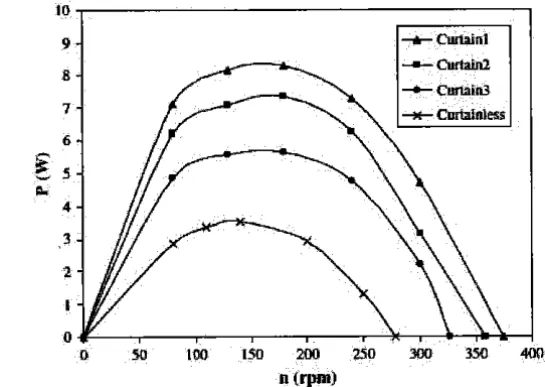
Altan et. a1 serves several types of curtain arrangements which classified as curtain 1, curtain 2 and curtain 3. Curtains was classified due to it long, medium and short dimension. The curtain 1 has the optimum length as shown in figure 2.13 due to high power coefficient gain. The lengths of the curtain 2 and 3 are 75% and 50% of the optimum lengths, respectively.
Altan et. a1 said most of the fluid guided by the curtain when the rotor's position is 0 = 90 escapes from over the convex blade will leads to an negative torque effect. This is the critical reason why it is when the rotor position is 0 = 90
,
[image:39.467.87.360.199.392.2]the lower torque value is obtained. When the rotor's position is0 = 45, however, more fluid escapes from between the end of the curtain and blade and the value of the applied torque decrease.
Figure 2.13: Comparison of the power changes with the rotor without curtain and the rotor with different curtain types for a
a
= 45 andP
= 15. [14]Figure 2.14: Schematic description of the geometry and hee optimization parameters XI, Y1, X2 used to modify the position of the shielding obstacle. Top: two-blade
Savonius rotor; bottom: three-blade savonius. [15, 161.
From this study, followed result and conclusion are obtained. The overall effect of this obstacle is extremely positive for both designs. Considering the obtained output power coefficient and the cost and complexity of the rotor, the two-blade configuration is clearly better than the three-blade turbine. This optimal configuration leads to a peak power output coefficient of 0.258 at /l = 0.8, and seems therefore very promising for wind energy generation in urban areas.
Mohamed et. a1 add another one important modification on his savonius turbine shape as shown in figure 2.15, He said from result obtained, the modified shape leads to an increase of the positive moment of the advancing blade as shown result in figure 2.16. For the overall conclusion, better configuration might be perhaps found by optimizing simultaneously blade shape and size and position of the obstacle plate.
Advanslng blade
+
RsWrnlng blade +
+
&t.SI.
aaUlol S.vmiur Optlmal~hap.
turbine
[image:40.469.60.411.549.695.2]m S.rOnrnurl(hOb.bsL
(a) 0.7
100X
-
So
ae
i
W e !
e
40
s
E
s
0 0
0.2 0.4 0.6 02 1 12 1.4 0 1 U L C 0 1 1 1 1 1 1
[image:41.469.41.427.51.228.2]Speed rafw 0,) Speed m.0 (A)
Figure 2.16: Performance of the optimized configuration (black plus) compared to the conventional Savonius with and without obstacle plate (filled an empty squares, respectively) (a) torque coefficient; (b) power coefficient. The corresponding relative
increase compared to the standard configuration is shown with stars.[l5,16]
Another one interesting design of external features of savonius turbine is guide box tunnel. Irabu & Roy, (2006) investigates to improve and adjust the output power of savonius rotor under various wind power and the method to prevent the rotor from strong wind disaster need to be suggest. So he employed guide-box tunnel (GBT) as drawn in figure 2.17, as an appropriate device to achieve the purpose. The GBT is like a rectangular box as wind passage in which a test rotor is included. The ratio between the inlet and exit of it is variable to adjust the inlet mass flow rate or input power.
In this study, Irabu et. a1 introduce new parameter to measure optimum size of
GBT passage that is widths ratio
I
where6 =
z;
1 = width of GBT, dt = rotor diameter. Using the GBT, as shown infigure 2.18, this study found that the maximum output power coefficient for two blades rotor is about 1.23 times at the largest compared with that without GBT and 1.5 times for three blades rotor of which reasonable width ratio of GBT is 1.4 and area ratio of it is 0.43.
Figure 2.17: Details of test rotors and guide-box tunnel: (a) guide-box tunnel with rotor; (b) two-blade rotor; and (c) three-blade rotor. [17]
[image:42.477.68.368.257.598.2]2.6 Development and performance of various types' geometry of drag-based VAWT.
Drag-based VAWT not only restricted in the form of savonius shape only. Nowadays, there are numerous numbers of different types and shape of VAWT in the market. Helical turbine, twisted, hunter turbine, zephyr vane are few example of drag-based VAWT. There is still lack study of performance of all those VAWT until today.
[image:43.478.108.353.403.555.2]Hassan et. a1 presents CFD analysis on helical blade savonius (figure 2.19). He said that design twisted rotor will be used in a small seafloor power generation system. Since this research study set the purpose below the sea, whch means the fluid flow is water instead of air, so the Power coefficient is low. But the author said the simulation results show better performance of twisted savonius as compared to the other conventional Savonius rotors which in this case the fluid is water. So it's quite possible to predict that performance of twisted savonius might be interesting to study in the air fluid stream condition.
REFERENCES
D'Ambrosio M., Medaglia M. (2010), Vertical Axis Wind Turbines: History,
Tec)inoloa) and Applications: Master thesis
http://www.windturbine-analysis.netfirms.com Access on April 2012 Yaoa. J, Wanga J., Yuanb W., Wanga H. & Caoa L., (201 I),
Analysis on the influence of Turbulence model changes to aerodynamic performance of vertical axis wind turbine? International Conference on
Advances in Computational Modelirlg and Simulation, 3 1, pp. 21 3-21 9
Wang L.B., Zhang L. and Zeng N.D. (2006), A potential flow 2-D vortex panel model: Applications to vertical axis straight blade tidal turbine, Energy
Conversion and Management, 48, pp. 454461
McTavish S., Feszty D. and Sankar T. (2011), Steady and rotating computational fluid dynamics simulations of a novel vertical axis wind turbine for small-scale power generation, Renewable Energy, 41 pp. 171e179 Dobreva I. and Massouha F. (2010), CFD and PIV investigation of unsteady flow through Savonius wind turbine Medgreen 201 1-LB, 6, pp. 71 1-720 Sargolzaei 3. and Kianifar A. (2007), Estimation of the power ratio and torque in wind turbine Savonius rotors using artificial neural Networks
International Journal of Energy, Issue 2, Vol. 1
Hassan M.I.
,
Iqbal T.,
Khan N.,
=nchey M.,
Masek V.,
CFD Analysis of a Twisted Savonius Turbine, Memorial Universig ofN~wfoundland St. John'sAjedegba J.O. (2008) Effect ofBlade ConJiguration on Flow Distribution and
Power Outptlt O f a Zephir Vertical Axis Wind Turbine, University of Ontario
Institude of Technology: Master thesis.
Manwell J., McGowan J., and Rogers A., Wind Energy Explained: Theory,
Design andApplication Second Edition John Wiley & Sons, Ltd 2009
Ashgriz A. and Mostaghimi J. An Introduction to Computational Fluid Dynamics in Fluid Flow Handbook, Department of Mechanical & Industrial Eng. University of Toronto Toronto, Ontario, Chapter 20.
Sodja J. Turbulence models in CFD in: prof. Rudolf Podgomik,. University of Ljubljana Faculty for mathematics and physics Department of physics, 2007
Altan B. D., Atllgan M. (2008), the use of a curtain design to increase the performance level of a Savonius wind rotors Energy Conversion and Management, 49, pp. 3425-3432
Mohamed M.H., Janiga G., Pap E., Thkvenin D. (2010), Optimization of Savonius turbines using an obstacle shielding the returning blade, Renewable Energy, 35, pp. 2618-2626
Mohamed M.H., Janiga G., Pap E., Thkvenin D. (2010), Optimal blade shape of a modified Savonius turbine using an obstacle shielding the returning blade, Energy Conversion and Management, 52, pp. 236-242.
Irabu K., Roy J.A. (2007), Characteristics of wind power on Savonius rotor using a guide-box tunnel, Experimental Thermal and Fluid Science, 32, pp.
580-586
Saha U.K., Thotla S. and Maity D. (20081, Optimum design configuration of Savonius rotor through wind tunnel experiments, Journal of Wind Engineering and Industrial Aerodynamics, 96 pp. 1359- 1375
Golecha K., Elclho T.I., Prabhu S.V. (201 l), Influence of the deflector plate on the performance of modified Savonius water turbine, Applied Energy, 88
pp. 3207-3217
Akwa
J.
A,, J h i o r G. A. d. S. and Petry A. P. (201 I), Discussion on the verification of the overlap ratio influence on performance coefficients of a Savonius wind rotor using computational fluid dynamics, Renewable Energy,38 pp. 141-149
Kamoji M.A., Kedare S.B. and Prabhu S.V., (2008), Performance tests on helical Savonius rotors, Renewable Energy, 34, pp. 521-529
Akwa J.A., Vielmo H.A. and Petry A.P., (2012), A review on the performance of Savonius wind turbines, Renewable and Sustainable Energy Reviews, Vol. 16, issue 5, pp. 3054-3064
Duque, Earl P. N., Burklund, Michael D., and Johnson (2003), Navier Stokes and Comprehensive Analysis Performance Predictions of the NREL Phase VI Experiment. Journal of Solar Energy Engineering, 125, pp. 457467.
htt~:/lchristopherteh.com/blog/201011 llwind-energy/ Access on April 2012 M. Ragheb (201 I), optimal rotor tip speed ratio, Retrieved on April 2012 from, http://netfiles.uiuc.edu.
ANSYS, Inc., Ansys-Fluent 12.0, Theory Guide, 2009.
M.Sc. Mohamed M. H. A,, (201 1) Design Optimization of Savonius and
Wells Turbines, University Magdeburg: Ph. D. thesis
Versteeg H. K., Malalasekera W. An introduction to computational jluid dynamics, the finite volume method 2"d edition, Pearson Education Limited
2007, pp. 4
![Figure 2.1 : Persian windmill [lo]](https://thumb-us.123doks.com/thumbv2/123dok_us/8774985.900909/29.472.116.327.50.230/figure-persian-windmill-lo.webp)
![Figure 2.3: Forces that act on the turbines [2]](https://thumb-us.123doks.com/thumbv2/123dok_us/8774985.900909/30.468.108.341.158.340/figure-forces-act-turbines.webp)
![Figure 2.4: Schematic of the computational domain [5]](https://thumb-us.123doks.com/thumbv2/123dok_us/8774985.900909/34.468.58.396.437.606/figure-schematic-computational-domain.webp)
![Figure 2.7: Comparison between power factors. [7]](https://thumb-us.123doks.com/thumbv2/123dok_us/8774985.900909/35.472.111.357.362.487/figure-comparison-between-power-factors.webp)
![Figure 2.8: Comparison between Power factor rotorl'I" to "III". [7]](https://thumb-us.123doks.com/thumbv2/123dok_us/8774985.900909/36.472.97.375.222.428/figure-comparison-between-power-factor-rotorl-i-iii.webp)
![Figure 2.10: Torque vs. angular position of rotor "II" in different wind speeds. [7]](https://thumb-us.123doks.com/thumbv2/123dok_us/8774985.900909/37.473.75.388.263.399/figure-torque-angular-position-rotor-different-wind-speeds.webp)
![Figure 2.12: Curtain design parameters and design of the curtain arrangement. [14]](https://thumb-us.123doks.com/thumbv2/123dok_us/8774985.900909/38.480.38.423.340.497/figure-curtain-design-parameters-design-curtain-arrangement.webp)
![Figure 2.1 5: Optimum configuration (right) obtained with the optimization procedure compared to the classical Savonius turbine (semi-cylindrical shape:left).[l5,16]](https://thumb-us.123doks.com/thumbv2/123dok_us/8774985.900909/40.469.31.429.73.192/configuration-obtained-optimization-procedure-compared-classical-savonius-cylindrical.webp)