International Journal of Emerging Technology and Advanced Engineering
Website: www.ijetae.com (ISSN 2250-2459,ISO 9001:2008 Certified Journal, Volume 5, Issue 10, October 2015)
78
Energy Efficient Routing Based on Sleep Schedule for Wireless
Sensor Networks
Suvarna S Menon
1, Anandhi V
21MTech student, 2Associate Professor, SCMS School of Engineering and Technology
Abstract
—
A wireless device network (WSN) consists of Associate in Nursing large vary of wireless device nodes. Since wireless device nodes unit battery hopped-up devices, theyhave restricted technique and transmission
power. Therefore on transmit sensing information to receiver effectively; it's necessary to vogue a routing protocol for WSNs. Since energy conservation is also a key issue in WSNs, information aggregation has to be compelled to be exploited therefore on save countless energy. Throughout this case, redundant information is combination at intermediate nodes reducing the dimensions and vary of changed messages and, thus, decreasing communication costs and energy consumption. This paper propose an Enhanced Forward Aware Factor-Energy Balanced Routing methodology
(EFAF-EBRM) supported information aggregation and sleep
planning technique that has some key aspects variety of a reduced vary of messages for fitting a routing tree, maximized vary of overlapping routes, active Time management and reliable information aggregation and transmission at intervals the experiments, planned methodology is compared with FAF-EBRM and LEACH. Experimental results show that planned methodology outperforms FAF-EBRM and LEACH, that balances the energy consumption, prolongs the network perform life and provides the foremost effective aggregation
quality.
Keywords — forward aware issue (FAF), Energy balance, Routing, Wireless device networks (WSNs).
I. INTRODUCTION
In recent years with the increase in Micro-Electro-Mechanical Systems (MEMS) technology, WSN have attained worldwide recognition .Compared to the standard sensors these sensors sq. Measure small, cheap with restricted technique and computing resources. These device nodes will sense, measure, and gather information from the setting and, supported some native decision methodology, they're reaching to transmit the perceived information to the user.
A device network [2] includes Associate in Nursing large vary of device nodes, that space unit thickly placed either at intervals the incidence or terribly near it.
Since wireless device nodes unit power-constrained devices, therefore on elongate the quantity of the network long-distance communication have to be compelled to be compelled to be compelled to be unbroken minimum. Thus, direct communications between nodes and to boot all-time low station don't seem to be meant. Making sure energy economical operation is crucial, considerably providing a typical WSN is deployed in remote and inaccessible space unit as and device nodes unit equipped with a restricted battery provide [6].
A WSN typically has very little or no or no infrastructure [4]. It consists of variety of device nodes (few tens to thousands) operational on to seem at a district to urge information regarding the setting. There area unit two sorts of WSNs: structured and unstructured. Associate in nursing unstructured WSN is one that contains a dense assortment of device nodes. Device nodes are to boot deployed in a very commercial ad-hoc manner into the sphere. Once deployed, the network is left unattended to perform observation and news functions. In Associate in Nursing unstructured WSN, network maintenance like managing property and work failures is tough since there sq. measure varied nodes. Terribly structured WSN, all or variety of the device nodes sq. measure deployed really pre-planned manner. The advantage of a structured network is that fewer nodes are deployed with lower network maintenance and management price. Fewer nodes is deployed presently since nodes unit placed at specific locations to produce coverage whereas spontaneous preparation will have uncovered regions. The position of device nodes needn't be designed or pre-determined[2].This allows random preparation in inaccessible terrains or disaster relief operations
International Journal of Emerging Technology and Advanced Engineering
Website: www.ijetae.com (ISSN 2250-2459,ISO 9001:2008 Certified Journal, Volume 5, Issue 10, October 2015)
79
Information is amalgamated throughout the data aggregation methodology. The amalgamated information can then be transmitted to rock bottom station directly. Rather than exploit the info to the nodes on high of things of the fusion, device nodes use their method skills to domestically perform easy computations and transmit solely the required and [*fr1] processed information. Wireless device networks (WSNs) unit being applied to industrial observation and management systems as they carry many blessings over ancient wired solutions at the facet of strength, simple installation, and reduced price.
it has been extra and additional used throughout a vary of applications starting from health care, environmental observation to industrial automation[11] for adscititious economical and effective data gathering with a minimum use of the restricted resources, device nodes have to be compelled to be designed to well report information by creating native alternatives. For this, information aggregation could also be a wise technique for saving energy in WSNs. As a result of the inherent redundancy in information gathered by the device nodes, in-networking aggregation will typically be accustomed decrease the communication price by eliminating redundancy and forwarding solely smaller combination information.
Sleep turning out with protocol [12] is to boost energy potency of proactive awaken. Then specifically selects the nodes to awaken and reduces their active time, thus on enhance energy efficiency with restricted trailing performance loss and increasing device nodes Life time.
Since marginal communication leads on to energy savings, that extends the network life. One altogether the foremost challenges in routing algorithms for WSNs is that the as a result of guarantee the delivery of the perceived information even at intervals the presence of nodes failures and interruptions in communications. These failures become even any essential once data aggregation is performed on the routing ways in throughout which since packets with combination information contain info from varied sources and, whenever one altogether these packets is lost a substantial quantity of information are lost.
II. RELATED WORKS
A. Low Energy Adaptive Clustering Hierarchy (LEACH) Protocol
The most illustrious stratified routing protocol which can increase the network quantity of a WSN is leach. Leach arranges nodes at intervals the network into little or no clusters and chooses one altogether the node as cluster head.
The operation of leach is split into 2 phases-setup and steady state section. In set up phase, the clusters unit shaped and a cluster head is chosen in step with the threshold value, T(n).Each node chooses a random vary „r‟ between zero and one. If this random vary could also be a smaller amount than a selected threshold value, T(n), the node becomes a CH for this spherical. Formula is given below Threshold value T(n) is calculated by the equation
T(n) = p/(1-p × r mod (1/p) ) , n€G 1 0 else
P is that the required proportion to become a cluster head, r is that this spherical and additionally the set of nodes that haven't become the cluster head at intervals the last 1/p rounds, is denoted by G.
Then every CH broadcasts a billboard message to the remainder of the nodes at intervals the network to raise them to hitch their clusters. The non-cluster nodes take their clusters supported the signal strength of this signal and reply with Associate in Nursing acknowledgement message indicating that they need joined. Then CH creates a TDMA schedule and assigns every node a interval at intervals that it's going to send the info. The CH chosen for this spherical can‟t everywhere once more become the CH until all the choice nodes haven‟t become the cluster head During steady state the non-cluster head node starts sensing information and sends into their CH in step with the TDMA schedule once receiving all information from the non-cluster nodes CH send it to all-time low station.
B. Forward Aware Factor –Energy Balanced Routing Method (FAF-EBRM)
In WSN typically members really} really cluster unit nearer to the sink than CH,but throughout this state of affairs it's to send information initial to CH then to the sink. This leads in wastage of energy as a result of backward transmission.
Here a routing protocol that uses forward transmission house (FTA) supported the position of sink and final information flow direction is meant. throughout this energy balanced routing protocol, FTA defines forward energy density composed of forward aware issue with link weight. An innovative communication protocol supported forward aware issue is planned therefore prolonging the period of the network and energy consumption is balanced.
III. EFAF-EBRM
International Journal of Emerging Technology and Advanced Engineering
Website: www.ijetae.com (ISSN 2250-2459,ISO 9001:2008 Certified Journal, Volume 5, Issue 10, October 2015)
80
It will deflate vary of messages for fitting a routing tree, high turnout, maximized vary of overlapping routes, high aggregation rate, and reliable information aggregation and transmission. in step with data mechanism of WSN, we've got a bent to tend to quantify the forward transmission area; define forward energy density that constitutes forward-aware issue with link weight. For energy economical transmission in event-driven WSN, information have to be compelled to be compelled to be reduced. It wishes correct
routing methodology for reliable transmission of
combination information to sink from the provision nodes. Here proposes an innovative communication protocol supported forward-aware admit order to envision next-hop node and information Routing for In-Network aggregation with sleep turning out with protocol. Thereby reducing the quantity of transmissions then leveling the energy consumption
A. Description of Network model
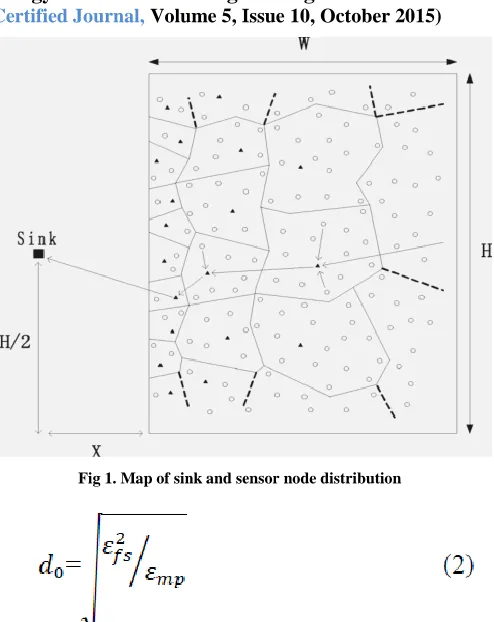
Contemplate Associate in Nursing rectangular sensing field W×H at intervals that device nodes square live every that approach distributed as shown in Fig one. Regional central node( cluster head) receives information from all the CMs then transfers to the sink node(sink).
The descriptions of network model unit given below
1)Communication ability and energy of all nodes unit
restricted, that they unit similarity in nature. Here each nodes image is indicated as‟i‟.
2)CH is any energy economical than a CM. therefore all
the cluster members lost its communication ability once a cluster head dies. Location of nodes and sink can not be changed. but energy of sink node is adscititious.
3)Transmission power of nodes can vary supported the
[image:3.612.324.571.115.426.2]globe to the receiver. at intervals the sensing field all nodes will receive ad message from the sink. in step with the received signal strength distance between offer and receiver is prepared.
Fig 1. Map of sink and sensor node distribution
Where and are the energy coefficients.
B. Establishment of the Network Model
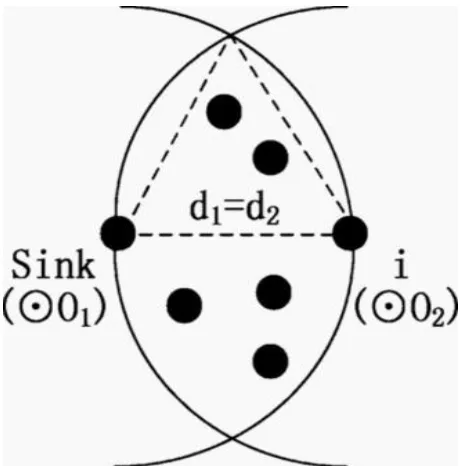
Let FTA(i) be the forward transmission house of node(i), N(i) be the set of nodes that have communication link with node (i), N„(i) be the set of nodes of N(i) that have edge with node i,d_ij Be the world between node i and node j.
assume a circle〖 ʘ〗_1 with sink as a results of the centre
and another circle ʘ_2 with node, i as a results of the
centre and〖 d〗_ip as a results of the radius as shown in
International Journal of Emerging Technology and Advanced Engineering
Website: www.ijetae.com (ISSN 2250-2459,ISO 9001:2008 Certified Journal, Volume 5, Issue 10, October 2015)
81
[image:4.612.63.267.237.599.2]This paper proposes Associate in Nursing energy balanced routing protocol that uses forward transmission house (FTA) supported position of sink and final data flow direction. In fig 2, the arc of circle ʘ_(1 )shows the probability of backward transmission of node i. Circle ʘ_2 contains all nodes that directly connected with node i. These circles contain all potential next nodes below topology and routing rule. FTA (i) is that the overlap section of these circles.
Fig 2. Forward transmission area of node i
By using (4), the area of FTA(i) is and can be
written as
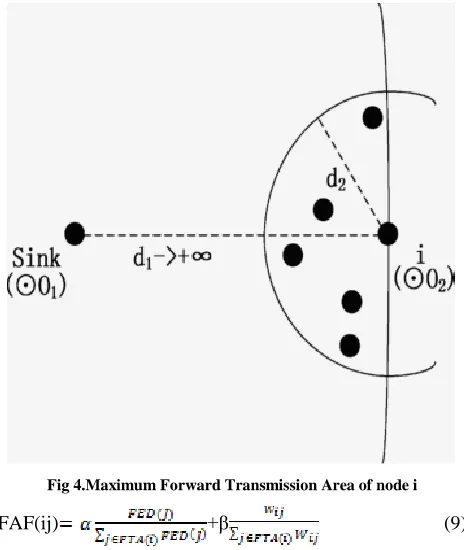
Consider another case at intervals that d_1 tends to eternity as shown in Fig four. Throughout this case, the
utmost house of FTA (i) is Π /2.
Once the radius of ʘ_1 becomes eternity, its arc tends to be a line. This arc passes the centre of ʘ_2and concerning dividing equally. The area of FTA (i) satisfies the condition of distinction
0 π (7)
Where is the communication radius
The node„s forward energy density FED (i,t) satisfies the condition of equality.
FED(i,t) (8)
Where is that the energy of node j at time t and as
well the dividend in (8) represents energy of all the neighbour combined in perform FTA(i). The forward aware issue (FAF) of the transmission link between node i and node j is written as
[image:4.612.328.560.351.584.2]International Journal of Emerging Technology and Advanced Engineering
Website: www.ijetae.com (ISSN 2250-2459,ISO 9001:2008 Certified Journal, Volume 5, Issue 10, October 2015)
[image:5.612.52.284.132.407.2]82
Fig 4.Maximum Forward Transmission Area of node iFAF(ij) +β (9)
In the on prime of equation, the first term represents the FED of all potential next hop nodes which suggests that the facility to transmit data. The second term represents the load of transmit link that's used to select out next hop node directly. In (9), the divisor of the first term represents FAF of all the neighbours combined in FTA(i) that of second term represents all of the link weights combined that i has in FTA. and ẞ unit positive harmonic coefficients that they sq.measure connected by
α+ẞ=1 (10)
C. Design of the Enhanced Forward Aware Factor – Energy Balanced Routing Method (EFAF-EBRM)
Giant scale WSN uses FAF-EBRM for static data assortment and event detection [14]. The routing rule of this technique is given below.
1) Confirm FTA (i) and each one altogether the potential
next-hop nodes of node i . First, take〖 d〗_0 as a results
of the communication radius, confirm the set of all of the nodes that have edges with i, N„(i).Select he nodes that nearer to Sink than during a position to i will be in an exceedingly very position to, that represent the set of all of the potential next-hop nodes and as well the furthest node confirm FTA (i).
2) Confirm FTA (j) and (j) of each potential
next-hop node. Confirm FTA (j) as we already did to determine FTA (i).
3) Calculate FED (j) of each potential next-hop node in step with (8).
4) Calculate the load of edges between i and each nodes. 5) Calculate FAF of each potential transmit link by pattern (9). Take subsequent-hop node pattern following equation
j (11)
6) If there is no node nearer to Sink than i in N„(i) , directly compare FAF of all of the nodes in N„(i), and take the next-hop node in step with (10). If there is no node in N„(i), in an exceedingly position to i will be able to extend the transmit power to urge a extended radius than until connected with another node, or ready to i will be ready to abandon the packet.
7) If Sink is among the forward transmit nodes, in an exceedingly position to i will be able to transmit information on to Sink and come through the procedure [12].
For energy efficient transmission, Data should be reduced. It requires proper routing method for reliable transmission of aggregated data to sink from the source nodes. This paper propose a new communication protocol based on forward-aware factor in order to determine next-hop node and sleep scheduling to reduce the number of transmissions and thus balancing the energy consumption , prolonging the network function lifetime and to improve QoS of WSN.
D. Data aggregation
A Wireless Sensor Network (WSN) typically consists of a sink node sometimes referred to as a Base Station and a number of small wireless sensor nodes. The base station is assumed to be secure with unlimited available energy while the sensor nodes are assumed to be unsecured with limited available energy. The sensor nodes monitor a geographical area and collect sensory information. Sensory information is communicated to the Base Station through Wireless hop by hop transmissions. To conserve energy this information is aggregated at intermediate sensor nodes by applying a suitable aggregation function on the received data. Aggregation reduces the amount of network traffic which helps to reduce energy consumption on sensor nodes.
International Journal of Emerging Technology and Advanced Engineering
Website: www.ijetae.com (ISSN 2250-2459,ISO 9001:2008 Certified Journal, Volume 5, Issue 10, October 2015)
83
It discards the overhearing packets from the nodes. And it sends aggregated data to the base station. Wireless sensor networks (WSNs) consist of a large number of battery-powered wireless sensor nodes, and one key issue in WSNs is to reduce the energy consumption while maintaining the normal functions of WSNs. Data aggregation, as a typical operation in data gathering applications, can cause a lot of energy wastage since sensor nodes, when not receiving data, may keep in the listen state during the data collection process. To save this energy wastage, sleep scheduling algorithms can be used to turn the nodes to the sleep state when their radios are not in use and wake them up when necessary. In this paper, we identify the contiguous link scheduling problem in WSNs, in which each node is assigned consecutive time slots so that the node can wake up only once in a scheduling period to fulfill its data collection task. The objective of the problem is to find an interference-free link scheduling with the minimum number of time slots used. In virtue of the contiguous link scheduling, the energy consumption caused by nodes‟ state transitions can be reduced.
E. Sleep scheduling algorithm
The routing protocol proposed for WSNs in which sensor nodes are static. Besides the applications running in the WSN require that the information gathered by the sensor nodes have to be transmitted immediately to the sink. Furthermore, it is also assumed that each node has a unique id, and the communication between neighboring nodes is symmetric and bidirectional.The objectives of the proposed routing algorithm with sleep scheduling and data aggregation are as follows
(i) Most sensor nodes should be in sleep mode most of the time so that the energy consumption by each node is reduced.
(ii) Consumption of energy by all the sensor nodes remains balanced, i.e., at any time, every node should have consumed nearly the same amount of energy.
(iii) Load shared by each node must be same so that no node is over used.
(iv) Time required to transmit data from a sensor node to the sink is as minimum as possible.
F. Proposed algorithm
In proposed algorithm a cluster is constructed and the CH is chosen according to the energy and memory.
1) Cluster head will send a status message to its cluster members informing them about the cluster head.
2) Once the message was received to the nodes they establish it as the cluster head. The message send to the nodes contains the information about the id,energy and memory of the cluster head.
3) Once the network of cluster head and nodes were established the cluster head will alot a particular time period for all the nodes for data transfer.
4) In That scheduled time period the nodes will be awakened and rest of the time the nodes will be in sleep mode.
5) The time period of awakening is different for each nodes. so as to avoid the wastage of energy and to avoid the congestion of node‟s information
6) When data is needed to the base station cluster head sends an awaken message to the particular nodes and the nodes will come active and once they are active, they will start sending message to the cluster head
7) Cluster head gathers the required information from the awakened nodes and from the gathered data it will discard the overheard data and this data will be send to the server by the cluster head
IV. SIMULATION RESULTS
By this method the nodes are made and then the clusters are formed and then from those clusters the cluster head was selected based on the energy efficiency and the memory.
International Journal of Emerging Technology and Advanced Engineering
Website: www.ijetae.com (ISSN 2250-2459,ISO 9001:2008 Certified Journal, Volume 5, Issue 10, October 2015)
84
Fig.7 cluster head selectionThen, we compare LEACH, EEBRM and FAF-EBRM by three parameters: packets reception radio (PRR),Throughput and packet loss. These three parameters of EFAF-EBRM is same as that of FAF-EBRM. But, in addition to these parameters, proposed method have some other advantages.
The additional advantages of EFAF-EBRM over existing methods are given below
• Decreases communication overhead
• Increases throughput and Packet delivery ratio Packet Delivery Ratio (PDR) means the ratio of the received packet to the Generated packet.here it is shown that EFAF-EBRM outperforms the other two method
Graph.1 simulation showing comparison of EBF
Graph.2. simulation showing comparison of average energy consumption
Also from graph 5 and 7 we can see that the throughput is greater and packet loss is small for the proposed method.
International Journal of Emerging Technology and Advanced Engineering
Website: www.ijetae.com (ISSN 2250-2459,ISO 9001:2008 Certified Journal, Volume 5, Issue 10, October 2015)
85
Graph.4. simulation showing comparison of PDRFrom the above results, we can see that EFAF-EBRM has a higher performance than LEACH and FAF-EBRM , which balances the energy consumption, prolongs the function lifetime and guarantees high QoS (such as Energy-Balanced, Long-Surviving, Packets Reception Radio) of WSN
Graph.5. simulation showing comparison of packet loss
Graph.6. simulation showing comparison of packet reception ratio
International Journal of Emerging Technology and Advanced Engineering
Website: www.ijetae.com (ISSN 2250-2459,ISO 9001:2008 Certified Journal, Volume 5, Issue 10, October 2015)
86
Graph.8. simulation showing comparison of overheadV. CONCLUSION
Energy balanced routing algorithms play an important role in event-based WSNs. An energy-balanced routing method of Sleep scheduling based on Forward Aware Factor is proposed in this paper. In FAF-EBRM, the next-hop node is selected according to the awareness of link weight and forward energy density In the experiment, enhanced FAF-EBRM algorithm is compared with LEACH and FAF-EBRM, and experimental results show that proposed algorithm outperforms LEACH and FAF-EBRM, which balances the energy consumption, prolongs the function lifetime, and guarantees high QoS of WSN.
REFERENCES
[1] Balakrishnan H, Chandrakasan A, Heinzelman W R(2000) „Energy Efficient Communication Protocol for Wireless Micro sensor Networks. IEEE. Published in the Proceedings of the Hawaii International Conference on System Sciences‟ vol 81 no 1 pp.41-47.
[2] I.F. Akyildiz, W. Su, Y. Sankarasubramaniam, and E. Cayirci, “Wireless Sensor Networks: A Survey,” Computer Networks, vol. 38, no. 4, pp. 393-422, 2002.
[3] W. B. Heinzelman, A. P. Chandrakasan, and H. Balakrishnan, “An application- specific protocol architecture for wireless sensor networks,” IEEE Trans. Wireless Commun., vol. 1, no. 4, pp. 660– 670, Oct. 2002.
[4] Jennifer Yick, Biswanath Mukherjee, Dipak Ghosal “Wireless sensor network survey” Computer Networks 52 (2008) 2292–2330 [5] Q. J. Chen, S. S. Kanhere, andM. Hassan, “Analysis of per-node
traffic load in multi-hop wireless sensor networks,” IEEE Trans. Wireless Commun., vol. 8, no. 2, pp. 958–967, Apr. 2009.
[6] H. B. Zhang and H. Shen, “Energy-efficient beaconless geographic routing in wireless sensor networks,” IEEE Trans. Parallel Distrib.Syst., vol. 21, no. 6, pp. 881–896, Jun. 2010.
[7] C. T. Cheng, C. K. Tse, and F. C. M. Lau, “A clustering algorithm for wireless sensor networks based on social insect colonies,” IEEE Sensors J., vol. 11, no. 3, pp. 711–721, Mar. 2011
[8] F. V. C. Martins and E. G. Garrano, “A hybrid multiobjective evolutionary approach for improving the performance of wireless sensor networks,” IEEE Sensors J., vol. 11, no. 3, pp. 545–554, Mar. 2011
[9] C. T. Cheng, C. K. Tse, and F. C. M. Lau, “A clustering algorithm for wireless sensor networks based on social insect colonies,” IEEE Sensors J., vol. 11, no. 3, pp. 711–721, Mar. 2011.
[10] Chen Y, Liu X and Zhang D (2012) „Improvement of LEACH in Wireless Sensor Networks Based on Balanced Energy Strategy‟ vol 44 no 27 pp.1478-1486
[11] K. Samaras and G. D. Hassapis, “A modified DPWS protocol stack for 6LoWPAN-based wireless sensor Networks,” IEEE Trans. Ind. Inf., vol. 9, no. 1, pp. 209–217, Feb. 2013.
[12] Bo Jiang, Student Member, IEEE, Binoy Ravindran, “Probability-Based Prediction and Sleep Scheduling for Energy-Efficient Target Tracking in Sensor Networks” IEEE TRANSACTIONS ON MOBILE COMPUTING, VOL. 12, NO. 4, APRIL 2013
[13] J. Aweya, “Technique for differential timing transfer over packet networks,”IEEE Trans. Ind. Inf., vol. 9, no. 1, pp. 325–336, Feb. 2013
[14] Degan Zhang, Guang Li, Ke Zheng, Xuechao Ming, and Zhao-Hua Pan, “An Energy-Balanced Routing Method Based on Forward-Aware Factor for Wireless Sensor Networks IEEE transactions on industrial informatics, vol. 10, no. 1, february 2014