Implementing Real-Time Traffic Light Detection & Classification
Himanshu Jat
1Namita Raghuvanshi
2Kanak Tenguria
31,2,3
Department of Computer Science & Engineering
1,2,3
Acropolis Institute of Technology & Research, Indore (M.P), India
Abstract— Object detection is widely used in the world of Neural Network based classifiers are used together with other object detection techniques. The aim of this study was to explore the modern open source based solutions for object detection on detecting traffic signals on road. Tensor Flow Object Detection API, an open source framework for object detection related tasks, was used for training and testing an SSD (Single-Shot Multi box Detector) with Mobilenet- model. The model was tested as pre-trained and with fine-tuning with a dataset consisting of images extracted from video footage of traffic signal.
Following hypotheses were examined:
1) Pre-trained model will not work on the data without fine-tuning.
2) Fine-tuned model will work reasonably well on the given data.
3) Fine-tuned model will have problems with occlusion and picture against roadside.
4) Using more variable training data will improve results on new images.
Key words: Real-Time Traffic, Light Detection, SSD, R-CNN
I. INTRODUCTION
Various kinds of driving support systems have been developed and the driving environment has been improved by the recent research and development of intelligent transportation systems. For implementation in these systems, many techniques for video processing have been proposed. Applications that use images or videos include vehicle detection, license plate recognition, traffic lane detection, road sign recognition, pedestrian detection, driver fatigue detection and so on.
According to the statistical report on traffic accidents, drivers who disregard traffic lights cause many of the traffic accidents. Hence, a driving support system that detects traffic lights and gives appropriate information to drivers would be useful. However, as compared to the applications mentioned above not many studies exists that address traffic light detection schemes that use images or videos. It is difficult to detect a traffic light by using typical pattern matching techniques, such as simple template matching, colour indexing or key-point detection. Since they are very small compared to other objects and objects similar to the traffic lights abound in the road environment.
Most of these existing methods attempt to detect traffic lights by searching pixels of the typical colours of traffic lights, i.e. red, yellow, and green. In these methods, traffic lights are detected through combining the colour with other information, such as shape or position. However, our preliminary experiments revealed that the colours of traffic lights captured by a digital video camera are easily over-saturated in various conditions. In this case, the colour is very different from the ordinary one, where it can be seen that most
of the pixels of the yellow traffic light are over-saturated and changed to white.
II. LITERATURE REVIEW
A. Modern Methods in Object Detection
Object detection is a common term for computer vision techniques classifying and locating objects in an image. Modern object detection is largely based on use of convolutional neural networks. Some of the most relevant system types today are Faster R-CNN, R-FCN, Multibox Single Shot Detector (SSD) and YOLO (You Only Look Once)
R-CNN method worked by running a neural net classifier on samples cropped from images using externally computed box proposals (=samples cropped with externally computed box proposals; feature extraction done on all the cropped samples). This approach was computationally expensive due to many crops.
Fast RCNN reduced the computation by doing the feature extraction only once to the whole image and using cropping on the lower layer (=feature extraction only once on the whole image; samples cropped with externally computed box proposals). Faster RCNN goes a step further and used the extracted features to create class-agnostic box proposals (=feature extraction only once on the whole image; no externally computed box proposals). FCN is like Faster R-CNN but the feature cropping is done in a different layer for increased efficiency
YOLO (You Only Look Once) works on different principle than the aforementioned models: it runs a single convolutional network on the whole input image to predict bounding boxes with confidence scores for each class simultaneously. The advantage of the simplicity of the approach is that the YOLO model is fast (compared to Faster R-CNN and SSD) and it learns a general representation of the objects. This increases localization error rate (also, YOLO does poorly with images with new aspect ratios or small object flocked together) but reduces false positive rate.
Single Shot Multibox Detector (SSD) differs from the R-CNN based approaches by not requiring a second stage per-proposal classification operation. This makes it fast enough for real-time detection applications. However, this comes with a price of reduced precision.
B. Speed-Accuracy Trade off
Fig. 1:
Figure-The above figure shows the impact of the feature extraction network on the three meta-structures. The horizontal axis shows the classification accuracy of the feature extraction network, and the vertical axis shows the mAP performance on the detection task. It can be seen that the SSD has the smallest difference above the vertical axis, and Faster - RCNN and R-FCN are more sensitive to feature extraction networks.
C. Object Detection in Real-Time Traffic Light
Various kinds of driving support systems have been developed and the driving environment has been improved by the recent research and development of intelligent transportation systems. For implementation in these systems, many techniques for video processing have been proposed. Applications that use images or videos include vehicle detection, license plate recognition, traffic lane detection, road sign recognition, pedestrian detection, driver fatigue detection and so on.
According to the statistical report on traffic accidents, drivers who disregard traffic lights cause many of the traffic accidents. Hence, a driving support system that detects traffic lights and gives appropriate information to drivers would be useful. However, as compared to the applications mentioned above not many studies exist that address traffic light detection schemes that use images or videos. It is difficult to detect a traffic light by using typical pattern matching techniques, such as simple template matching, colour indexing or key-point detection. Since they are very small compared to other objects and objects similar to the traffic lights abound in the road environment.
[image:2.595.311.544.65.423.2]Most of these existing methods attempt to detect traffic lights by searching pixels of the typical colours of traffic lights, i.e. red, yellow, and green. In these methods, traffic lights are detected through combining the colour with other information, such as shape or position. However, our preliminary experiments revealed that the colours of traffic lights captured by a digital video camera are easily over-saturated in various conditions. In this case, the colour is very different from the ordinary one.
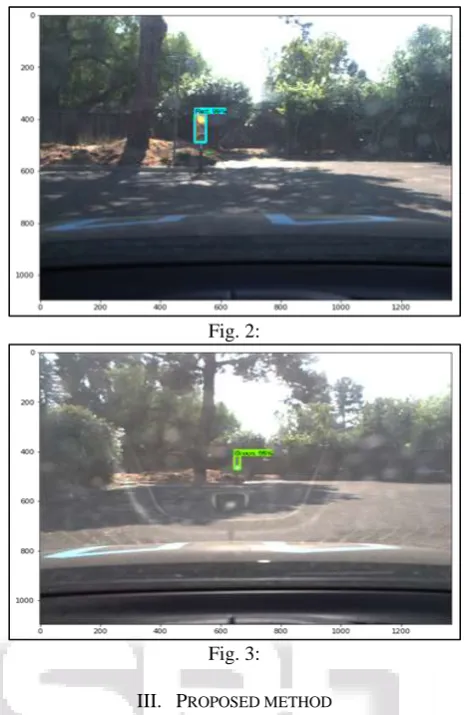
Fig. 2:
Fig. 3:
III. PROPOSED METHOD
Figure 2 shows the flow of the proposed method. First, a stereo image is acquired by a stereo camera, and distortion correction and paralleled transformation are applied using camera calibration parameters obtained in advance. Then, traffic light candidate regions are detected. The size of each region is compared to the standard size of a traffic light, and reliable candidates are selected. Each candidate is tracked with the Kalman filter to avoid an incorrect detection, and the recognition result is issued according to the tracking result
Fig. 4
A. Tracking of Traffic Lights
First, for each traffic light candidate region obtained in the first frame, a Kalman filter is created and tracking is initiated. For each frame, in order to obtain observation values for each Kalman filter, matching between Kalman filters and candidate regions is performed. After the matching process is completed, prediction and correction processes are performed using the state values at the previous time. For each candidate region to which a Kalman filter has not been assigned, a new Kalman filter is created. On the other hand, if a Kalman filter has no corresponding candidate region, there exists no observation value. In this case, prediction values are used as observation values for these Kalman filters so that the tracking is not interrupted. When a Kalman filter has no corresponding candidate region continuously for three frames, the tracking is stopped and the Kalman filter vanishes.
Let the state at time k be X k. In general, the state is represented as:
X k = AX k – 1 + Bu k – 1 + w k – 1, (1) where A is a matrix that represents the state transition from k − 1 to k, B is a matrix that relates the control input u k−1 to X k, and w k−1 represents the process noise. In the proposed method, the state X k is represented as
X k = [x y ẋ ẏ]T , (2) where (x, y) is the top left position of a candidate region and (ẋ, ẏ) is its velocity. Since there is no control input, Eq. (1) can be written as
X k = AX k – 1 + w k – 1, (3)
(4) Matrix A is defined like this since traffic lights actually do not move, and each candidate region moves approximately vertically in the frame according to the camera movement.
The observation value Z k at time k is represented by the state X k as
Z k = HX k + u k , (5)
where H is a matrix that represents an observation model and
u k is measurement noise. In the proposed method, H is determined
(6) Process noise w k and measurement noise u k follow the Gaussian distribution, the covariance matrices of which are Q and R, respectively.
The state vector is updated by a predictor-corrector algorithm. The prediction process is represented by
X̂ k = A X̂ k – 1, (7)
P = AP k – 1 A + Q, (8)
where X̂ k is the a priori state estimate at time k and
X̂ k−1 is the posteriori state estimate at time k − 1. P − k is the a priori estimate error covariance matrix at time k. The correction process is represented by
K k = P – k H T (HP – k H T + R) – 1, (9) X̂ k = X̂ k – + K k (Z k – H X̂ k – ) , (10) P k = (I – K k H) P – k, (11)
Where K k is the optimal Kalman gain, Z k is the observation value, and P k is the a posteriori error covariance matrix. The observation values, which are necessary for updating the state values of the Kalman filters, are determined using the results of the candidate region detection.
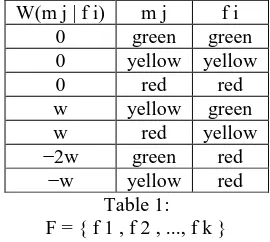
W(m j | f i) m j f i
0 green green
0 yellow yellow
0 red red
w yellow green
w red yellow
−2w green red
−w yellow red
Table 1: F = { f 1 , f 2 , ..., f k }
Let be a set of objects that the Kalman filters are tracking, where k is the number of objects. Each object f i (1 ≤ i ≤ k) has the following parameters: the position (x, y) and the velocity ( ẋ, ẏ) in a frame, the width of the traffic light in a frame, the actual distance z from the camera, and the colour of the traffic light. Let
M = {m 1 , m 2 , ..., m l }
[image:3.595.360.495.125.246.2]be a set of traffic light candidates, where l is the number of traffic light candidates. Each candidate m j (1 ≤ j ≤ l) has the following parameters: the position (x, y) in a frame, the width of the traffic light in a frame, the actual distance z from the camera, and the colour of the traffic light. For each candidate m j, the corresponding object f i is assigned by the criterion
Fig. 3:
(12) In Eq. (12), C (m j | f i ) is the cost function that represents the colour transition of traffic lights displayed in Fig. 3. In addition to the ordinary colour transition, there is a path from red to yellow because sometimes a red light is recognized as a yellow one.
𝐷( 𝑓 𝑖 , 𝑚 𝑗 ) = √(𝑥 𝑓 𝑖 + 𝑊(𝑚 𝑗 | 𝑓 𝑖 ) − 𝑥 𝑚 𝑗 ) 2 +
(𝑦 𝑓 𝑖 − 𝑦 𝑚 𝑗 ) 2 (13)
[image:3.595.313.546.402.569.2]camera, and α and β are the weighting factors. In the experiment, α = β = 1 was used.
Note that Eq. (13) takes into account only horizontally arranged traffic lights. However, vertically arranged traffic lights also exist. In order to take these into account, Eq. (14), which has the vertical correction term H(m j | f i ), should be used instead of Eq. (13).
𝐷( 𝑓 𝑖 , 𝑚 𝑗 ) = √ (𝑥 𝑓 𝑖 − 𝑥 𝑚 𝑗 )2 +
(𝑦 𝑓 𝑖 + 𝐻(𝑚 𝑗 | 𝑓 𝑖 ) − 𝑦 𝑚 𝑗 ) 2 (14)
IV. EXPERIMENTS
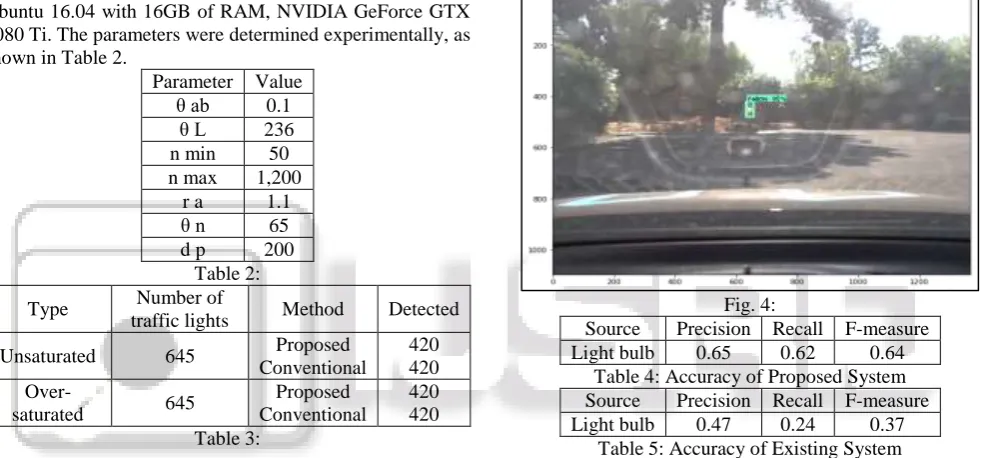
To verify the effect of the proposed method, we conducted experiments. Stereo images were acquired by an in-vehicle stereo camera. The image of 640 × 480 pixels at 15 frames per second (fps). The proposed method was tested using Ubuntu 16.04 with 16GB of RAM, NVIDIA GeForce GTX 1080 Ti. The parameters were determined experimentally, as shown in Table 2.
Parameter Value
θ ab 0.1
θ L 236
n min 50
n max 1,200
r a 1.1
θ n 65
d p 200
Table 2:
Type Number of
traffic lights Method Detected
Unsaturated 645 Proposed
Conventional
420 420
Over-saturated 645
Proposed Conventional
420 420 Table 3:
A. Accuracy of Detecting Traffic Light Candidate Regions
The first experiment was performed to verify the accuracy of the candidate region detection. To show the effect of detecting pixels, the colour of which is one of the traffic light colours, and over-saturated pixels simultaneously, the proposed candidate region detection method is compared to a method that does not use over-saturated pixels, as is common in most of the existing methods. In the experiment, six videos that include traffic lights with over-saturated pixels and six videos that include no over-saturated pixels were used. Thirty frames were used for each traffic light, and 360 frames were used in total.
Table shows the number of traffic lights that were correctly detected (true positive) by the proposed method and the method that does not use over-saturated pixels (conventional method).
The results show that both the methods can detect the traffic lights with unsaturated colour. However, the accuracy of the proposed method for over-saturated colour is much higher than that of the conventional method. These results show the efficacy of the approach used. Note that it is important to detect as many traffic lights as possible in the candidate region detection step, in spite of the increase in
false positives. As mentioned in section, incorrectly detected objects are discarded by using tracking.
B. Total Performance
The second experiment was performed to verify the traffic light detection performance of the proposed method. Video sequences were acquired from an in-vehicle stereo camera in a driving car. We used image sequences of 645 frames in total, of which 645 frames included traffic lights.
[image:4.595.53.549.257.486.2]In our evaluation, we used traffic lights having a distance from the camera greater than 40 m and smaller than 60 m. Since our method uses L*a*b* colour space, the method proposed by Yelalet which also uses L*a*b* colour space with contour tracking was compared with the proposed method as an existing method.
Fig. 4:
Source Precision Recall F-measure
Light bulb 0.65 0.62 0.64
Table 4: Accuracy of Proposed System Source Precision Recall F-measure
Light bulb 0.47 0.24 0.37
Table 5: Accuracy of Existing System
The efficiency was evaluated by precision, recall, and F-measure, averaged for all the frames. Let the numbers of correctly detected, incorrectly detected, and undetected traffic lights be n 1, n 2, and n 3 respectively. If the detected region overlaps 30% of the region of the actual traffic light, the detection results are considered correct. The values of precision and recall are calculated as
𝑃𝑟𝑒𝑐𝑖𝑠𝑖𝑜𝑛 = 𝑛1
𝑛1 +𝑛2 (15) 𝑅𝑒𝑐𝑎𝑙𝑙 = 𝑛1
𝑛1 +𝑛3 (16) The F-measure is the harmonic mean of these values. The experimental results are shown in Table 4 and Table 5. It was shown that the accuracy of the proposed method was much higher than that of the existing method.
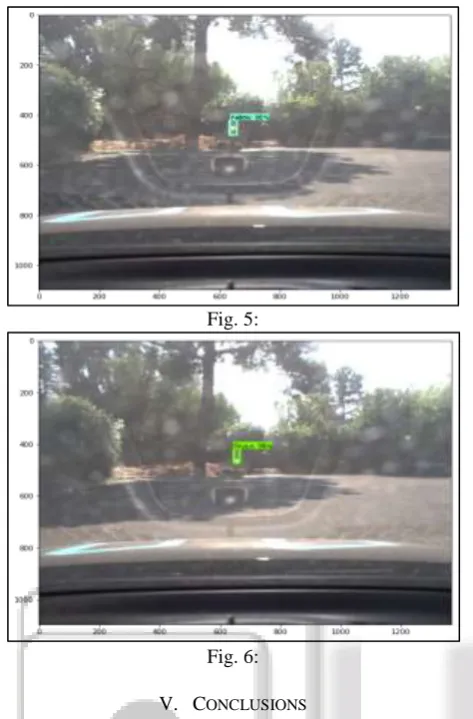
Fig. 5:
Fig. 6:
V. CONCLUSIONS
In this report, we proposed a method for detecting traffic lights using an in-vehicle stereo camera. Traffic light detection using image recognition techniques remains a difficult problem because of the existence of similar objects in the environment and the over-saturation of pixels. In order to overcome these problems, we proposed a method for detecting connected regions that include over-saturated and unsaturated pixels. In this method, in order to avoid incorrect detection, the detection result is verified using the object’s size by utilizing a stereo image.
Experiments were performed to verify the effect of the proposed method in two aspects. The effectiveness of the detection of traffic light candidate regions considering both over-saturated and unsaturated pixels was verified by the results of the first experiment.
The results of the second experiment confirmed the effect of traffic light tracking and the total performance of the proposed method.
Although the performance of the proposed method was much higher than that of the existing method, there is room for improvement. It is important in future work to decrease the number of detections of objects other than traffic lights by utilizing the shape or height information. In addition, it is necessary to examine possible techniques for handling the detection and tracking failures caused by motion blur. The development of a driving support system that has a traffic light detection function is also an important future work.
REFERENCES
[1] Traffic Light Mapping and Detection by Nathaniel Fairfield and Chris Urmson, Google Inc.
[image:5.595.50.287.65.425.2]