Reliability-Driven Reputation Based Scheduling for Public-Resource Computing
Using GA
Xiaofeng Wang#1
, Chee Shin Yeo*1
, Rajkumar Buyya*2
, Jinshu Su#2
#College of Computer, National University of Defence Technology Changsha, 410073, Hunan, China
{xf_wang1, sjs2}@nudt.edu.cn
*GRIDS Laboratory, Department of Computer Science and Software Engineering The University of Melbourne, VIC 3010, Australia
{csyeo1, raj2}@csse.unimelb.edu.au
Abstract— For an application in public-resource computing environments, providing reliable scheduling based on resource reliability evaluation is becoming increasingly important. Most existing reputation models used for reliability evaluation ignore the time influence. And very few works use a robust genetic algorithm to optimize both time and reliability for a workflow application. Hence, in this paper, we propose the reliability-driven (RD) reputation, which is time dependent and can be used to evaluate a task’s reliability directly using the exponential failure model. Based on the RD reputation, we also propose Knowledge-Based Genetic Algorithm (KBGA) to optimize both time and reliability for a workflow application. KBGA uses heuristics to accelerate the evolution process without giving invalid solutions. Our experiments show that the RD reputation can improve the reliability of a workflow application with more accurate reputation, while the KBGA can evolve to better scheduling solutions more quickly than traditional genetic algorithms.
Keywords—reliability, reputation, workflow scheduling, genetic algorithm, heuristic
1. Introduction
Public-resource computing which combines elements of Peer-to-Peer (P2P) and Grid computing is an important technology, and is used in many applications such as SETI@Home and BOINC [3]. Usually, public-resource computing comprises a large number of unsupervised resources which have no prior trust and are more susceptible to unreliability. Hence, many factors may lead to failures for an application. For example, a resource may be overloaded, slow connected, misconfigured or malicious. Thus, in public-resource computing, the scheduling of an application must also account for reliability, besides execution time (makespan) which is normally considered. To enable reliable scheduling, two important issues need to be considered: (i) how to evaluate a resource’s reliability and (ii) how to perform reliable scheduling based on the resource’s reliability information.
Reputation systems are commonly used to evaluate a resource’s reliability [1,2,9,11,13]. But, most existing reputation systems have two problems. Firstly, from the resource perspective, most reputation models [1,2,9,11] evaluate a resource’s reputation according to its ratio of successfully completed tasks. They do not consider the influence of the task’s runtime (size). For example, peer A has a higher task failure rate (task failures per unit time) than peer B, so peer B should have a better reputation. But, traditional reputation models will instead predict a better reputation for peer A when peer A executes more short runtime tasks and peer B executes more tasks with longer runtime. This is because peer A may complete more short tasks successfully than peer B. Secondly, from the task perspective, existing reputation models assigned the same reliability (success probability) [1,13] to all the tasks on a resource based on the resource’s reputation. But, the longer a task runs on an unreliable resource, the lower success probability it should have.
Given the resource reliability information, it is known to be a NP-hard problem to optimize both makespan and reliability for a workflow application with task dependencies [19]. Several list heuristics have been proposed for this problem in non-genetic algorithms [7,15,16]. Usually, genetic algorithms (GAs) can provide better quality solutions than list heuristics [6,12]. Although GA is more time consuming, it is acceptable for applications with long runtime. Moreover, the speed of GA can be accelerated by adopting parallel genetic algorithm technology [14]. Currently, bi-objective genetic algorithm (BGA) [17] is the only GA that we know can give both makespan and reliability optimized scheduling solutions for workflow applications. But BGA may give invalid solutions which violate the dependence between tasks. In addition, most GAs [8,10,17] evolve the scheduling solutions randomly, which may lead to slow convergence of the algorithm.
In this paper, we propose the novel reliability-driven (RD) reputation model for resource reliability evaluation. RD reputation considers the runtime of tasks by using the resource’s task failure rate (task failures per unit time) 2009 International Conference on Advanced Information Networking and Applications
to define the reputation. It also provides a real time reputation that can be used to evaluate a task’s reliability directly using the exponential failure model. Based on RD reputation, we then define the reliability-driven scheduling problem and two scheduling heuristics which aim to optimize makespan and reliability for a workflow application. Finally, we design the knowledge-based genetic algorithm (KBGA) to provide scheduling solutions. KBGA evolves the task execution order according to the task’s importance value, so that the scheduling will not violate the dependency between tasks. The mutation of KBGA has two operators namely swapping mutation and reassigning mutation which evolve the solutions intelligently based on our heuristics.
The remainder of this paper is organized as follows. Section 2 introduces related work. Section 3 presents the scheduling system model. Section 4 defines the RD reputation and its calculation algorithm. Section 5 defines the scheduling problem and two heuristics, while KBGA is presented in Section 6. Experimental results are presented in Section 7, followed by the conclusions in Section 8.
2. Related Work
The real time resource reliability can be monitored by the resource’s reputation, which can be defined as the probability that the resource can deliver the expected utility service [2]. For P2P systems, two popular reputations EigenTrust [9] and PowerTrust [11] were designed. They compute the local trust value based on the normalized number of successful transactions between two participants. For public-resource computing systems, Sonnek et al. [1] calculated a worker’s reliability as the ratio of correct responses. Neither the normalized number nor the ratio of correct responses considered the time influence. Song et al. [13] used fuzzy logic to evaluate the reputation. Although task runtime is included in their model, they did not specify how the task runtime affects the reputation. The time related performance can also be evaluated by the resource availability [4]. But it focused on the hardware analysis, not including the task level behaviour analysis. Moreover, most existing works did not give methods or algorithms to predict the real time task failure rate for a resource, which is needed for task scheduling. However, our reliability-driven reputation is specially defined to be time dependent, and our reputation calculation algorithm can provide a real time failure rate evaluation for a resource.
Optimizing both makespan and reliability for a workflow application is known to be a NP-hard problem. Many list heuristics have been proposed [7,15,16]. Dongarra et al. [15] proved that tasks should be scheduled to the node with the minimum multiplication value of the instruction execution time γ and reliability λ. Marek et al. [7] proposed a general bi-criteria scheduling
heuristic which divides the scheduling into primary and secondary scheduling. Generally, a genetic algorithm can give better scheduling solutions than list heuristics [12]. Dogan et al. proposed a bi-objective genetic algorithm (BGA) for workflow applications [17]. BGA evolves the scheduling solutions randomly which may give invalid solutions violating the dependency between tasks. Wang et al. [10] represented a scheduling solution as two strings: the task-resource assignment string and the task execution order string. Although this method can solve the invalid solution problem, they did not consider reliability. Most existing GAs [8,10,17] also evolve the scheduling solutions randomly, which may lead to slow convergence of the algorithm. In contrast, our KBGA evolves the task execution order according to the task’s importance value and mutates a solution based on our two heuristics. Thus, our KBGA can evolve the scheduling solutions intelligent without giving invalid solutions.
3. Models and Assumptions
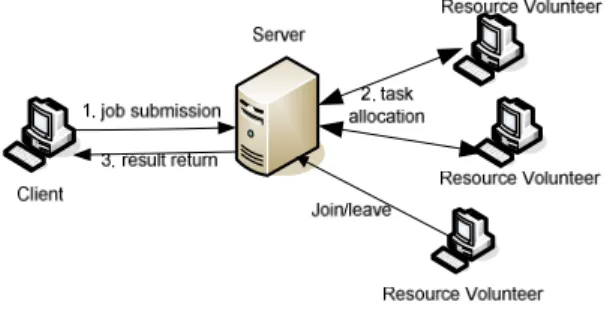
In the typical public-resource computing model [1] as shown in Fig. 1, there is a central server which assigns jobs submitted by the clients to the resource providers. We model a workflow job as a Directed Acyclic Graph (DAG): Job=(V,E) . V is the set of nodes
) 1
( i n
vi ≤ ≤ which denotes the tasks of the workflow job. E is the set of edgese(i,j)(1≤i< j≤n) which represents the dependence between tasks vi and vj ,
i
v is the parent task and vjis the child task. For each task nodevi, its weight vi is the number of instructions of this task which is assumed to be known using compiling technology [15]. The length of a path in the DAG is the sum of the weights of all nodes along the path.
Fig. 1. System Model.
There are some resource volunteers in the system, which are not centrally controlled and will join or leave the system dynamically. Let R={r1,r2"rm} be the m resources available in the system. Each resource
r
i is associated with two values: rdri , the resource’s RD reputation and γi , the resource’s computing speedillustrated by unitary instruction execution time (i.e. the time to execute one instruction). Given the resource’s information, the central server can schedule the workflow job. Let M :V →R denotes the mapping function, and thenM(i)=rj means task
v
iis assigned to resourcerj.We assume that the central server can only schedule at most one task to one resource at any time. We also assume that the central server can monitor the task execution, hence if a task successfully finishes or fails before completion, the server can detect it and send a reputation report. Several technologies have been proposed to deal with this problem such as checkpoint and quizzes verification [18].
4. Reliability Evaluation as Reputation
In public-resource computing, many discrete events may lead to failures of an application such as non-availability of required services, overloaded resource conditions and malicious activities. All these events are independent and may happen randomly, hence we use the commonly used Poisson Distribution [15,16,17] to model the failure of a resource provider. The failure density function is f(t)= λe−λt(t ≥0), where λ is the
failure rate of a resource. Let num_fails be the number of
failures within a resource during the job runtime period of run_time. We can compute the failure rate by Equation 1 which is the inverse of Mean Time To Failure (MTTF). time run fails num MTTF dx xe x _ _ 1 1 0 = = =
∫
∞λ −λ λ . (1)To enable reliable scheduling, the resource’s real time failure rate should be monitored. Although traditional reputation systems can be used to monitor the resource’s reliability, they neither predict the failure rate for a resource directly nor consider the time influence. Here, our time dependent reputation is directly related to the failure rate, which can be defined as:
Reliability-Driven (RD) Reputation (rdri) of a resource i
r
is the generally said or believed probability of taskfailure per unit time, with which the resource provider will fail to complete the tasks assigned to it.
4.1 Calculation of Real time RD Reputation
A resource’s RD reputation represents its real time
failure rate λ introduced above. To maintain the RD
reputation, we divide the successive time into time
intervals which last a window timeTwindow. For each
time interval, the server maintains a reputation statistic ) , , , ( _stai si fi runtimei ci
repu = for each resource
r
i.The variables si and fiare the start and finish times for
an interval respectively,
runtime
i is the total CPU timethat resource
r
i donates for task execution in the interval,and
c
iis the number of failures experienced by tasks.Algorithm 1 shows the RD reputation calculation algorithm. It begins with initializing each resource’s
reputation statistic repu_stai for the first time interval
(line 1~6).
Let us assume that the algorithm comes to time interval ti for resource
r
i. After a task vj assigned toresource
r
i successfully finishes or fails, the server givesa reputation report testimonyij =(sij,fji,cij), where
s
ijand fij are the start and finish times of task vj
respectively, and i
j
c is the number of failures during this
task. If a task fails, we simply assign i
j
c to be 1,
otherwise it is 0. The server uses this report to update the
reputation statisticrepu _stai( line 9~11).
After each update of the reputation statistic
i
sta
repu_ , a real time statistical failure rate
statistic i
λ for resource
r
i can be computed using Equation1. Here, the whole length of the current time interval is
f
i−s
i. During the runtimei of the resource’s donated task execution time in the current interval, the resourcehas
c
i task failures. During the remainingtime fi −si−runtimei in the current interval, the resource is assumed to work with a reputation observed
in the last time interval ti −1. Thus the assumed number
of task failures for the remaining time in the current interval isrdriti−1(fi−si −runtimei), where ti−1
i
rdr
is the recorded RD reputation for resource
r
i in the lasttime interval ti−1. And we can get the real time statistic failure rate by:
i i i i i t i i statistic s f runtime s f rdr c i i − − − + = −1( ) λ
.
(2)The reputation should decay over time, thus the real
time RD reputation for resource
r
i in the current timeinterval ti can be defined as:
) 1 0 ( , ) 1 ( 1+ − ≤ < ⋅ =
α
−α
λ
statisticα
i t i i rdr i rdr (3)where α is the decay factor. If α is zero, the real time RD
reputation will be equal to statistic
i
λ , which means it is
At the end of the current time interval it, the real
time RD reputation rdri is recorded as ti
i
rdr for
resource
r
i (line 16), and the server starts anotherreputation statistic for the next time interval ti +1(line
17~19). For the initial time interval, we assume that the RD reputation rdri0 for each resource
r
i isrdrinitial(line 2). rdrinitial is the initial RD reputation for all the resources. It should be set to a relatively high failure rate. In this way, it gives resource providers incentives to supply good quality services to improve their reputation.Algorithm 1 RD Reputation Calculation Algorithm 1 for each resource
r
i do2 initial i rdr rdr rdr = i0= 3 ti←1 4 si=fi=current_time 5 runtimei ←0; ci←0 6 end for
7 while there is a reputation record i
j
testimony do
8 if ( i i windows
j s T
f < + ) then //current interval
9 i j i i c c c ← + 10 runtimei ←runtimei+(fji−sij) 11 fi←max(fji,fi)
12 Remove the record i
j testimony 13 Compute statistic i
λ
by Equation 2 14 Computerdri by Equation 315 else //next interval
16 t i i rdr rdri ← 17 ti ←ti+1 18 si = fi =si+Twindows 19 runtimei ←0; ci←0 20 end if 21 end while
5. Reliability-Driven Scheduling Problem
In this section, the reliability-driven scheduling problem based on RD reputation is formalized first. Then two heuristics are defined for genetic algorithms to improve the scheduling solutions.
5.1 Problem Representation
In a workflow application, each task could be executed only after all its parent tasks have been
completed. Thus the available start time for a task
v
iis:e j E i j e avail i t t ∈ = ) , (max
,
(4)where tej is the end time for taskvj. If task
v
ihas no parent tasks, its available starting time is 0. Let function) (rj
idle be the time when resource
r
j is idle. Then thebeginning and ending times of taskvi can be defined as:
j j i b i e i avail i b i r M(i) where v t t i M idle t t = + = = ))} ( ( , max{ γ , (5)
where M(i)is the resource to which task viis assigned,
andγj is the instruction speed of resource
r
j. Lett
sjbethe time when resource
r
jfinishes all the tasks assignedto it in scheduling S, which can be defined as:
} { maxi|M(i) r ie j s t t = = j . (6)
The reliability of a workflow application is the probability that all its tasks complete successfully. It can be given by the probability that all the resources remain functional until all the tasks assigned to it are completed
[15]. Since rdri represents the failure rate for
resource
r
i , the probability that resource ri cansuccessfully complete all its tasks in scheduling S is
i i s rdr t i s
e
R
=
− ⋅ . Thus the success probabilityR
s foran application in scheduling S can be computed as the
product of allRsi, which is illustrated in Equation 7. We
can see that to maximize the reliability, we need to minimize the failure factor fal(S)
=
∑mi=1tsirdri.i i s m i t rdr m i i s s
R
e
R
−∑ ⋅ = =∏
=
=
1 1 . (7) The reliability-driven scheduling of a workflow application is to maximize the reliability and minimize the makespan for the application within the timeconstraint of the deadline D. Therefore the scheduling
problem can be formalized as:
D S time t S time rdr t S fal i s R r m i i i s i < = ⋅ = ∈ =
∑
) ( ) ( max ) ( ) ( ) ( Subject to Minimize 1 Minimize . (8) 5.2 Heuristic rulesTo maximize the reliability, Heuristic 1 can be applied [15]. It has been proved that to maximize the reliability, the task should be scheduled to the resource with minimal γirdri whenever it is possible.
Let S be a schedule where all the tasks are assigned to a
resource with minimum γirdri . Then any schedule
S
S′≠ with reliability of
R
s′ is such thatR
s′<
R
s. To minimize the makespan for an application, we should give higher priority to tasks that can start earlier and to tasks that have a bigger influence to the makespan of the application. Thus the second heuristic can be defined as:Heuristic 2
Let the importance of a task vi be the length of the
longest path beginning from the task in the DAG graph, which can be denoted as:
⎪⎩ ⎪ ⎨ ⎧ + ∉ ∀ = ∈ impt j otherwise v E j i e j v i impt E j i e i i ) ( max ) , ( , ) ( ) , ( . (9) And the task
v
i’s priorityp(i) is:))) ( ( , max( ) ( ) ( ) (i E impt i t idle M i p = γ ⋅ − iavail , (10)
whereE(γ)is the mean instruction speed of all resources.
Then, if there are two tasks scheduled to the same resource, the one with the higher priority should be scheduled first.
6. Reliability-driven Scheduling using
Genetic Algorithm
For the scheduling problem of workflow applications, a GA can usually give better solutions than list heuristics [12]. A typical GA consists of the following steps: (1) create an initial population consisting of randomly generated solutions which are also called chromosomes; (2) evaluate the fitness of each solution and remove poor solutions from the population; (3) generate a new generation of solutions by applying two evolution operators, namely crossover and mutation; and (4) repeat step 2 and 3 until the population converges. In order to make a GA converge to better solutions more quickly without giving invalid solutions, we design the knowledge-based genetic algorithm (KBGA). KBGA evolves the task execution order according to the task’s importance value. It also optimizes the typical GA by applying two new mutation operators based on our two heuristics. The details of KBGA are presented in the following sections.
6.1 Chromosome Encoding and Crossover
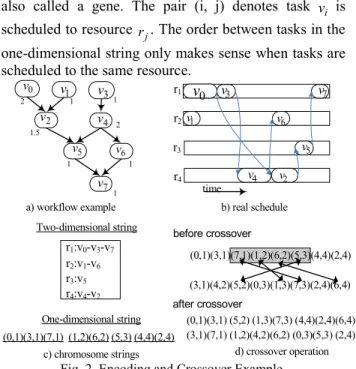
For workflow applications, a chromosome is a data structure into which a scheduling solution is encoded. We use a two-dimensional encoding string [8] to represent a scheduling solution. As illustrated in Fig. 2c, one dimension of the string represents the index of resources, while the other dimension shows the order of tasks on each resource. The two-dimensional string can be converted into a one-dimensional string according to
the resource’s index and task’s order. The one-dimensional string comprises a list of ordered pairs (i, j),
also called a gene. The pair (i, j) denotes task vi is
scheduled to resource rj. The order between tasks in the
one-dimensional string only makes sense when tasks are scheduled to the same resource.
c) chromosome strings time b) real schedule a) workflow example d) crossover operation r1 r2 r3 r4 0 v 1 v 7 v 3 v 2 v 5 v 4 v 6 v (0,1)(3,1)(7,1) (1,2)(6,2) (5,3) (4,4)(2,4) r1:v0-v3-v7 r2:v1-v6 r3:v5 r4:v4-v2 One-dimensional string
Two-dimensional string before crossover
after crossover (0,1)(3,1)(7,1)(1,2)(6,2)(5,3)(4,4)(2,4) (3,1)(4,2)(5,2)(0,3)(1,3)(7,3)(2,4)(6,4) (0,1)(3,1) (5,2) (1,3)(7,3) (4,4)(2,4)(6,4) (3,1)(7,1) (1,2)(4,2)(6,2) (0,3)(5,3) (2,4) 2 1 1 1 2 1 1.5 1 0 v 7 v 6 v 5 v 4 v 2 v 3 v 1 v
Fig. 2. Encoding and Crossover Example.
The crossover operation creates new chromosomes by randomly exchanging part genes of the existing chromosomes. As illustrated in Fig. 2d, our algorithm performs the crossover operation on the one-dimensional string as follows: (1) Two chromosomes are randomly chosen from the current population, and two random genes are selected from one of the chromosomes; (2) All the genes between the selected two genes are chosen as crossover genes, and the resource allocation for all the tasks related to the crossover genes are exchanged between the selected two chromosomes; and (3) For each resource in the two new chromosomes, the tasks assigned to it are rescheduled in the descending order of
their importance valueimpt(i). In this way, the parent
tasks are always scheduled before their child tasks, thus avoiding the invalid solution problem [17]. After crossover, two new offspring are generated by combining task assignments taken from the two parents.
6.2 Mutation
Typically, a mutation operation changes some of the genes in a chromosome randomly, which causes the algorithm to search randomly around the good solutions. We obtain two new mutation operators, namely
reassigning mutation and swapping mutation. They use the two defined heuristics to help the algorithm evolve more directly to the good solutions.
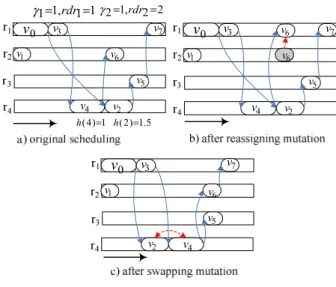
The reassigning mutation improves the reliability for a
scheduling using Heuristic 1. First, it chooses a task in
one scheduling solution randomly. Then it reassigns the
task order according to its importance value impt(i). In
Fig. 3a, task
v
6 is originally scheduled toresource
r
2whose γirdri is 2. The reassigning mutationreassigns it to resource
r
1with a lowerγirdri of 1 asshown in Fig. 3b. Hence the reliability of the workflow application has been improved, although the makespan remains the same.
The swapping mutation improves the makespan for a
scheduling according to Heuristic 2. It randomly chooses
a resource in one scheduling, and compares the priority of two successive tasks on the resource. It swaps the execution order of the two tasks if the preceding task has
a lower priority. In Fig. 3a, taskv4is scheduled before
2
v because it has a higher importance value, but has a
lower priority. Therefore the swapping mutation exchanges their execution order. Fig. 3c shows the new scheduling where the makespan of the application has been reduced. 2 2 , 1 2= rdr = γ 5 . 1 ) 2 ( = h 1 ) 4 ( = h 0 v 1 v 7 v 3 v 2 v 5 v 4 v 6 v 1 1 , 1 1= rdr = γ 0 v 1 v 7 v 3 v 2 v 5 v 4 v 6 v 6 v 0 v 1 v 7 v 3 v 2 v 5 v 4 v 6 v
Fig. 3. Mutation Operation.
6.3 Evaluation
In the evolutionary-based optimization methods, fitness functions are used to measure the quality of a solution according to the optimization objectives. As our goal is to optimize the reliability and makespan for a workflow application under the time constraint, the fitness value f(s)for a scheduling solution S can be defined as: if 1 if 0 ) ( where ) 1 ( ) ( ) ( ) ( ) ( 2 1 minTime maxTime minTime 2 minFal maxFal minFal 1 ⎩ ⎨ ⎧ > < = = + + ⋅ + ⋅ = −− −− D time(s) D time(s) s f s f s time s fal s f penalty penalty ω ω ω ω
.
(11)Here, maxFal and minFal are the maximum and minimum failure factors for the solutions in the current population respectively, while maxTime and minTime
are the maximum and minimum makespan respectively. The first two elements of f(s) encourage the algorithm to choose the solutions with minimum failure factor and minimum makespan. Both these two objectives are assigned a weight according to the user’s trade-off requirement. The third element
f
penalty(
s
)
is to handle the time constraint. If the makespan of a scheduling exceeds the time deadline D, the function will give a penalty to its fitness value.7. Experiments
We use GridSim [5] to simulate a public-resource computing environment for our experiments. There are 200 resource providers in the system. They donate various numbers of CPU cycles whose speed is uniformly distributed in [5×10−4,10−3] milliseconds per instruction. The actual failure rates for resource providers are assumed to be uniformly distributed from
h
/
10−3 ψto 10−4/h [17]. The structure of a workflow
application can be categorized into balanced and unbalanced [8]. Like other previous works [8,16,17], we use a random DAG generator to simulate the application. Our simulated workflow application consists of 300 tasks. The mean outdegree for a task node is 2. The
task’s size is chosen uniformly between 5×10³ Million
instructions (MI) and 72×105MI. The reputation decay
factor is 0.2, while the fitness evaluation weight ω1
andω2 are both set to be 0.5 so that the algorithm gives
the same priority to both reliability and makespan. a) RD reputation compared with traditional reputation: The traditional reputation model uses the ratio of successfully completed tasks as a resource’s reputation. To compare the difference between RD and traditional reputations, we test the two reputations under several extreme conditions: the size of all the test tasks
in the system are {12,24,36,48,60,72} ×105MI
respectively, the resource provider has a high failure rate
of 10−3/h or a low failure rate of 10−4/h , and the
resource provider donates resources of a fast speed of 1000MIPS or a slow speed 500MIPS. To facilitate the comparison, we derive the task failure probabilities for a medium-sized task based on the traditional and RD reputation. Fig. 4 shows the two failure probabilities normalized by the standard task failure probability based on the resource’s actual failure rate. The task failure probabilities based on RD reputation remain consistently close to the standard task failure probability. The traditional reputation based task failure probability gets close to the standard task failure probability only when the test tasks in the system also have the medium task size. Otherwise, the failure probability also increases as the size of the test tasks increases. And when the resources have a faster speed (Fig. 4a) or lower failure
rate (Fig. 4b), the task failure probability based on traditional reputation will have a greater deviation from the correct one. This is because the normalized failure probability based on traditional reputation obeys a negative exponential function. The lower failure rate and faster speed will contribute to a smaller exponent which results in greater deviation.
b) RD reputation’s influence to scheduling: To compare the scheduling results based on traditional and RD reputation, half of the resources in the simulation have the actual failure rate, while the other half of the resources have either RD reputation based failure rate or traditional reputation based task failure probability. Fig.
5 shows both the traditional reputation based scheduling and RD reputation based scheduling have almost the same makespan under various conditions. The RD reputation based scheduling also has a consistently lower failure probability, while the traditional reputation based scheduling has a higher failure probability, especially when the reputations are computed under conditions when the task’s size is very small or very large. This is because under such conditions, the traditional reputation gives a different resource failure rate from the standard one, and tasks are scheduled to more unreliable resources.
0.20 0.40 0.60 0.80 1.00 1.20 1.40 1.60 1.80 12 24 36 48 60 72
Task Size (E+5 MI)
N or m al iz ed F ailu re P ro ba bil ity RD_Fast RD_Slow Traditional_Fast Traditional_Slow
0.20 0.40 0.60 0.80 1.00 1.20 1.40 1.60 1.80 12 24 36 48 60 72 Task Size (E+5 MI)
N or m al iz ed Fai lu re P robabi lit y RD_HighRD_Low Traditional_High Traditional_Low
a. Varying Resource Speed b. Varying Resource Failure Rate
Fig. 4. Normalized failure probability of a medium-sized task based on traditional reputation and RD reputation.
0.15 0.20 0.25 0.30 0.35 0.40 0.45 0.50 0.55 12 24 36 48 60 72 Task Size (E+5 MI)
F a ilure P ro b a bi lit y RD_Low Traditional_Low RD_High Traditional_High
1.60 1.65 1.70 1.75 1.80 12 24 36 48 60 72 Task Size (E+5 MI)
N or ma lize d M ak es pan RD Traditional
Fig. 5. Failure probability and makespan of a workflow application based on traditional reputation and RD reputation.
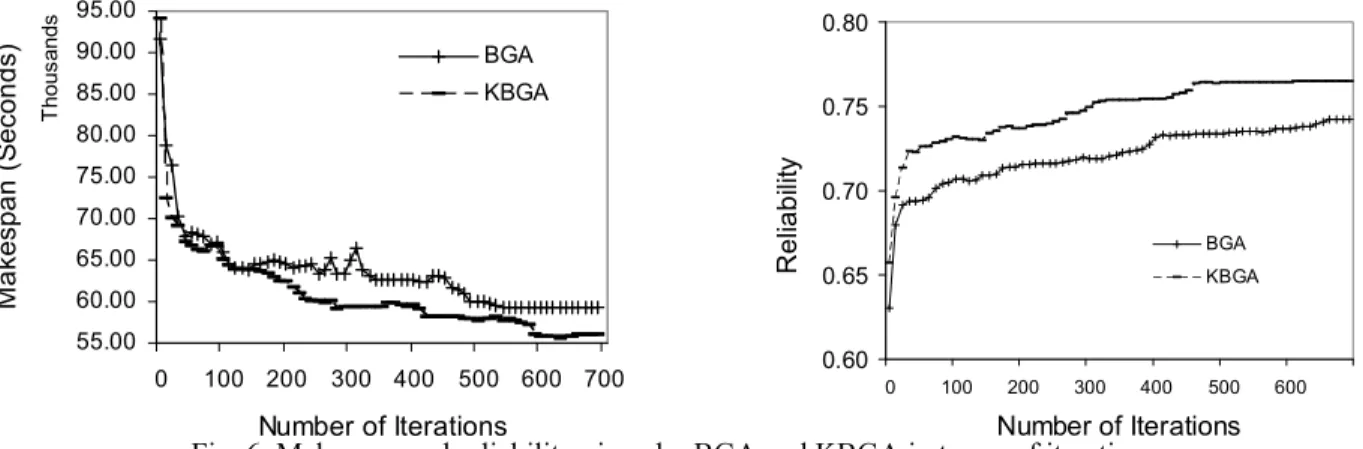
55.00 60.00 65.00 70.00 75.00 80.00 85.00 90.00 95.00 0 100 200 300 400 500 600 700 T hous ands Number of Iterations Mak e sp an (S e co nds ) BGA KBGA
0.60 0.65 0.70 0.75 0.80 0 100 200 300 400 500 600 Number of Iterations R e lia b ili ty BGA KBGA
c) KBGA’s performance: We compare KBGA with BGA [17] which also optimizes makespan and reliability for an application by evolving solutions randomly. The average makespan and reliability of all the solutions are computed after each iteration. Fig. 6 shows KBGA improves the makespan and the reliability for an application more quickly than BGA. After some iterations, it becomes very difficult for BGA to find a better solution by randomly evolving solutions, while it is easier for KBGA to evolve with heuristics. At the end of the algorithm, KBGA can give a better quality solution than BGA, in particular, the heuristics of KBGA can optimize reliability more than makespan.
8. Conclusions
In this paper, we studied the reliability-driven scheduling problem in public-resource computing environments. We proposed the time-dependent RD reputation for resource reliability evaluation. The RD reputation uses the failure rate to define a resource’s reputation so that it can be used to evaluate a task’s reliability directly using the exponential failure model. Our RD reputation calculation algorithm can also monitor the real-time changes of the reputation dynamically.
Based on the RD reputation, we defined the reliability-driven scheduling problem and two heuristics that aim to optimize makespan and reliability for a workflow application. We proposed the KBGA to evolve the scheduling solutions intelligently using the heuristics. KBGA addresses the invalid solution problem by evolving the order between tasks according to their importance value. Simulation results show that the RD reputation model can improve the reliability of a workflow application with more accurate reputation. The KBGA algorithm also outperforms the typical GA in evolving scheduling solutions.
Acknowledgments
Xiaofeng’s visit to the GRIDS Lab at the University of Melbourne is supported by the Chinese Scholarship Council. We thank Marco A. S. Netto and Sungjin Choi for their comments.
References
[1] J. Sonnek, A. Chandra, and J. Weissman. Adaptive Reputation-Based Scheduling on Unreliable Distributed Infrastructures. IEEE Transactions on Parallel and Distributed Systems, 18(11):1151-1564, 2007.
[2] A. Jøsang, R. Ismail, and C Boyd. A Survey of Trust and Reputation Systems for Online Service Provision. Decision Support Systems, 43(2):618-644, 2007.
[3] I. Foster, and A. Iamnitchi. On Death, Taxes, and the Convergence of Peer-to-Peer and Grid Computing. 2nd Int’l. Workshop on P2P Systems, 2003.
[4] D. Kondo, G. Fedak, F. Cappello, A.A. Chien, and H. Casanova: Characterizing resource availability in
enterprise desktop grids. Future Generation Comp. Syst. 23(7):888-903, 2007.
[5] A. Sulistio, G. Poduval, R. Buyya, and C. Tham, On Incorporating Differentiated Levels of Network Service into GridSim, Future Generation Computer Systems (FGCS), 23(4):606-615, 2007.
[6] X. Wang, R. Buyya and J. Su, Reliability-Oriented Genetic Algorithm for Workflow Applications Using Max-Min Strategy, 9th IEEE International Symposium on Cluster Computing and the Grid, 2009.
[7] M. Wieczorek, S. Podlipnig, R. Prodan, and T. Fahringer. Bi-criteria Scheduling of Scientific Workflows for the Grid. IEEE Symposium on Cluster Computing and the Grid, May, 2008.
[8] J. Yu, M. Kirley, and R. Buyya, Multi-objective Planning for Workflow Execution on Grids, IEEE/ACM Conference on Grid Computing, 2007.
[9] S. Kamvar, M. Schlosser, and H. Garcia-Molina, “The Eigentrust Algorithm for Reputation Management in P2P Networks,” ACM World Wide Web Conf. (WWW ’03), May, 2003.
[10] L. Wang, H. J. Siegel, V. P. Roychowdhury, et al., Task matching and scheduling in heterogeneous computing environments using a genetic-algorithm-based approach, J. Parallel Distrib. Comput. 47(1):8-22, 1997.
[11] R. Zhou and K. Hwang, "PowerTrust: A Robust and Scalable Reputation System for Trusted Peer-to-Peer Computing, IEEE Trans. on Parallel and Distributed Systems, 18(5):460-473, 2006.
[12] T. D. Braun, H. J. Siegel, N. Beck et al, A comparison of eleven static heuristics for mapping a class of independent tasks onto heterogeneous distributed computing systems, J. of Parallel and Distributed Computing, 61(6):810-837, 2001.
[13] S. Song, K. Hwang, and Y.K. Kwok, Risk-Resilient Heuristics and Genetic Algorithms for Security-Assured Grid Job Scheduling, IEEE Trans. on Computers, 55(6):703-719, 2006.
[14] D. Lim, Y. Ong, Y. Jin, B. Sendhoff, B. Lee, Efficient Hierarchical Parallel Genetic Algorithms using Grid computing, Future Generation Computer Systems, 23(4):658-670, 2007.
[15] J. Dongarra, E. Jeannot, E. Saule, and Z. Shi. Bi-objective Scheduling Algorithms for Optimizing Makespan and Reliability on Heterogeneous Systems. ACM Symp. on Parallelism in Algorithms and Architectures 2007.
[16] M. Hakem, and F. Butelle, Reliability and Scheduling on Systems Subject to Failures. International Conference on Parallel Processing(ICPP), Sept. 2007.
[17] A. Dogan and F. Ozguner. Bi-objective Scheduling Algorithms for Execution Time-Reliability Trade-off in Heterogeneous Computing Systems. The Computer Journal. 48(3):300-314, 2005.
[18] S. Zhao and V. Lo, Result Verification and Trust-based Scheduling in Open Peer-to-Peer Cycle Sharing systems, IEEE Conference on Peer-to-Peer Systems, Sept. 2005. [19] R. Duan, R. Prodan, and T. Fahringer, Performance and
Cost Optimization for Multiple Large-scale Grid Workflow Applications, ACM/IEEE Conference on Supercomputing, November, 2007