Int. J. Electrochem. Sci., 9 (2014) 6843 - 6851
International Journal of
ELECTROCHEMICAL
SCIENCE
www.electrochemsci.org
Short Communication
Synthesis of Palladium Nanoparticles on the Surface of Gold
Electrode for Determination of Dissolved Oxygen in Water
Y. Z. Song1,*, Weihao Song2,*, L. Qian1, J.H.Wang2, X.M.Zhang1, Xiaomeng Lü3, Jimi Xie3 1
Jiangsu Province Key Laboratory for Chemistry of Low-Dimensional Materials, School of Chemistry & Chemical Engineering, Huaiyin Normal University, Huai An 223300, PR China
2
Nanjing Foreign Language School Xianlin Campus, Nanjing 210023, PR China 3
School of Chemistry and Chemical Engineering, Jiangsu University, Zhenjiang, 212013, PR China *
E-mail: [email protected]; [email protected]
Received: 4 July 2014 / Accepted: 28 August 2014 / Published: 29 September 2014
In this paper the electrochemical technology was performed for synthesis of palladium nanoparticles on the surface of gold electrode using EDTA as a stable reagent. Electrochemical behavior of oxygen at palladium nanoparticle modified gold electrode was investigated. It was demonstrated that the gold electrode modified with palladium nanoparticles is a simple and effective sensor for obtaining highly sensitive determination of oxygen in water.
Keywords: palladium nanoparticles; gold electrode; oxygen; water
1. INTRODUCTION
lysine (PLL) film modified glassy carbon electrode (GCE) [8], polypyrrole/magnetite hybrid modified electrode [9] have been applied to determine DO.
Noble metal nanoparticles applied in various fields, such as catalysis, chemical sensing, bio-labeling or photonics, and palladium nanoparticles (PNs) are particular attractive. There are many methods to synthesize the modified electrode with desired PN composition, dimension and shape, such as palladium nanocube [10], palladium nanoparticles (PdNPs)-graphene nanosheets [11], carbon nanotubes (CNTs) supported palladium–iron bimetallic nanoparticles [12], carbon supported palladiumeIron nanoparticles [13] and triangular shaped palladium nanoparticles decorated nitrogen doped grapheme [14].
The electrochemical synthesis of metal nanoparticles is a conventional method to control the size, interparticle distance and shape of PNs [15-17], which could be controlled by not only the depositing time but also the different electrodes.
In present work, the electrochemical technology was applied for the synthesis of excellent repeatability and reproducibility PNs on the surface of gold electrode (GE) for DO. Electrochemical behavior of DO at PN modified electrode was investigated. The prepared sensor for determination of DO has many advantages such as easy preparation, high activity, simple operation, low cost, and no pollution.
2. EXPERIMENTAL
2.1. Regents
4.00g.L-1 PdCl2 were prepared by dissolving of 0.4000g PdCl2 in the mixtures of 10.00ml of 37% (w/v) HCl and 90.00ml of H2O. 2.00 g.L-1 10.00g.L-1 NH4Cl was prepared by dissolving 10.0000g NH4Cl in double-distilled water (pH=7.00). Double-distilled water was used throughout. All r reagents were analytical grade.
2.2. Instrument and Characterization
For all electrochemical experiments a CHI660B Electrochemical Analyzer (CHI, U.S.A.) was employed. The electrochemical cells consisted of a three electrodes, the PN modified electrode, platinum wire, and saturated calomel electrode (SCE) were used as working electrode, counter electrode and reference electrode, respectively. A TP350 oxygen analyzer (China) was performed for determination of DO in water. The PN composite was characterized by scan electron microscopy (SEM) (Guanwta FEC 450, FEI, U.S.A.).
2.3 Prepared PN modified electrode
The PNs were deposited at -0.3V for 30s on the surface of GE, GCE or GPE that was immersed in the solution containing 1.00ml of 4.00 g.L-1 PdCl2, 1.00ml of 2.00 g.L-1 EDTA.Na2 and 1.00ml of H2O, respectively. The obtained modified electrode was washed in doubly distilled water. Before the voltammetric measurements, the modified electrode was cycled between -0.6 and 0.6 V (scan rate 100 mV. s-1) in 10.00g/L NH4Cl buffer solution of pH 7.0 for several times until acquiring the reproducible responses.
3. RESULTS AND DISCUSSION
3.1. Cyclic voltammograms of EDTA-Pd
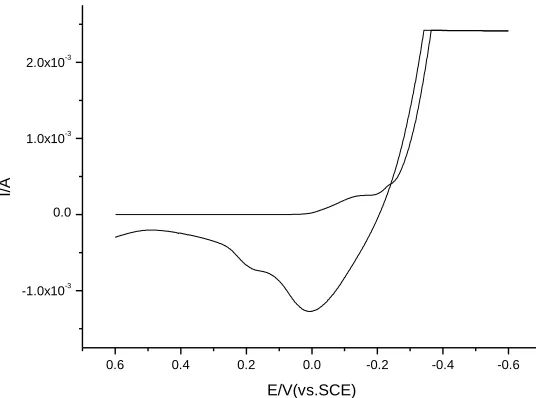
The cyclic voltammograms (CVs) of EDTA-Pd at bare GCE in the solution containing PdCl2, HCl and EDTA are shown in Fig.1, the reduction peak and oxidation peak were observed at -0.126 and 0.189V, respectively, which could be ascribe to the reduction of Pd-EDTA and oxidation of Pd, respectively.
0.6 0.4 0.2 0.0 -0.2 -0.4 -0.6 -1.0x10⁻³
0.0 1.0x10⁻³ 2.0x10⁻³
I/A
[image:3.596.164.432.396.595.2]E/V(vs.SCE)
Figure 1. CVs of EDTA-Pd at GCE; Scan rate: 100mV/s.
3.2. Assembling processes of PNs on the surface of bare electrode
0 5 10 15 20 25 30
2.0x10⁻⁴
4.0x10⁻⁴
6.0x10⁻⁴
8.0x10⁻⁴
GPE GCE
GE
I/A
[image:4.596.163.435.83.283.2]E/V(vs.SCE)
Figure 2. Electrochemical assembling processes of PNs on the surface of GE, GPE and GCE; initial E:
-0.30 V; final E: -0.30 V; sample interval: 0.1s; quiet time: 0s; run time: 30s.
3.3. SEM imagine of PNs
A B
C
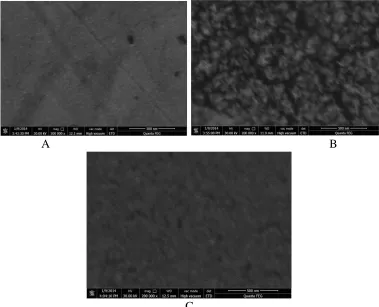
Figure 3. SEM imagine of PNs on the surface of (A) GE (B) GPE and (C) GCE
[image:4.596.109.488.388.695.2]
Many PNs on the surface of GE, GPE and GCE were observed in Fig. 3. The SEM image of like-snowflake PNs on the surface of GPE is shown in Fig. 3B, the similar shape of PNs on the surface of GCE was observed. The phenomena indicated that PNs had been assembled on the bare electrode surface. However, the PNs on the surface of GE are different to those on the surface of GCE and GPE, more and smaller PNs on the surface of GE were found (Fig. 3A).
3.4. CVs of DO at the modified electrode
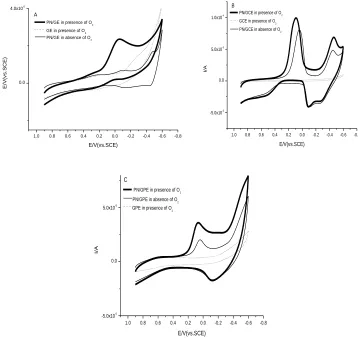
In order to found the sensitive modified electrodes for the determination of DO, the CVs of DO at the modified electrode in 10.00g.L-1 NH4Cl solution of pH 7.0 are shown in Fig.4. A typical curve for DO is shown in Fig. 4A and it is clear that a well formed reduction wave, E1/2 =0.062 V vs. SCE and a good limiting current plateau, is found, which is in agreement with the previous work [18].The reduction peak of DO at PN/GE was observed at -0.051 V, the reduction current of DO was more that of bare GE, and after the oxygen in 10.00g.L-1 NH4Cl was driven off by N2 for 10min, the current of GN/GE decreased, indicating that the PN modified GE promoted the electrochemical reduction of DO by considerably accelerating the rate of electron transfer.
1.0 0.8 0.6 0.4 0.2 0.0 -0.2 -0.4 -0.6 -0.8 0.0
4.0x10⁻⁵
PN/GE in absence of O
2
GE in presence of O
2
A
PN/GE in presence of O
2 E/ V( v s .SC E) E/V(vs.SCE)
1.0 0.8 0.6 0.4 0.2 0.0 -0.2 -0.4 -0.6 -0.8
-5.0x10⁻⁵
0.0 5.0x10⁻⁵
1.0x10⁻⁴
PN/GCE in absence of O2
GCE in presence of O2
B
PN/GCE in presence of O2
I/A
E/V(vs.SCE)
1.0 0.8 0.6 0.4 0.2 0.0 -0.2 -0.4 -0.6 -0.8
-5.0x10⁻⁵
0.0 5.0x10⁻⁵
GPE in presence of O
2
PN/GPE in absence of O2
C
PN/GPE in presence of O
2
I/A
E/V(vs.SCE)
Figure 4. CVs of DO at PN modified electrode and bare electrode; Scan rate: 100.0 mV. s–1;
[image:5.596.118.476.375.713.2]
However, the reduction peaks of GN/GCE and GN/GPE in 10.00g.L-1 NH4Cl solution were found at 0.093V and 0.064V, respectively, and after the oxygen in 10.00g.L-1 NH4Cl solution was driven off by N2 for 10min, the peaks shifted to negative direction (Fig.4B and 4C), which were not consistent with that of GN/GE, indicating that the structures of GN/GCE was different to that of GN/GCE and GN/GPE. Therefore, GN/GE was selected to determine the DO in samples.
3.5. Application
The contents of DO in sample were determined by the cathode electricity of CVs in Fig.5. The standard solution (STD) and samples were prepared by added 0.1000g NH4Cl into 10.00ml of double-distilled water and samples, respectively.
1.0 0.8 0.6 0.4 0.2 0.0 -0.2 -0.4 -0.6 -0.8 -1.0x10⁻⁵
0.0 1.0x10⁻⁵ 2.0x10⁻⁵ 3.0x10⁻⁵ 4.0x10⁻⁵
in absence of O2 in presence of O2
B
I/A
1.0 0.8 0.6 0.4 0.2 0.0 -0.2 -0.4 -0.6 -0.8 -5.0x10⁻⁶ 0.0 5.0x10⁻⁶ 1.0x10⁻⁵ 1.5x10⁻⁵ 2.0x10⁻⁵ 2.5x10⁻⁵ 3.0x10⁻⁵
in absence of O2
in presence of O2
C
I/A
E/V(vs.SCE)
Figure 5. CVs of PN modified GCE in standard solution and samples. Scan rate: 100.0 mV. s–1.
Supporting electrolyte: 10.00g.L-1 NH4Cl.
The contents of DO in STD and samples at 25℃ and 1atm were also detected by oxygen analyzer, and contents of DO of sample could be calculated as
1
2
STD STD
S S
Q Q C
Q Q C
Where QSTD andQS are the cathode electricity corresponding to the STD and sample in present of O2, Q1 and Q2 are the cathode electricity of corresponding to the STD and sample driven off O2 by
N2 for 10min, and CSTD andCs represent the contents of DO in STD and samples, respectively.
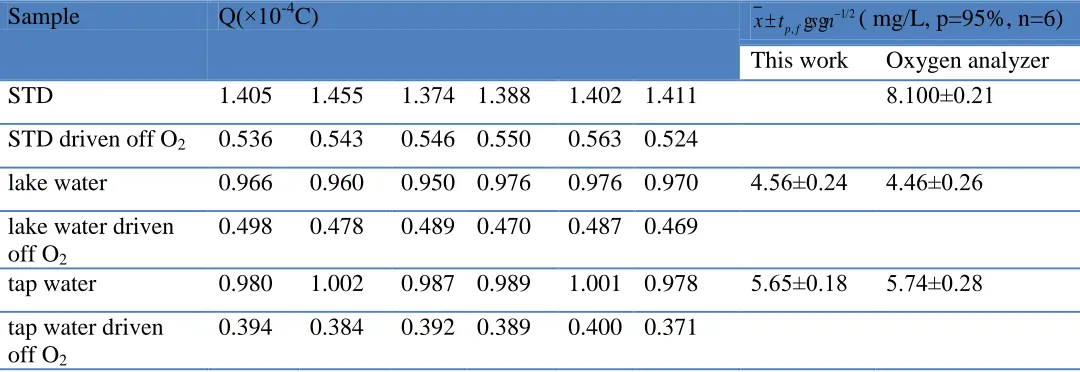
[image:7.596.152.448.83.276.2]The contents of DO in STD and samples at 25℃ and 1atm, detected by the cathode electricity of O2 and oxygen analyzer, are listed in Table 1, the contents of DO in samples are good in agreement with those detected by oxygen analyzer.
Table 1. Contents of DO in STD and sample
Sample Q(×10-4C) 1/2
, p f
x t g gs n ( mg/L, p=95%, n=6) This work Oxygen analyzer
STD 1.405 1.455 1.374 1.388 1.402 1.411 8.100±0.21
STD driven off O2 0.536 0.543 0.546 0.550 0.563 0.524
lake water 0.966 0.960 0.950 0.976 0.976 0.970 4.56±0.24 4.46±0.26 lake water driven
off O2
0.498 0.478 0.489 0.470 0.487 0.469
tap water 0.980 1.002 0.987 0.989 1.001 0.978 5.65±0.18 5.74±0.28 tap water driven
off O2
[image:7.596.25.565.581.767.2]
The influence of some salts was tested. The results show 100-fold of K+, Na+, Fe3+, Fe2+, Mg2+, Zn2+, Mn2+, Ca2+, PO43-, SO42-, F-, S2-, Ca2+ and Mg2+, 50-fold of NO3-, SO32-, S2O32- and NO2- did not interfere the determination.
To assess the applicability of the proposed method, on using the PNs modified GE daily and storing under ambient conditions over a period of 2 weeks, the electrode retained 97.8% of its initial peak current response for a DO concentration of 8.00mg/L, which shows long-term stability of the film modifier on the surface of GE. The results indicate that the modified electrode has an excellent repeatability and reproducibility.
4. CONCLUSIONS
In conclusion, it was demonstrated that modification of GE with PNs is a simple and effective method for obtaining highly sensitive, excellent repeatability and reproducibility electrode for determination of DO. High sensitivity of the PN modified GE are promising for the determination of DO in water.
ACKNOWLEDGMENTS
The authors gratefully acknowledge the financial support of the National Science Foundation of China (grant No. 51175245), the Open Science Foundation for Jiangsu Province Key Laboratory for Chemistry of Low-Dimentional Materials (grant no. JSKC13126), the Open Science Foundation for Jiangsu Key Laboratory for Biomass- based Energy and Enzyme Technology (grant No. JSBEET1207), and the Science Foundation for Huaiyin Normal University (grant no. 11HSGJBZ13).
References
1. J.P.A. Hobbs and C.A. McDonald. Indian Ocean. J. Fish Biol. 77(2010)1219–1229. 2. 2.Annual Book of ASTM Standards, D 888-09, vol. 11.01, ASTM, 2009, pp. 1–12.
3. Standard Methods for the Examination of Water and Wastewater, 14th ed., American Public Health Association (APHA), 1976, pp. 440–454
4. Cibely S. Martin, Tony R.L. Dadamos, Marcos F.S. Teixeira. Sensor. Actuat. B 175(2012)111– 117.
5. Rui-Juan Zheng, Yi-Min Fang, Su-Fang Qin, Jing Song, Ai-Hong Wu, Jian-Jun Sun. Sensor. Actuat. B 157 (2011)488– 493.
6. Hiroaki Matsuura,Yosuke Yamawaki, Kosuke Sasaki, Shunichi Uchiyama. J. Enviro. Sci. 25(6)(2013)1077–1082.
7. Yusun Zhou, Tao Jing, Qiaolin Hao, Yikai Zhou, Surong Mei. Electrochim. Acta 74(2012) 165– 170.
8. Rita de Cássia Silva Luz, Flavio Santos Damos, Auro Atsushi Tanak, Lauro Tatsuo Kubot. Sensor. Actuat. B 114(2006)1019–1027.
9. 9.Gábor Bencsik, Csaba Janáky, Balazs Endrődi, Csaba Visy. Electrochim. Acta 73(2012)53– 58. 10.H. Erikson, A. Sarapuu, N. Alexeyeva, K. Tammeveski, J. Solla-Gullón, J.M. Feliu. Electrochim.
11.Xiao-mei Chen, Zhi-xiong Cai, Zhi-yong Huang, Munetak Oyam, Ya-qi Jiang, Xi Chen. Electrochim. Acta 97(2013)398– 403.
12.Yigang Jia, Ruopeng Zhao, Guojie Zhang, Yu Chenb, Yawen Tang, Tianhong Lu. Electrochim. Acta 111(2013)898– 902.
13.Yu Pan, Fan Zhang, Ke Wu, Zhaoyang Lu, Yu Chen, Yiming Zhou, Yawen Tang, Tianhong Lu. Int. Journal Hydrogen energy. 37 (2012)2993-3000.
14.14.B.P. Vinayan, K. Sethupathi, S. Ramaprabhu. Int. J. Hydrogen energy. 38(2013)2240-2250. 15.K. Zhang, J. Wei, H. Zhu, F. Ma, S. Wang. Mater. Res. Bull. 48 (2013)1338-1341.
16.16.A. Taleb,Y. Xue. Electrochim. Acta 112(2013)838-844.
17.Y. Wang, Y. Rui, F. Li, M. Li. Electrochim. Acta 117(2014)398-403. 18. D. Pletcher, S. Sotiropoulos. Analy. Chim. Acta 322 (1996) 83-90.