Measuring the diffuse component of solar UV beneath shade structures:
a practical activity for an Australian summer
Abstract
This article presents an investigation to provide students with the opportunity to study the physics of electromagnetic radiation, particularly UV radiation, and the way it interacts with different environments. The protective ability of shade structures is generally misunderstood, and this investigation will give students the basic knowledge that even though shade structures protect the human body from direct UV radiation, it is now the diffuse UV radiation that is significant in the shade.
Introduction
Solar UV radiation plays a significant role in the development of life on this planet. UV radiation is both good and bad for humans, from helping to initiate the formation of vitamin D to increasing the risk of skin cancer and sun-related disorders (Turnbull, Parisi and Sabburg, 2003). The ultraviolet radiation waveband is broken into three sections: UVC (200 – 280 nm), UVB (280 – 320 nm) and UVA (320 – 400 nm). These sections comprise only a very small amount of the total incident solar flux (approximately 8.3%) (Simon, 1997). All of the UVC and most of the UVB is unable to penetrate the atmosphere due to attenuation. Attenuation occurs when the incident radiation is scattered and absorbed by molecules in the different layers of the atmosphere (Parisi and Kimlin, 1997).
exposure. It is a common misconception that shade completely protects the human body against ultraviolet radiation. Because of atmospheric scattering (Rayleigh and Mie scattering), UV radiation is incident in two components, direct and diffuse (Turnbull, Parisi and Sabburg, 2003). Rayleigh scattering is associated with scattering by atmospheric gas molecules, the amount of scattering is inversely proportional to the
fourth power of the wavelength of the radiation ( 14
λ
∝ ). Simply put, the shorter the
wavelength, the higher the scattering. Mie scattering occurs when the wavelength of the
incident radiation is similar in size to that of the scattering particles (
λ
1
∝ ). While direct
UV from the sun is generally reflected or absorbed by a shade structure, the diffuse component is still capable of affecting the body. This diffuse component is mainly due to atmospheric scattering (Toomey, Gies, and Roy, 1995). Although atmospheric scattering is the main cause of the diffuse component, other factors influence the amount of UV radiation that exists in the shade. These include clouds, air pollution, ozone levels, surface reflectivity, and seasonal and geographical variation.
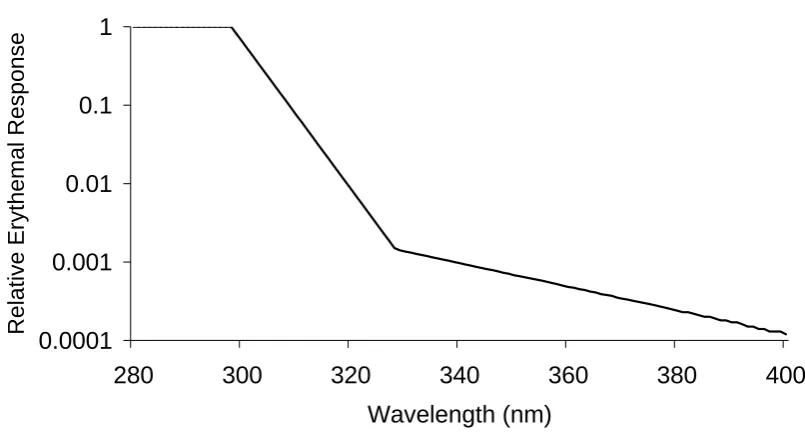
by the erythemal action spectrum (Figure 1). This investigation will give students the opportunity to measure erythemal UV radiation in full sun and in the shade. From this they can calculate each shade structure’s UPF.
The intended outcomes of this investigation
The specific outcomes of the investigation are:
1. Students will gain an understanding of the basic physics principles involving solar radiation, especially UV radiation.
2. Student will develop skills related to measuring solar UV radiation in full sun and in shade.
3. Students will gain an understanding of the effect of scattered UV radiation.
You will
need
• A hand-held UV radiometer that uses specific filters to approximate the human erythemal response (CIE, 1987). A cost effective model is the SafeSun Classic model available from Optix Tech Inc, 1050 17th Street, NW, Suite 1150, Washington, DC 20036 at a cost of approximately AU$200.
• A lux meter that measures the intensity of the visible radiation waveband and can respond to visible radiation approximating the average human eye. A typical model is available from Dick Smith’s Electronics for around $50.
Measuring UV Radiation
The protection offered by different shade environments is called the Ultraviolet Protection Factor (UPF). This is analogous to the Sun Protection Factor offered by sunscreens. The higher the UPF value, the better. UPF is defined by the following:
S UVBE
UVBE UPF =
where UVBE is the erythemal UV in full sun on a horizontal plane and UVBEs is the
erythemal UV in the shade on a horizontal plane. The shade ratio for each structure or material can also be calculated by simply inverting the above equation.
Warning: This investigation will require that you spend extended periods outdoors. Use appropriate sun protection strategies such as sunscreen, hats and sunglasses to reduce your personal UV exposure
Pick three or four different commonly used shade environments. Choose a cloud-free day, bright sunny day for this investigation. To investigate the effect of the different angles of the sun on the UV radiation in the shade and the resultant UPF, take following measurements in the morning, for example 9.00 am, and again at midday.
To measure the UVBE:
1. Set the radiometer at about chest height in the shade.
3. To reduce any obstruction to incident scattered UV, stay on the side with the least amount of visible sunlight.
4. Immediately after making the shade measurement, measure the UVBE in the full sun as far away from any structures or vegetation as possible.
5. Repeat the measurements for the other shade structures.
6. Measure the visible illumination levels on the horizontal plane with the lux meter in the middle of the shade.
7. Measure the ground level temperature with the thermometer in the shade and then in the full sun.
• Calculate the UPF, erythemal UV shade ratio and lux shade ratio for each shade structure for the morning and noon measurements.
• Compare the lux and UV shade ratios for different temperature ranges (e.g. 20-22oC, 22-24oC, etc).
8. Repeat the investigation on another day when the Sun is covered by cloud.
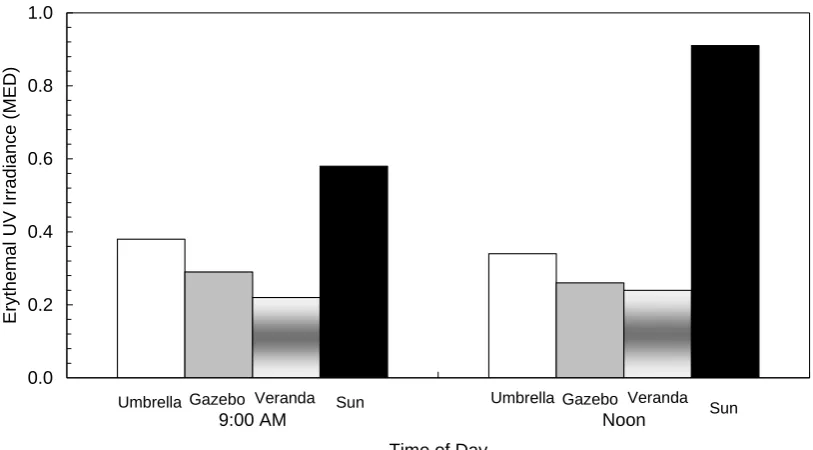
A sample results set: a basis for discussion
proportion of scattered UV in the shade equates to a decrease in the UPF of the shade structure. Table 2 gives sample results for illumination and temperature levels in full sun and in the shade for both times of day. The ratio of the illumination levels in the shade of the shade structures compared to full sun is less than the shade ratio for the erythemal UV radiation. This is a direct result of Rayleigh scattering. Because visible radiation has a much longer wavelength than the radiation associated with erythemal UV (refer to Figure 1), there is less visible radiation in the shade.
The illumination and temperature levels in the shade are no indication of the erythemal UV levels in the shade. What humans feel as heat when they stand in the sun is the infrared radiation reacting with the skin. People can still be burnt on a cold, cloudy day.
The implications of this investigation
Australian schools provide many different forms of shade for their students to use during their breaks, but generally little is known about the effects of scattered UV in the shade. Erythemal UV in full sun during winter can still be high enough to cause sunburn and research has shown that erythemal UV beneath a public shade structure was up to 65% of that in full sun (Turnbull, Parisi and Sabburg, 2003).
References
CIE (International Commission on Illumination) Research Note (1987). A reference action spectrum for ultraviolet induced erythema in human skin. CIE Journal, 6, 17-22. Simon, P.C. (1997). Extraterrestrial solar irradiances in the near and mid UV ranges. in
Solar Ultraviolet Radiation: Modelling, Measurements and effects, eds C.S. Zerefos & A.F. Bais, pp.1-12, Springer, Berlin.
Toomey, S., Gies, H.P. & Roy, C. (1995). UVR protection offered by shadecloths and polycarbonates. Radiation Protection in Australia, 13(2), 50-54.
Table 1. Sample of results for the three shade structures showing UV levels in the shade and full sun, with calculated UPFs and shade ratios.
Erythemal UV
Structure Time Shade Sun UPF Ratio
Umbrella 9 am 0.38 0.58 1.5 0.67
Noon 0.34 0.91 2.7 0.37
Gazebo 9 am 0.29 0.58 2.0 0.50
Noon 0.26 0.91 3.5 0.29
Veranda 9 am 0.22 0.58 2.7 0.38
Table 2. The illumination and temperature levels in the shade and in the full sun for all structures and both times of day.
Illumination (lux) Temperature (oC) Structure Time Shade Sun Ratio Shade Sun
Umbrella 9 am 14000 86400 0.16 20 25
Noon 8900 132000 0.07 24 30
Gazebo 9 am 6500 87000 0.07 21 25
Noon 4400 134000 0.03 25 30
Veranda 9 am 4500 87500 0.05 21 25
Figure Captions
Figure 1. The human erythemal action spectrum (CIE, 1987). The normalized relative effectiveness of the UV spectrum to cause sunburn.
0.0001 0.001 0.01 0.1 1
280 300 320 340 360 380 400
Wavelength (nm)
[image:11.595.98.501.152.368.2]Relative Erythemal Response
Umbrella
UmbrellaGazebo Veranda Sun Gazebo Veranda Sun
0.0 0.2 0.4 0.6 0.8 1.0
9:00 AM Noon
Time of Day
Erythe
mal
UV Irr
adian
[image:12.595.95.502.127.352.2]ce (MED)