AMONG PRIMI MOTHERS
A dissertation submitted to
THE TAMILNADU Dr.M.G.R. MEDICAL UNIVERSITY
CHENNAI
IN PARTIAL FULFILLMENT OF THE REQUIREMENTS FOR
THE AWARD OF THE DEGREE OF
MASTER OF SCIENCE IN NURSING
AMONG PRIMI MOTHERS
Certified that this is the bonafide work of
Reg. No: 30113278 CHILD HEALTH NURSING
THANTHAI ROEVER COLLEGE OF NURSING PERMBALUR- 621 212.
COLLEGE SEAL :
SIGNATURE :
Prof.Mrs. R.PUNITHAVATHI, M.Sc (N)., Principal
Thanthai Roever College of Nursing Perambalur.
Dissertation submitted to
THE TAMILNADU Dr. M.G.R MEDICAL UNIVERSITY CHENNAI
IN PARTIAL FULFILLMENT OF REQUIREMENTS FOR THE AWARD OF DEGREE OF
PRIMI MOTHERS
Approved by the Dissertation
Committee On : ___________________________
Research Guide : _________________________
Prof. Mrs.R.PUNITHAVATHI M. Sc (N)., Principal
Thanthai Roever College of Nursing Perambalur.
Clinical Specialty Guide : _________________________ Prof. Mrs. N. VIMALA M.Sc. (N)., Department of Pediatrics
Thanthai Roever College of Nursing Perambalur.
Dissertation submitted to
THE TAMILNADU DR. M.G.R MEDICAL UNIVERSITY CHENNAI
IN PARTIAL FULFILLMENT OF REQUIREMENTS FOR THE AWARD OF DEGREE OF
MASTER OF SCIENCE IN NURSING APRIL 2015
I, 30113278 hereby declare that this dissertation entitled A STUDY TO
ASSESS THE EFFECT OF PLANNED TEACHING PROGRAMME ON
KNOWLEDGE REGARDING NEWBORN CARE AMONG PRIMI
MOTHERS AT TRICHY has been prepared by me under the guidance and
directsupervision of Prof.Mrs. N. VIMALA,M.Sc(N), PROFESSOR,
DEPARTMENT IN PEDIATRICS Thanthai Roever College of Nursing,
Perambalur, as requirement for partial fulfillment of M.Sc Nursing degree course
under The Tamilnadu Dr. M.G.R. Medical University, Chennai – 32.This
dissertation had not beenpreviously formed and this will not be used in future for
award of any other degree/ diploma. This dissertation represents an independent
original work on the part of the candidate.
Place : Perambalur, 30113278
Date : April – 2015. II Year M.Sc (N) Student
Thanthai Roever College of Nursing
First, I praise and thank Almighty god with reverence and sincerity for
his abundant grace,which strengthened me in each step throughout his
endeavor in spite of weakness.
I wish to express my sincere thanks and gratitude to Our Chairman
Dr. K.Varadharajan B.A,B.L., for providing me for provision of required facilities for the successful completion of the study.
It is pleasure to extend my dept of genuine and hearty gratitude to my
research co-ordinator & Principal Prof. R.Punithavathi,M.sc.,(N).,for her valuable suggestions, enlightening ideas, continuous guidance and for being
the source of encouragement to ensure the best quality of this piece of work.
I wish to express my sincere thanks to Prof. Mrs. V.J. Elizabeth M.sc(N)., Vice Principal, Thanthai Roever College of Nursing for her valuable suggestion and guidance.
My deep sense of gratitude to my clinical specialty guide Mrs. N. Vimala M.Sc(N)., Professor, HOD in Department of Pediatrics for her elegant direction,support,guidance and suggestions and encouragement in
pediatrics for their constant support, guidance and suggestions throughout
the study which helped me to complete this project.
I kindly express my heartfelt gratitude to Prof. G.K.Venkatraman, M.Phil., Department of Bio-statistics for their statistical advice and helping in transferring the raw data of this study into valuable findings.
My special thanks to the Librarian Mr. Kameshwaren M.Phil of Thanthai Roever College of Nursing, for his assistance in literature review and for extending library facilities throughout the study.
I am deeply moved to thank my parents Mr. R.Sivalingam and Mrs.V.Padmini and My Husband Mr. S.Senthil Kumar and My Childrens who always been a source of inspiration, strengthen me with immense
prayer, blessings and helped me to carry out this study in a successful
manner.
Last but not least I extend my sincere thanks to the participants of this
study for their co-operation in their endeavour without which this project
CHAPTE
R NO
TITLE PAGE
NO
I INTRODUCTION
Background of the study
Need for the study
2
3
Statement of the problem 4
Objectives of the study 4
Research Hypotheses 4
Operational Definitions 4
Assumption 5
Limitations
Projected Outcome
5
6 II REVIEW OF LITERATURE
Studies related to Newborn Care 7
Studies related to Planned teaching regarding newborn care 8
Conceptual Framework 9
III METHODOLOGY
Research approach 12
Research design 12
Variables 12
Setting of the study 12
Population 13
Sample size and sampling technique 13
Criteria for sample selection 13
Pilot study 15
Procedure for data collection 15
Plan for data analysis 16
Ethical consideration 16
Schematic representation of research
methodology
17
IV DATA ANALYSIS AND
INTERPRETATION
18
V DISCUSSION 32
VI SUMMARY 34
Major findings of the study 35
Implications 36
Conclusion 37
Recommendations 37
REFERENCES 38
TABLE NO
TITLE PAGE
NO
1 Frequency and percentage distribu on of demographic variables of primi mothers
19
2 Pre‐test level of knowledge regarding newborn care among primi mothers.
22
3 Post‐test level of knowledge regarding newborn care among primi mothers.
25
4 Comparison of pre test and post test mean knowledge scores regarding newborn care among primi mothers
28
5 Associa on of post‐test level of knowledge regarding newborn care among primi mothers with their selected demographic variables.
FIGURE NO
TITLE PAGE
NO
1 Conceptual framework 11
2 Percentage distribu on of educa onal status of
primi mothers 21
3 Pre‐test level of knowledge regarding newborn care
among primi mothers 24
4 post‐test level of knowledge regarding newborn care
among primi mothers 27
5 Comparison of pre and post‐test mean knowledge
ANNEXURE NO
TITLE PAGE
NO
I Le er seeking expert’s opinion for content Validity i
II List of experts opinion for content validity of research
tool
ii
III Evalua on criteria checklist for valida on iii
IV Permission le er for research purpose iv
V Section A Demographic Variables English and Tamil v
VI Sec on B Data collec on tool English and Tamil vi
VII Informed Consent English and Tamil vii
VIII Lesson Plan English and Tamil
KNOWLEDGE REGARDING NEWBORN CARE AMONG PRIMI MOTHERS IN THILAGAVATHI HOSPITAL, TRICHY
ABSTRACT
INTRODUCTION: In India, 61.3% of all infant death occur within
the first month of life.
OBJECTIVE: To assess the effectiveness of planned teaching
programme on knowledge regarding newborn care among primi
mothers.
METHODS: Pre experimental design was adopted for this study.
Fifty primi mothers were selected by using non-probability convenient
sampling technique. Pre test knowledge assessed planned teaching
is given for seven days. Knowledge questionnaire tool is used for
2.99 and the post test mean score of knowledge was 18.68 with
S.D 1.25. The mean difference was 9.76 and the calculated paired
‘t’ value of t = 21.002 was found to be statistically significant at
p<0.001 level.
CONCLUSION: The findings showed that the planned teaching was
effective in improving the knowledge regarding newborn care among
CHAPTER – I
INTRODUCTION
Birth of a healthy newborn baby is one of the finest gift of nature. The process of birth takes only few moments but involves complex physiologic
adoptions in the newborn. The newborn has to adopt itself rapidly and
successfully to an alien external environment.
The first week of life is the most crucial period in the life of an infant.
In India, 61.3% of all infant death occur with in the first month of life.
WHO (2000) reports every year about 2 million babies (20%) of global
births are born. In India and almost 1.2 million die during newborn period
accounting for 30% of global death.
Essential newborn care is simple, requiring no expensive high
technology equipment, resuscitation, warmth to avoid hypothermia, early
breast feeding, hygiene, support for the mother infant relationship, and early treatment for low birth weight or sick infants.
Indian mothers are not aware of newborn care due to various reasons such as ignorance, low socio-economic status. Primipara mothers may have
some anxiety because they are not quite sure how to take care of newborn.
Rather than becoming anxious about it, the mothers need to learn all things about newborn care process.
Nurses play a major role in creating awareness and compitence among primi mothers for successful newborn care to their babies.
Teaching is most effective when it responds to learn need. There is an
important need to impart knowledge to the post natal mother about newborn.
The nurse can also help mothers to build self-confidence. It is the role
BACKGROUND OF THE STUDY
The entire universe is based on life and reproduction which is an important process of multiplication. There is an extreme happiness in all this
procreation of which some times sadness and unexpected things happen during
child birth and its development.
In India an estimated twenty-six millions of children born every year.
As per causes 2011, the share of children (0-6 years) accounts 13% of the total population in the country. An estimated 15.5 lakhs children die every year
before completely 5 years.
The WHO has issued guidelines for essential newborn care that include, hygiene during delivery, keeping the newborn warm, early initiation of breast
feeding, exclusive breast feeding, care of eyes, care during illness and immunization.
Rao (2010) says that India is ranked at 49th
out of 193 countries in
descending order of the under five mortality rate.
The right millineum development goals which target an end point of
2015 have been said to represent the most widely satisfied health and development goals in history. Millennium Development Goals focuses on
child survival, aiming for a reduction in under five child mortality by two thirds
by 2015, with global target of 32 per 1000 live births.
Globally each year, fifteen million babies are born too early and more
than one million of them die shortly after birth. Ninety nine percent of these death occur in middle and low income countries.
The Government of India has set a target of reducing the infant mortality
rate from 64% to 30% per 1000 live births by the year 2010, which acan only be possible if neonatal mortality is reduced from 44% to 2010.
NEED FOR THE STUDY
“A newborn baby has only three demands. They are warmth in arms of its
mothers, food from her breasts and security in the knowledge of her
presence”.
Dickregrantly
A healthy population is the nation’s prosperty, Healthy children today,
make a healthy nation tomorrow.
The important task of mother-hood is to fulfill physical, emotional, social, intellectual and moral needs of children. There is no doubt that a
mother plays an important role in this regard.
It is estimated that out of 3.9 million neonatal deaths that occur
worldwide, almost 30% occur in India. Globally under five years of age, mortality rates have declined over the past four decades, but the neonatal
mortality rates still remain high.
The morbidity and mortality rates in newborn infants are high.
Although parents are ultimately responsible for this care, nurses usually assume a major care giving role while the infant is with the nurse.
From the observation in the post natal ward, the researcher found that the mother especially primipara mothers are not aware of the facts regarding
newborn care of their babies.
STATEMENT OF THE PROBLEM
A study to assess the effectiveness of planned teaching programme on
OBJECTIVES
1.To assess the level of knowledge regarding newborn care among primi mothers.
2.To assess the effectiveness of planned teaching programme on knowledge regarding newborn care among primi mothers.
3.To associate the post-test level of knowledge regarding newborn care among primi mothers with their selected demographic variables.
HYPOTHESES
H1,There is a significant increase in knowledge regarding newborn care
after the planned teaching programme among primi mothers.
H2, There is a significant association between the post-test level
knowledge regarding newborn care among primi mothers and their selected
demographic variables.
OPERATIONAL DEFINITIONS
EFFECTIVENESS
In this study, effectiveness refers to gain in knowledge for mothers on
newborn care following interventions.
PLANNED TEACHING PROGRAMME
It refers to structured teaching through lecture cum discussion on
newborn care among primi mothers such as general information of newborn, thermoregulation, breast feeding, immunization and prevention of infections.
KNOWLEDGE
In this study, it refers to the correct response of the mothers to the
NEWBORN CARE
Newborn care means care given to the baby during the period from birth to the first 28 days of life in the aspects of general information of newborn, breast
feeding, thermoregulation, personal hygiene, immunization and prevention of
infections.
PRIMI MOTHER
A antenatal mother who is delivered the baby first time.
ASSUMPTIONS
Primi mother has inadequate knowledge regarding newborn care.
Planned teaching programme may increase the knowledge regarding
newborn care.
The setting is limited to only one hospital.
DELIMITATIONS
The study is delimited to primi mothers.
The data collection period is delimited to six weeks. PROJECTED OUTCOME
The findings of the study will determine the effectiveness of planned
teaching programme on knowledge regarding newborn care among primi mothers.
CHAPTER – II
REVIEW OF LITERATURE
A literature review provides a background to current knowledge on a topic and high lights the necessity for new studies.(Polit and Beck, 2010).
The review of related literature is an essential aspect of scientific
research. It entails the systematic identification, reflection, critical analysis and
reporting of existing information is relation to the problem of interest. The chapters includes reviews related
to:-Section I --- Studies related to newborn care.
Section II - Studies related planned Teaching programme on
knowledge regarding newborn care.
Section-I Studies related to newborn care.
Tanner metal.(2010) conducted a study to determine the
frequency of delivery and newborn care practices at southern Tanzania. This study concluded that there is a need to promote and facilitate health facility
deliveries, hygienic delivery practices for home births, delayed bathing and immediate and exclusive breast feeding to improve newborn health.
Kavitha.P et al (2012) conducted a descriptive study to assess the
knowledge of kangaroo mother care among post natal mothers at kadapa. This study concluded that the knowledge of mother had increased from 45.15% to
58.85%.
Peace Ibo Opara et al (2012) conducted a cross sectional study to
assess newborn cord care practices among mothersat Nigeria. This study
revealed that there is still a high rate in use of potentially harmful substances for cord care.
Chaudhary J et al (2013) conducted a cross sectional study to
determine the factors affecting newborn care practices among primi mothers
acceptable. Awareness programs regarding initiation of breast feeding with in
one hour of delivery should be strengthened.
Mahila Mandals suggested that regular training programme should be
organized for mother craft. The simple messages for basic care of pregnant women and healthy babies should be widely disseminated through available
media including radio and television.
Section-II Studies related to planned teaching programme on knowledge regarding newborn care.
K.B.N.JAYASOORIYA et al. (2014) study was conducted to examine
mothers’ knowledge and practices in thermoregulation of neonates at Sri
Lanka. This study revealed that 50% of mother had hypothermic babies, 65%
of mothers had good adequate knowledge and 34% mothers had poor knowledge.
MUDDUG. K. et al (2013) conducted a study to determine the mothers
knowledge and awareness about benefits of kangaroo mother care at hospital. This study concluded that mothers had good knowledge 97.8%.
SUDHA R. et al (2014) Pre experimental study was conductedto assess
the effectiveness of structured teaching programme on knowledge of newborn
care among the primi gravid women at Chennai. This study concluded that
83.3% had inadequate knowledge, 16.7% had moderately adequate knowledge in pre test. Where as in post test 86.6% had adequate knowledge,13.4% had
moderately adequate knowledge, No one had inadequate knowledge. So, the structured teaching programme was effective.
SUNITA TATA et al(2014) conducted a study to assess the knowledge
regarding essential newborn care among antenatal mothers at Madurai. This
study concluded that mean score was increased from 3.8% to 23.6 %
MOHAMED ASIF PADIYATH et al (2014) conducted a descriptive
study to assess the knowledge and attitude of neonatal care practices among postnatal mothers at pondicherry. This study concluded that mothers had
moderate adequateknowledge was 35%, adequate knowledge was 76%, there is effective and improvement of better care and health education for antenatal
mothers.
Kalpana Silwal et al (2013) conducted a descriptive study to assess the
knowledge and practice of newborn care among postnatal mothers at
Kathmandu. This study concluded that mothers knowledge on thermoregulation of newborn 44.2%, newborn care was 47.2%, immunization
was 67.33%, and 60% on breast feeding practices.
KANCHAN BALA et al (2013) conducted a quasi experimental study
to assess the effectiveness of an Instructional Teaching Programme on
knowledge of postnatal mothers regarding newborn care atuttarkhand. This study concluded thatpre test knowledge score of post natal mothers 30%, post
test knowledge score of post natal mothers was 42%, and post natal mothers
had good level of knowledge. Instructional Teaching Programme was effective to increase the knowledge of post natal mothers regarding newborn care.
MORAN A C, CHOWDRAY .N(2011) conducted a study to assess the
structured teaching programme on knowledge regarding newborn care among
primi mothers at Bangaladesh. This study concluded that 84% women had
adequate knowledge regarding drying the baby, 64% women had adequate knowledge regarding wrapping the baby after the birth.
CONCEPTUAL FRAME WORK
The conceptual framework for this study was derived from system
theory Ludvingvon Bertalenffy (1968). It serves as a model for viewing people
Open system has varying degree interaction with environment from
which the system receives. Input are gives output in the form of matter, energy of information. The feed back is the environment responses of the system,feed
back may be positive, negative or neutral.
System components
include:-Input, Throughput, Output, Feedback.
INPUT
It is the information needed by the system based on demographic variables under age, religion, education of mother, occupation of mother,
family income and type of family. Information obtained regarding newborn care.
THROUGHPUT
Throughput is the security phase where a planned teaching programme
was administered regarding main aspects of newborn care including General information of newborn, breast feeding, thermoregulation, personal hygiene,
immunization, umbilical cord care and prevention of infections. OUTPUT
The information are continuously processed through the system and
released as output in a altered state. In this study the output is the expected gain in knowledge by the primi mother about the newborn care including
General information of newborn, breast feeding, thermoregulation, personal
hygiene, immunization and prevention of infections. FEEDBACK
The feedback is the environment response of the system. Feedback may
MODIFIED SYSTEM MODEL
CHAPTER - III
METHODOLOGY
This chapter deals with research design, variables, settings, population, sample, criteria for sample selection, sample size, sampling
technique, development and description of tool, content validity, reliability, pilot study, data collection procedure and plan for data
analysis.
Research Approach:
Evaluative research approach
Research Design:
Pre-experimental research design [ one group pre-test and post-test
design)
PRE-TEST INTERVENTION POST-TEST
O1 X O2
O1 = PRE-TEST LEVEL OF KNOWLEDGE REGARDING NEWBORN
CARE.
X = PLANNED TEACHING PROGRAMME
O2 = POST-TEST LEVEL OF KNOWLEDGE REGARDING NEWBORN
CARE.
VARIABLES
Dependent Variable : knowledge regardingnewborn care.
Independent Variable : Planned teaching programme
Setting of the study The study was conducted in Thilagavathy
Hospital at Trichy.
Adequate
Knowledge was
good
Moderately
Knowledge was
fair
Inadequate
Knowledge was
poor
Post test
gained
knowledge
regarding
New born
Population
Target Population
The target population of this studyis primi mothers with newborn.
Accessible population
The accessible population of this study isprimi mothers with newborn
admitted in the Thilagavathy Hospital.
Sample
Primimothers with newborn admitted in the hospital who met the
inclusion criteria.
Sample Size
Sample size = 50
Sampling Technique
Non probability convenient sampling technique
CRITERIA FOR SAMPLE SELECTION
INCLUTION CRITERIA
All the primi mothers who are admitted in Thilagavathy hospital. Primi mothers who know to read and write in Tamil.
Primi mother who are willing to participate in the study. EXCLUSION CRITERIA
All multi gravid mothers
who are not willing to participate. TOOLS OF RESEARCH
The investigator used to questionnaire tool to assess the knowledge
DESCRIPTION OF THE TOOL
The tool was developed after an extensive review of literature and considering the opinions given by medical and nursing experts.
It consists of the following sections: SECTION I
Comprises interview questions to collect the demographic data such as
age in years, religion, education of mother, occupation of mother, family income and type of family.
SECTION II
Structured knowledge questionnaire tool for assessment of knowledge regarding Newborn care among primi mothers. It consists of 20 multiple
choice questions to assess the knowledge.
Knowledge Questionnaire tool consists of twenty items regarding the general information of the newborn,thermoregulation, breast feeding, personal
hygiene, immunization and prevention of infections. It is given as multiple
choice questions.
SCORING AND GRADING PROCEDURE:
The score will be calculated as the sum of the twenty items. The scores
are graded as follows:
SCORES LEVEL OF KNOWLEDGE
76 -- 100 % ADEQUATE
51 –75% MODERATELYADEQUATE
CONTENT VALIDITY
The content validity of the tool was obtained on the opinions of one in the field of medical specialist and four nursing experts. Tool was modified as
per the consensus of all the experts and the tool was finalized.
RELIABILITY
The reliability of the tool was determined by using test re-test method.
The reliability score was r = 0.86. Hence, the tool was considered highly reliable for proceeding the study .
PILOT STUDY
After obtaining permission from the concerned authority, pilot study was conducted among five participants in ThilagavathyHospitalatTrichy. The
pilot study was designed to find out the feasibility of the tool and practicability
of the designed methodology. There was no modification made in the tool after the pilot study. The primi mothers selected for the pilot study were not included
in the main study.
DATA COLLECTION PROCEDURE
Before conducting the study, formal permission was obtained from the
medical officer, ThilagavathyHospital for conducting the main study. By non probability convenient sampling technique, the subjects were recruited. Data
collection period was four weeks. The investigator collected the data for four days a week from 9 am to 4 pm. The investigator established rapport with the
primi mothers and obtained informed consent. They were assured that no
physical harm would be done in the course of study.
was taught to the subjects. On the day 7 , the post- test level of knowledge
regarding newborn care was done by using same knowledge questionnaire.
PLAN FOR DATA ANALYSIS
It was planned to use for data analysis descriptive and inferential
statistics.
DESCRIPTIVE STATISTICS:
Frequency and percentage distribution will be used to analyze the
demographic variables.
Mean and standard deviation will be used to assess the pre-test and
post-test scores.
INFERENTIAL STATISTICS
Paired t-test will be used to compare the pre-test and post-test
knowledge mean score.
Chi square will be used to find out the association of post-test level of
knowledge with their selected demographic variables. ETHICAL CONSIDERATION
The research proposal was approved by the dissertation committee of the institution prior to pilot study. Permission was obtained from the Medical
officer, Thilagavathy hospital, Trichy. The informed consent from each primimothers was obtained before data collection. Assurance was given to the
study participants regarding the confidentiality and no harm to the primi
SCHEMATIC REPRESENTATION OF RESEARCH METHODOLOGY
Research Approach
Evaluation Approach
Research Design
Pre Experimental (one Group Pre Test & post Test Design)
Target Population
Knowledge Regarding Newborn care among Primi Mothers.
Accessible Population
Knowledge Regarding Newborn care among Primi mothers in Thilagavathy hospital at Trichy
Sample,& sample Size.
Knowledge Regarding Newborn care among Primimothers in Thilagavathy hospital who met the
inclusion criteria, sample size=50
Pre Test -Knowledge Regarding Newborn care Intervention Planned Teaching Programme Post Test - Knowledge Regarding Newborn care
Analysis & Interpretation Descriptive and inferential Statistics
Findings
Planned Teaching Programme Regarding Newborn care among Primi Mothers
Report Background Factors Age Religion Education Occupation Family Income Type of family Sample Technique Non probability convenient sampling technique Data Collection Procedure ProgrammeIs used to flash cards was used the knowledge
regarding newborn care
CHAPTER – IV
DATA ANALYSIS AND INTERPRETATION
The analysis is a process of organizing and synthesizing the data in such a way that the research question can be answered and hypothesis tested (Polit
and Hungler, 2011).
This chapter deals with analysis and interpretation of the data collected
from 50 primi mothers. The data was organized, tabulated and analyzed
according to the objectives. The findings are presented under the following sections.
ORGANIZATION OF THE DATA
Section 1: Frequency and percentage distribution of demographic variables of
primi mothers.
Section II A: pretest level of knowledge regarding newborn care among primi
mothers.
B:post test level of knowledge regarding newborn care among
primi mothers.
Section III :Comparison of pre and post test mean knowledge scores regarding
newborn care among primi mothers.
Section IV: Association of post test level of knowledge regarding newborn
care among primi mothers with their selected demographic variables.
SECTION - I
Table 1: Frequency and percentage distribution of demographic variables
of primi mothers.
N = 50
Demographic Variables No. %
Age in years
20 years below 6 12
21 - 25 years 27 54
26 - 30 years 13 26
Above 31 years 4 8
Religion
Hindu 38 76
Muslim 7 14
Christian 5 10
Others 0 0
Educational status of mother
Illiterate 2 4
Primary school 4 8
Middle school 11 22
High school 33 66
Occupation
Private employed 7 14
Government 1 2
Cooly 4 8
Family income
Rs.Less than 1000 5 10
Rs.1001 to 2000 5 10
Rs.2001 to 3000 19 38
Rs.>3001 21 42
Type of family
Joint 26 52
Nuclear 26 52
The table 1 depicts that majority of the primi mothers 27(54%) were in
the age group of 21 – 25 years, 38(76%) were Hindus, 33(66%) of mothers were educated upto high school, 38(76%) were housewives, 21(42%) were
SECTION-II
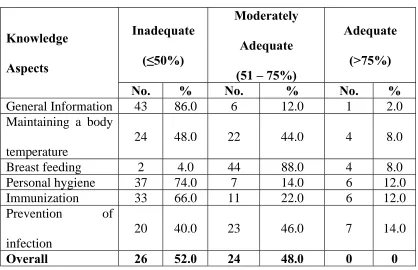
Table 2: pretest level of knowledge regarding newborn care among primi mothers
N = 50
Knowledge
Aspects
Inadequate
(≤50%)
Moderately
Adequate
(51 – 75%)
Adequate
(>75%)
No. % No. % No. %
General Information 43 86.0 6 12.0 1 2.0
Maintaining a body
temperature
24 48.0 22 44.0 4 8.0
Breast feeding 2 4.0 44 88.0 4 8.0
Personal hygiene 37 74.0 7 14.0 6 12.0
Immunization 33 66.0 11 22.0 6 12.0
Prevention of
infection
20 40.0 23 46.0 7 14.0
Overall 26 52.0 24 48.0 0 0
The table 2 shows that in the pretest, with regard to general information,
majority 43(86%) had inadequate knowledge and 6(12%) had moderately adequate knowledge regarding newborn care.
Considering the maintaining of body temperature, majority 24(48%) had
inadequate knowledge and 22(44%) had moderately adequate knowledge in the pretest.
Regarding breast feeding, majority 44(88%) had moderate adequate knowledge and 4(8%) had adequate knowledge.
Analysis of personal hygiene revealed that majority 37(74%) had
On analyzing the immunization it was found that majority 33(66%) had
inadequate knowledge and 11(22%) had moderately adequate knowledge.
With regard to prevention of infection, majority 23(46%) had
moderately adequate knowledge and 20(40%) had inadequate knowledge.
The overall pretest level of knowledge reveals that majority 26(52%)
had inadequate knowledge and 24(48%) had moderately adequate knowledge
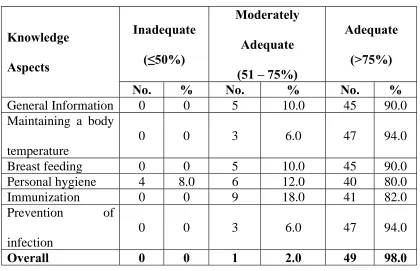
Table 3:post test level of knowledge regarding newborn care among primi mothers.
N = 50
Knowledge
Aspects
Inadequate
(≤50%)
Moderately
Adequate
(51 – 75%)
Adequate
(>75%)
No. % No. % No. %
General Information 0 0 5 10.0 45 90.0
Maintaining a body
temperature
0 0 3 6.0 47 94.0
Breast feeding 0 0 5 10.0 45 90.0
Personal hygiene 4 8.0 6 12.0 40 80.0
Immunization 0 0 9 18.0 41 82.0
Prevention of
infection
0 0 3 6.0 47 94.0
Overall 0 0 1 2.0 49 98.0
The table 3 shows that in the post test, with regard to general
information, majority 45(90%) had adequate knowledge and 5(10%) had moderately adequate knowledge regarding newborn care.
Considering the maintaining of body temperature, majority 47(94%) had adequate knowledge and 3(6%) had moderately adequate knowledge in the
pretest.
Regarding breast feeding, majority 45(90%) had adequate knowledge and 5(10%) had moderately adequate knowledge.
Analysis of personal hygiene revealed that, majority 40(80%) had adequate knowledge and 6(12%) had moderately adequate knowledge.
On analyzing the immunization it was found that majority 41(82%) had
With regard to prevention of infection, majority 47(94%) had adequate
knowledge and 6(12%) had moderately adequate knowledge.
The overall post test level of knowledge reveals that majority 49(98%)
SECTION-III
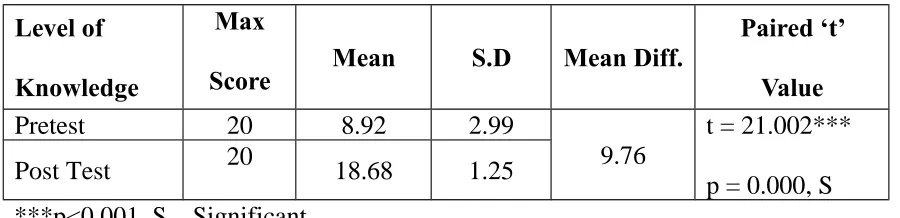
Table 4: Comparison of pre and post test mean knowledge scores regarding newborn care among primi mothers.
N = 50
Level of
Knowledge
Max
Score Mean S.D Mean Diff.
Paired ‘t’
Value
Pretest 20 8.92 2.99
9.76
t = 21.002***
p = 0.000, S
Post Test 20 18.68 1.25
***p<0.001, S – Significant
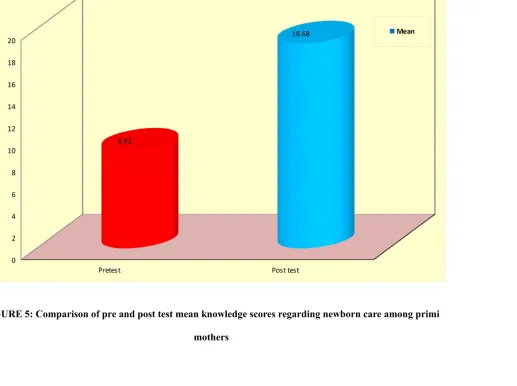
The table 4 shows that the pretest mean score of knowledge was 8.92 with
S.D 2.99 and the post test mean score of knowledge was 18.68 with S.D 1.25. The
mean difference was 9.76 and the calculated paired ‘t’ value of t = 21.002 was found to be statistically significant at p<0.001 level. This clearly shows that after
the implementation of planned teaching programme on knowledge regarding newborn care among primi mothers had significant improvement in their
FIGURE 5: Comparison of pre and post test mean knowledge scores regarding newborn care among primi
SECTION-IV
Table 5: Association of post test level of knowledge regarding newborn care among primi mothers with their selected demographic variables.
N = 50
Demographic Variables
Moderately Adequate
(51 – 75%)
Adequate
(>75%) Chi-Square Value
No. % No. %
Age in years
Below 20
21 - 25
26 - 30
above 31 0 1 0 0 0 2.0 0 0 6 26 13 4 12.0 52.0 26.0 8.0 χ2 = 0.869
d.f = 3
p = 0.833
N.S Religion Hindu Muslim Christian 0 1 0 0 2.0 0 38 6 5 76.0 12.0 10.0 χ2 = 6.268
d.f = 2
p = 0.044
S*
Others - - -
-Educational status of
mother 0 0 2 4.0
χ2
High school Occupation Private employed Government Cooly Housewife 0 0 0 1 0 0 0 2.0 7 1 4 37 14.0 2.0 8.0 74.0 χ2 = 0.322
d.f = 3
p = 0.956
N.S
Family income
Less than 1000
Rs.1001 to 2000
Rs.2001 to 3000
>3001 0 0 0 1 0 0 0 2.0 6 5 19 20 12.0 10.0 38.0 40.0 χ2 = 1.409
d.f = 3
p = 0.703
N.S
Type of family
1 2 0 25 50 0
χ2
= 0.942
d.f = 1
*p<0.05, S – Significant, N.S – Not Significant
The table 6 shows that the demographic variable religion had shown
statistically significant association with the post test level of knowledge regarding
newborn care among primi mothers and the other demographic variables had not
shown statistically significant association with the post test level of knowledge
CHAPTER – V
DISCUSSION
This chapter deals with the discussion of data analyzed based on the
objective and hypothesis of the study.
The aim of this study is to determine the effectiveness of planned teaching
programme on knowledge regarding newborn care among primi mothers which
are discussed
below:-The first objective of the study is to assess the level of knowledge regarding newborn care among primi mothers.
The overall pretest level of knowledge reveals that majority 26(52%) had
inadequate knowledge and 24(48%) had moderately adequate knowledge
regarding newborn care among primi mothers.
The overall post test level of knowledge reveals that majority 49(98%) had
adequate knowledge and 1(2%) had moderately adequate knowledge regarding
newborn care among primi mothers.
The second objective of the study is to assess the effectiveness of planned teaching programme on knowledge regarding newborn care among primi mothers.
Based on the study findings the stated hypotheses,
H1, There is a significant increase in knowledge regarding newborn care after planned teaching programme among primi mothers was accepted.
The following authors P. Kavitha, R. Arounprasath, K.B.N. Jayasooriya,
Enganemben Mongo Mireille suggested in their study that planned teaching
programme was significantly effective in newborn care among primi mothers.
The third objective of the study is to associate the post test level of knowledge regarding newborn care among primi mothers with their selected demographic variables.
Data findings revealed that there was a statistically significant association
found between post test knowledge regarding newborn care and Religion.
There was no significant association found between the post test level of
knowledge regarding newborn care and the demographic variables age, education
of mother, occupation of mother, family income and type of family as the
calculated Chi-square value is less than the table value at p<0.05 level.
Based on the study finding the stated hypotheses.
CHAPTER-VI
SUMMARY, MAJOR FINDINGS, IMPLEMENTATION
RECOMMENDATIONS AND CONCLUSION
This chapter is divided into two sections. Section I deals with summary of
the study, findings, and conclusion. Section II deals with implications in various
areas of nursing practice, nursing education, nursing administration and nursing
research, limitations and recommendations.
SUMMARY OF THE STUDY
The main objective of the study was to assess the effectiveness of planned
teaching programme on knowledge regarding newborn care among primi mothers
in selected Hospital, Trichy.
Conceptual framework based on Ludvingvon bertalenffy (1968) model is
used for this study. An evaluative research approach, one group pre-test and
post-test design was adopted for this study. Non probability purposive sampling
technique was used to select the samples size was 50.
The tool prepared for the present study included questions of demographic
data and knowledge questionnaire for the assessment of knowledge regarding
The data collection was undertaken for a period of four weeks. Planned
teaching was taught to the post natal mothers. Both inferential and descriptive
statistics were used to analysis the data and interpreted in terms of objectives and
hypothesis of the study.
The findings showed that the planned teaching was effective in improving the
knowledge regarding newborn care among primi mothers.
MAJOR FINDINGS OF THE STUDY
DEMOGRAPHIC VARIABLES
1. Majority 54% of subjects belonged to 21-25 years of age in primi mothers. 2. 76% of subjects belonged to Hindu Religion.
3. 66% of subjects had to high school educated in primi mothers 4. 76% were to house wives.
5. 42% had a family income of more than Rs.3001. 6. 50% live in to joint and nuclear family respectively.
II Findings related to effectiveness of planned teaching programme
The pre test mean score of knowledge regarding newborn care was that the
majority (76%) of subjects knowledge regarding newborn care was 8.92 with
standard deviation of 2.99 and the post test mean score was 18.68 with standard
deviation 1.25.
The mean difference score was 9.76. The obtained calculated ‘t’ value 21.002
was to statistically significant.
IMPLICATIONS FOR NURSING ADMINISTRATION
1. Nursing administrator should organize inservice education programme for
staff to get update with strategies in newborn care.
2. Nursing administrator should motivate the health care professionals to
organize the awareness campaigns to antenatal and postnatal mothers by
providing adequate information about healthy newborn and care.
3. The teaching sessions can be video taped and played for the mothers who
are waiting at out patient department.
IMPLICATION FOR NURSING RESEARCH
1. This study will be a motivating factor for the beginning researcher to
conduct the study on the same theme with different variables.
2. Researcher can be focused on various intervention focused programmes to
aim for the achievement of successful newborn care.
IMPLICATION FOR NURSING PRACTICE
1. The nurses are playing a vital role among all the health team members in
educating the mother about the practices of newborn.
2. They can prepare and use variety of audio visual aids to create awareness
among the mothers.
3. Community educational programmes have to be planned to enrich the
community awareness regarding newborn care.
4. Strengthening the newborn care programmes and policies.
IMPLICATION FOR NURSINIG EDUCATION
1. Nursing curriculum should focus on the necessity of improving the
4. Educational materials can be prepared based on the special needs of the
community.
RECOMMENDATIONS
1. A similar study can be undertaken with a large sample to generalize the
findings.
2. A study can be conducted using various teaching strategies on the
awareness of breast feeding and newborn care and practices.
3. A study can be conducted to identify the factors responsible for the
improper care of the newborn. CONCLUSIONS
The purpose of this study to assess the effectiveness of planned
teaching programme on knowledge regarding newborn care among primi
mothers at selected hospital, Trichy. It is proved that the planned teaching
programme was effective in increasing the knowledge regarding newborn
care among primi mothers.
On the whole, carrying out the present study was really an enriching
experience to the investigator. It also helped a great deal to explore and
BIBLIOGRAPHY
BOOK REFERENCES
Achar. (2007), Text book of Pediatrics 3rd
ed, New Delhi, J Viswanathan, AB
Desai [Orient Longman], Orient Longman Private Ltd. P.no.70-104.
Basavanthappa.B.T., (2007).Nursing Research.(3rd edition). Bangalore.
Jaypee Brothers. Gupta Suraj. (2004). The short textbook of Pediatrics.
(11th edition).JaypeePublicationnewdelhi, p.no.205
Beck C.T, Polit D.F (2010, Nursing Research – generating and Assessing
Evidence For Nursing practice , 8th
edition , Lippincott Williams and
Wilkins publishers , philadelphia .Polit, D and Hungler, B.199 , Nursing
Research Principles and Methods. Lippincott, Philadelphia. P.no. 323
Behrman, kliegman, jenson (2012)Nelsons Text book of pediatrics, 19th
edition, I
volume,W.B saunderspublication.p.no.1255-1256.
Ghai .O.P,(2010) , Essential of pediatrics , 6th
edititon, CBS publisher and
distributor, new delhi.P.no.654.
Marlow. R. Dorothy, Redding. A. Barbara (2010); “Text Book of Pediatric
Nursing” (6th
Ed); W.B. saunders Company; Philadelphia. p.no.
1133,1o21,754-755.
Marlow DR, (2007), Redding BA.Text book of Pediatric Nursing. 6th
ed, New
Delhi:Elsevier publication.755
Partha’s .K.(2013), fundamental of pediatrics ,second edition, Jaypee brother
medical publication p.no. 1009.
Parthasarathy.A, (2010).IAP Textbook of Pediatrics.3rd edition, Jaypeebrother
medical publication p(Ltd) new delhi.p.no.104.
PilliteriAdele(2008), Maternal and child health nursing, 5th
edition, Lippincott
Williams and wilkins publication , Philadelphia, .
RaoViswarana, et.al, (2007). An introduction to Biostatistics (2nd edition).Jaypee
Publications.p.no.55
Saundar’s (2004), Pediatric Primary Care, 4th edition, Elsevier publications, p.no.85.
SurajGupte. (2004) The short textbook of Pediatrics. 10th
ed. New Delhi:
Jaypeebrothers medical publishers (p) Ltd. P.no.77
Terri Kyle, (2009), Essential of Pediatric Nursing, South Asian edition, Wolters
private limited, p.no.71-105.
JOURNAL REFERENCES
Chaudhary. J (2013), Factors affecting newborn care practices, Journal of chitwan
medical college, 3(3): 42-45.
Jayasooriya et al, (2014), Mother’s knowledge and practices on thermoregulation
of neonates, European Journal of applied science and technology, Volume
1, No.4.
Kamta Charles et al, Knowledge and practice of mothers on essential newborn
care.
Muddu G.K. et al, (2013), Knowledge and awareness about benefit of kangaroo
mother care, Indian Journal of Pediatrics, 80(10); 799-803.
Mohammed Asif, et al, (2014), Knowledge and attitude of neonatal care practices
among primi mothers. Journal of Family Medical Primary Care, 3(3):
204-206.
Peace Ibo Opara et al, (2012), Newborn cord care practices amongst mothers.
International Journal of Clinical Medicine, 3, 22-27.
Silwal K.etal,(2013), Knowledge and practice of postnatal mothers in newborn
care, JNMA J.Nepal Medical Association, 52(190):372-7.
Sudha. R. et al (2014), Assess the effectiveness of Structured Teaching
Programme on knowledge of newborn care among primi mothers, Journal
of Health Science, Volume 2.
Sunita Tata et al, (2014), Impact of Structured Educational Programme on
Antenatal mothers regarding Newborn care. International Journal of science
and Research (IJSR), Volume 3, Issue.
Nations, “Millennium development goals,” in Proceedings of the UN Millennium
Summit: 2000, New York, NY, USA, September 2000.
“Saving newborn lives,” in State of the World's Newborns, pp. 1–49, Save the
Children Federation, Washington, DC, USA, 2001.
NET REFERENCES:
To assess the knowledge regarding prime mothers on newborn care (1968)
Prevention of General Information
Infection Thermoregulation Immunization Breast Feeding Personal Hygiene Breast Feeding Newborn Care THROUGHPUT INPUT OUTPUT Demographic Variables • Age • Religion • Education of
mother
• Occupation of mother
• Family income • Type of
Family.
Pre test Assessed the
knowledge Regarding
Newborn Care,
Adequate
Knowledge was good
Moderately Knowledge was fair
Inadequate
Knowledge was poor
ANNUXURE A
PERMISSION LETTER FOR RESEARCH PURPOSE From
30113278
M.Sc., (Nursing) II Year, Child health nursing,
Thanthai Roever College of Nursing, Perambalur.
Through
The principal,
Thanthai Roever College of Nursing Perambalur.
To
Dr.S. Thirunavukkarasu, M.B.B.S., M.D., Thilagavathi Hospital, Airport,
Trichy.
Respected Madam/Sir,
I am doing M.Sc.,(Nursing) II year in ThanthaiRoever College of Nursing Perambalur. Under the Tamil Nadu Dr.M.G.R.Medical University Chennai. As a Partial Fulfillment of My M.Sc.,(Nursing) Degree Programme, Iam going to conduct “A Study to assess the effectiveness of Planned Teaching Programme on
knowledge regarding New Born Care among Primi mothers in selected Hospital, at
Trichy District, Tamilnadu.” I would like to select your hospital for my data
collection, as I understand that I may get many children in your hospital. Hence I
kindly request you to give me permission to precede the data collection.
Thanking You
Place: Yours sincerely,
LETTER SEEKING EXPERTS OPINION FOR CONTENT VALIDITY
From
30113278
M.Sc (Nursing) II year,
ThanthaiRoever College of Nursing,
Perambalur.
To
Respected Sir/Madam,
Sub: Requisition for content validity of tool.
I am doing M.Sc (Nursing) II year in ThanthaiRoevedr College of
Nursing, Perambalur, Under The Tamilnadu, Dr.M.G.R. Medical University
Chennai. As a partial fulfillment of my M.Sc (Nursing) Degree Programme, I am
conducting a research on, “An Pre experimental study to assess the effectiveness of
planned teaching programme on knowledge regarding newborn care among primi
mothers at selected hospital, Trichy.” A tool has been developed for the research
study. I am sending the above stated for your expert and valuable opinion, I will
be thankful for your kind consideration. Kindly return it to the Undersigned.
Thanking you
Place: Yours sincerely,
ANNUXUREA(1)
LIST OF EXPPERTS OPINION FOR CONTENT VALIDITY
OF RESEARCH TOOLS
1. Mrs. Parasakthi M.Sc(N)., Vice-Principal,
Professor in pediatric Nursing Dr. Sakunthala college of Nursing Trichy.
2. Mrs. PonKrittinaveni M.Sc(N)., Professor in pediatric Nursing, Nehru College of Nursing Trichy.
3. Mrs.R.Punithavathi M.Sc(N)., Principal
Thanthai Roever college of Nursing Perambalur.
4. Mrs. N. Vimala M.Sc(N).,
Professor in child health Nursing Thanthai Roever College of Nursing Perambalur.
5. Mr. Dr. Mahesh Kumar MD(Pead)., Child Jesus Hospital,
Trichy.
EVALUATION CRITERIA CHECK LIST VALIDATION
INTRODUCTION
The expert is requested to go through the following criteria for evaluation.
Three columns are given for response and a column for remarks. Kindly place tick
mark in the appropriate column and give remarks.
Column I : Meets the criteria
Column II : partially meets the criteria
Column III : Does not meet the criteria
S.No. Criteria 1 2 3 Remarks
1 Scoring
- Adequacy - clarity
- Simplicity
2 Content
- Logical Sequence - Adequacy
- Relevance
3 Language
- Appropriate - Clarity - Simplicity 4 Practicability
- It is easy to score - Does it precisely - Utility
Signature : Any other suggestion
Name :
Designation :
CERTIFICATION TO ENGLISH EDITING TO WHOMSOEVER IT MAY CONCERN
This is to certify that the dissertation work AN PRE EXPERIMENTAL STUDY TO ASSESS THE EFFECTIVENESS OF PLANNED TEACHING PROGRAMME ON KNOWLEDGE REGARDING NEWBORN CARE AMONG PRIMI MOTHERS AT SELECTED HOSPITAL, TRICHY. Done by 30113278, II year M.sc Nursing, in Thanthai Roever college of Nursing,
Perambalur is edited for English language appropriateness by
CERTIFICATION TO TAMIL EDITING TO WHOMSOEVER IT MAY CONCERN
This is to certify that the dissertation work AN PRE EXPERIMENTAL STUDY TO ASSESS THE EFFECTIVENESS OF PLANNED TEACHING PROGRAMME ON KNOWLEDGE REGARDING NEWBORN CARE AMONG PRIMI MOTHERS AT SELECTED HOSPITAL, TRICHY. Done by 30113278, II year M.sc Nursing, in Thanthai Roever college of Nursing,
Perambalur is edited for Tamil language appropriateness by
PART _ I
DEMOGRAPHIC VARIABLES
NOTES: Kindly furnish the following details by placing a tick in appropriate
choice
1. Age in years
(a) 20 years below ( )
(b) 21-25 years ( )
(c) 26-30 years ( )
(d) 31 & above ( )
2. Religion
(a)Hindu ( )
(b)Muslim ( )
(c)Christian ( )
(d)Others ( )
3. Educational status of mothers
(a)Illiterate ( )
(b)Primary school ( )
(c)Middle school ( )
(d)High school ( )
4. Occupation
(a) Private employed ( )
(b) Government ( )
(c) Cooly ( )
(d) House Wife ( )
5. Family Income
(a) Less than 1000 ( )
(b) Rs. 1001 to 2000 ( )
(c) Rs. 2001 to 3000 ( )
6. Type of Family
(a) Joint ( )
(b) Nuclear ( )
PART –II
KNOWLEDGE AND PRACTICE REGARDING NEW BORN CARE.
1. What is the normal weight of newborn?
(a) 1500-2000 gms ( )
(b) 2100 – 2500 gms ( )
(c) 2600 – 3000 gms ( )
(d) 3100 – 3500 gms ( )
2. How many hours a newborn will sleep in a day?
(a) 8 – 12 hours ( )
(b) 13- 16 hours ( )
(c) 17 – 20 hours ( )
(d) Above 20 hours ( )
3.How many times a newborn pass the urine in a day?
(a) 4 – 5 times ( ) (b) 6 – 10 times ( ) (c) 10 – 15 times ( ) (d) Above 15 times ( )
4. How will you assess the body temperature?
(b) Touching abdomen ( )
(c) Touching extremities ( )
(d) Touching neck ( )
5. Which among the following is the best method to maintain body temperature of
a newborn?
(a) Skin-to-skin contact with the mother ( )
(b) Covering with blanket ( )
(c) Covering with clothes ( )
(d) Placing the newborn under the light ( )
6. How to prevent hypothermia in a newborn?
(a) Wearing shocks ( )
(b) Wearing swetter ( )
(c) Wrapping the body including the head ( )
(d) Wearing cap ( )
7. Which is the best milk for newborn?
(a) Goat’s milk ( )
(b) Breast milk ( )
(c) Cow’s milk ( )
(d) Honey ( )
8. When should breast feed in a newborn?
(a) immediately after birth ( )
(b) ½ an hour after birth ( )
(c) 2 hours after birth ( )
(d) 4 hours after birth ( )
(a) 2 times ( )
(b) whenever it need ( )
(c) 8 times ( )
(d) 12 time ( )
10. How long the newborn should take only breast feeding?
(a) 1 year ( )
(b) 2 months ( )
(c) 6 months ( )
(d) 1 months ( )
11. How eyes of a newborn should be cleaned?
(a) Cleaned the eyes separately with sterile water ( )
(b) Normal saline ( )
(c) Sterile water ( )
(d) All the above ( )
12. What can be applied over umbilical cord?
(a) Talcum powder ( )
(b) Ointment ( )
(c) Oil ( )
(d) Nothing should be applied ( )
13. How frequency napkin should be changed in a newborn?
(a) Immediately after wetting ( )
(b) ½ an hour after wetting ( )
(c) 1 hour after wetting ( )
(d) 2 hours after wetting ( )
14. Which among the following solution is used for diaper rash?
(a) Coconut oil ( )
(b) Bland ointment ( )
(c) Antifungai c ream ( )
15. What is the color of stool of breast feed newborn?
(a) Red ( )
(b) Golden yellow ( )
(c) Black ( )
(d) Greenish ( )
16. What is the benefit of immunization?
(a) Prevention of disease ( )
(b) Growth of the child ( )
(c) Drugs given at the cause of disease ( )
(d) Promote health ( )
17. What are the vaccines are administered at birth?
(a) BCG ( )
(b) Oral polio vaccine ( )
(c) DPT ( )
(d) All the above ( )
18. Where is the newborn usually immunized?
(a) Primary health centre ( )
(b) Government hospital ( )
(c) Private hospital ( )
(d) All of the above ( )
19. Which is the best practice to prevent infection?
(a) Feeding breast milk ( )
(b) Washing babies cloths ( )
(c) Keeping baby sunlight ( )
(d) Frequent hand washing ( )
20. What are the infections occur in newborn?
(a) Oral thrush ( )
(b) Umbilical sepsis ( )
(c) Pyoderma ( )
PART-II
KEY ANSWERS
1. B 2. C
LESSON PLAN ON NEWBORN CARE
TOPIC : NEWBORN CARE
GROUP : PRIMI MOTHERS
DURATION : 20Minutes
METHOD OF TEACHING : LECTURE CUM DISCUSSION
MEDIUM : TAMIL
A.V. AIDS : FLASH CARDS
PLACE : THILAGAVATHY HOSPITAL
CENTRAL OBJECTIVES:
At the end of the class , primi mothers will be able to understand about the
knowledge regarding newborn care and develop positive attitude and skill towards
S. N o. TIME OBJEC TIVE SPECIFIC OBJECTIVE CONTENT TEACHING ACTIVITY CEARNER S ACTIVITY I 5 mints Specify The
maintence of
hygiene
MAINTENANCE OF HYGIENE
Bathing of the infant affords an excellent opportunity
for making the observations that are necessary.
Bathing water should be warm. The temperature that
feels pleasantly warm to the elbow or wrist. It soap it
used, it should be mild.
When giving a bath , it should solid areas of the baby,
that is firm the eyes and face to the single and
To wash the infants hair daily.
DRESSING,DIAPERING AND
WRAPPING:-Cotton cloths should be used solid areas of the baby,
the neck opening of the grown before wearing to avoid
dragging the garment over the infants face.
Explaining
by using
Flash Cards.
DIAPERING:-A number of factors such as cost convenience,skin
care, infection control, and environmental concerns,
influence the patients choice of cloth versus disposable
covens,influence the patients choice of cloth wares
disposable size and positioned to the appropriate size
and to fit snugly but not doughtly used doapers should
danged immediately to avoid prolonged exposures
should of the defies alas to stools wet diapers should
danged immediately to avoid prolonged exposure
should of the defies alas to stools wet diapers should
be changed frequently to minimize exposure to
dampness.
-of mothers is using cloth dispenses it should be cotton
to protract irritation.
WAPPING
-Wrapping the infant snugly in a blanket males the
infant to easises to landler and offer quiets a fussy
baby. Mummify the baby.
- The baby should be covered full body and head. The
baby with his head taken to one side.
II 10
Mints
State the
Mechmims
to promote
thermoregul
ation
THERMOREGULATIONS
Newborn baby is a godmother, but this ability to stay
warm may be easily over whelmed by intones of
environmental temptation
-After the birth of the we should wrap the immediately
to provide warmth.
MAINTENANCE OF BABY TEMPERATURE
-Skin to skin cobalt between baby and mother
-Breast feeding
-Appropriate clothing and bedding
-Warm room temperature
Hypothermia
- The temperature below 36oC
Explaining
by using
chart
PREVENTION OF HYPOTHERMIA IN HOME
-Advice mother to maintain Breast feeding which
promotes baby imperative of the baby.
-Long time exposure of baby during bath leads to
childs.
Make sure the baby study warm all times, it
environment is cool, dress the baby with enter clothing
and cover his head.
COMPLICATIONS OF HYPOTHEMIA
-Hypoxia
-Weight (Chinas sign)
cNS depression (Lethargy, Bradycardia opal feeding,
aprons)
CLOTHING FOR THE BABY
- The clothof the infant should be made of very soft
material such as cotton in summer which had a
soothing and comforting effect on the soft.
-The cloths should be washed daily and dired is
sunlight which be inserted to change the wet nappy
immediately in a newborn is an essential basic need in
the early days of life.
10 List the
advantages of
Breast
Feeding
Breast Feeding
- Breast milk is the best milk for the baby, cloths
should be given immediately after Birth because it
contains more antibioties.
-Breast feeding be student immutably after birth
-Article the mothers it the baby is not taking enough
Breast, milk, there money be weight lased.
ADVANTAGE
- Art the mother to clean breast before and after
feeding the baby.
- During the 1st month th baby should not be it is a
natured one, no need plain water.
- Closter covens more antibodies.
-Promotes feeding beepers house times hear chances
of an already.
-It is reliable house sight temperature
Explaining
by using
chart.
-It is uncotamilarded and aspires.
-Colossian contends selatevily height proportion of
prefect against infection, consist of more antibodies.
-Lactose pleasant is milk inhibits the growth of E-co
10 and polirirus.
- Various divestures enxafons are present is human
milk.
- Breast feeding may drive as a portative function is
preventing Breast cancer.
-The Breast fed babies will pass stools 4-5 times/day.
FEEDING TECHNIQUE
- There are two main profiteers fen the months to
adopt while is Breast feeding
1. The first is eying on he and this may be appropriate
at different times during her location
POSITION OF BABY
TIME at Breast Feeding
The initial feeding should laft for 5 minits, at each
breast of the I week about 15 minits. Time is to be
spent of both breast.
The baby should sidle for 10 minitsts at the 1st breast
and 4 minits at the end one. The next feed should state
with the 2nd breast.
Frequently of feeding
The baby is put to the breath as some as the become
hungry.
5 mints Stimulant
the
Immecezatio
n schedule
IMMUNIZATION SCHEDULE FROM BIRTH
TO 2 YEARS
The main of immunization is to protract the baby from
disease.
Time Vaccines
At Birth BCG, oral, polio ,
Hepatitis B-1
HIb-1, Hepatitis B
21/2 -3 mth DPT-II, OPV-3,
HIb-2
4 -41/2 mthDPT-III, OPV-4,
HIb-3
6 months Hepatitis B, Caccine
9 months Measles, OPV-5
15-24 month MMR (15 months)
DPT (18 months)
OPV Booster Dose,
Typhoid
G- Diphtheria, P-Purturis,
T-Tetanus, His-Homophiles,
MMR-Meales, Mumps, Rubella
BCG for Tuberculosis
OPV – Oral Police Vaccine. Use of his vaccine is
5 Enlist the
precationatly
methods to
prevent
umbilical
cord infection
1. The cord must left open form fewness
2. The care of the umbilical card stamp consists of the
application of temple dye or other antiseptic, such as
alcohol 705 void prompted shun the two.
Tripe glue is applied at the cord, skin, engines, and tip
of the cord. The entropic solution is applies at the time
of bathing and at deadpan changing. To slump is keep
clean and day and is malodor, moisture on drainage
such as reduces, malodor, moisture of in faction such
as seduces, malodor, moisture or drenching from the
site. Any of the signs should be reported immediately
diaper should be flooded be reported away from the
card to air.
3. Umbilical cord should legato it open for healting of
the umbilical cord.
4. Andrade the mother to chuckle for discharge in
umbilical cord because it indicates infection.
Unhygienic parities of umbilical stamp leaves of septic