Adherence of hip and knee arthroplasty
studies to RSA standardization
guidelines: A systematic review
The Harvard community has made this
article openly available.
Please share
how
this access benefits you. Your story matters
Citation
Madanat, Rami, Tatu J Mäkinen, Hannu T Aro, Charles
Bragdon, and Henrik Malchau. 2014. “Adherence of hip
and knee arthroplasty studies to RSA standardization
guidelines: A systematic review.” Acta Orthopaedica 85
(5): 447-455. doi:10.3109/17453674.2014.934187. http://
dx.doi.org/10.3109/17453674.2014.934187.
Published Version
doi:10.3109/17453674.2014.934187
Citable link
http://nrs.harvard.edu/urn-3:HUL.InstRepos:13347623
Terms of Use
This article was downloaded from Harvard University’s DASH
repository, and is made available under the terms and conditions
applicable to Other Posted Material, as set forth at
http://
Adherence of hip and knee arthroplasty studies to RSA
stan-dardization guidelines
A systematic review
Rami Madanat
1, 3, Tatu J Mäkinen
1, Hannu T Aro
2, Charles Bragdon
3, and Henrik Malchau
31Helsinki University Central Hospital, Helsinki; 2Turku University Hospital and University of Turku, Turku, Finland; 3Harris Orthopaedic Laboratory,
Massachusetts General Hospital, Harvard Medical School, Boston, MA, USA. Correspondence: [email protected]
Submitted 13-08-19. Accepted 14-03-21
Open Access - This article is distributed under the terms of the Creative Commons Attribution Noncommercial License which permits any noncommercial use, distribution, and reproduction in any medium, provided the source is credited.
DOI 10.3109/17453674.2014.934187
Background and purpose —
Guidelines for standardization of
radiostereometry (RSA) of implants were published in 2005
to facilitate comparison of outcomes between various research
groups. In this systematic review, we determined how well studies
have adhered to these guidelines.
Methods —
We carried out a literature search to identify all
articles published between January 2000 and December 2011 that
used RSA in the evaluation of hip or knee prosthesis migration.
2 investigators independently evaluated each of the studies for
adherence to the 13 individual guideline items. Since some of the
13 points included more than 1 criterion, studies were assessed on
whether each point was fully met, partially met, or not met.
Results —
153 studies that met our inclusion criteria were
identified. 61 of these were published before the guidelines were
introduced (2000–2005) and 92 after the guidelines were
intro-duced (2006–2011). The methodological quality of RSA studies
clearly improved from 2000 to 2011. None of the studies fully met
all 13 guidelines. Nearly half (43) of the studies published after
the guidelines demonstrated a high methodological quality and
adhered at least partially to 10 of the 13 guidelines, whereas less
than one-fifth (11) of the studies published before the guidelines
had the same methodological quality. Commonly unaddressed
guideline items were related to imaging methodology,
determina-tion of precision from double examinadetermina-tions, and also mean error
of rigid-body fitting and condition number cutoff levels.
Interpretation —
The guidelines have improved
methodologi-cal reporting in RSA studies, but adherence to these guidelines is
still relatively low. There is a need to update and clarify the
guide-lines for clinical hip and knee arthroplasty RSA studies.
■
Since the introduction of radiostereometry (RSA) in 1974, the
method has continuously proven to be a valuable tool in the
assessment of migration following hip and knee arthroplasty.
Although the importance of a stepwise introduction of new
orthopedic implants was presented in 1995 (Malchau 1995),
only recently has it been fully acknowledged that deletion
of some of these crucial steps can have catastrophic
conse-quences (Kärrholm 2012). The phased or stepwise
introduc-tion process is based on the hypothesis that a more precise and
careful evaluation of new implants will reduce the number of
patients at risk of unexpected failures. There are 4 suggested
steps to this process (Malchau 1995). The initial step involves
preclinical implant testing. After this, the first clinical step
consists of prospective randomized studies that use RSA. The
second clinical step involves multicenter studies and the final
step is composed of registry studies.
(Mal-chau et al. 2011). Despite the fact that the algorithm for
intro-duction of new implant designs was established more than 15
years ago, many new and untested implants still appear on the
market. The orthopedic community has acknowledged that
the fast spread of undocumented new implants is no longer
acceptable (Kärrholm 2012).
With the increasing importance of RSA, it has also been
recognized that reporting of RSA outcomes should be
stan-dardized. The guidelines for standardization of
radiostereom-etry of implants were published in August 2005, to facilitate
comparison of RSA outcomes reported from different centers
(Valstar et al. 2005). In that paper, an appendix of 13 main
items that should be used to account for the results of a
clini-cal RSA study is outlined. Furthermore, since RSA is a highly
technical method, the reliability and reproducibility of a study
can only be assessed when all standardized output items have
been adequately addressed.
We investigated whether the RSA guidelines have resulted
in improved methodological reporting in clinical RSA studies
of hip and knee arthroplasty. We also assessed the overall level
of adherence to each of the individual guidelines following
their introduction.
Material and methods
We carried out a literature search using OVID Medline, the
OVID Cochrane central register of controlled trials, and
SCOPUS Embase to identify all articles published between
January 2000 and December 2011 that used RSA in the
evalu-ation of hip or knee prosthesis migrevalu-ation or wear. The search
strategy included the following terms: radiostereometric
ysis, radiostereometry, roentgen stereophotogrammetric
[image:3.609.54.359.81.299.2]anal-arthroplasty migration or wear), study design (retrospective,
prospective cohort, or RCT), the period of data collection, the
percentage of patients for whom RSA was not successful, and
the formula used to calculate confidence intervals.
Disagree-ment was resolved by consensus.
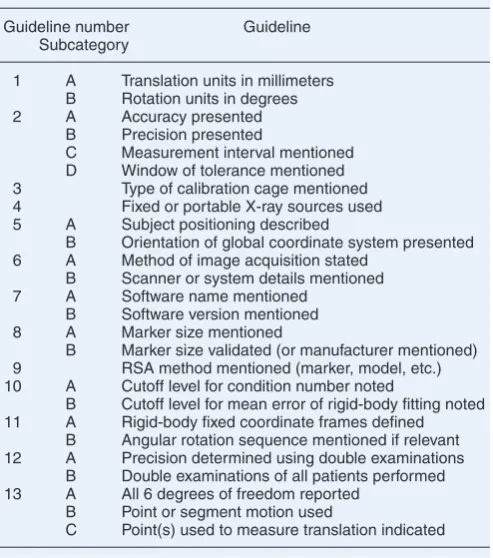
Table 1. List of the 13 guidelines and subcategories used to evalu-ate study adherence (adapted from Valstar et al. 2005)
Guideline number Guideline
Subcategory
1 A Translation units in millimeters B Rotation units in degrees 2 A Accuracy presented B Precision presented
C Measurement interval mentioned D Window of tolerance mentioned 3 Type of calibration cage mentioned 4 Fixed or portable X-ray sources used 5 A Subject positioning described
B Orientation of global coordinate system presented 6 A Method of image acquisition stated
B Scanner or system details mentioned 7 A Software name mentioned
B Software version mentioned 8 A Marker size mentioned
B Marker size validated (or manufacturer mentioned) 9 RSA method mentioned (marker, model, etc.) 10 A Cutoff level for condition number noted
B Cutoff level for mean error of rigid-body fitting noted 11 A Rigid-body fixed coordinate frames defined B Angular rotation sequence mentioned if relevant 12 A Precision determined using double examinations B Double examinations of all patients performed 13 A All 6 degrees of freedom reported
B Point or segment motion used
C Point(s) used to measure translation indicated Studies published from 2000–2011
identified through database searching n = 598
Study abstracts screened after removal of duplicates
n = 410
Full text articles assessed for eligibility
n = 167
Articles included in the final quantitative synthesis
n = 153
Studies published before guidelines (2000–2005)
n = 61
Studies published after guidelines (2006–2011)
n = 92
Studies excluded (n = 243): – not meeting inclusion criteria
[image:3.609.313.560.448.727.2]Study excluded (n = 14): – methodological studies, 7 – only one follow-up time-point, 5 – not related to implant migration or wear, 2
Figure 1. PRISMA flow chart of study selection.
ysis, RSA, hip, and knee. Only English
lan-guage clinical studies with at least 2 follow-up
time points were included. Case reports were
excluded. Study identification was performed
according to the PRISMA statement (Figure 1).
Results
153 studies that met our inclusion criteria were identified
(Figure 1). 61 of these were published before the guidelines
(2000 to 2005) and the remaining 92 after the guidelines
(2006 to 2011). 96 studies evaluated hip arthroplasty and 57
studies evaluated knee arthroplasty. Most of the studies (121)
used RSA to assess migration and 22 studies used RSA to
evaluate wear. Only 10 studies used RSA to measure both
wear and migration. Over half of the studies were randomized
controlled trials (81 studies), the remainder consisted largely
of prospective cohort studies (66 studies), and a few were
ret-rospective studies (6 studies).
None of the studies fully met all 13 guidelines. Only 7
stud-ies published after the guidelines showed partial adherence
to all guidelines. The highest number of guidelines fully met
was 10 and this was achieved in 8 studies, all of which were
published after the guidelines. Almost half of the studies
pub-lished after the guidelines (43) showed partial adherence to 10
of 13 guidelines, and accordingly we selected this adherence
level to mean high adherence. As expected, the
methodologi-cal quality of the RSA studies published before the guidelines
was low, with less than one-fifth (11) of the studies partially
fulfilling 10 of 13 guideline items.
The methodological quality of studies clearly improved
from 2000 to 2011 (Figure 2). The proportion of studies with
high adherence increased almost 3-fold when we compared
the means of time periods before and after the guidelines. The
annual number of publications included in the analysis varied
from 6 to 26. The largest number of publications was from
2006, during which a special Radiostereometric Analysis in
Orthopaedic Surgery symposium issue of Clinical
Orthopae-dics and Related Research was published.
Following introduction of the RSA guidelines, the items
with highest adherence were guideline 1 (measurement units),
9 (RSA method), and 11 (rigid-body fixed coordinate frames
and angular rotation sequence) whereas those with poorest
adherence were 3 (type of calibration cage), 4 (fixed or
por-table X-ray source), 6 (image acquisition method and system
details), and 10 (cutoff level for condition number or CN and
mean error of rigid-body fitting or ME) (Figure 3). Guideline
2 (accuracy, precision, measurement interval, and window
of tolerance) generally only had partial adherence. Although
the level of precision was presented in 60 studies (65%), the
level of accuracy was only mentioned in 12 studies (13%).
The measurement interval was mentioned in all studies, but
the window of tolerance was generally only mentioned for
the postoperative examination and was usually a one-week
window. Surprisingly, 35 studies did not mention the window
of tolerance for any of the RSA examinations. Only 2
stud-ies mentioned the window of tolerance for RSA examinations
after the postoperative examination and used a 5–10%
toler-ance limit.
[image:4.609.53.298.80.204.2]Most of the studies evaluated were from Nordic countries,
and these also had the highest level of adherence to the RSA
guidelines when compared to the other geographical regions
(Table 2). Similarly, the majority of the studies were published
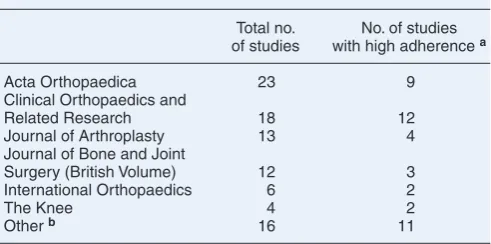
in Acta Orthopaedica (Table 3).
[image:4.609.312.561.109.185.2]Figure 2. The annual numbers of hip and knee arthroplasty RSA stud-ies published from 2000 to 2011 that met the inclusion criteria (bars) and the proportion of studies with high adherence (line). The RSA guidelines where published at the end of 2005.
Figure 3. Adherence of studies published after the guidelines to each of the 13 individual guideline items. The levels of adherence are pre-sented in green (full adherence), yellow (partial adherence), and red (no adherence). Guidelines are presented left to right from highest to lowest adherence. The guideline number is given in parentheses.
Table 2. Adherence of studies published during 2006–2011 to the RSA guidelines according to region of publication
Total no. of Number (%) of studies studies with high adherence a
Nordic countries b 55 29 (53)
Rest of Europe c 21 8 (38)
USA/Canada 9 3 (33)
Australia 7 3 (43)
a Partial or full adherence to at least 10 of 13 RSA guidelines. b Denmark, Finland, Norway, and Sweden.
[image:4.609.54.296.264.452.2]The proportion of patients for whom RSA was not
success-ful was difficult to extract from most of the studies, especially
from studies that included patients with bilateral arthroplasty
procedures. From the 75 studies published after the guidelines
with available data, RSA was not successful in 8% of knee
arthroplasty patients and in 12% of hip arthroplasty patients.
Furthermore, there was no mention of how the confidence
interval (CI)—and hence precision of the method—was
calcu-lated in 34 studies. The remaining studies that did report these
data used heterogeneous but accepted methods for calculating
the confidence interval, with some studies reporting the 99%
CI while others used the 95% CI. More than half of the
stud-ies published from 2006 to 2011 clearly mentioned the time
period of patient recruitment, but this information was lacking
in 43 studies.
Discussion
The guidelines for standardization of radiostereometry of
implants have clearly improved the methodological reporting
in RSA studies during the last decade. Nevertheless, the
over-all level of adherence to the guidelines is still low. We believe
that low adherence to some of the guidelines was due to
over-sight—or to the assumption that the reader is already aware
of the methodological details. Examples of this include not
mentioning the type of calibration cage, the image acquisition
method, or whether a fixed or portable X-ray source was used.
However, some guidelines such as the cutoff level for
con-dition number and mean error of rigid-body fitting are more
crucial to understanding of the validity of the results and
con-sequently their clinical significance. Furthermore, the stability
and distribution of RSA markers within a rigid body will
influ-ence the accuracy of the motion calculation and may affect the
conclusions drawn from the study.
Guideline 2 (accuracy, precision, measurement interval, and
window of tolerance) generally only had partial adherence.
Although the level of precision was presented in 65% of the
studies published after the guidelines, double examinations of
all patients were performed in only 18% of these. This raises
the question of whether it is reasonable to demand this, or if
it would be sufficient to perform double examinations on a
random selection of subcohort of the patients in a study.
Simi-larly, the level of accuracy was only mentioned in 13% of the
studies published after 2005. It is also noteworthy that several
studies used the term accuracy to mean clinical precision. The
measurement of true RSA accuracy requires data from
phan-tom studies and although this information is important, it is
not as clinically relevant as precision data from double
exami-nations, which define the true clinical accuracy.
As expected, most of the RSA studies were from Nordic
countries where the adherence to guidelines was also
high-est, probably for historical reasons. Journals with fewer RSA
studies tended to have higher adherence. This could be due to
more stringent enforcement during the peer review process,
since the RSA method is less familiar to the reviewers of these
journals. On the other hand, studies published in Clinical
Orthopaedics and Related Research also showed a high level
of adherence. This was clearly influenced by the RSA
sympo-sium issue published in 2006, which may have undergone a
more stringent review process due to the special focus of the
issue, and also as it was published soon after the guidelines.
Some information that is currently not included in the RSA
guidelines is the proportion of patients for whom RSA was not
successful. We feel that these data are important for 2 reasons:
firstly, because this information is crucial in understanding the
clinical relevance of the data; and secondly, because this
infor-mation is valuable to other researchers when planning similar
studies.
As model-based RSA is becoming more popular, it is
nec-essary to also include parameters that give an indication of
the quality of the data obtained. An example of this could be
the difference value (DIF) that is used in MBRSA software
(RSAcore, Leiden, the Netherlands), which is a surrogate for
the difference of the actual implant contour and the virtual
con-tour. Inclusion of such quality control parameters would
fur-ther standardize new developments in the RSA methodology.
[image:5.609.52.298.108.230.2]The strengths of this systematic review include the large
number of studies included (153) over a 12-year period. This
enabled us to gain a general understanding of the trends in
adherence over time. To our knowledge, this type of study has
not been published previously. One limitation of the study is
that no attempt was made to contact the authors of the papers.
This might have allowed us to obtain more information about
some aspects of guideline adherence that could not be assessed
from the papers directly. On the other hand, our aim was to
assess adherence to guidelines based on the information
avail-able from publications. Another limitation of the present study
is that it only assessed hip and knee arthroplasty studies and
excluded studies related to other applications such as spinal
fusion or fracture studies. Although these other applications
Table 3. Adherence of studies published during 2006–2011 to the RSA guidelines according to journal
Total no. No. of studies of studies with high adherence a
Acta Orthopaedica 23 9
Clinical Orthopaedics and
Related Research 18 12
Journal of Arthroplasty 13 4
Journal of Bone and Joint
Surgery (British Volume) 12 3
International Orthopaedics 6 2
The Knee 4 2
Other b 16 11
of RSA are also relevant, we decided to focus on the 2 main
applications of RSA.
In summary, RSA is important to ensure a safe yet effective
stepwise introduction of new implants. New developments
in RSA have enabled faster analysis and even measurement
of marker-free implants. The RSA guidelines are an integral
part of the methodology. Our study demonstrated that the
guidelines have clearly had a positive effect on the
method-ological quality of RSA publications, but there is still room
for improvement. The next step is to update, simplify, and
clarify the guidelines and also promote their use in the peer
review process. In future RSA publications, we suggest that
an appendix, similar to the one shown in Table 4, be included
in all future RSA publications.
RM and TJM collected the data and carried out the data analysis. All authors participated in the design of the study and in preparation of the manuscript.
We thank information specialist Tiina Heino of Helsinki University Library for assistance with the literature search.
HM is a stockowner and board member in RSA Biomedical Inc. This study was supported by grants from the Swedish Cultural Foundation in Finland,
the Jane and Aatos Erkko Foundation, the Paulo Foundation, and the Finnish Medical Foundation.
Adalberth G, Nilsson K G, Byström S, Kolstad K, Milbrink J. Low-conform-ing all-polyethylene tibial component not inferior to metal-backed compo-nent in cemented total knee arthroplasty: prospective, randomized radioste-reometric analysis study of the AGC total knee prosthesis. J Arthroplasty 2000; 15 (6): 783-92.
Adalberth G, Nilsson K G, Byström S, Kolstad K, Milbrink J. All-polyethyl-ene versus metal-backed and stemmed tibial components in cemented total knee arthroplasty. A prospective, randomized RSA study. J Bone Joint Surg (Br) 2001; 83 (6): 825-31.
Adalberth G, Nilsson K G, Kärrholm J, Hassander H. Fixation of the tibial component using CMW-1 or Palacos bone cement with gentamicin: similar outcome in a randomized radiostereometric study of 51 total knee arthro-plasties. Acta Orthop Scand 2002; 73 (5): 531-8.
Alfaro-Adrián J, Gill H S, Murray D W. Should total hip arthroplasty femoral components be designed to subside? A radiostereometric analysis study of the Charnley Elite and Exeter stems. J Arthroplasty 2001; 16 (5): 598-606. Astephen Wilson J L, Wilson D A, Dunbar M J, Deluzio K J. Preoperative
gait patterns and BMI are associated with tibial component migration. Acta Orthop 2010; 81 (4): 478-86.
Ayers D C, Hays P L, Drew J M, Eskander M S, Osuch D, Bragdon C R. Two-year radiostereometric analysis evaluation of femoral head penetra-tion in a challenging populapenetra-tion of young total hip arthroplasty patients. J Arthroplasty (6 Suppl) 2009; 24: 9-14.
Baad-Hansen T, Kold S, Nielsen P T, Laursen M B, Christensen P H, Soballe K. Comparison of trabecular metal cups and titanium fiber-mesh cups in primary hip arthroplasty: a randomized RSA and bone mineral densitom-etry study of 50 hips. Acta Orthop 2011a; 82 (2): 155-60.
Baad-Hansen T, Kold S, Olsen N, Christensen F, Søballe K. Excessive distal migration of fiber-mesh coated femoral stems. Acta Orthop 2011b; 82 (3): 308-14.
Baad-Hansen T, Storgaard Jakobsen S, Soballe K. Two-year migration results of the ReCap hip resurfacing system-a radiostereometric follow-up study of 23 hips. Int Orthop 2011c; 35 (4): 497-502.
Berend M E, Ritter M A, Hyldahl H C, Meding J B, Redelman R. Implant migration and failure in total knee arthroplasty is related to body mass index and tibial component size. J Arthroplasty (Suppl 1) 2008; 23 (6): 104-9.
Bottner F, Zawadsky M, Su E P, Bostrom M, Palm L, Ryd L, Sculco T P. Implant migration after early weightbearing in cementless hip replacement. Clin Orthop 2005; (436): 132-7.
Bourne R B, McCalden R W, Naudie D, Charron K D, Yuan X, Holdsworth D W. The next generation of acetabular shell design and bearing surfaces. Orthopedics (Suppl 2) 2008; 31 (12): [pages?].
Bragdon C R, Thanner J, Greene M E, Malchau H, Digas G, Harris W H, Kär-rholm J. Standing versus supine radiographs in RSA evaluation of femoral head penetration. Clin Orthop 2006; (448): 46-51.
Bragdon C R, Greene M E, Freiberg A A, Harris W H, Malchau H. Radioste-reometric analysis comparison of wear of highly cross-linked polyethylene against 36- vs 28-mm femoral heads. J Arthroplasty (Suppl 2) 2007; 22 (6): 125-9.
Bragonzoni L, Russo A, Loreti I, Montagna L, Visani A, Marcacci M. The stress-inducible displacement detected through RSA in non-migrating UKR. Knee 2005; 12 (4): 301-6.
Bøe B G, Röhrl S M, Heier T, Snorrason F, Nordsletten L. A prospective randomized study comparing electrochemically deposited hydroxyapatite and plasma-sprayed hydroxyapatite on titanium stems. Acta Orthop 2011; 82 (1): 13-9.
[image:6.609.306.559.111.744.2]Campbell D G, Field J R, Callary S A. Second-generation highly cross-linked X3™ polyethylene wear: a preliminary radiostereometric analysis study. Clin Orthop 2010a; (468) (10): 2704-9.
Table 4. Suggested presentation of standardized output for a clini-cal RSA study
Items relevant to the Materials and Methods section of the study
Time period of patient recruitment Positioning of subject and calibration cage
Orientation of the global coordinate system (consider a diagram) Rigid body fixed coordinate frames defined
RSA method (marker-based, geometrical or model-based) and version of RSA software
Units used for translation millimeters and the units for rotations degrees
Measurement interval
The points used to measure translation indicated (consider an x-ray or diagram)
Translations and angular rotations with all six degrees of freedom if applicable
Clinical precision
Number of patients for whom RSA was not successful
Items to be mentioned in an appendix of the study
Accuracy of the arrangement (if phantom studies have been performed)
Size and manufacturer of RSA markers Type and manufacturer of calibration cage Fixed or portable x-ray sources and manufacturer Radiographic exposure settings (kV and mAs)
Window of tolerance for both postoperative and follow-up RSA examinations (days/weeks)
Method of image acquisition and scanner or system details as well as image resolution
Number of patients for whom double examinations were performed Cut-off level for CN and ME
Campbell D, Mercer G, Nilsson K G, Wells V, Field J R, Callary S A. Wear of a highly cross-linked polyethylene liner: a preliminary RSA study. Eur J Orthop Surg Traumatol 2010b; 20: 23-7.
Campbell D, Mercer G, Nilsson K G, Wells V, Field J R, Callary S A. Early migration characteristics of a hydroxyapatite-coated femoral stem: an RSA study. Int Orthop 2011; 35 (4): 483-8.
Carlsson A, Björkman A, Besjakov J, Onsten I. Cemented tibial component fixation performs better than cementless fixation: a randomized radioste-reometric study comparing porous-coated, hydroxyapatite-coated and cemented tibial components over 5 years. Acta Orthop 2005; 76 (3): 362-9. Carlsson L V, Albrektsson B E, Albrektsson B G, Albrektsson T O, Jacobsson
C M, Macdonald W, Regnér L, Röstlund T, Weidenhielm L R. Stepwise introduction of a bone-conserving osseointegrated hip arthroplasty using RSA and a randomized study: I. Preliminary investigations–52 patients fol-lowed for 3 years. Acta Orthop 2006a; 77 (4): 549-58.
Carlsson L V, Albrektsson T, Albrektsson B E, Jacobsson C M, Macdonald W, Regnér L, Weidenhielm L R. Stepwise introduction of a bone-conserving osseointegrated hip arthroplasty using RSA and a randomized study: II. Clinical proof of concept–40 patients followed for 2 years. Acta Orthop 2006b; 77 (4): 559-66.
Carlsson L V, Albrektsson B E, Regnér L R. Minimally invasive surgery vs conventional exposure using the Miller-Galante unicompartmental knee arthroplasty: a randomized radiostereometric study. J Arthroplasty 2006c; 21 (2): 151-6.
Catani F, Leardini A, Ensini A, Cucca G, Bragonzoni L, Toksvig-Larsen S, Giannini S. The stability of the cemented tibial component of total knee arthroplasty: posterior cruciate-retaining versus posterior-stabilized design. J Arthroplasty 2004; 19 (6): 775-82.
Catani F, Ensini A, Leardini A, Bragonzoni L, Toksvig-Larsen S, Giannini S. Migration of cemented stem and restrictor after total hip arthroplasty: a radiostereometry study of 25 patients with Lubinus SP II stem. J Arthro-plasty 2005; 20 (2): 244-9.
Dahl J, Söderlund P, Nivbrant B, Nordsletten L, Röhrl S M. Less wear with aluminium-oxide heads than cobalt-chrome heads with ultra high molecu-lar weight cemented polyethylene cups: a ten-year follow-up with radioste-reometry. Int Orthop 2012; 36 (3): 485-90.
Dalén T, Nilsson K G. VersaBond bone cement prospective randomized study of the clinical properties of a new bone cement in total knee replacement. Knee 2005; 12 (4): 311-7.
Decking J, Schuetz, Decking R, Puhl W. The migration of femoral compo-nents after total hip replacement surgery: accuracy and precision of soft-ware-aided measurements. Skeletel Radiol 2003; 32 (9): 521-5.
Derbyshire B, Porter M L. A study of the Elite Plus femoral component using radiostereometric analysis. J Bone Joint Surg (Br) 2007; 89 (6): 730-5. Digas G, Kärrholm J, Thanner J, Malchau H, Herberts P. Highly cross-linked
polyethylene in cemented THA: randomized study of 61 hips. Clin Orthop 2003a; (417): 126-38.
Digas G, Thanner J, Nivbrant B, Röhrl S, Ström H, Kärrholm J. Increase in early polyethylene wear after sterilization with ethylene oxide: radioste-reometric analyses of 201 total hips. Acta Orthop Scand 2003b; 74 (5): 531-41.
Digas G, Kärrholm J, Thanner J, Malchau H, Herberts P. The Otto Aufranc Award. Highly cross-linked polyethylene in total hip arthroplasty: random-ized evaluation of penetration rate in cemented and uncemented sockets using radiostereometric analysis. Clin Orthop 2004a; (429): 6-16. Digas G, Thanner J, Anderberg C, Kärrholm J. Bioactive cement or ceramic/
porous coating vs. conventional cement to obtain early stability of the ace-tabular cup. Randomised study of 96 hips followed with radiostereometry. J Orthop Res 2004b; 22 (5): 1035-43.
Digas G, Thanner J, Anderberg C, Kärrholm J. Fluoride-containing acrylic bone cement in total hip arthroplasty. Randomized evaluation of 97 stems using radiostereometry and dual-energy x-ray absorptiometry. J Arthro-plasty 2005; 20 (6): 784-92.
Digas G, Kärrholm J, Thanner J. Addition of fluoride to acrylic bone cement does not improve fixation of a total hip arthroplasty stem. Clin Orthop 2006; (448): 58-66.
Digas G, Kärrholm J, Thanner J, Herberts P. 5-year experience of highly cross-linked polyethylene in cemented and uncemented sockets: two ran-domized studies using radiostereometric analysis. Acta Orthop 2007; 78 (6): 746-54.
Dunbar M J, Wilson D A, Hennigar A W, Amirault J D, Gross M, Reardon G P. Fixation of a trabecular metal knee arthroplasty component. A prospec-tive randomized study. J Bone Joint Surg (Am) 2009; 91 (7): 1578-86. Flivik G, Sanfridsson J, Onnerfält R, Kesteris U, Ryd L. Migration of the
acetabular component: effect of cement pressurization and significance of early radiolucency: a randomized 5-year study using radiostereometry. Acta Orthop 2005; 76 (2): 159-68.
Flivik G, Kristiansson I, Kesteris U, Ryd L. Is removal of subchondral bone plate advantageous in cemented cup fixation? A randomized RSA study. Clin Orthop 2006; (448): 164-72.
Fukuoka S, Yoshida K, Yamano Y. Estimation of the migration of tibial com-ponents in total knee arthroplasty. A roentgen stereophotogrammetric anal-ysis. J Bone Joint Surg (Br) 2000; 82 (2): 222-7.
Gao F, Henricson A, Nilsson K G. Cemented versus uncemented fixation of the femoral component of the NexGen CR total knee replacement in patients younger than 60 years: a prospective randomised controlled RSA study. Knee 2009; 16 (3): 200-6.
Garling E H, Valstar E R, Nelissen R G. Comparison of micromotion in mobile bearing and posterior stabilized total knee prostheses: a random-ized RSA study of 40 knees followed for 2 years. Acta Orthop 2005; 76 (3): 353-61.
Gill H S, Alfaro-Adrián J, Alfaro-Adrián C, McLardy-Smith P, Murray D W. The effect of anteversion on femoral component stability assessed by radio-stereometric analysis. J Arthroplasty 2002; 17 (8): 997-1005.
Glyn-Jones S, Hicks J, Alfaro-Adrian J, Gill H S, McLardy-Smith P, Murray D W. The influence of cement viscosity on the early migration of a tapered polished femoral stem. Int Orthop 2003; 27 (6): 362-5.
Glyn-Jones S, Gill H S, McLardy-Smith P, Murray D W. Roentgen stereopho-togrammetric analysis of the Birmingham hip resurfacing arthroplasty. A two-year study. J Bone Joint Surg (Br) 2004; 86 (2): 172-6.
Glyn-Jones S, Alfaro-Adrian J, Murray D W, Gill H S. The influence of sur-gical approach on cemented stem stability: an RSA study. Clin Orthop 2006a; (448): 87-91.
Glyn-Jones S, Polgár K, Hicks J, Murray D W, Gill H S. RSA-measured inducible micromotion and interface modeling with finite element meth-ods. Clin Orthop 2006b; (448): 98-104.
Glyn-Jones S, Isaac S, Hauptfleisch J, McLardy-Smith P, Murray D W, Gill H S. Does highly cross-linked polyethylene wear less than conventional polyethylene in total hip arthroplasty? A double-blind, randomized, and controlled trial using roentgen stereophotogrammetric analysis. J Arthro-plasty 2008a; 23 (3): 337-43.
Glyn-Jones S, McLardy-Smith P, Gill H S, Murray D W. The creep and wear of highly cross-linked polyethylene: a three-year randomised, controlled trial using radiostereometric analysis. J Bone Joint Surg (Br) 2008b; 90 (5): 556-61.
Grant P, Aamodt A, Falch J A, Nordsletten L. Differences in stability and bone remodeling between a customized uncemented hydroxyapatite coated and a standard cemented femoral stem A randomized study with use of radio-stereometry and bone densitometry. J Orthop Res 2005; 23 (6): 1280-5. Hallan G, Aamodt A, Furnes O, Skredderstuen A, Haugan K, Havelin L I.
Palamed G compared with Palacos R with gentamicin in Charnley total hip replacement. A randomised, radiostereometric study of 60 HIPS. J Bone Joint Surg (Br) 2006; 88 (9): 1143-8.
Hansson U, Toksvig-Larsen S, Jorn L P, Ryd L. Mobile vs. fixed meniscal bearing in total knee replacement: a randomised radiostereometric study. Knee 2005; 12 (6): 414-8.
Hansson U, Ryd L, Toksvig-Larsen S. A randomised RSA study of Peri-Apa-tite HA coating of a total knee prosthesis. Knee 2008; 15 (3): 211-6. Hansson U, Toksvig-Larsen S, Ryd L, Aspenberg P. Once-weekly oral
Havelin L I, Espehaug B, Vollset S E, Engesaeter L B. The effect of the type of cement on early revision of Charnley total hip prostheses. A review of eight thousand five hundred and seventy-nine primary arthroplasties from the Norwegian Arthroplasty Register. J Bone Joint Surg (Am) 1995; 77 (10): 1543-50.
Henricson A, Dalén T, Nilsson K G. Mobile bearings do not improve fixation in cemented total knee arthroplasty. Clin Orthop 2006; (448): 114-21. Henricson A, Linder L, Nilsson K G. A trabecular metal tibial component
in total knee replacement in patients younger than 60 years: a two-year radiostereophotogrammetric analysis. J Bone Joint Surg (Br) 2008; 90 (12): 1585-93.
Hilding M, Aspenberg P. Postoperative clodronate decreases prosthetic migra-tion: 4-year follow-up of a randomized radiostereometric study of 50 total knee patients. Acta Orthop 2006; 77 (6): 912-6.
Hilding M, Aspenberg P. Local peroperative treatment with a bisphosphonate improves the fixation of total knee prostheses: a randomized, double-blind radiostereometric study of 50 patients. Acta Orthop 2007; 78 (6): 795-9. Hilding M, Ryd L, Toksvig-Larsen S, Aspenberg P. Clodronate prevents
pros-thetic migration: a randomized radiostereometric study of 50 total knee patients. Acta Orthop Scand 2000; 71 (6): 553-7.
Hurschler C, Seehaus F, Emmerich J, Kaptein B L, Windhagen H. Accuracy of model-based RSA contour reduction in a typical clinical application. Clin Orthop 2008; (466) (8): 1978-86.
Hurschler C, Seehaus F, Emmerich J, Kaptein B L, Windhagen H. Compari-son of the model-based and marker-based roentgen stereophotogrammetry methods in a typical clinical setting. J Arthroplasty 2009; 24 (4): 594-606. Husby O S, Haugan K, Benum P, Foss O A. A prospective randomisedradio-stereometric analysis trial of SmartSet HV and Palacos R bone cements in primary total hip arthroplasty. J Orthop Traumatol 2010; 11 (1): 29-35. Hyldahl H C, Regnér L, Carlsson L, Kärrholm J, Weidenhielm L. Does metal
backing improve fixation of tibial component in unicondylar knee arthro-plasty? A randomized radiostereometric analysis. J Arthroplasty 2001; 16 (2): 174-9.
Hyldahl H, Regnér L, Carlsson L, Kärrholm J, Weidenhielm L. All-polyethyl-ene vs. metal-backed tibial component in total knee arthroplasty-a random-ized RSA study comparing early fixation of horizontally and completely cemented tibial components: part 2. Completely cemented components: MB not superior to AP components. Acta Orthop 2005a; 76 (6): 778-84. Hyldahl H, Regnér L, Carlsson L, Kärrholm J, Weidenhielm L.
All-polyethyl-ene vs. metal-backed tibial component in total knee arthroplasty-a random-ized RSA study comparing early fixation of horizontally and completely cemented tibial components: part 1. Horizontally cemented components: AP better fixated than MB. Acta Orthop 2005b; 76 (6): 769-77.
Höstner J, Hultmark P, Kärrholm J, Malchau H, Tveit M. Impaction technique and graft treatment in revisions of the femoral component: laboratory stud-ies and clinical validation. J Arthroplasty 2001; 16 (1): 76-82.
Itayem R, Arndt A, Nistor L, McMinn D, Lundberg A. Stability of the Bir-mingham hip resurfacing arthroplasty at two years. A radiostereophoto-grammetric analysis study. J Bone Joint Surg (Br) 2005; 87 (2): 158-62. Itayem R, Arndt A, McMinn D J, Daniel J, Lundberg A. A five-year
radio-stereometric follow-up of the Birmingham Hip Resurfacing arthroplasty. J Bone Joint Surg (Br) 2007; 89 (9): 1140-3.
Jeffcote B, Li M G, Barnet-Moorcroft A, Wood D, Nivbrant B. Roentgen ste-reophotogrammetric analysis and clinical assessment of unipolar versus bipolar hemiarthroplasty for subcapital femur fracture: a randomized pro-spective study. ANZ J Surg 2010; 80 (4): 242-6.
Kadar T, Hallan G, Aamodt A, Indrekvam K, Badawy M, Skredderstuen A, Havelin L I, Stokke T, Haugan K, Espehaug B, Furnes O. Wear and migra-tion of highly cross-linked and convenmigra-tional cemented polyethylene cups with cobalt chrome or Oxinium femoral heads: a randomized radiostereo-metric study of 150 patients. J Orthop Res 2011a; 29 (8): 1222-9. Kadar T, Hallan G, Aamodt A, Indrekvam K, Badawy M, Havelin L I, Stokke
T, Haugan K, Espehaug B, Furnes O. A randomized study on migration of the Spectron EF and the Charnley flanged 40 cemented femoral compo-nents using radiostereometric analysis at 2 years. Acta Orthop 2011b; 82 (5): 538-44.
Kellett C F, Short A, Price A, Gill H S, Murray D W. In vivo measurement of total knee replacement wear. Knee 2004; 11 (3): 183-7.
Kendrick B J, Simpson D J, Kaptein B L, Valstar E R, Gill H S, Murray D W, Price A J. Polyethylene wear of mobile-bearing unicompartmental knee replacement at 20 years. J Bone Joint Surg (Br) 2011; 93 (4): 470-5. Khan R J, Fick D, Alakeson R, Haebich S, de Cruz M, Nivbrant B, Wood D.
A constrained acetabular component for recurrent dislocation. J Bone Joint Surg (Br) 2006; 88 (7): 870-6.
Khan R J, Fick D, Alakeson R, Li M G, Nivbrant B, Wood D. The constrained acetabular component for hip instability. J Arthroplasty 2007; 22 (3): 377-82.
Kienapfel H, Hildebrand R, Neumann T, Specht R, Koller M, Celik I, Mueller H H, Griss P, Klose K J, Georg C. The effect of Palamed G bone cement on early migration of tibial components in total knee arthroplasty. Inflamm Res (Suppl 2) 2004; 53: S159-63.
Kneif D, Downing M R, Ashcroft G P, Knight D J, Ledingham W M, Gibson P H, Hutchison J D. The correlation between immediate radiolucent lines and early implant migration in cemented acetabular components. J Arthroplasty 2006; 21 (2): 215-20.
Kärrholm J. Radiostereometric analysis of early implant migration – a valu-able tool to ensure proper introduction of new implants. Acta Orthop 2012; 83 (6): 551-2.
Kärrholm J, Razaznejad R. Fixation and bone remodeling around a low stiff-ness stem in revision surgery. Clin Orthop 2008; (466) (2): 380-8. Kärrholm J, Anderberg C, Snorrason F, Thanner J, Langeland N, Malchau H,
Herberts P. Evaluation of a femoral stem with reduced stiffness. A random-ized study with use of radiostereometry and bone densitometry. J Bone Joint Surg (Am) 2002; 84 (9): 1651-8.
Kärrholm J, Hourigan P, Timperley J, Razaznejad R. Mixing bone graft with OP-1 does not improve cup or stem fixation in revision surgery of the hip: 5-year follow-up of 10 acetabular and 11 femoral study cases and 40 con-trol cases. Acta Orthop 2006; 77 (1): 39-48.
Li M G, Nilsson K G. No relationship between postoperative changes in bone density at the proximal tibia and the migration of the tibial component 2 years after total knee arthroplasty. J Arthroplasty 2001; 16 (7): 893-900. Li M G, Thorsen K, Nilsson K G. Increased bone turnover as reflected by
bio-chemical markers in patients with potentially unstable fixation of the tibial component. Arch Orthop Trauma Surg 2004; 124 (6): 404-9.
Lindalen E, Nordsletten L, Röhrl S M. Segment choice and cup stability influ-ence wear measurements using radiostereometric analysis: a radiostereo-metric study comparing wear measured by markers in the polyethylene with markers in the periacetabular bone. Clin Biomech (Bristol, Avon) 2012; 27 (5): 511-4.
Lindstrand A, Stenström A, Ryd L, Toksvig-Larsen S. The introduction period of unicompartmental knee arthroplasty is critical: a clinical, clinical mul-ticentered, and radiostereometric study of 251 Duracon unicompartmental knee arthroplasties. J Arthroplasty 2000; 15 (5): 608-16.
Luites JW, Spruit M, Hellemondt GG, Horstmann WG, Valstar ER. Failure of the uncoated titanium ProxiLock femoral hip prosthesis. Clin Orthop 2006; (448): 79-86.
Malchau H. On the importance of stepwise introduction of new hip implant technology. Thesis. Göteborg 1995. ISBN 91-628-1658-6.
Malchau H, Bragdon C R, Muratoglu O K. The stepwise introduction of inno-vation into orthopaedic surgery: the next level of dilemmas. J Arthroplasty 2011; 26 (6): 825-31.
Marcacci M, Soavi R, Loreti I, Bragonzoni L, Iacono F, Visani A. Micromo-tion between the half bearings in the interax prosthesis: a roentgen stereo-photogrammetric analysis. J Arthroplasty 2001; 16 (8): 991-7.
McCalden R W, Charron K D, Yuan X, Bourne R B, Naudie D D, MacDonald S J. Randomised controlled trial comparing early migration of two col-larless polished cemented stems using radiostereometric analysis. J Bone Joint Surg (Br) 2010; 92 (7): 935-40.
Moritz N, Alm J J, Lankinen P, Mäkinen T J, Mattila K, Aro H T. Quality of intertrochanteric cancellous bone as predictor of femoral stem RSA migra-tion in cementless total hip arthroplasty. J Biomech 2011; 44 (2): 221-7. Muirhead-Allwood S K. Lessons of a hip failure. BMJ 1998; 316 (7149): 644. Nelissen R G, Valstar E R, Pöll R G, Garling E H, Brand R. Factors associated
with excessive migration in bone impaction hip revision surgery: a radio-stereometric analysis study. J Arthroplasty 2002; 17 (7): 826-33. Nelissen R G, Garling E H, Valstar E R. Influence of cement viscosity and
cement mantle thickness on migration of the Exeter total hip prosthesis. J Arthroplasty 2005; 20 (4): 521-8.
Nilsson K G, Henricson A, Norgren B, Dalén T. Uncemented HA-coated implant is the optimum fixation for TKA in the young patient. Clin Orthop 2006; (448): 129-39.
Nivbrant B, Kärrholm J, Röhrl S, Hassander H, Wesslen B. Bone cement with reduced proportion of monomer in total hip arthroplasty: preclinical evaluation and randomized study of 47 cases with 5 years’ follow-up. Acta Orthop Scand 2001; 72 (6): 572-84.
Norgren B, Dalén T, Nilsson K G. All-poly tibial component better than metal-backed: a randomized RSA study. Knee 2004; 11 (3): 189-96. Norton M R, Yarlagadda R, Anderson G H. Catastrophic failure of the Elite
Plus total hip replacement, with a Hylamer acetabulum and Zirconia ceramic femoral head. J Bone Joint Surg (Br) 2002; 84 (5): 631-5. Olofsson K, Digas G, Kärrholm J. Influence of design variations on
earlymi-gration of a cemented stem in THA. Clin Orthop 2006; (448): 67-72. Ornstein E, Franzén H, Johnsson R, Sundberg M. Radiostereometric
analy-sis in hip revision surgery–optimal time for index examination: 6 patients revised with impacted allografts and cement followed weekly for 6 weeks. Acta Orthop Scand 2000; 71 (4): 360-4.
Ornstein E, Atroshi I, Franzén H, Johnsson R, Sandquist P, Sundberg M. Results of hip revision using the Exeter stem, impacted allograft bone, and cement. Clin Orthop 2001; (389): 126-33.
Ornstein E, Franzén H, Johnsson R, Stefánsdóttir A, Sundberg M, Tägil M. Hip revision with impacted morselized allografts: unrestricted weight-bearing and restricted weight-weight-bearing have similar effect on migration. A radiostereometry analysis. Arch Orthop Trauma Surg 2003; 123 (6): 261-7. Ornstein E, Franzen H, Johnsson R, Karlsson M K, Linder L, Sundberg M.
Hip revision using the Exeter stem, impacted morselized allograft bone and cement: a consecutive 5-year radiostereometric and radiographic study in 15 hips. Acta Orthop Scand 2004; 75 (5): 533-43.
Ornstein E, Franzén H, Johnsson R, Stefánsdóttir A, Sundberg M, Tägil M. Five-year follow-up of socket movements and loosening after revision with impacted morselized allograft bone and cement: a radiostereometric and radiographic analysis. J Arthroplasty 2006; 21 (7): 975-84.
Palm L, Olofsson J, Aström S E, Ivarsson I. No difference in migration or wear between cemented low-profile cups and standard cups : a randomized radiostereographic study of 53 patients over 3 years. Acta Orthop 2007; 78 (4): 479-84.
Pitto R P, Schikora N. Acetabular reconstruction in developmental hip dyspla-sia using reinforcement ring with a hook. Int Orthop 2004; 28 (4): 202-5. Regnér L, Carlsson L, Kärrholm J, Herberts P. Tibial component fixation in
porous- and hydroxyapatite-coated total knee arthroplasty: a radiostereo-metric evaluation of migration and inducible displacement after 5 years. J Arthroplasty 2000; 15 (6): 681-9.
Russo A, Montagna L, Bragonzoni L, Zampagni M L, Marcacci M. Fixation of total knee arthroplasty improved by mobile-bearing design. Clin Orthop 2005; (437): 186-95.
Russo A, Montagna L, Bragonzoni L, Visani A, Marcacci M. Changes in knee motion over the first 3 years with a mobile-bearing prosthesis. Knee 2006; 13 (4): 301-6.
Russo A, Bragonzoni L, Trozzi C, Iacono F, Visani A, Marcacci M. Radioste-reometric measurement of polyethylene deformation pattern in meniscal bearing TKR at 5 years follow-up. Knee Surg Sports Traumatol Arthrosc 2008a; 16 (2): 142-7.
Russo A, Bragonzoni L, Trozzi C, Zaffagnini S, Neri M P, Bruni D, Marcacci M. Recurrence of varus/valgus deformity after TKR at 3 years’ follow-up. Knee 2008b; 15 (1): 20-5.
Röhrl S M, Nivbrant B, Ström H, Nilsson K G. Effect of augmented cup fixation on stability, wear, and osteolysis: a 5-year follow-up of total hip arthroplasty with RSA. J Arthroplasty 2004; 19 (8): 962-71.
Röhrl S, Nivbrant B, Mingguo L, Hewitt B. In vivo wear and migration of highly cross-linked polyethylene cups a radiostereometry analysis study. J Arthroplasty 2005; 20 (4): 409-13.
Röhrl S M, Nivbrant B, Snorrason F, Kärrholm J, Nilsson K G. Porous-coated cups fixed with screws: a 12-year clinical and radiostereometric follow-up study of 50 hips. Acta Orthop 2006a; 77 (3): 393-401.
Röhrl S M, Li M G, Pedersen E, Ullmark G, Nivbrant B. Migration pattern of a short femoral neck preserving stem. Clin Orthop 2006b; (448): 73-8. Röhrl S M, Li M G, Nilsson K G, Nivbrant B. Very low wear of non-remelted
highly cross-linked polyethylene cups: an RSA study lasting up to 6 years. Acta Orthop 2007; 78 (6): 739-45.
Saari T, Uvehammer J, Carlsson L V, Regnér L, Kärrholm J. Influence of polyethylene constraint on tibial component fixation in total knee arthro-plasty: follow-up report after 5 years. J Arthroplasty 2006; 21 (7): 1032-7. Saari T, Li M G, Wood D, Nivbrant B. Comparison of cementing techniques
of the tibial component in total knee replacement. Int Orthop 2009; 33 (5): 1239-42.
Simpson D J, Kendrick B J, Hughes M, Glyn-Jones S, Gill H S, Rushforth G F, Murray D W. The migration patterns of two versions of the Furlong cementless femoral stem: a randomised, controlled trial using radiostereo-metric analysis. J Bone Joint Surg (Br) 2010; 92 (10): 1356-62.
Sköldenberg O G, Salemyr M O, Bodén H S, Lundberg A, Ahl T E, Adolph-son PY. A new uncemented hydroxyapatite-coated femoral component for the treatment of femoral neck fractures: two-year radiostereometric and bone densitometric evaluation in 50 hips. J Bone Joint Surg (Br) 2011; 93 (5): 665-77.
Soavi R, Loreti I, Bragonzoni L, La Palombara P F, Visani A, Marcacci M. A roentgen stereophotogrammetric analysis of unicompartmental knee arthroplasty. J Arthroplasty 2002; 17 (5): 556-61.
Stefánsdóttir A, Franzén H, Johnsson R, Ornstein E, Sundberg M. Movement pattern of the Exeter femoral stem; a radiostereometric analysis of 22 pri-mary hip arthroplasties followed for 5 years.. Acta Orthop Scand 2004; 75 (4): 408-14.
Stilling M, Larsen K, Andersen N T, Søballe K, Kold S, Rahbek O. The final follow-up plain radiograph is sufficient for clinical evaluation of polyeth-ylene wear in total hip arthroplasty. A study of validity and reliability. Acta Orthop 2010; 81 (5): 570-8.
Stilling M, Madsen F, Odgaard A, Rømer L, Andersen N T, Rahbek O, Søballe K. Superior fixation of pegged trabecular metal over screw-fixed pegged porous titanium fiber mesh: a randomized clinical RSA study on cementless tibial components. Acta Orthop 2011; 82 (2): 177-86. Ström H, Mallmin H, Milbrink J, Petrén-Mallmin M, Nivbrant B, Kolstad K.
The cone hip stem: a prospective study of 13 patients followed for 5 years with RSA. Acta Orthop Scand 2003; 74 (5): 525-30.
Ström H, Kolstad K, Mallmin H, Sahlstedt B, Milbrink J. Comparison of the uncemented Cone and the cemented Bimetric hip prosthesis in young patients with osteoarthritis: an RSA, clinical and radiographic study. Acta Orthop 2006; 77 (1): 71-8.
Ström H, Nilsson O, Milbrink J, Mallmin H, Larsson S. Early migration pat-tern of the uncemented CLS stem in total hip arthroplasties. Clin Orthop 2007a; (454): 127-32.
Ström H, Nilsson O, Milbrink J, Mallmin H, Larsson S. The effect of early weight bearing on migration pattern of the uncemented CLS stem in total hip arthroplasty. J Arthroplasty 2007b; 22 (8): 1122-9.
Sundberg M, Besjakov J, von Schewelow T, Carlsson A. Movement patterns of the C-stem femoral component: an RSA study of 33 primary total hip arthroplasties followed for two years. J Bone Joint Surg (Br) 2005; 87 (10): 1352-6.
Thanner J, Freij-Larsson C, Kärrholm J, Malchau H, Wesslen B. Evaluation of Boneloc. Chemical and mechanical properties, and a randomized clini-cal study of 30 total hip arthroplasties. Acta Orthop Scand 1995; 66 (3): 207-14.
Thanner J, Kärrholm J, Herberts P, Malchau H. Hydroxyapatite and trical-cium phosphate-coated cups with and without screw fixation: a randomized study of 64 hips. J Arthroplasty 2000; 15 (4): 405-12.
The B, Flivik G, Diercks R L, Verdonschot N. A new method to make 2-D wear measurements less sensitive to projection differences of cemented THAs. Clin Orthop 2008a; (466) (3): 684-90.
The B, Hosman A, Kootstra J, Kralj-Iglic V, Flivik G, Verdonschot N, Diercks R. Association between contact hip stress and RSA-measured wear rates in total hip arthroplasties of 31 patients. J Biomech 2008b; 41 (1): 100-5. Therbo M, Lund B, Jensen K E, Schrøder H M. Effect of bioactive coating of
the tibial component on migration pattern in uncemented total knee arthro-plasty: a randomized RSA study of 14 knees presented according to new RSA-guidelines. J Orthop Traumatol 2008; 9 (2): 63-7.
Thien T M, Ahnfelt L, Eriksson M, Strömberg C, Kärrholm J. Immediate weight bearing after uncemented total hip arthroplasty with an anteverted stem: a prospective randomized comparison using radiostereometry. Acta Orthop 2007; 78 (6): 730-8.
Thien T M, Thanner J, Kärrholm J. Randomized comparison between 3 sur-face treatments of a single anteverted stem design: 84 hips followed for 5 years. J Arthroplasty 2010; 25 (3): 437-44.
Thomas G E, Simpson D J, Mehmood S, Taylor A, McLardy-Smith P, Gill H S, Murray D W, Glyn-Jones S. The seven-year wear of highly cross-linked polyethylene in total hip arthroplasty: a double-blind, randomized controlled trial using radiostereometric analysis. J Bone Joint Surg (Am) 2011; 93 (8): 716-22.
Timperley A J, Whitehouse S L, Hourigan P G. The influence of a suction device on fixation of a cemented cup using RSA. Clin Orthop 2009; (467) (3): 792-8.
Uvehammer J, Regnér L, Kärrholm J. Flat vs. concave tibial joint surface in total knee arthroplasty: randomized evaluation of 39 cases using radioste-reometry. Acta Orthop Scand 2001a; 72 (3): 257-65.
Uvehammer J, Kärrholm J, Regnér L, Carlsson L, Herberts P. Concave versus posterior-stabilized tibial joint surface in total knee arthroplasty: random-ized evaluation of 47 knees. J Arthroplasty 2001b; 16 (1): 25-32.
Uvehammer J, Kärrholm J, Carlsson L. Cemented versus hydroxyapatite fixation of the femoral component of the Freeman-Samuelson total knee replacement: a radiostereometric analysis. J Bone Joint Surg (Br) 2007a; 89 (1): 39-44.
Uvehammer J, Kärrholm J, Carlsson L. Influence of joint area design on tibial component migration: comparison among a fixed symmetrical, asymmetri-cal, and moveable bearing. J Knee Surg 2007b; 20 (1): 20-6. Valstar E R, Gill R, Ryd L, Flivik G, Börlin N, Kärrholm J. Guidelines for standardization of radiostereometry (RSA) of implants. Acta Orthop 2005; 76 (4): 563-72.
van der Linde M J, Garling E H, Valstar E R, Tonino A J, Nelissen R G. Peri-apatite may not improve micromotion of knee prostheses in rheumatoid arthritis. Clin Orthop 2006; (448): 122-8.
van Doorn W J, ten Have B L, van Biezen F C, Hop W C, Ginai A Z, Ver-haar J A. Migration of the femoral stem after impaction bone grafting. First results of an ongoing, randomised study of the Exeter and Elite Plus femo-ral stems using radiostereometric analysis. J Bone Joint Surg (Br) 2002; 84 (6): 825-31.
van Strien T, van der Linden-van der Zwaag E, Kaptein B, van Erkel A, Val-star E, Nelissen R. Computer assisted versus conventional cemented total knee prostheses alignment accuracy and micromotion of the tibial compo-nent. Int Orthop 2009; 33 (5): 1255-61.
von Schewelov T, Sanzén L, Onsten I, Carlsson A. Catastrophic failure of an uncemented acetabular component due to high wear and osteolysis: an analysis of 154 omnifit prostheses with mean 6-year follow-up. Acta Orthop Scand 2004; 75 (3): 283-94.
von Schewelov T, Sanzén L, Onsten I, Carlsson A, Besjakov J. Total hip replacement with a zirconium oxide ceramic femoral head: a randomised roentgen stereophotogrammetric study. J Bone Joint Surg (Br) 2005; 87 (12): 1631-5.
von Schewelov T, Onsten I, Markusson P, Carlsson A. Weight bearing radio-graphs are not necessary for measurement of polyethylene penetration in total hip prostheses: a radiostereometric study of 111 patients examined in weight-bearing and supine position. Acta Orthop 2006; 77 (1): 104-8. von Schewelov T, Besjakov J, Sanzén L, Carlsson A. A clinical and
radioste-reometric study of the cemented PFC-sigma prosthesis: a 5-year study of 29 cases with a fixed bearing. J Knee Surg 2009; 22 (3): 231-6.
von Schewelov T, Sanzén L, Besjakov J, Carlsson A. The Elite-Plus stem migrates more than the flanged Charnley stem. Acta Orthop 2010; 81 (3): 280-5.
Wilson D A, Astephen J L, Hennigar A W, Dunbar M J. Inducible displace-ment of a trabecular metal tibial monoblock component. J Arthroplasty 2010; 25 (6): 893-900.
Wolf O, Mattsson P, Milbrink J, Larsson S, Mallmin H. Periprosthetic bone mineral density and fixation of the uncemented CLS stem related to differ-ent weight bearing regimes: A randomized study using DXA and RSA in 38 patients followed for 5 years. Acta Orthop 2010a; 81 (3): 286-91. Wolf O, Milbrink J, Larsson S, Mattsson P, Mallmin H. The optimal timing of
baseline radiostereometric analysis of uncemented press fit cups. Scand J Surg 2010b; 99 (4): 244-9.
Wolf O, Mattsson P, Milbrink J, Larsson S, Mallmin H. The effects of differ-ent weight-bearing regimes on press-fit cup stability: a randomised study with five years of follow-up using radiostereometry. Int Orthop 2012; 36 (4): 735-40.
Wolterbeek N, Garling E H, Mertens B J, Nelissen R G, Valstar E R. Kine-matics and early migration in single-radius mobile- and fixed-bearing total knee prostheses. Clin Biomech (Bristol, Avon) 2012; 27 (4): 398-402. Zampelis V, Ornstein E, Franzén H, Atroshi I. First-time revision using
impacted morsellised allograft bone with a cemented Exeter stem: radio-stereometric analysis of stem migration over nine years. J Bone Joint Surg (Br) 2011; 93 (6): 746-50.