make HFV vectors promising gene transfer vehicles.
The three major subfamilies of retroviruses are oncoviruses,
such as murine leukemia virus (MLV); lentiviruses, such as
human immunodeficiency virus (HIV); and foamy viruses or
spumaviruses (51). Foamy viruses have been isolated from
many vertebrate species, including primates, and are not
known to cause disease (14), even in accidentally infected
research personnel (47). Previous reports of human diseases
associated with foamy virus infection have not been confirmed
by an extensive analysis of the prevalence of foamy viruses in
human populations (47). Human foamy virus (HFV) was
orig-inally derived from a human nasopharyngeal carcinoma cell
line (1); however, subsequent studies indicate that it may be a
chimpanzee virus variant (3, 47).
Foamy viruses have the largest genome size of all the
retro-viruses (9). The HFV genomic RNA is 11,021 nucleotides in
length and, in addition to the gag, pol, and env genes found in
all retroviruses, contains three open reading frames (bel1 to
bel3) downstream from the env gene that are unique to
spu-maviruses (9, 10, 25) (see Fig. 1). Multiple splicing patterns
predict that as many as six gene products are encoded by the
bel reading frames (32), one of which (Bel1) is a transactivator
of transcription from the viral long terminal repeat (LTR)
promoter (17, 40, 49). The HFV genome also contains a
sec-ond promoter in the env gene that directs transcription of the
bel1 gene early in infection (20, 21).
HFV has been cloned as an infectious provirus (22, 39), and
a recent report describes the construction of replicating foamy
virus vectors with deletions in the bel2-3 region (45). We have
constructed replication-incompetent transducing vectors by
re-placing a portion of the env gene and bel1 promoter with
reporter genes. These vectors can be packaged as viral particles
by cotransfection with helper plasmids. In this work, we have
studied the transducing properties of HFV vectors and
com-pared them with vectors based on MLV. Our results suggest
that HFV vectors offer several potential advantages over
cur-rently available viral vectors and that they may prove useful for
a wide variety of gene transfer applications.
MATERIALS AND METHODS
Cell culture.The cultured cells used included normal human foreskin fibro-blasts (34), human 293 cells (11), COS-7 cells (simian virus 40 [SV40]-trans-formed African green monkey kidney cells; ATCC CRL 1651), Vero African
green monkey kidney cells (ATCC CCL 81), MDBK bovine kidney cells (ATCC CCL 22), sheep choroid plexus cells (ATCC CRL 1700), Cf2Th canine thymus cells (ATCC CRL 1430), CCC-81 cat cells transformed with Moloney murine sarcoma virus (8), AH 927 cat cells (from J. Overbaugh; originally from W. Nelson-Rees), NRK normal rat kidney cells (6), 208F rat fibroblasts (37), NIH 3T3 TK2mouse fibroblasts (50), PA317 mouse amphotropic MLV vector pack-aging cells (28), CHO-K1 Chinese hamster ovary cells (16), BHK21 baby hamster kidney cells (24), FAB hamster HFVb-galactosidase indicator cells (53), and primary White Leghorn chicken embryo fibroblasts (from P. Neiman). Unless otherwise indicated, all cells were grown in Dulbecco’s modified Eagle’s medium (DMEM) with 10% fetal bovine serum (FBS) at 378C in 10% CO2. FBS was heat
inactivated for 30 min at 568C except as indicated in the legend to Fig. 5. Nonessential amino acids were added to CHO-K1 cultures.
Stationary-phase 208F and human fibroblast cultures were prepared by main-taining confluent cultures for 2 to 3 weeks in DMEM conmain-taining 5% FBS and 1026M dexamethasone as described before (30, 43). Dividing cultures were
prepared by treating them with trypsin and plating the cells at a density of either 2.53105cells per 35-mm well in six-well plates or 43105cells per 60-mm dish
the day before infection. The percentage of cells passing through S phase every 24 h was determined by autoradiography (43).
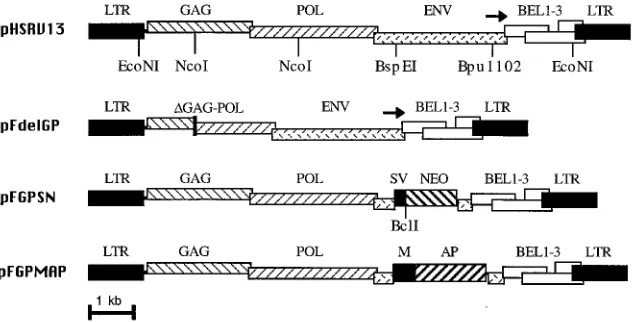
Vector construction and production.Relevant restriction sites are shown in Fig. 1. pFdelGP is a deletion derivative of pHSRV13 (22) lacking the internal
NcoI fragment. pFGPXhoI (not shown) is a deletion derivative of pHSRV13
made by digestion with BspEI and Bpu 1102, end-filling with the Klenow frag-ment of DNA polymerase I, and insertion of an XhoI linker (59 -CCTCGAGG-39). pFGPSN was made by inserting an NheI-XhoI fragment of pLXSN (29) containing the SV40 early promoter and neomycin phosphotransferase gene into the XhoI site of pFGPXhoI. pFGPMAP was made by inserting a SalI-BspMI fragment of pALAPSN (43) containing the MLV LTR promoter and the human placental alkaline phosphatase gene into the XhoI site of pFGPXhoI.
Vector stocks were made by calcium phosphate cotransfection of BHK21 cells with 10mg each of vector plasmid and helper plasmid per 6-cm dish, further culture for 3 to 11 days, with medium changes every 2 to 3 days, collection of culture medium, and filtration through cellulose acetate filters (0.45-mm pore size). Stocks were stored in aliquots at2768C. Unless otherwise indicated, stocks were prepared by transfecting with pFGPMAP and pHSRV13 (FGPMAP) or pFGPSN and pFdelGP (FGPSN). Stocks of the MLV vector LAPSN (31) were prepared in PA317 cells as described before (29).
Transduction assays.Unless otherwise indicated, all cells were plated at 23 105
cells per 35-mm well the day before infection, and infections were performed by adding dilutions of vector stocks in the presence of Polybrene (4mg/ml; Sigma). Polybrene did not increase the transduction efficiency of HFV vectors (data not shown) but was included to improve transduction of control cultures by MLV vectors. Transduction of G418 resistance was performed by infecting on day 1, treating with trypsin, plating the cells at different dilutions in DMEM with 10% FBS on day 2, and adding active G418 to 0.50 mg/ml (human fibroblasts) or 0.70 mg/ml (FAB cells and 208F cells) on day 3 (human fibroblasts and 208F cells) or day 2 (FAB cells). Surviving colonies were counted after staining with Coomassie brilliant blue G on days 7 to 10, when all cells in control cultures were dead. Transduction of alkaline phosphatase was measured by histochemical staining 2 days after infection and counting individual stained foci of cells (7). Helper virus expressing the bel1 gene was assayed in parallel with vector assays by staining FAB cells forb-galactosidase 2 days after infection (53).
RESULTS
Production of foamy virus vectors.
We replaced a portion of
the env gene of the pHSRV13 HFV provirus (22) with either
* Corresponding author. Present address: Markey Molecular Med-icine Center, Mailstop 357720, University of Washington, Seattle, WA 98195-7720. Phone: (206) 616-4562. Fax: (206) 543-3560.
217
on November 9, 2019 by guest
the neomycin phosphotransferase gene under the control of
the SV40 early promoter or the human placental alkaline
phos-phatase gene under the control of the MLV LTR promoter to
make the vector constructs pFGPSN and pFGPMAP,
respec-tively (Fig. 1). This env deletion prevents the synthesis of a
functional envelope protein and also disrupts the internal bel1
promoter required for high-level expression of the Bel1
trans-activator protein. Vector stocks were generated by
cotransfec-tion of BHK21 cells with a vector plasmid construct and either
the wild-type pHSRV13 plasmid or the pFdelGP helper
con-struct, containing a deletion in the gag and pol genes (Fig. 1).
Functional vector particles were measured by infecting FAB
cells with filtered culture medium collected at different times
after transfection. FAB cells contain an integrated copy of a
nuclear
b
-galactosidase gene under the control of the HFV
LTR promoter (53), so infection by viruses expressing the bel1
gene leads to transactivation of the HFV LTR, the production
of
b
-galactosidase, and blue histochemical nuclear staining. As
the pFGPSN and pFGPMAP vector constructs do not produce
high levels of Bel1, infection by vector particles does not lead
to detectable
b
-galactosidase expression, and transduction can
be measured by G418 resistance (FGPSN) or purple
histo-chemical staining for alkaline phosphatase (FGPMAP).
Al-though both titering methods measure gene expression from
an internal promoter, there could be differences in titering
efficiency as it relates to virion particle numbers.
After
transfecting
BHK21
cells
with
pFGPSN
and
pHSRV13, vector titers were approximately 10-fold lower than
helper virus titers, while transfection with pFGPSN and
pFdelGP produced nearly equivalent vector and helper titers
after 7 days (Fig. 2A and B). The higher helper titers obtained
with pHSRV13 were not unexpected, as this construct
pro-duces replication-competent virus, while pFdelGP can only
produce helper particles in the presence of gag and pol genes
encoded by the vector construct. When BHK21 cells were
transfected with pFGPSN and pHSRV13 and then cultured in
the presence of G418 to ensure that all cells infected with
helper virus also contain vector sequences, vector titers were as
high as helper titers (Fig. 2C). With the same transfection
procedures, the pFGPMAP construct produced similar titers,
ranging from 1
3
10
3to 5
3
10
4FAB cell transducing units at
5 to 7 days after transfection (data not shown). We have also
produced vector stocks by transfecting NIH 3T3 TK
2cells, 293
cells, and COS-7 cells (data not shown).
Transduction of different cell types by foamy virus vectors.
We screened a series of cell lines from different species to
determine the range of cells that can be transduced by HFV
vectors. Fourteen cell lines from species ranging from humans
to chickens were all transduced by the FGPMAP vector (Table
1). The small differences in transduction efficiencies did not
correlate with evolutionary divergence among species, cell
his-tological type, or state of cellular transformation.
Integration of vector genomes.
The structure of vector
ge-nomes present in transduced cells was determined by Southern
analysis. Independent G418-resistant clones were isolated
from rat 208F cells infected with FGPSN and expanded to
more than 10
7cells before high-molecular-weight DNA was
isolated. Figure 3 shows the results of EcoNI and BclI
restric-tion digests from six representative G418-resistant clones
probed with neo sequences. EcoNI cleaves inside both terminal
repeats of pFGPSN, producing an 8.9-kb fragment containing
the FGPSN coding regions, while BclI cleaves 5
9
to the neo
gene, producing fragments with 3
9
BclI sites in adjoining
chro-mosomal DNA (see Fig. 1). Three of these cell lines (clones 1
to 3) contained the EcoNI fragment expected from intact
pro-viruses bounded by LTRs. Two transductants (clones 4 and 6)
contained smaller proviruses, which further analysis showed
contained the gag-pol deletion present in the pFdelGP helper
construct (data not shown). We have analyzed a total of 10
transductants: 6 contained intact proviruses, 3 contained
gag-pol deletions from pFdelGP, and 1 (clone 5) contained a
pro-virus with a larger than expected EcoNI fragment, which we
have not characterized further (Fig. 3 and data not shown).
Digestion with BclI produced various sizes of neo-hybridizing
restriction fragments, consistent with random integration. No
integrated helper virus was detected in any of the clones
ana-lyzed when the blots were probed with viral sequences (data
not shown).
[image:2.612.149.467.72.233.2]Effect of cell proliferation on transduction.
We compared
the transduction rates of HFV vectors on stationary-phase and
dividing cultures of human fibroblasts and rat 208F cells.
In-fections were performed at low multiplicities to avoid
coinfec-tion with helper virus. Stacoinfec-tionary-phase cultures were prepared
by maintaining confluent cell monolayers in 5% FBS and 10
26M dexamethasone under conditions that resulted in
approxi-mately 4% (human fibroblasts) or
,
1% (208F cells) of the cells
passing through S phase each day (30, 43). Dividing cultures
were subconfluent cells grown in 10% FBS, with 60% (human
FIG. 1. Foamy virus constructs. The structures of HFV constructs used to generate vector stocks are shown. The positions of the viral gag, pol, env, and bel genes are indicated, as are the HFV LTRs and the internal viral promoter (arrow). Also shown are the pFdelGP gag-pol deletion and the SV40 early promoter (SV), neomycin phosphotransferase gene (NEO), MLV LTR promoter (M), and alkaline phosphatase gene (AP) present in the pFGPSN and pFGPMAP vectors. The locations of relevant restriction sites are shown below the constructs.
on November 9, 2019 by guest
http://jvi.asm.org/
fibroblasts) or
.
90% (208F cells) of the cells passing through
S phase each day (43) (data not shown). If transduction occurs
only in proliferating cells, stationary-phase cultures should be
transduced at approximately 7% or
,
1% the rate of dividing
cultures for human fibroblasts and 208F cells, respectively.
Figure 4 shows the relative transduction efficiencies of HFV
and MLV vectors on stationary-phase and dividing cultures,
plotted as the stationary-to-dividing efficiency ratio (S/D ratio).
In an alkaline phosphatase assay which can be performed
with-out stimulating cultures to divide, the S/D ratio for HFV
vec-tors was 0.18 on human fibroblast cultures and 0.07 on 208F
cells. While these results show that HFV vectors preferentially
transduce proliferating cells, the ratios are higher than those
expected if transduction occurred only in cells actively
prolif-erating at the time of infection and higher than those obtained
with MLV vectors. In a G418 resistance assay, which requires
that cells be treated with trypsin after the infection and allowed
to divide during selection, the S/D ratio was 1.0 for HFV
vectors and 0.14 for MLV vectors. The higher S/D ratios
ob-tained with the G418 resistance assay suggest that efficient
vector gene expression occurs after these cells are stimulated
to divide.
[image:3.612.58.296.65.491.2]Human serum does not inactivate HFV vectors.
Human
serum is known to inactivate several animal retroviruses,
in-cluding MLV (52), while human retroviruses such as human
T-cell leukemia virus and HIV are not inactivated by human
serum, which may contribute to their pathogenicity (2, 15). We
measured transduction by HFV and MLV vectors after
incu-bating them with three different human serum samples. As
shown in Fig. 5, there was no decrease in the transduction
efficiency of FGPMAP after serum exposure under conditions
that inactivated MLV vectors (42, 48). Thus, HFV is similar to
FIG. 2. Foamy virus vector production. BHK21 cells were cotransfected with pFGPSN and pHSRV13 (A and C) or pFdelGP (B) and then cultured for an additional 11 days. The medium was changed the day after transfection (day 1) and then collected and replaced every 2 days afterwards. Collected medium was filtered and used to infect FAB cells. Vector titers were measured by the pro-duction of G418-resistant colonies (G418 CFU), and helper titers were measured as blue-cell-forming units (BCFU) after staining forb-galactosidase. In panel B, the 3-day BCFU titer was,1/ml. In panel C, G418 (700mg of active drug per ml) was added to the culture on day 2. Titers are per milliliter.
FIG. 3. Integration of foamy virus vector genomes. Southern analysis was performed with a neo gene probe and 10mg of high-molecular-weight DNA isolated from six independent G418-resistant clones of 208F cells transduced by FGPSN (lanes 1 to 6) or untransduced 208F cells (No Vector lane). The pFG-PSN lane contains 10 pg of pFGpFG-PSN plasmid DNA mixed with untransduced 208F cell DNA. Samples were digested with EcoNI or BclI as indicated. The positions of size standards from the same gel are shown.
Chicken Embryo fibroblasts 2,700 0.16
aEach cell type was infected with FGPMAP and stained for alkaline phos-phatase (AP) expression 2 days later, and the number of AP focus-forming units (FFU) per milliliter (FFU/ml) of vector stock was determined. All results are the averages of two independent measurements that varied by less than 36% from the mean. No AP foci were observed in uninfected control cultures.
b
Relative transduction efficiency is the AP FFU/ml on each cell type divided by the AP FFU/ml on normal human fibroblasts.
on November 9, 2019 by guest
[image:3.612.337.528.553.663.2]known human retroviruses in its resistance to human
comple-ment.
DISCUSSION
Vector production.
The transient cotransfection procedure
that we have used generated vector stocks with titers as high as
5
3
10
4per ml. Wild-type HFV can be grown to titers of up to
10
9/ml under optimal conditions (53), so higher vector titers
may be possible with improved packaging systems. Vector
stocks free of helper virus were generated at early times after
transfection by using the pFdelGP deleted helper construct
(see Fig. 2B). However, a single recombination event between
vector and helper constructs could have generated
replication-competent helper virus at later time points. Further
modifica-tions of the helper construct should prevent the formation of
replication-competent helper virus, as was the case for MLV
packaging lines (27).
Host range.
Every vertebrate cell type that we tested was
transduced by HFV vectors, suggesting that the receptor used
for viral entry is a common cell surface molecule. Previous
studies concluded that some cell lines, including COS-7 cells,
were resistant to HFV infection, based on the absence of
observed cytopathic effects (3, 20, 22) and decreased virus
production (23). However, COS-7 cells were transduced by
HFV vectors in our experiments. Thus, it is possible that virus
entry, reverse transcription, and gene expression can occur
without cytopathic effects (syncytium formation) or the
pro-duction of functional viral particles in some cell types.
Provirus integration.
Cultures infected with foamy viruses
usually contain high copy numbers of episomal, linear cDNA
molecules that may be generated by repeated infections (18,
26, 38). As these cultures are producing viral particles, the
episomal viral DNA molecules could be transcriptionally
ac-tive. Although foamy viruses contain reverse transcriptase and
integrase genes that should allow the formation of an
inte-grated provirus, the limited life span of actively infected cells
and excess of episomal molecules make the detection of
inte-grated proviruses problematic. Inteinte-grated simian foamy virus 3
genomes were detected in infected Vero cells grown for more
than 50 passages in the presence of 3
9
-azido-3
9
-deoxythymidine
to prevent cytopathic effects (46). However, the efficiency of
integration is not known, and the entire foamy virus life cycle
could occur without chromosomal integration in most infected
cells.
All of the G418-resistant transductants that we analyzed
contained integrated vector proviruses, most of which
ap-peared to be randomly integrated, intact vector genomes
bounded by LTRs. Thus, foamy virus vectors integrate in a
typical retroviral pattern. The deleted proviruses that we
de-tected were presumably created by recombination between
vector and helper sequences, which could have happened
dur-ing the transfection procedure or durdur-ing reverse transcription.
Transductants contained single-copy proviruses and no helper
genomes, so vector integration occurred in the absence of
helper virus.
[image:4.612.372.503.68.255.2]Effects of cell proliferation on transduction.
Oncoviruses
such as MLV require cell proliferation for efficient infection
(13), while lentiviruses such as visna virus and HIV do not (12,
19). In the case of MLV, mitosis is required for nuclear entry
of viral particles (41), and vectors based on MLV require cell
division for efficient transduction (30). Although syncytium
formation and virus production are decreased when confluent
cultures are infected by foamy viruses (23, 35, 36), it is not
known if viral DNA synthesis and gene expression require cell
proliferation. Our findings suggest that HFV vectors
preferen-tially transduce dividing cultures, but the transduction
effi-ciency on stationary-phase cultures is higher than for MLV
vectors and higher than expected if transduction occurs only in
cells proliferating at the time of infection. The HFV Gag
[image:4.612.82.268.75.275.2]FIG. 4. Transduction in stationary-phase and dividing cultures. Stationary-phase and dividing cultures of human fibroblasts and rat 208F cells were trans-duced with the HFV vector FGPMAP (solid columns, alkaline phosphatase [AP] assay), the HFV vector FGPSN (solid columns, G418 assay), and the MLV vector LAPSN produced in PA317 cells (hatched columns) and then stained for alkaline phosphatase expression (AP assay) or selected for G418 resistance (G418 assay). The S/D ratio is the vector titer measured in stationary-phase cultures divided by that in dividing cultures. Mean values are plotted with standard errors. FGPMAP infections contained less than one transducing par-ticle and less than 10 helper parpar-ticles per 1,000 cells. FGPSN infections con-tained less than one transducing particle and less than 0.1 helper particle per 5,000 cells.
FIG. 5. HFV vectors are not inactivated by human serum. Stocks of FGP-MAP and LAPSN(PA317) were incubated with an equal volume of serum from three different individuals for 30 min at 378C and then used to transduce rat 208F cells as described before (42). Results are shown as the titer of vector stocks incubated with human serum divided by the titer of stocks incubated under identical conditions with heat-inactivated serum (30 min at 568C). Mean values are plotted with standard errors. Heat-inactivated serum samples did not de-crease vector titers compared with the titers after incubation with DMEM con-taining 10% FBS (data not shown).
on November 9, 2019 by guest
http://jvi.asm.org/
tion of nondividing cells. HFV vectors are not inactivated by
human serum and do not require the addition of polycations
such as Polybrene for efficient transduction, so they may be
especially well suited for in vivo gene delivery. Because Bel1 is
required for high-level transcription from the viral LTR,
inte-grated Bel1-deficient vectors should not activate downstream
cellular genes by promoter insertion. These properties, as well
as the lack of pathogenicity associated with foamy virus
infec-tions, suggest that foamy virus vectors may be safe and effective
in gene therapy protocols.
ACKNOWLEDGMENTS
We thank R. Flu¨gel for supplying pHSRV13, S. Yu for FAB cells, I. Alexander for helpful suggestions, and J. Alfano and R. Hirata for technical assistance.
This work was supported by grants HL53750, HL03100, and DK47754 from the U.S. National Institutes of Health (NIH) and grants from the American Society of Hematology and the American Philosophical Society.
REFERENCES
1. Achong, B. G., P. W. A. Mansel, M. A. Epstein, and P. Clifford. 1971. An unusual virus in cultures from a human nasopharyngeal carcinoma. J. Natl. Cancer Inst. 46:299–302.
2. Banapour, B., J. Sernatinger, and J. A. Levy. 1986. The AIDS-associated retrovirus is not sensitive to lysis or inactivation by human serum. Virology 152:268–271.
3. Brown, P., G. Nemo, and D. C. Gajdusek. 1978. Human foamy virus: further characterization, seroepidemiology, and relationship to chimpanzee foamy viruses. J. Infect. Dis. 137:421–427.
4. Bukrinsky, M. I., S. Haggerty, M. P. Dempsey, N. Sharova, A. Adzhubel, L. Spitz, P. Lewis, D. Goldfarb, M. Emerman, and M. Stevenson. 1993. A nuclear localization signal within HIV-1 matrix protein that governs infec-tion of non-dividing cells. Nature (London) 365:666–669.
5. Bukrinsky, M. I., N. Sharova, M. P. Dempsey, T. L. Stanwick, A. G. Bukrin-skaya, S. Haggerty, and M. Stevenson.1992. Active nuclear import of human immunodeficiency virus type 1 preintegration complexes. Proc. Natl. Acad. Sci. USA 89:6580–6584.
6. Duc-Ngugen, H., E. N. Rosenblum, and R. F. Zeigel. 1966. Persistent infec-tion of a rat kidney cell line with Rauscher murine leukemia virus. J. Bac-teriol. 92:1133–1140.
7. Fields-Berry, S. C., A. L. Halliday, and C. L. Cepko. 1992. A recombinant retrovirus encoding alkaline phosphatase confirms clonal boundary assign-ment in lineage analysis of murine retina. Proc. Natl. Acad. Sci. USA 89: 693–697.
8. Fischinger, P. J., S. Nomura, and D. P. Bolognesi. 1975. A novel murine oncornavirus with dual eco- and xenotropic properties. Proc. Natl. Acad. Sci. USA 72:5150–5155.
9. Flu¨gel, R. M.1991. Spumaviruses: a group of complex retroviruses. J. Ac-quired Immune Defic. Syndr. 4:739–750.
10. Flu¨gel, R. M., A. Rethwilm, B. Maurer, and G. Darai.1987. Nucleotide sequence analysis of the env gene and its flanking regions of the human spumaretrovirus reveals two novel genes. EMBO J. 6:2077–2084. 11. Graham, F. L., J. Smiley, W. C. Russell, and R. Nairn. 1977. Characteristics
of a human cell line transformed by DNA from human adenovirus type 5. J. Gen. Virol. 36:59–72.
19. Lewis, P., M. Hensel, and M. Emerman. 1992. Human immunodeficiency virus infection of cells arrested in the cell cycle. EMBO J. 11:3053–3058. 20. Lo¨chelt, M., R. M. Flu¨gel, and M. Aboud.1994. The human foamy virus
internal promoter directs the expression of the functional Bel 1 transactiva-tor and Bet protein early after infection. J. Virol. 68:638–645.
21. Lo¨chelt, M., W. Muranyi, and R. M. Flu¨gel.1993. Human foamy virus genome possesses an internal, Bel-1-dependent and functional promoter. Proc. Natl. Acad. Sci. USA 90:7317–7321.
22. Lo¨chelt, M., H. Zentgraf, and R. M. Flu¨gel.1991. Construction of an infec-tious DNA clone of the full-length human spumaretrovirus genome and mutagenesis of the bel1 gene. Virology 184:43–54.
23. Loh, P. C., and K. S. Ang. 1981. Replication of human syncytium-forming virus in human cells: effect of certain biological factors and selective chem-icals. J. Med. Virol. 7:67–73.
24. Macpherson, I., and M. Stoker. 1962. Polyoma transformation of hamster cell clones—an investigation of genetic factors affecting cell competence. Virology 16:147–151.
25. Maurer, B., H. Bannert, G. Darai, and R. M. Flu¨gel.1988. Analysis of the primary structure of the long terminal repeat and the gag and pol genes of the human spumaretrovirus. J. Virol. 62:1590–1597.
26. Mergia, A., and P. A. Luciw. 1991. Replication and regulation of primate foamy viruses. Virology 184:475–482.
27. Miller, A. D. 1992. Retroviral vectors. Curr. Top. Microbiol. Immunol. 158: 1–24.
28. Miller, A. D., and C. Buttimore. 1986. Redesign of retrovirus packaging cell lines to avoid recombination leading to helper virus production. Mol. Cell. Biol. 6:2895–2902.
29. Miller, A. D., and G. J. Rosman. 1989. Improved retroviral vectors for gene transfer and expression. Biotechniques 7:980–990.
30. Miller, D. G., M. A. Adam, and A. D. Miller. 1990. Gene transfer by retro-virus vectors occurs only in cells that are actively replicating at the time of infection. Mol. Cell. Biol. 10:4239–4242.
31. Miller, D. G., R. H. Edwards, and A. D. Miller. 1994. Cloning of the cellular receptor for amphotropic murine retroviruses reveals homology to that for gibbon ape leukemia virus. Proc. Natl. Acad. Sci. USA 91:78–82. 32. Muranyi, W., and R. M. Flu¨gel.1991. Analysis of splicing patterns of human
spumaretrovirus by polymerase chain reaction reveals complex RNA struc-tures. J. Virol. 65:727–735.
33. Muzyczka, N. 1992. Use of adeno-associated virus as a general transduction vector for mammalian cells. Curr. Top. Microbiol. Immunol. 158:97–129. 34. Palmer, T. D., R. A. Hock, W. R. A. Osborne, and A. D. Miller. 1987. Efficient
retrovirus-mediated transfer and expression of a human adenosine deami-nase gene in diploid skin fibroblasts from an adenosine deamideami-nase-deficient human. Proc. Natl. Acad. Sci. USA 84:1055–1059.
35. Parks, W. F., and G. J. Todaro. 1972. Biological properties of syncytium-forming (‘‘foamy’’) viruses. Virology 47:673–683.
36. Parks, W. F., G. J. Todaro, E. M. Scolnick, and S. A. Aaronson. 1971. RNA-dependent DNA polymerase in primate syncytium-forming (foamy) viruses. Nature (London) 229:258–260.
37. Quade, K. 1979. Transformation of mammalian cells by avian myelocytoma-tosis virus and avian erythroblasmyelocytoma-tosis virus. Virology 98:461–465. 38. Renshaw, R. W., M. A. Gonda, and J. W. Casey. 1991. Structure and
tran-scriptional status of bovine syncytial virus in cytopathic infections. Gene 105:179–184.
39. Rethwilm, A., G. Baunach, K.-O. Netzer, B. Maurer, B. Borisch, and V. ter Meulen.1990. Infectious DNA of the human spumaretrovirus. Nucleic Acids Res. 18:733–738.
40. Rethwilm, A., O. Erlwein, G. Baunach, B. Maurer, and V. ter Meulen. 1991. The transcriptional transactivator of human foamy virus maps to the bel1 genomic region. Proc. Natl. Acad. Sci. USA 88:941–945.
41. Roe, T. Y., T. C. Reynolds, G. Yu, and P. Brown. 1993. Integration of murine leukemia virus DNA depends on mitosis. EMBO J. 12:2099–2108.
on November 9, 2019 by guest
42. Russell, D. W., M. S. Berger, and A. D. Miller. 1995. The effects of human serum and cerebrospinal fluid on retroviral vectors and packaging cell lines. Human Gene Ther. 6:635–641.
43. Russell, D. W., A. D. Miller, and I. E. Alexander. 1994. Adeno-associated virus vectors preferentially transduce cells in S phase. Proc. Natl. Acad. Sci. USA 91:8915–8919.
44. Schliephake, A. W., and A. Rethwilm. 1994. Nuclear localization of foamy virus Gag precursor protein. J. Virol. 68:4946–4954.
45. Schmidt, M., and A. Rethwilm. 1995. Replicating foamy virus-based vectors directing high level expression of foreign genes. Virology 210:167–178. 46. Schweizer, M., U. Fleps, A. Ja¨ckle, R. Renne, R. Turek, and D.
Neumann-Haefelin.1993. Simian foamy virus type 3 (SFV-3) in latently infected Vero cells: reactivation by demethylation of proviral DNA. Virology 192:663–666. 47. Schweizer, M., R. Turek, H. Hahn, A. Schliephake, K.-O. Netzer, G. Eder, M. Reinhardt, A. Rethwilm, and D. Neumann-Haefelin.1995. Markers of foamy virus infections in monkeys, apes, and accidentally infected humans: appro-priate testing fails to confirm suspected foamy virus prevalence in humans. AIDS Res. Hum. Retroviruses 11:161–170.
48. Takeuchi, Y., F.-L. C. Cosset, P. J. Lachmann, H. Okada, R. A. Weiss, and
M. K. L. Collins.1994. Type C retrovirus inactivation by human complement is determined by both the viral genome and the producer cell. J. Virol. 68:8001–8007.
49. Venkatesh, L. K., P. A. Theodorakis, and G. Chinnadurai. 1991. Distinct cis-acting regions in U3 regulate trans-activation of the human spumaretro-virus long terminal repeat by the viral bel1 gene product. Nucleic Acids Res. 19:3661–3666.
50. Wei, C. M., M. Gibson, P. G. Spear, and E. M. Scolnick. 1981. Construction and isolation of a transmissible retrovirus containing the src gene of Harvey murine sarcoma virus and the thymidine kinase gene of herpes simplex virus type 1. J. Virol. 39:935–944.
51. Weiss, R. A., N. Teich, H. E. Varmus, and J. M. Coffin. 1984. RNA tumor viruses, 2nd ed. Cold Spring Harbor Laboratory, Cold Spring Harbor, N.Y. 52. Welsh, R. M., N. R. Cooper, F. C. Jensen, and M. B. A. Oldstone. 1975. Human serum lyses RNA tumour viruses. Nature (London) 257:612–614. 53. Yu, S. F., and M. L. Linial. 1993. Analysis of the role of the bel and bet open
reading frames of human foamy virus by using a new quantitative assay. J. Virol. 67:6618–6624.