A Note on the Partially Truncated
Euler–Maruyama Method
Qian Guo
1∗, Wei Liu
1†, Xuerong Mao
2‡1
Department of Mathematics,
Shanghai Normal University, Shanghai, China.
2
Department of Mathematics and Statistics,
University of Strathclyde, Glasgow G1 1XH, U.K.
Abstract
The partially truncated Euler–Maruyama (EM) method was recently proposed in our
earlier paper (Guo, Liu, Mao and Yue, 2017) for highly nonlinear stochastic differential
equations (SDEs), where the finite-time strongLr-convergence theory was established.
In this note, we will point out that one condition imposed there is restrictive in the sense
that this condition might force the stepsize to be so small that the partially truncated
EM method would be inapplicable. In this note, we will remove this restrictive condition
but still be able to establish the finite-time strongLr-convergence rate. The advantages
of our new results will be highlighted by the comparisons with our earlier results in (Guo,
Liu, Mao and Yue, 2017).
Key words: Stochastic differential equation, local Lipschitz condition,
Khasminskii-type condition, partially truncated Euler-Maruyama method, convergence rate.
1
Introduction
Influenced by Mao’s papers [8, 9], we recently in [3] developed a new explicit numerical scheme,
called the partially truncated EM method, for nonlinear SDEs under the local Lipschitz
condi-∗E-mail:[email protected]
tion plus the Khasminskii-type condition. The real benefits of this new method lie in that the
method can well preserve the asymptotic stability and boundedness of the underlying SDEs.
However, we will point out in Section 2 that one condition imposed in [3] is restrictive in the
sense that this condition might force the stepsize to be so small that the partially truncated
EM method would be inapplicable. In this note, we will remove this restrictive condition but
still be able to establish the finite-time strong Lr-convergence rate.
As this is the continuation of our earlier paper [3], we will use the same notation as used
there. We will only list and cite some necessary references here but the reader can find more
in [3].
2
Motivation
In this section, we will point out that one condition imposed in [3] is restrictive in the sense
that this condition might force the stepsize to be so small that the partially truncated EM
method would be inapplicable. For this purpose, we need to make a quick review on the
partially truncated EM method. Consider a d-dimensional SDE
dx(t) =f(x(t))dt+g(x(t))dB(t) (2.1)
on t ≥ 0 with the initial value x(0) = x0 ∈ Rd, where B(t) is an m-dimensional Brownian
motion,f :Rd→Rd and g :
Rd→Rd×m.We assume that f and g can be decomposed as
f(x) = F1(x) +F(x) and g(x) =G1(x) +G(x), (2.2)
where F1, F : Rd → Rd and G1, G : Rd → Rd×m are all Borel measurable. The assumptions
imposed in [3] are listed below.
Assumption 2.1 Assume that there are constants L1 >0 and γ ≥0 such that
|F1(x)−F1(y)| ∨ |G1(x)−G1(y)| ≤L1|x−y| (2.3)
and
|F(x)−F(y)| ∨ |G(x)−G(y)| ≤L1(1 +|x|γ+|y|γ)|x−y| (2.4)
Assumption 2.2 Assume that there is a pair of constants r >¯ 2 and L2 such that
(x−y)T(F(x)−F(y)) + ¯r−1
2 |G(x)−G(y)|
2 ≤L
2|x−y|2 (2.5)
for all x, y ∈Rd.
Assumption 2.3 Assume that there are constants p >¯ r¯and K2 >0 such that
xTF(x) + p¯−1 2 |G(x)|
2 ≤K
2(1 +|x|2) (2.6)
for all x∈Rd.
As pointed out in [3], (2.6) cannot be deduced from (2.5) as we need ¯p >r¯. Moreover, we
observe from (2.3) that the coefficients F1 andG1 satisfy the linear growth condition, namely
there exists a constant K1 >0 such that
|F1(x)| ∨ |G1(x)| ≤K1(1 +|x|) (2.7)
for all x∈Rd.
To define the partially truncated EM numerical solutions, we first choose a strictly
in-creasing continuous function µ:R+ →R+ such that µ(u)→ ∞ asu→ ∞ and
sup
|x|≤u
|F(x)| ∨ |G(x)|
≤µ(u), ∀u≥1. (2.8)
Denote byµ−1 the inverse function ofµand we see thatµ−1 is a strictly increasing continuous function from [µ(0),∞) toR+. We also choose a strictly decreasing functionh: (0,1]→(0,∞)
and a constant ¯h≥1 such that
lim
∆→0h(∆) =∞ and ∆ 1/4
h(∆)≤¯h, ∀∆∈(0,1]. (2.9)
Before we proceed, let us make an useful remark.
Remark 2.4 In [3] where the partially truncated EM was originally developed, it was required
to choose a number ∆∗ ∈ (0,1] and a strictly decreasing function h : (0,∆∗] → (0,∞) such that
h(∆∗)≥µ(1), lim
∆→0h(∆) =∞ and ∆ 1/4
h(∆) ≤1, ∀∆∈(0,1).
do not make any effect on the results in [3]. In fact, the condition h(∆∗)≥µ(1) was only used to show [3, Lemma 2.5] (followed from [8]). Instead of [3, Lemma 2.5], we will have our new
Lemma 3.2. Comparing these two lemmas, we observe that the constant 2K2 in [3, Lemma
2.5] is now replaced by K4 in our our new Lemma 3.2. But this change does not have any
effect on the results in [3]. We can also check that replacing ∆1/4h(∆) ≤1 by ∆1/4h(∆)≤ ¯h
does not make any effect on the proof of [3, Lemma 3.2],which we will cite as Lemma 3.3 in
this paper (in fact, such a change does not make any effect on any result in [3]).
For a given stepsize ∆ ∈(0,1], let us define the mappingπ∆ :Rd →Rd by
π∆(x) = (|x| ∧µ−1(h(∆)))
x
|x|,
where we set x/|x|= 0 when x= 0. We then define the truncated functions
F∆(x) =F(π∆(x)) and G∆(x) =G(π∆(x)) (2.10)
for x∈Rd. It is easy to see that
|F∆(x)| ∨ |G∆(x)| ≤µ(µ−1(h(∆))) =h(∆) ∀x∈Rd. (2.11)
From now on we will define
f∆(x) = F1(x) +F∆(x) and g∆(x) =G1(x) +G∆(x). (2.12)
The discrete-time partially truncated EM numerical solutionsX∆(tk)≈x(tk) fortk =k∆
are formed by setting X∆(0) =x0 and computing
X∆(tk+1) =X∆(tk) +f∆(X∆(tk))∆ +g∆(X∆(tk))∆Bk, (2.13)
fork = 0,1,· · ·, where ∆Bk =B(tk+1)−B(tk). There are two versions of the continuous-time
truncated EM solutions. The first one is defined by
¯
x∆(t) =
∞
X
k=0
X∆(tk)I[tk,tk+1)(t), t ≥0, (2.14)
where throughout this paper ID denotes the indicator function of set D. This is a simple step
process so its sample paths are not continuous. We will refer to this as the continuous-time
step-process partially truncated EM solution. The other one is defined by
x∆(t) =x0+
Z t
0
f∆(¯x∆(s))ds+
Z t
0
for t ≥0. We will refer to this as the continuous-time continuous-sample partially truncated
EM solution. We observe thatx∆(tk) = ¯x∆(tk) = X∆(tk) for all k ≥0. Moreover, x∆(t) is an
Itˆo process with its Itˆo differential
dx∆(t) = f∆(¯x∆(t))dt+g∆(¯x∆(t))dB(t). (2.16)
The following theorem is one of the main results in [3].
Theorem 2.5 ([3, Theorem 3.1]) Let Assumptions 2.1, 2.2 and 2.3 hold and let T > 0 be
arbitrary. If p∈(¯r,p¯), 2p >rγ¯ and for r∈[2,r¯)
h(∆)≥µ((∆r/2(h(∆))r)−1/(p−r)), (2.17)
then there is a ∆¯ ∈(0,∆∗] such that for all ∆∈(0,∆]¯
E|x∆(T)−x(T)|r≤C∆r/2(h(∆))r (2.18) and
E|x¯∆(T)−x(T)|r ≤C∆r/2(h(∆))r, (2.19) where throughout this paper C stands for generic positive real constants.
Let us now explain, via an example, that condition (2.17) is somehow restrictive as it
might force the stepsize to be so small that the partially truncated EM method would be
inapplicable. Consider the scalar power logistic model in a population system (see, e.g., [1])
dx(t) = x(t)[(5−10x2(t))dt+x(t)dB(t)], (2.20)
whereB(t) is a scalar Brownian motion. Naturally, we can decompose the coefficientsf(x) =
5x−10x3 and g(x) = x2 in the form of (2.2) with
F1(x) = 5x, F(x) =−10x3, G1(x) = 0, G(x) = x2.
Obviously, (2.3) is satisfied byF1 and G1, while it is easy to verify
|F(x)−F(y)| ∨ |G(x)−G(y)| ≤15|x−y|(1 +x2+y2), ∀x, y ∈R.
Thus, Assumption 2.1 is satisfied with γ = 2. It is also not difficult to show that for ¯r= 3,
(x−y)(F(x)−F(y)) + r¯−1
2 |G(x)−G(y)|
2 ≤
whence Assumption 2.2 is satisfied with ¯r = 3. Moreover, for ¯p= 21,
xF(x) + p¯−1 2 |G(x)|
2 = 0, ∀x,∈
R,
so Assumption 2.3 is satisfied with ¯p= 21. Furthermore, we have
sup
|x|≤u
|F(x)| ∨ |G(x)|
≤10u3, ∀u≥1,
whence we can choose µ(u) = 10u3. Finally choose h(∆) = ∆−1/6 which meets condition (2.9). Then, for r = 2 andp= 20, condition (2.17) becomes
∆−1/6 ≥10∆−1/9, namely ∆≤10−18. (2.21)
This means we have to use an extremely small stepsize in order to apply Theorem 2.5 but this
is not realistic. It is therefore very useful to remove this restrictive condition (2.17) and this
is the main driven force for us to write this note.
3
Main Results
3.1
Convergence rate
It was shown in [3] that under Assumptions 2.1 and 2.3, for anyp∈(2,p¯),
xTf(x) + p−1 2 |g(x)|
2 ≤
K3(1 +|x|2) (3.1)
for all x∈Rd, where
K3 = 2K1+K2 +
K2
1(p−1)(¯p−1)
¯
p−p .
It was also shown in [3] that under Assumptions 2.1 and 2.2, for any q∈(2,¯r)
(x−y)T(f(x)−f(y)) + q−1
2 |g(x)−g(y)|
2 ≤L
3|x−y|2, (3.2)
where
L3 = 2L1+L2+
L2
1(q−1)(¯r−1)
¯
r−q .
The following lemma is therefore well known (see, e.g., [5, 7, 11]).
Lemma 3.1 Under Assumptions 2.1 and 2.3, the SDE (2.1) has a unique global solution x(t)
and, moreover, for any p∈(2,p¯),
sup
0≤t≤T E
The following lemma shows that the truncated functionsF∆andG∆preserve Assumption
2.3 very well.
Lemma 3.2 Let Assumption 2.3 hold. Then, for all ∆∈(0,1], we have
xTF∆(x) +
¯
p−1
2 |G∆(x)|
2 ≤K
4(1 +|x|2), ∀x∈Rd, (3.4) where K4 = 2K2 1∨[1/µ−1(h(1))]
.
Proof. This lemma was essentially proved in [3, 8] but we here do not need conditionh(∆∗)≥
µ(1) as we pointed out in Remark 2.4.
Fix any ∆ ∈ (0,1]. For x ∈ Rd with |x| ≤ µ−1(h(∆)), the required assertion (3.4) holds
clearly. For x∈Rd with |x|> µ−1(h(∆)), the proof of [8, Lemma 2.4] shows that
xTF∆(x) +
¯
p−1
2 |G∆(x)|
2 ≤ |x|
µ−1(h(∆))K2(1 + [µ
−1(h(∆))]2).
Noting that µ−1(h(∆))≥µ−1(h(1)), we then derive
xTF∆(x) +
¯
p−1
2 |G∆(x)|
2 ≤K
2|x|
1
µ−1(h(1)) +|x|
≤ K2 1∨[1/µ−1(h(1))]
(|x|+|x|2)≤0.5K
4(1 + 2|x|2)≤K4(1 +|x|2)
as required. 2
As we explained in Remark 2.4, this lemma plays the same role as [3, Lemma 2.5] did and
all the results in [3] work although our new condition (2.9) on the function h(·) is simpler. In
particular, we can then cite a lemma from [3] for the use of this paper.
Lemma 3.3 Let Assumptions 2.1 and 2.3 hold. Let p∈(2,p¯) and T > 0 be arbitrary. Then
sup
0<∆≤1
sup
0≤t≤TE
|x∆(t)|p ≤C. (3.5)
(We emphasise once again that C stands for generic positive real constants dependent on
T,p, p, x¯ 0,K1, K2,¯hetc. but independent of∆and its values may change between occurrences.)
The following lemma was essentially proved in [3].
Lemma 3.4 Let Assumptions 2.1 and 2.3 hold. Let p∈(0,p¯) andT > 0be arbitrary. Then,
for every ∆∈(0,1],
Proof. This lemma was proved in [3] for p∈(2,p¯) in the sense that there is a ¯∆∈(0,1] such
that assertion (3.6) holds for all ∆∈(0,∆]. Our new version here is therefore an improvement¯
of that in [3]. It is sufficient to show our lemma for p ∈ (2,p¯) as the assertion for p ∈ (0,2]
follows then from the H¨older inequality. We hence fix p ∈ (2,p¯) arbitrarily. It follows from
Lemma 3.3 that
sup
0<∆≤1
sup
0≤t≤TE
|x∆(t)|p ≤C(h(1))p. (3.7)
Now, fix any ∆ ∈ (0,1]. For any t ∈ [0, T], there is a unique k ≥ 0 such that tk ≤ t ≤ tk+1.
By (2.7) and (2.11), it is easy to show from (2.15) that
E|x∆(t)−x¯∆(t)|p ≤C∆p/2
1 +E|x¯∆(t)|p+ (h(∆))p
. (3.8)
But, by (3.7) and the decreasing property of h,
E|x¯∆(t)|p ≤C(h(1))p ≤C(h(∆))p.
We hence get assertion (3.6) from (3.8). 2
Let us now present one more lemma which will be used in the proof of our main theorem
later.
Lemma 3.5 Let Assumption 2.1 hold. Then
|f(x)−f(y)| ∨ |g(x)−g(y)| ≤2L1(1 +|x|γ+|y|γ)|x−y| (3.9)
for all x, y ∈Rd. Moreover, for any ∆∈(0,1],
|f∆(x)−f∆(y)| ∨ |g∆(x)−g∆(y)| ≤2L1(1 +|x|γ+|y|γ)|x−y| (3.10)
for all x, y ∈Rd.
Proof. Assertion (3.9) follows easily from Assumption 2.1. To show assertion (3.10), we first
show that the truncated functions F∆ and G∆ preserve condition (2.4) perfectly. In fact, by
condition (2.4) , we have
|F∆(x)−F∆(y)| ∨ |G∆(x)−G∆(y)|
= |F(π∆(x))−F(π∆(y))| ∨ |G(π∆(x))−G(π∆(y))|
for all x, y ∈Rd. Noting
|π∆(x)| ≤ |x|, |π∆(y)| ≤ |y|, |π∆(x)−π∆(y)| ≤ |x−y|,
we get
|F∆(x)−F∆(y)| ∨ |G∆(x)−G∆(y)| ≤L1(1 +|x|γ+|y|γ)|x−y|. (3.11)
This, together with condition (2.3), implies the other assertion (3.10). 2
Moreover, we also observe from Assumption 2.1 that
|F(x)| ∨ |G(x)| ≤L4|x|(1+γ), ∀|x| ≥1, (3.12)
where L4 = 2L1+|F(0)|+|G(0)|.
The following theorem is our main result in this paper which shows the rate of Lr
-convergence. From now on, we will fix T >0 arbitrarily.
Theorem 3.6 Let Assumptions 2.1, 2.2, 2.3 hold and assume that there is a numberp∈(2,p¯)
such that
p > (1 +γ)¯r. (3.13)
Let r ∈[2,r¯) be arbitrary. Then for any ∆∈(0,1],
E|x(T)−x∆(T)|r ≤C
(µ−1(h(∆)))−(p−(1+γ)r)+ ∆r/2(h(∆))r
(3.14)
and
E|x(T)−x¯∆(T)|r ≤C
(µ−1(h(∆)))−(p−(1+γ)r)+ ∆r/2(h(∆))r. (3.15)
In particular, recalling (3.12), we may define
µ(u) =L4u(1+γ), u≥0, (3.16)
and let
h(∆) = ¯h∆−ε for some ε∈(0,1/4] (3.17)
to get
E|x(T)−x∆(T)|r ≤C ∆[ε(p−(1+γ)r)/(1+γ)]∧[r(1−2ε)/2] (3.18) and
Proof. First of all, fix a number q∈(r,r¯). By (3.13), we have
p > (1 +γ)q. (3.20)
We also fix ∆∈(0,1] arbitrarily. Letζ∆(t) = x(t)−x∆(t) fort≥0. For each integer n >|x0|,
define the stopping time
ρn = inf{t ≥0 :|x(t)| ∨ |x∆(t)| ≥n},
where we set inf∅=∞ (as usual ∅ denotes the empty set). By the Itˆo formula, we have that
for 0≤t≤T,
E|ζ∆(t∧ρn)|r ≤ E
Z t∧ρn
0
r|ζ∆(s)|r−2
ζ∆T(s)[f(x(s))−f∆(¯x∆(s))]
+r−1
2 |g(x(s))−g∆(¯x∆(s))|
2
ds. (3.21)
Noting
r−1
2 |g(x(s))−g∆(¯x∆(s))|
2
≤ r−1
2
h
1 + q−r
r−1
|g(x(s))−g(x∆(s))|2+
1 + r−1
q−r
|g(x∆(s))−g∆(¯x∆(s))|2 i
= q−1
2 |g(x(s))−g(x∆(s))|
2+(r−1)(q−1)
2(q−r) |g(x∆(s))−g(¯x∆(s))|
2,
we get from (3.21) that
E|ζ∆(t∧ρn)|r ≤H1+H2, (3.22)
where
H1 =E
Z t∧ρn
0
r|ζ∆(s)|r−2
ζ∆T(s)[f(x(s))−f(x∆(s))]
+ q−1
2 |g(x(s))−g(x∆(s))|
2ds (3.23)
and
H2 =E
Z t∧ρn
0
r|ζ∆(s)|r−2
ζ∆T(s)[f(x∆(s))−f∆(¯x∆(s))]
+ (r−1)(q−1)
2(q−r) |g(x∆(s))−g∆(¯x∆(s))|
2ds. (3.24)
By (3.2), we have
H1 ≤rL3E
Z t∧ρn
0
It is also easy to see that
H2 ≤H3+H4, (3.26)
where
H3 =E
Z t∧ρn
0
r|ζ∆(s)|r−2
ζ∆T(s)[f(x∆(s))−f∆(x∆(s))]
+(r−1)(q−1)
(q−r) |g(x∆(s))−g∆(x∆(s))|
2ds
and
H4 =E
Z t∧ρn
0
r|ζ∆(s)|r−2
ζ∆T(s)[f∆(x∆(s))−f∆(¯x∆(s))]
+(r−1)(q−1)
(q−r) |g∆(x∆(s))−g∆(¯x∆(s))|
2ds.
Let us estimate H4 first. By (3.10), we have
H4 ≤E
Z t∧ρn
0
r|ζ∆(s)|r−2
0.5|ζ∆(s)|2+ 0.5|f∆(x∆(s))−f∆(¯x∆(s))|2
+ (r−1)(q−1)
(q−r) |g∆(x∆(s))−g∆(¯x∆(s))|
2ds
≤0.5rE
Z t∧ρn
0
|ζ∆(s)|rds
+CE
Z t∧ρn
0
|ζ∆(s)|r−2(1 +|x∆(s)|2γ+|x¯∆(s)|2γ)|x∆(s)−x¯∆(s)|2ds. (3.27)
But, by the well-known Young inequality (see, e.g., [10, p.52]),
|ζ∆(s)|r−2(1 +|x∆(s)|2γ+|x¯∆(s)|2γ)|x∆(s)−x¯∆(s)|2
≤r−2
r |ζ∆(s)|
r
+ 2
r(1 +|x∆(s)|
2γ
+|x¯∆(s)|2γ)r/2|x∆(s)−x¯∆(s)|r
≤|ζ∆(s)|r+C(1 +|x∆(s)|γr+|x¯∆(s)|γr)|x∆(s)−x¯∆(s)|r.
Substituting this into (3.27) yields
H4 ≤CE
Z t∧ρn
0
|ζ∆(s)|rds
+C
Z T
0
E
(1 +|x∆(s)|γr+|x¯∆(s)|γr)|x∆(s)−x¯∆(s)|r
ds. (3.28)
By the H¨older inequality,
E
(1 +|x∆(s)|γr+|x¯∆(s)|γr)|x∆(s)−x¯∆(s)|r
≤3γr(p−1)/p E(1 +|x∆(s)|p+|x¯∆(s)|p)
γr/p
E|x∆(s)−x¯∆(s)|pr/(p−γr)
(p−γr)/p
But, by (3.20), we have p > (1 +γ)r and hence pr/(p−γr) < p. So we can apply Lemmas
3.3 and 3.4 to get
E
(1 +|x∆(s)|γr+|x¯∆(s)|γr)|x∆(s)−x¯∆(s)|r
≤C∆r/2(h(∆))r.
Substituting this into (3.28) gives
H4 ≤E
Z t∧ρn
0
|ζ∆(s)|rds+C∆r/2(h(∆))r. (3.29)
Let us now estimate H3. It is easy to show that
H3 ≤CE
Z t∧ρn
0
|ζ∆(s)|rds+H5, (3.30)
where
H5 =C
Z T
0
E|f(x∆(s))−f∆(x∆(s))|r+E|g(x∆(s))−g∆(x∆(s))|r
ds. (3.31)
Recalling (2.2), (2.12) and (2.10), we see
E|f(x∆(s))−f∆(x∆(s))|r =E|F(x∆(s))−F∆(x∆(s))|r=E|F(x∆(s))−F(π∆(x∆(s)))|r.
By (2.4), the H¨older inequality and Lemma 3.3, we then derive
E|f(x∆(s))−f∆(x∆(s))|r
≤C E(1 +|x∆(s)|γr+|π∆(x∆(s))|γr)|x∆(s)−π∆(x∆(s))|r
≤CE(1 +|x∆(s)|p+|π∆(x∆(s))|p)
γr/p
E|x∆(s)−π∆(x∆(s))|pr/(p−γr)
(p−γr)/p
≤CEhI{|x∆(s)|>µ−1(h(∆))}|x∆(s)|
pr/(p−γr)i(p−γr)/p
≤ChP{|x∆(s)|> µ−1(h(∆))}
i(p−(1+γ)r)/(p−γr)h
E|x∆(s)|p
ir/(p−γr)(p−γr)/p
≤C
E|x∆(s)|p
(µ−1(h(∆)))p
(p−(1+γ)r)/p
≤C(µ−1(h(∆)))−(p−(1+γ)r).
Similarly, we can show
E|g(x∆(s))−g∆(x∆(s))|r ≤C(µ−1(h(∆)))−(p−(1+γ)r).
Substituting the two inequalities into (3.31) and then putting the resulting inequality into
(3.30), we obtain
H3 ≤CE
Z t∧ρn
0
Combining (3.22), (3.25), (3.26, (3.29) and (3.32) together we get
E|ζ∆(t∧ρn)|r ≤ CE
Z t∧ρn
0
|ζ∆(s)|rds+ (µ−1(h(∆)))−(p−(1+γ)r)+ ∆r/2(h(∆))r
≤ C
Z t
0
E|ζ∆(s∧ρn)|rds+ (µ−1(h(∆)))−(p−(1+γ)r)+ ∆r/2(h(∆))r
. (3.33)
An application of the Gronwall inequality yields that
E|ζ∆(T ∧ρn)|r ≤C
(µ−1(h(∆)))−(p−(1+γ)r)+ ∆r/2(h(∆))r.
This implies the desired assertion (3.14) by letting n → ∞. The another assertion (3.15)
follows from (3.14) and Lemma 3.4.
Finally, when µ is defined by (3.16), then µ−1(u) = (u/L
4)1/(1+γ). Substituting this and
(3.17) into (3.14) we get
E|x(T)−x∆(T)|r ≤C
∆ε(p−(1+γ)r)/(1+γ)+ ∆r(1−2ε)/2,
which is the required assertion (3.18). Similarly, we can show (3.19). The proof is therefore
complete. 2
The following corollary shows that the order of Lr-convergence is close to 1/2. This is
almost optimal if we recall that the classical EM method has order 1/2 of Lr-convergence under the global Lipschitz condition.
Corollary 3.7 Let Assumptions 2.1, 2.2 hold and let Assumption 2.3 hold for any p >¯ r¯. Let
µ(·) and h(·) be defined by (3.16) and (3.17). Then, for any r∈[2,r¯) and any ε∈(0,1/4),
E|x(T)−x∆(T)|r ≤C∆r(1−2ε)/2 (3.34) and
E|x(T)−x¯∆(T)|r ≤C∆r(1−2ε)/2. (3.35) Proof. Choosing p sufficiently large for
ε(p−(1 +γ)r)/(1 +γ)> r(1−2ε)/2,
we get the assertions from (3.18) and (3.19). 2
Let us discuss an example to illustrate this corollary before we make a comparison between
Example 3.8 Consider the scalar stochastic Ginzburgh–Landau equation (see, e.g., [2, 6])
dx(t) = (ax(t)−bx3(t))dt+cx(t)dB(t), (3.36)
where B(t) is a scalar Brownian motion and a, b, c are three positive numbers. We naturally
decompose the coefficientsf(x) =ax−bx3 and g(x) =cx in the form of (2.2) with
F1(x) = ax, F(x) = bx3, G1(x) = cx, G(x) = 0
for x ∈ R. Both F1(x) and G1(x) are linear functions of x so they satisfy condition (2.3) of
course. Also, for x, y ∈R,
|F(x)−F(y)|=b(x2+xy+y2)|x−y| ≤2b(x2+y2)|x−y|.
Thus, Assumption 2.1 is satisfied with γ = 2 as G(x) = 0. Moreover, for any ¯r >2
(x−y)(F(x)−F(y)) + r¯−1
2 |G(x)−G(y)|
2 =−b(x2+xy+y2)(x−y)2 ≤0.
This means that Assumption 2.2 holds for any ¯r >2. Furthermore, for any ¯p > 2,
xF(x) + p¯−1 2 |G(x)|
2 =−bx4 ≤0.
Hence, Assumption 2.3 is also satisfied for any ¯p >2. To apply Corollary 3.7, we still need to
design functionsµ and h. Noting that
sup
|x|≤u
(|F(x)| ∨ |G(x)|)≤(b∨c)u3, ∀u≥1,
we can have µ(u) = (b∨v)u3 and its inverse function µ−1(u) = (u/(b∨c))1/3 for u≥ 0. For
ε ∈ (0,1/4], we define h(∆) = ¯h∆−ε for ∆ > 0. Obviously, (2.9) holds. We can therefore
conclude by Corollary 3.7 that for anyr ≥2, the partially truncated EM solutions of the SDE
(3.36) satisfy
E|x(T)−x∆(T)|r ≤C∆r(1−2ε)/2 and E|x(T)−x¯∆(T)|r ≤C(∆r(1−2ε)/2).
That is, the order of Lr-convergence can be arbitrarily close to 1/2.
3.2
Comparison
It is time to compare our new Theorem 3.6 with our earlier result, namely Theorem 2.5.
Although both theorems are formed under the same set of assumptions (i.e., Assumptions 2.1,
• Theorem 3.6 does not need condition (2.17) in Theorem 2.5.
• The assertions of Theorem 3.6 hold for any ∆∈ (0,1] while the assertions of Theorem
2.5 holds only for sufficiently small ∆ which satisfies condition (2.17).
• Condition p >(1 +γ)¯r in Theorem 3.6 is stronger than 2p > γr¯in Theorem 2.5.
• The convergence order showed by Theorem 3.6 is worse than that by Theorem 2.5,
although could be the same when p is sufficiently large as Corollary 3.7 has shown.
The key advantage of our new Theorem 3.6 lies in that it does not need condition (2.17).
We have already seen in Section 2 that condition (2.17) could sometimes make Theorem 2.5
inapplicable.
Example 3.9 Let us return to the SDE (2.20) and show that our new Theorem 3.6 is indeed
applicable. We have already verified that Assumptions 2.1, 2.2 and 2.3 hold withγ = 2, ¯r= 3
and ¯p= 21. We also have µ(u) = 3u3.
Let us first let h(∆) = ∆−1/5. For r = 2 andp= 20, condition (2.17) becomes
∆−1/5 ≥10−1/10, namely ∆≤10−10,
and Theorem 2.5 shows that the partially truncated EM method applied to the SDE (2.20)
has the property that
E|x(T)−x∆(T)|2∨E|x(T)−x¯∆(T)|2 ≤C∆3/5. (3.37)
On the other hand, all the conditions of our new Theorem 3.6 are satisfied and hence we can
conclude that
E|x(T)−x∆(T)|2∨E|x(T)−x¯∆(T)|2 ≤C(∆14/15+ ∆3/5)≤C∆3/5 (3.38)
for any stepsize ∆ ∈ (0,1]. This shows the same convergence rate as (3.37) did but we have
no longer required ∆≤10−10.
To improve the convergence rate, let us choose h(∆) = ∆−1/6. Again, let r = 2 and
p = 20. We already showed in Section 2 that condition (2.17) forces ∆ ≤ 10−18. In this
situation, Theorem 2.5 shows
But, applying Theorem 3.6 we get
E|x(T)−x∆(T)|2∨E|x(T)−x¯∆(T)|2 ≤C(∆7/9+ ∆2/3)≤C∆2/3. (3.40)
for any stepsize ∆∈(0,1]. In other words, our new Theorem 3.6 shows the same convergence
rate as Theorem 2.5 did without the unrealistic condition ∆≤10−18.
Let us discuss one 2-dimensional example to illustrate our theory further.
Example 3.10 Consider a 2-dimensional stochastic Lotka-Volterra system described by
dx(t) = diag(x1(t), x2(t))[b+Ax2(t)]dt+σx(t)dB(t), (3.41)
where xs(t) = (xs1(t), xs2(t))T for any s ≥1,b = (b1, b2)T,σ ∈R2×2,
A=
−1 −1
−1 −1
.
We naturally decompose the coefficients into f(x) =F1(x) +F(x) and g(x) = G1(x) +G(x)
with
F1(x) = (b1x1, b2x2)T, F(x) = (ϕ1(x), ϕ2(x))T, G1(x) =σx, G(x) = 0,
where
ϕi(x) =
2 X
j=1
aijxix2j, 1≤i≤2.
As both F1(x) andG1(x) are linear functions of x, they of course satisfy condition (2.3). For
x, y ∈R2, noting
ϕi(x)−ϕi(y) =
2 X
j=1
aij(xix2j −yiyj2) =
2 X
j=1
aij[xi(x2j −y
2
j) + (xi−yi)y2j],
we see that there is a positive constant L1 such that
|F(x)−F(y)| ≤L1(1 +|x|2+|y|2)|x−y|.
derive that
(x−y)T(F(x)−F(y)) =−(x−y)T(x|x|2−y|y|2)
=−(x−y)T((x−y)|x|2+y|x|2−x|y|2+ (x−y)|y|2)
=−(|x−y|2−xTy)(|x|2+|y|2) + 2|x|2|y|2
=− 1
2|x−y|
2
(|x|2+|y|2)− 1
2(|x|
2
+|y|2)2+ 2|x|2|y|2
=− 1
2|x−y|
2
(|x|2+|y|2)− 1
2(|x|
2− |
y|2)2
≤0.
This means that Assumption 2.2 holds for any ¯r >2. Meanwhile, for any ¯p >2,
xF(x) + p¯−1 2 |G(x)|
2 = (x2)TAx2 ≤0.
Thus, Assumption 2.3 is satisfied. Noting that
sup
|x|≤u
(|F(x)| ∨ |G(x)|)≤(|A|F ∨σ)u3, ∀u≥1,
which leads µ(u) = (3∨σ)u3. By using the same method in Example 3.8, we conclude that
the order of Lr-convergence can be arbitrarily close to 1/2 for any r≥2.
4
Numerical Example
The convergence rate of the partially truncated EM method was illustrated in [3] by the
following example.
Example 4.1 Consider a nonlinear SDE described by
dx(t) = (x(t)−x5(t))dt+x2(t)dB(t), t≥0, (4.1)
with the initial value x(0) = 1.
To our best knowledge, the fully tamed EM method (see [4]) defined by
Xi+1 =Xi+
f(Xi)∆ +g(Xi)∆Bi
max{1,∆|f(Xi)∆ +g(Xi)∆Bi|}
,
is also developed for SDEs with both drift and diffusion coefficients growing super-linearly.
10-4 10-3 10-2 10-1
Step Size
10-3 10-2 10-1 100 101
Mean-square Error
Reference line with slope 0.5 Truncated EM
[image:18.612.179.424.54.264.2]Fully tamed EM
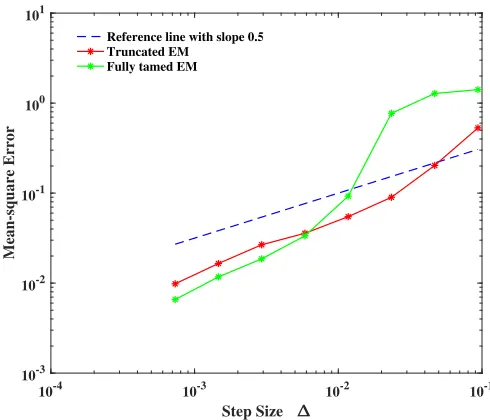
Figure 1: The strong convergence rate at the terminal timeT = 3.
simulate 10,000 sample paths to test the mean-square error. We regard the numerical solutions
generated by the partially truncated EM method and the fully tamed EM method in interval
[0,3] with the very small step size ∆ = 2−12 as the ‘exact solutions’, respectively. Figure 1 displays the L2 errors of the fully tamed EM method and the partially truncated EM method
at the terminal time T = 3. It is shown from the figure that both the two methods have the
convergence rate of approximately a half for the sufficiently small stepsizes.
Furthermore, we explore possibility of preserving positivity of the two methods using the
simulation results. The true solution of the SDE (4.1) starting from a positive initial value
will never cross the origin, see Appendix for the proof. It can be seen from the 3000 simulated
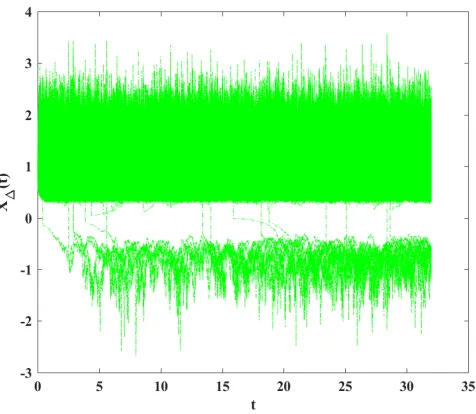
paths with the stepsize ∆ = 2−7 in Figures 2 and 3 that the partially truncated EM method
has higher chance to preserve the positivity than the fully tamed method. It should be noted
that the structure of either the partially truncated EM or the fully tamed method would not
guarantee non-negative numerical solutions. Therefore, it would be interesting to conduct
some rigorous analyses on the probability of non-negative solutions of both the two methods.
We have been working on this topic and will report it in the future work.
5
Conclusion
The main contribution of this paper is that we removed a restrictive condition imposed in [3]
Figure 2: The 3000 sample paths generated by the partially truncated EM method.
[image:19.612.186.424.459.666.2]A couple of examples were used to highlight the advantages of our new results compared with
the earlier ones in [3]. New techniques were developed in this paper to obtain the results.
Appendix
Now we prove almost all the sample path of dx(t) = (x(t)−x5(t))dt+x2(t)dB(t) starting
from a non-zero state, given x(0)>0, will never reach the origin.
Define the stopping time,
τk = inf{t >0 :x(t)∈/[
1
k, k]}.
Clearly, τk is increasing as k → ∞. Set τ∞ = lim
n→∞τk, if we can prove τk
a.s.
−→ ∞ as k → ∞,
then x(t) > 0 a.s. for all t > 0. That is to say, to complete the proof, we need to show
that τ∞ = ∞. To prove this, for any constant T, if P{τk ≤ T} → 0 as k → ∞, then we
have P{τ∞ =∞}= 1, which is the required assertion. For θ ∈ (0,1), define a C2− function
V : (0,∞)→(0,∞) by
V(x) = xθ−1−θlog(x).
It is clear that V(·)≥ 0 and V(x) → ∞ as x→ ∞ or x →0. Applying the Itˆo formula
yields
dV(x(t)) =
(θxθ−1(t)− θ
x(t))(x(t)−x
5(t)) + 1
2(θ(θ−1)x
θ−2(t) + θ
x2(t))x 4(t)
dt
+(θxθ−1(t)− θ
x(t))x
2(t)dB(t)
By boundedness of polynomial, for θ ∈(0,1), there exists a constant K1 such that
θxθ−θxθ+4−θ+θx4+ 1
2θ(θ−1)x
θ+2+ 1
2θx
2 ≤K
1.
Therefore, for any t∈[0, T],
EV(x(t∧τk))≤V(x(0)) +K1T.
So
P{τk ≤T}
V(1
k)∧V(k)
≤EV(x(T ∧τk))≤V(x(0)) +K1T.
Then we have P{τk ≤T} →0 since V(R1)∧V(k)→ ∞ ask → ∞.
That is
Acknowledgements
The authors would like to thank the Natural Science Foundation of Shanghai (14ZR1431300),
Shanghai Pujiang Program (16PJ1408000), the National Natural Science Foundation of China
(11701378), “Chenguang Program” supported by Shanghai Education Development
Founda-tion and Shanghai Municipal EducaFounda-tion Commission (16CG50), the Natural Science Fund of
Shanghai Normal University (SK201603), the EPSRC (EP/K503174/1), the Leverhulme Trust
(RF-2015-385), the Royal Society (Wolfson Research Merit Award WM160014), the Royal
So-ciety and the Newton Fund (NA160317, Royal SoSo-ciety-Newton Advanced Fellowship) and the
Ministry of Education (MOE) of China (MS2014DHDX020), for their financial support.
References
[1] Bahar, A. and Mao, X., Stochastic delay population dynamics, J. Int. Appl. Math.
11(4)(2004), 377–400.
[2] Ginzburg, V. L. and Landau, L. D.,On the theory of superconductivity, Zh. Eksperim. i
teor. Fiz. 20(1950), 1064–1082.
[3] Guo, Q., Liu, W., Mao, X. and Yue, R.,The partially truncated Euler–Maruyama method
and its stability and boundedness, Appl. Numer. Math. 115 (2017), 235–251.
[4] Hutzenthaler, M., Jentzen, A.,Numerical approximations of stochastic differential
equa-tions with non-globally Lipschitz continuous coefficients, Mem. Amer. Math. Soc. 236(2)
(2015) 99 pages.
[5] Khasminskii R.Z. , Stochastic Stability of Differential Equations, Alphen: Sijtjoff and
Noordhoff, 1980. (Translation of the Russian edition, Moscow, Nauka 1969).
[6] Kloeden, P. E. and Platen, E., Numerical Solution of Stochastic Differential Equations,
Springer-Verlog, Berlin, 1992.
[7] Mao, X., Stochastic Differential Equations and Applications, 2nd Edition, Horwood,
Chichester, UK, 2007.
[8] Mao, X.,The truncated Euler–Maruyama method for stochastic differential equations, J.
[9] Mao, X.,Convergence rates of the truncated Euler–Maruyama method for stochastic
dif-ferential equations, J. Comput. Appl. Math. 296 (2016), 362–375.
[10] Mao, X. and Yuan, C., Stochastic Differential Equations with Markovian Switching,
Im-perial College Press, 2006.
[11] Song, M., Hu, L., Mao, X. and Zhang, L., Khasminskii-Type theorems for stochastic
functional differential equations, Discrete Contin. Dyn. Syst. Ser. B 18(6) (2013), 1697–