Effect of Time Interval Variations on RTK Derived Distances Page 1 of 151
University of Southern Queensland
Faculty of Engineering and Surveying
EFFECT OF TIME INTERVAL VARIATIONS ON RTK
DERIVED DISTANCES
A dissertation submitted by
Mr. Vincent Stanley Bein
In fulfilment of the requirements of
Course ENG4111 & ENG4412 –Research Project
Bachelor of Spatial Science (Hons)
Effect of Time Interval Variations on RTK Derived Distances Page 2 of 151
ABSTRACT
The research problem statement was to determine if the time elapsed between observing
the first and second point when using Real-Time Kinematic (RTK) Global Navigation
Satellite System (GNSS) affected the accuracy and precision of a derived distance
between the two points. In particular, this paper focussed on the Queensland cadastral
system and RTK derived distances which are to be used on cadastral survey plans.
Several days of RTK GNSS (GPS and GLONASS only) data was collected under
laboratory type conditions. Several processing strategies and mathematical models
were developed to work in conjunction with the zero-distance baseline method to
determine distances and produce the results.
The results revealed the one minute data for the latitude distance error at 95% C.I.
achieved ± 4.6mm at the 3 minute window and gradually decreased to ± 7.2mm at the
720 minute window and the longitude distance error achieved ± 4.7mm to ± 8.8mm
respectively. The five second data ranged from ± 6.9mm to ± 8.6mm for latitude at the
95% C.I. from the 3 minute window to the 720 minute window and the longitude
achieved ± 6.4mm to ± 9.0mm respectively.
The five second and one minute data results revealed that there are improvements to
accuracy if points can be observed in quick succession. Waiting a pre-determined time
between observing the same two points does not improve the accuracy of a derived
distance when using a single-base RTK system and the GPS and GLONASS
Effect of Time Interval Variations on RTK Derived Distances Page 3 of 151 In conclusion, the results achieved in this paper is the first step in determining what
effects time has on RTK results that the practitioner would realise in their real-life field
environment. This first step is vital in not only understanding, the time component of
RTK at the field level but to aid in ensuring all economic benefits are realised in an
ever-demanding environment and to provide the practitioner with necessary confidence
to know the survey being undertaken complies with the survey standards. Further
research using different satellite constellations is required for the profession to realise
some economic benefit. If the practitioner can re-observe the same point while still
Effect of Time Interval Variations on RTK Derived Distances Page 4 of 151
DISCLAIMER
University of Southern Queensland
Faculty of Engineering and Surveying
Limitations of Use
The Council of the University of Southern Queensland, its Faculty of Engineering and Surveying, and the staff of the University of Southern Queensland, do not accept any responsibility for the material associated with or contained in this dissertation.
Persons using all or any part of this dissertation do so at their own risk, and not at the risk of the Council of the University of Southern Queensland, its faculty of Engineering and Surveying or the staff of the University of Southern Queensland. The sole purpose of the unit entitled “Project” is to contribute to the overall education process designed to assist the graduate enter the workforce at a level appropriate to the award.
The project dissertation is the report at of an educational exercise and the document, associated hardware, drawings, and other appendices or parts of the project should not be used for any other purpose. If they are so used, it is entirely at the risk of the user.
Effect of Time Interval Variations on RTK Derived Distances Page 5 of 151
CERTIFICATION
I certify that the ideas, designs and exp
e
rimental work, results, analysis andconclusions set out in this dissertation are entirely my own efforts, except where otherwise indicated and acknowledged.
I further certify that the work is original and has not been previously submitted for assessment in any other course or institution, except where specifically stated.
Vincent Stanley Bein
Student Number: 0031010799
……….
(Signature)
Effect of Time Interval Variations on RTK Derived Distances Page 6 of 151
ACKNOWLEDGEMENTS
This research was carried out under the principal supervision of Associate Professor Peter Gibbings. I would like to express my sincere gratitude to Professor Gibbings who has provided me with guidance, encouragement and has always kept my spirits up all through my candidature at the University of Southern Queensland.
Appreciation and thanks is also due to Mr Garry Cislowski – Department of Natural resources and Mines for all his support, patience and ongoing encouragement.
Effect of Time Interval Variations on RTK Derived Distances Page 7 of 151
TABLE OF CONTENTS
ABSTRACT ... 2
DISCLAIMER ... 4
CERTIFICATION ... 5
ACKNOWLEDGEMENTS ... 6
TABLE OF CONTENTS ... 7
TABLE OF FIGURES ... 10
LIST OF TABLES ... 13
NOMENCLATURE AND ACRONYMS ... 14
CHAPTER ONE - INTRODUCTION ... 15
1.1PROBLEM STATEMENT ... 21
1.1.1 RTK Accuracy and Precision ... 23
1.1.2 Point Positioning ... 25
1.1.3 Precise Point Positioning ... 26
1.1.4 Temporal and Spatial Error Sources ... 27
1.1.5 Sky view, Obstructions and their Effects ... 28
1.1.6 Queensland Survey Standards ... 30
1.1.7 The Problem ... 31
1.2RESEARCH AIM... 32
1.3JUSTIFICATION ... 32
1.3.1 Motivation ... 34
1.4RESEARCH METHOD ... 35
1.4.1 The Solution ... 35
1.5SCOPE AND LIMITATIONS OF THE RESEARCH PROJECT ... 36
1.6SUMMARY ... 37
CHAPTER 2 – LITERATURE REVIEW ... 38
2.1INTRODUCTION. ... 38
2.2RTKGPS/GNSS... 39
2.3QUEENSLAND SURVEY STANDARDS AND GUIDELINES ... 41
2.4CALIBRATION OF GPS/GNSS... 44
2.5ZERO-BASELINES AND ZERO-DISTANCE BASELINES ... 46
2.5.1 Previous Zero-baseline Method Research ... 46
2.5.2 Zero Baseline... 48
2.5.3 Zero-Distance Baseline... 50
2.6AVERAGING AND TIME INTERVAL (VARIATIONS)WINDOWS ... 54
2.6.1 Averaging ... 56
2.6.2 Windowing ... 57
2.5CONCLUSIONS ... 60
CHAPTER 3 ... 62
METHODOLOGY ... 62
3.1INTRODUCTION ... 62
3.2SITE SELECTION ... 63
3.3BASE STATION,RTKGNSSRECEIVER AND RADIO DETAILS ... 64
3.3.1 Testing Site ... 65
3.3.2 Base Receiver Information Details: ... 65
3.3.3 Trimble RTK GNSS Receiver Details: ... 66
3.4SITE SPECIFICS ... 68
3.4.1 Equipment Validation ... 71
3.4.2 Ancillary Equipment ... 72
3.5USING ZERO-DISTANCE BASELINE TESTING METHOD ... 73
3.6DATA COLLECTION VERIFICATION PROCESS ... 73
Effect of Time Interval Variations on RTK Derived Distances Page 8 of 151
3.6.2 Data Evaluation/Integrity ... 76
3.6.3 Data Processing ... 76
3.6.4 Processing Strategy ... 77
3.6.4.1 Single Epoch Processing Strategy ... 77
3.6.5.2 Five Second Averaged Single Epochs of Collected Data ... 78
3.6.5.3 One Minute Averaged Single Epochs of Collected Data ... 78
3.6.5.4 Tiers of Processing Strategy ... 79
3.6.6 Validation Method of Computations ... 81
3.7CONCLUSION OF CHAPTER 3 ... 84
CHAPTER 4 ... 86
4.1INTRODUCTION ... 86
4.1.1 Data Validation ... 87
4.1.2 Single Epoch Data Analysis ... 93
4.1.3 Single Latitude Epochs Defined ... 97
4.1.4 Single Longitude Epoch Defined ... 99
4.1.5 Notes ... 100
4.2FIVE SECOND/THREE MINUTE WINDOW DATASET AT 95%CONFIDENCE INTERVAL ... 100
4.3FIVE SECOND OBSERVATION TIME WITH INCREASING WINDOWS AT 95%CONFIDENCE INTERVAL ... 105
4.4FIVE SECOND OBSERVATION TIME AT THE THIRTY MINUTE WINDOW ... 108
4.5FIVE SECOND/NINETY-FIFTH PERCENTILES ... 111
4.5.1 Five Second/Ninety-fifth (95th) Percentile Distances ... 111
4.5.2 Region at which 95th Percentile of Five Second Data Falls ... 112
4.6ONE MINUTE OBSERVATION TIME DATASET ... 113
4.6.1 One Minute – with Thirty Minute Window Point Positions at 95% C.I. ... 114
4.6.2 One Minute Dataset – Maximum and the 95th Percentile Distances ... 115
4.6.3 Region at which the Ninety-fifth Percentile of One Minute Data Falls ... 117
4.7ONE MINUTE OBSERVATION TIME WITH INCREASING WINDOWS AT 95%CONFIDENCE INTERVAL... 118
4.8FIVE SECOND AND ONE MINUTE OBSERVATION OVER INCREASING WINDOWS AT 95%CONFIDENCE INTERVAL .... 120
4.9SUMMARY ... 121
CHAPTER 5 ... 122
RESULTS AND DISCUSSION ... 122
5.1INTRODUCTION ... 122
5.2DISCUSSION ... 122
5.3RESULTS ... 124
5.3.1 Single Epoch Data Analysis ... 124
5.3.2 Single Latitude Epochs Defined ... 124
5.3.3 Single Longitude Epochs Defined ... 124
5.3.4 Five Second/Three Minute Window Point Positions at 95% Confidence Interval... 125
5.3.5 Five Second Observation Time with Increasing Windows at the 95% Confidence Intervals ... 126
5.3.6 Five Second Observation Time at the Thirty Minute Window ... 127
5.3.7 Five Second/95th Percentiles ... 128
5.4ONE MINUTE OBSERVATION TIME DATASET ... 128
5.4.1 One Minute Dataset Point Positions with increasing Windows at the 95% Confidence Interval ... 128
5.4.2 One Minute – with Thirty Minute Window Point Positions at 95% C.I. ... 129
5.4.3 One Minute Dataset – Maximum and the 95th Percentile Distances ... 130
5.4.4 One Minute Observation Time with Increasing Windows at 95% Confidence Interval ... 134
5.5FIVE SECOND AND ONE MINUTE OBSERVATIONS OVER INCREASING WINDOWS AT THE 95%CONFIDENCE INTERVAL ... 135
5.6SUMMARY ... 136
5.7IMPLICATIONS ... 137
CHAPTER 6 ... 138
CONCLUSION ... 138
6.1INTRODUCTION ... 138
6.2MEETING THE AIMS AND OBJECTIVES ... 138
6.3FINDINGS AND RECOMMENDATIONS... 139
6.4COMPLIANCE TO STANDARDS ... 139
6.5OBSERVATION TIMES ... 140
6.6TIME WINDOWS ... 140
Effect of Time Interval Variations on RTK Derived Distances Page 9 of 151
6.8RECOMMENDATIONS ... 144
6.9CONCLUSION AND PROJECT CLOSURE ... 145
REFERENCES ... 146
Effect of Time Interval Variations on RTK Derived Distances Page 10 of 151
TABLE OF FIGURES
FIGURE 1: RADIAL SURVEY TECHNIQUE ... 23
FIGURE 2: RTK OBSERVATION TECHNIQUE ... 24
FIGURE 3: ERRORS ... 28
FIGURE 4: SIGNAL OBSCURATION ... 29
FIGURE 5: RTK DERIVED DISTANCE ... 31
FIGURE 6: RTK RADIAL SURVEY ... 34
FIGURE 7: SPLITTER FOR ZERO-BASELINE SETUP ... 48
FIGURE 8: SPLITTER AND GEODETIC ANTENNA SETUP ... 49
FIGURE 9: SIMULTANEOUS TRIGGERING OF BOTH VRS & RTK ... 49
FIGURE 10: USQ TRIMBLE ZEPHYR MODEL 2 ANTENNAE ... 50
FIGURE 11: ZERO-DISTANCE ERROR WITH BEARING ERROR INCLUDED ... 51
FIGURE 12: TRUE ZERO-DISTANCE BASELINE... 52
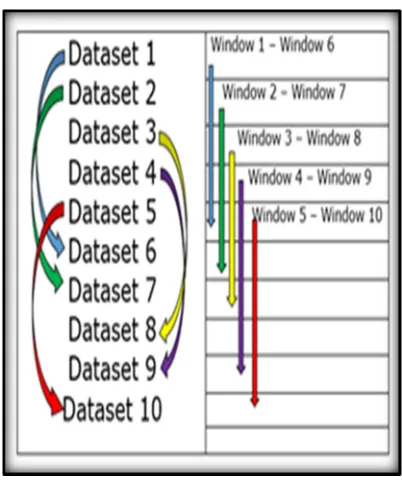
FIGURE 13: AVERAGING FIGURE 14: WINDOWING ... 57
FIGURE 15: ACCURACY DEFINITIONS ... 59
FIGURE 16: RINGS OF ACCURACY FOR GPS ... 59
FIGURE 17: POSITION ACCURACY MEASURES ... 59
FIGURE 18: USQ CORS BASE STATION 'ANANGA' ... 63
FIGURE 19: 'ANANGA' CORS PSM ... 64
FIGURE 20: SKY VIEW & STAY WIRES ... 65
FIGURE 21: LIGHTNING RODS ... 66
FIGURE 22: TRIMBLE R8-3 RTK GNSS RECEIVER ... 67
FIGURE 23: USQ RTK GNSS GEODETIC ANTENNA ... 67
Effect of Time Interval Variations on RTK Derived Distances Page 11 of 151
FIGURE 25: RE-BROADCASTER USQ Z-BLOCK Z120 ... 69
FIGURE 26: ANTENNA PHASE CENTRE ... 70
FIGURE 27: TRIMBLE ZEPHYR GEODETIC MODEL 2 ANTENNA ... 71
FIGURE 28: ANTENNA MEASUREMENT ... 71
FIGURE 29: USQ 450 TDL RADIO ... 72
FIGURE 30: NMEA-0183, GGA FIELD CODE ... 75
FIGURE 31: 90 DEGREES/1.0M INVERSE SOLUTION... 82
FIGURE 32: 90 DEGREES/1.0M DIRECT SOLUTION ... 82
FIGURE 33: 90 DEGREES/1.0M EXCEL LONGITUDE CHECK ... 82
FIGURE 34: ZERO DEGREES/1.0M DIRECT SOLUTION ... 83
FIGURE 35: ZERO DEGREES/1.0M INVERSE SOLUTION ... 83
FIGURE 36: EXCEL FORMULAE LATITUDE CHECK ... 83
FIGURE 37: 6KM TO 22KM AT 68% ... 88
FIGURE 38: 15KM TO 41KM AT 68% ... 90
FIGURE 39: 50KM TO 70 AT 68% ... 91
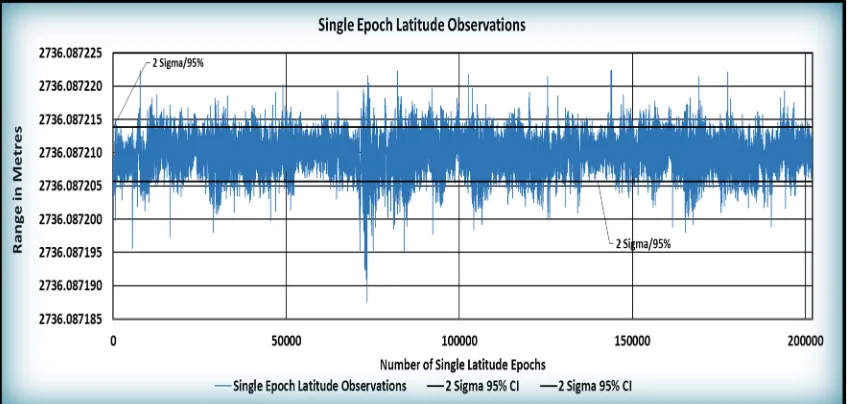
FIGURE 40: LATITUDE POINT POSITION RANGE WITH 95% C.I. OF DATASET INCLUDED. ... 96
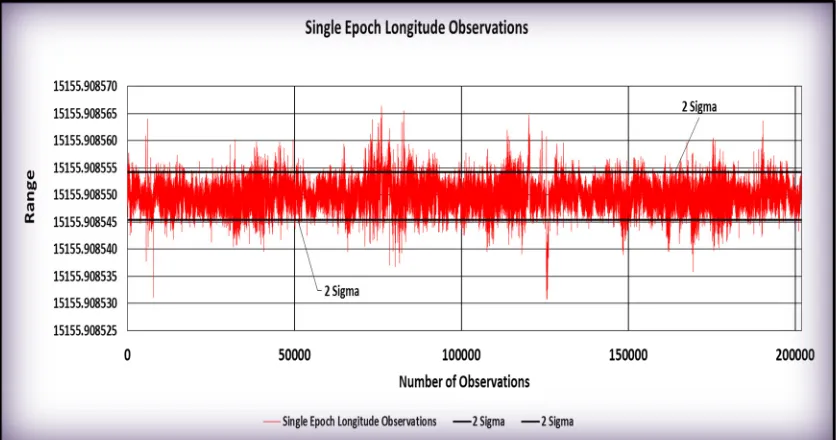
FIGURE 41: LONGITUDE POINT POSITION RANGE WITH 95% C.I. OF THE DATASET ... 97
FIGURE 42: SINGLE EPOCH LATITUDE POINT POSITION HISTOGRAM ... 97
FIGURE 43: SINGLE EPOCH LATITUDE POINT POSITION DESCRIPTIVE STATISTICS ... 98
FIGURE 44: SINGLE EPOCH LONGITUDE POINT POSITION HISTOGRAM ... 99
FIGURE 45: SINGLE EPOCH LONGITUDE POINT POSITION DESCRIPTIVE STATISTICS ... 99
FIGURE 46: WINDOWING EFFECT ... 101
FIGURE 47: 5 SECOND/3 MINUTE LONGITUDE DISTANCE ERRORS WITH 95% C.I. ... 102
FIGURE 48: 5 SECOND/3 MINUTE LATITUDE DISTANCE ERRORS WITH 95% C.I. ... 103
Effect of Time Interval Variations on RTK Derived Distances Page 12 of 151
FIGURE 50 : 5 SECOND/3 MINUTE LONGITUDE DISTANCE HISTOGRAM ... 104
FIGURE 51: PICTORIAL OF THE 5 SECOND AVERAGED EPOCH PRECISIONS OVER INCREASING TIME WINDOWS AT 95% C.I. ... 105
FIGURE 52: RE-GRAPHED 5 SECOND DATASET OVER INCREASING WINDOWS AT 95% C.I. ... 106
FIGURE 53: 5 SECOND/30 MINUTE WINDOW DISTRIBUTION HISTOGRAM ... 108
FIGURE 54: LONGITUDE - 5 SECOND/30 MINUTE WINDOW DISTRIBUTION HISTOGRAM ... 108
FIGURE 55: LATITUDE 5 SECOND/30 MINUTE WINDOW DISTANCES ... 109
FIGURE 56: LONGITUDE 5 SECOND/30 MINUTE WINDOW DISTANCES ... 109
FIGURE 57: 95TH PERCENTILE - ABSOLUTE MEASURED DISTANCE AT INCREASING WINDOWS ... 111
FIGURE 58: 95TH PERCENTILES – THE VALUE AT WHICH 95% OF DATA FALLS BELOW ... 112
FIGURE 59: RE-GRAPHED FIGURE 58 - 3 MINUTE TO 90 MINUTE WINDOWS ... 112
FIGURE 60: 1 MINUTE DATASET POINT POSITIONS AT INCREASING WINDOWS AT 95% C.I. ... 113
FIGURE 61: 1 MINUTE/30 MINUTE WINDOW LATITUDE AND LONGITUDE POINT POSITIONS WITH THE 95% CONFIDENCE INTERVALS ... 115
FIGURE 62: 95TH PERCENTILES - DISTANCES AND MAXIMUM DISTANCES ... 116
FIGURE 63: 1 MINUTE/95TH PERCENTILE LATITUDE & LONGITUDE - 3M TO 720M WINDOWS ... 117
FIGURE 64: 1 MINUTE DATASET - PRECISION AT 95% C.I. AS A FUNCTION OF TIME ... 118
FIGURE 65: DISTANCE ERROR AS A FUNCTION OF TIME ... 128
FIGURE 66: 1 MINUTE/30 MINUTE POINT POSITIONS ... 130
FIGURE 67: 1 MINUTE 95TH PERCENTILE DISTANCES OVERLAID WITH THE 95% C.I. ... 131
FIGURE 68: 1 MINUTE - 95TH PERCENTILE & MAXIMUM DISTANCES WITH THE 95% C.I. ... 132
FIGURE 69: NRTK VS RTK: DISTANCE DEVIATIONS FROM THE MEAN ... 133
FIGURE 70: 1 MINUTE/INCREASING WINDOWS - LATITUDE AND LONGITUDE 95% C.I. DISTANCE ERROR OVERLAIN WITH CSR VECTOR ACCURACY ... 134
Effect of Time Interval Variations on RTK Derived Distances Page 13 of 151
LIST OF TABLES
TABLE 1: 95% CONFIDENCE INTERVAL OF 201848 SINGLE EPOCHS OF COLLECTED DATA ... 92
TABLE 2: RANGE OF SINGLE EPOCH LATITUDE AND LONGITUDE POINT POSITIONS ... 94
TABLE 3: LATITUDE AND LONGITUDE SINGLE-EPOCH 95% CONFIDENCE INTERVAL OF THE POINT POSITIONS. ... 95
TABLE 4: RHO & NU CORRECTED FOR HEIGHT AT THAT POINT ... 95
TABLE 5: SINGLE EPOCH POINT POSITION COLLECTED DATA MEAN/MEDIAN/MODE DIFFERENCES. ... 100
TABLE 6: DESCRIPTIVE STATISTICS FOR 5 SECOND/3 MINUTE WINDOW DATASET ... 102
TABLE 7: TABULAR DESCRIPTION OF THE 5 SECOND DATASET OVER INCREASING TIME WINDOWS AT 95% C.I. ... 106
TABLE 8: RANGE OF 5 SECOND DATASET AT INCREASING WINDOWS ... 107
TABLE 9: 5 SECOND/30 MINUTE WINDOW STATISTICS ... 110
TABLE 10: 5 SECOND/95TH PERCENTILE AND MAXIMUM DISTANCES ... 111
TABLE 11: 5 SECOND - 95TH PERCENTILES AT INCREASING WINDOWS ... 113
TABLE 12: 1 MINUTE DATASET POINT POSITIONS AT INCREASING WINDOWS AT 95% C.I. ... 114
TABLE 13: 1 MINUTE/30 MINUTE LATITUDE AND LONGITUDE POINT POSITIONS WITH THE 95% C.I. 115 TABLE 14: 1 MINUTE DATASET WITH INCREASING WINDOWS - 95TH PERCENTILE DISTANCES... 116
TABLE 15: 1 MINUTE - 95TH PERCENTILE LATITUDE & LONGITUDE - 3M TO 720M WINDOWS ... 117
TABLE 16: 1 MINUTE DATASET AT INCREASING WINDOWS AT 95% C.I. ... 119
TABLE 17: 1 MINUTE & 5 SECOND DATASETS AT INCREASING WINDOWS AT 95% C.I. ... 120
TABLE 18: 1 MINUTE DATASET AT INCREASING WINDOWS AT 95% C.I. ... 129
TABLE 19: 1 MINUTE/30 MINUTE POINT POSITIONS ... 130
Effect of Time Interval Variations on RTK Derived Distances Page 14 of 151
NOMENCLATURE AND ACRONYMS
The following abbreviations have been used throughout the text and references:-
APC Antenna Phase Centre
CI Confidence Interval
CQ Coordinate Quality
CORS Continuously Operating Reference Station
CSR Cadastral Survey requirements
DOP Dilution of Precision
DoD Department of Defence in America
EDM Electronic Distance Measurement
GNSS Global Navigation Satellite System
GPS Global Positioning System
ICSM Intergovernmental Committee on Surveying and Mapping
MGA Map Grid of Australia
PPP Precise Point Positioning
ppm parts per million
PSM Permanent Survey Mark
RTK Real-time Kinematic
SBQ Surveyors Board of Queensland
SIS Signal-in-Space
SMI Act Surveying and Mapping Infrastructure Act 2003
SPS Standard Positioning Service
SP1 Special Publication #1
SV Space Vehicle
Effect of Time Interval Variations on RTK Derived Distances Page 15 of 151
CHAPTER ONE - INTRODUCTION
There are several grades of Global Navigation Satellite Systems (GNSS) instruments
and systems available to suit all needs. The systems are defined by their positional
accuracy capabilities. The can be further defined as civilian, mapping, surveying and
military grade. The most basic GNSS point positioning system is used for recreational
purposes such as orienteering, fishing, boating and the in-car navigation system. The
quality of information coming out of a GNSS is dependent on the quality of the
information going in and the quality of the information has a cost associated to it. The
more accurate and precise the more expensive. Real-Time Kinematic (RTK) is a survey
grade technique which utilises the signal from GNSS to obtain a point position in real
time.
RTK, like all surveying systems, does have accuracy and precision limitations which are
caused by systematic errors that occur prior to the receiver accepting the broadcast
navigation signal. RTK’s introduction into Australia prompted regulatory agencies to
update the existing survey standards and guidelines. These standards and guidelines
have been dynamic, based on substantiated quality research and reflect the technological
changes and developments as they occurred or became apparent. These
accomplishments have prompted the requirement for more research. Recent times has
seen more research on the temporal characteristics of using the RTK technique to derive
distances between separate observations.
These derived distances are used for many applications such as; pegging land allotments
and displaying ground distances on survey plans, engineering setout works and civil
Effect of Time Interval Variations on RTK Derived Distances Page 16 of 151 distances is paramount. In some instances, considerable time can elapse before a
practitioner can observe the second point which is needed to derive (compute) a
distance between two points. This time interval could be as short as three or four
minutes or as long as hours and even days at times. The effect of time interval variation
when using RTK to derive a distance demands further research to assess if any changes
occur to the normal RTK error budget.
With due regard to other applications and professions, the importance of an accurate
cadastre and State Database is also paramount when considering the importance of land
to the economy. The intent of this dissertation is to develop a workable mathematical
model to extrapolate distances from the collected data and determine the maximum,
minimum, range, standard deviation and ninety-five percent (95%) confidence interval
of pre-determined averaged datasets and increasing time interval windows. As
appropriately mentioned in the previous sentence this research project is about derived
distances between points at either end of a line when using an RTK single-base system.
Put into a simple context, the zero-distance baseline accepts that the RTK observations
are random and the distances are calculated between the observations as they ‘wander’
around. To elaborate, if we observe a position now, we achieve a set of coordinates
(say -26⁰ 30’ 00”, 150⁰ 30’ 00”) computed by the data recorder setup parameters e.g.
average of 5 epochs. We wait 30 minutes and re-observe the same point and achieve
coordinates of say, -26⁰ 30’ 30” & 150⁰ 30’ 30”. The difference between these two
coordinates is the zero-distance baseline (a distance expressed in metres in a one
dimensional form – latitude and longitude) and, obviously, because of the temporal and
spatial errors associated with RTK the coordinates of the same point ‘wander’ around
Effect of Time Interval Variations on RTK Derived Distances Page 17 of 151 error budget and concentrates more on how the practitioner can work with it. No one
observation is accepted as the true value for a point. It does not compute a mean of the
sample.
Initially, to set a benchmark, the single epochs of latitude and longitude will be
statistically analysed and graphed to ascertain trends, behaviours and patterns.
Following, the mathematical model will derive the arithmetic mean of the 201848 single
epochs of collected data. Next, the entire dataset will be divided into the predetermined
sets of averaged epochs of data of five second and one minute sets. These averaged
epochs of data will be called datasets and will represent observation time on the point
and are designed to replicate how long the practitioner might feasibly spend observing a
point. The five second average was chosen to set a platform which is well below any
recommended time span by notable researchers (Edwards et al. 2010; Gibbings & Zahl
2014a; Janssen & Haasdyk 2011b) and below the minimum recommended time in the
latest Queensland Cadastral Survey Requirements (Spatial Policy of Department of
Natural Resources and Mines. Cadastral Survey Requirements 2015, Version 7.0). The one minute observation was chosen to allow for comparisons with the single epochs of
latitude and longitude, the five second platform and a combination of all when
appropriate.
The time interval variation, from this point forward called a time interval window or
simply a window, sampling rate will commence at three minutes. The rate will then be
increased to five (5) minutes (m), 10m, 15m, 20m, 25m, 30m, 60m, 120m, 240m, and
Effect of Time Interval Variations on RTK Derived Distances Page 18 of 151 The time interval of 720m or twelve hours is to ensure the twelve hour orbit cycle of the
Space Vehicles (SV) is accounted for and the many multiple variations of satellite
configurations are experienced. Next, whilst holding the first window of five (5)
seconds the maximum, minimum, range, standard deviation and the ninety-five percent
(95%) confidence interval (C.I.) will be calculated for the entire time interval sampling
windows/increments. The 5 second dataset will undergo a single analysis and
subsequent graphing, involving increasing the time window to ascertain what effect
time windows has on precision.
The 5 second and 1 minute datasets will be analysed and graphed together at increasing
time windows and compared with the single epoch analysis and against one another as
appropriate. This mathematical process will be rigorous for all windows and the results
graphed against an absolute zero-distance baseline. The zero-distance baseline
produces distances relative to the true value coordinates and are expressed in metres.
All residual distance errors will be expressed in metres as latitude and longitude
separately and respectively and graphed accordingly.
Every instrument has intrinsic uncertainty when measuring the same point multiple
times and this uncertainty is usually stated as a constant and a distance dependent parts
per million (ppm) error. The RTK error is expressed in this same manner but its
accuracy and precision has a pattern and at the same time a randomness that is caused
by several temporal errors. The ever-changing satellite configuration, timing errors and
the lack of a yet-to-be discovered suitable model that addresses the atmospheric and
tropospheric conditions that broadcast ephemeris must travel through are some of the
Effect of Time Interval Variations on RTK Derived Distances Page 19 of 151 These errors, which are uncontrollable by human intervention, change as time expires
and the multitude of factors that affect these errors are inconsistent in themselves. The
significance of this phenomenon must be understood so the mathematical model is
designed to extract the necessary statistical data to be evaluated. Each epoch of data is a
random variable in itself and each windowed dataset will be a random variable in itself
also.
Each satellite has its own inherent errors and to overcome this the software inside the
receiver has a specifically designed set of satellite selection algorithms. These
algorithms allows the software to select a number of the most suitable satellites which
have the lowest Dilution of Precision (DOP) values (Langley 1999). DOP is, basically,
a measure of the number of visible satellites and their three dimensional position. The
lower the DOP the better the estimate of the position to its true value. The minimum
number of satellites required to obtain a resolution is four. One to solve for each of the
four unknowns; x, y, z and time.
It is common to measure the quality of the results by determining the mean but
precision determines the repeatability. As the dataset is windowed it is expected that
random variability will become somewhat hidden or disguised and it is also envisaged
the range established by averaging the entire dataset will remain constant. On
derivation of the results from the mathematical model comparisons will be made to the
Effect of Time Interval Variations on RTK Derived Distances Page 20 of 151 In Queensland, the Department of Natural Resources and Mines (DNRM) and the
Surveyors Board of Queensland (SBQ) are the primary regulatory authorities. Global
Satellite System (GPS) were introduced into Australia in 1994 and the main surveying
manuals for surveyors was the Surveyors Operational Manual (SOM) and the Board
Operational Manual (BOM). Like any new technologies ‘teething problems’ can be
experienced and as time expired RTK presented its own challenges.
Some of these challenges presented themselves in late 2012, when the Surveyors Board
of Queensland recognised there were some issues and potential confusion amongst
practitioners regarding the use of RTK for cadastral surveying. This prompted the SBQ
to release a guideline (Surveyors Board of Queensland November, 2012) which
provided clarification on the identified issues. Since then Gibbings, P. & Zahl, M.
(2014b) have released two articles with the express intention of emphasising the specific
capabilities and limitations of RTK. Gibbings, P. & Zahl, M. (2014b) made
comparisons between the results of their testing and the current Queensland cadastral
surveying legislation, survey standards and recommended guidelines.
The Surveying and Mapping Infrastructure Act 2003 (SMI Act) and the Surveyors Act
2003 provides legislative support to the Department of Natural Resources and Mines
(DNRM) and the SBQ. The Cadastral Survey Standards (CSR) is a standard under of
the Surveying and Mapping Infrastructure Act 1994 (SMI Act) and Section 3.4.2
(Measurement Accuracy) of the CSR (commonly known as Survey Standards) provides
several determinations as to how the accuracy of a cadastral survey in terms of both
angular and linear misclose can be achieved. DNRM has recently released version 7.0
Effect of Time Interval Variations on RTK Derived Distances Page 21 of 151 Version 7.0 of the CSR includes an entire chapter on the use of Global Navigation
Satellite Systems (GNSS) for cadastral surveying in Queensland. This new version
does provide much needed clarification on the issues identified by the SBQ but it is not
completely exhaustive. Previous research by Gibbings and Zahl (2014) has already
provided sufficient support for these new changes but it, also produced more questions
and the need for more research to further advance the understanding of RTK.
Therefore, it is a prerequisite and a professional obligation on spatial science students
and professionals to continue expanding on the existing research. This is especially
correct given the new SBQ guideline (2012), the release of the new CSR’s and the
increased pressure on practitioners to comply with relevant standards.
1.1 Problem Statement
Does the time elapsed between observing the first point and second point when using
RTK GNSS, affect the accuracy and precision of the derived distance between the two
points? This elapsed time will be referred to the ‘time interval variation or time interval
window or window’ from this point forward. No measuring instrument can measure a
distance perfectly and RTK GNSS is no exception. This imperfection is often referred
to as an error budget or biases’. The error budget consists of random, systematic and
gross errors. It is well-known and proven that the errors that influence the final RTK
positions have the potential to create survey standard compliance issues for the survey
profession, especially, when the survey standards appear more stringent than the known
limitations and capabilities of an RTK system (Gibbings & Zahl 2014b; Higgins 2001).
However, there has been little research on what effects time interval variations has on
RTK derived distances. That is, does the time elapsed between observing the first point
Effect of Time Interval Variations on RTK Derived Distances Page 22 of 151 Conventional surveying instruments, sometimes referred to as Terrestrial Instruments
(TI), Electromagnetic Distance Measurement Equipment (EDME) or a Total Station
(TS), are not affected by the errors associated with RTK. However, TI’s, TS’s and
EDME’s can be affected by other more localised issues such as the local climatic
conditions. The local meteorological data is entered into them and the survey
commences and is, generally, completed within the manufacturers’ instrument
specifications provided the obligatory check and balances are in place. TI’s, if
standardised correctly, are capable of consistently measuring the same distance to the
same level of accuracy and precision between the same two points, as per the individual
instrument manufacturer’s specifications, day after day. The same level of accuracy and
precision mentioned in this context satisfies the current Queensland survey standards.
RTK does not have this ability.
In fact, RTK surveys are radial in nature and distances between two points being
observed is calculated and not measured. In addition to this, due to its inherent errors, it
is extremely difficult for RTK to achieve or repeat the same computed distance or level
of accuracy and precision between the same two observed points after multiple
attempts. However, RTK’s main advantages are its ability to measure longer distances
which negates the need for multiple setups and it is not subject to intervisibility issues
Effect of Time Interval Variations on RTK Derived Distances Page 23 of 151
1.1.1 RTK Accuracy and Precision
Many researchers have, since the inception of GPS, established the accuracy and
precision for point positioning using RTK and the subsequent effects to a distance on a
calculated line (Gibbings & Zahl 2014b). ‘Calculated or derived’ meaning not
measured because RTK surveys are radial in nature. However, to the authors’
knowledge, little research exists which describes what the effects are to an RTK derived
distance as the time between observing the first and second point increases. As seen in
Figure 1, the RTK surveying technique is similar to undertaking a topographic survey
with a conventional survey instrument.
Figure 1: Radial Survey Technique
Source: http://www.slideshare.net/xuhui6996/em-1110-11005-control-and-topographic-surveying.
An RTK receiver uses the carrier phase and code observables to define its position and
the accuracy and precision of its point is estimated because orbital errors, satellite clock
errors, multipath and atmospheric errors (Olynik 2002) are predicted. These errors can
be well managed and to some extent reduced by adopting suitable techniques (Higgins
2001; Spatial Policy of Department of Natural Resources and Mines 2010-Version 6.0,
Effect of Time Interval Variations on RTK Derived Distances Page 24 of 151 The correct management of these errors can improve the positional and local uncertainty
(Inter-Governmental Committee on Surveying and Mapping (ICSM) October 2014) of
its point.
RTK is a passive system unlike conventional surveying instruments which receive a
return signal. This gives the conventional instrument an advantage because it sends and
receives multiple signals, as defined by the operator, which in itself has some
‘redundancy’ effect. An RTK system receives a data signal continuously, as seen in
Figure 2, and this signal contains errors outside the control of the user. Attached to this
signal is the broadcast ephemeris. The broadcast ephemeris contains predications on
where the satellite (spatial position), commonly called a space vehicle (SV), should be
and not where it truly is. This is defined as orbital errors and each SV has its own
prediction errors. It is not until the SV has passed a point before its true spatial position
can be accurately determined and, therefore, defining the rover receiver’s more
accurately. The main advantage of RTK would be lost if post processing of data is
required.
Figure 2: RTK Observation Technique
Effect of Time Interval Variations on RTK Derived Distances Page 25 of 151 The instrument collecting the data, commonly called a data collector, has built in
mathematical statistical algorithm’s which, based on the parameters and definitions set
by the user, accepts a predetermined number of epochs of data and mathematically
obtains the most probable value (MPV) for the point position. While this process
appears to isolate and neglect the errors previously mentioned it only reduces the
likelihood of accepting outliers by the use of simple statistics.
Outliers still exist and, initially, the user must rely on confidence, baseline accuracies
and Root Mean Square (RMS) values (highlighted on the status line on the data
recorder) before accepting the coordinates of the point. Whilst the magnitude or
randomness of these errors are not immediately noticeable there are appropriate survey
techniques available which are used to reveal them.
1.1.2 Point Positioning
Most new vehicles today come equipped with an in-car navigation system and a
recreational handheld GPS can be purchased for a few hundred dollars. There is no
special GPS receiver signals associated with the different grades of GPS instead the
internal software of individual grade GPS receivers have different capabilities for
extracting relevant information from the signals to achieve certain levels of accuracy
and precision. Obviously, purchase prices vary accordingly.
In short, recreational and professional GPS units are designed and built for different
purposes. As a general rule, recreational GPS’s have a positional accuracy of ±10m,
Effect of Time Interval Variations on RTK Derived Distances Page 26 of 151
1.1.3 Precise Point Positioning
In the 1990’s, the Jet Propulsion Laboratory at the National Aeronautical Space Agency
(NASA) in America pioneered new techniques that did not require differencing to
obtain precise positions. They labelled it Precise Point Positioning (PPP) (Nistor. S &
A.S. 2012). The word ‘Precise’ is used in the description to differentiate it from relative
point positioning. PPP is different from RTK. RTK requires two receivers, one base
receiver and one rover receiver whereas PPP requires a rover receiver only. PPP
receives differential corrections via kinematic or static mode and relies on predicted
satellite orbits, ionospheric models and real time satellite estimates (van Bree &
Tiberius 2012) to establish its position. Basically, PPP’s point position uses a GNSS
code observable and the navigation message. The accuracy and precision of PPP is
generally greater than RTK (van Bree & Tiberius 2012).
Research and testing by van Bree & Tiberius (2012) achieved standard deviations of
0.15 and 0.30m for the horizontal and vertical coordinates, respectively, with 95% error
values of approximately 0.30m and 0.65m. PPP is available through commercial
service providers for a fee and only a single GNSS receiver is needed which suggests
the cost of the fee is offset by the lack for the need for a base receiver.
PPP has lower positional accuracy than RTK which makes it unsuitable for cadastral
surveying in Queensland. PPP also requires longer convergence times, is not
constrained by baseline length and presents an efficient alternative for applications such
Effect of Time Interval Variations on RTK Derived Distances Page 27 of 151
1.1.4 Temporal and Spatial Error Sources
The American Department of Defence (DoD) established the conventional GPS system
for military purposes and maintains full control and authority with the system. The
following passage taken from Section 2.4.5 (Excluded Errors) of the ‘Global positioning system standard positioning service performance standard’ (DoD 2001) page 15, provides clear and definitive evidence of the errors associated with GNSS
systems (refer Figure 4). Note dot points with the following superscripts 1, 2, 3, 4, 6
and 7 are not controllable by any human source and can occur randomly but are always
present and have a direct influence on the final position (refer to Figure 3).
“The performance standards in Section 3 of this SPS PS do not take into consideration
any error source that is not under direct control of the Space Segment or Control
Segment. Specifically excluded errors include those due to the effects of:
• Signal distortions caused by ionospheric and/or tropospheric scintillation1
• Residual receiver ionospheric delay compensation errors2
• Residual receiver tropospheric delay compensation errors3
• Receiver noise (including received signal power and interference power) and
resolution4
• Receiver hardware/software faults5
• Multipath and receiver multipath mitigation6
• User antenna effects7
Effect of Time Interval Variations on RTK Derived Distances Page 28 of 151 A substantial amount of research has established the spatially and temporally correlated
errors (El-Rabbany & Kleusberg 2003; Olynik 2002) which affects the accuracy and
precision of RTK. Spatially correlated errors occur when the magnitude of the error is
similar at two different locations and errors are temporally correlated when their
magnitude is similar over a period of time (Miller, O'Keefe & Gao 2012).
Figure 3: Errors
Source: http://forum.xda-developers.com/showthread.php?t=1697306.
1.1.5 Sky view, Obstructions and their Effects
Dilution of Precision (DOP), in GPS positioning, is an indication of the geometric
strength of the configuration of the satellites in a particular constellation at a particular
moment and hence the quality of the results that can be expected (Van Sickle 2011).
The following statement taken from Section B.4.3 of the ‘Global positioning system standard positioning service performance standard’ (DoD 2001) page B38 and the following supporting figure 1, provide an explanation on how the Dilution of Precision
Effect of Time Interval Variations on RTK Derived Distances Page 29 of 151
Even when there is only one nearby obstruction that only blocks one SPS (Standard
Positioning Service) SIS (Signal-In-Space), the loss of that SPS SIS can radically
alter the DOP values. In such obstacle-rich environments, it is difficult to try to
predict in advance which satellite's SPS SIS will be blocked and when that blockage
will start or end (DoD 2001).
Figure 4: Signal Obscuration
Sourced: http://www.navcen.uscg.gov/pdf/gps/geninfo/2001SPSPerformanceStandardFINAL.pdf
The above-mentioned comment and Figure 4 relates specifically to the use of RTK in an
American urban environment. However, the paradigm is applicable to all world
locations and environment. A close inspection of Figure 4 reveals the minimum
elevation mask is 9º which is not a recommended standard under the current
Queensland Cadastral Survey Requirements. Figure 4 does highlight the effect
obscuration can have on RTK results especially if it being used where obstructions do
Effect of Time Interval Variations on RTK Derived Distances Page 30 of 151
1.1.6 Queensland Survey Standards
Section 3.4.2 (Measurement Accuracy) of the Cadastral Survey Requirements (CSR),
Version 7.0, states the accuracy of a cadastral survey in terms of both angular and linear
misclose, and then goes on to add the requirement that, ‘All surveyed lines (e.g. boundary lines, connections) must have a vector accuracy of 10 millimetres + 50 ppm’ (Spatial Policy of Department of Natural Resources and Mines. Cadastral Survey Requirements 2015, Version 7.0). Therefore, accurate determination of the distances involved is paramount if compliance is to be achieved regardless of whether the survey
is undertaken using a geodetic or conventional terrestrial instrument. The CSR must be
read and interpreted in conjunction with the SMI Act, the Surveyors Act and Special
Publication 1 (SP1), Version 2.1 (Inter-Governmental Committee on Surveying and
Mapping (ICSM) October 2014).
SP1 is a guideline developed by the Intergovernmental Committee on Surveying and
Mapping (ICSM) which is part of the Permanent Committee on Geodesy (PCG). The
guidelines’ primary purpose is to promote the adoption of uniform Global Navigation
Satellite System (GNSS) surveying procedures to achieve the highest level of rigour and
integrity in Australia’s survey control mark network (Inter-Governmental Committee on
Surveying and Mapping (ICSM) October 2014). The guideline outlines ICSM’s
Effect of Time Interval Variations on RTK Derived Distances Page 31 of 151
1.1.7 The Problem
The SBQ guideline and Gibbings, P. & Zahl, M (2014b) articles have answered some of
the questions regarding the use of RTK for cadastral surveying in Queensland. While
the above articles have advanced the practitioners understanding they have produced the
need for more research with regard to RTK and time interval variations/window. To the
author’s knowledge, there appears to be a distinct lack of research with regard to time
interval variation/window when using RTK.
The time interval window can be defined as;
1. The length of time that elapses between observing the first point and the second
point from which the derived RTK distance is to be calculated (refer Figure 5).
Figure 5: RTK Derived Distance
This time interval window and an apparent lack of research produces the following
question;
What are the effects to the calculated distances between two points if the practitioner
does not get to measure a reference point at the opposite end of a line, for which a
Effect of Time Interval Variations on RTK Derived Distances Page 32 of 151 This question has many hidden factors and disassembling into relevance produces;
Are there any effects to an RTK derived distance as the time between
observing the first and second end point increases and the satellite
constellation configuration changes?
Will the well-known existing RTK error budget be affected in any way
(accuracy, precision, range, standard deviation and confidence limit)?
Will the outcome have any effect on the existing proven RTK survey
technique (Surveyors Board of Queensland November, 2012) (Higgins
2001) (Gibbings & Zahl 2014b) (Spatial Policy of Department of Natural
Resources and Mines. Cadastral Survey Requirements 2015, Version 7.0)?
And will the outcome affect the practitioner or their practices in terms of
compliance?
1.2
Research Aim
The aim of this research is to investigate the effect of time interval variations (windows)
on a derived distance when using RTK.
1.3 Justification
The new Queensland Cadastral Survey Standards have a section dedicated to the use of
GNSS for cadastral surveying. In 2012, the SBQ identified some issues existed
regarding the use of RTK for cadastral surveying and determine that clarification was
required to help practitioners to understand and use this technology in the appropriate
manner. Specifically, there seemed to be potential confusion over the limitations of
RTK GNSS, namely, the accuracies and precisions of derived dimensions (Gibbings &
Effect of Time Interval Variations on RTK Derived Distances Page 33 of 151 In 2014, Gibbings and Zahl (2014b)released two articles which are essential, as well as
an adjunct to, in advancing the practitioners knowledge and resolving this confusion
within the profession.
Previous research has identified a technological gap which relates specifically to time interval variations. This time-based technological gap demands a resolution to ascertain if the existing error budget associated with RTK surveys is altered in any
form. This dissertation sets out to derive an outcome with respect to the time interval
variation/window and make comparisons between the outcome and the CSR’s as the
time between observing points at separate ends of a calculated line increases.
This new research will aid in narrowing the technological gap that presently exists in
assessing what effects time has on RTK derived distances. Being new research will
make it somewhat difficult to make comparable comparisons with previous research.
However, there is previous research into mathematical models, Kalman filtering
processes (Bisnath & Gao 2009), temporal characteristics (Odijk, Teunissen & Huisman
2012), stochastic modelling and time series analysis of GPS observables (Borre &
Tiberius 2000) which relates specifically to the spatial component of the temporal
characteristics of RTK.
The recent research by such researchers as Gibbings and Zahl (2014a), Janssen &
Haasdyk (2011b) and Edwards et al. (2010) will be referred to often because of the
context in which the data was collected, processed and what the results represent in the
Effect of Time Interval Variations on RTK Derived Distances Page 34 of 151 It must be remembered the RTK technique is radial in nature (see Figure 6.) and subject
to errors outside of the control of the surveyor. Note, also, in Figure 6 that the distances
between stations B – C, C – D, D – E and E – F are not actual measured but computed
from RTK coordinate values.
Figure 6: RTK Radial Survey
Sourced: http://www.gisresources.com/wp-content/uploads/2013/08/REM3.png.
1.3.1 Motivation
Since the inception of RTK GNSS it has been comprehensively researched by
academia, governments, professional authorities and other geodetic agencies. As a
result of this research the advantages, disadvantages, capabilities and limitations of
RTK are well established. But not all questions are answered and further research is
required.
Apart from this being a mandatory educational requirement for me to successfully
obtain my Bachelor Degree in Spatial Science (Hons). I see this opportunity as the first
Effect of Time Interval Variations on RTK Derived Distances Page 35 of 151
1.4 Research Method
1.4.1 The Solution
Answers are required to this problem. An outcome is required to determine if time
interval variations/windows has any effect on the expected normalised error budget and
if, in terms of compliance, the RTK techniques prescribed in the Queensland survey
standards and Special Publications 1 (SP1) are being challenged. To achieve the
outcome more research and subsequent testing is essential. Firstly, any mathematical
model must have the ability to isolate the time interval window residuals. Secondly, the
processing strategy must have the proficiency to isolate any anomalies and errors (in the
first instance) and then identify trends, behaviours, randomness and patterns. This will
be achieved in the following manner;
• Collect a sufficient amount of RTK data taking the 12 hour satellite orbit configuration and change into account,
• Producing a mathematical model and processing strategy to vary the observation
time intervals/windows and gradually increase the time interval window
between observing the first and second observation point and determine the
residuals using the zero-distance baseline technique,
• Graph the residuals in single dimension, Latitude (Northing) and Longitude (Easting) in metres, with respect to accuracy and precision as a function of time
at the ninety-five percent (95%) Confidence Interval (C.I.),
Effect of Time Interval Variations on RTK Derived Distances Page 36 of 151
1.5 Scope and Limitations of the Research Project
This dissertation has defined the problem in Section 1.3.1 and that problem is to derive
an outcome regarding the time interval variations/windows associated with RTK and
evaluate the outcome. During the testing, the time interval windows will be modified
to exhaust all opportunity for any non-compliant configurations and more reliable
techniques to be identified and evaluate any subsequent potential effects on RTK
surveying.
The limitations of this research is:
• The data was collected using conventional GPS and GLONASS satellite constellations
• There are no setup errors because the antennae are on single poles, dyna-bolted to a concrete floor and held in place by adjustable steel stay wires
• The base station is a permanent CORS station and is also securely held in position
• The research data is multipath free
• The site can comfortably be compared to a laboratory type site and conditions
Effect of Time Interval Variations on RTK Derived Distances Page 37 of 151
1.6 Summary
Chapter one provided background information, established the aims and objectives,
provided justification, identified the problem, the research methods and the solution and
confirmed the scope and limitations of the research project. The zero-distance baseline
concept and how it relates to real-life practical RTK surveying was explained. The
background information detailed point positioning, the effects to RTK due to temporal
and spatial error sources, the importance of having an unrestricted view of the sky and it
briefly described the transition from the 1996 Survey Operation Manual (SOM) into the
current version 7.0 CSR’s. The relevance and importance of the transition was not
overstated due to the technical content and it provided a definitive historical connection
to the past and the steps involved in the dynamics associated with emerging
technologies which leads to the current CSR’s.
Chapter two will consist of the literary review and provide some limited background on
the introduction of RTK into Australia. However, it will highlight with accuracy the
Queensland cadastral survey requirements, RTK’s inability to be calibrated, and the use
of zero-baseline testing, zero-distance baseline testing and time interval
window/variations. The review will draw on and highlight previous research from
notable sources to demonstrate the importance of this research, provide supporting
evidence and demonstrate the historical events that lead this research to this stage.
This research project is the next historical stage in advancing RTK GNSS for cadastral
surveying in Queensland. Furthermore, review of literature for this research project
will evidence the missing technological gap as well as provide the audience with the
necessary knowledge to make informed assessments of the construct of this project and
Effect of Time Interval Variations on RTK Derived Distances Page 38 of 151
CHAPTER 2 – LITERATURE REVIEW
2.1 Introduction.
Chapter oneestablishes the aims and objectives for this research project. To achieve the
aims for Chapter 2 a review and analysis of relevant literature will be conducted.
Previous research will identify the missing technological gap and the review will reveal
the current practices involving RTK. This will provide the reader with the solid
platform needed to make informed decisions regarding the information presented in
Chapter 3.
The introduction of RTK will be lightly examined. The use of a zero-distance baseline
model for testing and analysis of an error budget will be discussed. Sometimes the
zero-distance baseline is incorrectly described as a zero-baseline model which is used to
verify the specifications of several GNSS receivers simultaneously. This will be
clarified but not at length.
Multiple studies have definitively established the accuracy and precision of RTK GNSS
(Boey et al. 1996; Emardson et al. 2009; Gibbings & Zahl 2014b, 2014a; Olynik et al.
2002) and further analysis will not be conducted and will only be referred to on an as
need be basis. However, little previous research is available to which this research
project data results can be compared. In the introduction in Chapter One the
zero-distance baseline was explained in-depth and how this project and its results are based,
purely, on distances that follow the RTK message around and not on point positions of
Effect of Time Interval Variations on RTK Derived Distances Page 39 of 151 The author acknowledges and notes there is ample previous research relating to RTK
accuracy and precisions and accepts there is little comparable research available at the
time of completing this dissertation. The literature review is, therefore, hindered and
limited because of the lack of relevant research.
2.2
RTK GPS/GNSS
RTK revolutionised the surveying world because it presented the user with an
opportunity to survey and establish coordinates, in real time, for points at considerable
distance without the need for conventional traversing techniques. By setting the base
receiver over a point with ‘good quality published coordinates’ and, the user utilising
the RTK receiver to observe a new point the coordinates of this new point is
immediately available. In addition to this, the coordinates of the new point are available
in various formats. Initially, there was only one GPS system available and that was the
American system.
As time expired other countries developed their own GPS and this prompted the term
‘GPS’ to be expanded to ‘GNSS’ (Global Navigation Satellite System). GNSS refers to
the collection of the world’s global satellite positioning systems. Present systems
include the USA’s GPS, Russia’s GLONASS, China’s COMPASS and the European
Union’s Galileo satellite system. Early in 1994 the first truly automatic, centimetre level
RTK system was introduced (Edwards et al. 1999) into Australia. Various Global
Positional Systems were available prior to 1994 but not real-time kinematic (RTK)
GPS. RTK which requires two GPS receivers allows the user to obtain a point position
Effect of Time Interval Variations on RTK Derived Distances Page 40 of 151 However, the use of RTK GNSS has continued to increase and, in the author’s opinion,
research appears commensurate with this increase. The introduction of new satellite
constellations provides new improved configurations but accuracy and precision
capabilities cannot improve because of the prediction errors that are an inherent
component of the signal received by RTK. Certainly, initialisation times are reduced
and areas or places where initialisation could not be realised previously and which,
effectively, prevented surveys to be undertaken are now possible. These new
efficiencies suggest RTK is the preferred method of survey for many applications.
In the opinion of the author, this advancement in technology without an increase in
accuracy and precision capabilities suggests that pressure on practitioners to complete
surveys in less time is increased. It must be remembered that adherence to survey
standards still applies regardless of the method or time efficiency involved in the
survey.
The Surveyors Board of Queensland (SBQ) works in conjunction with the Department
of Natural Resources and Mines (DNRM) and ICSM to develop, promote and maintain
Queensland’s cadastral surveying standards and guidelines and, of course the cadastre.
The Surveyors Board of Queensland, constituted under the Surveyors Act 2003
Effect of Time Interval Variations on RTK Derived Distances Page 41 of 151 In 2012, the SBQ identified that there were concerns relating to practitioners using RTK
GNSS inappropriately for cadastral surveys and clarification was required to help
practitioners understand and use this technology. Of particular concern was the
seemingly potential misperception over the limitations of RTK GNSS, and the
accuracies and precisions of derived dimensions. As a result of this issue, the SBQ
commissioned the preparation of a guideline (Surveyors Board of Queensland 2012) for
the use of RTK GNSS for cadastral surveys.
2.3 Queensland Survey Standards and Guidelines
Queensland’s cadastre is of extreme importance to the economy of the State of
Queensland and Australia. Therefore, survey standards are a mandatory component of
any cadastre and these standards demand compliance if an accurate cadastre is to be
maintained and as upgrades are performed. RTK has many varied applications and
cadastral surveying is one of those. As per the CSR’s, cadastral surveying requires
ground distances to be calculated and/or measured and cadastral plans demand ground
distance be displayed. The word ‘ground’ being the operative word. Consequently, the
results obtained from this research project have the potential to affect the Queensland
surveying standards.
In Queensland, the current cadastral surveying standards is appropriately called the
Cadastral Survey Requirements (CSR) and the current version is 7.0 and DNRM has
specifically allocated an entire chapter (8) to ensure the new standards are adequately
communicated. The CSR is one of a series of standards and guidelines under the
Effect of Time Interval Variations on RTK Derived Distances Page 42 of 151 Section 3.4.2 (Measurement Accuracy) states the accuracy requirement of a cadastral
survey in terms of both angular and linear misclose, then goes on to add the requirement
that, All surveyed lines (e.g. boundary lines, connections) must have a vector accuracy of 10 millimetres + 50 ppm. This vector accuracy is at 95% relative uncertainty in accordance with ICSM Standard for the Australian Survey Control Network (SP1 v2.0) (Inter-Governmental Committee on Surveying and Mapping (ICSM) October 2014).
The following cautionary note by Gibbings, P. & Zahl, M. (2014b) – Using the example
in SP#1 version 1.7 (note this version is superseded by version 2.1), page B-27, the
standard deviation on a sample line between two RTK points was calculated as 17mm.
The 95% confidence interval was 42mm. The surveying standards require 10mm +
50ppm vector accuracy. This requirement then leads to a minimum distance of 640
metres, below which, distances should be measured with a conventional total station, as
the RTK measurements do not satisfy the version 6.0 of the CSR’s. Version 6.0 of the
CSR are now superseded by version 7.0.
Section 8.4.3.1 of the CSR, Guidance on specific GNSS survey techniques, provides the practitioner with guidance on real-time kinematic (RTK) technique when using RTK for
cadastral surveying to ensure compliance is achieved. The technique highlights the
minimum process that requires following if compliance to the standards is to be
achieved. Further to this, the following aspects that affect coordinate quality and,
subsequently, accuracy and precision are highlighted below;
1. Relative positions can be expressed as bearings and distances but it is important
to remember that those are derived quantities and not what is actually measured.
2. Measurements from each receiver are combined with each other and the satellite
Effect of Time Interval Variations on RTK Derived Distances Page 43 of 151 3. Signals generated by the satellites are measured by the surveyor’s antenna and
receiver
4. Site dependent effects such as obstructions to the signals, reflected signals
(known as multipath and potentially causing decimetre errors) and interference
from non-GNSS radio sources cause errors
5. Atmospheric effects due to the ionosphere and troposphere (errors),
6. That quality indicators displayed by the survey controller in the field or in
post-processing software can often be overly optimistic because it is based more on
internal measurement noise and can underestimate external effects, such as
multipath (especially for short occupation times). Therefore, the manufacturer’s
specification for a given piece of equipment and technique should be used to
compute the expected uncertainty of the measurements.
As can be seen above, all of these factors have significant relevance to this dissertation.
However, it must be noted that the ‘time or time window’ between observing points at
either end of a line for which a distance needs to be derived has not been given any
relevance or considered in depth which provides further support for this research
project. The new Chapter 8 of the CSR, version 7.0, is the result of research and
subsequent release of two articles by Gibbings, P. & Zahl, M. (2014b) and the release of
the SBQ guideline for use of RTK for cadastral surveys (Surveyors Board of
Queensland November, 2012). The SBQ implemented this guideline in its entirety in
Effect of Time Interval Variations on RTK Derived Distances Page 44 of 151
2.4 Calibration of GPS/GNSS
Every researcher agrees GNSS systems are not capable of calibration (Stewart et al.
1998) (Manning, Steed & SDI 2001) (Dickson 2012) and any prescribed accuracies and
precisions are only achievable under favourable conditions. Günther Retscher
(Retscher 2002) suggests the baseline accuracy of RTK GPS measurements are usually
described by a constant and a distance dependent error, e.g. 5-20mm ±1-2ppm. RTK
accuracy is defined as the degree of conformance of an estimated RTK position at a
given time to a defined reference coordinate value (or “true” value) which is obtained
from an independent approach, preferably at higher level accuracy (Feng & Wang
2008).
Conventional survey instruments operate autonomously, are self-reliant and this makes
them capable of calibration. Simply put, an Electronic Distance Measuring device
(EDM), a terrestrial instrument, sends an electromagnetic signal to a reflective prism
and the signal is returned. Instruments of this type are subject to the current medium
conditions, namely, temperature and pressure, which the signal must pass through on its
way to and from the reflective prism.
These parameters are input into the instrument prior to conducting a survey at that time.
The time taken for the signal to reach the prism and return is timed and the distance is
mathematically calculated by the instrument based on the speed of light. Originally,
before leaving the manufacturers factory the instrument is placed in a vacuum and the
signal pulse sent to a reflective prism. The signal and its return is timed in the vacuum
and the time multiplied by the speed of light in a vacuum and divided by two. The only
variables that exist in real life for the actual instrument is the changes