Int. J. Electrochem. Sci., 11 (2016) 432 - 445
International Journal of
ELECTROCHEMICAL
SCIENCE
www.electrochemsci.org
First-principles GGA+U Study on Structural and Electronic
Properties in LiMn
0.5Ni
0.5O
2, LiMn
0.5Co
0.5O
2and LiCo
0.5Ni
0.5O
2B.Liu, B.Xu* , M. S. Wu and C. Y. Ouyang
Department of Physics, Jiangxi Normal University, Nanchang, 330022, China *
E-mail: [email protected]
Received: 9 October 2015 / Accepted: 31 October 2015 / Published: 1 December 2015
The structural and electronic properties of lithium mixed transition metal oxides LiMn0.5Ni0.5O2, LiMn0.5Co0.5O2 and LiCo0.5Ni0.5O2 are studied by using first-principles calculations based on the density functional theory. Results show that the rhombohedral structure with R3m space group is the most stable configuration for LiMn0.5Ni0.5O2, LiMn0.5Co0.5O2 and LiCo0.5Ni0.5O2 compounds, indicating that the mixture of cations in the transition metal layers is help to suppress the Jahn-Teller distortion for the Ni- and Mn-containing oxides. Electronic structure calculations suggest that all the three compounds are semiconducting with small band gaps. In the Mn-containing oxides, LiMn0.5Ni0.5O2, LiMn0.5Co0.5O2, charge transfers from Mn ion to Co or Ni ions, resulting in Mn4+ and Ni2+ or Co2+. Charge transfer could be used to explain the suppression of the Jahn-Teller effect. As charge transfer cannot be observed between Co and Ni ions, the Jahn-Teller distortion still exists in LiCo0.5Ni0.5O2, but mitigated to some extent. The further electronic configurations, density of states and magnetic moments are also discussed. In addition, formation energy calculations show that LiMn0.5Ni0.5O2, LiMn0.5Co0.5O2 and LiCo0.5Ni0.5O2 compounds are thermodynamic stable when compared to the basic layered LiMO2 (M = Co, Mn, Ni), which means that the mixture of cations in the lithium transition metal oxides could be formed.
Keywords: First-principles, Jahn-Teller effect, Electronic structure, Cathode material.
1. INTRODUCTION
of LiCoO2 cathode material. LiNiO2, on the contrary, is considerably less expensive and has a higher initial capacity (200 mAh/g) than LiCoO2 [2]. However, LiNiO2 as cathode material is known to be more difficult to synthesize, which suffers from low reversible capacity and poor cyclability. This is mainly due to the poor structural stability of LiNiO2 compound caused by the Jahn-Teller (JT) effect of active Ni3+ ions in the lattice [3]. Manganese oxides are lower cost and less toxic than cobalt or nickel oxides, and have been proved to be safer on overcharge [4]. Thus, lithium manganese oxide cathodes have received much attention. Unfortunately, due to the more complex structure than those of LiCoO2 or LiNiO2, capacity fading, phase instability and structural transformation that occurs with cycling [5-9], there is a distance away from the practical application for the lithium manganese oxide.
Considering the advantages and disadvantages of the basic LiCoO2 or LiNiO2 or LiMnO2, considerable attention has therefore been paid to modify the commercial cathode material LiCoO2, i.e. partial substitution of Co by other transition metal ions such as Ni or Mn. Because Ni and Mn are more abundant and less expensive and less toxic than Co, while they can improve the materials capacity and stability. LiNiO2 is usually mixed with LiCoO2 in unit cell level by applying solid-state chemistry and electrochemistry methods, forming solid solution phase of LiCo1-xNixO2 [10,11]. It was shown experimentally that Co replacement of Ni ions in a reasonable concentration in LiCo1−xNixO2 can suppress the JT distortion of Ni3+, and thus enhance the thermal stability and cycling performance [12]. Stoyanova et al. reported that Co can be replaced by Mn to prepare a layered LiCo1-yMnyO2 solid solution (0 < y ≤0.2) with a hexagonal lattice [13,14], although Ohzuku et al. believed that LiCoO2 was immiscible with LiMnO2 in the whole range of y [15]. Theoretically, Shukla et al. reported that the structural transformation from rhombohedral to monoclinic would occur for the Ni- and Co-doped LiMnO2 based on first-principles calculations [16]. On the other hand, in order to improve the stability and capacity of LiNiO2, Mn and Co could also be used to replace the Ni ions. Wang et al. have theoretically studied that the JT distortion in LiNiO2 is substantially suppressed by Co atoms that replace Ni atoms in the lattice [17]. More recently, Hao et al. have found that Ti doping could further enhance the structural stability of LiCo0.5Ni0.5O2, thus improving the electrochemical properties [18]. Furthermore, Mn ions are easily incorporated into the Ni cation layers to prepare LiNi1-yMnyO2. Early work of Rossen et al. [19] investigated the solid-state synthesis and electrochemistry of the solid solution LiMnO2-LiNiO2. Ohzuku and Makimura [20]presented recent work on the LiNi0.5Mn0.5O2 system, showing a rhombohedral structure, a sloping discharge profile, and a reversible capacity (150 mAh/g) in the voltage range 2.5-4.3 V. Recently, FTIR and Raman experimental analysis has also confirmed the layered rhombohedral structure for the LiNi0.5Mn0.5O2 [21].
2. COMPUTATIONAL METHODOLOGIES
All calculations are performed using the Vienna ab initio simulation package (VASP) [22]. The core ion and valence electron interaction are described by the projector augmented wave (PAW) [23] method and the exchange-correlation part is described with the spin-polarized generalized gradient approximation (GGA) with Perdew-Burke-Ernzerhof (PBE) exchange correlation functional [24]. In order to correctly reproduce the electronic structure of the transition metal atoms with 3d electrons, GGA+U method is employed [25]. According to the previous studies of Li-ion battery materials [26,27], the effective onsite Coulomb term Ueff are set to be 3.5, 3.9 and 5.3 eV for Mn, Co and Ni, respectively.
The convergence tests of the total energy with respect to the k-point sampling and energy cutoff have been carefully examined, which ensure that the total energy is converged. The Brillouin zone (BZ) is sampled by using a 3×3×1 Monkhorst–Pack [28] grids for relaxation calculations and a 5×5×2 one for static calculations. Energy cutoff for the plane waves is chosen to be 550 eV. Both the lattice parameters and the ionic positions are fully relaxed. The final forces on all relaxed atoms are less than 0.01 eV/Å. The calculation of the density of states (DOS) is smeared by the Gaussian smearing method with a smearing width of 0.05 eV.
LiMO2 (M = Co, Mn, Ni) adopt the α-NaFeO2 structure. The stable form of LiCoO2 is layered rhombohedral structure with symmetry R3m. However, the monoclinic structures with C2/m space group symmetry are the stable phases for LiMnO2 and LiNiO2 due to the JT distortion of Mn3+ and Ni3+. Since R3m and C2/m space group could be both observed for the LiMO2 compound, we also consider the two phases in the various lithium mixed transition metal oxides. In order to construct the mixed system with 1:1 ratio of atom number for the two transition metal atoms, a 2×2×1 supercell for R3m phase, which contains 48 atoms, and a 2×2×2 supercell for C2/m phase, which contains 32 atoms, are employed in our study. Then, half of the transition metal atoms in each M-O layer are replaced by the other transition metal atoms, because Kim found that the structures of LiNiO2 doping with Co or Mn in the same layer are more stable [29]. For 2×2×1 supercell of R3m phase LiCoO2, for example, two Co atoms in each Co-O layer (Co4O8) are substituted by Mn atoms, forming the Co2Mn2O8 layer. In the end, the Li12Co6Mn6O24 supercell are obtained for the LiCo0.5Mn0.5O2 R3m phase. Similar methods are used to get the LiCo0.5Ni0.5O2, LiMn0.5Ni0.5O2 structures.
3. RESULTS AND DISCUSSION
3.1 Structures
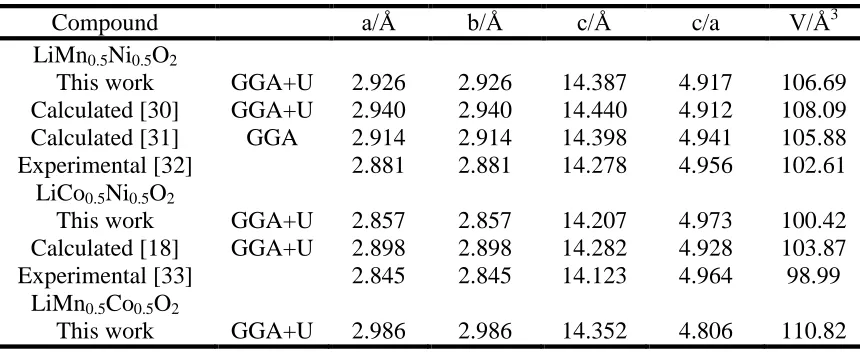
First, we examine the structures of the lithium mixed transition metal oxides. The structures with different arrangement of the transition metal atoms in both R3m and C2/m phases are optimized in our calculations. The most stable structures for LiMn0.5Ni0.5O2, LiCo0.5Ni0.5O2 and LiMn0.5Co0.5O2 are obtained and shown in Fig. 1(a), (b) and (c), respectively. The calculated and experimental lattice parameters are listed in Table 1, where the results available from other works are also given for comparison. It is found that our calculated results are reasonably in agreement with other reports and experimental values.
[image:4.596.132.477.260.440.2]Figure 1. Schematic views of the atomic structures of (a) LiMn0.5Ni0.5O2, (b) LiCo0.5Ni0.5O2 and (c) LiMn0.5Co0.5O2.
Table 1. Lattice parameters(a, b and c in Å), unit cell volume(V/Å3) of LiMn0.5Ni0.5O2, LiCo0.5Ni0.5O2, LiMn0.5Co0.5O2.
Compound a/Å b/Å c/Å c/a V/Å3
LiMn0.5Ni0.5O2
This work GGA+U 2.926 2.926 14.387 4.917 106.69 Calculated [30] GGA+U 2.940 2.940 14.440 4.912 108.09 Calculated [31] GGA 2.914 2.914 14.398 4.941 105.88
Experimental [32] 2.881 2.881 14.278 4.956 102.61
LiCo0.5Ni0.5O2
This work GGA+U 2.857 2.857 14.207 4.973 100.42 Calculated [18] GGA+U 2.898 2.898 14.282 4.928 103.87
Experimental [33] 2.845 2.845 14.123 4.964 98.99
LiMn0.5Co0.5O2
This work GGA+U 2.986 2.986 14.352 4.806 110.82
[image:4.596.84.514.528.704.2]
means that the JT effect lowers the structural symmetry in the LiMO2 compound. According to our total energy calculations, it is clearly found that LiMn0.5Ni0.5O2, LiCo0.5Ni0.5O2, and LiMn0.5Co0.5O2 all keep the α-NaFeO2 structures, which are rhombohedral with R3m symmetry. Obviously, the structural symmetry do not be lowered even if the LiMn0.5Ni0.5O2, LiCo0.5Ni0.5O2, and LiMn0.5Co0.5O2 compounds possess the Mn and Ni ions which are extremely easy to bring the JT effect. Our results are consistent with that of Prasad et al.[34], where they indicated that the dopants, such as Co and Fe, could destabilize the monoclinic structure relative to the rhombohedral structure for the LiMnO2 compound. For the lithium mixed transition metal oxides, therefore, the structural distortion resulting from the JT distortion of transition metal atoms are suppressed to some extent. From the application point of view, therefore, the cycling stability of the lithium mixed transition metal oxides should be better than that of LiNiO2 or LiMnO2 due to the higher structural symmetry.
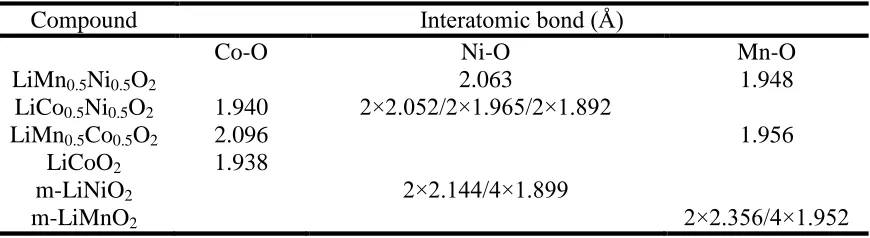
Table 2. Interatomic bonds between transition metal atoms and oxygen atoms in LiMn0.5Ni0.5O2, LiCo0.5Ni0.5O2, LiMn0.5Co0.5O2, and LiMO2 (M = Mn, Ni, Co).
Compound Interatomic bond (Å)
Co-O Ni-O Mn-O
LiMn0.5Ni0.5O2 2.063 1.948
LiCo0.5Ni0.5O2 1.940 2×2.052/2×1.965/2×1.892
LiMn0.5Co0.5O2 2.096 1.956
LiCoO2 1.938
m-LiNiO2 2×2.144/4×1.899
m-LiMnO2 2×2.356/4×1.952
[image:5.596.83.518.326.445.2]
CoO6 octahedron are still equal to each other, whereas the values of 2.096 Å is evidently larger than that in LiCoO2 (1.938 Å), which imply Co ion reduction. The calculated Co-O bond lengths for LiMn0.5Co0.5O2 are very close to that of the case for LiMn0.75Co0.25O2 [36], where the obtained Co-O bond lengths are 2.05 Å. In addition, the equivalent Mn-O bond lengths can also be obtained with 1.956 Å, which is basically equal to the short Mn-O bond lengths in monoclinic LiMnO2.
Different from the case of LiMn0.5Ni0.5O2 and LiMn0.5Co0.5O2, the JT distortion can be found in LiCo0.5Ni0.5O2. Although the six Co-O bond lengths are equal to 1.940 Å, which is almost the same as that in rhombohedral LiCoO2 (1.938 Å), three types of bond lengths are formed for the six Ni-O bonds in the NiO6 octahedron with 2.052, 1.965 and 1.892 Å for every two, respectively. Large differences among Ni-O bond lengths indicate the local structural distortion of the NiO6 octahedron, and thus relating with JT effect. On the other hand, it is found that the differences of Ni-O bond lengths are somewhat smaller than that in monoclinic LiNiO2, as listed in Table 2. As a result, the JT effect is mitigated when the Co atoms are incorporated into the LiNiO2 structure.
3.2 Electronic structures
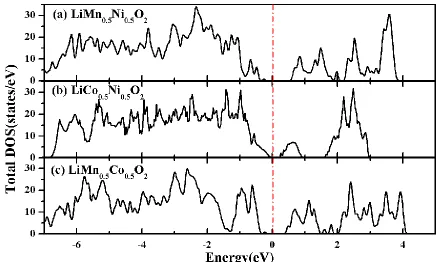
Figure 2. Total density of states of (a) LiMn0.5Ni0.5O2, (b) LiCo0.5Ni0.5O2, and (c) LiMn0.5Co0.5O2 obtained from GGA+U method.
[image:6.596.78.516.350.612.2]
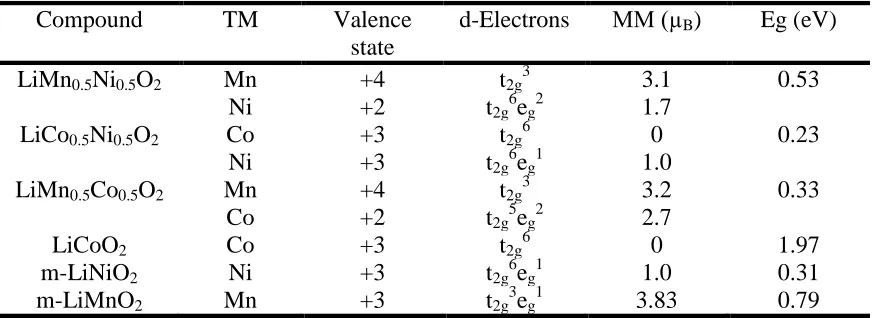
0.53, 0.23 and 0.33 eV for LiMn0.5Ni0.5O2, LiCo0.5Ni0.5O2 and LiMn0.5Co0.5O2, respectively. The corresponding values are listed in Table 3. The calculated energy band gaps of basic LiMO2 are also provided, which are 1.97, 0.31 and 0.79 eV for LiCoO2, LiNiO2 and LiMnO2, respectively. Therefore, the band gaps of the mixed transition metal compounds are comparable to that of LiNiO2, but smaller than that of LiMnO2 and LiCoO2. Although the DFT methods generally underestimate the band gap of the semiconducting materials to some extent, the small band gaps indicate that electronic conductivity of the three mixed transition metal compounds are not bad, especially better than LiCoO2.
Table 3. Physical properties for the layered structures calculated with the GGA+U method. MM represents the magnetic momentum (in unit µB) of transition metal atom, and Eg is energy band gap (in unit eV).
Compound TM Valence
state
d-Electrons MM (µB) Eg (eV)
LiMn0.5Ni0.5O2 Mn +4 t2g3 3.1 0.53
Ni +2 t2g6eg2 1.7
LiCo0.5Ni0.5O2 Co +3 t2g6 0 0.23
Ni +3 t2g6eg1 1.0
LiMn0.5Co0.5O2 Mn +4 t2g3 3.2 0.33
Co +2 t2g5eg2 2.7
LiCoO2 Co +3 t2g6 0 1.97
m-LiNiO2 Ni +3 t2g6eg1 1.0 0.31
m-LiMnO2 Mn +3 t2g3eg1 3.83 0.79
The detailed electron configurations of the transition metal atoms play an important role in the structural and magnetic properties. The projected density of states (PDOS) of the transition metal atoms could be conveniently used to study the electron configurations. The calculated PDOS of the transition metal atoms for different compounds are described as following. And the physical properties for the lithium transition metal oxides are listed in Table 3. In order to better compare, the results for LiMO2 (M = Mn, Ni, Co) are also given.
A. LiMn0.5Ni0.5O2
Figure 3 compares the Mn-3d PDOS in LiMnO2 and LiMn0.5Ni0.5O2 compounds. In LiMnO2, the eg orbital of Mn ion in the spin-up channel splits into two orbitals, namely dx2-y2 and dz2 orbitals. The t2g and dz2 orbitals in the spin-up channel are occupied, whereas the dx2-y2 orbitals in this channel is empty. In addition, the t2g and eg orbitals in the spin-down channel are entirely empty.
[image:7.596.81.520.272.431.2][image:8.596.141.454.165.345.2]
and thus forms Mn4+. Correspondingly, the magnetic moment of Mn ion in LiMn0.5Ni0.5O2 is 3.1 µB (as seen in Table 3). As the Mn4+ has no JT distortion, the Mn-O bond lengths are equal to each other in MnO6 octahedron of LiMn0.5Ni0.5O2, which could be used to explain the structural difference of MnO6 octahedron in LiMnO2 and LiMn0.5Ni0.5O2.
Figure 3. Mn-3d PDOS in LiMnO2 and LiMn0.5Ni0.5O2. The triplet and the duplet of the d-orbital are denoted as t2g and eg, respectively. The Fermi levels are all set to be 0 eV.
Figure 4. Ni-3d PDOS in LiNiO2 and LiMn0.5Ni0.5O2. The triplet and the duplet of the d-orbital are denoted as t2g and eg, respectively. The Fermi levels are all set to be 0 eV.
[image:8.596.131.466.420.620.2]
of Ni3+ is 1.0 µB. When Ni ions are incorporated into LiMnO2 to form LiMn0.5Ni0.5O2, a (t2g)6(eg)2 electronic configuration could be found. Comparison with the electron configuration of Ni ion in LiNiO2, Ni ion in LiMn0.5Ni0.5O2 gains one electron, which is localized at the dx2-y2 orbital of the spin-up channel, thus forming Ni2+. The magnetic moment of Ni2+ is calculated to be 1.7 µB. With such an electronic configuration, the NiO6 octahedron are no longer JT active, and the six Ni-O bonds have almost the same bond lengths. These results coincide with the previous LSDA calculations that are performed by Koyama et al. [15]
[image:9.596.118.478.226.436.2]B.LiMn0.5Co0.5O2
Figure 5. Mn-3d PDOS in LiMnO2 and LiMn0.5Co0.5O2. The triplet and the duplet of the d-orbital are denoted as t2g and eg, respectively. The Fermi levels are all set to be 0 eV.
[image:9.596.116.482.507.723.2]
Figure 5 shows the Mn-3d PDOS in LiMnO2 and LiMn0.5Co0.5O2 compounds. It is found that the results of Mn-3d PDOS in LiMn0.5Co0.5O2 is extremely similar to that in LiMn0.5Ni0.5O2. Therefore, the electron configuration of Mn ion in LiMn0.5Co0.5O2 is (t2g)3(eg)0, and thus coming into being +4 valence state (Mn4+) and 3.2 µB magnetic moment (as seen in Table 3). This result is also related with the equal Mn-O bond lengths in LiMn0.5Co0.5O2 due to the JT inactivity of Mn4+.
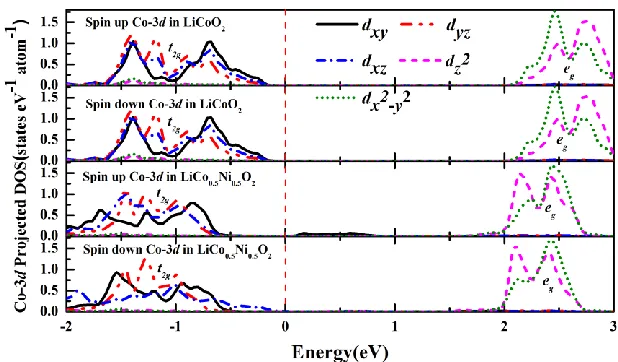
Due to the full occupation of t2g orbitals and non-occupation of eg orbitals for Co-3d orbitals in LiCoO2 compound, regardless of spin channels (as seen in Fig. 6), which results in the (t2g)6(eg)0 electron configuration, the valence state and the magnetic moment are +3 and 0 µB, respectively, which are in agreement with the results obtained by Xiong et al. [37] After the mixing of the Mn and Co atoms in the lithium transition metal oxides with 1:1 atomic ratio, the Co-3d PDOS change a lot. All t2g and eg orbitals with spin down are filled, and two t2g orbitals (dxy and dxz) with spin up are also occupied. However, the remanent orbials in the spin-up channel are unoccupied. As a result, the (t2g)5(eg)2 electron configuration is obtained, which results in the +2 valence state and 2.7 µB. Combining with the Mn-3d characteristic in LiMn0.5Co0.5O2, it can be found that charge transfers from Mn to Co. Our results are basically in agreement with that reported by Prasad et al. where the LiMn0.75Co0.25O2 is mainly discussed [36].
C. LiCo0.5Ni0.5O2
Figure 7 and Fig. 8 show the Co-3d and Ni-3d PDOS. For Co-3d PDOS, the occupation of orbitals in LiCo0.5Ni0.5O2 is the same as that in LiCoO2. The same thing happens for Ni-3d PDOS. This means that the electron configurations and magnetic moments of Co ion and Ni ion in the LiCo0.5Ni0.5O2 compound do not change when compared with LiCoO2 and LiNiO2. Therefore, the (t2g)6(eg)0 and (t2g)6(eg)1 electron configurations for Co3+ and Ni3+ respectively in LiCo0.5Ni0.5O2 can be obtained (as seen in Table 3), which is in accordance with the experimental observations [33]. In this case, no charge transfer between Co and Ni occurs.
[image:10.596.143.452.519.700.2]
Figure 8. Ni-3d PDOS in LiNiO2 and LiCo0.5Ni0.5O2. The triplet and the duplet of the d-orbital are denoted as t2g and eg, respectively. The Fermi levels are all set to be 0 eV.
3.3 Formation energy
In order to evaluate the thermodynamical stability of the lithium mixed transition metal oxides compared to the simple LiMO2 (M = Co, Mn, Ni) compound, we define the formation energy Eform as
following
Eform(LiM(1)0.5M(2)0.5O2)=E(LiM(1)0.5M(2)0.5O2)-1/2(E(LiM(1)O2)+ E(LiM(2)O2)) (1)
where M(1) and M(2) represent the different transition metal atoms, and E(LiM(1)0.5M(2)0.5O2), E(LiM(1)O2) and E(LiM(2)O2) are the total energies of LiM(1)0.5M(2)0.5O2, LiM(1)O2 and LiM(2)O2, respectively.
Actually, according to the general alloy theory [38], the definition of formation energy represents a measure of the effective M(1) and M(2) interactions when they are mixed. If Eform is
negative, M(1) and M(2) have an effective attractive interaction and the system could be either mixed or ordered, which depends on the strength of the interaction and the preparation temperature. If Eform is
[image:11.596.86.517.74.390.2]
Table 4. The calculated total energies and formation energies of the formula units. LiMn0.5Ni0.5O2 (eV/f.u.) LiMnO2 / LiNiO2 (eV/f.u.) Eform(meV)
-23.661 -26.411 / -20.156 -377
LiCo0.5Ni0.5O2 (eV/f.u.) LiCoO2 / LiNiO2 (eV/f.u.)
-21.294 -22.419/ -20.156 -6
LiMn0.5Co0.5O2 (eV/f.u.) LiMnO2 / LiCoO2 (eV/f.u.)
-24.477 -26.411/ -22.419 -62
As the lithium mixed transition metal oxides LiM(1)0.5M(2)0.5O2 with the lowest energy adopt the rhombohedral structures, the rhombohedral structures of LiM(1)O2 and LiM(2)O2 are also taken into account as the references.
From Table 4, it can be found that the Eform of LiMn0.5Ni0.5O2, LiCo0.5Ni0.5O2 and LiMn0.5Co0.5O2 are all negative, indicating that the mixture of the transition metal are favorite for the three lithium mixed transition metal oxides. Among them, the formation energy of LiMn0.5Ni0.5O2 (-377 meV per formula unit) is the lowest, which means that a strong ordering (attractive) tendency between Ni and Mn. Our calculated formation energy of LiMn0.5Ni0.5O2 is somewhat lower than that of previous study (-216 meV per formula unit) [31], which is probably because the selected structures for LiMnO2 and LiNiO2 in their study are different from our structures.In contrast to the case of LiMn0.5Ni0.5O2, the formation energy of LiCo0.5Ni0.5O2 is much higher, which is about -6 meV per formula unit. The high formation energy suggests that phase separation is relatively easy to occur though Co and Ni could be mixed in the LiCo0.5Ni0.5O2. Compared with LiCo0.5Ni0.5O2 and LiMn0.5Ni0.5O2, LiMn0.5Co0.5O2 has a modest formation energy of -62 meV per formula unit. According to the calculated formation energies, therefore, LiMn0.5Ni0.5O2 is most likely to be prepared among the three lithium mixed transition metal oxides.
4. CONCLUSIONS
gaps compared with the single phase LiMO2 (M = Co, Ni, Mn). In addition, formation energy calculations show that LiMn0.5Ni0.5O2, LiMn0.5Co0.5O2 and LiCo0.5Ni0.5O2 compounds are thermodynamics stable when compared to the basic layered LiMO2 (M = Co, Mn, Ni). Therefore, the mixture of cations in the lithium transition metal oxides could be formed, and the order for the mixture from easy to difficult is LiMn0.5Ni0.5O2 > LiMn0.5Co0.5O2 > LiCo0.5Ni0.5O2.
ACKNOWLEDGEMENTS
This work is supported by the Natural Science Foundation of China under Grand Nos. 11264014 and 11564016, and Natural Science foundation of Jiangxi Province under Grand No. 20133ACB21010, 20142BAB212002 and 20152ACB2101. B. Xu is also supported by the oversea returned project from the Ministry of Education.
References
1. R. Koksbang, J. Barker, H. Shi and M. Y. Saidi, Solid State Ionics, 84 (1996) 1. 2. T. Ohzuku, A. Ueda and M. Nagayama, J. Electrochem. Soc., 140 (1993) 1862.
3. A. Hirano, R. Kanno, Y. Kawamoto, K. Oikawa, T. Kamiyama and F. Izumi, Solid State Ionics, 791 (1996) 86.
4. M. Saiful Islam and R. Andrew Davies, Chem. Mater., 15 (2003) 4280. 5. P. G. Bruce, Chem. Commun., 19 (1997) 1817.
6. M. M. Thackeray, Prog. Solid State Chem., 25 (1997) 1.
7. M. S. Whittingham and P. Y. Zavalij, Solid State Ionics, 131 (2000) 109. 8. B. Ammundsen and J. Paulsen, Adv. Mater., 13 (2001) 943.
9. G. Amatucci and J. M. Tarascon, J. Electrochem. Soc., 149 (2002) K31.
10.T. Ohzuku, A. Ueda, M. Nagayama, Y. Iwakoshi and H. Komori, Electrochim. Acta, 38 (1993) 1159.
11.M. Broussely, J. P. Planchat, G. Rigobert, D. Virey and G. Sarre, J. Power Sources, 68 (1997) 8. 12.J. P. Cho, H. S. Jung, Y. C. Park, G. B. Kim and H. S. Lim, J. Electrochem. Soc., 147 (2000) 15. 13.Hernan, A. Caballero, J. Morales, E. R. Castellon and J. Santos, J. Power Sources, 128 (2004) 286. 14.R. Stoyanova, E. Zhecheva and L. Zarkova, Solid State Ionics, 73 (1994) 233.
15.Y. Koyama, Y. Makimura, I. Tanaka, H. Adachi and T. Ohzuku, J. Electrochem. Soc., 151 (2004) A1499.
16.N. N. Shukal, S. Shukal, R. Prasad and R. Benedek, Modelling Simul. Mater. Sci. Eng., 16 (2008) 055008.
17.J. M. Wang, J. P. Hu, C. Y. Ouyang, S. Q. Shi and M. S. Lei, Solid State Commun., 151 (2011) 234.
18.S. Hao, N. Q. Zhao, C. S. Shi, C. N. He, J. J. Li and E. Z. Liu, Ceram. Int., 41 (2015) 2294 19.E. Rossen, C. D. W. Jones and J. R. Dahn, Solid State Ionics, 57 (1992) 311.
20.T. Ohzuku and Y. Makimura, Chem. Lett., 8 (2001) 744.
21.P. Senthil Kumar, A. Sakunthala, M. Prabu, M. V. Reddy, R. Joshi, Solid State Ionics, 267 (2014) 1.
22.G. Kresse and J. Furthmuller, Phys. Rev. B, 54 (1996) 11169. 23.G. Krosse and J. Joubert, Phys. Rev. B, 59 (1999) 1758.
24.J. P. Perdew, K. Burke and M. Ernzerhof, Phys. Rev. Lett., 77 (1991) 3865. 25.V. I. Anisimov, J. Zaanen and O. K. Andersen, Phys. Rev. B, 44 (1991) 943.
26.I. V. Solovyev, P. H. Dederichs and V. I. Anisimov, Phys. Rev. B, 50 (1994) 16861.
28.H. J. Monkhorst and J. D. Pack, Phys. Rev. B, 13 (1976) 5188. 29.Y. Kim, J. Mater. Sci., 47 (2012) 7558.
30.A. Dianat, N. Seriani, M. Bobeth and G. Cuniberti, J. Mater. Chem. A, 1 (2013) 9273. 31.J. Reed, G. Ceder, Electrochem. Solid State Lett., 5 (2002) A145.
32.C. S. Johnson, J. S. Kim, A. J. Kropf, A. J. Kahaian, J. T. Vaughey, L. M. L. Fransson, K. Edström and M. M. Thackeray, Chem. Mater., 15 (2003) 2313.
33.T. Ohzuku and Y. Makimura, Res. Chem. Intermed., 32 (2006) 507. 34.R. Prasad, R. Benedek, M. M. Thackeray, Phys. Rev. B, 71 (2005) 134111.
35.Z. L. Chen, H. M. Zou, X. P. Zhu, J. Zou, J. F. Cao, J. Solid State Chem., 184 (2011) 1784. 36.R. Prasad, R. Benedek, A. J. Kropf, C. S. Johnson, A. D. Robertson, P. G. Bruce and M. M.
Thackeray, Phys. Rev. B, 68 (2003) 012101.
37.F. Xiong, H. J. Yan, Y. Chen, B. Xu, J. X. Le, C. Y. Ouyang, Int. J. Electrochem. Sci., 7 (2012) 9390
38.D. de Fontaine, Solid State Phys., Academic Press, New York, 47 (1994) 33.