State-Space Approach to Nonlinear Predictive
Generalized Minimum Variance Control
Mike
J
Grimble and Pawel Majecki
Industrial Control Centr University ofStrathclyde
Graham Hills Building 50 George Street GLASGOW GI tQE
oited Kingdom
Telephone 0: +44 (0)141 -524400 _xtensions: 2378/2880 Direct Line 0: 44 (0) 141 548 2378
Facsimil 0: +44(0)1415484203 Electronic Mail: [email protected]
http://www.icc.strath.ac. uk
Abstract
A Nonlinear Predictive Generuli::ed Minimum Variance (NPG!vfV) control algorithm is introduced
for the control of nonlinear discrete-time multivariable !'J~ystems. The plant model is repre ented by
the combination of a very gen ral nonlinear op rator and also a linear subsystem which can be
open-loop unstable and is represented in state- pac mod I form. The multi-step predictive control
cost index to be minimised involve both weighted error and control signal costing terms. The
solution for the control law is derived in the time-domain using a general op rator representation
of the process. he controller include, an int rnal m del of the nonlinear proce s but because of
the assumed structure of the system the state observ I' is only required to be linear. In the
asymptotic case, where the plant is linear, the controll I' reduces to a state-space v rsion of the
well known GPC controller.
Keywords: State-space, predictive, nonlinear. optimal, minimum variance, transport delay.
Acknowledgements: Ware grateful for the support of the PSRC on the Platform Grant
Proj ct 0 EP/C52642211 and for the usc of the ship model from the Marine Systems Simulator
Introduction
The aim is to design a relatively simple controller for nonlinear s st ms that has some of the
advantages of the popular Generalised Predictive Control (GPC) algorithms. The model based
predictive control (MBPC) approach based on linear theory has been applied very successfully in
the process industries, where it has repeatedly improved the profitability and competitiveness of a
production plant. It has been used to improve performance in difficult systems which contain long
dead times, tim -varying system parameter and multivariable interactions. Predictive algorithms
were initially applied on relatively slow processes (such as thermal processes) for the chemical,
petrochemical, food and cement industri s but are now applied on faster systems, such as servo
systems, h draufic systems and gas turbine applications. pynamic Matrix Control (DMC). due to
Cutler and Ramaker [11 and Generalized Predicti 'e Control (GPC), due to Clarke et. af. ([2], [3])
are popular. Richalet (l4J, [5]) developed some of the first predictive cantrall rs and has applied
the technique successfully in a ide range of applications. The relationship bet een LQ optimal
and predictive control was xplored in Bitmead et al [61. A tate-space version of a GP .
controlkr was obtained in [7].
The solution presented here b lilds upon previous results on Generalised Minimum
Variance (CiMV) control. A Nonlin ar Cieneralized Minimum Variance (NGMV) controller as
derived recently for nonlinear model hased multivariable s, stems b Grimhle ([8J, [9] and
Grimhle and Majecki rIO]. Th tension over the basic NGlv.fV control law involves an extension
of th N;MV cost-index to include future tracking error and control costing terms in a GPC t pe
of problem. When the system is linear the result. revert to those for a GPC controller \vhich i a
valuable solution for many applications. n advantage of the proposed predictive control
hard nonl inearities, a state-dependent . tate-space model, transfer operators or even nonl inear
function look up tables.
The possible advantages relative to other nonlinear predictive control approache can be listed as:
• The general approach is close in spirit to fixed model based control so avoids problems
with on-line linearization and behaviour hould b easier to predict.
• If the system is close to being linear the sy ·tem will b have like a linear GPe control
de ign which is of course similar to DMC and many other well used and accepted
techn iq ues.
• No advanced concepts are needed to d rive the solution presented here and this can be
valuable in gaining acceptance from busy engineers in industry.
The road map for this paper is a follow. The nonlinear plant and linear state-space di turbance
models are described in § 2. It i shown in § 3 that the solution orthe linear multi-step predictive
(GPC) control problem can be lound from the solution of n equivalent minimum variance control
problem. The cost function and the solution of the IJ>CiMV n nlinear optimal control problem are
described in § 4 together with the main theorem. The stability and design issues are consid red in
§ 5 An illustrative design example is presented in § 6. Finally conclusions that may be drawn arc
summari ed in § 7.
System Models
The plant model relating input and output can be grossly nonlinear, dynamic and may have a very
genera! form, how vel', the disturbance signal is a SLImed to have a linear time-invariant m del
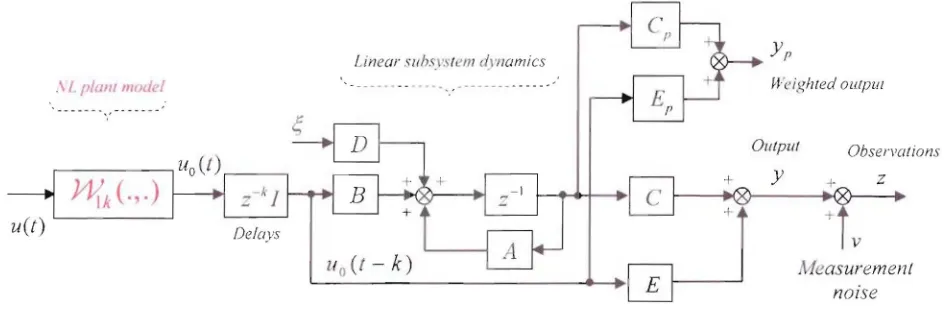
representation. The system il Fig. I includes the nonlinear plant model together with the linear
¢o = Pee +;r;.u + /~'OUO
...
r-y .1
, , Disturbance
----~:
Pc:----t~_.---
model:
- - - .:
+T+
:
IError I I
I I
weighting ,- - - Control ,- - - -; Input
: f:
I . h . ; FeG I I h, we/g t l n g , weig ting
' - _ _ ~ I - 1
I ...
I I
I I
I I
I I
Controller I I
I r
m
Reference I I -+
r
+
Nonlinear Linear
subsystem subsystem
Observations signal z v
d
y
+
+
Fig.1: Two Degrees of Freedom Feedback Control System for onlinear Plant
The signals v(t) and ~(t) are vector zero-mean. independent, Gaussian white noise ignals. The
white measurement nOIse signal {v(t)} IS assumed to have a constant covariance
matrix R, = R~ 2: 0 and there is no loss of generality in as uming that the zero-mean white noise
source {~(t)} has an identity covariance matrix. It will be shown that there is no requirement to
pecify the distribution of the noi~e sourc~, since the sp cial tructurc of the sy tcm leads to a
prediction equation, which is only dependent upon the linea!" stochastic disturbance model. The
plant may have a vel' general nonlinear
or
rat I' form.Nonlinear plant model: ( I)
where z-kJ denotes a diagonal matrix of the common d lay elements in the output signal paths.
The output of the non-linear subsystem Y\.)k will be denoted as
uo(t)=
()!~kU)(t). For simplicityWo =:: .k WOl" is introduced in more detail below and can contain any unstable modes. If ther is
no linear sub-system component then W(j~ = I. The generalisation 0 different delays in different
signal paths complicates the solution but is straightforward 19]. The weighted ou/pu/ equation can
include any stable dynamic cost-function weighting Yp(t) = PC(Z-l)y(t).
Linear Stule-.5'pacl! .)uhsystem Models
The first of the sub-systems to be defined is associated with the linear disturbance model and any
linear sub-system Wo in th plant ode!. Con ider first the linear subsyst ms shown in Fig. 2.
The linear sub-system model in Fig. 2 rna be assumed to b stabilizable and detectable and to be
represent d in the state-space equation form:
.r:(t + 1) == Ar(t) + Bull(t - k) + D~(t) (2)
y(t) == Cx(t) + Euu(t - k) (3)
Yp(t) == Cpx(t) + E ,1L
(t -
k) (4)1 u
z(t) == G.c(t) + EuuU - k) + v(t) (5)
\ here A. B. C. D, E. CI" E" are (;onstant matric s. The delay free plant transfer of the linear sub
system, referred to above. may be ritten as lVo~ == E + C<I)/3, wher. <1) = (21 - A) I. The input
signal channels in the plant model are assLim d to include a k-steps delay and the signals may b
listed a-:I:(1) == linear sub-system states; l/u(t) == input ignal to the lin\,;ar subsystem; n(t) =
control signal; y(t)
=
output signal; z(t) == observati n ; r(t) == set-point or reference; Yp(t)rVeighted OUlPUI
Output Observations
+ Z
v y
+
Linear SlIhsl'stem ,z\'/wmics
.\!. plulI/ //1m}!!!
u(t) Delays
_ _
---..~EC
+
+,
uo(t-k) ~
'--
Fig. 2: Nonlinear Plant Input Subsystem and Linear Output and Disturbance Subsystem
Future Outputs and States: uture values of the states and outputs may be obtained as:
xU + i) = A'xU) +
±
A'-/ (Buo(t + j -I-k) + Dc;(I +j -I))(6)
,~I
The expression for the future states may be obtained by changing the time ir (6) by th k-. teps of
the explicit transport delay giving:
x(t +i+ k) = ....I'x(l + k) +
±
A' I (Bu()(l +.i -
I) + Dc;U + j + k - I)) (7) I-IFuture Weighted Outputs: The weighted output equation can include any stable dynamic cost
weighting:tlp(t)
=
p,Jz-J)y(t) , which involves augmenting the st, te quation model. oting (3) thweighted output y('(t) has the following f rm (for 7. 21):
y/t + i + k) = CpA'x(t
+
k) +I
C'pA'-J(Buo(t +
.1-1) + Dc;(t + j + k-1))
+E,,!Lo(t+
i) (8)J-l
Th output arc to b computed lor controL in the interval T E
[t, t
+N].
Introducing an obviousnotation for these output signals they may be collected in an Nfl vector form as:
[image:7.612.80.555.101.259.2]Yp(t + k)
Yp(t + l + k)
Yp(t+2+k)
Yp(t + + k)
=
Epuo(t)
E),'Uo(t + 1)
Epuo(t + 2)
Ep'Uo(t + . ) +
CIp
CAp
C Ap 2
C p18
+
.r(t + k) +
0 CD p CADp
0 0 0
CpS 0 0
CpAB CpB
0 A'\ -lB
p C p A' -2B CpB
0 0 ~(t + k)
ueJt)
uo(t + 1)
uo(t+·T-1)
0 0 ';(t+l+k)
D
p (9)
0
AN-1D C A' -2D CD (t + N -1 + k)
p p p
With an obvious definition orterms this equation may be written as:
where the following vectors and block matrices ma b defined for the case: N > 0:
e r e ('
. =(
lag p' I" •• , .C P ( 1 and E'=
di n!J { E . E , ... , E } (N I square)P' P ]J
AN
=
1;12
AN
BN
=
() B AN-In () () 13
A v 2[
0 13 () 0 () ()
D
IV=
\if!t.N
=
1:( t)
~(t+ 1)
[f0
1.1
=
'/to(t)
uo(t + I)
Rt,N
(,(/+N-I)
'l/.oU
+ N)(J 0) 0 U AD AN-1n 0 0 D AN2 D 0 0 0 D
=
'r;,(t) r~(t+1)(I J)
.,. (t + J
For the special case: N
=
O,AN=
I ,BN=
DN=
o.
eN=
Cp ' EN=
Ep ' The transfer ~ '\denote a vector of future white noise inputs and U,.\, denote' a block vector of future control
signals. The block vector R",v denotes a vector of future reference ignals that must include the
same weighting as on the output (8) r~(t) -= Pc(z'l)r(t). The k steps-ahead tracking error, that
includes any dynamic error weighting, may be writt n as:
The 'eighted inferred output to be minimised is assumed to have the same dimension as the
control signal. The matrix
v'v
in (12) for N> 0. is ofa block 10 er triangular form:E p 0 0 0
CpB
E
p 0VN
=
GNBN +E,=
G AN 2B
p
G AN
In
l'
GpB
C AN -2
n
II
Ep
(,'fJ
- !'
0 Ell
(13)
For the special case of a single-slane cost ~
=
0 and thi . matrix must be defined as VN -= E p.Prediction Model
The i-steps ahead prediction of the utput signal ma be calculated by noting the ab ve re ult (8)
then, YpU + i + kit)
=
CpA'i:(t + kit) +L
1
CpA '-J
Buo(t + .J -1) + EpuoU + i) ( 14)
r 1
where .i:(t + kit) denotes a least squares state estimate from a Kalmanjilter. Collecting results
for the case N> 0 the vector of predicted outputs ~.kN may be obtained in the block matrix form:
Yp(t+k:lt)
Yp(t + 1+ kit)
Yp(t + 2 + kit)
yp(t + N + kit)
=
CI p CAp A2 )' CAN ]I '--v----'
i(t + kit) +
Ep 0 0 0
CB
Ji Ep 0
CB
]I C p A '-2B
C
AN-IBC
AN -2BEp
cn
0
E
l' P P P
1-to(t)
uo(t +1)
uo(t + N)
v ' ' - - - v - - - '
GNAN VN ",GNBN+E'N U~N
(15)
This N+ J step-ahead prediction in (15) can clearly be written in the form:
Y .
N=
C A".i(t
+ kit) + VvUo ( 16)t+k, i"¥ I "J
Output prediction error: - Y;.k N -, Yt , . , N
- hence. the injerred output estimation error:
where the k steps-ahead state estimation error: ,i:(t + kit) = :r(t + k) - i(t + l.:
I
t) . The stateestimation error IS indep ndent of the ch ice of control action. Also recall that the
optimal.i:(t + f..,;
I
t) and :r(t + kit) are orthogonal and the expectation of th product of the futuremean white noi, e driving signals, is null. It follows that the vector of predicted signals Y:Tk,N In
(16) and the prediction error Y; ., N are orthogonal.
Kalman Estimafor - Predictor Corrector Form
The estimates are r quired from a Kalman filter summari ed briefly as:
x(t
+
I It) = Ax(rIt)
+
BuoU - k) (Predictor) ( 19)x(r
+
11 t + I)=
x(r + II t) + Kf ( z(t+
I) - z(t+
IIt))
(Corrector) (20)z(t
+
II
t)=
Cx(t+
II
t)+
£uo(t+
1-k) (21 )The state estimate x(t + kit) may be obtained, k steps ahead. using a Kalman filter [II]. In this
form of the estimator the numb r of states in the filter is not increased by the number of the
synchronous delays k, The desired prediction equation:
(22)
where To(k,.:-I)den tes a finite impulse response hlock. To(O,Z-') = land for k ~ I:
ing (19) to (21) the optimal estimate may b written:
xU
+
IIt
+ I)=
Ax(rI
t)+ BuoU -k)+
K, (z(t + 1)-CAx(t 1t)-CBuo(t -k)- t'u()(t + l-k»)Th~ab ve equation may therefore be written:
where (25)
(26)
Observe that for the Kalman filter to be unbias d the following equation mu t be satisfied:
(27)
This result may be verified u ing (25) and (26).
Generalised Predictive Control Review
A review of the derivation of the CPC controller is provided below where the input (1,0) will be
taken to be that for the linear sub-system. The CPC criterion [12] to be minimised:
J
=
E{£
e/I
+ j + k)/ e,,(t + j + k) +J..7uo(t + j)' uo(t +j»1
t} (2S)/=0
where: E{.jt} denotes the conditional e, pectation, conditioned on measurements up to time t
and A) denote. a scalar control signal weighting actor. The vector of future weighted reference
signal is denoted by
r;,(L
+ j + k) where the weighted error (~p(t;)=
T~(t) - Yp(t). The futureoptimal control ignal is to be calculated for the interval t s
[l,
f +N].
The state-space modelsgenerating the sionals r, and y" may include any dynamic cost-function w ighting~.(=-').
rllJ.
lOptimal Cuntrol Solution Using Slale Estimate Feedback
(29)
(30)
where the co,t weightings on the future inputs 110 are written a i\~ =diag{A~,AI2,.... A~!}. The
terms in the cost-index can then be simplified, fir t by noting the optimal estimate Y;'k,N 15
orthogonal to the estimation err r Y;-k,N and second by recalling the future refer nee R'+kN IS
assumed to b a known signal over the N+ 1 steps. Simplifying, obtain the vector/matrix form:
Vector form GPC criterion: (31 )
where Jo =:: E{Y,~A ",Y,+k,,\' It}. Substituting from equation (16) f, r the vector of state-estimates:
and riting: (32)
Using these results the cost unctiol may be expanded as:
(33)
The proc~durefor minimising this cost term. if the signals are detcrmini'tic, is almost identical to
that when th conditional cost is con id red. The gradient or the cost-function must be set to zero,
to obtain the vector of future optimal control signals. From a perturbation and gradient calculation
[J2j, noting the Jl1 term is ind pendent of the control, the vector of/illure oplim"f confrol signals:
Th GPC optimal control is defined from this vector based on the receding horizon principle [13]
and the optima) control is taken as the first element in the vector of future cOl1trols [ltUN.
Equivalent Cosl Optimisation Problem
It is now shown that the above problem is equivalent to a sp cial cost minimisation control
problem which is needed to motivate the NPGMV problem introduced later. Let the constant
positive d finite, real symmetric matrix: XN :::: V;V
N
+
1\~ that enters the above olution, befactorised into the form: (35)
Observe that by completing the 'quares in equation (33) the cost-function may be written as:
That i , the co t-function: (36)
wh re the signal: (37)
The terms that are independent of the control action ma be written as: ./IU(t)::::./O +./I(t) where,
(38)
Since the last term J1U(t) in equation (36) does not depend upon control action the optimal control
is found by setting the first term to zero, giving the same control as defined in (34). It follows that the 0PC optimal controller for the above linear system is the same as the controller to minimise
Modified Cost-Index Giving GPC Controller
The above motivates the defir ition of a new multi-step minimum variance cost problem that has
the same solution for the optimal controller that i needed before the nonlinear problem can be
considered. A new signal to be minimised involving a weighted sum of error and inputs:
(39)
The vector offuture values of this signal, for a multi-step cost index, may therefore be written as:
()
(40) I ,.
Introduce co t-function weightings, ba ed on the GMVweightings above, to have the form:
~.\, =::
V/;
and (4\ )which will be justified by the property established in Theorem 3.1 b low. Then motivated by the
preceding, define a new minimum variance multi-step cost-function, using a vector of signals:
(42)
Predicting forward k-sleps (43)
Consider the ignal ¢t+k,N and substitut for the output Y:lk,N ==}~,J,;,N
+
~'k,N' Then from (43):(44)
This expression may be written in terms of the estimate and the estimation error vector as:
(45)
and the prediction error: <f:>t+k ,N
= -
~'N
Y;+k,N (46)Multi-Step Cost Index: The performance index (42) may therefore be simplifi d and written as:
The terms in (42) can b simplified, recalling the optimal estimate ~+k.N and the estimation error
~t-/;;, are orthogonal, and the future reference trajectory
R,...
J.N is a known signal. Thus,(47)
Thence, the cost-function may be written: (48)
The last cost term in (48) is independent of control action and may be written as:
(49)
This vector <Pt+k,N may be simplified by ubstituting for ~+/;;,N' from (16) and (35):
<P
~k.N =P (R eN IIk,N- f )
tik,N + po[o eN' t,1 =1> eN (R l.k,N -(' N r I·A·(t ty.Y . + . klt))-(\!I"V N N + I\.N A2)UOt,NThence, from (35) obtain: (50)
Recall the optimal multi-step minimum variance predicf;ve control sets the first squared ferm in
Theorem 3.1: Equivalent Minimum Variance Cost Optimisation Problem
Consider the minimisation of the GPC cost index (28) for the system and assumptions introduced
in §2, wh re the nonlinear subsystem: V\.{k
=
J and the v ctor of optimalGre
controls is given by(34), If the cost index is redefined to have a multi-step minimum variance form (42)
weightings
Pc", =
V;
and J';~.= -
\~,,
then the vector of future optimal controls is identical to theGPC controls in (34).
•
Solution: The proof follows b collecting the results in the ection above.
•
Nonlinear Predictive GMV Control
The actual input to the system is the control signal u(t), hown in Fig. I, rather than the input to
the linear sub-system uo' The cost-function for the nonlinear contI' I problem of interest must
therefore include an additional control signal co ting term, although the costing on the
intermediate signal uo(t) can be retained to e, amine limiting \.:ascs. If the small t delay in each
output channel of the plant is of magnitude k -steps this irnplie' the control affects the output
k-steps later and the control costing should include the dclay(~u)(t)=:: k (f;:kU)(t). This weighting
on the nonlinear sub-sy'tem input will be assumed to be full rank and invertible and can be a
linear dynamic operator but it may also be chosen to be nonlinear [11J. Thw, consider a new
signal to be minimised: ¢()(!) = p".e(l) + Fcouo(t) (;Z;:U)(l) (51 )
A multi-step cost index may now be defined that is an extension of the cost-function in (42).
The signal <D~+k,N is defined to includ the future control signal costing terms:
where the non-linear function ~k,N t,N will normally be defined to have a simple diagonal form:
(54)
and the vector of inputs: Ut~N = (Y1{k,NUt")' where Y1{k,l\ also has a block diagonal matrix form:
(55)
The problem simplifies when N = 0 to the single-step NGMV control problem.
The NPGMV 'antral Prohlem Solution
The solution follows from very similar steps to those in §3.3 and will therefore be summarised
briefly, Observe from (43) that <Do =cD + z-k.T."NUt and (D~+kN=<D~+kN 1,<D,o'.Lvwhere
t,N t.,v C,,-,..N • , .
<i>U =
cD
+.T.U = P (R -Y )
+ F UUO +.T U (56)
, ... k.N tlk.N "k,N L.N C'N t.k,N L+k,N (:N toN "k.N t.<
The estimation error: (57)
The future predicted values in the signal: <i>~+k,N involve' th e timatt:d vector of weighted outputs
~tk,N and these are orthogonal to }~'k.,\' ote the estimation error is zero mean and the expected
value of the product with any known signal is null. The cost-function may therefore be written as:
(58)
(59)
/vPGA1V Optimal Control
The v ctor of future controls follows from the condition for optimality in (59):
u =-
(7 - A2W )-1 P (R -Y
)
(60)t,,," ck,N N lk.:>' cO' l+k,N IJk,N
A solution of (59), that is useful for implementation becomes:
(61 )
The optimal predictive control law is nonlinear. since it involves the nonlinear control signal
costing t rm .T::..k,N and the nonlinear model for the plant J1{k,N' Further simplification [s
possible by substituting from (16) for~+k,N'since quation (59) may be written as:
or (62)
This condition fhr optimality i the equivalent f that stemming from (50) hut with the;z:;; ',N is
added. T 0 alternative solutions for the vector a/future optimal controls, in terms of the estimate
of the future predicted tate. therefore becom :
(63)
or U t.N
=
-.Tk-I I/~•r (P.,(R (/\ t t - " ' d ' "V - lNA,y:/;(t + kit)) - XNWlkJJ )
(64), I ' t,N
Remarks: The control law is implemented using a receding horizon philosophy and it b comes
zero (~k,N ----:; 0 J1{k,N
=
I). From (63) if the control weighting ~k,N----:;0 then !.N willintroduce the inverse of the plant model Y1{k,~ (if one exists) and the r suiting vector of future
controls Ut~N ill then be the same as the GPC comrols for the linear system that remains.
Optimal Nonlinl:'ar Predictive Control Signal
These expressions can be simpli led further by substituting for the expression for the optimal
predicted state in (22) and invoking the condition for optimality in (62):
Recall uo(t)
=
J1{kU(t) and vrite: ( 5)The alternative form for the condition for optimality follows as:
(67)
An alt rnativ xpres ion also follows from (66):
To impl ify the equations also introduce the constant matri x:
(69)
Condition for optimali~ll: Equation (66) may be written as:
Optimal control: Two possible expressions for the vector of future optimal controls folio
(71 )
Theorem 4.1: J. PGMV Optimal Controller
Consider the linear components of the plant, disturbance and output weighting models in state
space form (2), (3) with input from the nonlinear finite gain stable plant dynamics
Y\.ik'
Themulti-step predictive control co t-function to be minimised, involving a sum of future cost terms.
is defined in vector form as: J
=
E{<p°Tet>0
I
t}
(73)P f+k,N f+k,
where N> 0 and the signal <f>~+k,N dep nds up n future error, input and nonlinear control signal
costing terms: <f>0 tck,N
=
P E CN t+k,N +FO
oW t,N°
+.T ck,N U t,N (74)The error and input cost-function weightings are introduced as in the GPC problem (28) and these
determine the block matrix cost forms
P,,,,
=v'0
and F;0, :=: -A~,. The control cost weighting may benonlinear and has the fonn
(f;:U)(/)
:=:(y:;:-kll)(
t - k) , where k represents the transport dela and f;:kis full rank and invertible. Define the constant matrix XN
=
V~'vN+
A~ then the j f'GMV ptimalThe current control can b computed lIsing the receding horizon principle from the first element in
the alternative expression for the vector o/future optimal controls:
•
Solution: The proof of the optimal control was given bef< re the Theorem and the assumption to
ensure closed loop stability is explained in the stability analysis below.
•
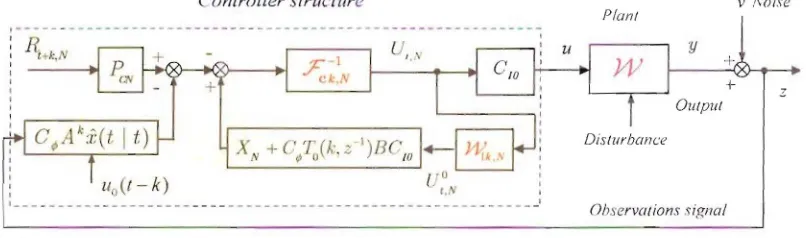
Remarks: The expression (76) leads to the structure in Fig. 3 which is useful for implementation.
This involves a Kalman predictor stage and note that the order of the Kalman tilter depends only
on the d lay free linear subsystems and not the channel delays. If the output weighting Pc includes
a near integrator it appears in the feedback and reference channels and it is desirable to move this
integrator term into the common path. The cost-index (74) when the input costing FU
j nul! eN
and in thi case<p;ltk,N
=
F~'EI+k,,y + (~k,i!IJ. Th limiting case of the NPGtvIV c ntroller istherefore related to an NGAifV control I r wher the error weighting is scaled by the E1 ' term.
p
('ontroller sfrut'tllre v /Voise
Plant
,---~
~~N + ; 'f
p'-p
+ :,
,
'---.:
I ,
,
,
II (/-k) UON :
l o t , I
1 • ~
i
Output
Observmions ,~iRnal
[image:22.612.103.506.596.715.2]Noise
]I Compensator structure
y Z
+ + Output Plant Disturbance + + ---, ,
: R!+k,N
,
:---toI
: l - - _ - - '
, ,
, , L.
-, , , , , ,, , , ,
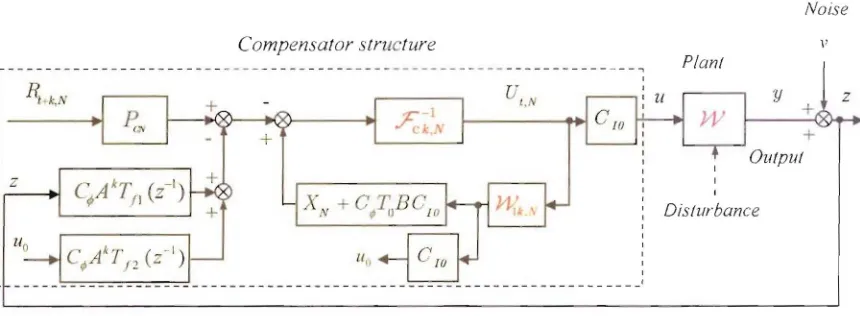
Fig. 4: NPGMV Compensator in Estimation Future Controls Form
Stability of the Closed Loop and Design Issues
To c nsider stability properties a different expr ssion is required for the cantI'l action where the
results are expressed in closed loop operator forlll. An algebraic result is fir t required involving
erms from the Kalman filter equations. Recall from (27):
but from (23) To(k,z 1)=(l-Akz-k)(=T-Afl. Usingth seresultsandnoling WOk =E+CC!>B,the
de ired result is obtained a :
C... T (I. I)fl (' 4 kl' ( 1) r< ,'kT" ( I) kHr ' ' ' ' ( l)fl (77)
/,! U r.: l Z ,¢' /2 Z +l q,''i /l Z Z n Ilk = '~4! Z
Assumptions and Closed l.oop Expressions
For lin ar GMV de iglls stability is ensured when the ombination of a control weighting and an
error w ighled plant model transfer is strictly minimum phase. For the proposed nonlinear
[image:23.612.96.526.102.260.2]upon the assumption of stability on the nonlinear plant sub-system U(k. For this stability
discussion assume that the stochastic inputs are null. Then
z(t)
=Cx(t)
+Euo(t -
k) +'o(t)
---+ (E +
Cet>B)uo(t - k),
and the optimal control b comes:Substituting from (77):
(78)
The control costing is normally a linear model and under this a 'sumption (78) corresponds to the
following condition for op imality:
(79)
where (YV;k.} t
J
= [(YV;k'u)(tf, ... ,(YV;kU)(t + N)Tf·
The desired expressions for the vectors offuture optimal control' ,md nonlinear plant sub ystem Ot tputs therefor become:
Future controls:
NL Subsystem future outputs:
(8t)
Total NL future plant outputs:
Stability Condition and Cost Function Weightings
linear plant sun-system is open loop stable all the operators in (80) to (82) are stable. If the open
loop plant is not stable then further assumptions are need cd to guarantee the stability of term In
(82).
[f there exi ts a PID controll r that will stabilize the nonlinear system. without transport
delay elements, then a set of cost weightings can be defined to guarantee the exi ·tence of this
inverse and hence ensure the stabiJ ity of th closed-loop. As ume that only the error and control
weighting are used. nd that the input weighting A~ --) (). Thcn
X
N=
V~VN + A~v --) V,~VRecall that in the ingle-step cost problem, wh re N = O. the matrix V
=
"'1 is assumed squarefollows that in this limiting case: (83)
Cost Weighting Choice
One of the main problems in nonlinear control is t ensure a stabilising control law and as the
assumption at the start of the main Theorem 4.1 confirms thi depends on the selection of the cost
weightings. A practical method of deriving such weighting. is suggested by these limiting results.
The telm (1 -.;z:;;~lE~·~.V~)kJ1{k) may be interpreted as the return-differenc operator for a
nonlinear syst m with delay-free plant model J1.{
=
WOk J1{k' Thus, if the plant already has a PJDcontroller that stabilises this model, the ratio ofweightings (-~kIE;Pe)can be chosen equal to the
PID controller. Then the weightings are linear and satisfy FC-k'E;~.
=
KI'J{)'Even for a linear GPC design stability is not guaranteed for all cost function weightings. There
will be some ystem descriptions where even scalar non-dynamic weightings mayor not ensure a
table closed-loop d sign. Now if the cost horizon is reduced to one step the cantrall r becomes
equal to an NGA1V design, which can be guaranteed to have a stabilizing solution by a imilar but
simpler method a in the previous paragraph. The argument is then that a' the multi-step cost is
introduced and the horizon increase it is normally the case that predictive c I1trols improve
resp nses. Thus the strategy or starting with a weI[ tuned NGMV solution and then increasing the cost horizon to introduce prcdicti e action is a practical method offinding co t terms that stabilize
Robustness of the Closed Loop System
In the predictive control of linear systems it is usually the case that step response overshoots
reduce as the cost horizon increases. This behaviour is related to smaller overshoots in frequency
domain terms in the sensitivity functions and this sugge ts there is a commensurate improvement
in robustness. Similar re ults are observed in the nonlinear case but robustness and sensitivity
then relates to the sensitivity operators. Th subject of robu tness in the presence of plant
uncertainties does of course deser e much more attention. A possible approach to the analy is of
NPGMV systems is indicated briefly belo....
Consider the case of a stable open loop sy tem and note that the relationship (77) can be employed
to show that the system in Fig. 4 can be redrawn as in 'ig. 5 below. This figure is of interest
because it resembles a Smith predictor type of structure but for the present discussion it allows
robustness to be assessed in a patiicular case. eglect for the moment most external inputs and
assume that the plant has an additive uncertainty of he form: W = W + W. Then noting the
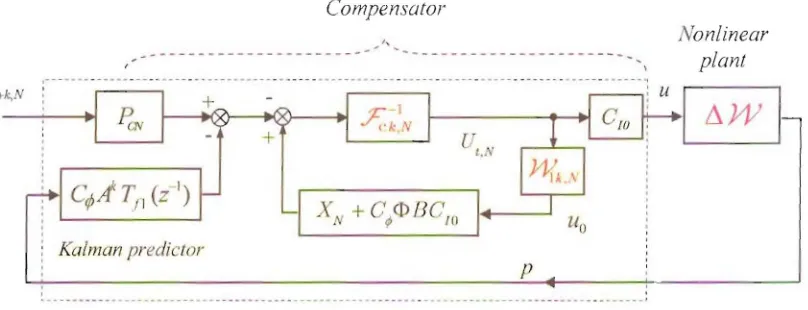
signs of the signals summed in the bottom path observe that the diagram in Fig. 5 may be redrawn
as shown in Fig. 6. From this diagram it is clear that the internal feedback loop which includes the
delay free plant model has a signiticant effect on robustness. his loop depend n both the error
and the control signal weighting choices. If for example the system has large high frequ ncy
uncertainty, such as resonances in a mechanical system, then th control costing can include a lead
term introduced at frequencies below the pos ibJe r onant behaviour. The result will be a low
gain in the forward path at high frequencies as determined by the inverse of the c ntrol co ting
within the inn r loop. To ome extent thi weighting acts as a natural so called robustification
filter. Zames (1966, (281) small gain theorem can then be applied to demonstrate that an
-
-Compensator .'vuise
Nonlinear v
'
---
---.z
+
y
+ Output plant
Disturbance
Ut,N
+
+
~
kNKalman predictor
p
+
Observations z: _ _ • • • • ---_ . _ _ -_ • • e • ~ _ • • • • a _ . • • • • !
Fig. 5: onlinear Smith Predictor Implied by NPGMVCompensator Structure
Compensator
Nonlinear
'
---~ ~---~ plant Ri+k,N
,--...--...--. _.._-... ---..---_. _. -_.. ---_.. _. ....-_ ...---...._. _.... _.-_.._. -"1
u+
,
+
Kalmun predictor
p
fig. 6: Loop Structure When Additive Uncertainty Present
Predictive Control Design for Dynamic Ship Positioning
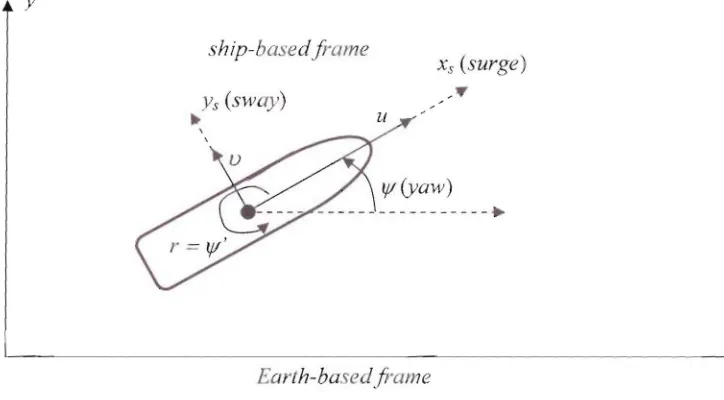
One of the potential applicati n areas for NPGlvIV control is in dynamic ship positioning and manoeuvring. A desired ship trajectory is often known in advanc (in the case of c~ynamicship positioning. the wntrol objective normally consists in ke .ping the v ssel's position constant,
[image:28.612.86.551.99.296.2] [image:28.612.107.511.396.551.2]Earth-based coordinate frame, as shown in Fig. 7. The bjective here is to control the vector of
ships position and heading '7
=
(x,Y,Ij/]'
via a thrusters/prop Iler propulsion s stem, so that adesired trajectory '7r<:1 is followed. This is a well known problem that ha been analyzed in detail
in literature - ee for examplc [14 to 17]. In the following, the NJ'GMV controller is lIsed and
assessed for this application.
Y
ship-basedframe
xs(surge)
,'t/f
Ys (sway)
u
IjI (yaw)
...
---.
Earth-basedframe x
Fig. 7: Dynamic Ship Positioning Problem
System model: The simplified lin ariLcd dynamics of the system are described by the following
di ffer ntial equ tion: Ali, + Dv = r (84)
where M is the inertia matrix, D represents sy. tem damping. v = [u u r( is a ship-based velocity
vector, and T is a vector of force' in X" and 'v',' directions, and the yaw torque. Thi pproximati n IS
valid especially at low spceds and positioning problems. The full nonlinear model, taking into
account Corio1is and nonlinear damping term. is given in [14J.
The velocity vector is related to the Earth-based po itions by the following kinematic
[image:29.612.113.475.265.465.2]where R(If) is the 3DOF rotation matrix: (86)
A simple diagonal thruster configuration was a umed in this paper. and the following nonlinear
static model for thru t forces and torq LIe was u d [15]:
(87)
where p is the water density. d is the thru ter diameter, n is the velocity in [rev/s]. and Kr is the
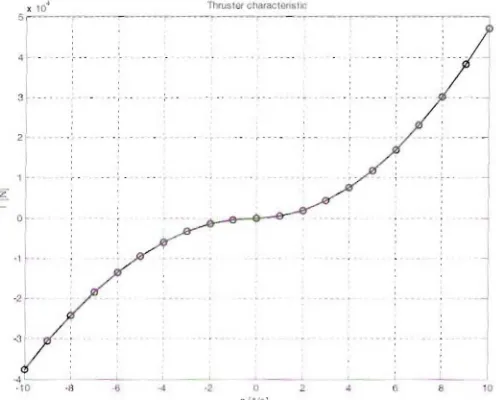
additional nonlinear thruster coefficient. The nonlinear thruster characteristic as a function of n is
shown in Fig. 8. In the following imulation studies. w have u ed models from the Marine
Syst ms Simulator Toolbox for Matlab [18].
x 10~ nvo-ster chara.ctonsllC
r - - ~
-51 :
r-·
4[
3 -- :--
-._
J
J
....~
_. ,.
t-of
i
.,
~I
::r
, ,
.... ---'--
-
J·'0 ·8 -6 .... -2 0 8 10
Il ~1/4i
"
fig. 8: Nonlinear Thrusters Cbaracteristic
Based on the ahove ystcm description, the opl.::n-Ioop Hammer tein model may be eparatcd into
nonlin ar and linear components as shown in Fig. 9. with the black-box model
J1{k
representingthe thrusters. Note that the nonlinear transfi rmation matrix R( Iff) i' not considered part of the
[image:30.612.180.428.368.568.2]For th controller design, a discrete model of the linear dynamics w s obtained using the Tustin method, with the ample time Ts
=
0.1 sec. A nominal one sample delay (k=
I) was assumed forthis model.
17£
----+ R(lj/)
11 1
l
'7
-T
•
~) s JThrusters Ship dynamics
Fig. 9: Decomposition of the Ship Model
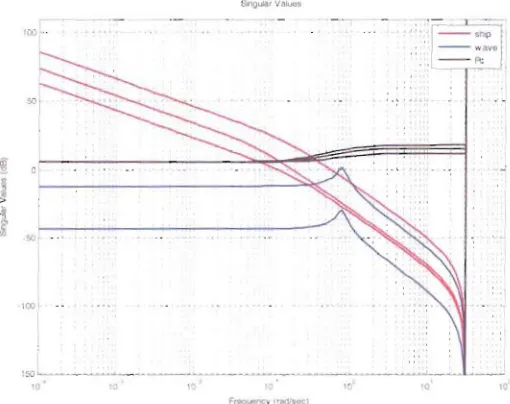
Wave model: The wave disturbance was described using a second order resonant system,
according to the transfer function: w(s)=, k , . where the parameters were defined as: s-+ 2t;OJ"s + (U,;
OJ" = 0.8 rad and t; == O. I. The scaling factor k was chosen '0 that realistic wave amplitudes ere
S
[image:31.612.133.482.188.299.2]100 .,
,',r:
:r:.
1
~ _.,100
--I
. - R :
~5oJ ~-~~---~---._----'
~-10· ":1 . H 10 to
f:'roquanq il(tfliliOCj
Fig. 10: Frequency Responses of System Models (plant, disturbance and nominal error weight)
NPGMV Controller implementation: Th structure of the model allows the solution of the
algebraic loop problem to be simplified. Recall the expression for the optimal control equence
(76):
The nonlinear thrusters model represented by J11~ is static and diagonal. while th control
weighting can bC'cparated into a component affected by the current control (the direct through
term) and a part dependent only on the past control values: .J;:k(r)=.r;;(r)+.F:(r), where .J;"(r)
contains a one- tep time-delay (note that a imilar decomposition would apply to a dynamic J1{k
model). Employing block matrix notation to indicate the block-diagonal structure of ';::1-'" the
expression for the vector of future controls can be n:writtcn as:
[image:32.612.181.436.104.306.2](88)
Since To(k.z~') contains a one-step time d lay, th right-hand side of (88) involve the vector of
controls computed in th pr vious step, and hence the current control is dependent on the past
controls and inputs and the algebraic loop is removed.
For a practical realization of the control law, it is necessary to invert the static operator
(JL;;,N - XNfiik,N ). Since /~v is in general a fu II matrix. a closed analytical form of the inverse wi II
not normally exi t, even though the M{A,\' nonlinearity i itself invertible. The solution is to sol e
the resulting nonlinear equation on-line. using an it rative Newton method [19]. An alternative is
to insert a memory block inside the ~ edback loop - this leads to a realizable but suboptimal
solution.
The final structure of the controller is as shown in Fig. j I. ote that the actuator saturation limits
have also been includ d in the model.
(',ANA'" -~ P,'N +
-,..
R,.k .N
'7(1)
X/II
Kalmall ~ L...
-.
iller
*
Z...
~.r17l
~ U/. N
I--(~.N
- XNU{k,N
)-1
"b1.J
+
-.;:;.
\+-I
C T B(' )1{k .\'
II 0 10
('/0
Clll
,(I)
~
[image:33.612.90.531.476.702.2]Nominal Design: Since the syst m includes integrators (the controlled variables are assumed to
be the position and heading), the controller does not normally rcquire integral action - the PD
structure is sufficient for perfect steady-state tracking. Following the tuning guidelines given in
§5.2. the
NPGMV
controll r design was initiall based on such aPD
controller C/'f)(Z·I) with thetuning gain selected as K~
=
2x I and Kd=
diag{6,2,4} (the derivative filters ith time-constant Iswere also includ d with the D terms). The dynamic weightings were thus defined as
-':(Z·I)=C/'J)(Z·I) and .7;k
=-V:'J'
with the input weighting A2, set to zero. As noted in Theorem4.1, for the case of N
=
0, these weightings correspond to the limiting case of the NGMVcontroller, whilst the horizon N> 0 con'esponds to the predictive control case.
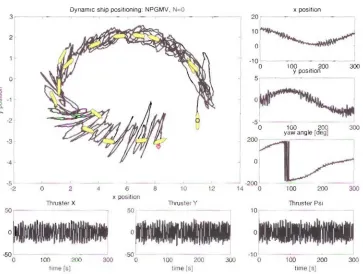
Two simulation scenarios were considered: point positioning ubject to wave motion and also
elliptical trajectory following. The nominal simulation results for the limiting case are shown in
Fig. 12 and 13. With the nominal eightings, the PGMV control p rformance is close to that of
PD
control (not shown) - this selection of weightings is thus au efu! starting point for the design.The responses wcre intentionally made r ther oscillat ry in order to show the rapid improvcment
with increasing N - the results that follow indicate that anI a few steps are ufticient for a
Dynamic ship positioning. NPGMV, N~O x position
3-~-- ~---~----._-- 20
1
100~
""9'•.'lll~tN"Y'''''\Ill'~
""h, , ~100 . 200 300
Yposition
O~
5o~-
~
1
-5 L - _ - - - _ _ , _ _.-J-2
I 0 y1~angle [Je~ 300
-3 l 160~
-
4t ~140 ~
I 120
- 5 L - - - ' - - - ' - -~---~---I1 0 0 L - - _
·2 0 2 4 6 8 10 12 0 100 200 300
x position
Thruster X Thruster Y Thruster Psi
50 - - - 50
10~,---o o o
_ _ _ _ _ _ --.-1
- 5 0 1 . - - - -10
o 100 200 300 100 200 300 o 100 200 300
time [sj tlme[s] lime [s]
Fig. 12: Ship Positioning - PG MV control with N = 0
DynamiC ship positioning: NPGMV. N~O x position
- - - . ,...---,--- 2 0 · - - -
j
1:~
J
-10 ' - - - -~--- - 5
~ 100 . 200 300, Y posItIOn
_!
-2'
300
-3
·4 ~ 0
J
-5 .200
-2 a 2 4 6 6 10 12 14 0 100 200 300
x position
Thn/ster X Thruster Y Thruster PSI
5 0 , - - 50 10
0 a
-10 1
100 ~ 300 100 200 300 lJ 100 200 300
l,me{S] lima!sl time(S)
[image:35.612.122.494.104.383.2] [image:35.612.124.487.426.700.2]Tuning Trials and Predictive Control: In the following modified design a lead term was included
in the control weighting to reduce high-frequency noise amplification, while the error weighting
Pe(:;-I) was modified by penalizing the frequency band corresponding to the wave motion
spectrum. This creates an inverted notch (bandpass) filter. In addition, th thrusters nonlinearities
were used to redefine the ontrol weighting as ';::Ju)== Fc~H('u) where F;.~(Z-I) is the nominal
linear control weighting, and H(u) is the thrust rs characteristic shown in Fig. 8. The inverse of H
was approximated by the expression: 1/ == 4.6078· signeT)
JiTI.
Such definition takes into accountthe varying nonlinear gain of the actuators.
Simulation trials were performed for increasing values of the prediction horizon N. The
responses for N
=
3 are shown in Figur s 14 - J5, and the reduced effect of the wave disturbanceis evident when compared with Figs. 12-13. This is achieved at the expense of the more aggressive
thrusters action (responding and compensating for the wave motion), however with saturation
Dynamic sl1ip posItIOning: NPG V. N=3 x position
3
2
\ : : [ - . , ' " . . I
,L
Ij
-'0L
---.lI
a 100 y pOSItIOn.. 200 300O~
·15 r - - - l
C
0
~
;;; -It
0 C
J
:[~
-2 r
a 100 20Q 300
yaw angle [deg]
-3r
4~
:::I~
.
120r
~ ~ I lOa L- - -
-2 a 2 4 6 8 10 12 a 100 200 300
-5~--~-x position
Thruster X Thruster Y Thruster Psi
50 . - - - . , . - - - , 50 10
o a a
-50
100 200 300 a 300 100 200 300
time [s] time [51
Fig. 14: Ship Positioning - Modified PGMV control with N = 3
100 200
[image:37.612.110.507.102.401.2]c
Dynamic ship positioning: NPGMV, N=3 x position
3~~--::~
-10 '
o 100 .. 200 300
Y position
5r--~---o
.~
</) -1
8-
o~
0>
_ _ _ _~ _-..--J
·2 - -5
l
o 100 200 300yaw angle [deg]
200 -
1
-5 L---'---'--~~ -200
-2 0 2 4 6 8 10 12 14 0 100 200 300
x position
Thruster X Thruster Y Thruster Psi
50 10
o o
100 200 300 100 200 300
time [s1 time [s]
Fig. IS: Elliptic trajectory following - Modified NPGMV control witb N= 3
Final Remarks on the Example: Predictive can rol, when an extended prediction horizo 1 is used,
has the advantage that the control action can begin .veil before the changes in the refer nee signal
occur, thanks to the future set point knowled e. Thi behavior is particularly useful in trajectory
tracking applications and was dem nstrated for the maneuvering subclass of the DP problem.
In addition to the nonlinear lhru ter characteristics in the controller internal model, the use of a
nonlinear control w ighting allowed to compensate or nonlinearitie, , while defining the dynamic
weightint:>s to penalize specific frequency ranges led to m re effective wave disturbance rej etion.
The luning procedure was facilitated by using the existing PO controller as a starting point ror the
design. The method does of cour e have it limitation; namely, the nonlinear part of the model is
[image:38.612.95.510.101.416.2]II. Despite th se limitations, it may be concluded that the NPGMV offers some advantages
relative to the basic NGMV design, exploiting the well-known GPe control properties, at the
expense of some additional complexity in the implementation. A generalization or this work will
involve state-dependent models and will make use of the full nonlinear model of the ship.
Concluding Remarks
There are many nonlinear predictive control strategies ba ed on ideas such as state-dependent
models, linearization around a trajectory and oth rs ([20] to [27 J). However, the aim of the
current development was to try to produce a control law which is related closely to fixed model
based control and simple to implement. The J PGMV control design problem for a state-space
system involved a multi-step predictive control cost-function and provided a method of
introducing future set-point information. The pI' dictive controls strategy described is a
dev lopment of the NGMV design method. It has the very nice property that if the system is linear
then the control reverts to the Generali 'ed PI' dictive Control design method which is well kn wn
and accepted in industry.
References
I. Cutler CR. and Ramaker B.L.. 1979. Dynamic rnatrix control - A computer control
algorithm, A.I.CH.E, 86th National Meeting, April 1979.
2. Clarke, D. W., C Montac j and P.S. Tuffs. 1987, Generalized predictive control - Part I, The
hasic algorithm, Part 2, Extensions and interpretations, Automatica, 23, 2, pp.l3 7-148.
3. Clark·, D. W., and C. Montadi. 1989, Properries of [!eneralised predictive control,
4. Richalet J., A. Rault, J.L. Testud, J. Papon 1978, Model predictive heuristic control
applications to industrial processes. Automatica, 14 pp. 4 J3-428.
5. Richalet, J., 1993, Industrial applications of model based predictive control, Automatica,
Vol. 29, 0.8, pp. 1251-1274.
6. Bitmead R., M. Gevers, and V. Wertz. 1990, Adaptive Optimal Control: The Thinking Man's
GPe. Prentice Hall.
7. Ordys, A.W., and D.W. Clarke. 1993, A state-space description for GPC controllers, Int. J.
Sy tems Science, Vol. 23, 0.2.
8. Grimble, M J, 2004, GMV control olnonlinear multivariable systems, KACC Conference
Contr I 2004, Univer ity of Bath 6-9 September.
9. Grimble, M J, 2005, Non-linear generalised minimum variance feedback, feedforward and
tracking control, Automatica, Vol. 41, pp 957-969.
10. Grimble, M J, and P Majecki, 2005, Nonlinear Generalised Minimum Variance Control
Under Actuator Saturation. IFAC World Congress, Prague, Friday 8 July, 2005.
11. Grimble, M J, 2006, Rohust industrial control, John Wiley, Chichester.
12. Grimble, M J, 200 I. Industrial control systems desi "Tn, John Wiley, Chichester.
13. Kwon W.II. and Pearson. A.E .. 1977. A modijied quadratic cost prohlem and feedback
stabilization of a linear system, JEEE Tran actions on Automatic Control, Vol. AC-22, No.
5, pp. 838-842.
14. Skjetne R, "The Maneuvering Prohlem", PhD thesis, 20 5, Faculty of Information
15 Fossen, T.1. , Sagatun S.l. and AJ. Sorensel . "Identtfication ofdynamically positioned ships",
Control Eng. Practice, Vol. 4, 0.3, pp. 369-376, 1996
16 Katcbi, M.R. Grimble MJ. and Y. Zhang,,,H robu t control design for dynamic ship
positioning", lEE Proceedings - Control Theory App!., Vol. 144, 0.2, 1997
17 Fossen T. 1., "Guidance and Control of Ocean Vehicles", John Wiley and Sons Ltd .. 1994
18 Fos 'en, T. I. and T. Perez, 2004, Marine Systems Simulator (MSS),
<www.marinecontrol.org>.
19. Press W H., Teukolsky SA., Vetterting W T., and B. P. Flannery, 2002, umerical Recipe
in c++: TheArt ofScientiticComputing, 'ambridge University press.
20. Michalska, H. and D.Q. Mayn , 1993, Robust receding horizon control of constrained non
linear systems, IEEE Transactions on Automatic Control, 38, pp.1623-1633.
21. Kouvaritakis, B., M. Cannon and J.A. Rossiter, J999, onlinear model based pr dictive
control. Int. J Control. 72( 10), pp. 9 J9-928.
22. Lee, Y.I., B. Kouvaritakis and M. Cannon, 2003, Constrained receding horizon predictive
control for nonlinear ystems, Automatiea 38( 12), pp. 2093-2102.
23. Mayne. D.Q., J.B. Rawlings, C.V. Rao and P.O.M. Scokaert, 2000, Constrained model
predictive control: stability and optimality, AUfoma/iea 36(6), pp. 789-814.
24. Scokaert, P.O.M .. D.Q. Mayne and J.B. Rawljners, 1999, Suboptimal mod I predictive control
25. Brooms, A.C. and B. Kouvaritakis, 2000, Successive constrained optimisation and interpolation in noo- inear model based predictive control In!. J Control, 73(4), pp. 312 316.
26. Allgo,ver, F., and R. Findeisen, 1998. Non-linear predictive control of a distillation column, International Symposium on Non-linear Mode! Predictive Control, Ascona, Switzerland.
27. Camacho, E.F., 1993, Constrained generalized predictive control. IEEE Tran uctions on Automatic Control, 38, pp. 327-332.
28. lames. G., 1966, On the input-output stability f time-varying nonlinear feedback syst ms. part i: Conditions derived using concepts of loop gain, conicity, and passivity," IEEE Trans.