International Journal of Innovative Technology and Exploring Engineering (IJITEE) ISSN: 2278-3075, Volume-8 Issue-7, May, 2019
Power efficient 5G Wireless Networks based on
Self-Organized Utility Function
Madan Mohan Rao. Nelluri, Habibullah Khan
Abstract: The problemof power control in uplink transmissionfor 5G wireless networks is studied in detailin this research paper, and an optimal technique in which power control in uplink direction isproposed using a Utility function in turn it can be treated as a self-organized technique. It is necessary that wireless networks ofnext generation must handle both multimedia and data services which may be real time or non-real time in an efficient way to achieveoptimal data rates to all users. By using optimal power control scheme and also rate control schemes system resources can be utilized efficiently.With the help of Utility function based on economic theory the efficient power control algorithm is being developed. The solution of Utility function for control of uplink poweris derived by Lagrangian equation method. It can also be proved that the self-organizing utility function can be best used to achieve the optimal uplink power control scheme and the unique results are obtainedwhich in turn depend on the different user environment. Numerical results of the algorithm presented here also show that optimal power control scheme is achieved using self -organized utility function.
Index terms: power control, 5G networks, utility function, self-organized network (SON), Lagrangian equation
I. INTRODUCTION
The research on the concept of Self organizing network (SON) is essential to minimize the operating expenditure (OPEX) and also to improve the system performance of the next generation wireless networks viz.LTE-A/5Gnetworks [1]. The concept of self-organizing network (SON) includes self-optimization, self- configurationand self-healing. The important researchtask of SON is power control and which is beneficial for wireless communication systems in differentways[2].
Because the battery energy for mobile users is limited, the power control has gained challenging research interest in wireless networks especially for LTE-A and 5G networks which again is a difficult issue and effectsoutput performance of the wireless network system [3].
The optimization issue of power control is anambitious concept which requires resource optimization for the improvement of performance in wireless communication networks [8].
Revised Manuscript Received on May 06, 2019
Madan Mohan Rao. Nelluri, Associate Professor, Department of ECE, DRK Institute of Technology, Hyderabad-Telangana, India.
Dr. Habibullah Khan, Professor and Dean (Student Affairs), Dept. of ECE, K L (Deemed to be) University, Vijayawada - Andhra Pradesh, India
Our research work concentrates on 5G networks and proposesautility function based optimal uplink power control strategy for getting maximum utilities in transmission. The required parameters pertaining to self- improvement of energy reduction are collected where the transmitting power is obtained using UE measurements without changing the capacity of the network [5]. To meet service requirements of users’ applications utility theory has been used extensively to solve optimized resource allocation problem in wireless networks. Resource optimization problem in networks can be solved by using the utility concept in many of the related works. It is a co-operative power control technique which means all the user equipment are divided based on coverage levels of base stations and also accessing probability. Each user in the network being allocated optimized power levels for obtaining flexible data rates and to maintain maximum utility function. Considering the inter cell interference parameter the proposed algorithm got the advantage of calculating the most accurate overall system capacity of the 5G mobile networks.
Generally power control schemes can be classified into two types. They are centralized and distributed. As the name indicates in centralized power control, mobile switching center will continuously monitor and calculate the optimum power levels for all mobile stations in the network. On the other hand in distributed power control, powers are computed bydetermining the transmitter power of base station within mobile stations.
The key aspect of this work is in considering power control scheme based on utility function and finding out energy cost because of congestion. The proposed research model meets the target of maximizing the utility level of total transmission with tradeoff between network throughput and power consumption. In this paper a novel optimal target and a new parameter based power control technique is proposed on contrary with the existing power control schemes.
control algorithm in series of steps in tabular format. Section V gives the numerical results for the proposed model. Conclusion of the entire paper is given the last section.
II. SYSTEM MODEL
In this section, the uplink power control scheme based on utility function will be discussed in detail.
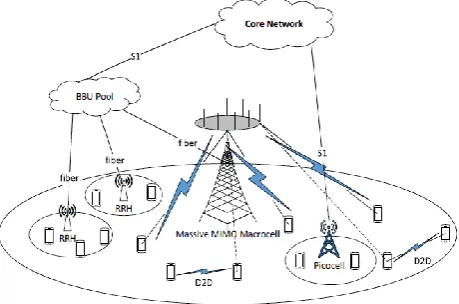
The complete mathematical expressions are derived and also explained how this work will be applied to the 5G networkmodel as shown in fig.(1) below and it is assumed with N users distributed over each of the M base stations (eNB) in the network.
The transmit data power level of xth user which is connected with yth base station is denoted by .
[image:2.595.55.285.259.411.2]There are some users which are served by one or more base stations.
Figure 1 5G network Architecture
Let us assume that the Gaussian noise variance for the uplink to be . The channels experienced by a path loss exponent at a distance of meters of xth user and is flat
Rayleigh fading function then the expression for SINR at user n can be expressed as
Fig 1.shows Relay 5G network architecture with 3 relay stations is considered and users UEs which are directly connected to base stations are considered as mUEs and users UEs which are connected via relay are named as rUEs. The relays sometimes cause interference to neighboring base stations.
The expected rate of transmission between xth mobile user equipment and yth base station is then we can
expresstheUtility function as
Where is Utility function positive parameter and is a
In the above formula each user’senergy cost is dependent on the transmitted power that is denotedby .
The expectedrate of transmission between xth user and yth
mobile station can be written as
Where is the SINR of xth user denoted by equation 1.
After substituting equation 3 in equation 2 the utility function can be written as
(4)
The throughput of each user xi.e. the addition of all mobile user data rates can be noted as capacity and also it is an important resource restriction of BW of each base station in the wireless network, that can be expressed as
Where Cx is the overall capacity of xth base station.
The efficient model of utility function 5G relay system can be written as
[image:2.595.320.528.471.663.2]
International Journal of Innovative Technology and Exploring Engineering (IJITEE) ISSN: 2278-3075, Volume-8 Issue-7, May, 2019
The utility function can be expressed in terms of mobile users, base stations and also transmission powers of usersPxy
as
where N = {1,2,…(x)…N} represent the mobile users , M
= {1,2,…(y)…M} denote the base stations and Pxy = {P11, P12……Pxy……PNM} give the allocated power profile of xth mobile user in yth base station.
The utility functions are the target of the optimized problem in equation (7).
After careful observation of the expressions of utility function U, it can be understood that they are not linear, and also is not similar with the exact normal form function.
III. OBSERVATIONS
Thedynamic optimized solution for the proposed model given by equations (6) and (7) will be explained in this section.
Observation 1:An optimal solution to the proposed model described by (6) and (7) can be assumed to be a set of control vectors , suppose for ally€N, there exists
The Solution for proposed model denoted by equations (6) and (7) denotes a set of self organized solution to maximize the utility function. Eachuser x will have its own self organized and uniquesolution. And no individual mobile user can have the best utility value because if individual mobile user changes in its power and bandwidth. All mobile users have the cooperation to get optimum value of utility function to satisfy
(0 ≤ ≤ 1)
Substituting for P1 and P2 in the above equation for utility function, we will have
Adding equations (10) and (11)
solving equations (9) and (12), we have
It is can be understood that when the base of logarithmic function is more than 1, logarithmic function is an increasing function, hence we can write
From the aboveequation we can conclude that the utility function leads to a concave function.
Observation 2: There exists an optimum solution for A set of control vectors to the powercontrol issue given by equations (6) and (7).
The power control problem of equations (6) and (7) can be explained by using the Lagrange equation technique. The Lagrangian multiplier equation for the optimization issue stated in equation (6) can be expressed as
Differentiate F with respect to Pxy
If we solve the above equation for getting the optimal power
After substituting equation (6) in (18) we get the following equation
Then we have the value of
Substituting equation (20) into (18) we get the optimal power level allocated to each user can be written as
Hence there is an efficient solution for power control issue for all users. The solution is achieved with the derivation of the utility function and it can be found easilythat solution for each user is unique. In this scenario of optimum condition every user in the system will have mutual coordination and highest utility can be achieved.
IV. POWER CONTROL ALGORITHM
The complete detailed steps of proposed heuristic algorithm are shown in table1 below. And we have already explained as in previouspart, the Lagrange multiplier technique gives us many individual solutions for all base stations and all are optimized solutions which satisfy the equations (6) and (7).
Table I Optimal Power control algorithm
1. Assign the initial values and find maximum utility
2. Power control mechanism
a. For all the values of y Reset Lagrange multiplier
b. Find out resource constraint problem c. Calculate the Lagrangian equation
d. Compute the optimal power level to get maximum
utility
e. Assign the values to users
3. Stop
V. SIMULATION RESULTS
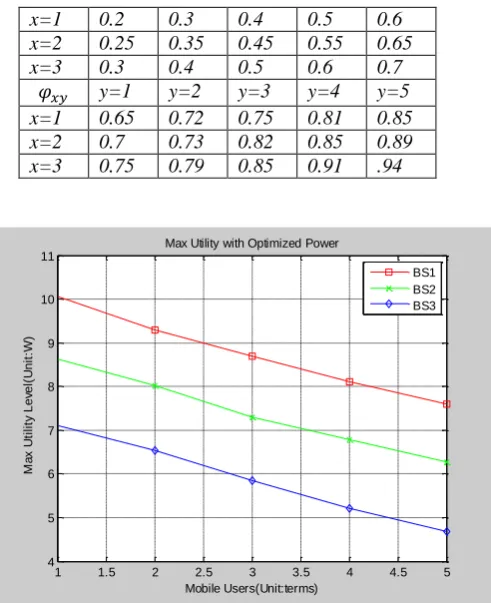
This sectionexplains the simulation on anetwork with three base stations as the servicing stations. The number of active users N in the network is taken as 60 and it is assumed that mobile users are distributed uniformly in the entire network. It is also assumed that all the cells experience same communication environment, equal capacity, traffic loads and also with same propagation
loss
. The capacity of every cell is assumed to same which is given by Cy. Table II and Table III shows simulation parameters. The maximum utility level of different mobile users with optimized power in all base stations is simulated and shown in Figure.2. The optimized power level of different users is illustrated in figure.3 The variation of Signal to Interference plus Noise Ratio (SINR) is shown in figure.4. it is clearly seen that SINR increases with power and fihure.5 illustrates total utility of each base station . From the result it is also found that utility of the base station 1 is more than base station 3 as base station 1 is nearer to mobile user when compared to base station 3.It is also obvious that the utility level of base station 1 is the highest among other base stations because congestion cost parameter is small.
The base station 2 has got a higher utility level when compared to base station 3, because of its smaller congestion cost parameter than base station 3. It is understood that the system overall performance is significantly affected by the congestion cost parameter.
TableII Simulation Parameters
Parameter Value
Number of Cells M 3
Number of users N 60
Number of users in each cell 20
Propagation Path Loss 0.8
AWGN power -83 DBM
Neighbour cell Interference power -10.3 DBM
Capacity of cell M 105 BPS
Positive Parameter
Probability parameter
Table III Parameters of and
[image:4.595.43.293.50.317.2]International Journal of Innovative Technology and Exploring Engineering (IJITEE) ISSN: 2278-3075, Volume-8 Issue-7, May, 2019
x=1 0.2 0.3 0.4 0.5 0.6
x=2 0.25 0.35 0.45 0.55 0.65
x=3 0.3 0.4 0.5 0.6 0.7
y=1 y=2 y=3 y=4 y=5
x=1 0.65 0.72 0.75 0.81 0.85
x=2 0.7 0.73 0.82 0.85 0.89
[image:5.595.50.296.47.349.2]x=3 0.75 0.79 0.85 0.91 .94
[image:5.595.305.559.50.240.2]Figure 2 Maximum utility level with optimized power
Figure 3 Optimal power levels for different users
[image:5.595.304.557.299.488.2]Figure 4 SINR versus interference of neighbor cell
Figure 5 Base stationTotal Utility levels
VI. CONCLUSIONS
In this researchpaper the uplink power control approach based on utility function is proposed in 5G wireless networks. The important contributions of this research work are modeling a utility function based optimal power control technique and utility function itself works as self-organizing scheme in 5G wireless networks. From the mathematical derivation it is provedthat utility function is a concave function and the energy cost occurredby thecongestion is a self-organized scheme with further reduction in Operational Expenditure. By using Lagrangian multiplier technique the optimum uplink power of every mobile user is calculated and it is also foundthat this is a unique optimal solution by this scheme. Several numerical simulations proved that our scheme achieved the optimal power and maximum utility.
1 1.5 2 2.5 3 3.5 4 4.5 5
4 5 6 7 8 9 10 11
Mobile Users(Unit:terms)
M
a
x
U
ti
li
ty
L
e
ve
l(
U
n
it
:W
)
Max Utility with Optimized Power
BS1 BS2 BS3
1 1.5 2 2.5 3 3.5 4 4.5 5
4 5 6 7 8 9 10 11 12 13 14
Mobile Users(Unit:terms)
O
p
ti
m
a
l
P
o
w
e
r
L
e
ve
l(
U
n
it
:W
)
Optimal Power Level for Different Users
BS1 BS2 BS3
1 2 3 4 5 6
0 10 20 30 40 50 60 70 80
Neighbour cell interference(units:mw)
S
IN
R
Signal-to-Interference-Plus-Noise-Ratio
Power=5mw Power=10mw Power=20mw
1 2 3
0 5 10 15 20 25 30 35 40 45
Base Station(Unit:terms)
U
ti
li
ty
L
e
ve
l(
U
n
it
:W
)
Total Utility Level of each base station
[image:5.595.47.295.408.595.2]ACKNOWLEDGEMENTS
The authors express special thanks ofgratitude to the reviewersand fellow research colleagues for their reviews and constructive comments in turn they have helped to achieve the best quality of research work.
REFERENCES
1. HaitaoXu, Xianwei Zhou, Yueyun Chen, “Automatic Uplink Resource Management in Mobile Cellular Networks: A Utility-Based Cooperative Power Control Strategy”, InternationalJournal of Wireless Information Networks, 2013, 20, 4, 365
2. Xinchen Zhang; Haenggi, M., "Random Power Control in Poisson Networks," IEEE Transactions on Communications, ,vol.60, no.9, pp.2602,2611, September 2012
3. 3GPP TS 36.300, “Evolved Universal Terrestrial Radio Access (EUTRA) and Evolved Universal Terrestrial Radio Access network (E-UTRAN): Overall Description. V11.1.0”, March 2012.
4. Xiaochen Li; Xihua Dong; Dapeng Wu, "On Optimal Power Control for Delay-Constrained Communication Over Fading Channels," IEEE Transactions onInformation Theory, vol.57, no.6, pp.3371, 3389, June 2011
5. R3-081281: "Issues and Enhanced Frame-work for the Energy Saving Use Case".
6. D. Goodman and N. Mandayam, “Power control for wireless data,”
IEEE Pers. Communication., vol. 7, no. 2, pp. 48–54, Apr. 2000 7. E. Lang, S. Redana and B. Raaf, “Business Impact of Relay
Deployment for Coverage Extension in 3GPP LTE-Advanced”, LTE Evolution Workshop in ICC 2009, Germany, June 2009, pp.1-5. 8. Saraydar, C.U.; Mandayam, Narayan B.; Goodman, D., "Efficient
power control via pricing in wireless data networks," IEEE Transactions on Communications ,vol.50, no.2, pp.291,303, Feb 2002 9. Runhua Chen; Andrews, J.G.; Heath, R.W.; Ghosh, A., "Uplink Power
Control in Multi-Cell Spatial Multiplexing Wireless Systems," IEEE Transactions on Wireless Communications,vol.6, no.7, pp.2700,2711, July 2007
10.Chung Shue Chen; Baccelli, F.;, ‘‘Self-Optimization in Mobile Cellular Networks: Power Control and User Association,’’ I E EE International Conference on C o m m u n i c a t i o n s ( I C C ) , 2 0 1 0, vol., no., pp.1-6, 23-27 May 2010.
11.E. Lang, S. Redana and B. Raaf, “Business Impact of Relay Deployment for Coverage Extension in 3GPP LTE-Advanced”, LTE Evolution Workshop in ICC 2009, Germany, June 2009, pp.1-5 12.XU Haitao and AN Xianwei, “Self-Organized Algorithm in LTE
Networks:AUtility Function Based Optimal Power Control Scheme,”
Communications, China Vol.11, Issue.14, Supplement No.2 2014, pp 95-101.
13.T. G. S. Krishna and R. Madhu, "A utility function based uplink power control algorithm in LTE-Advanced networks,"InternationalConference on Communication and Signal Processing (ICCSP), Melmaruvathur, 2016, pp. 0705-0709.
AUTHORS PROFILE
Madan Mohan Rao.NelluriReceived the B.Tech degree in Electronics and Communication Engineering from K L College of Engineering, Andhra Pradesh, in 2002 and M.E degree in Optical Communication from Anna University, Chennai, in 2006. He is currently pursuing his Research in AcharyaNagarjuna University, Andhra Pradesh,
India. His research interest includes emerging technologies of 5G Wireless Networks and Optical Communications. He has authored more than 7 international, national journals/conference papers in his credit.