White Rose Research Online URL for this paper: http://eprints.whiterose.ac.uk/81916/
Version: Accepted Version
Article:
McKeown, JD, Holt, J, Delvenne, J et al. (2 more authors) (2014) Active versus passive maintenance of visual nonverbal memory. Psychonomic Bulletin and Review, 21 (4). pp. 1041-1047. ISSN 1531-5320
https://doi.org/10.3758/s13423-013-0574-1
[email protected] https://eprints.whiterose.ac.uk/ Reuse
See Attached
Takedown
If you consider content in White Rose Research Online to be in breach of UK law, please notify us by
! "!
Active versus passive maintenance of visual
non-verbal memory
Denis McKeown, Jessica Holt, Jean-Francois Delvenne, Amy Smith and
Benjamin Griffiths
Institute of Psychological Sciences, University of Leeds, United
Kingdom
Correspondence address:
Denis McKeown
Institute of Psychological Sciences University of Leeds
Leeds LS2 9JT
Email: [email protected] Telephone: +44(0)113 242 5701
! #!
Abstract
Forgetting over the short-term has challenged researchers for more than a century, largely because of difficulty in controlling what goes on within the memory retention interval. But the Òrecent negative probesÓ procedure offers a valuable paradigm, by examining influences of (presumably) unattended memoranda from prior trials. Here we used a recent probes task to investigate forgetting for visual non-verbal short-term memory. Target stimuli (2 visually presented abstract shapes) on a trial were followed after a retention interval by a probe, and participants indicated whether the probe matched one of the target items. Proactive interference, and hence memory for old trial probes, was observed whereby participants were slowed in rejecting a non-matching probe on the present trial that nevertheless matched a target item on the previous trial (a recent negative probe). The attraction of the paradigm is that, by uncovering proactive influences of past trial probe stimuli, it is argued that active
maintenance in memory of those probes is unlikely. In two experiments we recorded such proactive interference of prior trial items over a range of interstimulus (ISI) and intertrial (ITI) intervals (between 1 and 6 seconds respectively). Consistent with a proposed two-process memory conception (the active-passive memory model or APM), actively maintained memories on current trials decayed but passively Òmaintained,Ó or unattended, visual memories of stimuli on past trials did not.
(abstract 221 words)
! $!
Introduction
In reporting the findings of a series of experimental tests of visual short-term memory in the years 1896 to 1897, a design that might well raise an eyebrow of a contemporary researcher, Madison Bentley (1899) reports only a slight decrease in accuracy of judgements over intervals extending from 2 to 60 seconds. His statement that the weakening of memory fidelity over time undoubtedly has the primary function Òto prepare the organism for future adjustmentsÓ (p. 46) would appeal to contemporary investigators, even if they would debate the mechanisms of forgetting, whether through some form of decay of the memory trace or interference-based forgetting (e.g., Barrouillet & Camos, 2009; Barrouillet, Portrat, & Camos, 2011; Lewandowsky, Oberauer, & Brown, 2009; Oberauer & Lewandowsky, 2008). Yet the main difficulty facing the investigator today is the same one acknowledged by Bentley: the difficulty of demonstrating 'pure' decay (increased forgetting as we extend the retention time interval) demands that we rule out both straightforward verbal rehearsal, as well as any form of interference within brief memory by events within the retention interval. This problem has not been successfully addressed. Notably, active rehearsal may be countered by introducing some rehearsal-preventing task (introducing some form of Òarticulatory suppressionÓ is the familiar approach) but this in turn may introduce interference of the memoranda.
! %!
probe), or was taken from the previous trial (recent negative probe) or was a completely new word (non-recent negative probe). The crucial measure was the slowed response times due to proactive interference on trial N caused by the recent negative probe from trial N-1 (Monsell, 1978). Interestingly, Berman et al found no significant effect of increasing the intertrial interval from about 4 seconds to 19 seconds, a finding counting against decay of short-term (verbal) memory. More recently, however, Campoy (2012) attempted to replicate the Berman et al study, but did report decay using a much smaller range of decay intervals (between 1.6 and 3.8 seconds).
In contrast to this suggestion by Campoy (2012) of rapid decay, recently we (Mercer & McKeown, 2013; McKeown & Mercer, 2012; Mercer & McKeown, 2010a, 2010b) have documented very gradual decay of short-term memories over periods of 30 seconds and beyond. We developed a non-verbal immediate memory (nime) task in which the stimuli were abstract stimulus patterns (complex tones with distinct timbres) that did not lend themselves to verbal labelling, and thereby avoided any form of maintenance by verbal rehearsal throughout the retention interval. However, we could not rule out another form of maintenance, active ÒrefreshingÓ (Raye, Johnson, Mitchell, Greene, & Johnson, 2007) which is believed to be a bringing back of the memoranda into the focus of attention, a mechanism that may be distinct from verbal rehearsal. In the present series of two experiments we therefore attempted to combine the advantages of the recent negative probes procedure (notably, making unlikely active maintenance through rehearsal or refreshing) and our non-verbal immediate memory task (ruling out verbal maintenance).
! &!
! '!
Experiment 1
Like Berman et al. (2009), here we recorded accuracy and response times to probes that occasionally matched those on prior trials (recent-negative probes). According to APM actively refreshed stimulus memory traces on trial N will be gradually degraded, whereas the traces of memories from trial N-1 will undergo little diminution across the intertrial interval, on the assumption that participants have no incentive for actively refreshing them. We also manipulated temporal distinctiveness of our stimuli (c.f. Brown, Neath, & Chater, 2007): the memory trace of the standard stimulus on trial N is distinct to the extent that it is well separated from surrounding stimuli (the comparison stimulus on trial N-1 and the comparison stimulus on trial N). Therefore, according to distinctiveness accounts, performance should be determined not by the absolute retention interval duration, but by the ratio of this interval to the interval separating the standard from the previous comparison tone (the intertrial interval or ITI).1
Method
Participants
Participants were 15 naive observers who had normal (self-reported) or corrected-to-normal vision.
Apparatus and Stimuli
The stimuli were presented on a 17-in. monitor and the experiment was run using E-Prime 2.0 software (Psychology Software Tools, Inc. www.pstnet.com/eprime). The viewing distance from the computer screen was approximately 70 cm. The stimuli !!!!!!!!!!!!!!!!!!!!!!!!!!!!!!!!!!!!!!!!!!!!!!!!!!!!!!!!!!!!!
"!We do not expand on the distinctiveness account in this brief report, but refer the reader to Brown et
! (!
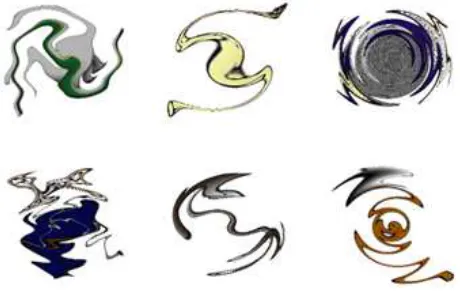
were taken from the revised set of the Snodgrass and Vanderwart (1980)Õs object databank (Rossion & Pourtois, 2004). The 260 objects were distorted in Photoshop until they appeared abstract and meaningless (see Figure 1). The memory display consisted of two different objects subtending each 4.3¡ x 4.3¡ of visual angle and presented laterally (centre deviating 4¡ from fixation) against a white background. The probe display consisted of a single object presented at fixation.
Fig. 1 Examples of stimuli used in the two experiments
Procedure and Design
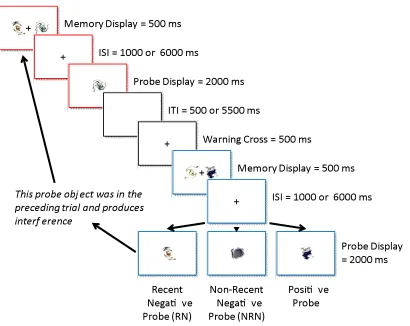
As shown in Figure 2 each trial began with the presentation of a central fixation cross (0.5¡ x 0.5¡) for 500 ms followed by the memory display for 500 ms. After a retention period (ISI = interstimulus interval) of either 1000 or 6000 ms, the probe display was presented for 2000 ms and participants were required to report whether the probe object had been presented on the previous memory display using s key for ÒyesÓ and l
[image:8.595.155.385.268.414.2]! )!
Fig. 2 Experimental procedure used in Experiment 1
The probe either matched one object from the memory display (Òpositive probeÓ; 50% of the trials), matched one object from the memory display of the preceding trial (Òrecent negative probeÓ (RN); 25% of the trials), or did not match any object from a minimum of 48 preceding trials (Ònon-recent negative probeÓ (NRN); 25% of the trials). The objects in the memory display never repeated within the same block and every combination of objects in the memory display was original (i.e., the same pair never repeated throughout the experiment).
[image:9.595.94.504.67.393.2]! *!
blocks of 48 trials in total that contained an equal number of each trial type. All conditions were randomized within blocks to prevent predictability.
Results and discussion
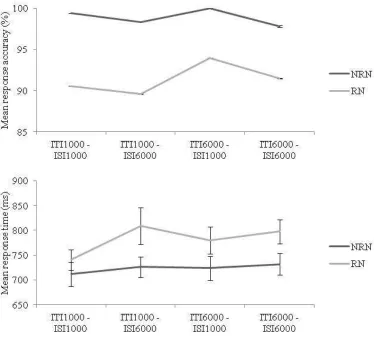
In order to investigate the effect of RN trials, RT and accuracy were analysed in a 2 (trial type: RN, NRN) x 2 (ITI: 1000, 6000) x 2 (ISI: 1000, 6000) repeated measures ANOVA. Analysis on RT (including correct response trials only) revealed a main effect of trial type [F(1, 14) = 47.44, p < .001] showing slower performance in RN trials relative to NRN trials, and a main effect of ISI [F(1, 14) = 14.39, p < .005] revealing slower RTs in trials with an ISI of 6000 ms relative to 1000 ms. The partial eta squared values were large for each analysis (!2 = .77 for trial type, and !2 = .51 for
ISI). No other main effects or interactions were shown. The same analysis on
! "+!
Fig. 3 Results of Experiment 1. Mean response accuracy and response times for recent negative (RN) and non recent negative (NRN) trials by condition (ITI 1000, ISI 1000; ITI 1000, ISI 6000; ITI 6000, ISI 1000; ITI 6000, ISI 6000). Vertical bars are standard errors (though barely visible for the accuracy measure)
[image:11.595.107.481.76.415.2]! ""!
measures ANOVA revealed no main effects or interactions for accuracy or RT (see Figure 3). In summary, a mild decrease in performance is observed within a retention interval when we extend that interval from 1 to 6 s, whereas the "recent negative effectÓ, that is the influence of the memory trace extending across the intertrial interval, does not appear to diminish as we extend that interval from 1 to 6 s. We have no reason for supposing that our participants had any inclination to attend or rehearse old trial stimuli, so we might conclude that old unattended visual memories do not decay. Finally, the failure to observe an interaction between ISI and ITI counts against a temporal distinctiveness explanation of our data.
!
Experiment 2
In this second experiment we reduced the ÒwindowÓ over which we examined the RN effect, to further test CampoyÕs (2012) argument that rather rapid decay is completed within 2 seconds or so. One possible difficulty with the recent negative probes arrangement used here and by Berman et al. (and by Campoy, 2012), is that the memory trace of the trial items on trial N-1 is always assessed following presentation of the set of target stimuli on trial N and that trialÕs probe and response. So as an additional precaution in the next experiment we removed at least some of the intervening material by introducing ÒdummyÓ trials without a probe or response.
Method
Participants
! "#! Procedure and Design
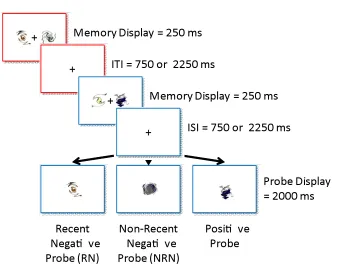
This experiment replicated Experiment 1 with the following timing changes: (i) the presentation of the warning cross and memory display was reduced to 250 ms; (ii) the ISI and ITI were either 750 or 2250 ms. In addition, in an attempt to remove some of the intervening material between the first and the second memory representations, the probe display that normally follows the first memory display was removed in some trials (relevant trials) and no responses were required; the next trial began with a new pair of target stimuli (see Figure 4). For the rest of the trials (irrelevant trials), a probe display followed the first memory display as in Experiment 1 to prevent predictability.
[image:13.595.91.434.391.659.2]! "$!
The experiment involved a total of 288 trials, of which 192 trials were relevant and 96 trials were irrelevant. The analyses were made on relevant trials only, of which 96 were positive probe, 48 were RN and 48 were NRN trials. Of all the trials, 50% were from each of the different ISI and ITI values. Each participant performed 16 practice trials and then proceeded to the testing stage that consisted of six blocks of 48 trials in total and contained an equal number of each trial type. All conditions were randomized within blocks.
Results and discussion
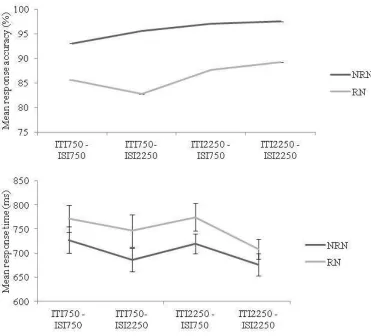
In order to investigate the effect of RN trials, RT and accuracy were analysed in a 2 (trial type: RN, NRN) x 2 (ITI: 2250, 750) x 2 (ISI: 2250, 750) repeated measures ANOVA. Analysis on RT (including correct response trials only) revealed a main effect of trial type [F(1, 16)= 27.20, p< .001] showing slower performance in RN trials relative to NRN trials, and a main effect of ISI [F(1, 16) = 19.54, p < .001] revealing slower RTs in trials with an ISI of 750 ms relative to 2250 ms. This slight increase in performance with the longer delay contrasts strongly with Campoy (2012), and might reflect a lack of preparedness for responding, or perhaps the reduced time available for consolidation of the memory trace at the shorter delay (see Ricker & Cowan, in press). The partial eta squared values were large for each analysis (!2 = .63
for trial type and !2 = .55 for ISI). No other main effects or interactions were shown.
! "%!
relative to 750 ms. For accuracy, the eta squared values were large for trial type (!2 =
.64) and modest for ITI (!2 = .26).No other main effects or interactions were revealed.
Fig. 5 Results of Experiment 2. Mean response accuracy and response times for recent negative (RN) and non recent negative (NRN) trials by condition (ITI 750, ISI 750; ITI 750, ISI 2250; ITI 2250, ISI 750; ITI 2250, ISI 2250). Vertical bars are standard errors
[image:15.595.106.477.158.494.2]! "&!
penalty for RT [F(2, 32) = .38, p = .69] or accuracy [F(2, 32) = .46, p = .64]. In addition, a 2 (ITI: 2250, 750) x 2 (ISI: 2250, 750) repeated measures ANOVA revealed no main effects or interactions for accuracy or RT (see Figure 5). Thus, the failure to observe any influence of the ratio of ISI and ITI further rules out a ÒdistinctivenessÓ account for our data (but see Horoufchin, Phillipp, & Koch, 2011). Contrasting with Campoy, decay was not evident across the brief ISI intervals tested (750 or 2500 ms), and nor was it evident as we extended the ITI across the same intervals.
General Discussion
! "'!
items within VSTM is well documented, especially early in the period following stimulus presentation (e.g., Gazzaley, 2011; Schmidt, Vogel, Woodman, & Luck, 2002), consistent with top-down modulation of visual processing and short-term memory storage, and attentional orienting to task-relevant items held within VSTM (Gazzaley & Nobre, 2012; Nobre, Griffin, & Rao, 2008). Possibly attentional selection is beneficial very early following stimulus presentation and when tasks demand spatial selection among competing objects. Yet when we greatly extend the memory retention interval beyond several seconds, and the task does not introduce competing objects, attentional selection and top-down maintenance may (we speculate) promote little advantage in memory trace maintenance, but rather may hinder it.
! "(!
assumption that the point of translation into an attentional or refreshing buffer is noisy. Increasing the number of opportunities for this revisiting of the trace will further degrade the fidelity of the trace, and one might speculate on the rate of this process. But an important consideration is that the recent-negative probes themselves will have almost certainly been refreshed according to the task demands of the preceding trial. The recent-neagtive probes procedure is not an uncontaminated window onto the precision of the memory trace.
Conclusion
! ")! Acknowledgements
We thank the reviewers and editor for their valuable comments. One of our annonymous reviewers in particular made a very significant contribution to the reorganisation and writing of our paper for which we are very grateful.
References
Barrouillet, P., & Camos, V. (2009). Interference: Unique source of forgetting in working memory? Trends in Cognitive Sciences, 13, 145-146.
Barrouillet, P., Portrat, S., & Camos, V. (2011). On the law relating processing to storage in working memory. Psychological Review, 118, 175-192.
Bentley, I., M. (1899). The memory image and its qualitative fidelity. Journal of Psychology, 9, 1-48.
Berman, M. G., Jonides, J., & Lewis, R. L. (2009). In search of decay in verbal short-term memory. Journal of Experimental Psychology: Learning, Memory, and Cognition, 35, 317-333.
Brown, G. D. A., Neath, I., & Chater, N. (2007). A temporal ratio model of memory.
! "*!
Campoy, G. (2012). Evidence for decay in verbal short-term memory: A commentary on Berman, Jonides, and Lewis (2009). Journal of Experimental Psychology: Learning, Memory, and Cognition, 38, 1129-1136.
Emmanouil, T. A., Burton, P., & Ro, T. (2013). Unconscious processing of unattended features in human visual cortex. Journal of Cognitive Neuroscience,
25, 329-337.
Gazzaley, A. (2011). Influence of early attentional modulation on working memory.
Neuropsychologia, 49, 1410-1449.
Gazzaley, A., & Nobre, A. C. (2012). Top-down modulation: Bridging selective attention and working memory. Trends in Cognitive Sciences, 16, 129-135.
Horoufchin, H., Philipp, A. M., & Koch, I. (2011). The dissipating task-repetition benefit in cued task switching: Task-set decay or temporal distinctiveness?
Journal of Experimental Psychology: Human Perception and Performance, 37, 455-472.
Lewandowsky, S., Oberauer, K., & Brown, G. D. A. (2009). No temporal decay in verbal short-term memory. Trends in Cognitive Sciences, 13, 120-126.
McKeown, D., & Mercer, T. (2012). Short-term forgetting without interference.
! #+!
Mercer, T., & McKeown, D. (2010a). Interference in short-term auditory memory.
Quarterly Journal of Experimental Psychology, 63, 1256-1265.
Mercer, T., & McKeown, D. (2010b). Updating and feature overwriting in short-term memory for timbre. Attention, Perception, & Psychophysics, 72, 2289-2303.
Monsell, S. (1978). Recency, immediate recognition memory, and reaction time.
Cognitive Psychology, 10, 465-501.
Nobre, A. C., Griffin, I. C., & Rao, A. (2008). Spatial attention can bias search in visual short-term memory. Frontiers in Human Neuroscience, 1, 1Ð9.
Oberauer, K., & Lewandowsky, S. (2008). Forgetting in immediate serial recall: Decay, temporal distinctiveness or interference? Psychological Review, 115, 544-576.
Raye, C. L., Johnson, M.K., Mitchell, K. J., Greene, E. J., & Johnson, M. R. (2007). Refreshing: A minimal executive function. Cortex, 43, 135-145.
! #"!
Rossion, B., & Pourtois, G. (2004). Revisiting Snodgrass and Vanderwart's object set: The role of surface detail in basic-level object recognition. Perception, 33, 217-236.
Schmidt, B. K, Vogel, E. K, Woodman, G. F, & Luck, S. J. (2002). Voluntary and automatic attentional control of visual working memory. Perception & Psychophysics, 64, 754Ð763.
Snodgrass, J. G., & Vanderwart, M. (1980). A standardized set of 260 pictures: norms for name agreement, image agreement, familiarity, and visual complexity. Journal of Experimental Psychology: Human Perception and Performance, 6, 174-215.
Zhang, W., & Luck, S. J. (2009). Sudden death and gradual decay in visual working memory. Psychological Science, 20, 423-428.
Zhang, W., & Luck, S. J. (2008). Discrete fixed-resolution representations in visual working memory. Nature, 453, 233-235.
(3927 words, excluding title page and abstract and figures, but including main text,