Theses
12-2-2018
Multi-Modal Deep Learning to Understand Vision
and Language
Shagan Sah
[email protected]Follow this and additional works at:
https://scholarworks.rit.edu/theses
This Dissertation is brought to you for free and open access by RIT Scholar Works. It has been accepted for inclusion in Theses by an authorized administrator of RIT Scholar Works. For more information, please [email protected].
Recommended Citation
by
Shagan Sah
B.E. University of Pune, 2009
M.S. Rochester Institute of Technology, 2013
A dissertation submitted in partial fulfillment of the requirements for the degree of Doctor of Philosophy in the Chester F. Carlson Center for Imaging Science
College of Science
Rochester Institute of Technology
December 2, 2018
Signature of the Author
Accepted by
ROCHESTER INSTITUTE OF TECHNOLOGY ROCHESTER, NEW YORK
CERTIFICATE OF APPROVAL
Ph.D. DEGREE DISSERTATION
The Ph.D. Degree Dissertation of Shagan Sah has been examined and approved by the dissertation committee as satisfactory for the
dissertation required for the Ph.D. degree in Imaging Science
Dr. Raymond Ptucha, Dissertation Advisor Date
Coordinator Ph.D. Degree Program Date
Dr. Carl Salvaggio Date
Dr. Nathan Cahill Date
Dr. Leon Reznik Date
COLLEGE OF SCIENCE
CHESTER F. CARLSON CENTER FOR IMAGING SCIENCE
Title of Dissertation:
Multi-Modal Deep Learning to Understand Vision and Language
I, Shagan Sah, hereby grant permission to Wallace Memorial Library of R.I.T. to reproduce my thesis in whole or in part. Any reproduction will not be for commercial use or profit.
Signature
Date
by Shagan Sah Submitted to the
Chester F. Carlson Center for Imaging Science in partial fulfillment of the requirements
for the Doctor of Philosophy Degree at the Rochester Institute of Technology
Abstract
Developing intelligent agents that can perceive and understand the rich visual world
around us has been a long-standing goal in the field of artificial intelligence. In the
last few years, significant progress has been made towards this goal and deep learning
has been attributed to recent incredible advances in general visual and language
under-standing. Convolutional neural networks have been used to learn image representations
while recurrent neural networks have demonstrated the ability to generate text from
visual stimuli. In this thesis, we develop methods and techniques using hybrid
convolu-tional and recurrent neural network architectures that connect visual data and natural
language utterances.
Towards appreciating these methods, this work is divided into two broad groups.
Firstly, we introduce a general purpose attention mechanism modeled using a continuous
function for video understanding. The use of an attention based hierarchical approach
along with automatic boundary detection advances state-of-the-art video captioning
re-sults. We also develop techniques for summarizing and annotating long videos. In the
second part, we introduce architectures along with training techniques to produce a
common connection space where natural language sentences are efficiently and
accu-rately connected with visual modalities. In this connection space, similar concepts lie
close, while dissimilar concepts lie far apart, irrespective‘ of their modality. We discuss
four modality transformations: visual to text, text to visual, visual to visual and text
to text. We introduce a novel attention mechanism to align multi-modal embeddings
which are learned through a multi-modal metric loss function. The common vector space
is shown to enable bidirectional generation of images and text. The learned common
vector space is evaluated on multiple image-text datasets for cross-modal retrieval and
zero-shot retrieval. The models are shown to advance the state-of-the-art on tasks that
There are many people I must thank for contributing to the wonderful years of my
experience as a PhD student.
First and foremost, I am deeply indebted to Dr. Ray Ptucha, my teacher and advisor,
for providing his valuable time and guidance throughout these years. His constant
encouragement and support towards experimenting with new ideas really had me going.
He was always willing to support and guide me on any research path. He was patient
to go through the terrible paper drafts that I produced. I am greatly honored to have
worked under him.
I would like to thank the members of my thesis advisory committee, Dr. Carl
Salvaggio, Dr. Nathan Cahill and Dr. Leon Reznik, for providing their knowledge and
time throughout this project. Thanks to Dr. David Messinger, Dr. Charles Bachmann
and Dr. John Kerekes from CIS for their support throughout the graduate program.
My sincere thanks goes to the Center for Imaging Science and the Computer
En-gineering department at RIT for providing financial support throughout this degree. I
also thank all the professors, staff, and all fellow students at the Imaging Science
depart-ment at RIT, for the wonderful experience and knowledge I have received throughout
the program.
During my PhD, I also squeezed in three summer internships at Xerox-PARC,
Mo-torola and NVIDIA. All three were wonderful learning experiences that had a lot of
impact on my research trajectory. From these internships, I would like to thank Bob
Loce, Sean Kelly, John Poplett, Elaine Jin and Robin Jenkin.
My gratitude goes out to the RIT academic and IT staff including Sue Chan, Beth
Lockwood, Joyce French, Kathryn Stefanik, Emilio Del Plato, Richard Flegal for their
help.
This work would not have been possible without help and support of all the people
around me, who were always kind and willing to give their time and valuable assistance
towards the completion of this thesis. I would like to thank my close collaborators
who Ive had the distinct pleasure of working with and learning from. There are many
others who I was fortunate to get to know and become friends with. From the MIL
Lab: Sumanth Chennupati, Sai Nooka, Ram Oruganti, Suhas Pillai, Sourabh Kulhare,
Naga Reddy, Ram Longman, Ameya Shringi, Felipe Such, Thang Nguyen, Dheeraj Peri,
Rohan Dhamdhere, Sabarish Gopalakrishnan, Sidharth Makhija. Fellow PhD students:
Chi Zhang, Miguel Dominguez, Srinivas Sridharan. From CIS: Bikash Basnet, Ritu
Basnet, Viraj Adduru, Madhurima Bandyopadhyay, Saugata Sinha, Allison Gray, Yilong
Liang, Daniel Simon. From UT Austin: Subhashini Venugopalan.
I thank Dr. Jan van Aardt for encouraging me to join the PhD program. I would
also like to extend thanks to people who I was fortunate to interact with before joining
the PhD program, especially Prof. A. K. Pachauri, Naval Kishore and Sushanta Jena
from NDMA, New Delhi.
Lastly, my deepest gratitude goes to my family for their support throughout these
1 Introduction 20
2 Video Captioning 27
2.1 Related Work . . . 28
2.1.1 Attention Models . . . 30
2.2 Video Captioning . . . 31
2.2.1 Gaussian Attention . . . 32
2.2.2 Multistream Hierarchical Boundary Model . . . 34
2.2.3 Attention Steering . . . 36
2.3 Video Captioning Framework . . . 39
2.4 Results and Discussion . . . 40
2.4.1 Training Details . . . 40
2.4.2 Datasets . . . 41
2.4.3 Evaluation Metrics . . . 42
2.4.4 Performance on MSVD . . . 42
2.4.5 Performance on MSR-VTT . . . 45
2.4.6 Performance on Movie Description Dataset . . . 47
2.4.7 Timing Comparison . . . 48
2.4.8 Compression Comparison . . . 50
3 Summarizing Long Videos 51
3.1 Related Work . . . 52
3.2 Summarizing Long Videos . . . 54
3.2.1 Superframe Segmentation Framework . . . 55
3.2.2 Key Frame Selection . . . 61
3.2.3 Video Clip Captioning . . . 61
3.2.4 Text Summarization . . . 62
3.3 Results and Discussion . . . 63
3.3.1 Datasets . . . 63
3.3.2 Captioning Results . . . 64
3.3.3 Human Evaluations . . . 64
3.3.4 Evaluating Superframe Cut Selection . . . 66
3.3.5 Evaluating Key Frame Selection . . . 67
4 Generative Models 69 4.1 Related Work . . . 70
4.1.1 Multi-Modal Learning using Vector Representation . . . 70
4.1.2 Conditional Image Generation . . . 71
4.1.3 Sequence-to-Sequence Models . . . 71
4.1.4 Image Captioning . . . 71
4.2 Proposed Framework . . . 72
4.2.1 n-gram Metric Conditioning . . . 74
4.2.2 Conditioning on Multiple Captions . . . 75
4.2.3 MMVR Architecture . . . 76
4.2.4 MMVR Inference . . . 78
4.3 Results and Discussions . . . 79
4.3.1 Image Generation . . . 79
5 Cross Modal Retrieval 89
5.1 Related Work . . . 92
5.2 Our Model . . . 93
5.2.1 Embedding Space . . . 93
5.2.2 Aligned Attention Layer . . . 96
5.3 Results and Discussion . . . 98
5.3.1 Datasets . . . 98
5.3.2 Implementation Details . . . 99
5.3.3 Evaluation Metrics . . . 100
5.3.4 Experiments . . . 100
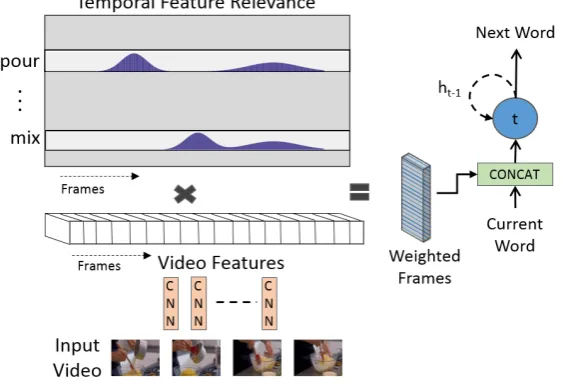
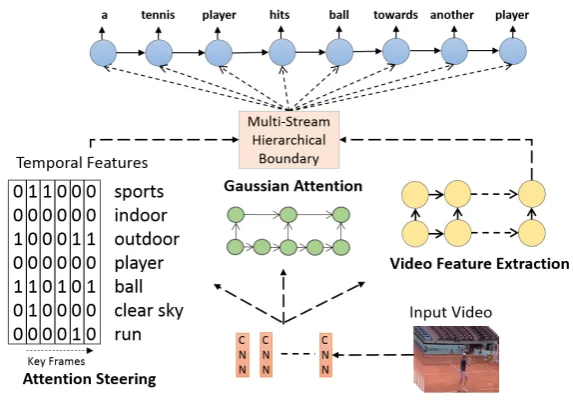
2.1 Overview of the Steered Gaussian Attention Model for video captioning.
The attention filter is learned by hierarchical boundary model (center),
temporal features (left), and a video summary (right). . . 31
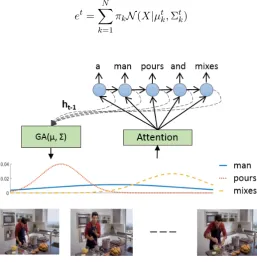
2.2 Illustration of the parameterized Gaussian attention model for steering
the temporal alignment between the video and word sequence. The
cap-tion is generated using a recurrent neural network. For a video, the mean
and standard deviation of the distribution is computed based on the
out-puts of the previous time steps (dotted lines). The curves depict change
in the attention over the video based on the word generated in the caption
generator. . . 32
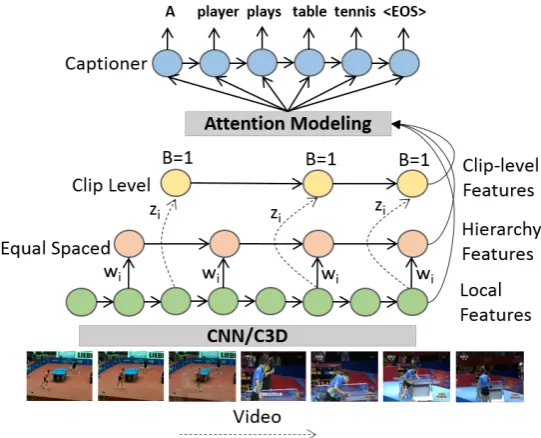
2.3 Overview of the Multistream Hierarchical Boundary Model for video
cap-tioning. The clip-level features adapt with each video and are learned
non-equally spaced and the hierarchy features are equally spaced features. 35
2.4 Example boundary attention vector where the “peaks” indicate video
boundaries in [0−1] normalized video. . . 37 2.5 Attention steering using normalized temporal feature relevance. Frame
level features are weighted based on the relevance map and assists in
guiding attention to video regions. WtandWt−1 are words at timestand t−1,ht−1 is RNN hidden state. . . 38
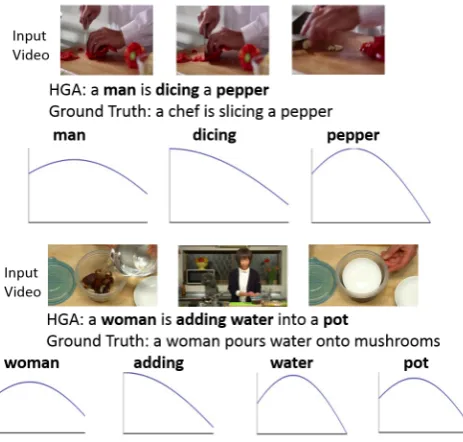
2.6 Gaussian attention visualization for sample videos from MSVD.
Distri-bution focuses on relevant video segment based on key words (bold) in
the sentence. For the word “adding”, relevant activity is in the starting
of video, hence the mean of the distribution is close to 0. X-axis ranges
from 0−1 normalized temporal video location and Y-axis is normalized attention weightαti. . . 44
2.7 Example videos and corresponding captions from the MSVD (left) and
MSRVTT (right) datasets. For each video, three random frames are
shown. Baseline is GA model with five Gaussian filters. HGA is our
model and GT is a sample ground truth caption. . . 48
3.1 Overview of video summarization. Interesting regions identify key
super-frame segments. Each key segment is annotated. All annotations are fed
into a text summarization module. . . 54
3.2 (top) The black trace shows frame-to-frame motion, the blue bars show
evenly spaced boundaries, and red bars show the final selected
super-frame boundary cuts. (bottom) The corresponding supersuper-frames impact
scores as bar graphs, overall interestingness score as a black line, and red
pentagrams indicate selected superframes. . . 56
3.3 Impact scores for superframe cuts in the three test videos. Different
colors represent contribution of features- Boundary, Attention, Contrast,
Sharpness, Saturation and Face impact. X-axis is the superframe cut
number and Y-axis is the normalized impact score. Solid black is Iscore,
red pentagrams show selected superframe cuts with ω= 50%. (Figure
best viewed at 200%). . . 59
3.4 S2VT: A two layer LSTM model to learn video representation in the
4.1 Overview of the Multi-Modal Vector Representation model. It consists
of two pre-trained modules – an image generator (G) that inputs a latent
representationh and generates an image ˆx; and an image captioner that
inputs an image ˆxand generates a caption ˆy. To update the latent vector
h, cross-entropy between the generated caption ˆy and a ground truth
captiony is used while the weights for the generator and CNN are fixed. 72
4.2 Conditioning the image generation through multiple captions by
aggre-gating the gradients from individual caption cross-entropy. Solid black
lines show the direction of forward pass during sentence generation and
dashed red lines show direction of error back-propagation during latent
vector update. . . 75
4.3 The sequence-to-sequence model for generating sentence paraphrases. Both
the encoder and decoder process individual elements of their respective
sequences in a recurrent manner. The solid black lines show direction of
the forward pass and dashed blue lines show the carry-forward of
previ-ous element during sequence decoding. <BOS> and<EOS>are special
tokens for begin-of-sentence and end-of-sentence, respectively. . . 78
4.4 Examples of the YOLO object detection on generated images. The
bound-ing boxes and correspondbound-ing labels are detections with confidence greater
than 0.5 threshold. . . 80
4.5 Examples of the visual-to-visual (left) and text-to-visual (right) modes of
MMVR. The inputs can be the visual or text modalities. . . 81
4.6 Examples of the text-to-image generation as conditioned on varying
num-ber of input captions. We observe more detailed images being synthesized
with increase in number of captions. . . 83
4.7 Examples comparing the text-to-image for PPGN and the BLEU-1 scaled
cross-entropy. Even though slight improvements could be observed with
4.8 Examples that show text-to-image improvements after fine-tuning the
generator on MS-COCO dataset. Object categories such as giraffe and
stop sign that are not part of ImageNet dataset show some enhancement
in details. We also observed slight improvements in understanding of size,
shape and quantity aspects. . . 86
4.9 Examples of the visual-to-text (left) and text-to-text (right) modes of the
MMVR. The inputs can be the visual or text modalities. . . 87
4.10 Examples of arithmetic operations in the latent space for the text-to-text
model. . . 88
5.1 Overview of the bidirectional image-text retrieval model. . . 89
5.2 The Common Vector Space (CVS) model. Inputs from multiple
modal-ities are mapped to a common latent representation using a series of
embedding layers. The red, blue and yellow boxes indicate individual
modality encoders, embedding functions and the proposed aligned
atten-tion, respectively. The outputs of the attention layer are treated as the
common vector representation. . . 90
5.3 Introduced architecture for learning multi-modal embeddings. Only two
modalities- image and text are shown for simplicity. Features are
ex-tracted from raw inputs using respective encoders (CNN for image and
sent2vec for text). Individual embedding functions and shared aligned
attention layers are learned during training using positive and negative
pairs. . . 96
5.4 Architecture of the aligned attention layer. S is Softmax activation and
N is normalization. . . 97
5.5 Loss curves for models with and without the aligned attention layer. . . 103
5.6 Mean attention vector (αis) visualization of test samples of the ten
5.7 t-SNE visualization of learned CVS for XMedia dataset. Individual colors
indicate different modalities and numbers denote categories. (Best viewed
at 400% zoom.) . . . 107
5.8 t-SNE visualization of image and sentence samples of unseen test
cate-gories from CUB dataset. (Best viewed at 1600% zoom.) . . . 108
5.9 Examples of cross-modal retrieval on the Pascal Sentences dataset. Top
two rows are image-to-text retrieval and bottom two rows are
text-to-image retrieval. We show Top-5 retrieved samples. . . 109
5.10 Sample results for sentence localization using the CVS model from the
test set of Pascal Sentences dataset. The red box is the region aligning
2.1 Video-sentence pair dataset statistics. . . 41
2.2 Performance evaluation with number of Gaussian filters for attention on
the MSVD test set. . . 43
2.3 MSVD caption evaluation results on the held out test set. All scores are
reported in percentage. . . 45
2.4 MSR-VTT results on the held out test set. We compare with recent
entries in the MSR Video to Language Challenge. . . 46
2.5 Comparing Gaussian attention at different layers for MSR-VTT test set.
Adding GA show clear improvement over SA and attention is most
im-portant at the word generation layer. B-1 to B-4 are n-gram BLEU scores. 47
2.6 Run(test) time for various models by varying number of frames per video
for MSVD dataset. . . 49
2.7 Meteor score for various models by varying number of frames per video
for MSVD dataset. . . 50
2.8 Meteor score for various models by varying video fidelity for MSVD dataset. 50
3.1 ROUGE-2 scores (higher is better) for VideoSet dataset. (lu= Luhn,
ed=Edmundson, lsa=LSA, tr = text-rank, lr = LexRank, sb = SumBasic) 64
3.2 ROUGE-2 scores for machine generated vs. ground truth on VideoSet
test videos. (LSA/LexRank/SumBasic methods) . . . 65
3.3 Example of a machine generated summary for DY01 video using LSA.
(<en unk>indicates that the model generated a word representation not
found in the trained dictionary.) . . . 65
3.4 Human evaluation scores on machine generated video summaries using
LSA. . . 66
3.5 Feature evaluation on SumMe dataset. Mean rank position (lower is
better); number of times feature was selected 1st; 1st or 2nd; and 1st,
2nd, or 3rd. . . 67
3.6 Evaluation scores for key frame selection. High ratio is better. . . 68
4.1 Sentence pairs statistics in captioning datasets. . . 78
4.2 Evaluation of the generated image quality using the inception, detection
and human scores on the test set. . . 82
4.3 Evaluation of the generated image quality by conditioning on varying
number of paraphrased sentences (NC). . . 84
4.4 Comparison of image quality with different BLEU metrics for scaling the
latent vector update function. . . 84
4.5 Evaluation of Text-to-Text paraphrasing model with variation of noise in
the latent vector space. The noise scale is the multiplier for the standard
deviation of the feature space to generate random uniform noise. Noise
with scale 0.0 could be considered as the upper-limit of the paraphraser. 88
5.1 XMedia dataset [1] statistics. . . 99
5.2 Mean average precision for cross-modal retrieval (image-to-text and
text-to-image) on Pascal Sentences, NUS-WIDE-10k and XMediaNet datasets.
5.3 Mean average precision for zero-shot retrieval on CUB and Oxford
Flow-ers datasets. Baseline CVS model is trained with only multi-modal metric
loss, AA is Aligned Attention. The best models reported include
classifi-cation loss. . . 103
5.4 Mean average precision for multimodal retrieval on XMedia dataset (I
-image, T- text, A - audio, V - video, 3D - three dimension). Q is query
and R is retrieval modality. . . 104
5.5 Mean average precision scores for cross-modal retrieval for different
ex-periment settings on NUS-WIDE-10k dataset. AA is Aligned Attention. 105
5.6 NMI scores for different datasets to evaluate the quality of clusters in
CVS. 1 indicates scores for unseen test categories of zero-shot learning
Introduction
It is easy for humans to accomplish a wide variety of tasks that involve complex scene
understanding and visual recognition, tasks that involve communication in natural
lan-guage and tasks that combine translation between the two modalities. For instance, a
quick glance at an image is sufficient for humans to notice the immense amount of details
about the visual scene and communicate that information using natural language. The
creation and availability of large scale image and video datasets has seen tremendous
growth with the machine learning revolution. Recent developments in convolutional and
recurrent neural networks have led to unprecedented vision and language understanding.
Steady advances in image classification [2, 3, 4, 5], object detection [6, 7, 8], semantic
segmentation [9, 10, 11], and localized image description [12] led to some very elegant
and powerful image captioning [13, 14, 15, 16] and video [17, 18, 19] captioning
frame-works that have resulted in numerous deep netframe-works capable of providing apt textual
description of images and videos.
Applications in the consumer, medical, security, and military fields have seen
tremen-dous growth in the past few years due to recent discoveries in deep learning. Hundreds
of videos per minute are uploaded to YouTube, while the use of surveillance,
automo-bile and body cameras are projected to increase dramatically. A few years ago one
would have downloaded a repair manual to replace a broken tail light on a car, but
today, it is much more common to watch an instructional video. It is impossible for
a human to effectively and efficiently utilize the voluminous amount of data without
automated search, retrieval, summarization, and indexing methods. The efficacy of
au-tomated methods is contingent on their ability to understand the underlying content
in the video. Towards this goal, there has been much research on video understanding.
Tasks such as activity classification, video captioning, retrieval and object tracking have
helped generate improved video analytics.
Early work on video captioning relied on extracting semantic content such as
sub-ject, verb, obsub-ject, and associating corresponding visual elements [20, 21]. For instance,
Thomason et al. [20] form a Factor Graph Model to obtain the probability for the
semantic content and use a search based optimization to get the best combination to
fit in a sentence template. Earlier works were also limited to activity or context
spe-cific videos with a small vocabulary of objects and activities. With availability of large
video-sentence pair datasets with rich language information, recent studies [17, 13] have
demonstrated the use of neural networks to directly model language conditioned on
video.
Chapter 2 furthers the field of video understanding by introducing semantic video
information in the captioning task. A robust captioning framework is introduced which
can deal with both simple and complex videos. The main contributions in this chapter
are four fold. Firstly, introduction of length agnostic Gaussian attention since existing
soft attention models have an intrinsic limitation that all input buffers need to be of
the same duration. This is because the attention vector is associated with a learnable,
but fixed dimension weight matrix. For videos, this requires reducing longer videos or
padding shorter videos. The proposed parametric Gaussian attention model removes
this limitation by applying a continuous, rather than a discrete weight distribution.
Secondly, using temporal features of a video to adaptively determine hierarchical
tran-sition points and allow a variable number of trantran-sitions from a granular (frame) level to
referred as the multistream hierarchical boundary model. Thirdly, proposing a temporal
attention steering mechanism that uses frame level visual concepts to guide attention
based on current video properties (activities, events, and detection of objects). Most
existing attention models are guided by temporal features of the training data. Lastly,
a real-time analysis of video captioning over varying video quality and frame rates is
presented. A family of captioning frameworks are contrasted such that applications can
make appropriate quality vs. speed trade-offs. The video fidelity and timing experiments
suggest video captioning models are now suitable for automated surveillance systems in
applications such as retail stores, amusement parks, power plants, and military
instal-lations.
Ease of use, instant sharing, and high image quality have resulted in abundant
amounts video capture not only on social media outlets like Facebook and Youtube,
but also personal devices including cell phones and computers. Several solutions are
available to manage, organize, and search still images. Applying similar techniques to
video works well for short snippets, but breaks down for videos over a few minutes
long. In Chapter 3, the field of video captioning is advanced by leveraging several recent
discoveries in the video summarization, video annotation, and text summarization fields,
for summarizing very long videos.
The proposed method uniquely identifies interesting segments from long videos
us-ing image quality and consumer preference. Key frames are extracted from interestus-ing
segments whereby deep visual-captioning techniques generate visual and textual
sum-maries. Captions from interesting segments are fed into extractive methods to generate
paragraph summaries from the entire video. The paragraph summary is suitable for
search and organization of videos, and the individual segment captions are suitable for
efficient seeking to proper temporal offset in long videos. Because boundary cuts of
interesting segments follow cinematography rules, the concatenation of segments forms
a shorter summary of the long video. The method provides knobs to increase and/or
methods are evaluated on egocentric videos and TV episodes, similar techniques can also
be used in commercial and government applications such as sports event summarization
or surveillance, security, and reconnaissance.
An ambitious goal for machine learning and signal processing research is being able to
represent different modalities of data that have the same meaning with a common latent
representation. For example, words like “beach” and “ocean”, a sentence describing a
beach scene, a paragraph depicting waves crashing on a beach, and image and video
representations of a beach all refer to a common concept. Concepts that are similar
lie close together in this space while dissimilar concepts lie far apart. A sufficiently
powerful model should be able to store similar concepts in a similar vector representation
or produce any of these realizations from the same latent vector. One such application
of image-text alignment has fueled the growth of new capabilities such as improved
description of visual stimulus [22], advanced image and video search [23], and video
summarization [24, 25]. Successfully mapping of visual and textual modalities in and
out of this latent space would significantly impact the broad task of information retrieval.
Recent success in image captioning [13, 26, 14, 27] has shown that deep networks
are capable of providing apt textual descriptions of visual data, thereby enabling a
one-way path between modalities from image or video to text. In parallel, advances in
conditioned image generation [28, 29, 30, 31] provide photo-realistic and diverse images
from a text based prior. A common occurrence in the aforementioned domains is the
presence of a latent vector representation that facilitates modality transition.
The task of generating an image has been made possible by Generative Adversarial
Networks (GANs) [32] in which a generator is pitted against a discriminator which tries
to classify the images as real or fake. However, such models are associated with complex
learning mechanisms and demand large datasets. The adversarial loss used in GAN
training is not indicative of the image quality and hence the generated images do not look
visually appealing for challenging datasets like MS-COCO. In Chapter 4, we combine the
transition. We demonstrate the efficacy of our model in within-domain and cross-domain
transformations. The contributions in this chapter are three fold. Firstly, a latent
representation based model is formulated that merges inputs across multiple modalities.
Secondly, an n-gram based cost function is proposed that generalizes better to a text
prior. Lastly, a sentence paraphrasing model capable of synthesizing similar sentences
is trained and used to generate multiple sentences for conditioning image generation
on generalized text. To evaluate the models, an inception score [33], proposed object
detector based metric, and human evaluations are used. Results show that adding
paraphrased sentences improves images quality across all three metrics. Along with
quantitative evaluation, qualitative evaluation through text and image arithmetic in
latent space is introduced. The results demonstrate mathematical properties exhibited
by latent representations for certain objects.
In addition to the task of image and text generation, we also extend the common
vec-tor space model for cross-modal retrieval in Chapter 5. The contributions in this chapter
are two fold. Firstly, we introduce a novel attention mechanism to align multi-modal
embeddings which are learned through a multi-modal metric loss function. Secondly,
we evaluate the learned common vector space on multiple image-text datasets for
cross-modal retrieval and zero-shot retrieval. We extend the methodology to five different
modalities- image, sentence, audio, video and three-dimension model and demonstrate
multi-modal retrieval. We obtain state-of-the-art Mean Average Precision (mAP) scores
for cross-modal and zero-shot retrieval to demonstrate the robustness of the trained
com-mon vector space.
The learnings from Chapters 2 and 3 helps in developing a system to attain
vision-to-text transformations. Chapters 4 and 5 extends the ability for bidirectional
trans-formations between the visual and text modalities. Using learning from these chapters,
the research goals of this thesis are to understand the underlying content in video and
represent different modalities of data that have the same meaning with a common latent
Finally, in Chapter 6, we summarize the aforementioned works, identify the
remain-ing challenges and discuss the path forward.
Motivations−The goal of connecting vision and language modalities can be motivated on a long-term scale of building intelligent machines, which would enable interaction
between humans and computers in a natural and intuitive fashion. Developing such
artificially intelligent agents require us to make large amounts of data, about our world
available to computers. This data includes two main sources of knowledge- the physical
world that is captured through sensors and includes scenes, objects and interactions;
and the digital world of the Internet that contains vast amount of semantic
informa-tion primarily in the form of images and text. Both these data sources complement
each other. Therefore, vision and language are the two primary channels of knowledge
through which information in the world can be accessed. It is very important that
techniques are developed to relate information across these two channels rather than
processing them independently.
The ambition to connect the vision and language modalities can also be motivated
with short-term and practical application oriented arguments. Natural language offers
appealing practical properties by representing nouns (objects, scenes, people), adjectives
(attributes), verbs (actions) and nested constructs that assert relationships. Areas of
computer vision such as classification of scene, attribute, action or objects are generalized
by the task of natural language prediction from a visual input. The task of language
prediction inherits all challenges faced by individual visual recognition tasks. Moreover,
the end users of most computer vision systems are humans who are already familiar with
natural language. Thus, using natural language as a bridge for learning vision problems
enables natural and easy interactions between computers and humans. For instance,
image search over the web using a query “person running in a park” would be more
instinctive for a human compared to searching using intermediate stages for
categories-“person”, “run” and “park”. The algorithms should be able to directly consume natural
language. Another direct application of a captioning system is describing or answering
queries about a scene or movie to a visually impaired person.
Outline of Contributions − In this dissertation, we solve multi-modal vision and natural language tasks using a common latent representation through which models and
algorithms communicate. For example, a captioning model should be able to take an
image or video as input and describe the contents in natural language. Additionally,
a model should be able to process an input natural language description and generate
or identify the visual counterparts that depict the description. Overall, the goal is to
connect the two modalities of vision and language through a common vector space such
that translations between them is possible. In summary, in this dissertation we adopt
the end-to-end learning paradigm and design neural network architectures for the tasks
of image and video captioning, bi-directional image and text generation and cross-modal
Video Captioning
Before the advent of deep learning, automatic annotation of image and videos with
natural language seemed years away. Subsequent research using attention mechanisms
over spatial [27, 34], temporal [35, 36, 37] and attribute [38] domains localized focus
to specific spatiotemporal locations to push the field further. While these attention
mechanisms are one of the primary drivers for recent progress, our ability to understand
how well temporal attention works on video is limited given that most datasets are
comprised of short videos. For example, the average video duration of the MSVD [39]
YouTube clips is 10.2 seconds and M-VAD [40] movie descriptions clips is 5.8 seconds.
Tranet al. [41] introduced VGG-like 3D convolutional nets for video feature
extrac-tion. Rather than learn a multiple C3D vectors, Puet al. [42] introduced attention over
intermediate convolution layers. Features from lower layers focus on fine-grained
infor-mation while features at top of the CNN focus on global inforinfor-mation. Rather than seek
correlations between convolutional layers, our model extracts frame-wise visual concepts
across the length of the video. This elegantly enables the model to correlate specific
concepts such as woman, man, and skateboarding, with region-specific locations across
the video.
As attention weights are learned parameters, and the number of parameters needs
to be fixed at train time, attention models are constrained such that all samples have
equivalent dimensions. To learn and reproduce handwriting, Graves [43] introduced
attention to arbitrary regions of the output by predicting parameters of a mixture model.
To enable the attention mechanism to be independent of video duration, we present a
Gaussian attention model which learns a continuous function and samples this function
temporally into discrete regions.
The hierarchical abstraction afforded by deep neural nets enables the learning of
ac-tivation maps of high and low spatial detail. Panet al. [36] introduced a neural encoder
for video captioning using a recurrent hierarchical partitioning structure to create a
pyramid of abstract representations. However, the temporal transition between frames
and clips is a fixed hyperparameter. We introduce an intelligent boundary learning
scheme that helps to form an adaptive hierarchy for encoding a video. Our steered
hi-erarchical Gaussian attention model uses an intuitive video2vec latent encoding. When
applied to variable length videos in an adaptive hierarchical fashion, we can demonstrate
state-of-the-art captioning results on the MSR-VTT [44], MSVD [39] and M-VAD [40]
video captioning datasets.
This chapter is organized as follows: Section 2.1 reviews the relevant literature,
Sec-tion 2.2 introduced the proposed Gaussian attenSec-tion, the multistream hierarchy
bound-ary model and attention steering approaches in detail, Section 2.3 overviews the complete
video captioning framework and Section 2.4 discusses the experiments and the results.
2.1
Related Work
Success of deep learning in the still image domain has influenced research in the video
understanding domain [45, 46]. Early work on video captioning relied on extracting
semantic content such as subject, verb, object, and associating it with the visual elements
[20, 21]. For instance, [20] used a Factor Graph Model to obtain the probability for the
semantic content and then use a search based optimization to combine a subject, verb
specific videos with a small vocabulary of objects and activities. With availability of
large video-sentence pair datasets with rich language information, recent studies [17, 13]
have demonstrated use of neural networks to directly model language conditioned on
video. Deep neural network architectures for video classification are now prevalent
[47, 48].
Initial works that introduced Recurrent Neural Networks (RNNs) for video
caption-ing used a mean pooled feature as the video representation [17]. An alternate approach
uses an encoder-decoder [18] framework that encodes f frames, one at a time to the
first layer of a two layer Long-Short-Term Memory (LSTM), wheref can be of variable
length. S2VT [19] encodes the entire video, then decodes one word at a time.
Attention mechanisms were initially proposed in [49] and used in video captioning
context by [35]. They allow the focus of relevant temporal segments of a video
con-ditioned on the text-generating recurrent network. Spatial attention over parts of an
image was shown by [27]. They used the outputs of the last convolution layer to guide
the word generation to look into specific regions of an image. They also presented a
hard-attention mechanism equivalent to reinforcement learning with the reward for
se-lecting the image region proportional to the target sentence. Semantic attention over
word attributes was shown to enhance image captioning by [38]. Similarly, [50] and [51]
included video attributes or tags to help generate improved captions. Dong et al. [50]
used a tagging embedding to enrich the LSTM input and re-rank generated sentences
by their relevance to a video. Rich object and motion video features have also been
used in video captioning [52]. The attribute or tag selection is not trained along with
the language model and it becomes challenging to obtain rich attributes or “concepts”
for videos that can also categorize actions along with objects.
More recently, video captioning was extended to paragraph generation using
inde-pendent recurrent networks at the word and sentence level [37]. Hierarchical recurrent
networks have also been used to encode the video in an embedding before generating
also applied the attention over multiple stages (local, regional and global) which
in-creases the number of learnable parameters. All described methods were dependent on
availability of large scale datasets with video-sentence paired data.
Knowledge transfer from independent language and image data for image captioning
was demonstrated by [53]. Our work is loosely inspired by this study because we want to
use sentence independent visual features to improve the generated captions. Our work is
additionally inspired by the soft attention model for video captioning presented in [35].
We augment it by parameterizing the attention mechanism with a Gaussian distribution
over the video length and then further guide the attention using independent temporal
“concepts” of the video inspired by the word attributes from [38]. Gaussian attention
filters are discussed in [54] but the application is limited to activity classification and
their equally spaced attention filters limit the use of attention for word generation. Our
model is length agnostic since each Gaussian learns normalized mean and sigma values
from the distribution.
2.1.1 Attention Models
A simple way to encode video features is by averaging pixels or features across all frames
in the video. Most commonly, features are the output of a frame passed into an ImageNet
pre-trained CNN. Soft Attention (SA) uses a weighted combination of these frame-level
features, where the weights are influenced by the word decoder. Soft attention was first
used in the context of video captioning in [35]. They computed a frame relevance score
e(it) for each frame iof video v1, v2, ..., vn at decoder time step t.
e(it)=w>tanh(Waht−1+Uavi+ba) (2.1)
Where, ht−1 is the hidden state at the previous time step of the decoder, vi is the frame feature vector representation of the ith frame, and w, Wa, Ua, ba are learned parameters. This can be interpreted as an alignment between the encoder and decoder
video. As the frame relevance score is computed using fixed dimension weight matrices,
it restricts the exact number of frames in the video. Moreover, given that the average
length of videos is a few seconds in most datasets, it seems counter intuitive to have
strong localized attention in such a short duration. As the attention is at a frame level,
alignment of the most relevant video segment with the decoder sequence would yield
more appropriate relevance scores.
[image:32.595.152.439.299.499.2]2.2
Video Captioning
Figure 2.1: Overview of the Steered Gaussian Attention Model for video captioning. The attention filter is learned by hierarchical boundary model (center), temporal features (left), and a video summary (right).
This section describes the main components of the video captioning model- Gaussian
attention, multi-stream hierarchical boundary model, attention steering and Video2Vec
2.2.1 Gaussian Attention
We define the Gaussian Attention (GA) to remove restrictions with the generic soft
attention mechanism. The relevance score that weighs the input sequence is modeled
with a Gaussian distribution. At each time step, the decoder observes a filtered/weighted
encoder sequence. GA weighs the input sequence based on the temporal location and
the shape of the distribution modeled by the mean and standard deviation, respectively.
We adapt the function to compute a continuous relevance scoreetacross the entire input
sequence X= (x1, x2, ..., xF) at decoder time stept as:
et= N
X
k=1
[image:33.595.166.424.300.564.2]πkN(X|µtk,Σtk) (2.2)
Figure 2.2: Illustration of the parameterized Gaussian attention model for steering the temporal alignment between the video and word sequence. The caption is generated using a recurrent neural network. For a video, the mean and standard deviation of the distribution is computed based on the outputs of the previous time steps (dotted lines). The curves depict change in the attention over the video based on the word generated in the caption generator.
covariance matrix Σtk at time t, N is the number of Gaussians and πk is the mixing
coefficient. The mixing coefficients are normalized to sum to one. The input features
X ∈ RD×F×M, where D is the number of input modalities, F is the length of the
each sequence, and M is the dimension of each feature. For example, if the two input
modalities of spatial domain and temporal domain are used, we can learn a unique set of
Gaussians for each modality by settingD= 2. By computing the mean and covariance of
sufficient number of Gaussians, superposition can approximate any continuous function.
Hence with correct parameters, a GA model can achieve the same function as soft
attention. We choose to model independent Gaussians, and replace Σtk with a scalar
standard deviation,σtk at each timet.
Computing the parameters allows the filter to temporally adapt to decoder decisions.
With loss backpropagated at each time step, the mean value of the Gaussian learns to
control focus on relevant locations of the sequence. Similarly, the standard deviation
can learn to extract information from a longer or shorter segment. Thus, the GA
formulation makes it adaptive both in terms of location and range. Resource utilization
can be optimized as the decoder need not necessarily compute attention over the entire
input sequence. The mean and standard deviation are computed as:
µt=℘(Wµht−1+UµX+bµ) (2.3)
σt=|Wσht−1+UσX+bσ| (2.4)
where, Wµ, Wσ, Uµ, Uσ, bµ, bσ are learned weights. We use the activation ℘(s) =
|s|/(|s|+c) for the mean values to scale to range [0,1] as the input sequence is normal-ized temporally, where c is a hyper-parameter. The normalization allows the model
to compute attention over sequences of varying length. It also reduces the number of
learnable weights fromRh×h toRh×N, whereh is hidden dimension size of decoder and
scale these values other than constraining them to be positive. Similar to soft attention,
the attention weightsαti at timetfor inputXare obtained by normalizing the relevance
scores. The input to the decoder is a weighted sum of the input X using the attention
at timet.
αti = exp(e t i)
PF
j=1exp(etj)
(2.5)
Φt(X) = F
X
i=1
αtixi (2.6)
Modeling the attention filter with a parametric distribution allows the decoder to
view inputs with varying duration and hence it is better at exploiting the temporal
structure of an input sequence. The parametric attention has the capability to sense the
complete encoder sequence if required. This is important in a translation like task where
the generated word may hold relevance throughout the video. For example, after the
word man in Figure 2.2, the model learns to expand the attention to allow the caption
generator to view the entire input as the associated visual feature of man appears in
the entire video.
2.2.2 Multistream Hierarchical Boundary Model
In hierarchical models, the output of local features from the first layer are input to the
second layer in a fixed stride style over short video chunks [36]. This is demonstrated
by the local and hierarchical features as the bottom two layers in Figure 2.3. The fixed
stride may mix up several shots with no related features. [55] proposed a boundary
detection unit to learn individual segments, resetting the prior RNN state after each
segment. This method has a drawback in cases of videos with no natural boundaries- in
such cases it could not leverage the intrinsic temporal dependencies in the video stream.
To deal with clips with different structures, we propose a Multistream Hierarchical
boundary architectures. The MHB model consists of multiple stages, with the encoder
stage transforming video frames to a vector representation and the caption decoder stage
[image:36.595.159.430.185.404.2]transforming those vectors into arbitrary length sentences.
Figure 2.3: Overview of the Multistream Hierarchical Boundary Model for video cap-tioning. The clip-level features adapt with each video and are learned non-equally spaced and the hierarchy features are equally spaced features.
Referring to Figure 2.3, the encoding stage takes in a given video stream, whereby
the first layer takes in local features (x1, x2, ..., xn), and outputs two sequence vectors:
1) equal spaced (w1, w2, ..., wp); and 2) clip level (z1, z2, ..., zq). The equal spaced output
layer gets p outputs from first layer with p =n/k (n is number of input features and
k is designed stride value). The clip level output layer utilizes information on shot
boundaries guided by a learned vector based on the cosine distance:
zi=yi.(∆(i, j).Wyd+byd) (2.7)
where Wyd and byd are learned weights and bias,yi is output at each time step of first
spaced and clip level feature representations. The fusion of local (frame) level, hierarchy
(equally spaced) and clip (detected boundaries) level is input to the caption decoder.
At each time step, the model adapts the boundary weights to extract information from
the relevant segments of the video thus being extremely efficient in encoding complex
video sequences. We incorporate Gaussian attention at the equally spaced and clip level
hierarchies.
Shot Boundary Detection−Features extracted from CNN models have proven to be useful in cut-transition boundary detection between two shots in a video stream [56].
Given αi and αj are two CNN feature vectors of two consecutive frames, the cosine
distance ∆(i, j) between them can be calculated as follows:
∆(i, j) = cos(αi, αj) =
αi.αj
k(αi).k(αj)
(2.8)
where, ∆(i, j)∈[0,1]. Higher values indicate higher probability of a boundary cut. For example, one could experimentally determine a threshold ζ where a boundary exists
when ∆(i, j) > ζ. Unlike Euclidean distance, the cosine distance needs no additional
normalization steps. Xu et al. [56] determined this distance is effective in the
cut-transition detection task. Our results concur and we employ it to detect the boundary
to facilitate the soft hierarchy layer.
Figure 2.4 demonstrates this concept in an example video. The cosine similiarities of
compared frames are tracked until the threshold is passed, signifying a change in scene.
The threshold is determined as a hyper-paramter.
2.2.3 Attention Steering
Traditional attention models are associated with a set of weight matrices that are learned
during training. During test time, the weight matrices guide the attention and hence
limit the attention mechanisms by prior temporal statistics. We introduce temporal
Figure 2.4: Example boundary attention vector where the “peaks” indicate video bound-aries in [0−1] normalized video.
(Attention Steering module on left side of Figure 2.1). The temporal features across
the video are normalized over all frames. The resulting matrix is a temporal map that
translates feature relevance to frame relevance. At each LSTM time step, the model
computes an updated frame relevance vector. For example, if the network computes
that “apple” is an important feature for the next word prediction, the relevance factor
of the feature “apple” will be higher. The temporal feature map in Figure 2.5 would then
translate the relevance factor of “apple” to the center/end of the video. This provides
a way to steer the attention without increasing the number of inputs to the system.
We investigate the use of word label embeddings of objects present in video frames
as temporal visual features. We use an ImageNet classifier trained on 4k classes [57]
represented using a GloVe [58] word embedding. This embedding was built on 400,000
vocabulary entries pre-trained on a 6 Billion word corpus fromWikipediaandGigaword.
Representing a large number of objects is important for “in-the-wild” videos. A
bottom-up grobottom-uping strategy [57] is applied to the categories to deal with the problems of
over-specific classes. In reality, a sentence is described by both the objects and the whole
scene as the context. Distinguishing individual objects from others in a scene, especially
EdgeBox is used [59] to obtain proposal bounding box regions within each frame of a
video. For the top 95% of all bounding boxes, we compute GloVe word embedding of the
ImageNet 4K CNN classes. The GloVe word embeddings of bounding box class labels
are mean pooled to obtain a frame-level representation. We discover that the mean
pooled class label embedding is rich in semantic information and is closer to the words
in the ground truth sentence. Moreover, use of word embedding reduces the feature
dimension from 4K to 300. This design choice reduces number of parameters to be
learned substantially. As a complementary or alternative approach to temporal word
[image:39.595.159.441.315.507.2]embeddings, one could use frame CNN features directly.
Figure 2.5: Attention steering using normalized temporal feature relevance. Frame level features are weighted based on the relevance map and assists in guiding attention to video regions. Wtand Wt−1 are words at timestand t−1,ht−1 is RNN hidden state.
Video2Vec Representation− In addition to the steering mechanism, an embedded vector representation of the entire video is input into the captioning model (right input
in Figure 2.1). To learn powerful action and motion representations, we use a recent
activity classification dataset- ActivityNet [60], on human activity understanding that
over 200 activity classes. As these videos were collected from online video sharing sites
they are excellent to transfer learned features for MSVD and MSR-VTT datasets which
are also based on Youtube videos. The labeled videos are used to train a standard
video-based activity classifier. We utilize two independent models with RGB (3- color
channels) and Optical Flow (OF) inputs. Features before the loss layer are used as
Video2Vec-Activity representation. We fine-tune the last fully-connected layer during
caption generation.
2.3
Video Captioning Framework
Hierarchy with Gaussian Attention−The proposed MHB technique efficiently cap-tures temporal dependencies in videos. Hence, we integrate it with our GA model and
term it as Hierarchy with Gaussian Attention (HGA). The hierarchy of recurrent layers
adds more non-linearity to the GA model. The hidden state of LSTM in layer l−1 at the last time step is the input to layer l. This ensures easy back-propagation of loss
compared with a simple layer stacking by reducing the number of steps the loss
back-propagates. The first layer learns local temporal dynamics within short clips and the
second layer learns the difference between these short clip sequences. The output at the
last time step of the second layer is a vector representation for the entire video.
The video captioning framework has three main components – Attention Steering,
Video2Vec encoder and Hierarchical Gaussian attention based sentence generator as
shown in Figure 2.1 (left, right and center). The sentence generation engine takes input
from all three to generate word sequences. Recurrent Neural Networks (RNN) are a
natural choice for generating sequences such as natural language sentences. However,
RNNs suffer from vanishing and exploding gradient problems when learning long
se-quences. To solve this, we use the LSTM variant of RNNs to learn sentence generation
as it is known to learn sequences with both short and long temporal dependencies [13].
for the sentence w1, w2..., wτ. The word-based loss for a video is losscaption. The
log-likelihood is optimized by minimizing the loss for videoV with word embeddingsVcand
Video2Vec embeddingSv.
θ∗ = max θ
τ+1
X
t=0
log(wt|V, Sv, Vc, wt−1;θ) (2.9)
wherew0 andwτ+1 are special tokens for start and end of sentence. During testing, the
model is input with the token for beginning of sentence and it generates words until the
end of sentence token is generated.
Word Feature Loss –Inspired by the work in [61] on multi-modal embedding between
text and visual inputs, we compute the cosine similarity between the mean pooled video
level word embedding (Vc) and Gaussian attention weighted video vector (ΦV). This
similarity measure is added to the caption generation loss for the entire video using
(2.8), replacing αi andαj withVc, and ΦV.
2.4
Results and Discussion
2.4.1 Training Details
Each video frame is passed through the 152-layer ResNet CNN model [3] pre-trained
on the ImageNet dataset [62], where the [1×2048] vector from the last pooling layer (pool5) is used as the visual feature vector. In our HGA model, each batch of 12 frames
input into the first hierarchical layer yield a single input to the second hierarchy layer.
We preprocess all words in captions with the PTBTokenizer in the Stanford CoreNLP
tools [63]. This toolkit converts all text to lower case, removes punctuation, and
tok-enizes the sentences. We use captions only from the training and validation set to
gen-erate the vocabulary. Words start as one-hot encoding. For MSR-VTT video categories,
we use 300-dimension GloVe embedding [58] to obtain word vector representations.
The architecture is implemented in TensorFlow [64]. During training, ADAM
is 2×10⁻⁴ and we use decay parameters (β1 = 0.9, β2 = 0.999). The dimension of
the LSTM hidden vectors is 1024 for HGA and 384 for the sentence generation layer.
We employ a Dropout [66] probability of 0.5 on the output of all LSTM layers. The
mini-batch size is 100 videos and all models are trained for 40 epochs. Hyperparameters
are evaluated on the validation set.
Beam Search − The LSTM generates a single word at each time step. Instead of a greedy search for the most probable word, we employ beam search at test time to yield
a wider variety of sentences. A beam width of kproduces a list of k top words at time
step tfor each ofkpartial sentences. The topk most probable sentences from thesek2
candidates are pushed forward to the next time step and the remainder are dropped.
Empirically, a beam width of 10 with MSVD and 20 with MSR-VTT performs best. We
suspect the large vocabulary size for MSR-VTT required higher beam width. This is in
agreement with [50].
2.4.2 Datasets
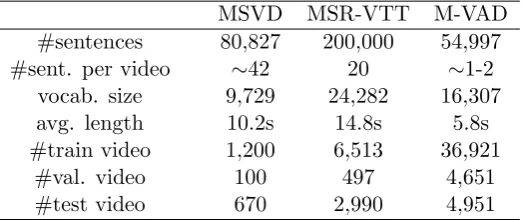
We train and evaluate our models on the Microsoft Video Description Dataset (MSVD)
[39], the newly released Microsoft Research - Video to Text (MSR-VTT) [44] and the
movie description datset M-VAD [40]. Standard train, validation and test splits were
[image:42.595.168.430.535.645.2]used for all datasets. Table 4.1 summarizes the high-level properties of each dataset.
Table 2.1: Video-sentence pair dataset statistics.
MSVD MSR-VTT M-VAD
#sentences 80,827 200,000 54,997
#sent. per video ∼42 20 ∼1-2
vocab. size 9,729 24,282 16,307
avg. length 10.2s 14.8s 5.8s
#train video 1,200 6,513 36,921
#val. video 100 497 4,651
2.4.3 Evaluation Metrics
Quantitative evaluation was performed using the Microsoft COCO caption evaluation
tool [67] to make our results directly comparable with other studies. This tool computes
standard captioning metrics: BLEU [68], METEOR [69] CIDEr [70] and ROUGE [71]
to score a predicted sentence against all ground truth sentences.
BLEU is a metric for precision of word n-grams between predicted and ground truth
sentences. ROUGE takes into account sentence level structure similarity naturally and
identifies the longest co-occurring sequence in n-grams automatically. METEOR was
designed to fix some of the problems found in the more popular BLEU metric, and also
produce good correlation with human judgment at the sentence or segment level. It has
several features not found in other metrics, such as stemming and synonymy matching,
along with the standard exact word matching. CIDEr computes the average cosine
similarity between n-grams found in the generated caption and those found in reference
sentences, weighting them using TF-IDF. METEOR is more semantically preferred than
BLEU and ROUGE.
Typically, the generated sentence correlates well with a human judgment when the
metrics are high as they measure the overall sentence meaning and fluency. However,
the reliability of these metrics are ultimately subject to the mutual agreement between
the visual input and the ground truth sentences. A model that learns from nonsensical
sentences may accurately recognize patterns and achieve high scores, but will not be
useful in practice. We report all scores as percentages.
2.4.4 Performance on MSVD
Table 2.3 reports current captioning results (top third) vs. variations on the number of
Gaussians (middle third) vs. variations on MHB models (bottom third) on the MSVD
Gaussian Attention on MSVD
With respect to Table 2.3, middle third, we evaluate our Gaussian Attention module.
Our baseline model (Baseline GA-5) is a Gaussian attention with five Gaussians. The
addition of hierarchical modeling (+HGA) improves all scores. Overall, the HGA model
learns bigger-picture motion features that compliment the more locally-focused Gaussian
attention.
As recommended in [37], we test a variant with BLEU-4 score included in the caption
loss (BLEU reg). The BLEU score is computed on the validation set and regularized
with the loss after each mini-batch. Though it significantly improves BLEU-4 score,
other scores are not much affected and we notice that sentence fluency degrades as well.
The addition of Video2Vec-Activity (+RGB,OF) further improves METEOR scores.
These features give us extra motion understanding, as well as an understanding of the
action concepts in Activitynet. The highest METEOR score that we achieve using GA
is 33.1% which matches the state-of-the-art.
The advantage of learning multiple Gaussians is that more complex functions can
be represented. This also allows, for example, multimodal distributions or distributions
with a more discriminative shape than two parameters will allow. We evaluate the
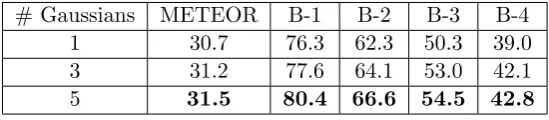
quality of the captions as the number of learned Gaussians is increased. Results are
reported in Table 2.2. More Gaussians increase METEOR and BLEU scores across the
board. We would have increased the number of Gaussians even further but ran into
[image:44.595.160.435.593.653.2]exploding gradients beyond five Gaussians.
Table 2.2: Performance evaluation with number of Gaussian filters for attention on the MSVD test set.
# Gaussians METEOR B-1 B-2 B-3 B-4
1 30.7 76.3 62.3 50.3 39.0
3 31.2 77.6 64.1 53.0 42.1
5 31.5 80.4 66.6 54.5 42.8
Gaus-Figure 2.6: Gaussian attention visualization for sample videos from MSVD. Distribution focuses on relevant video segment based on key words (bold) in the sentence. For the word “adding”, relevant activity is in the starting of video, hence the mean of the distribution is close to 0. X-axis ranges from 0−1 normalized temporal video location and Y-axis is normalized attention weightαti.
sian attention distributions generated on sample test MSVD videos. The distribution
shows the adaptable nature of Gaussian attention. Even though the videos are short, at
certain times the model needs to attend to different parts of the video. We anticipate
that with longer and more complex videos, a higher number of Gaussians would be
required.
Multistream Hierarchal Boundaries Model Experiments
We turn our focus to evaluating the Multistream Hierarchal Boundaries (MHB) Model.
The bottom of Table 2.3 shows that our results on MSVD achieve the
state-of-the-art METEOR score. MHB is a complex architecture combining many ideas, so an
ablation study is necessary to evaluate the contribution of each idea. We compare the
[image:45.595.183.415.103.324.2]reported in percentage.
Method METEOR BLEU-4 CIDEr ROUGE-L
S2VT [19] 29.8 - -
-SA [35] 29.6 41.9 51.67
-p-RNN [37] 32.6 49.9 65.8
-HRNE Att [36] 33.1 43.8 -
-Baseline GA-5 31.5 42.8 65.8 67.9
GA-5+BLEU reg 31.3 43.8 64.9 68.4
GA-5+HGA 32.8 43.9 74.7 69.3
GA-5+HGA+RGB,OF 33.1 43.0 71.1 68.8
MHB w/o GA 30.2 39.8 62.0 65.4
MHB w/o Bdr 32.5 42.3 68.6 68.2
MHB w/ LSTM 32.9 42.3 70.4 68.6
MHB 33.2 43.0 71.1 68.7
GA removes Gaussian Attention from the boundary layer. This means that the only
attention in the model is the fixed-length soft attention in the equally-spaced layer. MHB
w/o Bdr removes the Boundary layer entirely, leaving only the equally-spaced layer.
MHB w/ LSTM replaces the Recurrent Highway Network cells with traditional LSTM
cells. Omitting the Boundary Layer or Recurrent Highway Network cells incur small
reductions in performance across all common captioning metrics. Omitting the Gaussian
Attention alone causes the biggest reduction in performance. This is interesting because
the Omitting the Boundary layer entirely also causes Gaussian Attention to be omitted,
but is less damaging. This suggests that the Boundary Layer is only worthwhile if a
flexible attention mechanism is applied to it.
2.4.5 Performance on MSR-VTT
Caption evaluation scores for our models on the MSR-VTT dataset are reported in
Tables 2.4. All our models are trained end-to-end. A single layer GA performs
bet-ter than the mean pooled video frame input features. The HGA model adds hierarchy
depen-dencies. The significance of Gaussian attention is shown by comparison of HGA with
and without attention. This has better performance than a weighted average through
an attention mechanism. To study the importance of temporal steering (STE) and
Video2Vec-Activity (RGB and OF) features, we also input these as features to the
cap-tioning model. All of these inputs have positive impacts on the evaluation metrics. The
addition of activity features show clear improvement over the baseline HGA. The OF
features yield slightly improved scores over RGB. This indicates that motion/activity
features from the ActivityNet dataset generalize well to other datasets.
Across all features, we observe that the scores did not change significantly when
trained without word features loss (as in Section 2.3). However, it helped the model to
converge faster. While generating the vocabulary from the training captions, we note
that out of total 24,282 words, 10,155 words appear just once and 3,211 words twice.
From the vocabulary, 4,716 words were not part of the GloVe 400K dictionary. Such
issues add to challenges of the language model. Similar trends appear in other datasets
as well.
Table 2.4: MSR-VTT results on the held out test set. We compare with recent entries in the MSR Video to Language Challenge.
Method METEOR BLEU-4 CIDEr ROUGE-L
Donget al. [50] 26.9 39.3 45.9 58.3
Multimodal (only visual input) [72] 27.0 38.3 41.8 59.7
Shetty and Laaksonen [52] 27.7 41.1 46.4 59.6
Mean pool 25.4 34.1 35.8 57.7
Ours
MHB 27.3 37.8 42.6 58.8
Only GA 1-layer 25.6 34.6 37.4 57.4
HGA (w/o att) 26.6 36.0 38.9 58.4
HGA 27.4 38.8 43.4 59.1
+ STE 27.6 37.9 43.4 59.2
+RGB 27.6 38.6 42.8 58.9
+OF 27.7 39.0 43.8 59.6
+RGB, OF 27.7 39.2 43.5 59.2
+RGB, OF, CAT 28.2 40.5 45.3 60.4
combination of RGB and optical flow features, all other metrics show improvement. It
also indicates that either of the features are sufficient to capture the activity information.
We also use the GloVe embedded video category label (CAT) available for all videos. The
combined model is trained by concatenating the features before input to the LSTM. We
note that the categories are the ground truth labels that are part of the original dataset
and hence are better than any features generalized from an another dataset.
Gaussian Attention in Different HGA Layers Experiments were run on the
HGA model to compare soft (SA) and Gaussian attentions (GA). The HGA-only model
can be interpreted as a three layer LSTM with the first two hierarchical layers as the
video encoder and the last layer as the sentence generator or word decoder. We replace
soft attention with GA at multiple layer combinations. Results are reported in Table
2.5. Adding GA at more layers seem to help focus on relevant inputs and features.
Attention on the middle HGA layers can be viewed as the weighted sum of the encoded
outputs of video clips input to the first layer. Attention is most important at the word
decoder (layer 3) as it not only finds relevant segments in the video but also relevant
HGA encoded features based on generated words.
Table 2.5: Comparing Gaussian attention at different layers for MSR-VTT test set. Adding GA show clear improvement over SA and attention is most important at the word generation layer. B-1 to B-4 are n-gram BLEU scores.
Layer replacing SA with GA METEOR B-1 B-2 B-3 B-4
None 26.7 77.7 62.6 48.4 36.1
3 27.3 78.9 63.6 49.8 38.1
3,2 27.4 79.3 64.5 50.8 38.8
3,2,1 (HGA) 27.4 79.7 64.8 51.1 38.8
2.4.6 Performance on Movie Description Dataset
We present results of the HGA model on the M-VAD movie description dataset. This is
a very challenging dataset as the videos are not specific activities but are movie scenes
![Figure 2.4: Example boundary attention vector where the “peaks” indicate video bound-aries in [0 − 1] normalized video.](https://thumb-us.123doks.com/thumbv2/123dok_us/32830.2594/38.595.98.501.103.255/figure-example-boundary-attention-vector-peaks-indicate-normalized.webp)