SCHOOL CHILDREN BETWEEN 8 TO 11 YRS
A dissertation submitted to
THE TAMILNADU DR. M.G.R MEDICAL UNIVERSITY CHENNAI
IN PARTIAL FULFILLMENT OF THE REQUIREMENT FOR THE AWARD OF DEGREE OF
MASTER OF SCIENCE IN NURSING
SCHOOL CHILDRENBETWEEN 8 TO 11 YRS Certified that this is the bonafide work of
Reg. No: 301316652 CHILD HEALTH NURSING
THANTHAI ROEVER COLLEGE OF NURSING PERMBALUR
COLLEGE SEAL :
SIGNATURE :
Prof. Mrs. R.PUNITHAVATHI RN.,RM.,M.Sc (N).,
Principal
Thanthai Roever College of Nursing Perambalur
A dissertation submitted to
THE TAMILNADU DR. M.G.R MEDICAL UNIVERSITY CHENNAI IN PARTIAL FULFILLMENT OF THE REQUIREMENT
SCHOOL CHILDREN BETWEEN 8 TO 11 YRS
Approved by the Dissertation :
Committee On
Research Guide :
Prof. Mrs. R.PUNITHAVATHI RN.,RM.,M.Sc (N)
Principal
Thanthai Roever College of Nursing Perambalur.
Clinical Specialty Guide :
Prof.Mrs.VIMALA.N RN.,RM.,M.Sc(N).,
Professor, Child Health Nursing Thanthai Roever College of Nursing Perambalur
A dissertation submitted to
THE TAMILNADU DR. M.G.R MEDICAL UNIVERSITY CHENNAI IN PARTIAL FULFILLMENT OF THE REQUIREMENT
FOR THE AWARD OF DEGREE OF MASTER OF SCIENCE IN NURSING APRIL 2015
I, 301316652 hereby declare that this dissertation entitled “EFFECT OF CHILD TO CHILD APPROACH ON KNOWLEDGE REGARDING PRACTICES OF ORAL HYGIENE AMONG SCHOOL CHILDREN BETWEEN 8 TO 11 YRS AT PERAMBALUR” has been prepared by me under the guidance and direct supervision of Prof.Mrs.N.VIMALA,M.Sc(N), PROFESSOR OF, Thanthai Roever College of Nursing, Perambalur, as requirement for partial fulfilment of M.Sc Nursing degree course under The Tamilnadu Dr. M.G.R. Medical University, Chennai – 32. This dissertation had not been previously formed and this will not be used in future for award of any other degree/ diploma. This dissertation represents an independent original work on the part of the candidate.
Place : Perambalur, 301316652
Date : April – 2015. II Year M.Sc (N) Student
First, I praise and thank Almighty god with reverence and sincerity for his abundant grace, which strengthened me in each step throughout his endeavor in spite of weakness.
I express my sincere gratitude to Dr. K. Varadharaajen, BA.,BL., Chairman and Managing Trustee, Thanthai Roever College of Nursing, Perambalur for providing me an opportunity to pursue this Post Graduate programme in this esteemed institution. I express my thanks to him for his encouragement and support.
I would like to express my gratitude to Prof. Mrs. R. Punithavathi, M.Sc. (N)., Principal Thanthai Roever College of Nursing for her valuable guidance.
I wish to express my sincere thanks to Mrs.V.J.Elizabeth M.Sc (N)., Vice Principal, Thanthai Roever College of Nursing for her valuable suggestion and guidance.
My deep sense of gratitude to my clinical specialty guide Mrs.Vimala, M.Sc (N)., Professor, HOD in Department of Pediatrics for her elegant direction, support, guidance and suggestions and encouragement in making this study a great success.
I am grateful to, Mrs.S.Santhi, M.sc (N)., reader , Department of pediatrics for her constant support, guidance and suggestions throughout the study which helped me to complete this project.
Dr. M.G.R. Medical University, Chennai for their support and guidance in procuring the literature related to the study.
I would like to dedicate this study to my husband N. Arivazhgan for leading and helping me in successful completion of this dissertation.
It is my immense pleasure to express my heartiest gratitude to my family members, Mr.K.Mannaggatti my dear father for his moral support and priceless encouragement, Mrs. Amutha my dear mother for her kind unconditional help, love and encouragement from birth till now.
SCHOOL CHILDRENBETWEEN 8 TO 11 YRS ABSTRACT
INTRODUCTION
Oral health may be defined as a standard of health of the oral and related tissues which enables an individual to eat, speak and socialize without active disease, discomfort or embarrassment and which contributes to general wellbeing.
OBJECTIVES
To assess the effectiveness of child to child approach on knowledge regarding practices of oral hygiene among school children between 8 to 11 yrs
METHODS
Study design was pre experimental, one group pre test post test only design. Fifty school students were selected by using Non probability convenient sampling technique. The intervention of child to child approach was once daily for seven day and post test was done after seven days. Interview checklist was used to assess the knowledge regarding practices of oral hygiene.
RESULTS
Statistical findings revealed thatthe pretest mean score of knowledge was 5.56 with S.D 1.36 and the post test mean score of knowledge was 12.12 with S.D 1.76. The mean difference was 6.56 and the calculated paired ‘t’ value 24.453 was found to statistically significant at p<0.001 level.
CONCLUSION
CHAPTER
NO CONTENT PAGE NO.
I INTRODUCTION 1
Background of the Study 2
Need for the Study 3
Statement of the Problem 5
Objectives 5
Hypotheses 6
Operational Definitions 6
Assumptions 7
Delimitations 7
II REVIEW OF LITERATURE 8
Related Studies 8
Conceptual Framework 13
III METHODOLOGY 16
Research Approach 16
Research design 16
Variables 16
Setting of the study 16
Population 17
Sample 17
Sample size 17
Sampling Technique 17
Criteria for selection of samples 17
Tools of research 18
Development and description of the data collection tool
18
Scoring and grading procedure 18
Pilot study 19
Data collection procedure 20
Methodology
IV DATA ANALYSIS AND INTERPRETATIONN
23
V DISCUSSION 36
VI SUMMARY, MAJOR FINDINGS OF THE STUDY, CONCLUSION,
IMPLICATIONS,
RECOMMENDATIONS
39
REFERENCES 50
ANNEXURES I-VIII
TABLE NO.
TITLE PAGE
NO.
1. Frequency and percentage distribution of demographic variables of school children between 8
2. Pre and post test level of knowledge regarding practices of oral hygiene among school children between 8 to11 yrs
29
3.
4.
Comparison of pre and post test knowledge mean scores practices of oral hygiene among school children between 8 to 11 yrs
Association of post test level of knowledge regarding practices on oral hygiene among school children between 8 to 11yrs and their selected demographic variables
31
LIST OF FIGURES
FIGURE NO.
TITLE PAGE NO.
1. Conceptual framework 15
2.1 Percentage distribution of sex of school children 27
2.2 Percentage distribution of Education of mother 28
2.3 Percentage distribution of pre and post test level of knowledge regarding practices of oral hygiene among school children between 8 to11 yrs.
30
2.4 Comparison of Pre and Post test knowledge mean scores regarding practices of oral hygiene among school children between 8 to 11 yrs.
ANNEXURE TITLE PAGE NO
I Letter Seeking Permission to Conduct a Research purpose
I
II Letter seeking experts opinion for content validity. II
III Evaluation Criteria Check List Validation III
IV List of Experts IV
V Certificate of English editing V
VI Certificate of Tamil editing VI
VII Data collection tool (English & Tamil) VII
CHAPTER – I
INTRODUCTION
Oral hygiene is an integral part of overall health. Oral cavity plays a vital role in the life of children through functions like mastication, phonetics, communication and emotional expressions. It is highly essential to safeguard oral health of all children from early childhood.
Poor oral hygiene is highly prevalent among school children and to be a significant public health problem around worldwide, poor oral hygiene is found in all children, irrespective of age, caste, creed or geographical location. It is found as 95% of all cavities are caused by specific eating habits like sugar ,candies, ice-cream and canned juice which usually develop during early childhood which leads to toothache, sensitivity to food ,pus formation with severe pain ,inability to chew , swelling in cheek , fever, gingivitis and dental caries.
The common oral problem in school children is Dental caries, Periodontal disease, Tartar, Plaque, Malocclusion, Missing teeth and Teeth mobility.
WHO (2012) reported that oral health is essential to general health and quality of life, It is state of being free from mouth and facial pain , oral and throat cancer, oral infection and sores, Periodontal and Gum diseases and disorders that limit an individual’s capacity of biting ,chewing, smiling, speaking and psychosocial well-being.
51,000,000 school hours are lost annually because of oral health problems which affect children’s performance at school.
The majority of Indian population resides in rural areas, of which more than 40% constitute children. These children cannot avail dental facilities due to inaccessibility, financial constraints and poor public dental healthcare services. This entails the health professionals to adopt a more practical approach to achieve primary prevention of oral diseases. The most viable solution seems to be dental health education.
The child-to-child approach concept was launched in 1979, which was celebrated as the "year of the child". The child to child approach teaching is a spreading health messages through children, the messages were simple but essential for saving lives, such as teaching little children about road safety, significance of hand washing ,personal hygiene, oral hygiene and Brushing technique etc.
Prevention is better than cure, most of us remember the importance of oral health only when a problem occurs. Good oral health will keep away most of the oral and dental problems protecting us from toothaches and dental treatments.
BACK GROUND OF THE STUDY
“MOUTH IS THE MIRROR OF THE BODY”
comes from the pediatric population ,that oral debris is very commonly seen in mouth with poor oral hygiene in the age group of 5-8 yrs.
World Dental Fedaration., (2014) reported “ world oral health day” is celebrated every year on the 20th March. The purpose of this day is to increase
global awareness for oral health as well as impact of oral diseases on general health and well being. The theme is “celebrating healthy smile”.
Indian Dental Association.,(2012) The council of dental health (CDH) plans and organizes oral health programs. These include dental health education in schools, dental camps, exhibitions, distribution of free dentures, essay writing and painting competitions and other related activities on a regular .
National Oral Health Care reported that the dental caries is a public health problem in school children with prevalence rate 60 – 80% in India. Apart from this, about 30% of children suffer from malaligned teeth and jaws affecting proper functioning of the dento-facial apparatus.
Jose. et.,al. (2008) conducted a study on prevalence of dental health problems among 1068 school children 12-15 years in rural kerala. The study concluded 54 % showed evidence of dental caries.
WHO reported that dietary components such as cow’s milk , whole grain foods ,peanuts, hard cheeses and chewing gum also stimulate salivary flow and protect against dental caries.
NEED FOR THE STUDY
care. Most of these dental and mouth problems may be avoided just by maintaining good oral hygiene.
Risk factor for dental caries family history of caries, presence of plaque, presence of demineralized enamel, abnormal tooth structure, inadequate exposure of fluoride, frequent consumption of fermentable carbohydrate, night time use of bottle, braces/orthodontic appliances, low socioeconomic status, inadequate dental care.
School Dental Programme (2012) started the awareness about good oral habits at school targeted at children in the age-groups between 9 to 14 years. In this programme spreading the message of how brushing twice a day with fluoridated toothpaste can play a significant role in preventing tooth decay and gum disease. Under this Programme activities such as free dental check-ups, distribution of samples of toothpaste and toothbrushes as well as educational leaflets and posters and large-scale community- based oral health camps are organized.
Mohammad Ali Lehari, et al. (2012) conducted a cross sectional study to assess the prevalence of dental caries and risk factor among 399 schoolchildren 12-15 years both boys and girls at Karachi. This study revealed there were 51% boys and 49% girls. The prevalence of dental caries was 66.67%.The mean Decayed, Missing, Filled Teeth (DMFT) score was1.26. Mean was significantly higher in girls than boys.
School Nurses play an integral role in preventing oral health problems. Nurse can be active members of preventive educational program and serve as counselor to the families regarding the importance of regular dental care, oral hygiene and dietary management. Nurses should encourage good oral hygiene and teach correct brushing technique to both children and their parents and Maintaining good dental and oral health should be a life long every day habit.
STATEMENT OF THE PROBLEM
“A study to assess the effectiveness of child to child approach on knowledge regarding practices of oral hygiene among school children between 8 to 11 yrs in Thanthai Roever Higher Secondary School at Perambalur.
OBJECTIVES OF THE STUDY
1. To assess the level of knowledge regarding practices of oral hygiene among school children between 8 to 11yrs.
2. To assess the effectiveness of child to child approach on knowledge regarding practices of oral hygiene among school children between 8 to 11 yrs.
3. To find out the association between the post-test level of knowledge regarding practices of oral hygiene among school children between 8 to 11yrs and their selected demographic variables.
H1: There is a significant increase in knowledge regarding practices of oral hygiene after implementation of child to child approach among school children between 8 to 11yrs.
H2: There is a significant association between post-test level of knowledge regarding practices of oral hygiene among school children between 8 to 11yrs and their selected demographic variables.
OPERATIONAL DEFINITIONS
EFFECTIVENESS
In this study, effectiveness refers to gain in the knowledge regarding practices of oral hygiene after implementation of child to child approach.
CHILD TO CHILD APPROACH
In this study it is refers to Teaching session with the use of flash card in small groups of children by a elder child of 9 yrs as changing agent who will be trained by the investigator for teaching knowledge regarding practices of oral hygiene. The ratio of changing agent and children is 1:5.
KNOWLEDGE
In this study it refers to the factual information regarding practices of oral hygiene existing among children.
PRACTICESOF ORAL HYGIENE
SCHOOL CHILDREN
They are children who are going to the school as well as in the age group of 8 to 11yrs.
ASSUMPTIONS
1. School children may have inadequate knowledge regarding practices of oral hygiene.
2. Child to child approach may enhance the knowledge on oral hygiene among school children.
3. Knowledge on practices may influence the school children to improve oral hygiene.
DELIMITATION
The setting is limited to only one school. A study sample is limited to only one school.
The sample is limited to children between 8 to11yrs only. Data collection duration is limited to only 4 weeks.
PROJECTED OUTCOME
The findings of this study will to determine the effectiveness of child to child approach on knowledge regarding practices of oral hygiene among school children between 8 to11 yrs .
The study findings will help the health care members to implement child to child programmes.
CHAPTER – II
REVIEW OF LITERATURE
A literature reviews provides a back ground of current knowledge on a topic and highlights the necessity for new studies. ( polit and beck 2011)
The review of related literature is an essential aspect of scientific research, it entails the systemic identification , reflection, critical analysis and reporting of existing information in relation to the problem of interest.
PART - I
The review of literature was presented under the following headings
SECTION A: Studies related to knowledge and practices of oral hygiene
SECTION B: Studies related to child to child approach regarding Oral hygiene
A) STUDIES RELATED TO KNOWLEDGE AND PRACTICES OF ORAL HYGIENE
Aziz Kamran , et al. (2014) conducted a Cross-Sectional Study to evaluate oral hygiene knowledge ,practice and attitude among school children at Iran . This study revealed that 83% reported that use of fluoride paste strengthens the teeth and 18.2% reported the healthy teeth are strong ,5% participant reported for general dental check up and75% visited dentist only when dental pain. 8.2% had the habit of rinsing their mouth after eating. Oral hygiene practice and knowledge among school children is not satisfactory.
Rekha S.Sonavane , et al. (2014) conducted a cross sectional study to assess oral hygiene knowledge, and practices among 300 school children7-12 years at Bijapur . This study concluded that 37.33% of the children had oral problems, 18% had carious teeth, 67.67% brushed their teeth once a day. 75.33% brushed their teeth in horizontal strokes only, 80.43% did not visit the dentist for regular check-ups. The oral hygiene of school children in Bijapur was poor .
Baranya shrikrishna suprabha, et al. (2013) conducted a cross sectional study,to assess the knowledge, attitude, and oral health care practices and prevalence of dental caries among 858 (10-11)year old children at mangalore. This study concluded that the dental caries prevalence was 59.4%, and 54.5% had low knowledge. Children with low knowledge had significantly higher odds of having (Decayed, Missing and Filed teeth)DMFT≥1, not using fluoridated toothpaste, and being afraid of going to the dentist due to possible pain.
children 75.3% and male children 60.3%, Overall the level of knowledge score was statistically significant with P = 0.004.
Sofia Kabir, et al. (2013) conducted a cross sectional study to assess the Knowledge, Practices , attitude regarding oral hygiene among 400 school children at shimla .This study concluded that 41.4% girls had adequate knowledge and 66.8% of students had good practice.
Manveerkaur.MS (2013) conducted a pre-experimental study to assess the effectiveness of structured teaching programme on knowledge regarding dental hygiene among 60 schoolchildren at Punjab. This study concluded that the pre-test mean score was 14.91 and After structure teaching programme the post-test mean score was of 23.01. The students had 32%adequate knowledge ,68 % had good level of knowledge and 0% had poor level of knowledge.
Jiji George.K( 2012) conducted a quasi experimental study on video assisted teaching to evaluate the effectiveness of planned teaching programme on knowledge regarding oral hygiene among 60 school children at kerala. This study concluded that the Pretest knowledge score was 50%. After the video teaching programme the post test knowledge score was 74.32% .The student knowledge was improved after video teaching programme.
Vakani ,et al . (2011) conducted a Cross-sectional study to assess the oral hygiene knowledge, and practices among 300 school children and evaluate their DMFT (Decayed/Missing/Filled Teeth) at karachi. This study concluded that the mean DMFT score was 1.27. A statistically significant association was found between frequency of brushing and children’s knowledge of the problems related to irregular tooth brushing (p < 0.001).
II) STUDIES RELATED TO CHILD TO CHILD APPROACH REGARDING ORAL HYGIENE
Aswathy Chandran (2013) conducted a pre experimental study to assess effectiveness of child to child approach on knowledge regarding practices of oral hygiene among 120 school children 8-11yrs at Bangalore. This study revealed that the child to child approach was significantly improve knowledge regarding practice of oral hygiene.
Mohammad Sayeed Ahmad, et al. (2013) conducted a quasi experimental study regarding child to child education on oro-dental hygiene among school students at Bangladesh. This study concluded that the Pretest knowledge score was 51.7% and after child to child education the post test knowledge score was 90%. This study revealed 80% of the students heard about the importance of oro -dental hygiene that reached to 100% after intervention.
Amirthaleena (2012) conducted a quasi experimental a study to assess the effectiveness of child to child programme on dental health among 50 primary school children at kanyakumari. This study revealed that the pretest mean score was 9.3 and after implementation of child to child programme the post test mean score was 14.0.
AnnaP.Chandy.MR ( 2010) conducted a pre experimental design a study to assess effectiveness of child to child approach among elder child to young child regarding dental hygiene among 50 school children at salem . This study revealed that the pre test knowledge on dental hygiene was 83.47% and post test score knowledge on dental hygiene was 74.13 %.and pre test knowledge on brushing technique was 74.13% and post test knowledge on brushing technique was 87.2%.
Sadiq Ali.N, (2009) conducted a Quasi experimental study to assess the effectiveness of child to child programme between elder children to younger child on dental hygiene among school children at Erode. This study concluded that the pretest knowledge score was 65.6% and post test knowledge score was 83.47%.
PART-II
CONCEPTUAL FRAME WORK
The conceptual frame work for this study was derived from Ludwig Von Bertalanffy’S(1968) , as cited by chirtensen J.paula and Kenny W.Janet (1995) General system theory. The general system theory was initially introduced in 1930s by Von Bertalanffy’s. A system is a set of interrelated parts that come together to form a whole. Each part is necessary or integral component is required to make a complete meaningful whole. All living system or open systems which mean that they exchange energy matter and information across their boundaries with the environment general system theory consists of scientific explanation whole or wholeness ; it has its sub system or input , through put, output. Input and output are the process by which a system is able to communicate and react its environment.
Input
Refers to matter, energy and information enters into the system its boundary. In this study input consists of demographic variables age, sex, education, type of family, residence, occupation of father, education of mother, education of father, dental caries and existing knowledge regarding practices of oral hygiene.
Through put
Selection of tooth brush and toothpaste, Brushing technique, Rinsing,Diet management, Regular dental check up, complication of poor oral hygiene.
Out put
Is an energy, information (or) matter that is transformed to the environment. In this study the expected outcome was obtained by evaluating the knowledge regarding practices of oral hygiene through interview checklist. The output was evaluated by the post test after intervention. This is ultimately resulting in the improvement in the level of knowledge.
Feed back
e INPUT THROUGHPUT
OUTPUT
Existing knowledge regarding practices of oral hygiene among school children between 8 to 11 yrs
EXTRANEOUS VARIABLES Age,Sex,Education,Residence Occupation of Father,Education of Mother,Education of Father ,Type of family,Dental caries
Child to Child approach on knowledge regarding practices of oral hygiene
¾ Type of teeth and structure
¾ Causes of poor oral hygiene
¾ Selection of toothbrush and tooth paste
¾ Brushing technique
¾ Rinsing
¾ Diet management
¾ Regular dental check up
¾ Harmful activities
¾ Complication of poor
Change in the level of knowledge regarding practices of oral hygiene
Adequate knowledge
Moderately adequate Knowledge
Inadequate knowledge
[image:28.612.7.767.87.522.2]FEED BACK
CHAPTER – III
METHODOLOGY
This chapter deals with the research design, variables, setting, population, sample, criteria for selection of sample , sample size, sampling technique, development and description of the tool, content validity , reliability, pilot study, data collection procedure , and plan for data analysis.
RESEARCH APPROACH
Quantitative Evaluative approach
RESEARCH DESIGN
Pre experimental study [ one group pretest and post test design]
PRE TEST INTERVENTION POST TEST
O1 X O2
O1 - pre test assessment of knowledge X-child to child approach
O2- post test assessment of knowledge
VARIABLES
POPULATION
The Target population
The target population of this study was 8 to 11 years of school children.
Accessible population
The accessible population of this study was 8 to 11 years of school children studying in Thanthai Roever Higher Secondary School at Perambalur.
SAMPLE
8 to 11 years of school children of both genders (female and male) in Thanthai Roever Higher Secondary School those who met the inclusion criteria.
SAMPLE SIZE 50
SAMPLING THCHNIQUE
Non probability convenient sampling technique
DURATION OF THE STUDY 4 Weeks
CRITERIA FOR SELECTION OF SAMPLES
A)Inclusion criteria
Children between 8 to 11 years
The Investigator used a interview checklist to assess the knowledge regarding practices of oral hygiene
DEVELOPMENT DESCRIPTION OF THE DATA COLLECTION TOOL The tools was developed after an extensive review of literature and considering the opinion given by medical and nursing experts.
It consists of the following two sections
Section I
Interview guide which consists of question of the demographic data.
Section-II
Interview checklist for assessment of knowledge regarding practices of oral hygiene consists of 15.
SCORING GRADING PROCEDURE SCORING
The correct answer of each question carries ‘one’ mark and the wrong answers is marked ‘zero’, the maximum score is 15. The scores obtained by the children ‘s is converted to percentage and graded as follows.
GRADING PROCEDURE
agent. Re- training was given to the changing agent in case of those who had inadequate knowledge. They were trained till they gain adequate knowledge. On the 5th day the student were allotted to the changing agent by Non probability
convenient sampling technique.
CONTENT VALIDITY
The content validity of the tool was obtained on the opinions of one in the field of medical specialist and four nursing experts. Tool was modified as per the consensus of all the experts and the tool was finalized.
RELIABILITY
The reliability of the tool was determined by Test re-test method. The reliability score was r = 0.82 Hence, the tool was considered highly reliable for proceeding the study.
PILOT STUDY
The pilot study was done at Thanthai Roever Higher Secondary School from 19.5.2014 to 26.5.2014 to test feasibility relevance and practicability. Permissionwas obtained from headmaster of Thanthai Roever Higher Secondary School.
pretest post test design was adopted in this study. Non probability convenient sampling technique was used to select the sample. The investigator collected the data for 4 days a week from 9 am to 4 pm. The investigator established rapport with the children and obtained informed consent.
On day 1 the investigator did the pretest using Demographic data and interview checklist tool and assessed knowledge regarding practices of oral hygiene for changing agent and Re- training was given to the changing agent in case of those who had inadequate knowledge. They were trained till they gain adequate knowledge on the 5th day the student were allotted to the changing agent
and should teach to their allotted children about the knowledge regarding practices of oral hygiene. Over all supervision was done by the investigator and post test was administered after seven days.
PLAN FOR DATA ANALYSIS
It was planned to analyze the collected data by using descriptive and inferential statistical will be used.
DESCRIPTIVE STATISTICS
Frequency and percentage distribution will be used to analyze the demographic variables and assessment of knowledge regarding practice of oral hygiene among school children between 8 to 11 yrs
Chi-square test will be used to find association of knowledge regarding practices of oral hygiene with their selected demographic variables.
ETHICAL CONSIDRATION
The research proposal was approved by the dissertation committee of the institution prior to pilot study. Permission was sought from principal of Thanthai Roever Higher secondary school, Perambalur. The informed consent from each children was obtained before data collection. Assurance was given to the study participants regarding the confidentiality and no harm to the children in the course of study.
SCHEMATIC REPRESENTATION OF RESEARCH
METHODOLOGY
RESEARCH DESIGN
Pre-experimental (one –group pretest posttest design)
TARGET POPULATION 8 to 11 Yrs school children
ACCESSIBLE POPULATION 8 to11 yrs school children at Perambalur
SAMPLE AND SAMPLE SIZE
8 to 11 Yrs school children in Perambalur who met the inclusion criteria. Sample size-50 BACKGROUN D FACTORS ¾ Age ¾ Sex ¾ Education ¾ Residence ¾ Occupation of Father
¾ Type of Family ¾ Education of Mother ¾ Education of Father ¾ Dental caries SAMPLING TECHNIQUE Non-Probability convenient sampling PRETEST Interview Check List
DATA COLLECTION
PROCEDURE
Interview Check list Scale was used for assessing child to child approach on Intervention
POSTTEST Interview Check List
Analysis and Interpretation
Research Approach
CHAPTER – IV
DATA ANALYSIS AND INTERPRETATION
The analysis is a process of organizing and synthesizing the data in such a way that the research question can be answered and hypothesis tested (Polit and Hungler, 2011)
\
This chapter deals with analysis and interpretation of the data collected from 50 school children 8 to 11 yrs. The data was organized, tabulated and analyzed according to the objectives. The findings are presented under the following sections.
ORGANIZATION OF THE DATA
SECTION I : Description of the demographic variables of the school children between 8 to 11 yrs.
SECTION II : Pre and post test level of knowledge regarding Practices of oral hygiene among school children between 8 to 11 yrs.
SECTION III : Effectiveness of child to child approach on
SECTION I
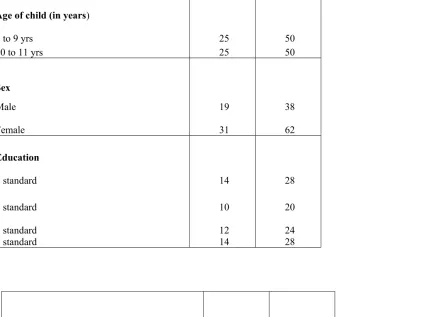
Table 1: Frequency and percentage distribution of demographic variables of school children between 8 to 11 yrs
N = 50
Demographic Variables f %
Age of child (in years)
8 to 9 yrs 25 50
10 to 11 yrs 25 50
Sex
Male
Female
19
31
38
62
Education
3 standard 14 28
4 standard
5 standard
10
12
20
24
Occupation of father Professional Skilled worker Unskilled worker Unemployed 0 16 25 9 0 32 50 18
Type of family
Joint family Nuclear family 28 22 56 44
Education of mother
Education of father
Illiterate
Primary education
Secondary education
Higher secondary
Graduate
15
14
17
2
2
30
28
34
4
4
Dental caries
Yes
No
24
26
48
52
The table 1 depicts that majority 25(50%) of the child were in the age group of 8 to 9 yrs and 10 to 11 yrs, 31(62%) were female, 14(28%) were studying in 3rd
and 4th 36(72%) were residing in urban area, 25(50%) of fathers were unskilled
Figure -2.1 Percentage distribution of sex of school children
[image:40.612.105.700.119.465.2]SECTION II
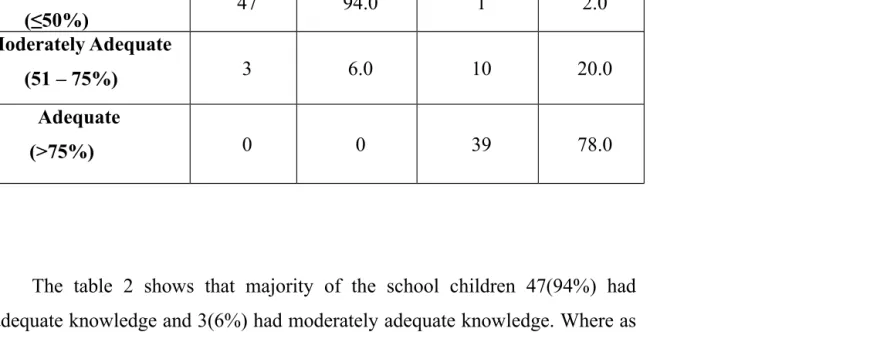
Table 2: pre and post test level of knowledge regarding practices of oral hygiene among school children between 8 to 11 yrs.
N = 50
Level of Knowledge Pretest Post Test f % f % Inadequate
(≤50%) 47 94.0 1 2.0 Moderately Adequate
(51 – 75%) 3 6.0 10 20.0
Adequate
(>75%) 0 0 39 78.0
Figure -2.3 Percentage distribution of pre and post test level of knowledge regarding practices of oral hygiene among school children between 8 to 11 yrs
SECTION III
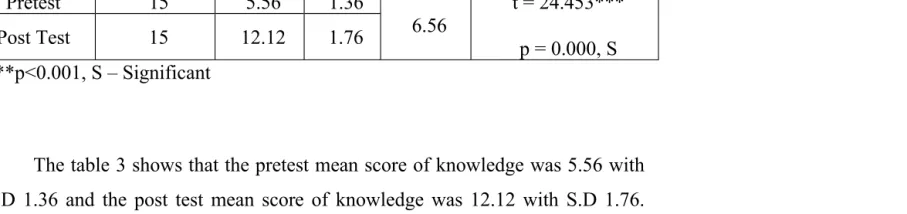
Table 3: Comparison of pre and post test knowledge mean scores regarding practices of oral hygiene among school children between 8 to 11yrs.
N = 50
Knowledge Maximum
score Mean S.D
Mean
Diff. Paired ‘t’ Value
Pretest 15 5.56 1.36
6.56 t = 24.453*** p = 0.000, S
Post Test 15 12.12 1.76
***p<0.001, S – Significant
SECTION IV
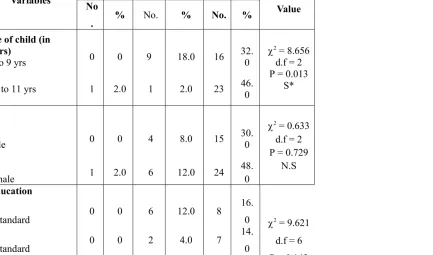
Table 4: Association of post test level of knowledge regarding practices on oral hygiene among school children between 8 to 11 yrs and their selected
demographic variables.
Demographic Variables
Inadequat e (≤50%)
Moderately Adequate (51 – 75%)
Adequate
(>75%) Chi-Square
Value No
. % No. % No. % Age of child (in
years)
8 to 9 yrs 0 0
χ2 = 8.656
d.f = 2 P = 0.013
S* 9 18.0 16 32.0
10 to 11 yrs 1 2.0 1 2.0 23 46.0
Sex
χ2 = 0.633
d.f = 2 P = 0.729
N.S
Male 0 0 4 8.0 15
30. 0
Female 1 2.0 6 12.0 24
48. 0 Education
χ2 = 9.621
d.f = 6 P 0 142
3 standard 0 0 6 12.0 8
16. 0
4 standard 0 0 2 4.0 7
Demographic Variables
Inadequat e (≤50%)
Moderately Adequate (51 – 75%)
Adequate
(>75%) Chi-Square
Value No
. % No. % No. %
Residence χ2 = 1.211
d.f = 2 P = 0.546
N.S
Rural area 0 0 4 8.0 10
20. 0
Urban area 1 2.0 6 12.0 29
58. 0
Occupation of father
χ2 = 5.118
d.f = 4 P = 0.275
N.S
Professional - - -
-Skilled worker 0 0 2 4.0
14 20 28. 0 40. 0 Unskilled worker
1 2.0 4 8.0
Unemployed 0 0 4 8.0 5
10. 0
Type of family χ2 = 0.924
d.f = 2 P = 0.630
N.S
Joint family 1 2.0 6 12.0 21
42. 0
Nuclear family 0 0 4 8.0 18
36. 0
Demographic Variables
Inadequat e (≤50%)
Moderately Adequate (51 – 75%)
Adequate
(>75%) Chi-Square
Value No
. % No. % No. % 0
Secondary education 0 0 4 8.0 12
24. 0
Higher secondary 0 0 0 0 1 2.0
Graduate 0 0 1 2.0 2 4.0
Education of father
χ2 = 5.358
d.f = 8 P = 0.719
N.S
Illiterate 1 2.0 4 8.0 10
20. 0
Primary education 0 0 3 6.0 11
22. 0 Secondary education Higher secondary 0 0 0 0 2 1 4.0 2.0 15 1 30. 0 2.0
Graduate 0 0 0 0 2 4.0
Dental caries χ2 = 1.553
d.f = 2 P = 0.460
N.S
Yes 0 0 6 12.0 18
36. 0
No 1 2.0 4 8.0 21
42. 0
CHAPTER - V
DISCUSSION
This chapter deals with the discussion of the data analyzed based on the objective and hypotheses of the study.
The main aim of the study was to assess the effectiveness of child to child approach on knowledge regarding practices of oral hygiene among school children between 8 to 11 yrs are discussed below along with objectives,
OBJECTIVES OF THE STUDY
The first objective of the study to assess the level of knowledge regarding practices of oral hygiene among school children between 8 to 11yrs
The analysis of pretest level of knowledge regarding practices of oral hygiene revealed that 47(94%) had inadequate knowledge and 3(6%) had moderately adequate knowledge regarding practices of oral hygiene .
The second objective of the study to assess the effectiveness of child to child approach on knowledge regarding practices of oral hygiene among school children between 8to11 yrs
The pre test mean score of knowledge regarding practices of oral hygiene was 5.56 with the standard deviation 1.36 and post test mean score was 12.12 with standard deviation 1.76.
The mean difference was 6.56 and calculated paired ‘t’value of t= 24.453 was greater than table value(0.000) at p <0.001 level.
Hence the stated hypothesis,
H1. There is a significant increase in knowledge regarding practices of oral hygiene after implementation of child to child approach among school children between 8 to 11yrs was accepted.
The following authors Mohammad sayeed ahamed, Neethimozhi, Amirthaleena, Anna chandy, sadiq ali.N also suggested in their study the child to child approach was significantly improve knowledge regarding practices of oral hygiene.
There was no significant association found between the post test level of knowledge regarding practice of oral hygiene and demographic variables of sex, education, residence ,occupation of father, type of family , education of mother, education of father, dental caries as the calculated chi-square value less than table value at p<0.05 level.
Based on the study findings the hypothesis.
CHAPTER - VI
SUMMARY, MAJOR FINDINGS, IMPLICATION,
RECOMMENDATION, CONCLUSION
This chapter is divided into two section. Section I deals with summary of the study , findings. Section II deals with implication in various areas of nursing practice, nursing education , nursing administration, and nursing research and its limitation and recommendations.
SUMMARY OF THE STUDY
The objectives of the study was to assess the effectiveness of child to child approach on knowledge regarding practices of oral hygiene among school children between 8 to11 years in Thanthai Roever Higher Secondary School at Perambalur.
A quantitative evaluative approach, pre- experimental one- group pretest post test only the design was adopted for this study. Non probability convenient sampling technique was used to select the sample and the sample size was 50. Conceptual framework Ludwig von bertalanffy‘s general system theory (1968) model is used for this study.
days. Over all supervision was done by the investigator and post test was done after seven days.
Both inferential and descriptive statistics were used to analyze the data, interpreted in terms of objectives and hypothesis of the study. The study findings shows that the child to child approach was effective in improve knowledge regarding practices of oral hygiene among school children between 8to11 yrs.
MAJOR FINDINDS OF THE STUDY
I Demographic variables
¾ Majority 50% of children’s were belonged to 8 to 9 years and 10 to 11 years.
¾ Majority 62 % of children’s were belonged to female.
¾ Majority 28% of children’s were belonged to studying in 3rd and 4th
standards.
¾ Majority 72% of children’s were belonged to residing in urban area.
¾ Majority 50% children’s fathers were unskilled workers.
¾ Majority 56% children’s were belonged to joint family.
¾ Majority 34%of children’ mother were educated upto primary education.
¾ Majority 34%of children’s fathers were educated upto secondary education.
¾ Majority 52% of children’ experienced no dental caries.
II Findings related to effectiveness of child to child approach
Data findings revealed that there was a statistically significant association of post level of oral hygiene and the demographic variables age of the child. The observed chi- square value (8.656) was greater than the table value (0.013) at p < 0.05 level of significance.
The calculated value was less than the table value at p < 0.05 level for sex, education, residence, occupation of father . type of family, education of mother, education of father, dental caries. So , there was no significant the post test level of oral hygiene and the demographic variables sex , education, residence , occupation of father . type of family, education of mother, education of father, dental caries.
IMPLICATIONS
The findings of the study have implication in various areas of nursing practice , nursing education, nursing administration and nursing research.
Implication for Nursing Practice
The pediatric nurses have a vital role in providing safe and effective nursing care for children to enhance knowledge regarding practice of oral hygiene.
This can be facilitated by motivating the pediatric nurses to
will help to prevent disease and promote health for which she can use child – child approach.
3. Nurse should take individual initiative and interest to teach regarding dental hygiene and it is correct brushing technique.
4. Regular screening of school children to detect the dental caries earlier and refer them to dentist before the complication arises.
Implication for Nursing Education
1. Nursing curriculum should provide opportunities to the students to plan and conduct an oral health service programme for clients in a various settings like school, family community, industry, hospital and primary health centre.
2. Oral hygiene have to included as a part of curriculum with more emphasis on preventive and promotive aspect of health care practice.
3. Nurse educator can organize and encourage the nursing students to celebrate the world oral health day and conduct rally to create awareness among general population in clinical and community setting.
Implication for nursing administration
1. Collaborative with governing bodies to formulate standard policies and protocols to emphasizes nursing care on poor oral hygiene for children.
2. Conduct in service programme and continuing education programme for effective management of poor oral hygiene using different teaching method on oral hygiene.
3. Ensure and conduct workshops , conferences, seminars on different teaching methods to reduce poor oral hygiene for children.
4. Plan for man power, money, materials ,methods and time to conduct successful and useful educational materials
Implication for Nursing Research
1. Dental caries is one of the leading cause in children, research studies can be conducted in various areas to take up projects on new methods of teaching, focusing on children’s interest, it’s quality and cost effectiveness.
2. Disseminate the findings of the research through conferences, seminars, and publishing in nursing journal.
LIMITATIONS
1. Generalization will be better if large samples were included.
2. Due to constraints the investigator was un enables to take more than fifty samples for the study.
RECOMMENDATIONS
The study recommends the following future research
¾ The similar study can be conducted with large samples for better generalization.
¾ A comparative study can be conducted to assess the child – child approach with other remedy for children with poor oral hygiene.
¾ A study can be conducted to assess the effectiveness of other measures such as video assisted instruction and computer assisted instruction, drama , puppet show for child with poor oral hygiene.
CONCLUSION
BIOLIOGRAPHY
BOOK REFERENCE
Basavanthappa. B.T., 2007. Nursing Research. (3rd edition). Jaypee Brothers Medical publication . Bangalore Pg.no:135-137.
Gupta Suraj. 2004,.The short textbook of Pediatrics. (11th edition). Jaypee Brother medical publishers .pg.no: 432.
Beck C.T, Polit D.F 2010. Nursing Research – generating and Assessing Evidence For Nursing practice .8th edition . Lippincott Williams and
Wilkins publishers . philadelphia .pg.no:337.
Polit, D and Hungler, B.199 . Nursing Research Principles and Methods. Lippincott. Philadelphia. Pg.no:369.
Behrman, kliegman , jenson 2012 . Nelsons Text book of pediatrics . 19th edition I
volume.W.B saunderspublication.pg.no:1255-1256.
Ghai .O.P,2010 . Essential of pediatrics ,.6th edititon,.CBS publisher and
distributor. new delhi.pg.no: 654.
Hocken berry Wilson.2009.J.wongs. Essential of pediatric nursing, 8th edition,
Marlow. R. Dorothy, Redding. A. Barbara (2010).“Text Book of Pediatric Nursing” (6thEd). W.B. saunders Company. Philadelphia. Page:-1133, 1021, 754-755,756.
Meharban Singh1992, “Pediatric Clinical Methods” (2ndEd):-Sagar Publications;
New.Delhi; Page :-30.
Partha’s . K.2013.fundamental of pediatrics .second edition. Jaypee brother medical publication .pg.no:1009.
Parthasarathy. A, 2010, IAP Textbook of Pediatrics. (3rd edition)765.Jaypee brother medical publication p(Ltd) new delhi pg.no:824.
Pilliteri Adele2008. Maternal and child health nursing. 5th edition, Lippincott
Williams and wilkins publication . Philadelphia. Pg.no :228.
Rao Viswarana, et.al, 2007. An introduction to Biostatistics (2nd edition). Jaypee Publications.
Rudolph .D. colin 2011. Text book of pediatrics. the mcGraw- hill companies publication.pg.no: 1344.
JOURNAL REFERENCE
Amirthaleena. the effectiveness of child to child programme on dental hygiene kanyakumari . Master Degree Thesis.The Tamilnadu Dr.M.G.R. Medical University, 2012 Chennai.
Aziz Kamran .Oral Hygiene Behaviors, Knowledge and Attitude among School Children at Iran International Journal of Health SciencesJune 2014, Vol. 2, No. 2, pp. 83-95ISSN: 2372-5060 (Print), 2372-5079.
Baranya shrikrishna. utility of KAP survey and prevalence of dental caries school children in an urban community in india april 2013. PMCID journal
Chauhan D a study of oral hygiene status and prevalence of gingival diseases school children of a hilly state .india. India. Int J Health Allied Sci 2012;1:258-62.
Jiji George , A Video assisted teaching to evaluate the effectiveness of planned teaching programme regarding Dental Hygiene at Kerala. The Tamilnadu Dr.M.G.R.MedicalUniversity, 2012 Chennai.
MR.Anna P.chandy. to assess effectiveness of child to child approach regarding dental hygiene among school children salem Master Degree Thesis, The Tamilnadu Dr.M.G.R.MedicalUniversity, 2010Chennai.
Neethimozhi the effectiveness of child to child approach on oral hygiene among school children Trichy Master Degree Thesis, The Tamilnadu Dr.M.G.R.MedicalUniversity, 2012 Chennai.
Mohammad Sayeed Ahmad An intervention study was conducted on oro-dental hygieneamong secondary school students in a specific
school City Dent. Coll. J Volume-10, Number-2, July-2013.
Okemwa KA, Gatogi PM, Rotich JK. The oral health knowledge and oral hygiene practices among school children in a rural area of Uasin Gishu district, Kenya. East Afr J public health 2010 Jun; 7(2):187-90.
Prabhu S, Joseph the prevalence of dental caries among 12- year old children from urban and rural areas inTamil Nadu, India journal of dentistry.
Ravichandran D., Evaluation of child to child approach on Dental hygiene among school children in Erode dist, India Master Degree Thesis, The Tamilnadu Dr.M.G.R.MedicalUniversity, 2008Chennai.
Rekha S. Sonavane , to assess the knowledge and practice of oral hygiene among children Journal of Eolution of Medical and Dental Science . Vol.3. Issue 38 ,.August 25 Page: 9727-9734 : DOI: 10 . 1460 / jemds / 2014/ 3258.
Sara Dakhili1 Oral hygiene knowledge and practice among school children in Ajman. United Arab Emirates. American Journal of Research Communication, 2014, 2(10): 39-48} .
Shylaja, the effectiveness of planned teaching programme on knowledge and attitude regarding dental hygiene Master Degree Thesis, The Tamilnadu Dr.M.G.R.MedicalUniversity, 2012 Chennai.
World Health Organisation Report on Oral Health, Fact Sheet No.
318. Global School-based StudentHealth Survey (GSHS). Technical report: 2012 .
Vakani, et al Oral Hygiene KAP Assessment and DMFT Scoring
NET REFERENCE
http:// ecommons.aku/Pakistan-fhs-mc-cpe
http://www.ncbi.nlm.nih.gov/pubmed/21413602
http://www.gmc.edu.np/journals/vol2_issue2
http:// www.ejournalofdentistry.com
http:// www.usa-journals.com, ISSN: 2325-4076.
http://www.biomedcentral.com/1472-6831/13/20
http://www.who.int/mediacentre/factsheets/fs318/en/
http://www.jdentaled.org
http://www.iosrjournals.org
http://www.who.int/chp/gshs/methodology/en/index.html
http://www.jsirjournal.com
http://www.child-to-child.org
ANNEXURE – I
LETTER SEEKING PERMISSION FOR RESEARCH PURPOSE
From
Reg No: 301316652, II - Year M.sc [Nursing],
Thanthai Roever College of Nursing, Perambalur
Through
The principal,
Thanthai Roever College of Nursing, Perambalur.
To
Respected Madam /Sir,
Sub: Requisition for granting permission regarding,
I am doing II- Year M.sc [ Nursing] in Thanthai Roever college of Nursing, Perambalur, under the Tamilnadu Dr.M.G.R. Medical University Chennai. As a partial fulfillment of my M.Sc [Nursing] Degree programme, I am going to conduct a study on, “A study to assess the effectiveness of Child to child approach on knowledge regarding practices of oral hygiene among school children between 8 to 11 yrs at perambalur’’. I would like to select your place for my data collection. Hence, I kindly request you to give me permission to conduct the study in your place.
Thanking you,
Place: Yours sincerely, Date: RegNo: 301316652
LETTER SEEKING EXPERT’S OPINION FOR CONTENT VALIDITY
From
301316652
M.sc (Nursing) II Year,
Thanthai Roever College of Nursing, Perambalur.
To
Respected Sir/Madam,
Sub: Requisition for content validity of tool.
I am doing M.sc (Nursing) II Year in Thanthai Roever college of Nursing, perambalur, under The Tamilnadu, Dr.M.G.R. Medical University Chennai. As a partial fulfillment of my M.Sc (Nursing) Degree programme, I am conducting a research on, “A study to assess the effectiveness of child to child approach on knowledge regarding practices of oral hygiene among school going children (8 to11yrs)selected school perambalur ”. A tool has been developed for the research study . I am sending the above stated for your expert and valuable opinion, I will be thankful for your kind consideration. Kindly return it to the Undersigned.
Thanking you
Place: Yours sincerely, Date:
[301316652]
EVALUATION CRITERIA CHECK LIST VALIDATION INTRODUCTION
The expert is requested to go through the following criteria for evaluation. Three columns are given for response and a column for remarks. Kindly place tick mark in the appropriate column and give remarks.
Interpretation of column: Column I : Meets the criteria
Column II : partially meets the criteria Column III : Does not meet the criteria
S.No. Criteria 1 2 3 Remarks
1 Scoring - Adequacy - clarity - Simplicity 2 Content - Logical Sequence - Adequacy - Relevance 3 Language - Appropriate - Clarity - Simplicity 4 Practicability
- It is easy to score
- Does it precisely - Utility
Signature : Any other suggestion
Name :
Designation : Address :
LIST OF EXPERTS OPINION FOR CONTENT VALIDITY FO RESEARCH TOOL
1. Dr.Kala Devi, M.D Child Health Nursing Perambalur
2. Dr.Dulasi Raman B.D.S Senior surgeon
Perambalur
3. Mrs.R.Punithavathi M.Sc (N)., Principal
Thanthai Roever college of Nursing Perambalur.
4. Mrs.N.Vimala M.Sc (N)., Professor
Thanthai Roever college of Nursing Perambalur.
5. Mrs.Sherin Ph.D., Principal
Indira Gandhi College of Nursing 6. Mrs.Parasakthi M.Sc (N).,
Vice principal
Sagunthala college of Nursing
CERTIFICATE OF ENGLISH EDITING
TO WHOMSOEVER IT MAY CONCERN
This is to certify that Reg No: 301316652, II- Year M.sc [ Nursing] Student of Thanthai Roever college of Nursing has done a dissertation study on “A study to assess the effectiveness of Child to child approach on knowledge regarding practices of oral hygiene among school children between 8 to 11 yrs at Perambalur’’. This study was edited for English language appropriateness.
Signature ,
CERTIFICATE OF TAMIL EDITING
This is to certify that Reg No: 301316652, II- Year M.Sc [Nursing] Student of Thanthai Roever college of Nursing has done a dissertation study on “A study to assess the effectiveness of Child to child approach on knowledge regarding practices of oral hygiene among school children between 8 to 11 yrs at Perambalur’’. This study was edited for Tamil language appropriateness.
Signature,
SECTION-A
DEMOGRAPHIC DATA
Notes: Kindly furnish the following details by placing a tick in appropriate choice. 1. Age of child (in years)
A] 8 to 9 yrs B] 10 to11 years 2. Sex
A] Male B] Female 3. Education
A] 3 standard B] 4 standard C] 5 standard D] 6 standard 4. Residence
A] Rural area B] Urban area 5. Occupation of father
A] professional B] Skilled worker C] Unskilled worker D] Unemployed 6. Type of family
A] Joint family B] Nuclear family 7. Education of mother
A] Illerate B] primary education C] secondary education D] Higher secondary E] Graduate
8. Education of father
A] Illerate B] primary education C] secondary education D] Higher secondary E] Graduate
9. Dental caries
REGARDING PRACTICES ORAL HYGIENE
S.
NO QUESTION RIGHT WRONG
1 Brushing the teeth before taking coffee in morning as well as bed time
2 Changing the tooth brush 3month once
3 Tooth brushing with fluoride tooth paste is to prevent oral problem
4 Brushing the teeth twice a day
5 It is necessary to visit dentist every month for keeping oral health
6 Brushing the teeth circular direction
7 Brushing the inner surface of the chewing surface 8 Taking the vit c is important for healthy gum
9 Keeping the chocolate in the mouth will cause the dental caries
10 Pricking the teeth with use of safety pin 11 After brushing tongue cleaning is necessary
12 After eating the food and sugar items gargle the mouth
13 Brushing the teeth regularly will not affect dental caries 14 After the brushing massaging the gum
15 Using hard brush & hard brusing habits will affect the gum
Correct answer
5) Wrong 6) Right 7) Right 8) Right 9) Right 10)wrong 11)Right 12)Right 13)Right 14)Right 15)Right