'' ( '
0
•
-
>
-)(
..
U,I UJ
0
I
Internal Market and Financial Services
General matters and coordination, free movement of persons and direct taxation
External dimension
of
the internal market and financial servicesKOREA
B ssels, 12 June 1995
Ref N lgg -tcr/korea
XV A-2
I,
I
' I
Introduction
GDP in Korea reached 265 trn Won (294 bn ECUI) in 1993. With a population of 44.1 mn this represented 6 mn Won (6,660 ECU) per head. The Korean economy has experienced considerable growth in recent .years with real GDP growing at an annual average of 6.5 % in 1993.
CREDIT INSTITUTIONS
Overview
The 1993 Blueprint for financial sector liberalisation lays down a provisional timetable for deregulation of the currently tightly controlled financial sector. The main mean foreseen for reform relate to interest rate· deregulation, credit control management, improvement o the short-term money market and foreign exchange and capital account liberalisations with significant reforms scheduled for the later stages of the Blueprint. The government has brought forward the timetable for some measures. Some meaningful improvements have been made.
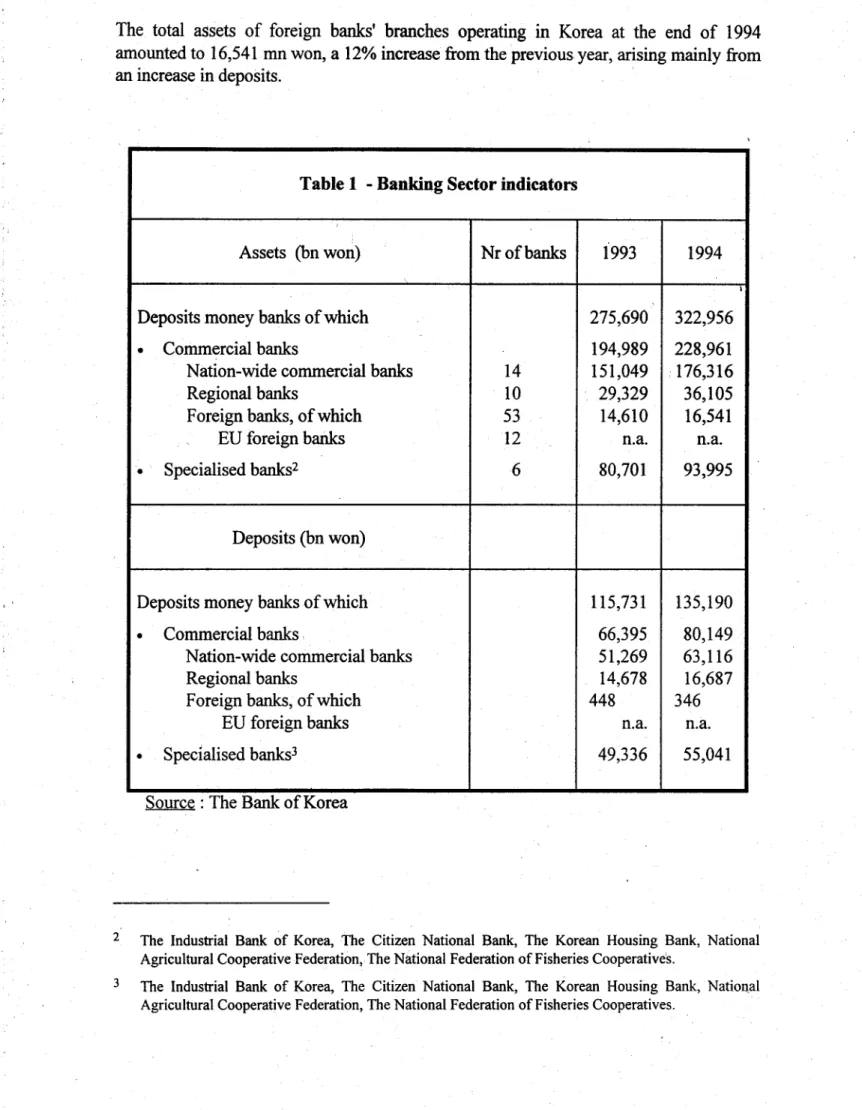
The Korean banking system is comprised of 14 nation-wide commercial banks, 10 regional commercial banks and 6 specialised banks established with government capital to provide financial support for particular sectors of the economy. The assets of the commercial banks (229 trn won in 1994) account for over two thirds of the total assets of Deposit Money Banks (323 trn won). Of the commercial banks the nation-wide banks play a dominant role accounting for 71 % of assets in 1994. The six specialised banks have recently expanded into commercial banking and now compete directly with the commercial banks for deposits. the regional banks represent I 1.2% of total assets in 1994.
Role of foreign banks
Foreign banks are allowed to establish branches provided they comply with the MoF criteria. In 1994 there were 53 foreign banks with branch operations and a further 23 with representative offices. Of the foreign banks, 21 originate in the European Community, 12 of which have branch operations and 9 with representative offices.
1 Exchange rates:
The total assets of foreign banks' branches operating in Korea at the end of 1994 amounted to 16,541 mn won, a 12% increase from the previous year, arising mainly from an increase in deposits.
2
3
Table 1 - Banking Sector indicators
Assets (bn won) Nrofbanks 1993 1994
I
Deposits money banks of which 275,690 322,956
•
Commercial banks 194,989 228,961Nation-wide commercial banks 14 151,049 176,316
Regional banks 10 29,329 36,105
Foreign banks, of which 53 14,610 16,541
EU foreign banks 12 n.a. n.a.
• Specialised banks2 6 80,701 93,995
Deposits (bn won)
Deposits money banks of which 115,731 135,190
• Commercial banks 66,395 80,149
Nation-wide commercial banks 51,269 63,116
Regional banks 14,678 16,687
Foreign banks, of which 448 346
EU foreign banks n.a. n.a.
• Specialised banks3 49,336 55,041
Source : The Bank of Korea
The Industrial Bank of Korea, The Citizen National Bank, The Korean Housing Bank, National Agricultural Cooperative Federation, The National Federation of Fisheries Cooperative's.
TREATMENT OF EC CREDIT INSTITUTIONS
Access by foreign banks to the Korean market continues to be subject to a number of restrictions, including market access problems as well as problems in their operations. Some of them are legal restrictions which may not cause important problems in the short term to EC banks operating or wishing to operate in Korea ; on other occasions, problems arise from the specific features of banking regulation in Korea and domestic banks. Korea is now more than halfway through its economic reform package in financial services. The benefits of their deregulatory measures have not yet produced significant market opening effects as the measures of greatest interest to foreign entities are scheduled for the last phase in the 1997-1998 time frame.
Establishment
Subsidiaries are not authorised. There is a 10% limit on foreign participation in existing commercial banks; foreign participation in domestic merchant banks is allowed.
ranches of foreign banks are required to capitalise each branch with three bn won which domestic banks are not required to do. This, in turn, affects the determination of funding and lending limits. Korea's unwillingness to consider the parent bank capitalisation reduces the branches lending limits.
Foreign banks wishing to establish branches must be among the top 500 in the world (measured by assets) and have been operating as a representative office for at least one year. The criteria on multiple branching has been relaxed and the Korean authorities maintain that the same criteria and procedures as apply to Korean banks now apply to foreign banks wishing to set up additional branches, thus effectively eliminating any restrictions on expanding operations.
Activity
Funding in local currency causes foreign banks difficulties. Access to government funds is limited to· domestic banks, ownership of real estate property is severely restricted and restrictions are placed on foreign banks handling certain types of mortgages. Foreign banks are not allowed to secure their loans with real estate, thus giving rise to practices where banks ask for compensating balances amounting to a certain percentage of all outstanding loans. Defaulting companies can, however, be required by a foreign bank to sell real estate, if necessary, if the company defaults on its loan.
Despite the integration of the local currency call market, foreign banks experienced difficulties in obtaining funds from domestic banks at competitive rates compared to domestic banks. The "blind brokerage system" was put into place to improve the operation of the call market. Access to reliable sources of local funding is a problem for foreign banks whenever the market becomes tight.
In July 1994, the allowable period for certificates of deposit was expanded to 60-270 days, from the previous 90-180 days. This does not, however, seem to respond to most foreign banks' preference for elimination of maturity and issuance limits. Although the foreign exchange business has expanded significantly in the last four years, the market share of foreign banks has decreased significantly.
\
Liquidity is controlled by the BOK via a system of rediscount rates, reserve-requirement ratios and monetary stabilisation bonds. Short term deposits, lending rates on policy loans are expected to be liberalised in the 1995-1996 time frame while other lending and deposit rates were liberalised in 1993. However, even though interest rates have been liberalised, commercial banks are confronted with MOFrules which set ceilings on bank loans to business. Rather than freeing more funds for industry and making Korean banks more competitive, the effect of liberalising interest rates has been a recourse by banks to the stock market as well as other more profitable investments.
The rules on access to the BOK rediscount window facility negatively affected foreign banks due to their difficulties in ensuring that 35% of their loans are provided to SMEs. For this reason, foreign banks frequently forego use of the rediscount window of the BOK. The MoF responded to these difficulties by amending the rules to allow banks to treat convertible bonds ·issued by SMEs and Industrial Bank of Korea bonds as satisfying the 35% requirement.
The limits on overbuying and overselling foreign exchange transactions continue to restrict the ability of foreign banks to compete, as one of the criteria for determination of the limits is based on the foreign bank's branch capital.
The introduction of new banking products and services is subject to prior approval. The Blueprint forese.es no changes in this regard. Also, deferred credit operations remain an area where foreign banks experience difficulties due to burdensome regulations, even though the repayment period has been extended to 150 days. Further improvement has been promised but not specific plan or timetable has been announced.
Foreign banks were initially excluded from accepting ratification's of planned investment. This rule was blatantly discriminatory to foreign banks. Beginning in January 1995, the government will allow branches of foreign banks to accept notifications of planned direct investment in Korea.
For foreign banks in Korea, problems persist. The lending limits to top five and 30 conglomerates are burdensome for foreign banks as is the requirement to lend to small and medium-sized companies. Foreign banks have no access to government funds. MOF regulations restrict foreign banks either from accepting or enforcing certain kinds of mortg~es. Foreign banks are restricted in their ability to own property. MOF rules regulating foreign exchange transactions impose a comparatively heavier burden on foreign banks. The. issuance of certificates of deposit and other banking businesses are tied to branch capital of foreign banks here. Each branch of a bank must be separately capitalised without consideration of the parent bank's capital assets.
INSURANCE
Overview
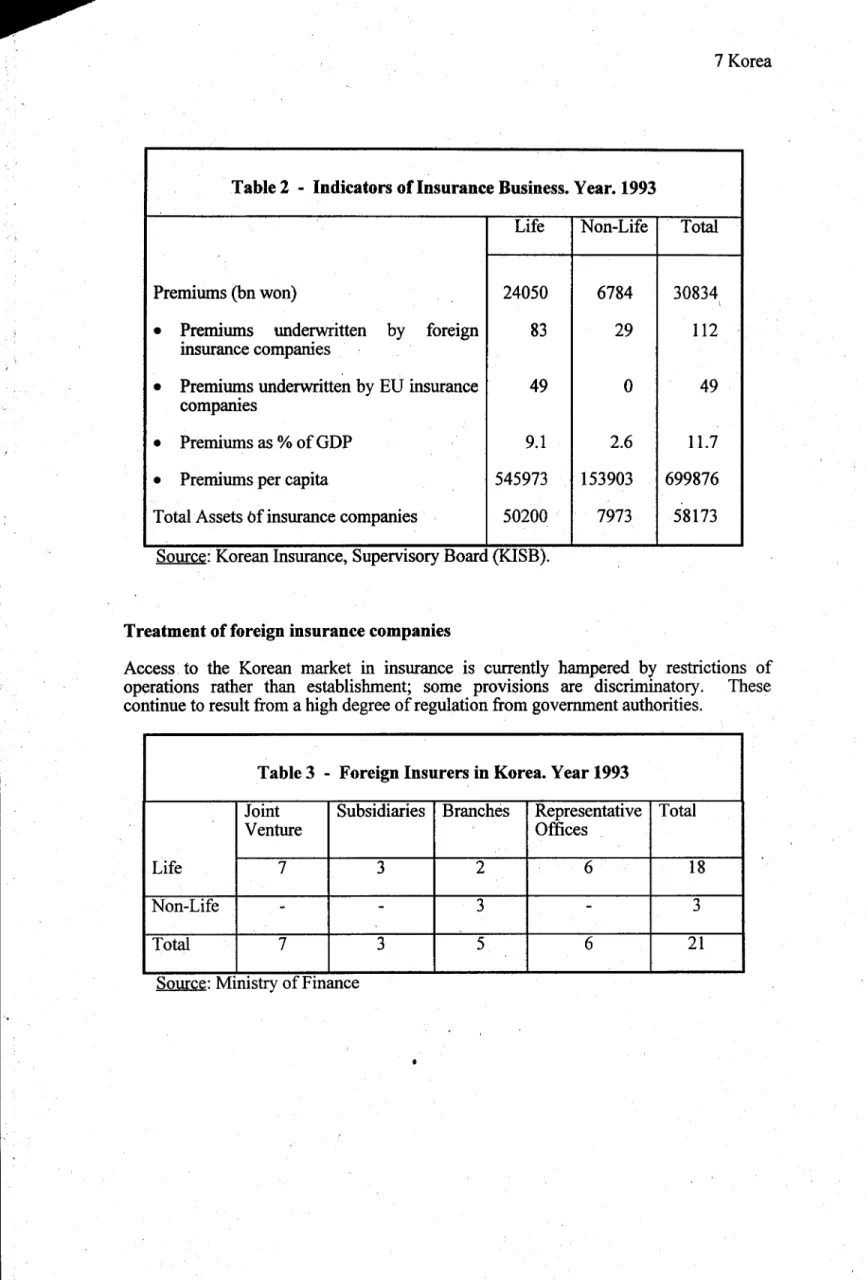
Insurance premium income in fiscal 1993 reached 30.8 tm won with life insurance premiums reaching 24.05 tm won or 78% of total premium.income. Non-life premiums attained 6. 78 tm won, 22% of total premiums.
Total assets 58.1 tm won at March 1994. Insurance sector has experienced rapid growth. Life and non-life separate businesses ; liberalisation of price and product has begun but some restrictions still in place; in July 1993 · system of authorisation changed to allow a system of declaration. April 1994 Korea introduced system of insurance agents in which two different companies' products could be offered by a single agent. A system of independent agents will be adopted in 1997. In April 1996, non-life insurance will be offered by independent agents.
Table 2 - Indicators of Insurance Business. Year. 1993
Life Non-Life Total
Premiums (bn won)
24050
6784
30834
\•
Premiums underwritten.
.
by foreign83
29
112msurance compames
•
Premi~s underwritten by EU insurance49
0
49
companies
•
Premiums as % of GDP9.1
2.6
11.7
•
Premiums per capita545973
153903
699876
Total Assets bf insurance companies
50200
7973
58173
Source: Korean Insurance, Supervisory Board (KISB).
Treatment of foreign insurance companies
Access. to the Korean market in insurance is currently hampered by restrictions of operations rather than establishment; some provisions are discriminatory. These continue to result from a high degree of regulation from government authorities.
Table 3 - Foreign Insurers in Korea. Year 1993
Joint Subsidiaries Branches Representative Total
Venture Offices
Life
7
3
26
18
Non-Life - -
3
-
3
Total
7
3
5 621
Establishment
Korea maintains an economic needs test to grant insurance licenses. Foreign insurers are allowed to set up in Korea under the corporate fol'Ill of their choice but certain criteria must be fulfilled. Foreign companies in Korea receive the same treatment as domestic with certain exceptions. Restrictions on the acquisition of real estate were Hfted in April 1994.
Non-life joint ventures and wholly owned subsidiaries are not permitted. Both, life and non-life insurers are allowed to set up subsidiaries, branches and representative offices. There are 17 foreign insurance companies in Korea (14 life, 3 non-life). Premiums for non-life and automobile insurance are currently still regulated with plans for deregulated rates in 1998 and for life insurance thereafter. Cross border provision of insurance services is not permitted.
Activity
The main problems faced by EC insurance companies in Korea stem more from the tight and exhaustive regulation of insurance business in Korea, which is not transperent. It is in most instances applicable in the same manner both to foreign as well as to domestic insurance companies; these regulations affect in particular the ability of foreign insurance companies to operate with full freedom in those areas where they are most competitive. Among these regulatory problems are the following :
a) regulation of insurance policies is very tight, extending to tariff controls for many insurance policies, commissions paid to agents, as well as to tp.e prior approval or systematic notification in many cases; although in 1988 a new system of notification (no approval, "use and file" and "file and use" systems) was introduced, leaving prior authorisation for new insurance products, it is reported that the "file and use" system is still burdensome; the limitation of tariff controls only to statutory insurance and possibly also to motor insurance would facilitate the ability of foreign insurance companies to compete; also related to the introduction of new products, pension funds do not exist and cannot be introduced
in Korea;
-b) there is no system of insurance brokerage in Korea, and agents are tied to a single company; the formation of an agent network for foreign companies is difficult for foreign firms; however, foreign brokerage firms were allowed in '1988 to enter the , domestic niarket as "exclusive agents" acting on behalf of one company only ;
c) any company - foreign or domestic - wishing to offer motor insurance needs to have a nation-wide network of agencies for claims services, which is difficult for newly established companies;
e) the purchase of real estate by foreign insurers is subject to restrictions, although the use of real estate is categorised as one of the forms of asset management
authorised by the domestic insurance acts ; ·
f) foreign insurance companies' branches in Korea shall have their licenses renewed every two years; although licenses are normally renewed automatically unless there are solvency problems, this requirement does not favour confidence among foreign insurance companies.
SECURITIES
Overview
Korea is now the third· largest securities market in Asia. Following the limited relaxation, in 1992, on foreign ownership of Korean stocks, the stock market has experienced considerable growth. Trading volume and shares prices have both increased since 1992. The membership fee for the Korea Stock Exchange remains prohibitive, such that no foreign securities firm has yet obtained a seat on the KSE.
Foreign access to Korean stocks is currently limited to 12 % with a proposed maximum of 15%. The rules adopted in July 1994 raised the limits on the maximum value of foreign securities that Korean companies are allowed to acquire.
Korea's market opening plan has been pursued somewhat cautiously. Limited genuine liberalisation has taken place since 1992 although Korea's stock market has largely recovered from the downturn in share prices in the early 90's. Foreign investment in Korean companies continues to be limited, often distorting the prices of the shares themselves and causing fluctuations in the overall index due to skewed trading practices.
Table 4 - Foreign Securities Firms in Korea (for 1 April- 3 March 1993).
Stock trading Domestic firms Foreign Firms
Total (bn won) 169,640 278
% of total market 150% n.s.
% of trading 99;84% 0.16
Source: Securities Supervisory Board.
·,
I
I
Foreign Participation
In 1994, there were 32 domestic securities firms. There were 11 branches of foreign securities companies operating in Korea of which 6 were EU firms, 26 foreign representative offices of which 6 were EU and four joint ventures. ·
Foreign participation in stock exchange activity, measured by the proportion of shares held by foreigners remains low. Foreign brokerage houses in Korea hold approximately 28% of the market in foreign investors' stock trading (2.48 trillion won).
TREATMENT OF EU INSTITUTIONS
Considerable restrictions result from the rules applicable to the investment trust and investment consulting business in Korea. Representative offices and equity participation were allowed to foreign investment trust . companies and investment advisors as from January 1993. With the limit on foreign ownership of Korean shares in a single company at present fixed at 12% and set to rise only to 15% at the culmination of liberalisation, the ability of foreign firms to engage in the investment trust and advisory businesses is severely restricted. The Korean government has indicated that it will reconsider the limit on foreign equity participation in the investment consulting and investment trust sectors.
Under the new rules relaxing purchase limits on foreign securities for companies and individuals, foreign securities firms are not allowed to accept orders from Korean clients as they are not authorised to engage in this sector of the busines~.
Establishment
Korean law allows establishment of branch offices of a foreign firm subject to MoF approval. Permission remains dependent on the discretionary criteria decided upon by the MOF, including an economic needs test which has not been applied in practice. There are indications that the authorities are still operating an approach based on quantitative limits on the number of market participants. Subsidiaries of foreign firms are not allowed. Representative offices are not allowed to conduct any direct securities related business and must function as a liasion office to the parent company. Their role is primarily market research and identification of potential clients for the parent company.
Activity
The operating conditions for foreign firms are generally the same as for domestic firms. The important exception is the foreign owned equity limits on domestic shares. The rules on foreign ownership of domestic bonds have been relaxed. The continued application of the deposit requirement ratio for stock acquisition, first introduced in January 1994 and subsequently reduced from 40 per cent to 20 per cent of the stock value, is particularly burdensome for foreign institutional investors.
The MoF has allowed merchant banks and short-term finance companies to take up certain underwriting activities, in government and public sector bonds primarily. As from July 1994, the MoF authorised foreign investors to purchase non-guaranteed convertible bonds issued by listed SMEs as well as certain state and public sector
bonds.. ,
Foreign ownership of an investment trust business is limited to 10 percent with a 5 percent limit for individual firms. Under Korean law, only investment trusts and merchant banks are authorised to manage most mutual funds. This arrangement severely curtails the ability of foreign financial institutions to engage in mutual fund management. Merchant banks, for which there are no limitations on foreign participation, are authorised to· manage funds composed solely of bond instruments. Foreign. investment management companies and foreign investment advisor.s are authorised to conduct only limited operations.
Although the MoF removed the limits on offshore acquisition of foreign securities in 1944, only Korean firms are authorised to broker the tranactions involving acquisition of foreign securities by Koreans. A total of 24 domestic firms have received licenses to act on behalf of Korean residents in the acquisition of foreign securities. To date, the MoF · has refused to issue licenses to foreign securities firms.
able 5 - Securities Market Indicators
1992 1993
Turnover in equity shares (tm won) 90.7 169.9
Turnover as % of GDP 34.2 64.0
<;::apitalisation equity shares (bn won) 84.7 112.6
No of companies listed 688 693
PROSPECTS FOR IMPROVEMENT OF FOREIGN MARKET ACCESS