Abstract: Recent advancement in biometric system prefer multimodal biometric system instead of single biometric system to overcome challenges faced by unimodal biometric system such as intra class variation, noise sensitivity, non universality, spoofing attack, etc. Most of the existing iris biometric systems are dependent on ideal condition which needs user cooperation during image acquisition with help of NIR camera to avoid noise. Such system performance significantly degrades when images are taken under visible light without user cooperation called unconstrained environment. Proposed multi modal eye biometric system provides improvement in segmentation accuracy using entropy based convolution neural network (E-CNN) based on contour feature. It also reduces the time required for segmentation up to 0.9second. Multi algorithmic feature extraction for color, texture features of iris and pupil and Y-shaped features of sclera exploit the improvement in feature extraction performance. Proposed feature level support value based fusion (SVBF)approach provide better performance of multimodal eye biometric system and achieves good improvement in recognition accuracy 93.33% and 97% when framework is tested for the images taken from the MMU and UBIRIS.v2 unconstrained eye image database respectively as compared to the related competing approaches.
Index Terms: multimodal, entropy based CNN, contour features, support value based fusion.
I. INTRODUCTION
Biometric systems are commonly used in commercial and non commercial application and electronic gazette to authenticate person identity depending on its behavioral and physical characteristics which can not be stolen and forgotten like traditional identity proof such as password, cards etc.[1]-[3]. Iris recognition is more popular biometric trait due to its uniqueness and stability over period of time. Iris provide higher authentication rate among all biometric traits such as face, fingerprint, retina, voice, etc.[2]. Unfortunately performance of iris recognition system degrades when images are acquired in visible spectrum under unconstrained environment without user cooperation. Challenges faced by iris recognition systems for noisy colored eye images are dark iris images, reflection, occlusion effect, eyelid and eyelash occurrence, off angle and at-a-distance images[5],[6]. These challenges can be overcome by multimodal eye biometric system by combining features of iris features with other ocular
Revised Manuscript Received on July 05, 2019
Mrunal Pathak, Department of Computer Science and Engineering, K.L. University, Guntur, India.
Dr. Vinayak Bairagi, Department of Electronics and
Telecommunication, AISSM’s Institute of Information Tech., Pune, India.
Dr. N. Srinivasu, Department of Computer Science and Engineering , K.L. University, Guntur, India..
or periocular biometric features like sclera, retina, pupil and face region around eye to improve the performance of biometric recognition system for noisy eye images[7]. In this research paper, multimodal eye biometric system for unconstrained colored eye images is proposed by combining features of iris, sclera and pupil to develop efficient and more accurate biometric system for person identification. We proposed the deep learning based segmentation approach by using convolution neural network based on entropy values calculated from contour texture, color and brightness features extracted from eye image. Proposed segmentation algorithm improves the accuracy up to 97.15% by reducing time required for segmentation. Color, texture and shape based features are prominent for iris, pupil and sclera. Therefore we proposed multi algorithmic feature extraction to extract these feature using combination of color histogram with log Gabor filter and Y-shaped sclera features. Feature level fusion of these features based on SVBF matching improved performance of recognition to achieve accuracy up to 93.33% and 97% for unconstrained images taken from database MMU and UBIRIS.v2 respectively.
II. LITERATURE SURVEY A. Motivation
This section discuss about the various multibiometric systems from literature where iris features are combined with other biometric features to improve the performance of biometric recognition system for person authentication.
In paper [8] Zhu et.al. proposed multimodal eye biometric system using kernel based fusion of iris and sclera features extracted using 1-D log Gabor filter to improve performance of eye biometric system .In 2012 they proposed quality score based match score level fusion [9] where quality score of whole image, eye area and sclera area was measured after feature extraction and quality score fusion was performed to improve performance of authentication. In paper [10], Vikas Gottemukkaka et. al described about ocular biometric system by combining iris and conjunctival vasculature feature. They proposed weighted fusion using sum rule. Performance of this ocular biometric system depends on the size of tile. Jibu Varghese et. al. were developed a dual authentication system using iris and sclera features in which iris and sclera template
matching was perform
separately to build efficient biometric system [11].
Multimodal Eye Biometric System Based on
Contour Based E-CNN and Multi Algorithmic
Feature Extraction Using SVBF Matching
Feature Extraction E-CNN Based Segmentation C. Immaalate Mary was proposed multimodal eye
biometric system based on inter fusion of iris and sclera surface using Laplace transform [IISLT].He assured stability by the use of least mean squared method for iris and sclera surface pattern matching [12].Nassima Kihal et.al.[13] implemented eye biometric system by combining iris and corneal features to identify person. They was used Zernike polynomial expansion to extract features using LDA and Gabor filter and then intra ocular fusion was performed using weighted sum, min and max rule to improve recognition performance. Mrunal Pathak et al[14] was proposed multibiometric eye recognition system based on multi algorithmic feature extraction where feature of iris and sclera extracted using grey level cooccurrence matrix (GLCM) and wavelet transform. These extracted features were combined using match score level fusion to improve performance of recognition. Zi Wang et. al.[15] proposed eye recognition system based on deep learning method by eliminating traditional preprocessing and feature extraction step. They described fast learning architecture by defining Max convolution and residual network (MiCoReNet) which increases recognition accuracy.
B. Objective
Objective of this research paper is to describe the multimodal eye biometric system by combining iris, sclera and pupil features to improve the accuracy of iris recognition for noisy eye images acquired in visible spectrum under unconstrained environment.
[image:2.595.338.543.180.668.2]ig .1.
Fig. 1. Sample Noisy Eye Images In Visible Spectrum
C. Contribution
1.Introduces Entropy based convolution neural network (E-CNN) for segmentation of noisy eye images using contour values of extracted color, texture and brightness features.
2.Proposed multi algorithmic feature extraction method by combining texture, color features of iris and pupil, also Y-shaped sclera features to increase accuracy of recognition.
3.Contribute support value based feature level fusion for iris, sclera and pupil features to reduce computational complexity.
III. PROPOSED MULTIMODAL EYE BIOMETRIC SYSTEM
Performance of iris and sclera recognition system strongly dependent on accuracy of segmentation of eye images acquired in non ideal condition without user cooperation. To overcome this challenge, the proposed segmentation algorithm used the deep learning technique using convolutional neural network (CNN) to classify iris, sclera
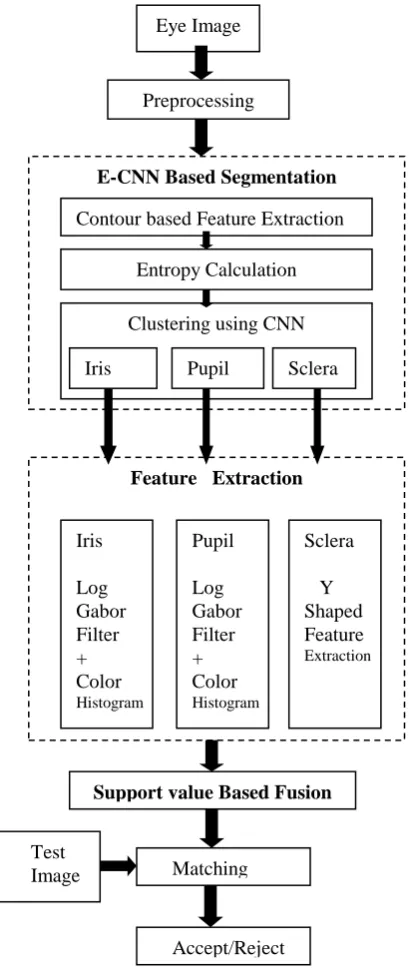
[image:2.595.55.287.415.488.2]and pupil region accurately. Computational complexity of proposed algorithm is reduced by designing CNN based on entropy values which also reduces time required for segmentation [16]. For feature extraction, multi algorithmic approach is used to extract dominant color plus texture features of iris and pupil in addition to Y-shaped sclera features from segmented eye images. The proposed support value based feature level fusion is used to reduce computational complexity.
Fig.2. Proposed multimodal eye biometric system framework
In preprocessing step, input image was taken from eye image database. The Min-Max normalization technique was used to fit the image into a fixed specific dimension. After normalization bilateral filter
was used to pursue the edges for smoothing the image and
Eye Image
Preprocessing
Contour based Feature Extraction
Entropy Calculation
Clustering using CNN
Iris Pupil Sclera
Iris
Log Gabor Filter + Color
Histogram
Pupil
Log Gabor Filter + Color
Histogram
Sclera
Y Shaped Feature
Extraction
Support value Based Fusion
Test
Image Matching
reduced noise in area of low color distortion.
A. Segmentation of Iris, Sclera and Pupil for noisy eye images
[image:3.595.51.288.182.336.2]In proposed segmentation algorithm entropy is measured based on extracted color, texture and brightness features of images which was used as input to convolution neural network (CNN) for clustering eye image into iris, sclera and pupil region. Framework for E-CNN based segmentation is shown in figure[16].
Fig.3. Segmentation of iris, sclera and pupil using E-CNN Contour Feature Extraction
In computer vision, image segmentation is performed using region or contour based approach where contour used to define boundaries of region [17]. At the beginning stage of contour detection, we consider the function that predicts the posterior probability of a boundary with point of reference pat each image pixel (x, y) by estimating the distinction in
[image:3.595.81.259.500.629.2]local image brightness, color, and texture channels. This section depicts the brightness, color, and texture feature and how it is computed efficiently.
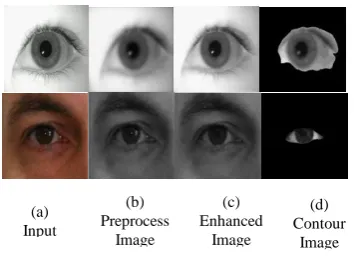
Fig. 4. Processing the input image to get the contour image based on color, texture and brightness feature for MMU and UBIRIS V2 database
Texture Feature Extraction
Texture characteristics of local image are represented by bank of filter output which is known as texon which is mapped with each individual pixel[17,19]. Pixel’s surrounding information is necessary to check the probability of pixel weather it lies on boundary or not. True value of this probability given by equation ( 1) provide correct segmentation .
]
)
(
exp[
1
1
1
~
2
LR texture
X
P
(1)The value of
P
~
texture lies between 0 and 1. It is large ifdistribution of both sides is same, else small where XLR is maximum likelihood esteem.
Color Feature Extraction
Color is prominent visual attribute of an object which is easily recognized by human eye. 3D color spaces such as RGB, HSV are used to represent each pixel. These features describe the rate of occurrence of each color indexes in an image with dissimilar densities [20]. Color feature vector for a given image is computed using following equation.
Mj i
z
M
z
1
1
ˆ
(2)
Where Zi is pixel intensity and M defines quantity of pixels.
Brightness Feature Extraction
In situation where color in image is silent and object categories as black and white, brightness is distinguish feature. Brightness was measured by converting color image into gray scale with the help of following equation by comparing pixel intensities with neighboring pixel.
b a
b
a
P
b
a
B
,
2
)
,
(
ˆ
(3)
Where
B
ˆ
defines brightness and at location(
a
,
b
)
the pixel represented byP
(
a
,
b
)
.
Entropy Calculation
Entropy (En) is measure of haphazardness that is utilized to describe the texture of input image. Texture features of iris, sclera and pupil was differentiated with the help of entropy estimated based on contour features. Entropy (E’y) of i
th super pixel was measured as follows.
10 1
0
2
(
(
,
)))
log
)(
,
(
mi m
j i
y
P
i
j
P
i
j
E
(4)
Where, i and j are the coefficients of co-occurrence matrix, P(i,j )is the component in the co-occurrence matrix at the coordinates i and j and N is the dimension of the co-occurrence matrix. This calculated entropy feature set
i
y y y y i
y
E
E
E
E
E
f
(
)
1,
2,
3,...
was given as input to CNN to cluster iris, sclera and pupil region.Proposed Entropy based Convolution Neural Network (E-CNN) for Segmentation
Images are high dimensional vectors with large number of parameters used to portray the system .To address this issue, E-CNN was proposed to decrease the quantity of parameters and address network architecture particularly for vision task. CNN is multilayered architecture used to recognize visual pattern from input pixel image. In proposed system, set of entropy (E’y) values evaluated based on contour features was input for CNN. Based on this
input entropy values, CNN segmented iris, sclera and pupil region into different
(a) Input Image
(b) Preprocess
Image
(c) Enhanced
Image
(d) Contour
clusters.CNN classifier comprises of three layers such as convolution layer, pooling layer and fully connected layer [17]. The weights ascertained utilizing the condition (5) is given as the input to modified cuckoo search algorithm and results the optimal outputs and the deep CNN classifier utilizing the optimal weights for additional processing. This optimization procedure is continual in each layer of the CNN and results the efficient classification. Output of CNN classifier was based on weight and biases which was updated using equation (5) and (6) respectively.
)
(
t
W
m
W
C
n
x
W
r
x
W
l l ll
(5))
(
t
B
m
B
C
n
x
B
l ll
(6) [image:4.595.316.529.225.381.2]In above equation weight is defined by W, Bias by
B
,no of layers by n, regularization parameter by
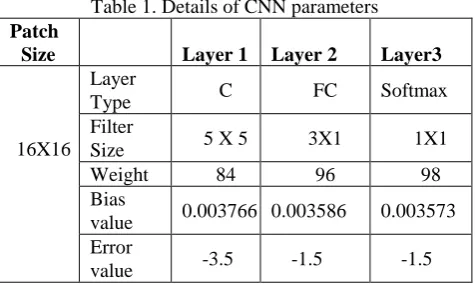
, learning rate is x, total number of samples defined by n, momentum defined by m, updating step given by t and cost function was defined by e. Details about the each CNN parameter for three layer was mentioned in Table 1 for 16 X 16 for input patch size as follows.Table 1. Details of CNN parameters Patch
Size Layer 1 Layer 2 Layer3
16X16 Layer
Type C FC Softmax
Filter
Size 5 X 5 3X1 1X1
Weight 84 96 98
Bias
value 0.003766 0.003586 0.003573
Error
value -3.5 -1.5 -1.5
B. Proposed Multi Algorithmic Feature Extraction for Iris, Sclera and Pupil
In this paper, we proposed effective multi algorithmic feature extraction approach by combining color, texture and y- shaped feature to identify person in unconstrained environment. Color features do not contain spatial information where as it represented by texture features. Therefore, proposed method performed multi future fusion of features extracted by uncorrelated method such as color histogram was used to extract color features, log Gabor wavelet was used to extract texture features of iris and sclera. Also Y-shaped features were used to extract sclera features. Feature Extraction of Iris and Pupil
Color Histogram
Color feature are semantic features which are reliable and easily integrated into mathematical information to produce strong preceptor of human eye. Number of pixels at certain intensity represents the distribution of colors from images in different color spaces. Color histogram is used to extract RGB features from segmented iris and pupil region separately which was described by using color histogram as below [21];
N K N i K i K QCH
I
H
i
H
i
D
(
)
1 1~
[
]
~
[
]
2(7)
Where
H
~
QKH
~
iK are color histograms for K region fromcolor block
H
~
QK[
i
]
and[
]
~
i
H
iK among N blocks.Log Gabor wavelet
Log Gabor filter was used to extract the discriminating texture features of different densities from image which was represented in frequency domain by using large number of filter banks [22]. It provides local and global information of image. Frequency response of log Gabor filter was given by following function.
2 2log
2
log
exp
)
(
~
c cf
f
f
f
G
(8)Where, filter bandwidth is
σ
and center frequency isfc.
Fig. 5. Segmentation of iris, pupil and sclera regions for images of MMU and UBIRIS database based on E--CNN. Feature Extraction of Sclera using Y-shaped Method Along with color and texture features, shape based features are also important queues for object recognition which represents geometrical forms an object with interior content. Sclera has unique blood vessel patters unaffected by aging used to identify human. Features of these blood vein pattern easily extracted using Y-shape descriptor to describe Y shape branches which are identified by searching nearest line segment and angle between them at regular distance [23]. Searching of Y shape of vein pattern was performed with the help of following equations.
2 2 2 2 1 1 2 0
0
)
(
)
(
)
(
)
,
(
Y
TiY
Tj i j i j i jd
(9)2 2
)
(
)
(
)
,
(
Y
TiY
Tjx
ix
jy
iy
jy
x
d
(10) Sclera test template (Ttest) and target template (T target) ,
Y
Ti,and
Y
Tj was the Y shape descriptors values respectively.
d
was the Euclidian distance of angle element of descriptors vector given by equation (9).d
x
y
was the Euclidian distance of two descriptor centers defined as (10). [image:4.595.51.289.323.465.2]
det(
)
(
)
2
B
kT
B
R
r
(11) Where Tr is matrix trace, k is constant and B is imagestructure matrix based on image derivatives
Fig. 6. Sclera feature extraction using Y-shape method
IV. SUPPORT VALUE BASED FUSION AND MATCHING
Fusion of extracted features was performed at feature level using proposed support value based fusion. Support values for extracted feature set is calculated by using equation (12)
)
(
)
(
))
(
)
(
(
~
I
D
R
f
G
I
D
R
f
G
S
LCH LCH
value
(12)
min max
~
W
W
S
S
value
(13)
Where, Support value based score is generated using equation (13)
where Wmax and Wmin as maximum and minimum value from all estimated score values. After that match score is generated between training and testing score by using Euclidean distance (14) which was compared with threshold value. If match score value was less than threshold person was recognized otherwise authentication result fails.
Nj
testing training
D
S
j
S
j
E
1
2
)
(
)
(
~
(14)
V. EXPERIMENATION AND RESULTS In this section, detail explanatory work is described with all outcomes for segmentation, feature extraction and matching results. The proposed multimodal eye biometric system framework is implemented using MATLAB platform and tests are conducted on following two databases MMU and UBIRIS V2 database which are publically available to check the performance of proposed system.
A. Databases
Proposed multimodal eye biometric system was tested on following two MMU and UBIRIS.V2 dataset based on 80:20 proportion of training and testing images from respective databases.
MMU dataset
Semi automated camera was used to take the iris images at 47-53 cm range far from user. MMU dataset consist of 995 iris images with 320X240 resolutions in bitmap format acquired from 100 volunteers [24].
UBIRIS V2 database
This database contains the images acquired in unconstrained environment without user cooperation under visible spectrum. These are sRGB images taken from 4 to 8 meters away from acquisition system. UBIRIS V2 database contains 11,102 images of 400X300 pixels from 171 classes [25].
B. Experimentation
Results for image preprocessing and segmentation based on entropy values using convolutional neural network (E-CNN) are shown in figure 3 and figure 4 for MMU and UBIRIS V2 database respectively.
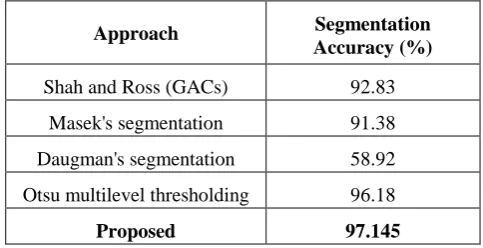
The performance of proposed E-CNN based segmentation accuracy for input eye image into iris, sclera and pupil region is compared with existing segmentation algorithm as shown in table 2. The result shows that the proposed E-CNN outperform as compared to existing methods. Computational complexity is a drawback of convolution neural network which was overcome by proposed Entropy based convolutional neural network and also reduce time required for segmentation as shown in table 3.
Table 2: Performance Comparison of E-CNN based segmentation with existing methods.
Approach Segmentation
Accuracy (%)
Shah and Ross (GACs) 92.83
Masek's segmentation 91.38
Daugman's segmentation 58.92
Otsu multilevel thresholding 96.18
[image:5.595.56.278.105.155.2]Proposed 97.145
Table 3: Comparison of average segmentation time required for proposed method with existing method.
Approach Computation Time
(Seconds)
Fast iris segmentation method 1.09
Geodesic active contours 6.2
Balloon active contour 2.2
Hough transform and active contour
5.8
Proposed 0.9
[image:5.595.305.547.266.390.2] [image:5.595.312.548.446.566.2](a)
(b)
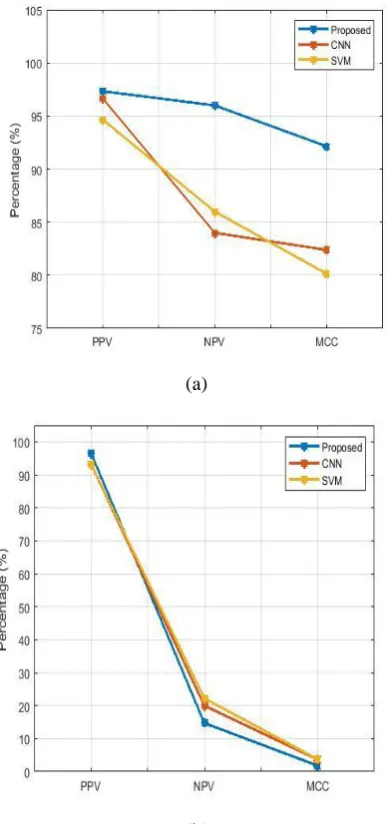
Fig.7. performance analysis of proposed method with CNN and SVM for (a) UBIRIS.v2 and (b) MMU
database
The performance measures such as accuracy, false acceptance ratio, false rejection ratio and genuine acceptance ratio is shown in table 4 and table 5 for MMU and UBIRIS V2 databases respectively which are compared with traditional Convolutional neural network and support value based biometric recognition. Improvement shows in accuracy up to 3% to 5% for both databases. False acceptance ratio degrades for MMU database but it is improved by 3% to 8% for noisy unconstrained eye images from UBIRIS V2 database.
Table 4: Performance analysis of proposed eye biometric system with existing CNN and SVM method for MMU
database
Methods Accuracy(%) FAR(%) FRR(%) GAR(%) Proposed
E-CNN 93.33 85.8 98.2 94.8
CNN 90 78.9 96.3 92.1
[image:6.595.70.264.60.473.2]SVM 88.88 76.9 96.2 91.2
Table 5: Performance analysis of proposed eye biometric system with existing CNN and SVM method for UBIRIS V2
database
Methods Accuracy(%) FAR(%) FRR(%) GAR(%) Proposed
E-CNN 97 7.69 1.35 98.64
CNN 93.5 10.63 5.22 94.77
[image:6.595.304.548.90.388.2]SVM 92.5 15.68 4.69 95.30
Fig.8 ROC curves obtained for the proposed method with existing CNN-SVM and CNN- PAIRWISE Performance of proposed eye biometric system with respect to ROC curves generated for UBIRIS V2 noisy images is shown in figure 8. Proposed system provide better improvement in recognition rate as compared to existing CNN-SVM and CNN-pair wise based system [27] from obtained ROC curves.
VI. CONCLUSION
REFERENCES
1. Proença, Hugo, and João C. Neves A Reminiscence of Mastermind: Iris/Periocular Biometrics by In
2. Wang, Zi, Chengcheng Li, Huiru Shao, and Jiande Sun. Eye Recognition with Mixed Convolutional and Residual Network (MiCoRe
3. Hugo Proenc et.al.,” The UBIRIS.v2: A Database of Visible Wavelength Iris Images Captured On-the-Move and At -a- Distance”, IEEE Transactions on Pattern Analysis and Machine Intelligence, Vol. 32, No. 8, August 2010,Pp. 1529-1535.
4. Multimedia University. MMU iris image database, 2004. http://pesona.mmu. edu.my/centre
5. C. Hema and T. Viveka,” Human identification based on vein structure in Sclera”, Journal of Network Communications and Emerging Technologies (JNCET) , May (2015),Volume 1( 3).
6. P. Pradeep Kumar, I. Krishna Rao, Log Gabor Filter Based Feature Detection in Image Verification Application, International Journal of Science and Research (IJSR), Volume 3 Issue 12, December 2014,pp.703-707
7. S. Narote, L. M. Waghmare, “Performance Evaluation of Different Color ModelsUsed in Color Iris Authentication”, Intl. Conference on Advances in Computing, Communications and Informatics (ICACCI), Sept. 2016, Jaipur, India,pp.2736-2739
8. Umarani Jayaraman, Surya Prakash, Phalguni Gupta,” An efficient color and texture based iris image retrieval technique” Expert Systems with Applications, 39 (2012) ,4915–4926
9. Ryszard S. Choras, “Image Feature Extraction Techniques and Their Applications for CBIR and Biometrics Systems”, International Journal Of Biology And Biomedical Engineering, (2007), Vol. 1(1),pp. 6-16. 10. Jitendra Malik et.al.,” Contour and Texture Analysis for Image
Segmentation”, International Journal of Computer Vision 43(1), 7–27, (200)1,pp.07-27
11. Alaa S. Al-Waisy et.al.,”A multi-biometric iris recognition system based on a deep learning approach”, Pattern Anal Applic (2018) 21:7pp.83–802
12. Mrunal Pathak, N. Srinivasu, and Yinayak .Bairagi,”Effective
segmentation of sclera, iris and pupil in noisy eye images, TELKOMNIKA journal,(2019), Vol.17 (5) (Accepted).
13. Zi Wang, et.al., "Eye Recognition with Mixed Convolutional and Residual Network (MiCoRe-Net)." IEEE Access 6 (2018): 17905-17912.
14. Mrunal Pathak et. al.,” Match score level fusion of iris and sclera descriptor for iris recognition, International Conference on Soft Computing and its Engineering Applications (icSoftComp), ,(2017),ISBN: 978-1-5386-2053-3
15. Nassima Kihal et.al., ”Efficient multimodal ocular biometric systemfor person authentication based on iris texture and corneal shape”, IET Biometrics, 2017, Vol. 6 Iss. 6, pp. 379-386
16. Immaculate Mary, “Inter-Fusion of Iris and Sclera Surface Patterns: Biometric Recognition Using the Laplace Transform”, International Journal of Advanced Research in Computer Science and Software Engineering, Volume 4, Issue 11, November 2014 ,pp.195-204 17. Jibu Varghese K,et.al, “Development Of A Dual Authentication
System Using Iris And Sclera Features”, International Journal of Industrial Electronics and Electrical Engineering, ISSN: 2347-6982 Volume-2, Issue-11, Nov.-2014,pp26-31
18. ] Vikas Gottemukkula, et.al,“Fusing Iris and Conjunctival Vasculature: Ocular Biometrics in the Visible Spectrum, Proc. of IEEE International Conference on Technologies for Homeland Security, November 2012,pp.150-155.
19. Sriram Pavan Tankasala et.al.,” Biometric Recognition of Conjunctival Vasculature using GLCM Features, International Conference on Image Information Processing (ICIIP 2011)
20. Zhi Zhou et al.,”Quality Fusion Based Multimodal Eye Recognition, IEEE International Conference on Systems, Man, and Cybernetics October 14-17, 2012, COEX, Seoul, Korea
21. Z. Zhou et al.“Multimodal eye recognition,” Proceedings of International Society for Optical Engineering, vol.7708, 2010, pp. 770806.
22. Z. Zhou, Y. Du and C. Belcher, “Transforming Traditional Iris Recognition Systems to Work in Non ideal Situations,” Industrial Electronics, IEEE Transactions on,vol. 56, no. 8, 2009, pp. 3203-3213; DOI10.1109/tie.2009.2024653.
23. E. Sung, X. Chen, and J. Yang. Towards non-cooperative iris recognition systems. In Proceedings of the Seventh International Conference on Control, Automation, Robotics and Vision (ICARV’02), pages 990–995, Singapore, December 2002
24. J. Daugman, “New Methods in Iris Recognition, “Systems, Man, and Cybernetics, Part B, IEEE Transactions on, vol. 37, no. 5, 2007, pp. 1167-1175
A. K. Jain, A. Ross, and S. Prabhakar, “An introduction to biometric recognition,” IEEE Transactions on Circuits and Systems for Video Technology, vol. 14, no. 1, pp. 4–20, 2004
25. J. Daugman, “How iris recognition works,” IEEE Transactions on Circuits and Systems for Video Technology, vol. 14, no. 1, pp. 21–30,2004
26. K. Bowyer, K. Hollingsworth, and P. Flynn, “Image understanding for iris biometrics: A survey,” Computer Vision and Image Understanding, vol. 110, no. 2, pp. 281–307, 2008.
AUTHORS PROFILE
Mrs Mrunal Pathak has completed her
BE(Computer) and ME(Computer Science and Engineering) from Savitribai Phule Pune University. She is research scholar from K.L. University , Guntur,India. She has teaching experience as Assistant professor more than 12 years. Her research interests include pattern recognition, Image Processing,Machine Learining, Digital Signal processing and Soft computing. She had more than 17 publication in various International, National journals and Conferences..
Dr. Vinayak Bairagi has completed M.E. (Electronic) from Sinhgad COE, Pune in. University of Pune has awarded him a PhD degree in Engineering. He has teaching experience of 12 years and research experience of 8 years. He has filed 9 patents and 5 copyrights in technical field. He has published more than 58 papers, of which 26 papers are in International journals of which 12 papers in SCI Indexed journals, Springer journal, The_IET journal publication. He is a reviewer for nine scientific journals including IEEE Transactions, The-IET Journal, and Springer Journals. He is the member of INENG (UK), IETE (India), ISTE (India) & BMS (India). He had worked on Image compression at College of Engineering, Pune, under Pune University. Currently he is associated with AISSMS Institute of Information Technology (Affiliated college to S P Pune University), Pune as Professor in Electronics and Telecommunication Engineering