i
UNIVERSITI TEKNIKAL MALAYSIA MELAKA
REAL - TIME FACE RECOGNITION SYSTEM FOR AUTOMATIC DOOR ACCESS CONTROL
MOHAMAD NASRIQ BIN KAMARUDDIN
This Report Is Submitted in Partial Fulfillment Of The Requirements For The Bachelor Degree of Electronic Engineering (Industrial Electronic) With Honours
Faculty of Electronic and Computer Engineering University Teknikal Malaysia Melaka (UTeM)
UNIVERSTI TEKNIKAL MALAYSIA MELAKA
FAKULTI KEJURUTERAAN ELEKTRONIK DAN KEJURUTERAAN KOMPUTER
BORANG PENGESAHAN STATUS LAPORAN
PROJEK SARJANA MUDA II
Tajuk Projek: Real Time Face Recognition system for Automatic Door Access
Sesi Pengajian: 1 6 / 1 7
Saya MOHAMAD NASRIQ BIN KAMARUDDIN mengaku membenarkan Laporan Projek Sarjana Muda ini disimpan di Perpustakaan dengan syarat-syarat kegunaan seperti berikut:
1. Laporan adalah hakmilik Universiti Teknikal Malaysia Melaka.
2. Perpustakaan dibenarkan membuat salinan untuk tujuan pengajian sahaja.
3. Perpustakaan dibenarkan membuat salinan laporan ini sebagai bahan pertukaran antara institusi pengajian tinggi.
4. Sila tandakan ( √ ) :
SULIT* *(Mengandungi maklumat yang berdarjah keselamatan atau
kepentingan Malaysia seperti yang termaktub di dalam
AKTA RAHSIA RASMI 1972)
TERHAD** **(Mengandungi maklumat terhad yang telah ditentukan oleh
organisasi/badan di mana penyelidikan dijalankan)
TIDAK TERHAD
√
Disahkan oleh:(TANDATANGAN PENULIS) (COP DAN TANDATANGAN PENYELIA)
iii
“Saya akui laporan ini adalah hasil kerja saya sendiri kecuali ringkasan dan petikan yang tiap-tiap satunya telah saya jelaskan sumbernya.”
Signature: ………. Author: Mohamad Nasriq Bin Kamaruddin
“Saya akui bahawa saya telah membaca karya ini pada pandangan saya/kami karya ini adalah memadai dari skop dan kualiti untuk tujuan penganugerahan Ijazah Sarjana Muda
Kejuruteraan Elektronik (Elektronik Industri).” Signature: ……… Supervisor’s Name: Dr. Syafeeza Binti Ahmad Radzi
v
ACKNOWLEDGMENT
Bismillahirarrahmanirrahim,
Its grateful to Allah S.W.T because with His blessing, I am able to solve my problems and get the opportunity to complete this Projek Sarjana Muda 2 (PSM 2) report which entitled Real Time Face Recognition System for Automatic Door. This Projek Sarjana Muda 2 (PSM 2) was prepared for Faculty of Electronics and Computer Engineering, Universiti Teknikal Malaysia Melaka (UTeM) basically for final year student to complete the Bachelor of Electronics Engineering.
First of all I would like to thank to my beloved family that willing to give me moral support in order to finish this project. Thank you for giving me your fully support whether from your advices or the money that you give to me. Also to my late mother and father without them I would not have the change to be here and earn my bachelor. Thanks you and my prayer will always be with you.
vii
ABSTRAK
ABSTRACT
ix
CONTENT
CHAPTER TITLE PAGE
PROJECT TITLE i
DECLARATION ii
SUPERVISOR DECLARATION iv
DEDICATION v
ACKNOWLEDGMENT vi
ABSTRACT vii
CONTENTS xi
LIST OF TABLE xii
LIST OF DIAGRAM xiii
I INTRODUCTION
1.1Project Background 1-2
1.2Problem Statement 2-3
1.3Project Objective 3
1.4Scope of project 4
1.5Expected Outcome 5
1.6 Report Organization 5
II LITERATURE REVIEW
2.0 Introduction 6-7
2.1 Previous Research 7-20
2.1.1 Real Time face Detection
And Recognition system 7-10 2.1.2 A Robust Face Recognition
System in Image and Video 10-14 2.1.3 Face Recognition System
Based on Raspberry Pi 2 14-16 2.1.4 Human Face Detection and Tracking
Using Raspberry Pi Processor 16-17 2.1.5 3D Face Recognition in an Ambient
Intelligent Environment Scenario 17-20
2.2 Review and Analysis 21-24
2.3 Summary 24
xi
3.0 Flowchart 25-26
3.1 Hardware Implementation 26-35
3.1.1 Block Diagram 26-28
3.1.2 Circuit and Connection 29-30
3.1.3 Raspberry Pi 3 31-32
3.1.4 Web Cam 33
3.1.5 TowerPro SG90 Servo Motor 34-35
3.2 Software Development 36-39
3.2.1 Image Processing 36-39
IV RESULT AND DISCUSSION
4.1 Open Source Computer Vision Library
(OpenCV) 40-41
4.2 Data Base of Face Images 41
4.3 Training Set 42-43
4.4 Recognition 44
4.5 Hardware Prototype 45
V CONCLUSION AND REOMMENDATION
5.1 Conclusion 46-47
5.2 Recommendation 48
LIST OF TABLE
NO TITLE PAGE
1.1 Table 1: Face Recognition Development using MATLAB 21 1.2 Table 2: Face Recognition using Artificial Neural Network 22
1.3 Table 3: Face Recognition using OpenCV 23
xiii
LIST OF DIAGRAM
NO TITLE PAGE
1.1 Figure 2.1 Block Diagram of the system 8
1.2 Figure 2.2 Types of HAAR Like Features 8 1.3 Figure 2.3: Haar Like Feature for Face Detection 9 1.4 Figure 2.4: Preprocessing for Face Detection and Recognition
system 9
1.5 Figure 2.5: flow chart skin color detection 11
1.6 Figure 2.6: skin color segmentation 11
1.7 Figure 2.7: Morphological Processing on The Segmented Image 12 1.8 Figure 2.8: Applying Morphological operation 12 1.9 Figure 2.9: Overview of The Feature Extraction and
Face Recognition System 13
1.10 Figure 2.10: Face recognition component 15
1.11 Figure 2.11: Raspberry Pi Processor 17
1.12 Figure 2.12: Interfacing camera with processor 17 1.13 Figure 2.13: Facial Expression Recognition Flow 18 1.14 Figure 2.14: 1) 3d mesh model, 2) wireframe model
3) projection in 2d spatial coordinates,
4) normal map 19
[image:13.612.113.492.237.723.2]Normal-Mood (First Row), Good Mood (Second Row),
Bad Mood (Third Row) 20
1.18 Figure 3.1: Flow Chart of methodology 26
1.19 Figure 3.2: Block Diagram 27
1.20 Figure 3.3 Lock server connection 29
1.21 Figure 3.4 Push Button Connection 30
1.22 Figure 3.5 Bread Board Connection 30
1.23 Figure 3.6 Raspberry Pi 3 32
1.24 Figure 3.7 Web Cam 33
1.25 Figure 3.8 Servo Motor 34
1.26 Figure 3.9 Specification 35
1.27 Figure 3.10 The picture start with 320x240
pixel and the presence of a banner 37 1.28 Figure 3.11 The scale been enlarged to 640x480
pixel with the presence of a banner 38 1.29 Figure 3.12 The scale been enlarged to 640x480
pixel with the presence of a banner 39
1.30 Figure 4.1 Training set for 400 images 41
1.31 Figure 4.2 Positive and Negative Image 42
1.32 Figure 4.3: Negative Images Samples 43
1.33 Figure 4.4: Positive Images Samples 43
1.34 Figure 4.5: Door Prototype 45
1
CHAPTER 1
INTRODUCTION
1.0Project Background
Face recognition system commonly used in security system, computational models of face recognition in particular are interesting as it can contribute to practical application as well instead of theoretical insight. Computer that recognizes faces in a high level visual problem which has numerous practical application such as criminal identification, biometric, security monitoring image and film processing, pattern recognition and human-computer interaction.
The project is about developing a real-time face recognition for automatic door access that consists of hardware and software. The purpose of this project is to improve the security by recognize the owner face. This system can be used in home, office and many more places that need high security.
This system functions by interfacing the software and hardware. When the camera recognizes the face, it will unlock the door. This project uses Raspberry PI, that acts like a computer because it has a SD card that will function as an operating system in it.
1.1Problem Statement
People often misplaces their keys and sometimes people also may have lost their key due to their carelessness. This face recognition for automatic door access system is the solution for this situation because this system is embedded into the door and it will function by recognizing a person. Besides that, it increases your home security and decrease the chances of key loses.
3 Using face recognition system also allows a person to enter a place or building without manually open the door knob. It is also an advantage when a person walks in with many things in their hand this system will automatically open when the face been recognition.
Face recognition have many benefits such as it can prevent a person to cheat their attendance in class or for work, it can detect criminal faces in the security camera around us and it can be integrated easily to become a system.
1.2Objective
• To develop a portable control access device.
• To identify the user ID.
• To install the face recognition system and can identify a person’s face.
Item Scope
Data Base • For offline method, AT&T database will be used to
test the detection and recognition method.
Software • Python Language
• Putty
• XLaunch
Hardware • Raspberry PI 3
• Serve Motor
• SD Card
Performance Masure • Fake Acceptance Rate (FAR)
• False Rejection Rate (FRR)
• True Acceptance (TA)
• Accuracy
5
• A small house that will be installed with the face recognition system and the door.
• The door will be unlocked when the registered user stand in front of the door.
• This system can be applied for home or laboratory.
1.6 Report Organization
This report is presented in four chapters. Chapter 1 focused on brief introduction of the project carried. The important overview or description including the problem statement, project objective and project scopes are well emphasized in this part.
Chapter 2 will be based on literature review of the project. It is mainly focused on the previous research and the conceptual information applied on this system.
Chapter 3 will explain on the concepts, theories and principles used to complete the project. This part consists of the methodology and the information on research and experiment during the project development.
CHAPTER 2
LITERATURE REVIEW
2.0Introduction
7 Besides that, there are a number of resources on the topic of Face Recognition system that have been widely published. This information has been collected from different resources such as published documentation, white paper and journals in the web site.
This chapter will be separated into two sections that are face detection and face recognition. It provides an overview of literature review as well as basic concept on how face recognition is carried out by using various methods.
2.1Previous Research
2.1.1 Real Time Face Detection and Recognition System
Figure 2.1: Block diagram of the system
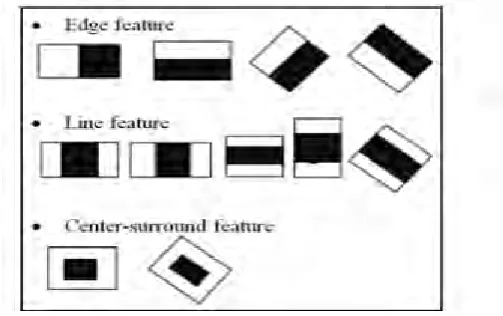
Haar Like Feature for Face Detection Haar like features are digital image feature used for object detection but here we used it for face detection. The biggest advantage of it over most other features is its calculation speed. Figure 2.2 shows the types of Haar like feature. Generally, eye region is darker than other region from the face. Figure 2.3 shows how Haar like feature is used for face detection purpose. Figure 2.4 gives the complete preprocessing steps, which includes binary to gray scale image conversion, Histogram Equalization method (HE), Laplacian of Gaussian filter (LG) and final step is contrast adjustment. Preprocessing is done because we have to remove influence cause by illumination variation for accurate face recognition [1].
• Edge feature • Line feature
• Center-surround feature
[image:24.595.192.444.580.738.2]