RESEARCH NOTE
Benefits of a mentoring support
program for individuals with an eating disorder:
a proof of concept pilot program
Lucie M. Ramjan
1*, Phillipa Hay
2and Sarah Fogarty
3*Abstract
Objective: The aim of this proof-of-concept pilot study was to assess the usefulness of a mentoring support program with a goal to improve hope for recovery in people with an eating disorder.
Results: Significant improvements (p ≤ 0.05) in hope for recovery were found for the mentees in the following domains: social relationships (p = 0.027), romantic relationships (p = 0.032), family life (p = 0.047), work (0.003) and overall scores (p = 0.003). There were no significant findings for any of the areas for the mentors. Despite this, men-toring programs that focus on improving hope may provide a valuable adjunct support for those in treatment for an eating disorder.
Keywords: Mentoring support, Eating disorders, Anorexia nervosa
© The Author(s) 2017. This article is distributed under the terms of the Creative Commons Attribution 4.0 International License (http://creativecommons.org/licenses/by/4.0/), which permits unrestricted use, distribution, and reproduction in any medium, provided you give appropriate credit to the original author(s) and the source, provide a link to the Creative Commons license, and indicate if changes were made. The Creative Commons Public Domain Dedication waiver (http://creativecommons.org/ publicdomain/zero/1.0/) applies to the data made available in this article, unless otherwise stated.
Introduction
Mentoring in the context of eating disorders, is a rela-tionship between “a person with a lived experience of an eating disorder who has recovered” (mentor) and a person with an eating disorder (mentee) [1, 2]. Mentor-ing aims to improve self-esteem and body image [2–4] however as an adjunct to established treatments has had limited attention [2]. We know of no trials which have investigated the benefits of mentoring as a positive adjunct to improving hope [2, 4]. Hope has been shown to be important in recovery from an eating disorder [5–10] and linked to an enhanced therapeutic alliance, improved treatment compliance and behavioral change [10, 11]. Hope also provides a buffer against stress and assists in coping during difficulty and suffering [12]. Thus a mentoring program for individuals with an eat-ing disorder may provide support that promotes hope for
recovery and or a better quality of life. The primary aim of this “proof of concept” trial was to assess the impact of a mentoring support program on instilling hope in indi-viduals with an eating disorder.
Main text
Method
Population, sample and procedure
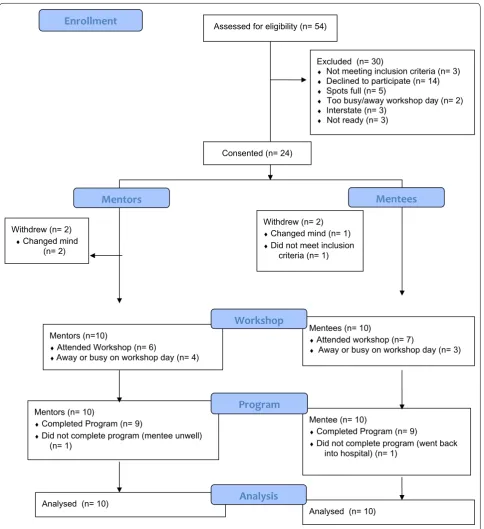
The pilot study was advertised, in eating disorder treat-ment facilities and online through relevant websites. Fifty-four individuals responded, see Fig. 1. The mentee sample (N = 10 females) were women with a mixture of eating disorders; five with anorexia nervosa (AN), two with severe and enduring AN (SEAN), and one each with binge eating disorder (BED), bulimia nervosa (BN) and other specified or unspecified feeding or eating dis-orders (OS/UFED), aged between 20 and 42 years (mean 29.2/SD 8.2). The mentor sample (N = 10 females) were women recovered from AN (some of whom also previ-ously had BN), aged between 23 and 52 (mean 28.9/SD 8.2) who had on average 5 years recovery from the eat-ing disorder. Recovery was self-reported by the men-tors and verified by interview with a psychiatrist (author PH). The psychiatrist assessed recovery and the mentors’ suitability [including determining that the mentor had
Open Access
*Correspondence: [email protected]; doctorfogarty@ gmail.com
1 School of Nursing and Midwifery, Centre for Applied Nursing Research,
Ingham Institute of Applied Medical Research, Western Sydney University, Locked Bag 1797, Penrith, NSW 2751, Australia
3 School of Nursing and Midwifery, Western Sydney University, Locked
Bag 1797, Penrith, NSW 2751, Australia
appropriate psychological support(s) in place]. Men-tors were excluded if assessed as unsuitable. All menMen-tors and mentees had to be ≥ 18 years of age. Mentees had
to have an eating disorder. Mentors had to be recovered. The study was conducted in Sydney, Australia and all mentees were from Sydney. Nine of the mentors were
from Sydney and one was from the USA. One men-tee specifically requested an online relationship due to severe social anxiety and was paired with the men-tor from the USA. The University of Western Sydney Human Research Ethics Committee approved the study (H10825).
Assessed for eligibility (n= 54)
Excluded (n= 30)
♦ Not meeting inclusion criteria (n= 3) ♦ Declined to participate (n= 14) ♦ Spots full (n= 5)
♦ Too busy/away workshop day (n= 2) ♦ Interstate (n= 3)
♦ Not ready (n= 3)
Analysed (n= 10) Mentors (n= 10)
♦Completed Program (n= 9)
♦Did not complete program (mentee unwell)
(n= 1)
Mentors (n=10)
♦Attended Workshop (n= 6)
♦Away or busy on workshop day (n= 4)
Mentee (n= 10)
♦Completed Program (n= 9)
♦Did not complete program (went back
into hospital) (n= 1) Mentees (n= 10)
♦Attended workshop (n= 7)
♦Away or busy on workshop day (n= 3)
Analysed (n= 10) Consented (n= 24)
Withdrew (n= 2)
♦Changed mind (n= 1) ♦Did not meet inclusion
criteria (n= 1) Withdrew (n= 2)
♦Changed mind
(n= 2)
Workshop
Analysis
Program
Enrollment
Mentees
Mentors
[image:2.595.58.543.86.616.2]Mentoring program
The mentoring program was an adjunct to individuals’ eating disorder treatment. As no mentoring programs have assessed the promotion of hope, a proof-of-con-cept (POC) study was considered. Proof-of-conproof-of-con-cept studies are considered when the objective of the study is to obtain an initial evaluation of the potential ben-efit of a treatment or program [13]. Participatory action research (PAR) principles founded program develop-ment. PAR “is a form of action research that focuses on the participatory aspect of research in action” [14]. PAR allows participants the flexibility to determine aspects of the program that suit their needs within a framework. Whilst aspects of the program were flex-ible e.g. when and how communication occurred, there were non-negotiables for all mentoring dyads which included: the program length, minimum of three face-to-face meetings, average time spent with mentor/ mentee (approx. 1 h/week), reiteration that the mentor was not a counselor and crisis care and risk manage-ment plans, including mandatory reporting of child abuse and risk of self-harm. In addition, the investiga-tors (SF/LR) monitored meninvestiga-tors and mentees regularly. See Nicholls et al. [14] for details of a similar mentor-ing program. The program ran for 13 weeks. There were ten mentor–mentee pairs.
Measures
There were two types of measures used in the study: (1) those to assess the benefits of the program and; (2) those to monitor the health and well-being of the participants during the study.
The benefits of the program
The primary outcome measure was hope. Hope was measured using the validated Domain Specific Hope Scale [15]. This scale is a 50 item, self-report instru-ment for measuring an individual’s level of dispositional hope in relation to 6 life areas—social, academic, fam-ily, romance/relationships, work/occupation, and leisure activities. The higher the score the greater the level of hope. It has robust psychometrics [15].
The secondary outcome measures included quality of life, distress and the mentoring relationship. Quality of life was assessed with the validated self-report ques-tionnaires; SF-12 [16] and the Eating Disorder Quality of Life Scale (EDQoL) [17]. The SF-12 is a 12-item self-report questionnaire that measures functional health and well-being using two subscales; the physical component summary and the mental component summary [16]. The EDQoL scale is a 25-item self-report measure assess-ing the degree to which an individual feels their eatassess-ing disorder affects their quality of life [17]. There are four
subscales: psychological, physical/cognitive, work/school and financial.
Distress was assessed with the Kessler Psychological Distress Scale (K10) [18]. The K10 is a 10-item self-report questionnaire that yields a global measure of distress based on questions about anxiety and depressive symp-toms. It has robust psychometrics [18].
The perception of the mentoring relationship was assessed using the validated match characteristic ques-tionnaire (MCQ) [19]. The MCQ is a 29 item, self-report instrument for measuring positive and negative percep-tions of the mentoring relapercep-tionship, the valuation of dif-ferent purposes in the match, and the effects of external influences on the match [19].
These measures were assessed at baseline (before the program started) and at completion of the program except for the MCQ, which was assessed post program only.
The health and wellbeing of participants
The following were used to monitor the participants well-being during the study: 12-item short form survey (SF-12) [16] and the Eating Disorder Quality of Life Scale (EDQoL) [17], Kessler Psychological Distress Scale (K10) [18], eating concerns with the short version eating disor-der examination (EDE-Q) [20] and the perception of the mentoring relationship with Global Mentoring Relation-ship Questionnaire Scale (GMeRQS) [21]. Individuals completed assessments mid program (at 7 weeks) and post program except for the GMeRQS which was com-pleted at weeks 3 and 9 of the program to monitor stages of the mentoring relationship. Fortnightly logbooks qual-itatively measured participants’ health and the mentoring relationship by providing feedback on issues.
Analysis
All outcomes (except for the MCQ) assessing the ben-efit of the program were analysed using a paired t test comparing baseline and the post treatment results using Microsoft Excel. Standard scoring methods were applied to the validated questionnaires.
The MCQ was scored using the tool available from
http://www.mentoringevaluation.com. This scores each of the domains. The Australian scoring tool was used and provides a population average for comparison against the mentors only. As the mentees could not be compared to any means there were no comparisons. The MCQ scoring was done only post program.
Results
The dyad who corresponded via email only discontinued the program 2 weeks after commencement, as the men-tee returned to hospital (eating disorder related). This couple did not complete any further questionnaires. In addition one mentee did not complete any of the post program questionnaires.
Presentation of the quantitative outcomes
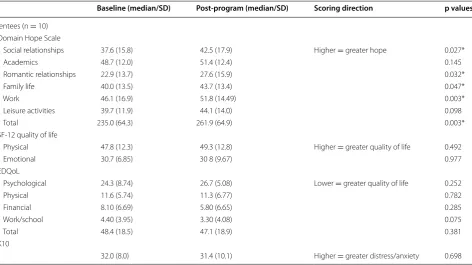
Medians and standard deviations for the data for assessing benefit are reported (see Tables 1 and 2). Sig-nificant results (p ≤ 0.05) were found between pre and
post program scores for the mentees in increasing hope overall (p = 0.003) and in the following hope domains:
social relationships (p = 0.027), Romantic relationships
(p = 0.032), family life (p = 0.047), and Work (0.003). There were no other significant results for the other outcome measures; however, in all outcome measures, except for the EDQoL Psychological domain, mentees outcome measures improved or were stable on average.
Population averages were only available for the mentors for the MCQ and the mentors were generally similar to the population norms (see Additional file 1). The men-tors did not feel as close and felt more distance between themselves and the mentees than the population norm. The mentors perceived the mentees needed support (both academic and non-academic), which was greater
than the population norm. The mentors also valued talk-ing and shartalk-ing more than the population norm.
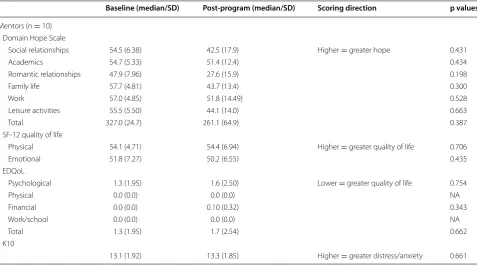
There were no significant results for the mentors. The mentors’ outcome measures remained stable from pre to post program completion.
Discussion
There was a significant increase in hope for the mentees from baseline to post program. The authors found no mentoring and eating disorder trials that assessed hope however there is considerable qualitative research that shows that hope is an important aspect in the recov-ery process from an eating disorder [5–10]. Previous research shows hope has been linked to improved treat-ment compliance and has improved the therapeutic alli-ance in treatment for those with severe and enduring AN [10]. The focus of this program was not to improve treat-ment compliance but future studies may want to consider using treatment compliance as an outcome measure. Recovery from an eating disorder is difficult [6] and any adjunct treatment that supports recovery is valuable.
While improvement in hope was seen for the mentees as a group, specifically the two participants with severe and enduring AN had small increases in hope from base-line to post program. Hope is an important factor in the recovery process from longstanding AN. These individu-als are often resistant to traditional treatments with high
Table 1 Pre and post program values and results for mentees
* Denotes significance at p < 0.05
Baseline (median/SD) Post-program (median/SD) Scoring direction p values
Mentees (n = 10) Domain Hope Scale
Social relationships 37.6 (15.8) 42.5 (17.9) Higher = greater hope 0.027* Academics 48.7 (12.0) 51.4 (12.4) 0.145 Romantic relationships 22.9 (13.7) 27.6 (15.9) 0.032* Family life 40.0 (13.5) 43.7 (13.4) 0.047*
Work 46.1 (16.9) 51.8 (14.49) 0.003*
Leisure activities 39.7 (11.9) 44.1 (14.0) 0.098
Total 235.0 (64.3) 261.9 (64.9) 0.003*
SF-12 quality of life
Physical 47.8 (12.3) 49.3 (12.8) Higher = greater quality of life 0.492 Emotional 30.7 (6.85) 30 8 (9.67) 0.977 EDQoL
Psychological 24.3 (8.74) 26.7 (5.08) Lower = greater quality of life 0.252
Physical 11.6 (5.74) 11.3 (6.77) 0.782
Financial 8.10 (6.69) 5.80 (6.65) 0.285 Work/school 4.40 (3.95) 3.30 (4.08) 0.075
Total 48.4 (18.5) 47.1 (18.9) 0.381
K10
[image:4.595.64.537.451.716.2]levels of impairment in most aspects of life with poor outcomes [6]. Mentoring programs that focus on improv-ing hope may provide valuable adjunct support for those in treatment for an eating disorder including those with SEAN. Further research could specifically investigate the use of a mentoring program for individuals with SEAN.
One of the concerns of a mentoring program for indi-viduals with an eating disorder is maintaining safety. The study results show that the mentors remained sta-ble during the program and although non-significant in all aspects, except for reported hope domains, the men-tees, on average, improved or were stable in all study outcomes, except the EDQoL psychological domain for which there was a small decrease. The reason for the decrease in the psychological EDQoL domain is unknown. The mid-point EDQoL results for mentees also showed a small average rise so it seems unlikely that the end of the program influenced quality of life. Exami-nation of the individual answers to the psychological domain questions did not indicate a specific decrease in any one aspect of psychological QoL. The program can be viewed as ‘safe’ for both mentors and mentees.
Interest exceeded expectations and resources indicat-ing that individuals with an eatindicat-ing disorder are interested in a mentoring program. Given this, it is feasible that a larger study could recruit the mentee participant num-bers needed. Further given the increase of hope seen and
the promising results that indicate program safety, future efficacy randomised controlled trials are warranted.
Conclusion
The mentoring support program showed promise in improving hope. The program appears ‘safe’ for both mentors and mentees. Further research involving a larger sample size is needed to replicate these findings.
Limitations
It is important to note that the program had no com-parator intervention so whilst the results are promising it is not within the scope of this study to determine its efficacy.
Abbreviations
AN: Anorexia nervosa; SEAN: severe and enduring anorexia nervosa; BED: binge eating disorder; BN: bulimia nervosa; OS/UFED: other specified or unspecified feeding or eating disorder; POC: proof-of-concept; PAR: participa-tory action research; EDQoL: Eating Disorder Quality of Life Scale; K10: Kessler Psychological Distress Scale; MCQ: match characteristic questionnaire; SF-12: 12-item short form survey; EDE-Q: eating disorders examination questionnaire; GMeRQS: Global Mentoring Relationship Questionnaire Scale.
Additional file
Additional file 1. MCQ post-program values and results for mentees and mentors. MCQ post-program results for mentors compared to population norms.
Table 2 Pre and post program values and results for mentors
* Denotes significance at p < 0.05
Baseline (median/SD) Post-program (median/SD) Scoring direction p values
Mentors (n = 10) Domain Hope Scale
Social relationships 54.5 (6.38) 42.5 (17.9) Higher = greater hope 0.431 Academics 54.7 (5.33) 51.4 (12.4) 0.434 Romantic relationships 47.9 (7.96) 27.6 (15.9) 0.198 Family life 57.7 (4.81) 43.7 (13.4) 0.300
Work 57.0 (4.85) 51.8 (14.49) 0.528
Leisure activities 55.5 (5.50) 44.1 (14.0) 0.663
Total 327.0 (24.7) 261.1 (64.9) 0.387
SF-12 quality of life
Physical 54.1 (4.71) 54.4 (6.94) Higher = greater quality of life 0.706 Emotional 51.8 (7.27) 50.2 (6.55) 0.435 EDQoL
Psychological 1.3 (1.95) 1.6 (2.50) Lower = greater quality of life 0.754
Physical 0.0 (0.0) 0.0 (0.0) NA
Financial 0.0 (0.0) 0.10 (0.32) 0.343
Work/school 0.0 (0.0) 0.0 (0.0) NA
Total 1.3 (1.95) 1.7 (2.54) 0.662
K10
[image:5.595.59.537.101.366.2]Authors’ contributions
SF analysed and interpreted the data. SF drafted the manuscript. LR and PH checked the data and made critical revisions to the paper for important intel-lectual content. All authors read and approved the final manuscript.
Author details
1 School of Nursing and Midwifery, Centre for Applied Nursing Research,
Ingham Institute of Applied Medical Research, Western Sydney University, Locked Bag 1797, Penrith, NSW 2751, Australia. 2 School of Medicine and
Cen-tre for Health Research, Western Sydney University, Locked Bag 1797, Penrith, NSW 2751, Australia. 3 School of Nursing and Midwifery, Western Sydney
University, Locked Bag 1797, Penrith, NSW 2751, Australia.
Acknowledgements
Not applicable.
Competing interests
The authors declare that they have no competing interests.
Availability of data and materials
The datasets generated and/or analysed during the current study are not pub-licly available and are not included within the article or in additional files due to the small study numbers and the likelihood of identification of participants.
Consent for publication
Not applicable.
Ethics approval and consent to participate
The study was approved by the University of Western Sydney Human Research Ethics Committee (H10825). The participants provided written consent to participate in the study.
Funding
The authors would like to acknowledge receipt of a grant from Western Syd-ney University for this project.
Publisher’s Note
Springer Nature remains neutral with regard to jurisdictional claims in pub-lished maps and institutional affiliations.
Received: 31 August 2017 Accepted: 29 November 2017
References
1. Collins Dictionary of the English Language. In: Wilkes GAE, editor. Collins Dictionary of the English Language. Sydney: Collins; 1979.
2. Perez M, Van Diest AK, Cutts S. Preliminaray examination of a mentor-based program for eating disorders. J Eat Dis. 2014;2(1):24.
3. McVey G, Kirsh G, Maker D, Walker K, Mullane J, Laliberte M, et al. Promot-ing positive body image among university students: a collaborative pilot study. Body Image. 2010. https://doi.org/10.1016/j.bodyim.2010.02.005. 4. Lippi DE. The impact of the mentoring relationship upon women in the
process of recovering from eating disorders. Bell & Howell Information and Learning Company: Temple University; 2000.
5. Fogarty S, Ramjan LM, Hay P. A systematic review and meta-synthesis of the effects and experience of mentoring in eating disorders and disordered eating. Eat Behav. 2016;21(1):66–75. https://doi.org/10.1016/j. eatbeh.2015.12.004.
6. Dawson L, Rhodes P, Touyz S. “Doing the Impossible”: the process of recovery from chronic anorexia nervosa. Qual Health Res. 2014;24(4):494– 505. https://doi.org/10.1177/1049732314524029.
7. Lindgren B-M, Enmark A, Bohman A, Lundström M. A qualitative study of young women’s experiences of recovery from bulimia nervosa. J Adv Nurs. 2015;71(4):860–9. https://doi.org/10.1111/jan.12554.
8. Hay PJ, Cho K. A qualitative exploration of influences on the process of recovery from personal written accounts of people with anorexia nervosa. Women Health. 2013. https://doi.org/10.1080/03630242.2013.82 1694.
9. Las Hayas C, Padierna J, Muñoz P, Aguirre M, Gómez Del Barrio A, Beato-Fernández L, et al. Resilience in eating disorders: a qualitative study. Women Health. 2016;56(5):576–94. https://doi.org/10.1080/03630242.201 5.1101744.
10. Stiles-Shields C, Touyz S, Hay P, Lacey H, Crosby R, Rieger E, et al. Thera-peutic alliance in two treatments for adults with severe and enduring anorexia nervosa. Int J Eat Disord. 2013;46:783–9.
11. Castonguay L, Pincus A, Agras W, Hines C. The role of emotion in group cognitive-behavioral therapy for binge eating disorder: when things have to feel worse before they get better. Psychother Res. 1998;8(2):225–38. 12. Miller J. Inspiring hope. In: Miller J, editor. Coping and chronic illness:
overcoming powerlessness. 2nd ed. Philadelphia: Davis; 1999. p. 413–33. 13. Gewandter JS, Dworkin RH, Turk DC, McDermott MP, Baron R, Gastonguay
MR, et al. Research designs for proof-of-concept chronic pain clinical trials: IMMPACT recommendations. Pain. 2014;155(9):1683–95. https://doi. org/10.1016/j.pain.2014.05.025.
14. Nicholls D, Fogarty S, Hay P, Ramjan LM. Participatory action research for women with anorexia nervosa. Nurse Res. 2016;23(5):26–30.
15. Simpson S. Validation of the Domain Specific Hope Scale: exploring hope in life domains. Lawrence: University of Kansas; 1999.
16. Ware JJ, Kosinski M, Keller S. A 12 item short form health survey: construc-tion of scales and preliminary tests of reliability and validity. Med Care. 1996;34:220–33.
17. Engel SG, Wittrock DA, Crosby RD, Wonderlich SA, Mitchell JE, Kolotkin RL. Development and psychometric validation of an eating disorder-specific health-related quality of life instrument. Int J Eat Disord. 2005;39(1):62–71. 18. Kessler RC, Andrews G, Colpe L, Hiripi E, Mroczek D, Normand S, et al.
Short screening scales to monitor population prevalences and trends in non-specific psychological distress. Psychol Med. 2002;32:959–76. 19. Karcher MJ, Nakkula MJ, Harris J. Developmental mentoring match
characteristics: correspondence between mentors’ and mentees’ assess-ments of relationship quality. 2005;26(2):93–110. https://doi.org/10.1007/ s10935-005-1847-x.
20. Cooper Z, Fairburn CG. The eating disorder examination: a semi-struc-tured interview for the assessment of the specific psychopathology of eating disorders. Int J Eat Disord. 1987;6:2–9.