METHOD DEVELOPMENT OF ACCELERATED STABILITY STUDY OF ADAPALENE GEL BY HPLC IN PHARMACEUTICAL FORMULATIONS
DISSERTATION
Submitted to
THE TAMIL NADU DR.M.G.R. MEDICAL UNIVERSITY,
CHENNAI.
In partial fulfilment for the award of the degree of
MASTER OF PHARMACY
In
(Pharmaceutical Analysis)
By
261230015
Under the Guidance of
Dr. SHANTHA ARCOT, M.Sc.(Pharm).,Ph.D.,
HOD, Department of Pharmaceutical Analysis
DEPARTMENT OF PHARMACEUTICAL ANALYSIS
C.L.BAID METHA COLLEGE OF PHARMACY
CHENNAI – 600 097
SRI. VINOD KHANNA SRI. L. UDAY METHA
Chairman Secretary & Correspondent
Dr. SHANTHA ARCOT, M.Sc.(Pharm).,Ph.D., Dr.GRACE RATHNAM, MPharm.,Ph.D., HOD, Department of Pharmaceutical Analysis, Principal
CERTIFICATE
This is to certify that the project entitled “METHOD DEVELOPMENT OF ACCELERATED
STABILITY STUDY OF ADAPALENE GEL BY HPLC IN PHARMACEUTICAL
FORMULATIONS” submitted by 261230015 in partial fulfilment for the award of degree of
Master of Pharmacy. It was carried out at Strides Acrolab, Bangalore and at C.L. Baid Metha College of Pharmacy, Chennai-96. under the supervision of Mrs. Dr. A.Shantha, B.Pharm, M.Sc.(Pharm).,Ph.D., HOD, Department of pharmaceutical analysis during the academic year
2013-2014.
Place: Chennai- 97 Mrs. Dr. A.Shantha, B.Pharm, M.Sc.(Pharm).,Ph.D.,
SRI. VINOD KHANNA SRI. L. UDAY METHA
Chairman Secretary & Correspondent
Dr.SHANTHA ARCOT , M.Sc.(Pharm).,Ph.D. Dr.GRACE RATHNAM,MPharm.,Ph.D
HOD, Department of Pharmaceutical Analysis. Principal
CERTIFICATE
This is to certify that the project “METHOD DEVELOPMENT OF ACCELERATED
STABILITY STUDY OF ADAPALENE GEL BY HPLC IN PHARMACEUTICAL
FORMULATIONS” submitted by 261230015 in partial fulfilment for the award of degree of
Master of Pharmacy. It was carried out at Strides Acrolab,Bangalore and at C.L.Baid Metha
college of Pharmacy, Chennai-96. Under the supervision of Mrs. Dr. A.Shantha, B.Pharm, M.Sc.(Pharm).,Ph.D., HOD, Department of pharmaceutical analysis during the academic year
2013-2014.
Place: Chennai -97 Mrs. Dr. GRACE RATHNAM, M.Pharm, Ph.D.,
DECLARATION
The thesis entitled. “METHOD OF ACCELERATED STABILITY STUDY OF
ADAPALENE GEL BY HPLC IN PHARMACEUTICAL FORMULATIONS” was carried
out by me in Department of Pharmaceutical Analysis, C.L.Baid Metha College of Pharmacy, Chennai – 97 during the academic year 2013 -2014. The work embodied in this thesis is original, and is not submitted in part or full for any other degree of this or any other University.
Place: Chennai- 97
Date: [Reg.No: 261230015]
ACKNOWLEDGMENT
The completion of this thesis is not only fulfilment of my dreams, but also the dreams of my
parents, who have taken lots of pain for me for completion of my higher studies.
I would like to take the golden opportunity to express my humble gratitude on the successful
completion of my thesis work. Firstly I am very thankful to my respected guide Mrs. Dr.
A.Shantha, B.Pharm, M.Sc.(Pharm).,Ph.D., HOD, Department of Pharmaceutical Analysis, C.L.Baid Metha College of Pharmacy, Chennai – 97. I am honoured to work under her guidance
and have her precious guidelines, constant encouragement and support throughout my research
work. I am very obliged for the patience with which she guided me at every step of my research
work.
It’s my privilege to express my grateful and sincere gratitude to Dr. GRACE RATHNAM, M.Pharm., Ph.D, Principal, and HOD of pharmaceutics, C.L.Baid Metha College of Pharmacy. I acknowledge my sincere thanks to Mrs. Dr G. UMA, M.Pharm., Ph.D., Assistant professor, Mrs. N VIJAYANAGARAJAN, M.Pharm.,(Ph.D), Assistant professor, Mrs. VIJAYAGEETHA, M.Pharm., (Ph.D)., Assistant professor, for their valuable suggestions throughout my thesis work.
I would like to use this opportunity to thank Mr. Darwin Paul for their kind cooperation rendered in fulfilling my work.
I specially thank Mrs G.Surya, M.Sc, Incharge of Ceeal lab for her guidance and source of inspiration that I have received from her throughout my project work.
I extend my sincere thanks to Chief Librarian M. Rajalakshmi C.L. Baid Metha College of Pharmacy in helping me to utilize the library facilities for references.
I thank all non-teaching staff members of our college including Mrs.R.Usha, Mrs.Valli and
Mrs.A.P.Karpakam for their help extended during my project work.
My humble thanks to the almighty, who gave me strength and confidence all along.
Place: Chennai -97 Reg. No: 261230015
Dedicated to
CONTENTS
Chapter No. Title Page No.
1 INTRODUCTION 1-26
2 DRUG PROFILE 27-30
3 REVIEW OF LITERATURE 31-32
4 OBJECTIVE 32-34
5 METHODOLOGY 34-69
5.1
Results
455.2 Discussion
675.3
Summary
696 CONCLUSION 70
7 BIBLIOGRAPHY 71
LIST OF ABBREVIATIONS USED
⁰C Degree Celsius
µL Micro litre
% Percentage
AR Analytical Reagent
ANDA Abbreviated New Drug Application
NDA New Drug Application
BMR Batch Manufacturing Record
BP British pharmacopoeia
cGMP Current Good Manufacturing Practice
NA Not Applicable
ND Not detected
NP Not performed
RS Related substance
FD Formulation Development
GMP Good Manufacturing Practice
HPLC High Pressure liquid chromatography
IP Indian Pharmacopoeia
ISO International Organization for Standardization
MFR Master formula record
QA Quality Assurance
QCD Quality control department
RH Relative Humidity
SOP Standard operating Procedure
TGA Therapeutic Goods Administration
USFDA United States Food& Drug Administration
USP United states pharmacopoeia
DAD Photodiode array detector
IH In-house
API Active pharmaceutical ingredient
ICH International Conference of Harmonisation
WHO World Health organisation
INTRODUCTION
The pharmaceutical industry is a vital segment of the health care system that conducts research, manufactures and markets pharmaceuticals and biological products for the treatment and diagnosis of diseases.
The increasing path way of research in pharmaceutical industries has resulted in emergence of novel and competent formulations in market. Some of this dosage forms are highly potent whereas some contain impurities. Such development naturally requires precise, easy and sensitive methods of chemical analysis, as quality is very important in a pharmaceutical product. Since it involves
life, unlike other customer goods there can be and there is no second quality in medicines. Quality can be also achieved through the quality control department and quality assurance.
Quality control:
Quality control department is responsible for day-to-day control of quality within a company. The department does the analytical testing of the raw materials, intermediates and finished products as well as the inspection of the packaging components.
Quality assurance:
Quality assurance is defined as the activity of providing to all concerned; the evidence needed to establish confidence that the quality function is being performed adequately. It covers all matter, which individually or collectively influence the quality of a product. It ensures that quality is built in to the product, beginning with research and development, through testing and production of the final product.
Stability is a chief quality characteristic of the pharmaceutical products and any deviation from the pre-set limits may affect the safety and efficacy of the products and thereby may found unsuitable for the intended purpose. Establishing the stability profile of pharmaceutical product is the key chemistry, manufacturing and controls development activity which includes a number of pre – determined scientific studies on the active entity, intermediates and the finished product under various conditions. It is vital to be noted that all the possible environment conditions under the product could be exposed, starting from manufacturing throughout the supply chain.
Optimum design, practical implementation, monitoring and assessment of the studies are also important for obtaining required and precise stability data.
The container closure system also should be scrutinized for its compatibility with the drug substance and its formulation to make sure that the container does not give a chance to degrade or deteriorate.
The stability study usually consists of a serious of tests performed in order to obtain an assurance of the stability of a drug product, namely maintenance of the specifications of the drug product packed in its specified packaging material and stored in the established storage condition within the determined time period.
1.1
Different types of pharmaceutical dosage forms.
1.
Solid dosage forms:
a) Tablets b) Capsules c) Pills
2.
Liquid dosage forms:
a) Sterile products: Eye drops, injections etc. b) Non-sterile products: Syrups, solutions etc.
3.
Semi-solid dosage forms:
a)
Ointmentsb)
CreamsThe stability studies of these dosage forms have to be performed in their respective container
closure system to concentrate the integrity of the product throughout its self-life.
These normally begin with the compatibility study on the drug when mixed with its excipients corresponding to the formulation and thereby consecutively to eliminate any excipients which tends to cause a loss in potency of the chief chemical substance during its storage. Stability studies are normally performed on development lots before the intended formulations for marketing is finalized. Studies are then migrated on to large scale batches, which is a representation of the commercial product. The final stage of the stability study is the framing of a protocol intended for the future stability studies.
The purpose of stability testing is to provide evidence on how the quality of an active substance or pharmaceutical product varies with time under the influence of a variety of environmental factors such as temperature, humidity and light. In addition, product-related factors influence the stability, e.g. the chemical and physical properties of the active substance and the pharmaceutical
excipients, the manufacturing process, dosage forms and its composition, the nature of the container-closure system and the properties of the packaging materials. Also, the stability of excipients that may contain or form reactive degradation products, have to be considered. As a result of stability testing a re-test period for the active substance or a shelf life for the pharmaceutical product can be established, and storage conditions can be recommended.
GUIDELINES FOR STABILITY STUDIES
Guidelines are nothing but a set of pre-set rules and laws to comply with a particular procedure to ensure that the predetermined guideline fetches the intended results.
When it comes to the area of stability study there are various guidelines which are set by various countries, committees and regulatory bodies. Out of which few are listed below,
1) ICH Guideline 2) USFDA guideline 3) WHO guideline
ICH Guideline:
Stability testing of Drug substances and product.
1.1 Objectives of the guideline
The following guideline is a revised version of the ICHQ1A guideline and defines the stability data package for a new drug substance or a product that is sufficient for a registration within in three religions of the Europe, Japan and the United States.
The guideline seeks to exemplify the core stability data package for new substances and products but leaves sufficient flexibility to encompass the variety of different practical situations that may be encountered due to specific scientific considerations and characteristics of the materials being evaluated.
1.2 Scope of the guideline
The guideline addresses the information to be submitted in the registration application for new molecular entities and associated drug products.
1.3 General principles
The purpose of stability testing is to provide evidence how the quality of the drug or drug product varies with time under the influence of environmental factors such as temperature, humidity and light.
To establish a retest period for the drug substance or a shelf life for the drug product and recommend storage conditions.
The choice of test conditions defined in this guideline is based on the analysis of effects of climatic conditions in the three regions of the EC, Japan and the United States. The mean kinetic Temperature in any part of the world can be derived from the climatic data and the world can be
divided in to four climatic zones, 1-4. This guideline addresses the climatic zones 1&2.
2. GUIDELINES
2.1.1 General
Information on the stability of the drug substance is an integral part of the system approach to the stability evaluation.
2.1.2 Stress testing
Stress testing of the drug can help identify the likely degradation products, which can in turn help
establish the degradation pathways and the intrinsic stability of the molecule and validate the stability indicating power of the analytical procedure used.
Stress testing is likely to be carried out on a single batch of the drug substance. it should include the effect of temperature (in 10ºc increments) above that for accelerated testing, humidity (eg75% RH) where appropriate oxidation ,and photolysis on the drug substances. The testing should also evaluate the susceptibility of the drug substance to hydrolysis across a wide range of pH values when in the solution or suspension.
2.1.3 Selection of batches
Data form the formal stability studies should be provided on a least three primary batches of the substance. The batches should be manufactured to a minimum pilot scale by the same synthetic route as and using a method of manufacture and procedure that stimulates the final process to be used for production batches. The overall quality of the batches of drug substance placed on formal stability studies should be representative of the quality of the material to be made on a production scale.
2.1.4 Container closure system
The stability studies should be conducted on the drug substance packaged in a container closure system that is the same as or stimulates the packaging proposed for storage and distribution.
2.1.5 Specification
chemical, biological and microbiological attributes. Validated stability - indicating analytical procedures should be applied whether and to what extend replication should be performed will depend on the results from validation studies.
2.1.6 Testing frequency:
For long term studies, frequency of testing should be sufficient to establish the stability profile of the drug. For drug substance with a proposed re test period of at least 12 months, the frequency of testing at the long term storage should normally be every 3 months over the first year, every 6 months over the second year ,and annually thereafter through the proposed re test period.
At the accelerated storage condition, a minimum of three time points, including the initial and final time points(eg:0, 3 and 6 months) from a 6 months study is recommended. Where an expectation (based on development experience) exists that results from accelerated studies are likely to approach significant change criteria, increased testing should conducted either by adding samples at the final time point by including a fourth time point in the study design.
When testing at the intermediate storage condition is called for as result of significant change at the accelerated storage condition, a minimum of four points, including the final and initial points (0, 6, 9, 12) from a 12 month study is recommended.
2.1.7 Storage conditions:
In general a drug substance should be evaluated under storage conditions (with appropriate tolerances) that test its thermal stability and if applicable its sensitivity to moisture. The long term testing should cover a minimum of 12 months duration on at least three primary batches at the time of submission and should be continued for a period of time sufficient to cover the proposed re-test period. Additional data accumulated during the assessment period of the registration application should be submitted to the authorities if requested. Data from the accelerated storage condition can be used to evaluate the effect of short term excursions outside the label storage
conditions (such as might occur during shipping).
General Considerations
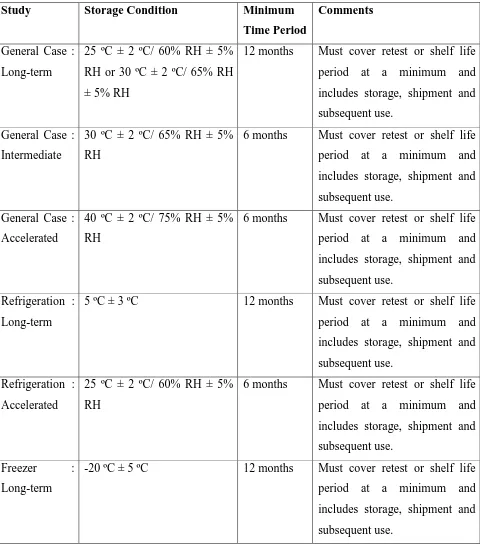
[image:18.595.71.551.155.702.2]Summary of Stability Parameters
Table No: 1
Study Storage Condition Minimum
Time Period
Comments
General Case : Long-term
25 ºC ± 2 ºC/ 60% RH ± 5% RH or 30 ºC ± 2 ºC/ 65% RH ± 5% RH
12 months Must cover retest or shelf life period at a minimum and includes storage, shipment and subsequent use.
General Case : Intermediate
30 ºC ± 2 ºC/ 65% RH ± 5% RH
6 months Must cover retest or shelf life period at a minimum and includes storage, shipment and subsequent use.
General Case : Accelerated
40 ºC ± 2 ºC/ 75% RH ± 5% RH
6 months Must cover retest or shelf life period at a minimum and includes storage, shipment and subsequent use.
Refrigeration : Long-term
5 ºC ± 3 ºC 12 months Must cover retest or shelf life period at a minimum and includes storage, shipment and subsequent use.
Refrigeration : Accelerated
25 ºC ± 2 ºC/ 60% RH ± 5% RH
6 months Must cover retest or shelf life period at a minimum and includes storage, shipment and subsequent use.
Freezer : Long-term
If long term studies are conducted at 25◦c±2ºc RH±5% and “significant change “ occur at any time during 6 months, testing at the accelerated storage condition, additional testing at the intermediate storage condition should be conducted and evaluation against significant change criteria
Testing at the intermediate storage condition should include all tests, unless otherwise justified the initial application should include a minimum of 6 months data from a 12 month study at the intermediate storage condition.
Data from refrigerated storage should be assessed according to the evaluation section of this guideline, expect where explicitly noted below.
If significant change occurs between 3 and 6 months, testing at the accelerated storage condition the proposed re test period should be based on the real time data available at the long term storage condition.
2.1.8 Stability Commitment
When available long term stability data on primary batches do not cover the proposed re-test period granted at the time of approval , a commitment should be made to continue the stability studies post approval in order to firmly established the re test period.
Where the submission includes long term stability data on three production batches covering the proposal re-test period, a post approval commitment is considered unnecessary. Otherwise one of the following commitments should be made:
1. If the submission includes data from the stability studies of at least three production
batches, a commitment should be made to continue these studies through the proposed re-test period.
2. If the submission includes data from the stability studies on fewer than three production batches, a commitment should be made to continue these studies through the proposed re-test period and to place additional production batches, to a total of at least three, on long term stability studies through the proposed re-test period.
3. If the submission does not include stability data on production batches, a commitment
should be made to place the first three production batches on long term stability studies through the proposed re test period.
2.1.9 Evaluation
The purpose of the stability study is to establish ,based on testing a minimum of three batches of the drug substance and evaluating the stability information(including as appropriate to all the physical, chemical, biological and microbiological tests) a re-test period applicable to all future batches of the drug substance manufactured under similar circumstances. The degree of variability of individual batches affects the confidence that a future production batch remain within specification throughout the assigned re-test period.
The data may show so little degradation and so little variability that it is apparent from looking at
the data that the requested re-test period will be granted. Under these circumstances, it is normally unnecessary to go through the formal statistical analysis, providing a justification for the omission should be sufficient.
An approach for analysing the data on a quantitative attribute that is expected to change with time is to determine the time at which the 95% one sided confidence limit for the mean curve intersects the acceptance criterion. If analysis shows the batch to batch variability is small, it is advantageous to combine the data into one overall estimate. This can be done by first applying appropriate statistical test (e.g. p values for level of significance of rejection of more than 0.25)
To the slopes of the regression lines and zero time intercepts for the individual batches. If it is inappropriate to combine data from several batches, the over-all retest period should be based on the minimum time a batch can be expected to remain within acceptance criteria.
The nature of any degradation relationship will determine whether the data should be transformed of linear regression analysis. usually the relationship can be represented by a linear, quadratic or cubic function on an arithmetic or logarithmic scale .statistical methods should be employed to test the goodness of fit of the data on all batches and combined batches(where appropriate) to the assumed degradation line or curve.
Limited extrapolation of the real time data from the long term storage condition beyond the observed range to extend the re-test period can be undertaken at approval time, if justified. This justification should be based on what is known about the mechanism of degradation, the results of testing under accelerated conditions, the goodness of fit of any mathematical model, batch size,
However, this extrapolation assumes that the same degradation relationship will continue to apply beyond the observed data. Any evaluation should cover not only the assay, but also the levels of degradation products and other appropriate attributes.
2.1.10 Statements / Labelling
A storage statement should be established for the labelling in accordance with relevant national/regional requirements. The statement should be based on the stability evaluation of the drug substance. Where applicable, specific instruction should be provided, particularly for drug substances that cannot tolerate freezing. Terms such as “ambient conditions” or “room temperature” should be avoided.
There should be a direct link between the label storage statement and the demonstrated stability of the drug product. An expiration date should be displayed on the container.
A re- test period should be derived from the stability evaluation and a retest date should be displayed on the container label if appropriate
Scheme of protocol for stability study of adapalene
1. Scope:
Scale up batch
2. Purpose:
New product
3. Reference:
SOP on general stability programme
4. Market:
5. Ingredient details:
Table No: 2
Ingredients
Label claim
Input
Adapelene
Preservatives: Methylparaben Phenoxyethanol
Each g gel contains 1 mg of adapelene
Each g gel contains: 1 mg of Methylparaben 2.5 mg of Phenoxyethanol
1 mg of adapelene
1 mg of Methylparaben 2.5 mg of Phenoxyethanol
6. API Details:
Table No: 3
Ingredients Source AR No:
Adapelene
(micronized)
Zhejiang Neo-Dankong Pharma Ltd 500154616789
7. Primary Packing Details:
Material Specification / Description Manufacturer
8. Conditions:
Table No: 4
Condition Table No
5 ºC ± 3 ºC (refrigerator) A
40 ºC ± 2 ºC / 75% ± 5% RH (accelerated) B
30 ºC ± 2 ºC / 65% ± 5% RH (intermediate) C
25 ºC ± 2 ºC / 65% ± 5% RH (intermediate) D 30 ºC ± 2 ºC / 60% ± 5% RH (long tem) E
Others, specify if any NA
9. Number of Samples Required For Testing:
Table No: 5
Sl No: Test Parameters No. of units used / test
1 Description 2
2 Identification 2
3 Assay and RS 2
4 Preservative Content 2
5 pH 2
6 Water content 2
7 In-vitro release 2
8 Homogeneity 2
9 Viscosity 1
Sampling Plan
Storage Conditions:
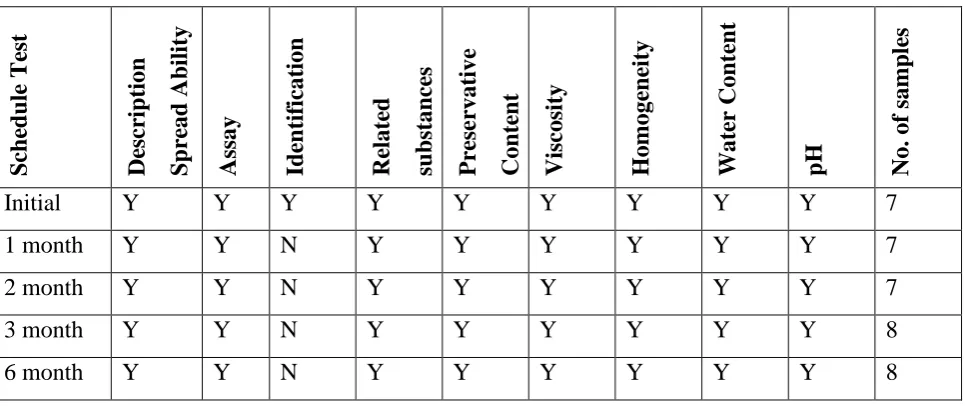
[image:24.595.70.553.192.395.2]Storage: 40 ºC ± 2 ºC / 75 ± 5% RH
Table No: 6
S ch ed u le Te st De sc rip tion S p re ad Abi li ty Assay Id en tif icat ion Re late d su b stance s Pr ese rvative Conte n t Visco sity Homoge n eity Wate r Cont en t
pH No. of
sampl
es
Initial Y Y Y Y Y Y Y Y Y 7
1 month Y Y N Y Y Y Y Y Y 7
2 month Y Y N Y Y Y Y Y Y 7
3 month Y Y N Y Y Y Y Y Y 8
6 month Y Y N Y Y Y Y Y Y 8
Y: Indicates sample to be analysed
N: Indicates sample to be analysed
Storage Condition: 25 ºC ± 2 ºC / 60% ± 5% RH
Table No: 7
S ch ed u le Te st De sc rip tion Assay Id en tif icat ion Re late d su b stance s Pr ese rvative Conte n t Visco sity Homoge n eity Wate r Cont en t
pH No. of
sampl
es
Initial Y Y Y Y Y Y Y Y Y 6
3 month Y Y N Y Y Y Y Y Y 6
6 month Y Y N Y Y Y Y Y Y 7
9 month NA
[image:24.595.69.553.550.751.2]Storage Condition: 30 ºC ± 2 ºC / 75% RH ± 5% RH
Table No: 8
S ch ed u le Te st De sc rip tion Assay Id en tif icat ion Re late d su b stance s Pr ese rvative Conte n t Visco sity Homoge n eity Wate r Cont en t
pH No. of
sampl
es
Initial Y Y Y Y Y Y Y Y Y 6
3 month Y Y N Y Y Y Y Y Y 6
6 month Y Y N Y Y Y Y Y Y 7
9 month NA
12 month Y Y N Y Y Y Y Y Y 7
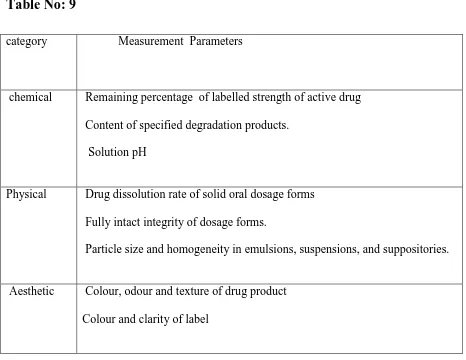
Drug shelf lives and its parameters-
Table No: 9
category Measurement Parameters
chemical Remaining percentage of labelled strength of active drug
Content of specified degradation products.
Solution pH
Physical Drug dissolution rate of solid oral dosage forms
Fully intact integrity of dosage forms.
Particle size and homogeneity in emulsions, suspensions, and suppositories.
Aesthetic Colour, odour and texture of drug product
[image:25.595.66.532.372.732.2]Terms and Definitions used under stability studies:
Climatic zones
The four zones in the world are distinguished by their characteristic prevalent annual climatic conditions. This is based on the concept described by Grimm.w (Drugs Made in Germany, 28 :196-202,1985 and 29:39-47,1986)
Commitment batches
Production batches of a drug substance or drug product for which the stability studies are initiated or completed post approval through a commitment made in the registration application.
Container closure system
The sum of packaging components together contains and protects the dosage form. This includes primary packaging components and secondary packaging components, if the latter are intended to provide additional protection to the drug product. A packaging system is equivalent to a container closure system.
Dosage form
A pharmaceutical product type (e.g., tablet, capsule, solution, cream)that contains a drug
substance generally, but not necessarily, in association with excipients.
Drug product
The dosage form in the final immediate packaging intended for marketing.
Drug substance
The unformulated drug substance that may subsequently be formulated with excipients to produce the dosage form.
Excipient
Expiration date
The date placed on the container label of a drug product designating the time prior to which a batch of the product is expected to remain within the approved shelf life specification if stored under defined conditions and after which it must not be used.
Formal stability studies
Long term and accelerated (and intermediate) studies undertaken on primary and /or commitment batches according to a prescribed stability protocol to establish or confirm the re-test period of a drug substance or the shelf life of a drug product
Impermeable containers:
Containers that provide a permanent barrier to the passage of gases or solvents, e.g sealed aluminium tubes for semisolids, sealed glass ampoules for solutions.
Mean kinetic temperature:
A single derived temperature that, if maintained over a defined period of time, affords the same thermal challenge to a drug substance or drug product as would be experienced over a range of both higher and lower temperatures for an equivalent defined period. The mean kinetic
temperature is higher than the arithmetic mean temperature and takes into the account the Arrhenius equation.
When establishing the mean kinetic temperature for a defined period, the formula of Haynes J.D
(J.Pharm.Sci.,60:927-929,1971) can be used.
New molecular entity:
Pilot scale batch:
A batch of a drug substance or drug product manufactured by a procedure fully representative of and simulating that is to be applied to a full production scale batch. For solid oral dosage forms a pilot scale is generally, at a minimum, one-tenth that of a full production scale or 100,000 tablets or capsules, wherever is the larger.
Primary batch:
A batch of a drug substance or drug product used in a formal stability study, from which stability data are submitted in a registration application for the purpose of establishing a re-test period or shelf life, respectively. A primary batch of a drug substance should be at least a pilot scale batch. For a drug product, two of the three batches should be at least a pilot scale batch and the batch can be smaller if it is representative with regard to the critical manufacturing steps, however, a primary batch may be a production batch.
Production batch:
A batch of a drug substance or drug product manufactured at production scale by using production equipment in a production facility as specified in the application.
Re-test date
: the date after which samples of the drug substance should be examined to ensurethat the material is still in compliance with the specification and thus suitable for use in the
manufacture of a given drug product.
Re-test period:
Semipermeable membrane:
Containers that allow the passage of solvent, usually water while preventing solute loss. The mechanism for solvent transport occurs by absorption into one container surface, diffusion through the bulk of the container material, and desorption from the other surface. Transport is driven by a partial pressure gradient. Examples of semipermeable containers include plastic bags and semi-rigid, low-density polyethylene (LDPE) pouches for large volume parental (LVPs) and LDPE ampoules, bottles, and vials.
Shelf life (also referred to as expiration dating period):
The time period during which a drug product is expected to remain within the approved shelf life specification, provided that it is stored under the conditions defined on the container label.
Specification:
Specification is a list of tests, reference to analytical procedures, and proposed acceptance criteria, including the concept of different acceptance criteria for release and shelf life specifications.
Specification- release:
The combination of physical, chemical, biological and microbiological tests and acceptance
criteria that determine the suitability of a drug product at the time of its release.
Specification – shelf life:
The combination of physical, chemical, biological, and microbiological tests and acceptance criteria that determine the suitability of a drug product throughout its re-test period, or that a drug product should meet throughout its shelf life.
Storage condition tolerances:
tolerances for more than 24 hours should be described in the study report, and their effect assessed.
Stress testing (drug substance):
Studies undertaken to elucidate the intrinsic stability of the drug substance is known as stress testing of drug substance. Such testing is the part of development strategy and is normally carried out under more severe conditions than those used for accelerated testing.
Stress testing (drug product):
Studies undertaken to access the effect of severe conditions on the drug product is known as stress testing of drug product. Such studies include photo stability testing and specific testing on certain products (e.g., metered dose inhalers, creams, emulsions, refrigerated aqueous liquid products)
Supporting data:
Data other than those from formal stability studies, which support the analytical procedures, the proposed re-tested period or shelf life, and the label storage statements. Such data includes (1) stability data on early synthetic route batches of drug substances, small scale batches of materials ,investigational formulations not proposed for marketing ,related formulations, and product presented in containers and closures other than those proposed for marketing (2) information regarding test results on containers, and (3)other scientific rationales.
INTERNATIONAL CLIMATIC ZONES
Table No: 10
ZONES AVERAGE ANNUAL TEMPERATURE MKT(mean kinetic temperature) Average humidity Temperature United Kingdom, Northern Europe, Canada ,Russia
20⁰C 21⁰C 45%
Mediterranean United States, Japan, Southern Europe (Portugal Greece)
20.5 -24⁰C 26⁰C 60%
Hot dry
Iran, Iraq, Sudan. India
24⁰C 31⁰C 40%
Hot and humid Brazil, Ghana, India, Indonesia
Chromatographic methods
:
Chromatography is a technique by which solutes of two or more components are separated by a dynamic differential migrational process, in a system consist of two phases, one of which moves continuously in a given direction and in which the individual component exhibits different mobility due to difference in adsorption or partition or molecular size, ion exchange etc. There are various advanced chromatographic techniques which are most reliable and widely used for the estimation of the multicomponent drugs in their formulations namely Gas chromatography (GC), High performance liquid chromatography (HPLC) and High performance
thin layer chromatography (HPTLC).
a)
Gas liquid chromatography(GLC):
In this technique, a carrier gas is used a mobile phase and it is passes over a stationary phase. It employs a liquid non- volatile stationary phase, coated on an inert solid support and separation is according to the difference in partition coefficient of components in a mixture. The separation is achieved by changes in nature of stationary phase, carrier gas flow, change in column temperature etc. The quantification is done by measurement of recorded peak area or peak height which is directly proportional to concentration of the analyte.
.
b)
High performance liquid chromatography (HPLC):
The technique of HPLC is so called because of its improvement performance in terms of rapidity, specificity, sensitivity, accuracy, convenience, ease of automation and the cost of analysis when compared to classical column chromatography. Advances in column technology high pressure
pumping system and sensitive detectors have transformed liquid column chromatography in to a high speed, efficient, accurate, and highly resolved method of resolution.
c) High performance thin layer chromatography (HPTLC):
The term HPTLC is used for the technique in which substance are accurately and precisely assayed during high performance grade of silica gel. HPTLC is a sophisticated and automated form of TLC, which is the modern thin layer chromatographic technique and has the following synonyms
Planar chromatography.
Instrumental thin layer chromatography.
Fig.1 HPLC instrument
Modes of separation in HPLC:
There are different modes of separation in HPLC. They are normal phase mode, reversed phase mode, reversed phase ion pair chromatography, ion exchange chromatography, affinity chromatography and size exclusion chromatography (gel permeation and gel filtration chromatography).
Normal phase mode
In normal phase mode, the nature of stationary phase is polar adsorbent and the mobile phase is generally a mixture of non-aqueous solvents. The silica structure is saturated with silanol group at the end in normal phase separations. These OH groups are statistically distributed over the whole of the surface. The silanol groups represent the active sites (very polar) in the stationary phase.
This forms a weak bond with many molecules in the vicinity when any of the following interactions are present. Dipole- induced dipole, dipole-dipole, Hydrogen bonding. These situations arise when the molecule has one or several atoms with lone pair electrons or a double bond. The adsorption strength and hence „K‟ value (elution series) increase in the following order. Saturated hydrocarbons < olefins < aromatic < organic < halogen compounds < sulphides < ethers < esters < aldehydes and ketones < amines < sulphones < amides < carboxylic acids. The strength of interactions depends not only on the functional groups in the sample molecule but also on stearic factors. If a molecule has several functional groups in the sample molecule but also on stearic factors. If a molecule has several functional groups , then the most polar one determines the reaction properties.
Chemically modified silica, such a aminopropyl, cyanopropyl, and diol phases are the stationary phases alternative to silica gel in normal phase chromatography.
The aminopropyl and cyanopropyl phases provide opportunities for specific interactions between the analyte and the stationary phase and thus offer additional options for the optimization of
separations. Other advantages of bonded phases lie in the increased homogencity of the stationary phase surface.
In this technique, nonpolar compounds travel faster and are eluted first because of the lower affinity between the nonpolar compounds and the stationary phase. Polar compounds are retained for longer times and take more time to elute because of their higher affinity with the stationary phase. Normal phase mode of separation is not generally used for pharmaceutical applications because most of the drug molecules are polar in nature and hence take longer time to elute.
Reverse phase mode
In 1960s, chromatography started modified the polar nature of the silanol group by chemically reacting silicon with organic silanes .The object was to make silica less polar or non polar so that
polar solvents can be used to separate water soluble polar compounds .Since the ionic nature of the chemically modified silica in now reversed .i.e, it is non-polar or the nature of the phase is reverted, the chromatographic separation carried out with such silica is referred to as reverse- phase chromatography.
Reverse phase liquid chromatography (RPLC) is considered as the method of choice for the analysis of pharmaceutical compounds for many reasons like its compatibility with aqueous and organic solutions as well as with different detection systems and its high consistency and repeatability. Sensitive and accurate RPLC analysis, whether in the pharmaceutical or bio analytical field necessitates the use of stationary phases which give symmetrical and efficient peaks.
Hence manufacturers of stationary phases are continuously improving and introducing new RPLC products and the selection of various types of reverse phase stationary phases is high. The needs for consistency as well as the globalization of pharmaceutical companies require that the methods will be transferred from site to site using either the same column brands or their equivalents. Therefore, an extensive categorization or characterization of the rich selection of the stationary phases has been done in recent years.
The stationary phase in the Reverse Phase chromatographic columns is a hydrophobic support that mainly consists of porous particles of silica gel in various shapes (spherical or irregular) at various diameters(1.8,3,5,7,10 µm etc.) at various pore sizes (such as 60, 100, 120, 300).
The surface of these particles is covered with various chemical entities, such as various
The parameters that govern the retention in Reverse Phase systems are:-
1. The chemical nature of the stationary phase
The chemical nature is determined by the size and chemistry of hydrocarbon bonded on the silica
gel surface, its bonding density (units of µmole/m²), and the purity and quality of the silica gel
support. As a rule, the more carbons in a bonded hydrocarbon, the more it retains organic solutes (as long as similar % coverage is compared). The higher the bonding density, the longer the organic solutes are retained. A column is considered relatively hydrophobic if its bonding density exceeds 3 µmole/m².
Very important modifiers of the stationary phase‟s surface are surface active substances used as mobile phase‟s additives, acting as ion pair reagents. These are substances such as tri-ethylamine
or tetrabutylamine or hexyl, heptyl, octyl sulfonate. They are distributed between the mobile phase and the hydrophobic surface and cover it with either positive (alkylamines) or negatives (alkyl sulfonates) charges. This change of the surface into charged surface affects the retention significantly, especially on charged species in the sample.
2. Composition of the mobile phase
As a rule, the weakest solvent in Reverse Phase is the most polar one, water. The other polar organic solvents are considered stronger solvents, where the order of solvent strength follows more or less their dielectric properties, or polarity. The less polar the solvent added to the mobile phase, the stronger it gets, shortening the retention times.
3. pH and ionic strength of the mobile phase
When the samples contain solutes of ionisable functional groups such as amines, carboxyls, phosphates, phosphonates, sulfates and sulfonates, it is possible to control their ionization degree with the help of buffers in the mobile phase. As a rule, the change of an ionisable molecule to an ion makes it more polar and less available to the stationary phase.
In
Ion exchange chromatography
, the stationary phase contains ionic groups like NR3+ orIon pair chromatography
It may be used for the separation of ionic compounds and this method can also substitute for ion exchange chromatography. Strong acidic and basic compounds may be separated by reversed phase mode by forming ion pairs (columbic association species formed between two ions of opposite electrical charge) with suitable counter ions. This technique is referred to as reversed phase ion pair chromatography or soap chromatography.
Affinity chromatography
It
uses highly specific biochemical interactions for separation. The stationary phase containsspecific groups of molecules which can absorb the sample if certain steric and charge related conditions are satisfied. This technique can be used to isolate proteins, enzymes as well as antibodies from complex mixtures.
Size exclusion chromatography
It separates molecules according to their molecular mass. Largest molecules are eluting first and the smallest molecules are eluting last. This method is generally used when a mixture contains compounds with a molecular mass difference of at least 10 %. This mode can be further sub
divided into gel permeation chromatography (with organic solvents) and gel filtration chromatography (with aqueous solvents).
The various components of HPLC are pumps (solvent delivery system), mixing unit, gradient controller and solvent degasser, injector (manual or auto), guard column, analytical columns, detectors, recorders and/or integrators. Recent models are equipped with computers and software for data acquisition and processing. The choice of the column should be made after a careful consideration of the mode of the chromatographic technique. Three types of columns available based upon the type of packing and particle size, namely, rigid solids, hard gels and porous and pellicular layer beads. The columns of smaller particles (3-10uM) are always preferred because the offer high efficiency (number of theoretical plated/meter) and speed of analysis.
The different types of detection used in HPLC methods based on ultraviolet (UV), fluorescence, refractive index, mass spectrophotometric and electrochemical. In most cases, method development in HPLC is carried out with UV detection using a variable wavelength spectrophotometric detector or a diode array detector (DAD).
integrators are even more sophisticated and offer a number of features in addition to basic digital integration because these devices have both memory and computing capabilities to upgrade integrating parameters to maintain accuracy as the separation progress and eluting peaks become broader. Many of these devices print out a complete report, including names of the compounds, retention times, peak areas and area correction factors. With the help of peak area and height values, the peak width can be calculated (considering the peak as a triangle) and it can also be used for the calculation of number of theoretical plates.
2. DRUG PROFILE
ADAPELENE
Appearance : smooth white powder
Chemical Name : 6-[3-(adamantan-1-yl)-4-methoxyphenyl]naphthalene-2-carboxylic acid
Molecular formula : C28H28O3
Molecular weight : 412.53
Solubility: Insoluble in water
Soluble in Tetrahydrofuran
Sparingly soluble in Ethanol
Adapalene is a topical retinoid primarily used in the treatment of acne and is also used to treat keratosis pilaris as well as other skin conditions. It is currently marketed by Galderma under the trade names DIFFERIN in some countries, and ADAFERIN in India.
Chemical Structure:
Pharmacology:
Adapelene is a chemically stable retinoid like compound. Biochemical and pharmacological profile studies have demonstrated that adapelene is a modulator of cellular differentiation, keratinization and inflammatory processes all of which represent important features in the pathology of acne vulgaris. Adapelene has a retinoid structure and adamantine group is attached. Retinoic acid belongs to the group Vitamin A, and plays a role in non-vision functions – regulating the growth and differentiation of normal and malignant cells, whereas retinal (metabolically active aldehyde of retinol) is used in vision functions as a component of
photoreceptor pigment in the retina of the eye.
Pharmacological actions:
Anti-acne
Anti-retinoic
Dermatologic
Non-narcotic analgesic
Non-steroidal Anti-inflammatory
Peripheral Nervous System Agent
Sensory System Agent
Mechanism of Action:
Mechanistically, Adapalene binds to specific retinoic acid nuclear receptors but does not bind to the cytosolic receptor protein. Although the exact mode of action of Adapalene is unknown, it is
suggested that tropical Adapalene may normalize the differentiation of follicular epithelial cells resulting in decreased microcomedone formation.
prevent microcomedone formation, similar to the mechanism of retinoic acid. Unlike retinoic acid, Adapalene selectively binds to some nuclear retinoic acid receptors (RARs)and does not bind to cellular receptors called cytosolic retinoic acid binding proteins (CRABPs).
It is hypothesized that by selectively binding to certain nuclear retinoic acid receptors and not others, Adapalene enhances keratinocyte differentiation without including epidermal hyperplasia and several irritation, such as is seen with retinoic acid. Also Adapalene may help reduce cell-mediated inflammation, an effect demonstrated by in vitro studies. Adapalene decreases formation of comedowns and inflammatory and non –inflammatory acne lesions.
One other proposed mechanism of action is that it binds to the specific retinoic acid nuclear receptors but does not binds to the cytosolic receptor protein, Adapalene works by making the skin
pores free from being clogged by helping the skin renew itself as a fast rate .the mechanism is still believed to be the same as with other retinoid which is increased cell turnover or peeling of the
skin. Adapalene is also claimed to effect the cellular differentiation, keratinization.
Absorption
Absorption of adapalene through human skin is low. Only trace amounts (<0.25ng/mL) of parent substance have been found in the plasma of acne patients following chronic topical application of adapalene in controlled clinical trials.
Toxicity
The acute oral toxicity of adapalene in mice and rats is greater than 10mL/Kg. Chronic ingestion of the drug may lead to the same side effects as those associated with excessive oral intake of Vitamin A
Carcinogencity/ Tumorigenicity
Pregnancy/reproduction
Pregnancy
Adequate and well controlled studies in humans have not been done. It is recommended that pregnant women not use adapalene, based on data for other topical retinoid. As a general precaution, women of reproductive age may want contraception counselling before initiating treatment.
Teratologic studies of tropical adapalene use in rats and rabbits are in conclusive. An increased
number of ribs were seen in studies done in rats given topical doses of 0.6,2 and 6 mg/kg a day (doses up to 150 times greater than usual tropical human dose) fetotoxicity was not seen in rats or rabbits at these doses. In oral doses of 25mg/kg a day, adapalene is teratogenic in rats, rabbits.
Paediatrics
No information is available on the relationship of age to the effects of adapalene in paediatric patients. Safety and efficacy in children up to 12 years of age have not been established.
Adverse Effects
The following side/adverse effects have been selected on the basis of their potential clinical significance (possible signs and symptoms in parentheses where appropriate)- not necessarily inclusive
Erythema (redness of skin)
Pruritus (itching of skin)
4. LITERATURE REVIEW
1. 1.R.Ruhul, R.Thiel, T.S Lacker have reported about the synthesis. High performance liquid chromatography- nuclear magnetic characterization and pharmacokinetics in mice of
CD271 glucereonide. (Adapalene).
2. B Shroot, S Michael have reported about the pharmacology and chemistry of Adapalene. 3. B Martin, D Montels and Watts have reported about the chemical stability of Adapalene
and Tretionin when combined with benzoyl peroxide in presence and in absence of visible light and ultra violet radiation. Adapalene and tretinoin are molecules used in the topical treatment of acne vulgaris. Commercial formulations (adapalene 0.1% gel and tretinoin 0.025% gel) were mixed with equal volumes of commercially available benzoyl peroxide formulation (10% lotion) and subsequently exposed to light over 24 h. With and without exposition to light, adapalene exhibits a remarkable stability whereas tretinoin is very sensitive to light and oxidation. The combination of benzoyl peroxide and light results in more than 50% degradation of tretinoin in about 2 h and 95% in 24 h.
4. Ofgain C et al. Have reported about the stability testing of active ingredients through the
principle of accelerated degradation.
5. R Rahul, H Nau have reported about the determination of Adapalene and retinol in plasma and tissue by on-line solid-phase extraction and HPLC analysis.
6. B Martin, C Meunier have reported about the chemical stability of Adapalene and Tretionin when combined with benzoyl peroxide in presence and in absence of light. 7. Eric A Schimtt et al have reported about the rapid, practical and predicative excipient
compatibility screening using iso- thermal microcalorimetry.
8. D Rigopoulos, D Joannides, D Kalageromitros have reported about the comparison of topical retinoids in the treatment of acne.
9. Drug bank provides general information, chemical structure, standards, indications,
mechanism of action about the drug adaplene.
10. British Journal of Dermatology provides ample lot information about the clinical aspects
and adverse drug reactions caused by the drug Adapalene.
11. Chandra, Pradeep have reported Design, development and formulation of antiacne
OBJECTIVE
The objective of the current project is to develop the study to indicate the stability of adapalene and also to assess the preservatives using a reverse-phase High Performance liquid Chromatographic method throughout its storage and also to determine the shelf-life, which is the storage time at a particular condition during which the pharmaceutical product will still cope up with its compendial specifications. Stability is an absolutely necessary factor of quality, safety and efficacy of a drug product. A pharmaceutical product, which is not of desirable stability, may lead to physical changes (hardness, change in release rate, phase separation, difference in expected
consistency etc.) as well as chemical characteristics (formation of toxic decomposition by products). Similarly if a sterile preparation fails to meet its sterility criteria that too can be fatal.
The purpose of carrying out the project work on stability studies is to fulfil the following objectives:
To study how to furnish a product and its packaging, so that the product has necessary
aesthetics and consistency during the desired Shelf-life under the specified conditions of storage.
To develop and appropriate formulation of the drug Adapalene and thereafter to design a good and Adaptive container closure.
To provide the evidence on how the quality of a drug substance/drug product varies with
time under the influence of a variety of environmental factor such as temperature, humidity and light and to establish a retest period/Shelf-life.
5. METHODOLOGY
METHOD OF ACCELERATED STABILITY STUDY OF ADAPALENE GEL
BY HPLC IN PHARMACEUTICAL FORMULATIONS
ABSTRACT
The stability studies of commercially available Adapalene gel (0.1%w/w& 0.3%w/w).in 3 batches packed in the container closure system proposed for marketing were carried out for 6 months by subjecting them to three different stability testing conditions which are,
Accelerated Stability Testing (40ºC±2ºC/75%RH±5%RH) Intermediate Stability Testing (30ºC±2ºC/65%RH±5%RH) Long- Term Stability Testing (25ºC±2ºC/60%RH±5%RH)
The samples were withdrawn at the respective time intervals as proposed by ICH guidelines and were analysed for appearance, Description, viscosity, pH, Water content, Related Substance,
Assay, potency, and preservative content.
The results of all the stability studies carried out at 0.3.and 6 months‟ time period at three different
5. METHOD OF ACCELERATED STABILITY STUDY OF ADAPALENE
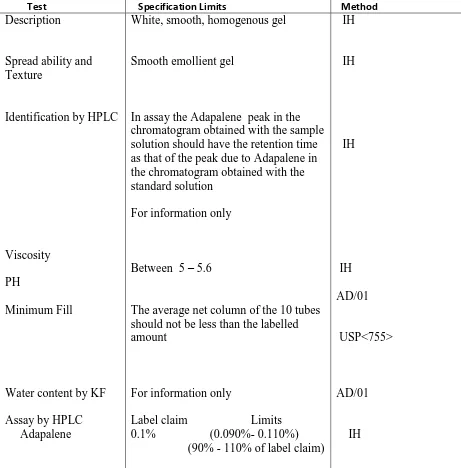
[image:49.595.67.528.168.636.2]GEL
Table No: 11
Test Specification Limits Method
Description
Spread ability and Texture
Identification by HPLC
Viscosity
PH
Minimum Fill
Water content by KF
Assay by HPLC Adapalene
White, smooth, homogenous gel
Smooth emollient gel
In assay the Adapalene peak in the chromatogram obtained with the sample solution should have the retention time as that of the peak due to Adapalene in the chromatogram obtained with the standard solution
For information only
Between 5 – 5.6
The average net column of the 10 tubes should not be less than the labelled amount
For information only
Label claim Limits 0.1% (0.090%- 0.110%) (90% - 110% of label claim)
IH
IH
IH
IH
AD/01
USP<755>
AD/01
Test Specification Limits Method
09) Related substances by HPLC.
a) Any unknown impurity
b) Total impurity
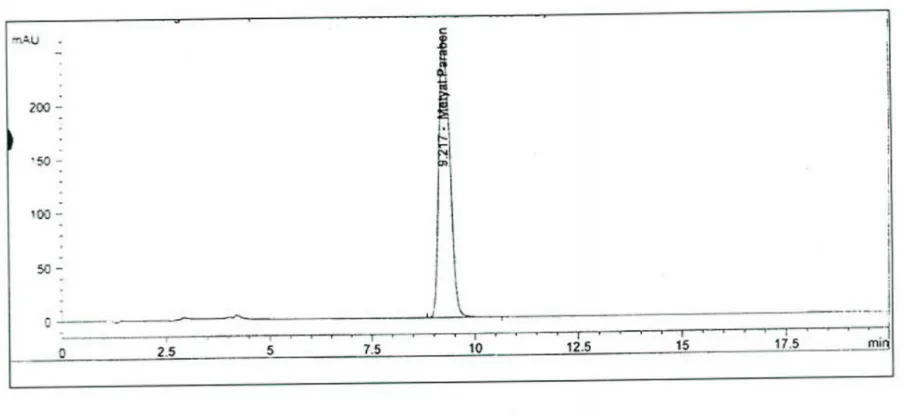
10)Preservative content by HPLC
Not more than 0.1%
Not more than 2.0%
Label claim Limits 0.1% w/w 0.08% - 0.12%
(80% - 120% of label claim) IH
IH
Reference: STP No: AD/FRSDP/TO3/R
Storage: Store at controlled room temperature between 200c- 250c (680F -770F) with excess ions permitted between 590F and 860F (150c -300c).protect from freezing.
Packing: In Laminated tubes
Note: 1) Report the assay values in percentage and percentage of label claim 2) IH refers to in-house.
Test procedures
1) Description:
Take out a sufficient quantity of sample from the tube from few tubes on a butter paper and record the apparent consistency, transparency, translucency and colour.
Record and report the findings.
2) Spreadability and Texture:
3) Identification by HPLC:
3.1) Check whether the RT (retention time) of Adapalene in the chromatogram of the sample is preparation and standard preparation are identical, as obtained in the test for Assay.
3.2) Record and report the findings.
4) Viscosity:
4.1) instrument: Brookfield‟s Viscometer
4.2) Instrument parameters:
Spindle : T bar spindle
Reading time: After 10 min
4.3) Procedure:
By using sufficient quantity of sample carry out the test as per the SOP of the Brookfield‟s
Viscometer.
4.4) Record and report the findings.
5) PH
5.1) Take out a sufficient quantity of sample from the tube and dissolve in it in water. Dip the electrode into it and note the readings immediately.
5.2) Record and report the findings.
6) Minimum fill:
6.1) Select a sample of 10 filled tubes.
6.3) Dry and weigh each empty tubes
6.5) The difference between 2 weights is the net weight of the contents of the tube.
6.6) calculate the content per tube using the following expression.
Net content per tube in gm = Gross Weight of the tube with the closure in g – Weight of the
empty tube with their closure and other parts in g.
6.7) Calculate the average net content/tube = sum of the net content of all tubes
10
7) Water content:
Determination of water:
The water content in the drug product has significant importance since it affects the physical characteristic, microbiological stability and shelf life of the product.
As the water content directly influences the quality, process ability, shelf life and stability of a wide range of products, various physical and chemical methods are used to determine the water content. Among these, the Karl Fisher Titration has established itself as a reference method for general use. It is characterized by its high specificity and precision and works over a wide concentration range from ppm up to 100% .Additional advantages are short determination times.
The trimetric determination of water is based up on the quantitative reaction of water with an un hydrous solution of sculptures dioxide and iodine in the presence of buffer that reacts with hydrogen ions. The reaction for the oxidation of the alkyl sulphite anion to alkyl sulphate by iodine is given below:
CH3OH + SO² + RN → [RNH]SO3CH3
H2O + I2 + [RNH]SO3CH3 + 2RN → [RNH]SO3CH3 +2 [RNH]I
Apparatus:
Reagent:
iodosulphourous reagent .commercially available stabilized solution of Karl Fischertype reagent may be used. Standardize the reagent before use.
Protect it from moisture while in use.
Standardization of the reagent:
Place about 20ml of anhydrous methanol in the titration vessel and titrate to the electrometric end
point with the reagent. Add accurately weighed suitable amount of (25-40mg) water and titrate to the end point. Calculate the water –equivalent of reagent in mg/ml .the minimum water equivalent is 3.5 mg of water per ml of reagent.
Calculate the water equivalent factor, in mg of water per ml of the reagent by the formula.
F = w/v
Where,
W= weight of water taken in mg
V =volume of reagent required in ml
Procedure
:
Add 20 ml of un hydrous methanol to the titration vessel and titrate to the amperometric end point with the Karl Fisher Reagent. Quickly add the accurately weighed sample (0.3g), mix for 1 min and again titrate with KARL Fischer reagent to the amperometric and point.
Calculation:
water (%w/w) (by KF) = V×F×100
W
Where, V = volume in ml of KARL Fischer reagent consumed
F = water equivalence factor of the reagent (mg/ml)
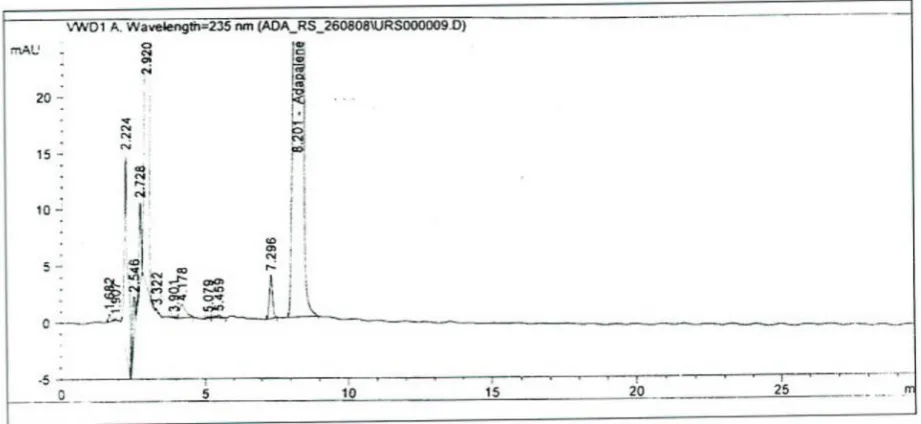
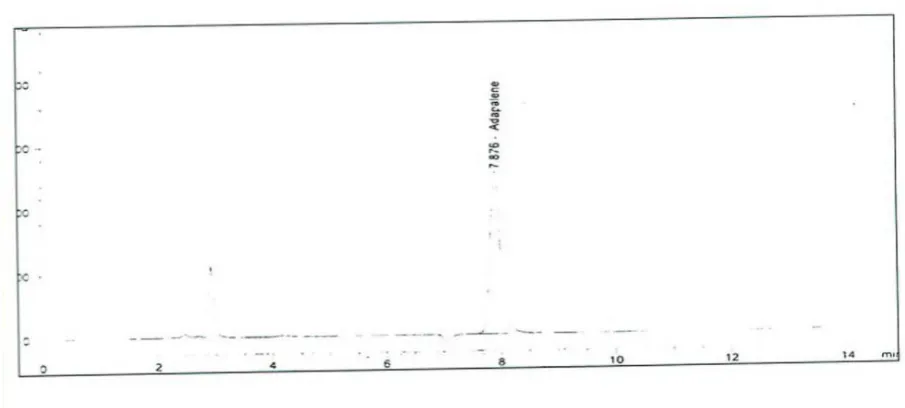
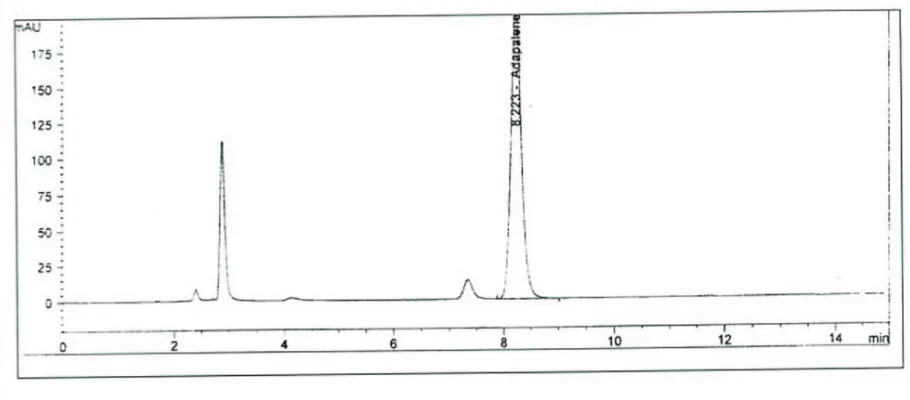
8) Assay by HPLC
Instrument:
HPLCInstrument specifications
The HPLC system consisted of an Agilent 1100 series HPLC quaternary pump (G1311A), Agilent 1100 series Photodiode array detector (G1315A), with a 10mm path length cell, Agilent on –line solvent vacuum degasser (G1379A),and an Agilent auto sampler (G1313A). the data were acquired and processed by means of chemstation software version 3.02. Analytical Column: 4.6mm×250mm i.e,5µmm LI:Cosmosil C -18 or Equivalent.
8.1)
Chemical reagents
Acetonitrile - HPLC grade Tetrahydrofuran - HPLC grade Trifluroacetic acid - AR grade
8.2) preparation of Mobile phase
:Mix Acetonitrile, Tetrahydrofuran, Trifluroacetic acid and water in the ratio 430:360:210:0.2. Then subject to degas.
8.3)
Chromatographic Conditions
Column : Cosmosil C18,250×4.6mm, 5µm
Flow rate : 1ml/min
Run time : 15 min
Detector : Photodiode array detector
injection volume : 20µl
Wave length : 235nm
8.4) Diluent:
8.5) Preparation of Standard solution
:
Weigh accurately about 20.0 mg of Adapalene standard into a 100 ml volumetric flask add 50 ml
of Tetrahydrofuran. Sonic ate to dissolve Make up to the volume with Tetrahydrofuran. Further dilute 50 ml, of this solution to 500ml with the diluents and mix.
8.6) Preparation of sample solution:
Gel (0.1%w/v): Weigh accurately about 2.0 g of Adapalene gel sample in to a 100ml, volumetric flask. Add 10.0ml of Tetrahydrofuran, sonic ate to dissolve .Make up to the volume with the diluent and mix. Filter thoroughly through a 0.45 min Nylon filter paper.
Gel (0.3%w/v): Weigh accurately about 6.7g.of Adapalene gel sample in to a 100ml, volumetric flask. Add 10.0ml of Tetrahydrofuran, sonic ate to dissolve .Make up to the volume with the diluent and mix. Filter thoroughly through a 0.45 min Nylon filter paper.
8.7) Procedure:
1) Inject blank (diluents 1 injection), standard (5) injections. Then check for system suitability
2) The RSD (relative standard deviation) for Adapalane area response from 5 injections of standard solution not be more than 20%.
3) The tailing factor for the adapalene peak should not be more than 2.0.
4) The theoretical plates for the Adapalene should not be less than 200.
5) If the system suitability parameters passes the required criteria inject the sample solution (2 injections) and record their response.
8.8) Calculations:
Calculate the content of the Adapalene in percentage by using the formula.
Adapalene in % = AS X WS X DT X P X 100
AT DS WT LC
AT = Average area of Adapalene peak from the standard solution
WT = weight of Adapalene sample in mg
WS = weight of Adapalene standard in mg
DS = Dilution of the standard solution
DT = Dilution of the sample solution
LC = label claim of adapalene in % w/w
P =Potency of Adapalene standard in % w/w on as is basis
Adapalene in percentage label claim = Content of Adapalene in % × Adapalene label claim in %
100
9) Related substance by HPLC
9.1) Instrument: HPLC
9.2) preparation of Mobile phase
:
Mix Acetonitrile, Tetrahydrofuran Water and ,Trifluroacetic acid in the ratio 430:360:210:0.2. Then subject to degas.
9.3) Chromatographic Conditions
Column : Cosmosil C18,250×4.6mm, 5µm
Flow rate : 1ml/min
Detector : Photodiode array detector
injection volume : 20µl
Wave length : 235nm
Run time : Standard : 15 min
: Blank : 30 min