City, University of London Institutional Repository
Citation
:
Giaralis, A. and Spanos, P. D. (2009). Wavelet-based response spectrum compatible synthesis of accelerograms-Eurocode application (EC8). Soil Dynamics and Earthquake Engineering, 29(1), pp. 219-235. doi: 10.1016/j.soildyn.2007.12.002This is the unspecified version of the paper.
This version of the publication may differ from the final published
version.
Permanent repository link:
http://openaccess.city.ac.uk/922/Link to published version
:
http://dx.doi.org/10.1016/j.soildyn.2007.12.002Copyright and reuse:
City Research Online aims to make research
outputs of City, University of London available to a wider audience.
Copyright and Moral Rights remain with the author(s) and/or copyright
holders. URLs from City Research Online may be freely distributed and
linked to.
Wavelets based response spectrum compatible synthesis of
accelerograms- Eurocode application (EC8)
Authors
A. Giaralis1, P.D. Spanos2*
Affiliations
1Ph.D. Candidate, Department of Civil Engineering, Rice University, Houston, Texas
2 L. B. Ryon Chair in Engineering, Rice University, Houston, Texas
Abstract
An integrated approach for addressing the problem of synthesizing artificial
seismic accelerograms compatible with a given displacement design/target spectrum is
presented in conjunction with aseismic design applications. Initially, a stochastic
dynamics solution is used to obtain a family of simulated non-stationary earthquake
records whose response spectrum is on the average in good agreement with the target
spectrum. The degree of the agreement depends significantly on the adoption of an
appropriate parametric evolutionary power spectral form which is related to the target
spectrum in an approximate manner. The performance of two commonly-used spectral
forms along with a newly proposed one is assessed with respect to the elastic
displacement design spectrum defined by the European code regulations (EC8).
* Pol D. Spanos, George R. Brown School of Engineering, L. B. Ryon Chair in
Engineering, Rice University, MS 321, P.O. Box 1892, Houston, TX 77251, U.S.A.
Subsequently, the computational versatility of the family of harmonic wavelets is
employed to modify iteratively the simulated records to satisfy the compatibility criteria
for artificial accelerograms prescribed by EC8. In the process, baseline correction steps,
ordinarily taken to ensure that the obtained accelerograms are characterized by physically
meaningful velocity and displacement traces, are elucidated. Obviously, the presented
approach can be used not only in the case of the EC8, for which extensive numerical
results/ examples are included, but also for any code provisions mandated by regulatory
agencies. In any case, the presented numerical results can be quite useful in any aseismic
design process dominated by the EC8 specifications.
Keywords: Response Spectrum; Stochastic Processes; Accelerograms; Evolutionary
Power Spectrum; Harmonic Wavelets; Eurocode 8.
1. Introduction
Traditionally, code provisions for aseismic design of structures describe the
seismic severity by means of smooth design (response) elastic and inelastic spectra. This
practice facilitates significantly the design of regular structures in the framework of
equivalent linear static or dynamic analysis incorporating proper modal combination
rules. However, aseismic code regulations prescribe additional linear and/or non-linear
dynamic time-history analyses to be performed for the design of facilities of critical
importance and of structures incorporating non-conventional means of protection against
the seismic hazard (e.g. seismic isolation, energy dissipation devices, tuned-mass
recorded earthquake accelerograms associated with historical seismic events or by an
ensemble of numerically simulated earthquake signals. Typically, the response spectra of
the adopted time-histories must satisfy certain criteria of compatibility with the elastic
design spectra.
There are several factors likely to contribute to the extensive use of
time-integration analyses for the mitigation of the seismic hazard in the built environment in
the near future. These include the availability of more powerful computers, the increased
capabilities of commercial software to account for potential inelastic behavior of
structural systems, the need for constructing ever more sophisticated structured facilities
(e.g. base isolated structures, nuclear power plants e.t.c.), and for upgrading/retrofitting
the important/damaged existing ones. In this context, the development of dependable
tools to make readily available realistic design spectrum compatible seismic
accelerograms satisfying the related aseismic code provisions to practitioners is quite
pertinent.
Most of the early methods for the generation of response spectrum compatible
earthquake records are cited in the review articles of Ahmadi [1], and Spanos [2]. More
recent commonly-used methods for the purpose are described in the studies of Preumont
[3], Naeim and Lew [4], and Carballo and Cornell [5].
Lately, the problem at hand has been addressed by several researchers using
various non-traditional in the field of structural dynamics techniques. Wang et al. [6]
processed a collection of real accelerograms via the adaptive chirplet transform to reach a
joint time-frequency representation of the signals. Similarly, Wen and Gu [7] utilized the
an alternative time-frequency representation of individual accelerograms. In both of these
studies, the derived representations were used in conjunction with a common random
field simulation method to produce artificial seismic records possessing frequency
content and response spectra of similar characteristics to those attained by the original
recorded signals. Gupta and Joshi [8] and Shrinkhade and Gupta [9] cast the problem on a
purely stochastic basis by deriving response spectrum consistent power spectra. Then, the
phase characteristics of certain real accelerograms were used to introduce non-stationary
attributes in the generated artificial time-histories. Conte and Peng [10] obtained similar
results by considering a time-dependent (evolutionary) power spectrum numerically
estimated by individual real acceleration time-histories. Subsequently, non-stationary
artificial accelerograms compatible with this evolutionary power spectrum were produced
by way of a special adaptive least-square fitting scheme. Lin and Ghaboussi [11]
considered a relatively large ensemble of real accelerograms to “train” an appropriately
constructed stochastic neural network. Hence, the trained network was used to generate
artificial signals of comparable spectral and waveform characteristics with those of the
ensemble accelerograms given a design spectrum as input.
From a deterministic viewpoint, Karabalis et al. [12] incorporated certain
numerical schemes to appropriately modify individual recorded accelerograms so that
their response spectra are in close agreement with a given design spectrum. Mukherjee
and Gupta [13] and Hancock et al. [14] employed wavelet-based methods in the
frequency and in the time domain, respectively, for the same purpose. A considerably
different approach was proposed by Naeim et al. [15], incorporating a specific genetic
accelerograms out of a large databank obeying to certain design spectrum compatibility
criteria.
Obviously, in the preceding methods and in most of other ones proposed in the
literature, a suite of real seismic accelerograms is assumed to be available to the designer.
Ideally, it should include strong ground motion time histories recorded under certain soil
conditions and seismological environments related to the design spectrum with which
compatibility is ultimately pursued. Even though databases of recorded accelerograms are
being gradually extended, the formation of such a suite of signals may not be readily
feasible for specific seismically active regions. For instance, in some cases, such
databases contain incomplete background information about the provided signals.
Furthermore, the regulatory agencies may only provide a very “loose” classification of
soil types, while typically no detailed information is included about the seismogenetic
features of the source(s) considered in the definition of the design spectrum.
To circumvent the above requirement and the limitations of the deterministic
methods, a stochastic approach originally established in Spanos and Vargas Loli [16], is
followed in this paper to obtain ensembles of seismic records whose average response
spectrum bears close resemblance with a given design (response) spectrum. It should be
noted that this approach accounts for the non-stationarity of the generated signals in a
more direct manner than in the previous studies of Gupta and Joshi [8], and Shrinkhade
and Gupta [9]. In particular, a simulated earthquake accelerogram is construed as a
sample of a non-stationary zero-mean random process characterized by an analytically
defined uniformly modulated evolutionary power spectrum (EPS) [17]. The latter
maximum variance of the amplitude of the response of a single-degree-of-freedom
oscillator to a non-stationary stochastic excitation. An appropriate minimization problem
is formulated and solved numerically to determine the requisite parameters defining the
EPS. Upon determination of the EPS, an auto-regressive-moving-average model is
employed to simulate non-stationary artificial accelerograms compatible with the EPS
[18]. The obtained signals are then individually modified by means of the harmonic
wavelet transform [19, 20], in the context of an iterative scheme [13], to improve the
agreement of their response spectra with the target design spectrum. It is noted that the
unique attributes of the generalized harmonic wavelets provide enhanced flexibility in the
representation of signals throughout the frequency domain which enhances significantly
the efficiency of the original matching procedure of Mukherjee and Gupta [13]. In the
process, an efficient baseline correction technique is utilized [21] to yield accelerograms
possessing physically proper velocity and displacement traces.
The proposed methodology encompasses two distinct formulations: the stochastic
formulation where an appropriate EPS must be defined and the iterative matching
formulation whose efficiency depends on the construction of the harmonic wavelet basis
functions. Both of these formulations are extended and/or customized with respect to the
elastic displacement design spectrum, and the corresponding compatibility criteria for
artificial accelerograms set forth by the European aseismic code provisions (EC8) [22].
Nevertheless, adopting the specific code provisions does not limit the applicability of the
proposed methodology; it only exemplifies its versatility.
To this end, the potential of three different spectral forms of exponentially
EPS: the Kanai-Tajimi [23], the Clough-Penzien [24], and a novel one comprising a
predefined high-pass Butterworth filter (e.g. [25]) in series with the Kanai-Tajimi
spectrum. Furthermore, the construction of custom case-dependent harmonic wavelet
basis with scales of non-uniform width in the frequency domain is adopted to satisfy
efficiently the compatibility criteria mandated by the EC8.
2. Stochastic simulation of spectrum compatible artificial earthquake records
In this section, the pertinent theoretical background for associating an
evolutionary power spectrum with a given displacement response (design) spectrum is
first reviewed. Special attention is given to the analytical spectral form characterizing the
stationary part of this evolutionary power spectrum and alternative expressions are
considered for the purpose. A brief presentation of an efficient filtering method for
generating non-stationary signals being samples of an underlying evolutionary power
spectrum is also included.
2.1. Formulation of the simulation problem on a stochastic basis
Let the ground acceleration ug(t) due to a seismic event be modeled as a realization of a zero-mean separable non-stationary stochastic process expressed in the
domain of time t by the equation
( )
( ) ( )
g
u t =A t y t , (1)
evolutionary power spectrum S(t,ω) of the non-stationary process is expressed in the frequency (ω) domain as [17]
( )
( ) ( )
2,
S t ω = A t S ω , (2)
where S(ω) is the two-sided power spectrum of the stationary process y(t).
Consider a unit-mass linear single-degree-of-freedom (SDOF) quiescent oscillator
with ratio of critical damping ζ and natural frequency ωn, base-excited by the process
ug(t). The motion of this system is governed by the equation
( )
( )
( )
( )
( )
( )
2
2
0 0 0
n n g
x t x t x t u t
x x
ζω ω
+ + = −
= =
, (3)
in which x(t) is the displacement trace of the oscillator relative to the motion of the ground and the dot over a symbol denotes differentiation with respect to time.
Assuming that the input energy, as expressed by S(t,ω), is distributed over a broad frequency band throughout the duration of the process ug(t), it can be argued that the response of lightly damped oscillators (ζ<<1) trails a pseudo-sinusoidal motion. That
is:
( )
( )
cos n( )
x t =a t ⎡⎣ω t+ϕ t ⎤⎦, (4)
where α(t) and φ(t), are the response amplitude and phase and correspond to processes of slow temporal evolution statistics.
The aforementioned assumptions are common in the field of random vibrations
(see e.g. [26]), and reflect the fact that SDOF systems with small ratio of critical damping
attain highly resonant transfer functions centered at the natural frequency (ωn). Therefore,
these systems act as pass-band filters when excited by relatively broadband input, as is
dominated by the frequencies close to ωn. Under these assumptions, it can be shown that
the probability density function of the response amplitude follows a time-dependent
Rayleigh distribution [27]
( )
, 2( )
exp 2 2( )
2a a
a a
p a t
t t
σ σ
⎛ − ⎞
= ⎜⎜ ⎟⎟
⎝ ⎠, (5)
where the function σa2(t) is the variance of the amplitude given by the equation
( )
(
)
(
) (
)
2
2
0
exp 2 exp 2 ,
t
a n n n
n
t π t S d
σ ζω ζω τ τ ω τ
ω
= −
∫
. (6)To this end, a straightforward relation between a given (target) displacement
design spectrum Sd(ωn, ζ) and the evolutionary power spectrum of Eq. (2) can be established through the maximum value of the variance of the response amplitude [16]:
(
,)
max{
(
,)
}
d n a n
S ω ζ =r σ ω ζ , (7)
where r is known as the “peak factor” [28]. In general, r depends on the stiffness (ωn),
and damping (ζ) of the SDOF oscillator, on the frequency content and duration of the
input process ug(t), and on the level of uncertainty furnished by the design spectrum as specified by regulatory agencies. The exact determination of the peak factor requires the
solution of the first-passage problem which is mathematically intractable, especially for
non-stationary input processes. It is pointed out that for stationary input processes some
reliable approximate formulae for estimating the peak factor exist in the literature (e.g.
[29], [30]). However, the use of such formulae for the determination of r in the case considered herein necessitates replacing the non-stationary process of Eq. (1) by an
equivalent stationary process of reduced duration [28]: an assumption which is not
non-stationary process. Therefore, for the purposes of the present study, r will be treated as a constant. Additional comments on selecting an appropriate value for the peak factor are
given in section 4 incorporating new numerical results pertaining to the EC8
displacement design spectrum [22].
2.2 Spectral form of the evolutionary power spectrum
In pursuing a solution to the simulation problem defined by Eq. (7), appropriate
analytical expressions for the modulation function A(t) and the power spectrum S(ω)
must be adopted. These must be compatible with the assumptions made in deriving Eqs.
(5) and (6) and should capture adequately the physical aspects of the problem.
In this regard, the Bogdanoff-Golberg-Bernard (BGB) envelope function defined
by [31]
( )
exp 2b A t =Ct ⎛⎜− t⎞⎟
⎝ ⎠ (8)
is used, where C>0 and 0<b<1 are parameters to be determined. This function accommodates appropriately the time-evolving intensity typically exhibited by recorded
seismic accelerograms; namely, a decaying segment preceded by a short initial period of
development. Note that the value of C is proportional to the peak ground acceleration, while the parameter b controls the shape of the envelope and thus the effective duration of the strong ground motion. Recently, the “slowly-varying” feature of the BGB function,
which must hold for Eq. (2) to be valid, was ascertained by means of the adaptive chirplet
( )
( )
2 2 2 2 2 2 1 4 ; 1 4 g g b g g g S G ω ζ ωω ω ω ω
ω ζ ω
ω ω ⎛ ⎞ + ⎜⎜ ⎟⎟ ⎝ ⎠ = ≤ ⎛ ⎛ ⎞ ⎞ ⎛ ⎞ ⎜ −⎜ ⎟ ⎟ + ⎜ ⎟ ⎜ ⎟ ⎜ ⎟ ⎜ ⎝ ⎠ ⎟ ⎝ ⎠ ⎝ ⎠ , (9)
in which ωg and ζg are positive parameters and ωb signifies the highest frequency of
interest.
Setting G(ω)= 1 in Eq. (9) yields the well-known Kanai-Tajimi (KT) spectrum [23]. Apart from its simplicity, the main asset of the KT spectrum is that it lends itself to
a clear physical interpretation associated with site specific soil conditions. In particular, it
accounts for the resonant filtering effects that the surface soil deposits have on
propagating seismic waves by a linear SDOF system with natural frequency ωg and
damping ratio ζg. In this context, it has been extensively used in the past in random
vibration analysis of structures (e.g [28], [29]), and in strong ground motion
characterization (e.g. [33]). Nevertheless, the KT filter has the major disadvantage of
allowing for the presence of non-negligible low frequency content in the spectral
representation of the acceleration process ug(t). Such low frequency components are considerably accentuated upon integration of the accelerograms and have a significant
impact to their corresponding displacement traces. Specifically, this leads to displacement
time-histories exhibiting a monotonically increasing trend and yielding unrealistically
high permanent deformations similar to those reported in [4].
The Clough-Penzien (CP) spectral form incorporates a second order high-pass
filter to suppress the low frequency content allowed by the KT spectrum [24]. It is
( )
4 2 2 2 2 1 4 f f f f G ω ω ωω ζ ω
ω ω ⎛ ⎞ ⎜ ⎟ ⎜ ⎟ ⎝ ⎠ = ⎛ ⎛ ⎞ ⎞ ⎛ ⎞ ⎜ −⎜ ⎟ ⎟ + ⎜ ⎟ ⎜ ⎟ ⎜ ⎟ ⎜ ⎝ ⎠ ⎟ ⎝ ⎠ ⎝ ⎠ , (10)
in Eq. (9), where ωf and ζf are positive parameters related with the cut-off frequency and
the steepness of the transfer function of the high-pass filter G(ω). It is reasonable to attribute physical meaning to Eq. (10), since it coincides with the transfer function of a
SDOF system with natural frequency ωf and damping ratio ζf, and is used in series with
the KT filter. Indeed, some researchers have argued that ωf and ζf can be interpreted as
the stiffness and damping ratio of the geological formations of the crust of the Earth, the
bedrock (e.g. [34]). Nevertheless, the filter of Eq. (10) is primarily a signal processing
element, and thus, the values of parameters ωf and ζf should be set appropriately to
eliminate the spurious low frequencies [24]. In any case, note that by adopting the CP
spectral form the complexity of the simulation problem is significantly increased since
four more undetermined parameters are additionally introduced to the required
parameters, two, for the definition of the BGB modulating envelop. In this respect, it is
proposed to utilize a predefined standard infinite impulse response high-pass filter in
cascade with the KT band-pass filter. For instance, a Butterworth filter given by the
equation [25]
( )
2 2 2 NN N
o
G ω ω
ω ω
=
+ (11)
can be assumed in Eq. (9), where N and ωο denote the filter order and cut-off frequency, respectively. These quantities can be judicially selected so that adequate filtering of the
of the simulation problem. Further elucidating comments on the various spectral forms
presented in this section are given in light of numerical results in section 4.1.
2.3 Approximate solution of the simulation problem
Combining Eqs. (2), (6), and (8) the following expression for the time-dependent
variance of the response amplitude is obtained
( )
2{
( )
( )
( )
(
)
}
2 2 2
2 3 exp 2 exp 2exp 2exp 2
a n
n C
t π t bt t bt bt t
σ γ γ ζω
ω γ
= − − − + − − − , (12)
where
2 n b
γ = ζω − . (13)
This expression possesses a global maximum at time t=t*. This time instant can be
determined by setting the first time derivative of Eq. (12) equal to zero. This criterion
leads to the condition
(
)
(
)
( )
2 2 * *2 2 1 * 2 4 exp * 0 n
t bt bt b t
γ − − γ − − + ζω −γ = . (14)
Application of the previous operation in Eq. (6), and use of Eqs. (2) and (8) yields the
maximum value of the variance of the response amplitude. That is,
(
)
{
}
2 *2 3( )
*( )
exp
max ,
2
a n n
n C t bt
S π
σ ω ζ ω
ζω −
= . (15)
An approximate solution to the simulation problem defined by Eqs. (7), (14), and
(15) is next pursued, as it has been proposed in [16]. In this regard, it is sought to satisfy
(
)
2 2
1
min M j j
j S σ = ⎧ ⎫ − ⎨ ⎬
⎩
∑
⎭, (16)where
( )
(
)
2 , , 1,...,
0 , 1,..., 2
d n j j
S j M
S
j M M
ω ζ
⎧ =
⎪ = ⎨
= +
⎪⎩ , (17)
and
( )
( )
( )
( )(
)
(
)
( )
(
)
2 2 *2 *
3
2 * *2 *
*
exp
, 1,...,
2
2 2 1
2 4 exp , 1,..., 2
j j
n j n j
j j M j M j M j M j M j M j M n j M
r C t bt
S j M
t bt bt
b t j M M
ω ζω
σ γ γ
ζω γ − − − − − − − − ⎧ − ⎪ = ⎪ ⎪⎪ =⎨ − − − − ⎪ − + − = + ⎪ ⎪ ⎪⎩ .. (18)
In Eqs. (16)-(18) the unknowns to be determined are the set of M time instants {tk*}, C, b, plus all necessary parameters involved in the analytical expression of S(ω), while the number of equations is 2M. In practice, the number of equations will always be greater than the total number of unknowns, since for an acceptable approximation to the
solution of the problem considered several tenths of points {ωn(j)} along the frequency band of concern should be included. Thus, Eqs. (16)-(18) define a typical
high-dimensional over-determined non-linear least-square fit optimization problem. In this
study, a Levenberg-Marquardt algorithm with line search is utilized to numerically solve
this problem (see e.g. [35]).
2.4 Generation of artificial non-stationary earthquake records
Upon solving the optimization problem of Eq. (16), the complete definition for
field simulation technique can be employed to synthesize an arbitrarily large number of
non-stationary accelerograms as realizations of the process characterized by S(t,ω). In the case of the uniformly modulated non-stationary stochastic processes, this task can be
carried out conveniently in two steps: First, stationary time histories y(t) compatible with a specific power spectrum S(ω) are generated. Next, the corresponding non-stationary time-histories are obtained by multiplying the stationary records with the envelop
function A(t), as Eq. (1) suggests. A plethora of techniques for synthesizing power spectrum compatible stationary signals exist in the literature. A self-contained exposition
of the topic presenting the most common of the methods is provided in [18].
In this study, the so-called ARMA simulation method is used. Specifically, a
discrete stationary stochastic process y is generated as the response of a linear time-invariant autoregressive moving average (ARMA) digital filter subject to clipped white
noise excitation [36]. The s-sample of an ARMA(p,q) process is calculated recursively as
a linear combination of the previous p samples plus a convolution term as follows
[ ]
[
]
[
]
1 0
p q
k l
k l
y s b y s k c w r l
= =
= −
∑
− +∑
−, (19)
where the bk and cl are the coefficients of the ARMA filter. The symbol w denotes a discrete white noise process band-limited to ωb defined by the autocorrelation function
[ ] [ ]
{
}
2 b uvE w u w v = ω δ . (20)
In this equation E{.} denotes the operator of mathematical expectation, and δuv is the Kronecker delta. Intuitively, the objective in this procedure is to “color” the latter process
via the ARMA filter so that the filtered process is characterized by the given power
and cl such that the squared modulus of the frequency response of the ARMA filter matches the power spectrum S(ω). Specifically, require that
( )
( )
2s
i T
S ω = H eω . (21)
In Eq. (21) Ts is the sampling period of the discrete process which must comply with the Nyquist condition to avoid aliasing. That is,
s b T π
ω
≤ . (22)
Further, H denotes the transfer function of the ARMA filter which can be expressed as
( )
01 1 s s s q li T l i T l
p ki T k k c e H e b e ω ω ω − = − = = +
∑
∑
. (23)In the ensuing analysis the auto/cross-correlation matching (ACM) procedure is
used to determine the filter coefficients. In implementing this scheme, linear prediction
theory used in system identification is used to construct a relatively long autoregressive
(AR) digital filter to represent S(ω) as a first approximation. Next, the output auto-correlation and the input/output cross-auto-correlation sequences between this preliminary AR
and the final ARMA model are equated. Eventually, the coefficients of the ARMA filter
are calculated by solving a p+q by p+q system of linear equations. The mathematical
3. Enhanced response spectrum matching of synthesized records using the Harmonic Wavelet Transform
Obviously, the previously described procedure cannot guarantee that the response
spectrum of the individual synthetic signals produced will match exactly the target design
spectrum and satisfy the usual criteria for artificial accelerograms mandated by regulatory
agencies (see e.g. [22]). This is because of the various assumptions involved in the
formulation of the simulation problem, the approximate manner by which a solution to
this problem is sought, and the statistical nature characterizing the generation of the
signals by way of random field simulation.
Nevertheless, any arbitrary seismic accelerogram, whether artificial or recorded,
can be appropriately modified to improve the agreement of its response spectrum with the
target design spectrum. For this purpose, the generalized harmonic wavelets [19, 20] are
utilized herein for processing the generated accelerograms along with an iterative
matching procedure originally proposed in [13]. Compared to the modified
Littlewood-Pauley basis functions considered in [13], the generalized harmonic wavelets provide a
more flexible and balanced representation of signals throughout the frequency domain
[20]. Furthermore, advantage is taken of an efficient algorithm incorporating the Fast
Fourier Transform for the signal decomposition and reconstruction [37]. These attributes
render the Harmonic wavelet transform an effective tool for processing signals to achieve
enhanced response spectrum matching as will be shown in the ensuing numerical results.
This objective is achieved herein by an iterative numerical procedure combined with an
3.1 The Harmonic Wavelet Transform
Generalized harmonic wavelets have a box-shaped band-limited spectrum. A
wavelet of (m,n) scale and k position in time is represented in the frequency domain by the equation [19]
( ) (
)
(
)
, 1 exp , 0 , o m n i kT m nn m n m
otherwise
ω ω ω ω
ω ω
⎧ ⎛− ⎞
Δ ≤ ≤ Δ
⎪ ⎜⎜ ⎟⎟
Ψ =⎨ − Δ ⎝ − ⎠
⎪ ⎩
, (24)
where m, n, and k are taken to be positive integer numbers in what follows and 2
o T
π ω
Δ = , (25)
with To being the total length of the time interval considered (i.e. the duration of the signals generated by Eq. (20)), in seconds. The time-domain Fourier Transform pair of
Eq. (25) is complex-valued [20], with magnitude
( )
(
)
(
)
( , ),
sin
o m n k
o
t k
n m
T n m
t
t k
n m
T n m
π ψ π ⎛ ⎛ ⎞ ⎞ − − ⎜ ⎜ − ⎟ ⎟ ⎝ ⎠ ⎝ ⎠ = ⎛ ⎞ − − ⎜ − ⎟ ⎝ ⎠ , (26) and phase
( )
(
)
( , ),m n k
o
t k
t m n
T n m
ϕ =π⎛⎜ − ⎞⎟ +
−
⎝ ⎠ . (27)
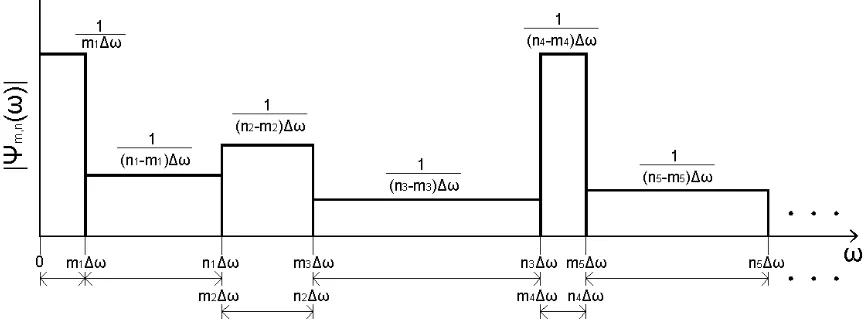
It has been proved [19] that a collection of harmonic wavelets spanning adjacent
non-overlapping intervals at different scales along the frequency axis, as shown
schematically in Fig. 1, forms a complete orthogonal basis. Then, the pertinent
(
, ,)
( )
( , ),m n k( )
o n m
W f m n k f t t dt T ψ ψ ∞ −∞ − ⎡ ⎤ =
⎣ ⎦
∫
, (28)projects any finite energy signal f(t) on this basis function. In Eq. (28) the bar over a symbol stands for complex conjugation. It is emphasized that the orthogonal property of
the harmonic wavelet basis allows for a perfect reconstruction of the original signal given
its HWT, and is associated with energy preservation concepts.
3.2 Iterative matching scheme
It can be deduced by the preceding exposition that the HWT decomposes a real
signal f(t) into several sub-signals fm,n (t), each one of them corresponding to a certain band of frequencies defined by the (m,n) pair, so that [20]
( )
,( )
,m n m n
f t =
∑
f t , (29)where
( )
1(
)
( )
, ( , ),
0
2 Re n m , ,
m n m n k
k
f t − − W fψ m n k ψ t
=
⎧ ⎡ ⎤ ⎫
= ⎨ ⎣ ⎦ ⎬
⎩
∑
⎭. (30)Taking into consideration the discussions of section 2.1 concerning the shape of
the transfer function of lightly damped SDOF oscillators, it can be argued that a specific
part fmj,nj(t) of the original signal f(t) will mainly influence the response of those SDOF oscillators whose natural frequencies fall within the interval [mjΔω, njΔω]. Thus, an iterative modification procedure can be devised to improve the matching of the
( )
( )
( )( )
( )
( )( )
1 , , n dv v m
m n m n n v m
S d
f t f t
D d ω ω ω ω ω ω ω ω Δ + Δ Δ Δ =
∫
∫
, (31)where D(v)(T) is the displacement response spectrum related to f(v)(t) which is obtained by Eq. (29). Note that a sufficient number of properly defined (m,n) pairs should be used to cover all frequencies of interest. Furthermore, the width (n-m)Δω of the various pairs can be arbitrarily small and varying among different scales, as illustrated in Fig. 1 for a given
duration To. This yields a significant advantage over the modified Littlewood-Pauley basis which defines intervals of logarithmically increasing width on the frequency
domain as it proceeds towards the higher frequencies [13]. Numerical evidence, and
additional comments on this feature of the harmonic wavelets in practical terms are
provided in sections 4.3 and 4.4.
3.3 Baseline correction considerations
Artificial seismic accelerograms to be used in the earthquake resistant design of
structures require that certain baseline corrections must be performed as in the case of
any recorded accelerogram [38]. This requirement has been reported and addressed by
several researchers in the past (e.g. [4], [12], [13]). It stems from the need to produce
accelerograms yielding realistic displacement traces. To this end, processing of the
accelerograms with a Butterworth high-pass filter of order 4 and cut-off frequency of
0.10Hz is employed in this study to acquire baseline corrected accelerograms.
Anti-causal zero-phase filtering is carried out. That is, the accelerogram is filtered once by the
and passes through the same filter again. In this manner, no phase distortion takes place,
and thus the properties of the filter considered have minimum impact on both the shape
of the displacement time-histories and the long period displacement spectral ordinates
[39]. Appropriate zero-padding before the initiation and at the end of the accelerograms is
performed before applying the anti-causal filter [40]. These pads are retained throughout
the integrations to construct compatible suites of acceleration, velocity and displacement
records [41].
4. Application to the Eurocode 8 design spectrum
This section provides numerical results pertaining to the displacement design
spectrum prescribed by the European aseismic code provisions (EC8) given in Appendix
A. In this context, an estimate for the value of the peak factor which yields a better
matching of the average response spectra of simulated accelerograms with the target
spectrum is proposed. Furthermore, an assessment of the three spectral forms of section
2.2 is included. The performance of the harmonic wavelet-based iterative scheme is also
demonstrated using a single simulated signal. Lastly, it is shown how to take advantage
of the versatility of the generalized harmonic wavelet basis to satisfy the compatibility
criteria for artificial accelerograms mandated by the EC8.
4.1 Selection of the peak factor r
to the ratio of the maximum mean (μ) over the maximum standard deviation (σ) for
Rayleigh distribution. That is, [16]
{ }
{ }
max
max 2
a a
r μ π
σ
= = . (32)
However, extensive numerical experimentation (Monte Carlo simulations), not included
here for brevity, pertaining to the EC8 design spectrum has shown that adopting the
above value for r yield rather conservative results. In particular, the obtained response spectral ordinates of the simulated time-histories tend to be, on average, rather larger than
the target ones for all natural periods considered. Notably, a similar trend is witnessed in
the numerical results of the relevant research work by Spanos and Vargas Loli (1985)
[16] for the case of the Newmark-Blume-Kapur and the Housner design spectra. In this
respect, it is noted that the aforementioned numerical experiments have suggested that, at
least in the case of the EC8 spectrum, adopting a peak factor 25% larger than that of Eq.
(32) yields ensembles of artificial accelerograms whose average response spectra are
close to the corresponding design spectra while a desirable level of conservatism is
maintained. Thus, the latter value is the one adopted for r for all the ensuing numerical results included in this study.
4.2 Assessment of various evolutionary power spectral forms
Let the EC8 displacement design spectrum for soil conditions B, damping ratio ζ=
5%, and peak ground acceleration (PGA) equal to 36% the acceleration of the gravity (g) be the target spectrum (see also the Appendix A). The minimization problem set by Eq.
(16) is solved for the three spectral forms defined in section 2.2. Namely the KT
Butterworth filtered Kanai-Tajimi (BWKT) spectrum (Eqs. (9) and (11)), modulated by
the BGB envelop function (Eq. (8)) on an interval [Tmin, Tmax] of the axis of natural periods. The numerical values of the requisite parameters to defining the design spectrum
compatible evolutionary power spectral forms under consideration are given in Table 1.
It is noted that in the BWKT case, the cut-off frequency ωo of the high-pass filter
of Eq. (12) has been judicially selected to coincide with the “corner” period TD= 2sec (see Fig. (A1) of Appendix A), prior to the solution of Eqs. (16)-(18). Incidentally, the value
of TD is the same for all soil types [22], and thus the selected value for ωο is globally applicable. Should this specification change in future versions of the EC8, it is suggested
to always set the cut-off frequency of the Butterworth filter equal to the corner period TD; extensive numerical testing has found this to be an effective choice. Moreover, the order
of the Butterworth filter was set to N= 2, so that a meaningful comparison with the CP case to be possible.
It should be noted that for all soil conditions, the EC8 assumes that the maximum
displacement of oscillators of natural period greater than 10 sec is independent of the
stiffness of the oscillators, that is, it attains a constant value equal to the maximum
displacement of the ground (see also Fig. A1 of Appendix A). Thus, extending the
point-wise matching to periods beyond 10sec will not capture any additional physics to the
optimization problem at hand. Hence, it is logical to assume Tmax= 10 sec. In both the CP and BWKT cases of Table 1 excellent point-wise matching at 100 frequencies ωn has
been achieved on the interval [0.63, 314.16] (rad/sec) which is mapped onto the interval
greater than TD= 2sec (i.e. to frequencies lower than 3.14 rad/sec) results in an unacceptably poor matching. An example is shown in Fig. 2 for Tmax= 4sec. In fact, the optimization algorithm completely fails in the KT case for Tmax>TE (= 5 sec for soil B).
This is because the KT spectrum does not incorporate enough “degrees of freedom” to
effectively trace the given design spectrum in the region of relatively long periods. This
aspect is interwoven with the incapability of the KT filter to effectively suppress the low
frequencies as have been discussed to some extent in section 2.2. This disadvantage of
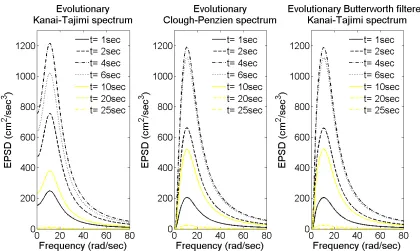
the KT spectral form can also be inferred by Fig. 3 where plots of certain evolutionary
power spectra of Table 1 are presented. In the same figure, it is observed that all spectra
remain relatively broad throughout their effective duration and that their energy becomes
negligible after 25 seconds.
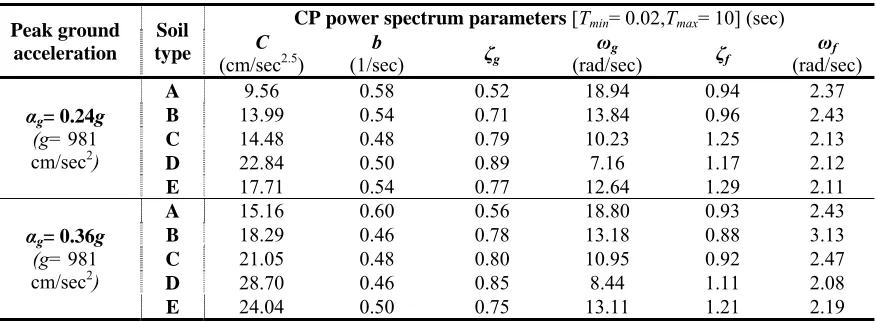
Additional evolutionary CP power spectra compatible with EC8 design spectra for
two different levels of intensity, and for all soil types defined in EC8 are included in
Table 2. These results provide evidence that the values of the parameters yielded by the
optimization solver are not numerical artifacts but actually reflect the physical aspects of
the problem. Indeed, even though soil characterization is beyond the scope of the present
study, it can be readily seen that the various soil conditions are represented by the power
spectrum parameters. For instance, the value of ωg decreases while the damping ratio ζg
increases marching from stiff (i.e. type A) towards softer soil conditions (i.e. type D).
More importantly, Table 2 can be used as an interpolation guide for assigning initial/seed
values for the unknown parameters required by all common optimization algorithms for
the solution of Eqs. (16)-(18); this is especially pertinent in case the use of a different
Three ensembles of 40 accelerograms, each compatible with the KT (Tmax= 2sec), the BWKT, and the CP power spectra presented in Table 1 are synthesized using Eq. (19)
and a discrete version of Eq. (1). The sampling interval has been taken equal to 0.01 sec
to satisfy the condition of Eq. (22), and the duration of each record is 40sec. Baseline
corrected versions of these records have been also produced using the methodology
detailed in section 3.3. The average displacement response spectra for 5% damping of
each of the ensembles are plotted in Figs. 4-6 for both the uncorrected (dotted lines) and
the baseline corrected (solid lines) signals versus the target spectrum. In the same figures,
the largest and smallest maximum displacement responses along with the medians are
also shown versus the natural period of the oscillators considered to illustrate the
statistical nature of the obtained spectral ordinates.
The fact that the KT spectrum does not filter the very low-frequency content in
the acceleration traces causes difficulties in the corresponding displacement
time-histories. This attribute ultimately affects the matching of the displacement response
spectra with the target spectrum exhibiting undesirable trends as evidenced in Fig. (4).
Clearly, the KT spectrum is not an optimal choice for the purpose. However, both the
BWKT and the CP spectra yield satisfactory and practically similar results. Evidently,
these spectra can be used interchangeably to shape the form of the evolutionary power
spectrum of Eq. (2). To this end, note that the BWKT featuring the predefined high-pass
Butterworth filter involves fewer free parameters to be determined. Furthermore, it is
usually more convenient/ intuitive in practice to define a high-pass filter in signal
processing terms; namely by selecting the properties of a typical IIR filter, versus
proposed BWKT filter may be more advantageous over the CP filter from a practical
perspective.
4.3 Performance of the iterative Harmonic Wavelet-based matching procedure
In the context of the HWT, the efficiency of the iterative procedure outlined by
Eq. (31) to modify a certain accelerogram for achieving a better matching of its response
spectrum with a given design spectrum at all frequencies relies on the total number of the
wavelet scales (bins of Fig. 1) considered. For a specific range of frequencies, and
assuming uniform width for all scales, this number depends on the difference n-m (see Eq. (24)), and on the duration To of the accelerogram through the value of Δω (see Eq.
(25)). Addressing the second dependence, it is a common practice in standard Fourier
analysis to artificially augment the duration of a signal by adding zeros at the end of the
record for obtaining a more adequate representation of the original signal in the
frequency domain. This technique can be used herein to obtain a smaller value of Δω
which eventually yields a larger number of scales for a fixed value of n-m. Then, upon reconstructing the modified signal using Eq. (29), the artificially appended segment can
be discarded. It is noted that for all practical cases the latter operation will have negligible
impact on the response spectrum of the modified signal and thus on the matching with the
design spectrum, since most of the signal energy would have been released at earlier
times.
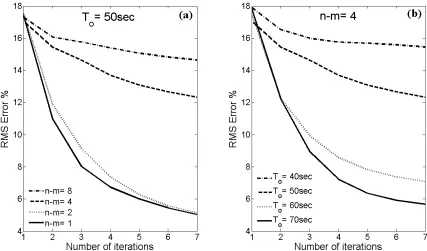
Fig. 7 provides a numerical example involving a single 40sec long artificial
accelerogram belonging to the previously presented BWKT ensemble to further elucidate
of the seismic record D(T) and the target spectrum Sd(T) is gauged against the number of iterations performed in terms of the root-mean-squared error (RMS). That is, the
( ) ( )
( )
2
1
1 Nk
d j j
j
k d j
S T D T
RMS error
N = S T
⎛ − ⎞
⎜ ⎟
=
⎜ ⎟
⎝ ⎠
∑
(33)is evaluated at Nk= 250 equally spaced points on the interval [0.02, 5] of natural periods
T. Note that evaluating the RMS error for T>5sec does not serve the purpose of assessing the performance of the iterative matching procedure since at this range of periods the
behavior of the response spectrum is primarily governed by the necessary baseline
adjustments (see also Figs. 4-6). In Fig. 7a four harmonic wavelet bases of various scale
widths (n-m), constant at all frequencies are used for processing the same artificially augmented record by 10sec of total duration To= 50sec. In Fig. 7b, the difference n-m is fixed to 2, and the original signal with To= 40sec plus three other records zero-padded to various total durations are considered. As expected, use of smaller n-m values and/or larger signal durations To achieves better and faster convergence of the response spectrum to the target spectrum. This, of course, comes at the expense of increased computational
effort per iteration.
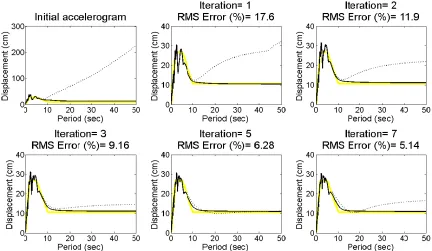
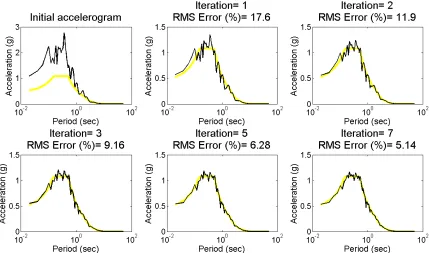
Figs. 8 and 9 provide snapshots of the improved matching achieved by means of
the proposed harmonic wavelet-based iterative scheme in terms of the displacement and
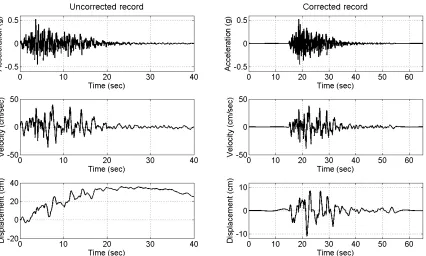
the pseudo-acceleration spectra respectively for n-m=2 and To= 50sec. Furthermore, Fig. 10 includes the acceleration, velocity and displacement time histories of the uncorrected
and the baseline corrected record considered in Figs. 8 and 9 after 7 iterations. The
obvious low-frequency unnatural trend of the displacement trace of the uncorrected
trace. As discussed in section 2.3, an appropriate number of zeros have been appended in
the beginning and at the end of the signal prior to the baseline adjustment [21]. These
padded segments are maintained throughout the integrations to derive a suite of
compatible acceleration, velocity, and displacement traces [40]. As can be inferred by
Fig. 10 ,this need is justified by the fact that both the velocity trace and to a greater extent
the displacement trace of the corrected accelerogram attain significant non-zero values
during these initial and final appended segments. These values are artifacts that represent
the end effects induced by the application of anti-causal filtering. However, their
relatively small intensity has minor contribution to the response spectral ordinates [39].
4.4 Adjustment of the Harmonic Wavelet basis to meet the EC8 compatibility criteria
Noticeably, most of the contemporary regulations adopt compatibility criteria for
artificial accelerograms to be used for the earthquake resistance design of structures
significantly different from what Eq. (33) suggests. For a structure of fundamental natural
period T1, the EC8 requires considering a collection of at least three accelerograms
obeying the following two rules: (a) The average of the zero period spectral response
acceleration values calculated from the individual time histories should be greater than
the product αgS (see also the Appendix), and (b) In the range of periods [0.2T1, 2T1] no
value of the average response spectrum for 5% damping, calculated from all time
histories, should be less than 90% of the corresponding value of the 5% damping design
spectrum [22]. These rules can be mathematically expressed by the equations:
1
1
1
s
N j j
s g
PGA N
a S
= >
∑
and
( )
( )
1 1 1 1min 0.90 , 0.2 2
s N j j s T d D T N
T T T S T
=
⎧ ⎫
⎪ ⎪
⎪ ⎪ > ≤ ≤
⎨ ⎬ ⎪ ⎪ ⎪ ⎪ ⎩ ⎭
∑
, (35)where Ns≥ 3 is the number of accelerograms considered while PGAj and Dj(T) are the peak ground acceleration and the displacement response spectrum of the j-th
accelerogram, respectively.
Taking advantage of the versatility of the generalized harmonic wavelets, already
discussed to some detail in section 3.2, a case-dependent wavelet base featuring scales of
non-uniform bandwidths (n-m)Δω across the frequency axis can readily be constructed. The objective is to have a more detailed discretization of the frequency domain in the
range of frequencies corresponding to the interval [0.2T1 2T1] and a sparser grid outside
this range. In this fashion, more weight is assigned to obtaining enhanced agreement of
the response spectral ordinates of the accelerograms with the target spectrum for the
oscillators whose natural frequencies lie closer to the fundamental period T1 of interest.
This renders the iterative matching procedure much more efficient and cheaper in
computational cost.
For instance, suppose a structure of fundamental natural period T1= 1.5 sec is to be designed for PGA= 0.36g and soil conditions B. Three arbitrarily selected
accelerograms out of the previously generated BWKT ensemble are processed using Eq.
(31) by means of a generalized harmonic wavelet basis with n-m =1 in the range of frequencies [2.09, 20.93] (rad/sec). This band corresponds to the range [0.3, 3] (sec) of
zero-padding at the end of the records has been considered prior to the modification of
the signals so that their total duration equals 50sec. This additional segment is completely
removed, as previously explained, after the required spectrum matching is achieved and
before any high-pass filtering for the baseline adjustment is made. After only four
iterations the compatibility criteria of EC8 are satisfied for the baseline corrected
artificial seismic signals. Specifically, the ratios of Eqs. (34) and (35) are computed as
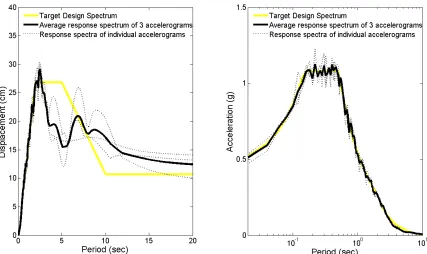
1.19 (>1) and 0.92 (>0.90), respectively. The individual and the average displacement
and pseudo-acceleration response spectra of the three thus obtained signals are shown in
Fig. 11; Fig. 12 includes the acceleration, velocity and displacement traces these signals
in the time domain.
5. Concluding remarks
A stochastic approach for simulating non-stationary strong ground motion records
compatible with a given design displacement (target) spectrum in combination with a
harmonic wavelet-based iterative procedure have been presented. Without loss of
generality, the design spectrum prescribed by the European aseismic code provisions
(EC8) has been exclusively considered in all numerical examples provided.
At first, a previously established in the literature stochastic method has been
extended to relate in an approximate manner the target spectrum with a modulated
evolutionary power spectrum (EPS), which is parametrically expressed by an analytical
formula. This is accomplished by the use of a constant peak factor whose value has been
calibrated via Monte Carlo simulations pertaining to the EC8 design spectrum. Upon
spectrum have been synthesized using an appropriate auto-regressive-moving-average
filter driven by white noise. It has been shown numerically that a reasonable agreement
of the average response spectra of these accelerograms with the EC8 design spectrum can
be achieved if the assumed spectral form of the EPS can effectively suppress the spurious
low-frequency components of the underlying non-stationary process. In this respect, the
Kanai-Tajimi power spectrum has been found rather inappropriate for the purpose, while
the Clough-Penzien spectrum and a newly proposed Butterworth-filtered-Kanai-Tajimi
spectrum constitute viable choices for defining the requisite EPS.
It is acknowledged that the initially determined stochastic model yields
accelerograms whose frequency composition does not evolve with time, as is the case for
usual recorded seismic signals. Nevertheless, it does possess a significant practical merit
since it can yield any required number of design spectrum compatible artificial seismic
accelerograms, “from scratch”, without the need of having access to any real records.
Furthermore, it has been verified by numerically obtained EPSs associated with various
levels of seismic intensity and for all soil types prescribed by the EC8 that the proposed
approach captures reliably the site-specific soil conditions, as they are reflected in the
EC8 design spectrum. Clearly these results, given in a tabular form, can facilitate the
application of stochastic dynamics-based seismic risk assessment of contemporary
constructed facilities.
Subsequently, the wavelet transform has been employed to decompose the
simulated signals in a generalized harmonic wavelet basis of functions. In this regard, an
iterative scheme has been used to process individually each of the decomposed signals to
shown how to take advantage of the unique attributes of harmonic wavelets to construct
appropriately customized basis to efficiently treat small suites of simulated accelerograms
for satisfying compatibility criteria for artificial accelerograms posed by the EC8.
Special attention has also been given in obtaining records possessing realistic
velocity and displacement traces. In this respect, a state-of-the-art baseline correction
technique, used in the processing of recorded accelerograms pertaining to actual seismic
events, has been adopted. This step is critical for the design of extremely flexible
structures or of structures expected to exhibit severe inelastic behavior. In fact, the
attained values of the displacement spectral ordinates of the simulated records and thus
their closeness to the corresponding target spectrum in the region of long periods is
exclusively governed by the baseline adjustment considerations.
Obviously, the two distinct techniques presented in this study, namely the
evolutionary power spectrum-based representation of the seismic severity and the
subsequent wavelet-based iterative modification procedure of individual accelerograms
can be used independently to address, as well, certain needs arising in the practice of
aseismic design of structures. Specifically, the former may be used in conjunction with
any appropriate stochastic dynamics technique (e.g. Monte Carlo-based [18] or statistical
linearization-based [42]), for design scenarios necessitating the incorporation of the
uncertainty attributes of the seismic hazard, explicitly. Further, the latter can be readily
utilized to modify real recorded accelerograms in cases where accounting for the
temporal evolution of the frequency content of strong ground motions is deemed
essential. In both cases, the numerical results presented herein could be of particular
Acknowledgements
The financial support of this work by a grant from NSF is greatly acknowledged.
References
[1] Ahmadi G. Generation of artificial time histories compatible with given response spectra- A review. Solid Mech Arch 1979;4:207-239.
[2] Spanos PD. Digital synthesis of response-design spectrum compatible earthquake records for dynamic analyses. Shock Vib Digest 1983;15:21-30.
[3] Preumont A. The generation of spectrum compatible accelerograms for the design of nuclear power plants. Earthquake Eng Struct Dyn 1984;12:481-497.
[4] Naeim F, Lew M. On the use of design spectrum compatible time histories. Earthquake Spectra 1995;11:111-127.
[5] Carballo JE, Cornell CA. Probabilistic seismic demand analysis: Spectrum matching and design. Report RMS-41, Department of Civil and Environmental Engineering, Stanford University; 2000.
[6] Wang J, Fan L, Qian S, Zhou J. Simulations of non-stationary frequency content and its importance to seismic assessment of structures. Earthquake Eng Struct Dyn 2002;31:993-1005.
[7] Wen YK, Gu P. Description and simulation of nonstationary processes based on Hilbert spectra. J Eng Mech ASCE 2004;130:942-951.
[8] Gupta ID and Joshi RG. On synthesizing response spectrum compatible accelerograms. Eur Earthquake Eng 1993;7(2):3-12.
[9] Shrinkhande M and Gupta VK. On generating ensemble of design spectrum-compatible accelerograms. Eur Earthquake Eng 1996;10(3):49-56.
[10] Conte JP, Peng BF. Fully nonstationary analytical earthquake ground-motion model. J Eng Mech ASCE 1997;123:15-24.
[11] Lin C-CJ, Ghaboussi J. Generating multiple spectrum compatible accelerograms using stochastic neural networks. Earthquake Eng Struct Dyn 2001;30:1021-1042.
[13] Mukherjee S and Gupta VK. Wavelet-based generation of spectrum-compatible time-histories. Soil Dyn Earthquake Eng 2002;22:799-804.
[14] Hancock J, Watson-Lamprey J, Abrahamson NA, Bommer JJ, Markatis A, McCoy E, Mendis R. An improved method of matching response spectra of recorded earthquake ground motion using wavelets. J Earthquake Eng 2006;10:67-89.
[15] Naeim F, Alimoradi A, Pezeshk S. Selection and scaling of ground motion time histories for structural design using genetic algorithms. Earthquake Spectra 2004;20:413-426.
[16] Spanos PD, Vargas Loli LM. A statistical approach to generation of design spectrum compatible earthquake time histories. Soil Dyn Earthquake Eng 1985;4:2-8.
[17] Priestley MB. Evolutionary spectra and non-stationary processes. J Royal Stat Soc B 1965;27:204-237.
[18] Spanos PD, Zeldin BA. Monte Carlo treatment of random fields: A broad perspective. Appl Mech Rev 1998;51:219-237.
[19] Newland DE. Harmonic and musical wavelets. Proc Royal Soc Lond A 1994;444:605-620.
[20] Spanos PD, Tezcan J, Tratskas P. Stochastic processes evolutionary spectrum estimation via harmonic wavelets. Comp Meth Appl Mech Eng 2005;194:1367-1383.
[21] Converse AM, Brady AG. BAP: basic strong-motion accelerogram processing software, version 1.0. Open File Report 92-296A. United States Department of the interior Geological Survey; 1992.
[22] CEN. Eurocode 8: Design of Structures for Earthquake Resistance - Part 1: General Rules, Seismic Actions and Rules for Buildings. EN 1998-1: 2003 E. Comité Européen de Normalisation, Brussels, 2003.
[23] Kanai K. Semi-empirical formula for the seismic characteristics of the ground. University of Tokyo, Bull Earthquake Research Institute 1957;35:309-325.
[24] Clough RW, Penzien J. Dynamics of structures. Second Edition. Mc-Graw Hill, New York, 1993.
[25] Parks TW, Burrus CS. Digital Filter Design. John Wiley & Sons, New York, 1987.
[27] Spanos PD, Solomos GP. Markov approximation to transient vibration. J Eng Mech Div ASCE 1983;109:1134-1150.
[28] Vanmarcke EH. Structural response to earthquakes. Seismic Risk and Engineering Decisions (Eds. Lomnitz C, Rosenblueth E). Elsevier, Amsterdam, 1976.
[29] Der Kiureghian A. Structural response to stationary excitation. J Eng Mech Div ASCE 1980;106:1195-1213.
[30] Spanos PD. Numerics for common first-passage problem. J Eng Mech Div ASCE 1982;108:864-882.
[31] Bogdanoff JL, Goldberg JE, Bernard MC. Response of a simple structure to a random earthquake-type disturbance. Bull Seism Soc Am 1961;51:293-310.
[32] Politis NP, Giaralis A, Spanos PD. Joint time-frequency representation of simulated earthquake accelerograms via the adaptive chirplet transform. Computational Stochastic Mechanics-5 (Eds. Deodatis G, Spanos PD). Millpress, Rotterdam, 2007.
[33] Lai SP. Statistical characterization of strong ground motions using power spectral density function. Bull Seism Soc Am 1982;72:259-274.
[34] Manolis GD, Koliopoulos PK. Stochastic Structural Dynamics in Earthquake Engineering. WIT Press, Southampton, 2001.
[35] Nocedal J, Wright SJ. Numerical Optimization. Springer- Verlag, New York, 1999.
[36] Spanos PD, Mignolet MP. Z-transform modeling of p-m wave spectrum. J Eng Mech ASCE 1986;112:745-759.
[37] Newland DE. Time-frequency and time-scale signal analysis by harmonic wavelets. Signal analysis and prediction (Eds. Procházka A, Uhlír J, Rayner PJW, Kingsbury NG). Birkhaüser, Boston, 1998.
[38] Boore DM and Bommer JJ. Processing of strong-motion accelerograms: needs, options and consequences. Soil Dyn Earthquake Eng 2005;25:93-115.
[39] Boore DM, Akkar S. Effect of causal and acausal filters on elastic and inelastic response spectra. Earthquake Eng Struct Dyn 2003;32:1729-1748.
[40] Boore DM. On pads and filters: Processing strong-motion data. Bull Seism Soc Am 2005;95:745-750.
[42] Roberts JB, Spanos PD. Random Vibration and Statistical Linearization. Dover Publications, New York, 2003.
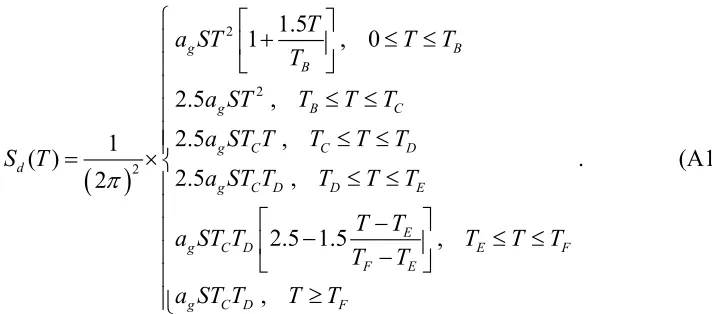
APPENDIX A
The elastic displacement response spectrum for oscillators with 5% ratio of
critical damping and natural period T, is defined by the European aseismic code
provisions (EC8) [22] by the expression
( )
2
2
2
1.5
1 , 0
2.5 , 2.5 , 1 ( ) 2.5 , 2
2.5 1.5 ,
,
g B
B
g B C
g C C D
d
g C D D E
E
g C D E F
F E
g C D F
T
a ST T T
T
a ST T T T a ST T T T T S T
a ST T T T T T T
a ST T T T T
T T a ST T T T
π ⎧ ⎡ ⎤ + ≤ ≤ ⎪ ⎢ ⎥ ⎣ ⎦ ⎪ ⎪ ≤ ≤ ⎪ ⎪ ≤ ≤ ⎪ = × ⎨ ≤ ≤ ⎪ ⎪ ⎡ − ⎤ ⎪ ⎢ − ⎥ ≤ ≤ ⎪ ⎣ − ⎦ ⎪ ≥ ⎪⎩ . (A1)
In this equation, αg is the peak ground acceleration (PGA), S is a soil-dependent amplification factor, and TB, TC, TD, TE, and TF are soil-dependent corner periods which
define the various branches of the design spectrum, as shown in Figure A1. The values of
[image:37.612.160.516.279.436.2]these quantities for the five different types of soil considered in EC8 are included in
Table 1. Parameters for the definition of various evolutionary power spectral forms compatible with the EC8 design spectrum for soil type B and peak ground acceleration
ag= 0.36g (g= 981 cm/sec2). KT spectrum
[Tmin= 0.02,Tmax= 2] (sec)
KT spectrum
[Tmin= 0.02,Tmax= 4] (sec)
BWKT spectrum
[Tmin= 0.02,Tmax= 10] (sec)
CP spectrum
[Tmin= 0.02,Tmax= 10] (sec) C= 19.05 cm/sec2.5
b= 0.51 sec-1
ζg= 0.71
ωg= 14.27 rad/sec
C= 7.66 cm/sec2.5 b= 0.25 sec-1
ζg= 0.47
ωg= 15.34 rad/sec
C= 17.20 cm/sec2.5 b= 0.45 sec-1
ζg= 0.74
ωg= 14.03 rad/sec
N= 2
ωο= 3.14 rad/sec
C= 18.29 cm/sec2.5 b= 0.46 sec-1
ζg= 0.78
ωg= 13.18 rad/sec
ζf= 0.88
[image:38.612.90.528.318.479.2]ωf= 3.13 rad/sec
Table 2. Parameters for the definition of CP evolutionary power spectra compatible with various EC8 design spectra.
Peak ground acceleration
Soil type
CP power spectrum parameters [Tmin= 0.02,Tmax= 10] (sec)
C
(cm/sec2.5) (1/sec) b ζg (rad/sec) ωg ζf (rad/sec) ωf
αg= 0.24g
(g= 981 cm/sec2)
A 9.56 0.58 0.52 18.94 0.94 2.37 B 13.99 0.54 0.71 13.84 0.96 2.43 C 14.48 0.48 0.79 10.23 1.25 2.13 D 22.84 0.50 0.89 7.16 1.17 2.12 E 17.71 0.54 0.77 12.64 1.29 2.11
αg= 0.36g
(g= 981 cm/sec2)
A 15.16 0.60 0.56 18.80 0.93 2.43 B 18.29 0.46 0.78 13.18 0.88 3.13 C 21.05 0.48 0.80 10.95 0.92 2.47 D 28.70 0.46 0.85 8.44 1.11 2.08 E 24.04 0.50 0.75 13.11 1.21 2.19
Table A1. Soil-dependent parameters for the definition of the EC8 design spectrum [22].
Soil type S TB (sec) TC (sec) TD (sec) TE (sec) TF (sec)
A 1.00 0.15 0.40 2.00 4.50 10.00
[image:38.612.127.482.563.634.2]Fig. 1. An example of a generalized harmonic wavelets basis spanning non-overlapping intervals of arbitrary bandwidths in the frequency domain.
[image:39.612.97.520.381.634.2]Fig. 3. Evolutionary power spectral forms given in Table 1. The plotted KT corresponds to the case of Tmax= 2sec.
[image:40.612.92.522.403.652.2]Fig. 5. Displacement response spectra of an ensemble of 40 simulated accelerograms compatible with the BWKT evolutionary power spectrum given in Table 1.
[image:41.612.98.523.388.644.2]