City, University of London Institutional Repository
Citation:
He, Y. and Jejjala, V. (2003). Modular matrix models (UPR-1048-T, VPI-IPPAP-03-12). Philadelphia: The University of Pennsylvania.This is the unspecified version of the paper.
This version of the publication may differ from the final published
version.
Permanent repository link:
http://openaccess.city.ac.uk/845/Link to published version:
UPR-1048-T, VPI-IPPAP-03-12Copyright and reuse: City Research Online aims to make research
outputs of City, University of London available to a wider audience.
Copyright and Moral Rights remain with the author(s) and/or copyright
holders. URLs from City Research Online may be freely distributed and
linked to.
arXiv:hep-th/0307293v2 8 Oct 2003
UPR-1048-T
VPI-IPPAP-03-12
hep-th/0307293
Modular Matrix Models
Yang-Hui He
†and Vishnu Jejjala
∗ [email protected], [email protected]†Department of Physics,
David Rittenhouse Laboratories, The University of Pennsylvania,
209 S. 33rd St., Philadelphia, PA 19104-6396, U.S.A.
∗Institute for Particle Physics and Astrophysics,
Physics Department, Robeson Hall, Virginia Tech,
Blacksburg, VA 24061-0435, U.S.A.
Abstract
Inspired by a formal resemblance of certain q-expansions of modular forms and the master field formalism of matrix models in terms of Cuntz operators, we construct a Hermitian
one-matrix model, which we dub the “modular one-matrix model.” Together with an N = 1 gauge theory and a special Calabi-Yau geometry, we find a modular matrix model that naturally
Contents
1 Introduction 3
2 Dramatis Personæ 5
2.1 The Klein Invariant j-function . . . 5
2.2 The One-Matrix Model . . . 7
2.3 The Master Field Formulation . . . 9
2.4 N = 1 Field Theory, Matrix Models, and Special Geometry . . . 12
3 Modular Matrix Models 14 3.1 Seeking the Master . . . 14
3.2 The Inverse j-function . . . 15
3.2.1 The Branch Cuts and Multi-Valuedness . . . 16
3.3 Obtaining the Matrix Model . . . 17
3.3.1 Some Salient Features of the Matrix Model . . . 20
3.3.2 A Closely Related Matrix Model . . . 21
3.3.3 Variations on a Theme by the Master . . . 22
3.4 A Dijkgraaf-Vafa Perspective . . . 23
3.4.1 An N = 1 Gauge Theory . . . 23
3.4.2 A Calabi-Yau Geometry . . . 24
W
enn nur ein Traum das Leben ist, Warum denn M¨uh’ und Plag’ ? Ich trinke, bis ich nicht mehr kann, Den ganzen, lieben Tag!1
Introduction
The recent resurrection of the old matrix model in string theory has invited the community to re-examine many intricate properties of random matrix integrals under a new light. The technology of using fat matrix Feynman diagrams to cover the Riemann surfaces associated to the string worldsheet is once more pertinent. Non-perturbative information about a wide class of N = 1 gauge theories is ascertained from partition functions of bosonic matrix models [2, 3, 4]. Moreover, the elegant relation between the spectral curve associated to the eigenvalues of a random matrix and the special Calabi-Yau geometry that is used to engineer the supersymmetric gauge theory has been pointed out.
A somewhat parallel phenomenon occurred in mathematics some two decades ago. McKay and Thompson observed [5] that the coefficients in the Fourier expansion of Klein’s modular invariant function j(q) are simple linear combinations of the dimensions of the irreducible representations of the then freshly-conjectured Monster sporadic group. This observation prompted the “Monstrous Moonshine” conjectures [6] that compelled mathematicians to re-investigate the century-old j -function with a modern eye. The finaltour de forceproof of the Moonshine conjectures by Borcherds [7] would employ methods that Frenkel, Lepowsky, and Meurman [8] borrowed from vertex algebra techniques arising from two-dimensional conformal field theory.
The j-function is not new to string theory. The modular invariant torus partition function for bosonic closed string theory on the 24-dimensional torus obtained by quotienting R24 on the Leech lattice1 is exactly determined by thej-function [10]:
ZLeech(q) =
ΘΛLeech(q)
η(q)24 =
P
β∈ΛLeech
q12β
2
η(q)24 =j(q) + const., (1) 1
The Leech lattice ΛLeechis the unique even, self-dual lattice in 24 dimensions with no points of length-squared
where η(q) = q1/24 Q∞
n=1
(1−qn) is the Dedekind η-function. The central charge of the conformal
field theory (CFT) fixes the constant term in Z(q). The Monster sporadic group is itself the automorphism group of (the Z2 orbifold of) this CFT.
We suggest that the parallels between recent trends in string theory and Moonshine run deeper still. Inspired by McKay’s often daring and insightful speculations, in this paper we formulate an observation that relates the matrix model description of field theories to the Klein invariant
j-function. We believe that this interrelation is non-trivial and itself hints at intricate and profound connexions among modular forms, simple groups, N = 1 gauge theories, and Calabi-Yau geometry, as well as to random matrix theory. String theory is a unifying principle that blends these disparate notions together.
The observation begins with the form of theq-expansion of thej-function, which is the following:
j(q) = 1
q +b0+b1q+b2q
2+. . . . (2)
This is reminiscent of an object in matrix models. There is a famous formulation of matrix models known as the “Master Field” [11], in which all correlation functions in the model can be computed without recourse to complicated integrals over infinite dimensional random matrices. For the (Her-mitian) one-matrix model, correlators are encoded in the master field ˆM, which is an operator acting on a certain Fock space of free probability. This master field is expandable in a basis of so-called Cuntz operators {a, a†} as
ˆ
M =a+m0+m1a†+m2(a†)2+. . . . (3)
And so an immediate task is evident. What is the matrix model whose master field is the Klein invariantj-function? What is its potential, its free-energy, and its density of eigenvalues? Utilizing further the Dijkgraaf-Vafa dictionary, what then are theN = 1 gauge theory whose Seiberg-Witten curve and the geometrically engineerable Calabi-Yau threefold whose special geometry encode this modular invariant? All these various players on the stage would naturally encode the q-coefficients of j(q), and hence by Moonshine, the irreducible representations of the Monster.
that any other meromorphic function that is modular invariant can be constructed from it. To consider how modular invariant functions translate to matrix models, it therefore makes sense to treat j(q) as the exemplar. Furthermore, the intimate relation between the j-function and the Monster group may suggest a new arena for examining the properties of the largest of sporadic groups using string theoretic and random matrix techniques. A realization of the Monster in terms of geometry and physics is by itself interesting.
The organization of this article is as follows. Section 2 will briefly review the pieces of our puzzle,
viz, the ellipticj-function, the master field formulation of the Hermitian one-matrix model, and the Dijkgraaf-Vafa correspondence. Next, in Section 3, we construct explicitly the matrix model whose master field is j(q). We shall dub this the modular matrix model. The potential for the model will enjoy the property that
V′(z)∼j−1(q) + 1
j−1(q), q =e
2πiz, (4)
forz ∈[1,∞)⊂R. We compute the relevant observables in this matrix model. Then, we construct the N = 1 gauge theory, its full non-perturbative superpotential, and the Calabi-Yau on which the theory may be geometrically engineered. In due course, we shall find a hyperelliptic curve which encodes the q-coefficients. This is perhaps related to a conjecture of Lian and Yau regarding the mirror map of a class of K3 surfaces as 1/j(q). We conclude with a discussion of various prospects that await our investigation.
2
Dramatis Personæ
In this section, we introduce three characters who shall play important rˆoles in our narrative,
viz, the Klein j-invariant, the master field formalism of Hermitian one-matrix models, and the Dijkgraaf-Vafa correspondence between supersymmetric gauge theories and matrix models. As all these notions figure prominently elsewhere in the literature, this section is included as a concise review.
2.1
The Klein Invariant
j
-function
We begin by introducing the most important function invariant under the modular group: the Klein invariant functionj(q), with q:=e2πiz. Thej-function2 is important because it is the unique
2
modular function in that all meromorphic functions invariant under SL(2,Z) are meromorphic functions of j(q). In terms of the Jacobi ϑ-functions, the j-function is defined as
j(q) := 1728 J(√q), (5)
J(q) := 4
27
(1−λ(q) +λ(q)2)3
λ(q)2(1−λ(q))2 , (6)
λ(q) :=
ϑ2(q)
ϑ3(q)
4
. (7)
The function J(q) is referred to as Klein’s absolute invariant.
The j-function is a modular invariant in the sense that under the SL(2,Z) transformation
z 7→z′ = az+b
cz+d, ad−bc= 1, a, b, c, d∈Z, (8)
j(q=e2πiz) =j(q′ =e2πiz′
). Thus, to study the behavior of the j-function, it suffices to look at the fundamental domain defined byH/SL(2;Z), whereH is the upper halfz-plane,{Im(z)>0}. The
j-function maps this domain to the complex numbers:
j(e2πiz) :H/SL(2;Z)→C. (9)
We briefly relate a number of other properties regarding the j-function [12]:
• The j-function is meromorphic on H/SL(2;Z).
• j(q) is an algebraic number, which is rational or integer at special values of q.
• The q-expansion of the modular invariant j-function is
j(q) = q−1+ 744 + 196884q+ 21493760q2+ 864299970q3+ (10)
20245856256q4+ 333202640600q5+ 4252023300096q6+. . . ,
which is convergent on the fundamental domain. Indeed, on the upper-half plane,Im(z)>0, and so q =e2πiRe(z)e−2πIm(z) has an exponential decay which overwhelms the growth of these
integer q-coefficients.
la r´esolution de l’´equation du cinqui`eme degr´e,”Comptes Rendus, 46(1858). Dedekind and Kronecker anticipated
• The coefficients in the q-expansion (10) are remarkable. They are simple linear combinations of the dimensions of the irreducible representations of the Fischer-Griess Monster sporadic group (also, the “Friendly Giant”):
j-function Monster 196884 = 1 + 196883,
21493760 = 1 + 196883 + 21296876,
864299970 = 2·1 + 2·196883 + 21296876 + 842609326, . . .
This beautiful observation due to McKay and Thompson [5], subsequently dubbed by Conway and Norton [6] as “Monstrous Moonshine,” was proved by Borcherds [7]. It is truly arresting that the most important modular function is related to the largest simple sporadic group. (See Ref. [13] for a fascinating tangled history of the Monster sporadic group and the modular
j-function.)
2.2
The One-Matrix Model
Our next ingredient comes from the physics of (0 + 1)-dimensional matrix quantum mechanics. We briefly recall some relevant facts about the zero-dimensional, one-matrix model. Our discussion follows the conventions of the review Ref. [14]. Let Φ be an N ×N Hermitian matrix,3 with its
potential given by V(Φ). The matrix model is then defined by the partition function Z, which is the following random matrix integral:
Z = 1
Vol(U(N))
Z
[DΦ] exp
−1
gTr V(Φ)
,
= 1
Vol(U(N))
Z N Y
i=1
dλi∆(λ)2exp −
N g
X
i
V(λi)
!
. (11)
In eq. (11), we have normalized by the volume Vol(U(N)) of the space of Hermitian matrices, and in the second line, we have written the integration over Φ in the basis of eigenvalues. The factor
∆(λ) = Y
i<j
(λj−λi) (12)
3
Such a Hermitian matrix has N real eigenvalues. One can equally well think of matrices Φ inGL(N,C) with
is called the Vandermonde determinant, which in the large-N limit, induces a repulsion between the eigenvalues of Φ. The integral in eq. (11) is performed using saddle point methods, obtained from the variation of the integrand with respect to a single eigenvalueλi. This dictates that toO(1/N),
that is to say, in the planar limit, 2
N X
j6=i
1
λi−λj
= 1
g V
′(λ
i). (13)
The value of the partition function at O(1/N) is therefore simply the integrand evaluated at the solutions to eq. (13), and hence the planar free energy is
F := 1
N2logZ =
1
N2 2 log ∆(˜λi)−
N g
X
i
V(˜λi)
!
, (14)
with ˜λi the solution of eq. (13). To solve eq. (13), we introduce the following trace, dubbed the
resolvent R(z) of our matrix model:
R(z) := 1
N Tr
1
z−Φ
= 1 N X i 1
z−λi
. (15)
Multiplying both sides of eq. (13) by 1/(z−λi) and summing over i, we arrive at the loop equation
R(z)2− 1
N R
′
(z)− 1
g V
′
(z)R(z) + 1
gN X
i
V′(z)−V′(λ
i)
λi−z
= 0. (16)
The term involving R′(z) drops out to leading order in N. Additionally, in the large-N limit, the
density of eigenvalues
ρ(λ) := 1
N X
i
δ(λ−λi) (17)
becomes continuous. The resolvent and the normalization conditions then read
R(z) =
Z
dλ ρ(λ)
z−λ,
Z
dλ ρ(λ) = 1. (18)
In terms of the eigenvalue density, the saddle point equation (13) becomes
2−
Z
dτ ρ(τ)
λ−τ =
1
g V
′
(λ), (19)
where by −R
we mean principal value integration. Likewise the loop equation (16) becomes
R(z)2− 1
gV
′(z)R(z)
− 1
with
f(z) := 4g Z
dλ ρ(λ)
z−λ(V
′(z)
−V′(λ)) = 4g
V′(z)R(z)
−
Z
dλρ(λ)V
′(λ)
z−λ
. (21)
Eq. (20) is now an algebraic equation in the resolvent, known as the spectral curve.
The key facts that we wish to extract from this discussion are that knowing the functionsρ(z) or
R(z) completely determines the partition functionZ, and hence the free energyF and subsequently all physical observables of the matrix model. Finding these two functions amounts to solving eqs. (18) and (19). These we recognize to be Fredholm integral equations of the first kind and Cauchy type, and the reader is referred to Refs. [16, 17] for a solution thereof (cf. Ref. [18] in this context). The idea is that R(z) is always a multi-valued function, for which we describe various branch cuts on the real line, the number of which is determined by the number of critical points of V′(z). We
shall shortly see that the one-cut model will be our chief interest. The discontinuity across the branch cut constitutes the solutions of eqs. (18) and (19). In particular, the density of eigenvalues captures the multi-valued piece of R(z),
ρ(z) = 1
2πilimǫ→0(R(z+iǫ)−R(z−iǫ)), (22)
while the potential captures the holomorphic piece,
− 1
gV
′
(z) = lim
ǫ→0(R(z+iǫ) +R(z−iǫ)). (23)
2.3
The Master Field Formulation
At large-N, there is an especially convenient formulation which computes the physical observables of the matrix model. This is the so-called Master Field formalism [11]. The observables are the correlators, i.e., the vacuum expectation values (vevs), of the operators Ok = Φk. These are
hOki=Z−1 lim N→∞
1
N Z
[DΦ] TrOkexp
−N
g Tr V(Φ)
, (24)
withZ given by eq. (11). The information captured in these correlation functions may be extracted by computing the trace of an auxiliary matrix known as themaster field. We shall quote the relevant results and refer the reader to Ref. [19] for further details.
The master field offers the following remarkable properties that follow from the application of
free probability theory [20]:
• No integration needs be performed to evaluate the correlators; it suffices to perform algebraic manipulations with
hOki= tr[Mk] := lim N→∞
1
NhTrM
k
i. (25)
• Any correlator in the free probability theory can be reduced to evaluating expectation values of powers of M.
To be more explicit, the master field M defines a linear functional ˆM acting on a Hilbert space. In analogy to the familiar ladder operators for harmonic oscillators, a basis for the Hilbert space is given by
(a†)n|0i. (26)
The creation operatora† is the adjoint ofa, which annihilates the vacuum
|0i. The operatorsa and
a† satisfy the Cuntz algebra:
aa† = 11, a†a=|0ih0|, with a|0i= 0. (27)
This is nothing but the q-deformed Heisenberg algebra, aa†−q a†a= 11, for the special case q = 0.
The operator ˆM associated to the master fieldM is a function ofaanda†. In particular, Voiculescu
has shown [20] that it is of the special form
ˆ
M(a, a†) = a+
∞
X
n=0
mn(a†)n (28)
with the {mn} some scalar coefficients of expansion.
Using eqs. (27) and (28), the vevs may be computed by commutations. These will turn out to be polynomials in {mn}. The first few such Voiculescu polynomialsare
hO1i = tr[M] := h0|Mˆ(a, a†)|0i=m0,
hO2i = tr[M2] := h0|Mˆ(a, a†)2|0i=m20+m1, (29) hO3i = tr[M3] := h0|Mˆ(a, a†)3|0i=m30+ 3m0m1+m2.
At each stage, a new coefficient emerges. Thus, one can recursively compute the coefficients {mn}
from the traces {tr[Mn]} and hence all physical observables in the matrix model.
It is convenient to map ˆM(a, a†), which is an operator on the Hilbert space, to a holomorphic
function in the complex plane:
K(z) = 1
z +
∞
X
n=0
Then
h0|F′( ˆM(a, a†))|0i= 1 2πi
I
C
dz F(K(z)), (31)
where F is any meromorphic function and C is a contour around the origin. A proof of this statement is given in Ref. [19]. Now, suppose we have found an operator ˆM such that
tr[Mk] = h0|Mˆ(a, a†)k
|0i, (32)
for allk. Then the resolvent R(z), which we recall from eq. (15), is simply the generating functional of the moments of the matrix M (i.e., the vevs), becomes, due to eq. (31),
R(z) =
Z
dλ ρ(λ)
z−λ = tr
1
z−M
=
∞
X
k=0
z−k−1tr[Mk] =
∞
X
k=0
z−k−1h0|Mˆ(a, a†)k|0i
=
∞
X
k=0
1
k+ 1z
−k−1 1
2πi I
C
dζ(K(ζ))k+1 =− 1
2πi I
C
dζ log[z−K(ζ)]. (33)
Putting K(ζ) =τ,ζ =K−1(τ) =:H(τ), we have
R(z) =− 1
2πi I
C
dτ H′(τ) log[z
−τ] = 1 2πi
I
C
dτ H(τ)
τ −z =H(z) =K
−1(z). (34)
The point d’appuiof the above discussion is that eq. (34) states that the resolvent is the inverse, with respect to composition, of the holomorphic function K(z) obtained from taking the operator
ˆ
M(a, a†) and making the formal replacements a7→1/zand (a†)n7→zn. Stated briefly,the resolvent
is the inverse of the master field.
Bearing this in mind, we now have an efficient method of generating the Voiculescu polynomials. Take a function with a Laurent expansion as follows (which is the form of K(z)),
f(z) = 1
z +b0+b1z+b2z
2+b
3z3+b4z4+. . . . (35)
Determining the inverse of this function order by order,4 we find that
f−1(z) = 1
z +
b0
z2 +
b02+b1
z3 +
b03+ 3b0b1+b2
z4 +
b04+ 6b02b1+ 2b12+ 4b0b2+b3
z5
+b0
5+ 10b
03b1+ 10b0b12+ 10b02b2+ 5b1b2+ 5b0b3+b4
z6 +. . . . (36)
4
This is done as follows. To first order, let f−1
(z) = 1
z + x
z2, then z = f−
1
(f(z)) implies 1 +xz +b0z =
1 + 2b0z+O(z2), givingx=b0. Iterating to next order, we letf−1(z) = 1
z+ b0
z2 +
x
z3, and matching the coefficients
ofz2
reads 3b2
We see the Voiculescu polynomials emerging naturally as the coefficients of expansion of the inverse. This is how one conveniently generates the expressions in eq. (29).
Let us entice the reader with a brief preview. We shall explore a particular one-matrix model using the technology of the master field. Our interest in this model is closely related to the formal substitutions we have made in defining K(z). We observe that the form of the Klein invariant
j-function is precisely that of the master field of a one-matrix model, and the coefficients of the j -function determine the Voiculescu polynomials. We need only make the formal replacement q−1 7→a
and qn 7→ (a†)n in the Laurent expansion of the j-function.5 This paper explores features of the
matrix model thus obtained.
2.4
N
= 1
Field Theory, Matrix Models, and Special Geometry
Our final ingredient comes from string theory. Recently, Dijkgraaf and Vafa [2, 3, 4, 22, 23] have made the remarkable observation that the holomorphic data, including the superpotential, of an
N = 1 theory in four dimensions can be computed from an auxiliary matrix model. The matrix model encodes both perturbative and non-perturbative aspects of the field theory. We shall summa-rize a few salient features of the correspondence. For simplicity, we examine anU(n) gauge theory with an adjoint chiral multiplet Φ and tree-level single-trace superpotential
Wtree(Φ) =
p+1
X
k=1
1
kgkTr Φ
k. (37)
• An effective low-energy action for Φ can be written in terms of the glueball superfield
S = 1
32π2 Tr W
α
Wα, (38)
where Wα is the gauge field strength of the U(n) vector superfield. The theory is treated
perturbatively in terms of Feynman diagrams, which are considered using ’t Hooft’s double line notation. Only the planar graphs contribute to the free energy! The full non-perturbative superpotential in terms of the glueball is
Weff(S) =n
∂
∂SF0(S) +S(nlog(S/Λ
3)−2πiτ), (39)
where F0(S) is the planar (genus zero) free energy and τ = 2θπ + 4gπi2 is the complexified
coupling.
5
Sinceq−1
·q7→aa† = 11 while q·q−1
• The field theory results are reproduced by an associated matrix model. We promote the chiral field Φ to anN×N Hermitian matrix.6 The potential of the matrix model, to be inserted into
the partition function (11), is formally the tree-level superpotential (37). The planar limit in the field theory is the sameas the large-N limit of the matrix model. The glueball superfield
S is identified with the ’t Hooft couplinggN in the matrix model.
• In the original papers [2, 3] the correspondence between four-dimensional N = 1 field theory and matrix models is mediated through Calabi-Yau geometry. The theory (37) is geometrically engineered [24, 25] on the (local) Calabi-Yau three-manifold
{u2+v2+y2+Wtree′ (x)2 =fp−1(x)} ⊂C4, (40)
where fp−1(x), an order (p−1) polynomial, is a complex deformation parameter, to be
iden-tified with its namesake parameter f(z) from eq. (21) that appears in the spectral curve (20). Let the volume form on the Calabi-Yau be Ω. Then the following special geometry relations, as period integrals along compactA-cycles and non-compact B-cycles, manifestly identify the glueball S:
Si =
Z
Ai
Ω, Πi:=
∂F0
∂Si
=
Z
Bi
Ω. (41)
The effective superpotential (cf. eq. (39)) [26] is
Weff(S) =
Z
CY3
G3∧Ω =
p
X
i=1
NiΠi+α
p
X
i=1
Si, Ni :=
Z
Ai
G3, α:=
Z
Bi
G3, (42)
where the Calabi-Yau has a three-form flux G3 = F3(RR) − τ H (N S)
3 , with τ the type IIB
axiodilaton. The constant α, independent of the choice ofB-cycle, is identified with the bare coupling of the low-energy Yang-Mills theory.
Now, the non-trivial part of the Calabi-Yau threefold (40) is the hyperelliptic curve
y2=Wtree′ (x)2 +fp−1(x), (43)
which encapsulates the Seiberg-Witten geometry [27] and encodes holomorphic information about the gauge theory. But this curve is precisely the spectral curve (20) of the corresponding matrix model! Geometry thus interpolates between a field theory and its associated matrix model.
6
3
Modular Matrix Models
Having set the stage for our analyses and the grounds for our speculation, in this section, we will introduce our protagonist: themodular matrix models. We have already mentioned in passing at the end of§2.3 the formal resemblance between the Cuntz-expansion of the master field in a Hermitian one-matrix model and the q-expansion of the j-function, or indeed of an abundance of modular forms. It is now our purpose to perform the analysis in detail and construct the matrix model whose master field is the j-function. We shall name this model, and any similar models for other modular forms with analogous q-expansion, the “modular matrix model.”
3.1
Seeking the Master
We recall from eq. (10) that the j-function affords the q-expansion
j(q) = 1
q +
∞
X
n=0
mnqn =
1
q +m0+m1q+. . . (44)
with coefficients
{m0, m1, . . . , m6, . . .}=
{744,196884,21493760,864299970,20245856256,333202640600,4252023300096, . . .}.
(45)
Next, we recall that the C-number version of the master field, defined as K(z) in eq. (30) is
K(z) = 1
z +
∞
P
n=0
mnzn. Caveat emptur! We are here establishing an identification not with K(z) as
was done in eq. (30), but rather with K(q), where q=e2πiz, i.e.,
j(q)≃K(q) = 1
q +
∞
X
n=0
mnqn. (46)
This is a simple change of variables. We know that j(q) has the correct expansion that resembles the master field and hence can be used in that its coefficients yield the desired vevs. The resolvent, according to eq. (34), is the inverse, being careful now to use q = e2πiz. Therefore, we must
determine the inverse function of j(e2πiz) as a function of z. We shall see below that this is a
well-known function. We summarize by stating that we seek a matrix model whose resolvent is given by
3.2
The Inverse
j
-function
As a brief prelude, we remind the reader that the inverse function toj(q) can readily be determined order by order:
j−1(q) = 1
q +
744
q2 +
750420
q3 +
872769632
q4 +
1102652742882
q5 +
1470561136292880
q6 +. . . . (48)
That is,
j−1(q) =
∞
X
k=0
1
qk+1ak−1, q =e
2πiz, (49)
where ak = ak({mi}ki=0) is the k-th Voiculescu polynomial in the coefficients of the j-function as
given in eq. (48) anda−1 = 1 by definition.7
This expansion, to which we shall return, will of course give us no information about the cut-structure. Indeed, the previous subsection dictates that it is j−1(e2πiz) that is required. Now, the
inverse function of Klein’s absolute invariant J(e2πiz) is well-known; see for example, Ref. [29]. We
have that
J−1(z) = i
2 ˜
r(z)−s˜(z)
˜
r(z) + ˜s(z), (50)
˜
r(z) := Γ
5 12
2
2F1
1 12, 1 12; 1 2; 1−z
, (51)
˜
s(z) := 2(√3−2) Γ
11 12
2√
z−1 2F1
7 12, 7 12; 3 2; 1−z
, (52)
where 2F1(a, b;c;z) is the standard hypergeometric function and the range is
|J−1(z)| ≥1, −1
2 ≤Re(J
−1(z))≤0 for z ∈C. (53)
Subsequently, we can determine the inverse of the j-function from eq. (5), which we recall to be
j(e2πiz) = 1728J(eπiz), (54)
as
j−1(z) =i
r(z)−s(z)
r(z) +s(z)
, r(z) := ˜r z
1728
, s(z) := ˜s z
1728
. (55)
Henceforth, we send z/1728→z and use this rescaled z without ambiguity.
7
3.2.1 The Branch Cuts and Multi-Valuedness
Let us analyze the branch cuts of eq. (55). 2F1(a, b;c;z) is a single-valued function on C with a
single branch cut (1,∞), where it is continuous from below, i.e., for z >1,
lim
ǫ→02F1(a, b;c;z−iǫ) =2F1(a, b;c;z),
lim
ǫ→02F1(a, b;c;z+iǫ) =
2πieπi(a+b−c)Γ(c)
Γ(c−a)Γ(c−b)Γ(a+b−c+ 1)2F1(a, b;a+b−c+ 1; 1−z) +e
2πi(a+b−c)
2F1(a, b;c;z).
(56)
Therefore, the branch cut we take for 2F1(a, b;c; 1−z), which appears in eq. (55) will be (−∞,0).
Also, we take the branch cut (1,∞) for √z−1. In conjunction, therefore, we have that
r(z)→
iǫ −iǫ
z ∈(−∞,0) −eπi3 r(z) +t(z) r(z)
z ∈(0,1) r(z) r(z)
z ∈(1,∞) r(z) r(z)
, t(z) := 2ie
−πi 3 π3/2
Γ 2 3
2F1 1 12, 1 12; 2 3;z
, (57)
and that
s(z)→
iǫ −iǫ
z ∈(−∞,0) −eπi3 s(z) +u(z) s(z)
z ∈(0,1) s(z) s(z)
z ∈(1,∞) s(z) −s(z)
,
u(z) := 2(√3−2)√z−1 2ie
−πi 3π3/2
Γ 2 3
2F1 7 12, 7 12; 2 3;z
.
(58)
Recalling finally the relation (47), we find that
R(z+iǫ)±R(z−iǫ) =
i e πi
3 (s−r)+(t−u)
−eπi3 (s+r)+(t+u) ±i
r−s
r+s, z ∈(−∞,0);
(1±1)ir−s
r+s, z ∈(0,1);
ir−s
r+s±i r+s
r−s, z ∈(1,∞).
3.3
Obtaining the Matrix Model
Armed with the above mathematical machinery, we are ready to develop the modular matrix model associated with the j-function. First, let us find the eigenvalue distribution. We recall from eq. (22) that the density of eigenvalues is given by the difference of the resolvent along the branch cuts. Therefore, we find, upon simplifying eq. (59), that
ρ(z) =
1
π
st−ru
(r+s)(t+u−eπi3(r+s))
, z ∈(−∞,0);
0, z ∈(0,1);
1
π
2rs s2−
r2
, z ∈(1,∞).
(60)
A subtlety needs to be pointed out. The eigenvalue density eq. (60) is not real, which is a property enjoyed by Hermitian matrix models.8 We shall apply an easy cure instead. For simplicity, we will
consider only real densities, i.e., Hermitian matrix models. Although ρ is complex from (−∞,0), it is real from (1,∞). Let us only consider this latter region. It is actually quite remarkable, that there is a region such that a Hermitian matrix model could be retrieved. This truncation, i.e., a restriction to the space of large-N matrices to be integrated, is certainly a common practice, as was performed in periodic potentials such as the Gross-Witten model [31].
Another caveat is that ρ(z) is not bounded, which is another desired feature. This could be mended by choosing a normalization scheme as follows. We multiply ρ by a constant A and let ρ
be defined from 1 to a such that
A Z a
1
dz ρ(z) = 1. (61)
Awill depend on athrough eq. (61). Indeed, we can takea to infinity andAto zero consistently at the end of the calculation. We will ascertain the form ofA(a) when we impose finitude on physical observables later on. In summary then, our density function, together with a plot (recall that we
8
have scaled z by 1728), is as follows.
ρ(z) =
(
0, z <1;
A(a)
π
2rs s2−
r2
, z ∈(1, a).
ρ
(z)
2 4 6 8 10
0.02 0.04 0.06 0.08 0.1 0.12 0.14
z
a
(62) A benefit of this simplification is that we are now dealing only with a one-cut matrix model instead of a two-cut model, thereby reducing the complexity of the computations significantly.
What then is the original matrix model? We recall from eq. (23), that, complementing the eigenvalue density, the potential is given by the sum across the branch cuts. Therefore, within our chosen region, we have from eq. (59) that
− 1gV′(z) =A(a)
ir−s
r+s +i
r+s
r−s
=A
j−1(e2πiz) + 1
j−1(e2πiz)
, z ∈(1, a), (63)
which is a purely imaginary function. Consequently,
V(z) =−gA(a)i
Z z
1
dz′
r(z′)−s(z′)
r(z′) +s(z′) +
r(z′) +s(z′)
r(z′)−s(z′)
. (64)
Though an analytic computation of the integral seems intractable, V(z) can be numerically deter-mined.
To give a flavor of the form of the potential, we power expand the first few terms as
V(z) = −gA(a)i1.73205 + 0.335531z31 −0.0649988z 2
3 −0.025183z+ 0.0377546z 4 3
−0.0151001z53 −0.00886708z2+ 0.0159885z 7
3 −0.00729369z 8
3 +O(z3)
. (65)
is more natural to expand about this point instead. Subsequently, we arrive at an ordinary Taylor series for the potential which we shall henceforth use:
V(z) = −gA(a)i
2z+ 0.0696001(z−1)
2
2 −0.0284334
(z−1)3
3 + 0.0168107
(z−1)4
4 −
0.0115703(z−1)
5
5 + 0.00865627
(z−1)6
6 −0.00682747
(z−1)7
7 +
0.00558517(z−1)
8
8
+O(z9). (66)
In possession of the eigenvalue density and the (classical) potential in ourd= 0 matrix model, we next find the planar free energy, which is the generating function for all the (connected) correlators. In terms of the eigenvalue density and the potential, this is computed in the standard way [21] by taking the large-N limit of eq. (14):
F =
Z
dx ρ(x)V(x)−
Z Z
dx dy ρ(x)ρ(y) log|x−y|
=
Z
dx ρ(x)
1
2V(x)−logx
= Z a 1 dz A π 2rs
s2−r2
Z z
1
dz′(−gA i)r
2 +s2
r2−s2 −log(z)
. (67)
Using the above expressions and eq. (61), we can power expand eq. (67) as a function of the cut-off parameter a as:
F = −0.108828i g A2(a−1)32 − 0.0335904A+ 0.0544111i g A2 (a−1) 5 2 +
0.0166887A+ 0.00414015i g A2
(a−1)72 − 0.00980934A+ 0.00108499i g A2 (a−1) 9 2 +
0.00643459A+ 0.000424347i g A2
(a−1)112 − 0.00454071A+ 0.000204799i g A2 (a−1) 13
2 +
0.00337413A+ 0.00011274i g A2
(a−1)152 +O(a8). (68)
Now, this is an observable and needs to be finite. From the expansion above we can approximate the behavior of our normalizationA with respect to the cut-off scale a. We see that
|F| ≤
∞
X
n=3
|ai|A(1 +gA)(a−1)n/2 ≤
√
a−1 A
∞
X
n=1
(a−1)n+O(A2), (69)
where we have used the fact that all the numerical expansion coefficientsai in eq. (68) have modulus
less than unity. Therefore, we see that the free energy will be bounded if we choose the normalization
3.3.1 Some Salient Features of the Matrix Model
In the above we have worked in the z-variable, in order to conveniently power expand necessary physical quantities. We must not forget however, that the interesting number theoretic properties of the j-function, and indeed of any modular form, are encoded in the q-expansion. If we take the potential of our matrix model, which we recall from eq. (63) is
V′(z) =
−gA
j−1(e2πiz) + 1
j−1(e2πiz)
, (71)
and expand about q = exp(2πiz), we would find, according to the order by order treatment of eq. (48), that
d
dzV(q) = −gA
1
q +
744
q2 +
750420
q3 +
872769632
q4 +
1102652742882
q5 +
1470561136292880
q6 +. . .
+
q−744−196884
q −
167975456
q2 −
180592706130
q3 −
217940004309744
q4 +. . .
= −gA
q−744− 196883
q −
167974712
q2 −
180591955710
q3 −
217939131540112
q4 −. . .
.
(72)
Using dz = 21πidqq, aq-expansion for the potential of our Hermitian matrix model may subsequently be developed:
V(q) = −gA
2πi
q−744 logq+ 196883
q +
83987356
q2 +
60197568710
q3 +
54485001077436
q4 +. . .
.
(73) From eq. (29), we recall that the expectation values of the matrix model are Voiculescu poly-nomials of the expansion coefficients of the master field. The master field we have chosen in our theory is the j-function; therefore, the expectation values computed from eq. (66) or eq. (73) will be Voiculescu polynomials in the coefficients of the j-function. Indeed, from the coefficients of the series expansion ofj−1(z) obtained order by order fromj(z) in eq. (48), we see that
744 = 744 =m0;
750420 = 196884 + 7442=m1 +m20;
872769632 = 21493760 + 3·744·196884 + 7443 =m2+ 3m0m1+m30;
20245856256 = 864299970 + 2·1968842+ 4·744·21493760 + 6·7442·196884 + 7444
=m3+ 2m21+ 4m0m2+ 6m20m1+m40;
which is the expected pattern of Voiculescu polynomials. If we compute the fat Feynman diagrams associated with the correlation functions
tr[Φp] =h0|Φˆp|0i=Z−1Z [
DΦ] Tr Φpexp
−g1Tr V(Φ)
, (75)
using V(Φ) from eq. (66) or eq. (73), we shall retrieve precisely the list in eq. (74).
3.3.2 A Closely Related Matrix Model
Equally could we have asked ourselves, now that we have a Hermitian one-matrix model whose vacuum expectation values are Voiculescu polynomials in the q-coefficients of the j-function, how might we establish a similar model whose moments are the q-coefficients themselves? To construct this latter model, we need only invert the Voiculescu polynomials. Therefore, we desire a master field
M(q(z)) = 1
q +
∞
X
n=0
µnqn, (76)
such that
tr[Φ] = µ0 = 744;
tr[Φ2] = µ1+µ20 = 196884;
tr[Φ3] = µ2+ 3µ0µ1+µ30 = 21493760;
tr[Φ4] = µ3+ 2µ21+ 4µ0µ2+ 6µ20µ1 +µ40 = 864299970;
tr[Φ5] = µ4+ 5µ1µ2+ 5µ0µ3 + 10µ0µ21+ 10µ20µ2+ 10µ30µ1+µ50 = 20245856256;
. . . . (77)
Subsequently, the first few coefficients can be iteratively obtained:
µ0 = 744, µ1 =−356652, µ2 = 405710240, µ3 =−582814446942, . . . . (78)
In other words, we impose that
j(q) = 1
q +µ0+ (µ1+µ
2
0)q+ (µ2+ 3µ0µ1+µ30)q2+. . . , (79)
signifying that
1
q2 j(1/q) =
1
q +
µ0
q2 +
µ1+µ20
q3 +
µ2+ 3µ0µ1+µ30
Therefore, using eq. (36), this means that
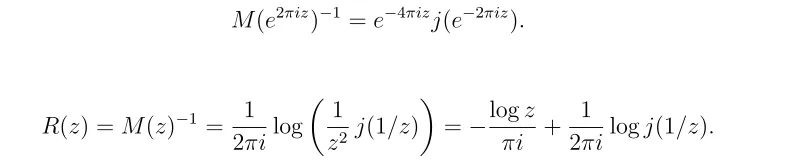
1
q2j(1/q) =M(q)
−1, (81)
and hence we have constructed the inverse for our master field eq. (76), which, we recall, is the resolvent of our desired matrix model. In terms of z, we have that
M(e2πiz)−1 =e−4πizj(e−2πiz). (82)
Thus,
R(z) =M(z)−1 = 1
2πilog
1
z2 j(1/z)
=−logz
πi +
1
2πilogj(1/z). (83)
An analogous route to the preceding sections could be taken. Now, as j(z) has no branch points, the only branch cut comes from the logarithm, which extends from 0 to ∞. However, j(z) is not defined over the real axis, but only on the upper half plane. Therefore, this deceptively simpler model escapes the usual analysis in the context of Hermitian matrix models. Our initial choice, wherein the vacuum expectation values are the Voiculescu polynomials in theq-coefficients on which we have thus far focused, is a more becoming choice. Of course, we could employ the technology of more involved (e.g., complex) matrix models on eq. (83), but that is another story, which we shall relate another time. This is a lesson in the simple fact that not every meromorphic function can be used as a resolvent of a Hermitian matrix model; that the inverse of thej-function could be, and is consistently constructable as one, is a pleasant surprise.
3.3.3 Variations on a Theme by the Master
[image:23.612.99.492.198.278.2]The content of Moonshine subsists in the observation that the coefficients in the q-expansion (10) encode data about the irreducible representations of the Monster sporadic group. Any resolvent that organizes this information faithfully will offer a realization of the Monster group’s character table in terms of a matrix model and can then be employed to make statements in the language of field theory and geometry about the Monster sporadic group itself. While the relations (47) and (83) are particularly natural in the sense that they express the resolvent or the Voiculescu polynomials in terms of the j-function in a convenient and direct manner, there are other models that also bottle the substance of Moonshine. For example, we could have taken R(z) = exp(2πij−1(z)) as
particularly organic. In this case, we are led to a zero-dimensional, Hermitian one-matrix model with a single branch cut that lends itself to simple computations and still distills some essential virtues of Moonshine.
3.4
A Dijkgraaf-Vafa Perspective
3.4.1 An N = 1 Gauge Theory
Having constructed a Hermitian matrix model which naturally encodes the j-function, it will be expedient to seek yet more physical quantities which bear connexion with j(z). We shall present some intriguing speculations in this section.
As reviewed in §2.4, it is the realization of a recent set of seminal works by Dijkgraaf and Vafa [2, 3, 4] that matrix models of the type described above actually compute the full non-perturbative content of an N = 1 gauge theory. The tree-level superpotential, according to the correspondence, is simply the (classical) potential for the matrix model. We formally replace the Hermitian matrix by the single adjoint field Φ of the U(n) N = 1 gauge theory, and obtain the superpotential as
Wtree(Φ) = −i g A
2Φ + 0.0696001(Φ−1)
2
2 −0.0284334
(Φ−1)3
3 + 0.0168107
(Φ−1)4
4 −
0.0115703(Φ−1)
5
5 + 0.00865627
(Φ−1)6
6 −0.00682747
(Φ−1)7
7 +. . .
= −gA 2πi e
2πiΦ−744 (2πiΦ) + 196883e−2πiΦ+ 83987356e−4πiΦ+
60197568710e−6πiΦ+ 54485001077436e−8πiΦ+. . .
. (84)
using eqs. (66) and (73). The fact that the tree-level potential is non-polynomial need not disturb us; the famous Gross-Witten model [31] has a cosine potential, for which a Dijkgraaf-Vafa analysis was carried out in Ref. [3].
We can use the standard Dijkgraaf-Vafa prescription to determine the full non-perturbative potential in terms of the glueball condensate
S = 1
32π2Tr WαW
α, (85)
which obtains from the gauge field strength Wα. Accordingly, one identifies S with the ’t Hooft
coupling in the matrix model, and the full superpotential is simply
Weff ≃ SlogS+
∂
using the planar free energyF0 computed in eq. (68). It is now necessary to restore the powers ofN
in the matrix model, accompanying the powers of the gauge couplingg, on which the cut-parameter
a depends through normalization. The derivative becomes, from eq. (68),
∂
∂SF0 =−0.163242i g A
′(
S)2a′(
S)(a(S)−1)12 +
0.014491i g A(S)2a′(S) +A(S) (0.058411a′(S) + 0.10882i A′(S))−0.03359A′(S)
(a(S)−1)52 +
0.0023339i g A(S)2a′(
S) +A(S) (0.03539a′(
S) + 0.00217i A′(
S))−0.00981A′(
S)
(a(S)−1)92 +
+O((a(S)−1)132 ), (87)
wherea′(S) andA′(S) are derivatives ofa and Awith respect to S. The functional form ofa(S) is
easily determined by restoring the coupling and further, the appropriate power ofN, into eq. (61),
viz,
A gN
Z a
1
dz ρ(z) = 1. (88)
This means that, upon taking the derivative of S =gN,
∂
∂Sf(a) =
π A
1− S
A ∂A
∂S
, (89)
where f(a) is the anti-derivative of s(2zr)(2z−)s(z)
r(z)2. We can then numerically solve this differential
equation to find the form of a(S) and back-substitute into eq. (87) to determine the effective superpotential in terms of the glueball S. The Weff we obtain at last, has a q-expansion just like
the potential V did. A pressing question is whether this is a modular form. Unfortunately, due to the fact that we cannot integrate eq. (63) analytically, the answer to this question eludes us at present. As we only have the perturbative expansion of the function, it is difficult to determine such properties as modularity. Be that as it may, were Weff to be a modular form, it would provide
a natural quantum generalization of the j-function.
3.4.2 A Calabi-Yau Geometry
Our final venture, having embarked upon a course from the q-expansion of thej-function, shall be to the realm of special geometry. We recall from §2.4 that the Dijkgraaf-Vafa correspondence also provides us a singular Calabi-Yau geometry associated to the matrix model which is a generalization of a conifold. The singular geometry is that of hyperelliptic curve, given by the spectral curve of the eigenvalue densities, transverse to a C2. In particular, embedded inC4, the Calabi-Yau is
with s(x, y) the hyperelliptic spectral curve. For our model, this curve is
y2−V′(x)2
− 1
4g2f(x) = 0, (91)
with f(x) the remainder term given in the spectral curve (20). It is to be considered as a quantum correction (deformation) to the geometry.
Now our potential, from eq. (63), is V′(z) =Aj−1(e2πiz) + 1
j−1
(e2πiz
)
. Therefore, eq. (21) tells us that we have
f(z) = 4g
V′(z)R(z)
−
Z ∞
1
dλρ(λ)V
′(λ)
z−λ
= −4Ag2
1 + (j−1(e2πiz))2+i
Z ∞
1
dλ
z−λ
A π
4rs(r2+s2)
(s2−r2)2
. (92)
Hence, the spectral curve is fully determined, complete with its quantum correction f(z).
The above geometrical digression is reminiscent of an earlier proposal circulated amongst math-ematicians. It is a known result (cf. Ref. [32]) that for the family of elliptic curves over P1 given by
y2 = 4x3− 27s
s−1x−
27s
s−1, s∈P
1, (93)
the mirror map z :P1 7→s∈P1 at a point of maximal nilpotent monodromy, is precisely
z(q) = 1
j(q), (94)
the reciprocal of the j-function, namely the inverse of j(q) with respect to multiplication. In fact, an old conjecture of Lian and Yau [33] states that for a wide class of K3 surfaces, the q-series of the mirror map is a Thompson series Tg(q) for some element g of the Monster sporadic group M.9
What is the relation between our hyperelliptic curve (91) and the family (93) of elliptic curves? We leave this as an open problem.
9
AHauptmodulis a functionJg(q) =q−
1
+P∞
n=1an(g)qn, forg∈M. Although|M| ≃8×10
53
there are “only” 171 distinct Hauptmoduls of M. Consider J11(q) =j(q)−744. The coefficients of thej-function (and also J11(q))
are related to the irreducible representations ofM. Replacing the m-th coefficient of the Fourier expansion of the
HauptmodulJ11(q) by the corresponding representation ofM, we have a formal power series T11(q) =V−1q−
1
+ 0 +V1q+V2q 2
+. . . ,
whereVrarehead representations ofM(V−1=1, V1=1⊕196883, etc.) andV =LrVr. Thompson [5] proposed
that by analogy, for an arbitrary elementg∈M, we write the formal power series
Tg(q) := chV,q(g) = chV−1(g)q
−1
+ 0 + chV1(g)q+ chV2(g)q
2
+. . . ,
4
Prospectus
Grounded in the observation that the formal resemblance between the q-expansion of Klein’s ellip-tic j-function and the Cuntz-expansion of the master field in a one-matrix model is more than an accident, we have in this paper constructed the “modular matrix model.” The key property of this Hermitian bosonic matrix model is that its master field is by construction j(q). The vacuum ex-pectation values, i.e., the observables, in the theory are Voiculescu polynomials in theq-coefficients of the j-function. We have computed the eigenvalue density, the resolvent, and the free energy of the model. Furthermore, we have established the (classical) potential. Utilizing the Dijkgraaf-Vafa correspondence, we have also constructed the associated supersymmetricN = 1 gauge theory which localizes to such a bosonic matrix model. Subsequently, we have computed the full non-perturbative superpotential as well as a local Calabi-Yau geometry as a fibration of a hyperelliptic curve on which the gauge theory may be geometrically engineered.
A host of tantalizing questions immediately opens to us. We have much alluded to the complex (i.e.,GL(N,C)) version of our analysis, which, among others, would give us a matrix model directly encoding the q-coefficients of j(q). Does such an extension lead to further intriguing observations? Of course, one cannot resist considering other variations of the matrix model. The current resurgence of interest in c= 1 matrix models perhaps tempts us to seek the one-dimensional extension to the matrix models that we have considered here. Would this quantum mechanics of matrices, by promoting Φ to Φ(t) in eq. (84), offer new perspectives on the j-function?
It is clear that we should explore the special geometry of the hyperelliptic curve for the modular matrix model further. Can one establish a relation between our hyperelliptic spectral curve and the Lian-Yau conjecture concerning the family of elliptic K3 surfaces? Now, the latter conjecture relates classes of K3 surfaces to the Thompson series of Hauptmoduls. What about our Calabi-Yau three-fold, which describes a deformed conifold geometry? How does our geometry, which naturally encodes the j-function, relate to these Thompson series?
back-ground Neveu-Schwarz B-field was shown to have a partition function that encodes the Monster representations. How does our story enter into this picture?
Already in eqs. (73) and (78) we have encountered some quite large integers that are suggestive of this interplay. It was suggested to us10 that the Voiculescu polynomials in the q-coefficients may
count certain open-string topological invariants associated with the large-N geometry. Moreover, as we have emphasized, we have performed all our computations in the planar limit, which is to say, we have solved the saddle point equation to O(1/N). The large-N limit of this matrix model allows us, by the Dijkgraaf-Vafa correspondence, to recover details about an N = 1 field theory whose tree-level superpotential is determined by the resolvent.
But this is only a leading order result. One can compute the higher O(1/Nk) corrections in
the matrix model. In the field theory, this corresponds to non-planar diagrams and gravitational corrections. Such higher-order terms arise through quantum effects and should proffer a quantum modification to the Conway-Norton Moonshine conjectures. In other words, theO(1/Nk) terms, in
correcting the observables in the matrix model, and hence the Calabi-Yau geometry, should provide a natural generalization of the ellipticj-invariant and hence provide a quantum version of the Monster group. What interpretation do the quantum corrections have in terms of the Monster sporadic group? Is this a quantum deformation to the presentation of the Monster? We have mentioned in
§3.4 that the full non-perturbative superpotential might be a modular form, which would be yet another way of finding quantum corrections to Moonshine. The Dijkgraaf-Vafa program therefore would offer not only a perturbative window into non-perturbative physics, but also a perturbative window into number theory.
Finally, we see that as the form of q-expansion is generic to modular forms, what would an analogous analysis to ours give for one of a myriad other modular functions? What number theoretic and geometric data would these encode? We have perhaps raised as many questions as we have presented answers, and this is our hope. It is our desire that “modular matrix models” should shed light into various hitherto unexplored corners of string theory, number theory, and geometry.
10
Acknowledgments
F¨ur Gustav Mahler.
We are grateful for enlightening discussions with Ian Ellwood, Amer Iqbal, Calin Lazaroiu, John McKay, Djordje Minic, and Mithat Unsal. We are especially indebted to Asad Naqvi, for his keen physical insights, and to Matthew Szczesny, for our ongoing collaborations. The authors thank the High Energy Group at the University of Pennsylvania and the Physics Department at Virginia Tech for sponsoring reciprocal visits to each other’s home institutions. VJ thanks the Pacific Institute for Mathematical Sciences at the University of British Columbia for providing the stimulating environment in which this paper was completed. Finally, we toast to stately, plump Buck Buchanan for offering us a strong drink in celebration of Bloomsday.
The research of YHH is funded in part by cooperative research agreement #DE-FG02-95ER40893 with the U. S. Department of Energy and the National Science Foundation Focused Research Grant DMS0139799 for “The Geometry of Superstrings”. The research of VJ is funded in part by coop-erative research agreement #DE-FG05-92ER40709 with the U. S. Department of Energy.
References
[1] Dedication text by Hans Bethge, after the French of Judith Gautier and D’Hervey-Saint-Denys; originally from the Chinese of Li Tai-Po. Set by Gustav Mahler,Das Lied von der Erde, no. 5, “Der Trunkene im Fr¨uhling.”
[2] R. Dijkgraaf and C. Vafa, “Matrix models, topological strings, and supersymmetric gauge theories,” Nucl. Phys. B 644, 3 (2002) [arXiv:hep-th/0206255].
[3] R. Dijkgraaf and C. Vafa, “On geometry and matrix models,” Nucl. Phys. B 644, 21 (2002) [arXiv:hep-th/0207106].
[4] R. Dijkgraaf and C. Vafa, “A perturbative window into non-perturbative physics,” arXiv:hep-th/0208048.
[5] J. McKay, letter to J. G. Thompson, ca. 1978.
[6] J. H. Conway and S. P. Norton, “Monstrous moonshine,” Bull. London Math. Soc. 11, 308 (1979).
[7] R. E. Borcherds, “Monstrous moonshine and monstrous Lie superalgebras,” Invent. Math.109, 405 (1992).
[8] I. Frenkel, J. Lepowsky, and A. Meurman, Vertex operator algebras and the Monster, Oxford Univ. Press, Oxford (1998).
[9] J. H. Conway and N. J. A. Sloane,Sphere packings, lattices, and groups, Springer-Verlag, New York (1998).
[10] L. J. Dixon, P. Ginsparg, and J. A. Harvey, “Beauty and the Beast: Superconformal symmetry in a Monster module,” Commun. Math. Phys. 119, 221 (1988).
[11] E. Witten, “The 1/N expansion in atomic and particle physics,” in Recent developments in gauge theories, G. ’t Hooft,et al., eds., Plenum Press, New York, 403 (1980).
[12] E. W. Weisstein, http://mathworld.wolfram.com/j-Function.html.
[13] T. Gannon, “Monstrous moonshine and the classification of CFT,” arXiv:math.qa/9906167.
[14] P. Di Francesco, P. Ginsparg, and J. Zinn-Justin, “2-D gravity and random matrices,” Phys. Rept. 254, 1 (1995) [arXiv:hep-th/9306153].
[15] Y.-H. He, V. Jejjala, and M. Szczesny, to appear at a pre-print server near you.
[16] T. Carleman, “Uber die Abelsche Integralgleichung mit Konstanten Integrationsgrenzen,” Mathematische Zeitschrift, 15, 111 (1922).
[17] J. Kondo, Integral Equations, Clarendon Press, Oxford (1992).
[18] V. Balasubramanian, J. de Boer, B. Feng, Y.-H. He, M.-x. Huang, V. Jejjala, and A. Naqvi, “Multi-trace superpotentials vs. Matrix models,” arXiv:hep-th/0212082.
[19] R. Gopakumar and D. J. Gross, “Mastering the master field,” Nucl. Phys. B 451, 379 (1995) [arXiv:hep-th/9411021].
[20] D. Voiculescu, K. J. Dykema, and A. Nica, Free Random Variables, CRM Monograph Series,
[21] E. Brezin, C. Itzykson, G. Parisi, and J. B. Zuber, “Planar diagrams,”Commun. Math. Phys.
59 35 (1978).
[22] R. Dijkgraaf, M. T. Grisaru, C. S. Lam, C. Vafa, and D. Zanon, “Perturbative computation of glueball superpotentials,” arXiv:hep-th/0211017.
[23] F. Cachazo, M. R. Douglas, N. Seiberg, and E. Witten, “Chiral rings and anomalies in super-symmetric gauge theory,” JHEP 0212, 071 (2002) [arXiv:hep-th/0211170].
[24] F. Cachazo, K. A. Intriligator, and C. Vafa, “A large N duality via a geometric transition,” Nucl. Phys. B 603, 3 (2001) [arXiv:hep-th/0103067].
[25] F. Cachazo and C. Vafa, “N = 1 and N = 2 geometry from fluxes,” arXiv:hep-th/0206017.
[26] S. Gukov, C. Vafa, and E. Witten, “CFT’s from Calabi-Yau four-folds,” Nucl. Phys. B 584, 69 (2000) [Erratum-ibid. Nucl. Phys. B 608, 477 (2001)] [arXiv:hep-th/9906070].
T. R. Taylor and C. Vafa, “RR flux on Calabi-Yau and partial supersymmetry breaking,” Phys. Lett. B 474, 130 (2000) [arXiv:hep-th/9912152].
[27] N. Seiberg and E. Witten, “Electric - magnetic duality, monopole condensation, and confine-ment in N=2 supersymmetric Yang-Mills theory,” Nucl. Phys. B426, 19 (1994) [Erratum-ibid. Nucl. Phys. B 430, 485 (1994)] [arXiv:hep-th/9407087].
N. Seiberg and E. Witten, “Monopoles, duality and chiral symmetry breaking in N=2 super-symmetric QCD,” Nucl. Phys. B 431, 484 (1994) [arXiv:hep-th/9408099].
[28] D. Ford and J. McKay, “Monstrous Moonshine,” Unpublished.
[29] http://functions.wolfram.com/EllipticFunctions/KleinInvariantJ/27/01/0001/.
[30] C. I. Lazaroiu, “Holomorphic matrix models,” JHEP0305, 044 (2003) [arXiv:hep-th/0303008].
[31] D. J. Gross and E. Witten, “Possible third order phase transition in the large N lattice gauge theory,” Phys. Rev. D21, 446 (1980).
[32] C. F. Doran, “Picard-Fuchs uniformization: Modularity of the mirror map and mirror-moonshine,” arXiv:math.ag/9812162.