City, University of London Institutional Repository
Citation
:
Zwarenstein, M., Grimshaw, J. M., Presseau, J., Francis, J., Godin, G.,
Johnston, M., Eccles, M. P., Tetroe, J., Shiller, S., Croxford, R., Kelsall, D., Paterson, J. M.,
Austin, P. C., Tu, K., Yun, L. and Hux, J. E. (2016). Printed educational messages fail to
increase use of thiazides as first-line medication for hypertension in primary care: a cluster
randomized controlled trial [ISRCTN72772651]. Implementation Science, 11(1), 124.. doi:
10.1186/s13012-016-0486-3
This is the published version of the paper.
This version of the publication may differ from the final published
version.
Permanent repository link:
http://openaccess.city.ac.uk/16180/
Link to published version
:
http://dx.doi.org/10.1186/s13012-016-0486-3
Copyright and reuse:
City Research Online aims to make research
outputs of City, University of London available to a wider audience.
Copyright and Moral Rights remain with the author(s) and/or copyright
holders. URLs from City Research Online may be freely distributed and
linked to.
City Research Online:
http://openaccess.city.ac.uk/
[email protected]
R E S E A R C H
Open Access
Printed educational messages fail to
increase use of thiazides as first-line
medication for hypertension in primary
care: a cluster randomized controlled trial
[ISRCTN72772651]
Merrick Zwarenstein
1,2*, Jeremy M. Grimshaw
3,4, Justin Presseau
3,5, Jill J. Francis
6, Gaston Godin
7, Marie Johnston
8,
Martin P. Eccles
9, Jacqueline Tetroe
10, Susan K. Shiller
2, Ruth Croxford
2, Diane Kelsall
11, J. Michael Paterson
2,12,
Peter C. Austin
2,12, Karen Tu
2,13, Lingsong Yun
2and Janet E. Hux
2,12,14Abstract
Background:Evidence on the effectiveness of printed educational messages in contributing to increasing
evidence-based clinical practice is contradictory. Nonetheless, these messages flood physician offices, in an attempt to promote treatments that can reduce costs while improving patient outcomes.
This study evaluated the ability of printed educational messages to promote the choice of thiazides as the first-line treatment for individuals newly diagnosed with hypertension, a practice supported by good evidence and included in guidelines, and one which could reduce costs to the health care system.
Methods:The study uses a pragmatic, cluster randomized controlled trial (randomized by physician practice group).
Setting:The setting involves all Ontario general/family practice physicians.
Messages advising the use of thiazides as the first-line treatment of hypertension were mailed to each physician in conjunction with a widely read professional newsletter. Physicians were randomized to receive differing versions of printed educational messages: an“insert”(two-page evidence-based article) and/or one of two different versions of an“outsert”(short, directive message stapled to the outside of the newsletter). One outsert was developed without an explicit theory and one with messages developed targeting factors from the theory of planned behaviour or neither (newsletter only, with no mention of thiazides).
The percentage of patients aged over 65 and newly diagnosed with hypertension who were prescribed a thiazide as the sole initial prescription medication. The effect of the intervention was estimated using a logistic regression model estimated using generalized estimating equation methods to account for the clustering of patients within physician practices.
(Continued on next page)
* Correspondence:[email protected]
1Centre for Studies in Family Medicine, Department of Family Medicine,
Schulich School of Medicine and Dentistry, Western University, 1465 Richmond Street, London, Ontario N6A 3K7, Canada
2Institute for Clinical Evaluative Sciences, 2075 Bayview Avenue, Toronto,
Ontario M4N 3M5, Canada
Full list of author information is available at the end of the article
(Continued from previous page)
Results:Four thousand five hundred four physicians (with 23,508 patients) were randomized, providing 97 % power to detect a 5 % absolute increase in prescription of thiazides. No intervention effect was detected. Thiazides were prescribed to 27.6 % of the patients who saw control physicians, 27.4 % for the insert, 26.8 % for the outsert and 28.3 % of the patients who saw insert + outsert physicians,p= 0.54.
Conclusions:The study conclusively failed to demonstrate any impact of the printed educational messages on increasing prescribing of thiazide diuretics for first-line management of hypertension.
Trial registration:ISRCTN72772651
Background
The cost-effectiveness of treatment options, particularly for the treatment of common health conditions, can have a large impact on the cost of health care. At the time of the conduct of the present trial, over a third of Canadians between the ages of 18 and 74 years had hypertension [1]; and despite the fact that only a fraction of these individuals were being treated [2], prescription drugs used in the treatment of hypertension are the leading therapeutic category of prescription drugs in Canada, accounting for 20 % of total prescription drug sales [3]. Decisions concerning the medical management of hypertension therefore have the potential to have a significant impact on health care costs.
Initial treatment of hypertension with thiazide diuretics has been shown to significantly reduce morbidity and mortality, with benefits at least as great as with other clas-ses of antihypertensive drugs, at less cost [4]. Yet in Canada and elsewhere, there is evidence of low adherence to published recommendations that thiazides be used as the first-line treatment for patients with uncomplicated hypertension [2]. The cost to patients and insurers may be high: one study estimated savings of $13.8 million (in US dollars in the year 2000) for Canada (year 2000 population 31,281,100) by using thiazides as the first-line antihyper-tensive drug [2]. Since most individuals with hypertension were not being treated [2, 5], more aggressive screening and treatment of hypertension would markedly increase the number of prescriptions and thus the beneficial eco-nomic impact of choosing thiazides over other antihyper-tensive treatment.
Printed educational messages (PEMs) directed to phy-sicians are one way to address health care gaps that are under physician influence. While PEMs have the advan-tages of low cost and easy dissemination, there is great uncertainty about their effects. Several early systematic reviews concluded that printed materials, on their own, do not lead to change in physician practices [6, 7]. How-ever, Grimshaw observed that the median effect in the RCTs where guidelines were disseminated as PEMs was 8.1 % absolute risk reduction (range +3.6 to +17.0 %) [8], on par with other much more expensive interven-tions like audit and feedback or academic outreach, and
this result was the main stimulus for the current trial. A subsequent larger review of PEMs observed a smaller effect size, showing a median absolute risk difference of 0.02 (range 0 to 0.11) in seven RCTs reporting categor-ical outcomes and a standardized mean difference of 0.13 (range −0.16 to 0.36) in three RCTs reporting con-tinuous outcomes [9]. A recent review of trials of PEMs for improving physician behaviour specifically in primary care settings did not show significant improvement in physician behaviour across included trials [10].
The uncertainty in the evidence leaves policy makers uncertain about the role of PEMs, at a time when clos-ing evidence-to-practice gaps has become a more cost-effective investment of health system resources than developing new interventions [11].
Reviews cannot overcome limitations of the primary evidence: the small number of trials (of varying size) and methodological weaknesses (insufficient power to detect modest effects, unit of analysis errors). Thus, there is a need for a pragmatic [12], randomized controlled trial on the effect of PEMs on guideline adherence, con-ducted in real-world settings, on typical practitioners, taking into account group practices. Given the simplicity and low cost of PEM-based practice change programs, and the large population impact that even modest improvements may achieve when applied to all potential beneficiaries, a large trial is needed.
We developed and used four criteria to identify im-portant evidence/practice gaps in Ontario primary care on which to test the impact of PEMs in a pragmatic trial: the gap is large and important to patients; it involves a common disorder; evidence-based practice is not con-strained by structural or financial barriers; and process indicators exist that are measurable using the adminis-trative datasets available to us.
the trivial cost of a letter to each physician, Ontario’s health care system stands to save over $1 million, at current levels of treatment of hypertension [2, 5], with correspondingly greater savings if identification and treatment of hypertension is improved. The Ontario Printed Educational Materials (OPEM) trial aimed to evaluate different forms of PEMs: long inserts compared to shorter bullet-pointed outserts and different forms of outserts. We hypothesized that active arms would be superior to control, that individually, different forms of PEMs would be similarly effective on prescribing thia-zides, and would be more effective when combined and when developed using a theory of behaviour.
Methods
The interventions
informedwas a free, peer-reviewed, evidence-based prac-tice synopsis, mailed to nearly 15,000 primary care pro-viders in Ontario from 1994 to January 2007 (when publication ceased). Articles were developed by clinical and research staff from the Institute for Clinical Evalu-ative Sciences (ICES).
Two types of PEMs addressed the identified evidence-practice gap: a two-page article, indistinguishable from the rest of the newsletter in size and style (the “insert”) and two versions of a short, directive, evidence-based PEM on a postcard-sized card stapled to the front page of informed (the “outsert”). The insert and one of the versions of the outsert (the atheoretical outsert) were de-veloped without any explicit theory of action using input from a diverse group of physicians who identified bar-riers to evidence-based practice and from a communica-tions expert. The second outsert (the theory of planned behaviour-based outsert) was developed by a group
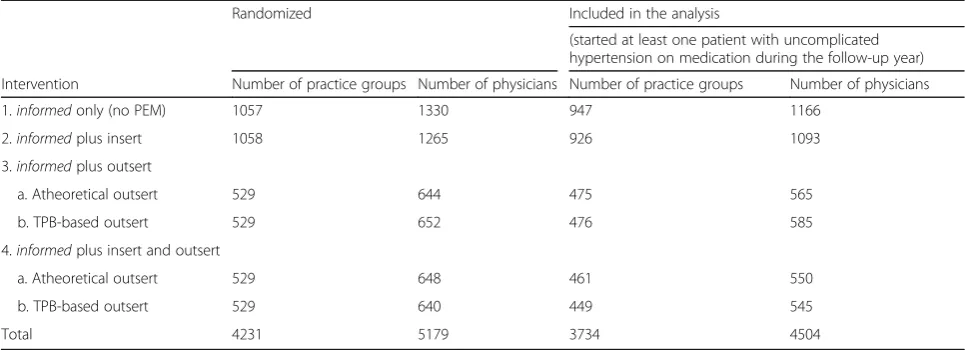
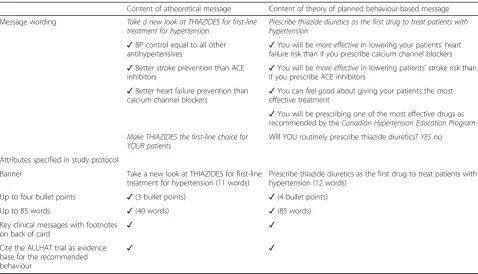
consisting of three health psychologists and two imple-mentation researchers with experience using theories of behaviour. Full details about the development process for this outsert are described in the study protocol [13]. The addition of the“theory of planned behaviour-based” outsert allowed us to test the hypothesis that a message inspired by a psychological theory, specifically thetheory of planned behaviour[14] (TPB), would be more effect-ive in changing clinical behaviour toward more evidence-based practice than a message designed with-out an explicit theoretical basis. The study design is shown in Table 1. Table 2 shows the two versions of the outserts, and the insert is included in Additional file 1. The interventions were included with the July 2005 edi-tion ofinformed.
Data sources
Ontario has a single-payer public health insurance system, in which necessary medical and hospital care and prescription drugs are covered for all Ontario residents aged 65 years and older. The following ad-ministrative data sources from this insurance plan were used [15, 16]:
The OHIP Claim History Database details payments to health care professionals, including an encoded provider number unique to each health care professional, an anonymous, encoded patient identifier unique to each patient, the service provided and the service date.
[image:4.595.56.539.523.698.2]The Canadian Institute for Health Information (CIHI) Discharge Abstract Database (DAD) contains the primary and up to 24 secondary diagnoses for all discharges from acute care hospitals.
Table 1Study design and number of practice groups/number of physicians
Randomized Included in the analysis
(started at least one patient with uncomplicated hypertension on medication during the follow-up year)
Intervention Number of practice groups Number of physicians Number of practice groups Number of physicians
1.informedonly (no PEM) 1057 1330 947 1166
2.informedplus insert 1058 1265 926 1093
3.informedplus outsert
a. Atheoretical outsert 529 644 475 565
b. TPB-based outsert 529 652 476 585
4.informedplus insert and outsert
a. Atheoretical outsert 529 648 461 550
b. TPB-based outsert 529 640 449 545
Total 4231 5179 3734 4504
Physician practices were randomly assigned to one of four intervention groups. The two intervention groups selected to receive an outsert were further randomly divided into two sub-groups, one of which received the outsert developed by the OPEM team (atheoretical outsert), the other receiving the TPB-based outsert. Interventions were included in the July 2005 edition ofinformed
The OHIP Registered Persons Database (RPDB) contains basic demographic, place of residence and vital status information for each insured person.
The OHIP Corporate Provider Database contains demographic and practice information for each physician.
The Ontario Drug Benefit (ODB) Program database contains prescription drug claims data for eligible beneficiaries (age over 65, patients on social assistance and qualifying for Trillium [low income] drug program) of the program, including an encoded prescriber identifier.
Records from these datasets were linked, using unique, encoded patient and physician identifiers and analysed at the Institute for Clinical Evaluative Sciences (ICES; www.ices.on.ca), to determine which individuals were newly treated for hypertension during the study period, and which of the target physicians prescribed their anti-hypertensive medication.
Study practices
All Ontario physicians with an active general/family practice in Ontario in 2003/2004 were eligible for inclu-sion. “Active”practice was defined as having a total bill-ing volume for the year of at least $50,000 and writbill-ing prescriptions for at least 100 different patients (aged 65 years and older), with at least one prescription in at least 10 of the 12 months.
Physician identifiers were linked to the College of Phy-sicians and Surgeons of Ontario (CPSO) number at ICES. CPSO numbers were then hand-linked to the pub-licly available CPSO database (www.cpso.on.ca) to obtain practice addresses.
Trials of interventions aimed at changing clinical prac-tice must be randomized at the level at which they are directed—in this case, the family physician. In a group practice, doctors may share information. To prevent contamination, we randomized at the level of the prac-tice. Physicians were placed into practices on the basis of a shared address.
Study patients
[image:5.595.57.536.97.371.2]The Ontario Drug Benefit database was used to identify Ontario residents who filled one or more prescriptions for an antihypertensive medication between July 11, 2005, and July 24, 2006. To ensure that these individuals were started on an antihypertensive agent for treatment of hypertension and not another indication, the cohort was linked with the CIHI DAD, the RPDB and the ODB Database. We excluded those patients with OHIP claims within 3 years or CIHI claims within 4 years (or any an-tihypertensive medications prescribed within 1 year) for any of the following conditions: myocardial infarction or angina, heart failure, arrhythmias, renal disease (includ-ing nephropathy), liver disease (includ(includ-ing oesophageal varices), stroke or transient ischemic attack, hyperthy-roidism or migraines [17]. Consistent with guideline
Table 2Theory of planned behaviour and atheoretical outserts
Content of atheoretical message Content of theory of planned behaviour-based message
Message wording Take a new look at THIAZIDES for first-line treatment for hypertension
Prescribe thiazide diuretics as the first drug to treat patients with hypertension
✓BP control equal to all other antihypertensives
✓You will bemore effectivein lowering your patients’heart failure risk than if you prescribe calcium channel blockers
✓Better stroke prevention than ACE
inhibitors ✓
You will bemore effectivein lowering patients’stroke risk than if you prescribe ACE inhibitors
✓Better heart failure prevention than calcium channel blockers
✓You canfeel goodabout giving your patients the most effective treatment
✓You will be prescribing one of the most effective drugs as recommended by theCanadian Hypertension Education Program
Make THIAZIDES the first-line choice for YOUR patients
Will YOU routinely prescribe thiazide diuretics?YESno
Attributes specified in study protocol
Banner Take a new look at THIAZIDES for first-line treatment for hypertension (11 words)
Prescribe thiazide diuretics as the first drug to treat patients with hypertension (12 words)
Up to four bullet points ✓(3 bullet points) ✓(4 bullet points)
Up to 85 words ✓(40 words) ✓(85 words)
Key clinical messages with footnotes on back of card
✓ ✓
Cite the ALLHAT trial as evidence base for the recommended behaviour
recommendations for treatment of hypertension [18], we focused on thiazide prescribing as the first-line treat-ment in individuals with uncomplicated hypertension. In order to ensure that the cohort included only individuals newly treated for hypertension, individuals who had filled a prescription for any antihypertensive medication in the year prior to the intervention were also excluded [17]. Only the first prescription for an antihypertensive filled during the observation year was included; all pre-scriptions filled on the same day were taken into consid-eration when determining the outcome. While data were available for individuals 65 years and over, all individuals included in the study were at least 66 years old at the time they filled their first prescription for an antihyper-tensive medication in order to ensure that information covering a 1-year look back period for prior prescrip-tions was available.
Using the OHIP physician claims database, we identi-fied the physician seen during the 14 days prior to and including the date the antihypertensive prescription was filled. In some cases, more than one study physician was selected. (Patients who had not visited any of the study physicians during the 14-day period were not included in the analysis.) We included patient visits to the physi-cian’s office, physician visits to the patient’s home or to a patient in a long-term care facility and physician phone calls to the patient.
Study design
The study was a pragmatic, factorial, cluster-randomized controlled trial with the physician practice as the unit of randomization. Practices were randomly assigned to one of six intervention groups by the study statistician (see Table 1), using computer-generated random numbers. Pa-tient and physician participants were unaware of allocation and administrative data were collected without knowledge of the research under way. Full details of the study design can be seen in the published protocols [13, 19, 20].
Outcomes
The objectives of the study were to determine whether the format of the PEM affected the likelihood that the only medication initially prescribed for hypertension was a thiazide and whether a theory of planned behaviour-based approach to developing the message was any more effective than a PEM developed without use of explicit theory. A“successful”outcome was a first-line prescrip-tion for a thiazide and no other antihypertensive medica-tion. Combinations of a thiazide plus potassium or a potassium-sparing medication were counted as a “ suc-cess”; combinations of a thiazide plus another diuretic were counted as a“failure”. A prescription for any non-thiazide antihypertensive medication was also counted as a“failure”.
Power
Even a 5 % improvement in the prevalence of care for common conditions represents a meaningful health benefit. Based on pilot data, Monte Carlo simulations, assuming an intracluster correlation coefficient of 0.092, three patients per physician, a baseline success rate of 0.36 and absolute intervention effects of 0.05, 0.075 and 0.10, demonstrated that a trial with 1250 practices per arm would provide over 97 % power to detect a 5 % increase, and over 98 % power to distinguish between the effects of the combined intervention and either alone, assuming the combined effect to be additive. This original power calculation was based on testing the effectiveness of the insert and one version of the outsert. We conducted a follow-up simulation to assess whether we could test a second version of the outsert (theory of planned behaviour-based), which suggested that the power would be greater than 80 %. The research oppor-tunity that this modification presented was judged to outweigh the loss of power. These decisions were made during the design phase and prior to randomization, as detailed in our published protocols [13, 19, 20].
Statistical analysis
Logistic regression was used to test the hypothesis that the intervention affected the choice of first-line medica-tion for hypertension. While the unit of randomizamedica-tion was the physician practice, outcomes were measured at the individual patient level. The logistic regression model was estimated using generalized estimating equa-tions (GEE) to account for the clustering of patients within physician practices [21]. This method of analysis allows for the inclusion of patient-level and physician-level covariates (e.g. patient age, physician age), while at the same time accounting for possible correlations amongst patient outcomes within a practice.
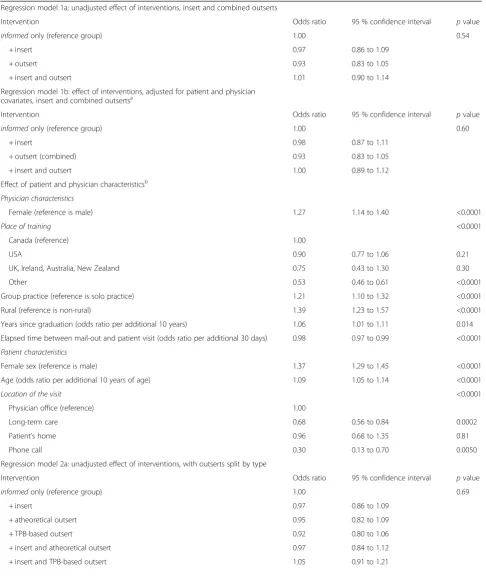
Analysis was on an intention-to-treat basis. As shown in Table 3, models were fit to test: insert and both outserts combined, and insert and two outserts split (theory of planned behaviour-based vs. atheoretical). These were fit using unadjusted (regressions 1a and 2a) models and models adjusting for patient- and physician-level covari-ates (regressions 1b and 2b). The full model in 1b included interaction terms between the intervention and each co-variate, to determine whether the impact of the interven-tion depended on patient and/or physician characteristics.
Patient and physician characteristics were compared between randomization arms using chi-square tests for categorical variables and Kruskal-Wallis tests for con-tinuous variables.
Table 3Results of the logistic regression
Regression model 1a: unadjusted effect of interventions, insert and combined outserts
Intervention Odds ratio 95 % confidence interval pvalue
informedonly (reference group) 1.00 0.54
+ insert 0.97 0.86 to 1.09
+ outsert 0.93 0.83 to 1.05
+ insert and outsert 1.01 0.90 to 1.14
Regression model 1b: effect of interventions, adjusted for patient and physician covariates, insert and combined outsertsa
Intervention Odds ratio 95 % confidence interval pvalue
informedonly (reference group) 1.00 0.60
+ insert 0.98 0.87 to 1.11
+ outsert (combined) 0.93 0.83 to 1.05
+ insert and outsert 1.00 0.89 to 1.12
Effect of patient and physician characteristicsb
Physician characteristics
Female (reference is male) 1.27 1.14 to 1.40 <0.0001
Place of training <0.0001
Canada (reference) 1.00
USA 0.90 0.77 to 1.06 0.21
UK, Ireland, Australia, New Zealand 0.75 0.43 to 1.30 0.30
Other 0.53 0.46 to 0.61 <0.0001
Group practice (reference is solo practice) 1.21 1.10 to 1.32 <0.0001
Rural (reference is non-rural) 1.39 1.23 to 1.57 <0.0001
Years since graduation (odds ratio per additional 10 years) 1.06 1.01 to 1.11 0.014
Elapsed time between mail-out and patient visit (odds ratio per additional 30 days) 0.98 0.97 to 0.99 <0.0001
Patient characteristics
Female sex (reference is male) 1.37 1.29 to 1.45 <0.0001
Age (odds ratio per additional 10 years of age) 1.09 1.05 to 1.14 <0.0001
Location of the visit <0.0001
Physician office (reference) 1.00
Long-term care 0.68 0.56 to 0.84 0.0002
Patient’s home 0.96 0.68 to 1.35 0.81
Phone call 0.30 0.13 to 0.70 0.0050
Regression model 2a: unadjusted effect of interventions, with outserts split by type
Intervention Odds ratio 95 % confidence interval pvalue
informedonly (reference group) 1.00 0.69
+ insert 0.97 0.86 to 1.09
+ atheoretical outsert 0.95 0.82 to 1.09
+ TPB-based outsert 0.92 0.80 to 1.06
+ insert and atheoretical outsert 0.97 0.84 to 1.12
Results
Physician and patient selection
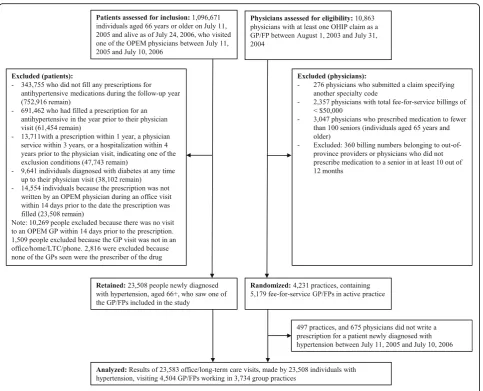
Figure 1 shows the number of physicians and patients included in the study. Three quarters of Ontarians aged 66 years and older filled a prescription for an antihyper-tensive medication in the year following the mail-out, but almost all (92 %) had already filled a prescription for an antihypertensive medication during the preceding year. A further 38 % of those who filled a prescription for the first time were excluded because there was evi-dence that the antihypertensive might have been pre-scribed for a reason other than hypertension. We identified 38,102 individuals who were taking medication for hypertension for the first time and were able to link the prescriptions of 23,508 of these individuals to one of the physicians targeted by the intervention (Fig. 1). Thir-teen percent of family physicians randomized to receive one of the interventions were excluded from the analysis because they were not linked to at least one patient newly treated for hypertension.
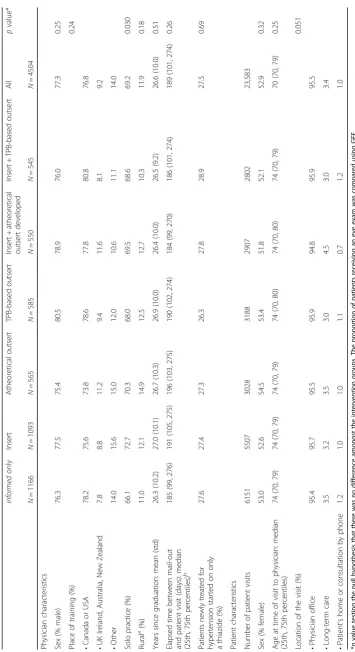
Physician and patient characteristics
There were small, statistically significant but clinically unimportant, differences between the characteristics of the physicians in the six intervention groups (Table 4).
Analysis of intervention effects
The intracluster correlation coefficient was 0.18 (95 % confidence interval 0.16 to 0.19). Intervention effects are
shown in Table 3. Neither the unadjusted nor the adjusted results show evidence that any of the interven-tions, alone or in combination, were effective. The wid-est confidence interval reported in the table, an odds ratio between 0.91 and 1.21 for the insert + TPB-based outsert corresponds to a true absolute effect of the inter-vention lying between a decrease of 1.5 % and an increase of 3.5 %. Thus, not only did the intervention fail to achieve statistical significance but as well the confi-dence interval does not contain values of much practical importance.
While the probability of being prescribed a thiazide as the first-line drug depended on both physician and patient characteristics, there was no indication that the interventions themselves were any more or less effective in any physician or patient sub-group. The pvalues for the interactions between the intervention and the phys-ician/patient variables were all non-significant, ranging from 0.15 to 0.97.
Discussion
[image:8.595.52.543.98.223.2]This printed information intervention was designed to increase physician prescribing of thiazides as the first-line pharmaceutical treatment for hypertension. The in-terventions, evaluated in a very large trial, with sufficient power to detect a small change in physician behaviour, failed to change prescribing practice. This confirms the results of studies [22] that found no impact of mailing
Table 3Results of the logistic regression(Continued)
Regression model 2b: effect of interventions, adjusted for patient and physician covariates, insert and outserts split by type
Intervention Odds ratio 95 % confidence interval pvalue
informedonly (reference group) 1.00 0.71
+ insert 0.98 0.87 to 1.11
+ atheoretical outsert 0.94 0.81 to 1.08
+ TPB-based outsert 0.93 0.81 to 1.07
+ insert and atheoretical outsert 0.96 0.83 to 1.10
+ insert and TPB-based outsert 1.05 0.91 to 1.21
a
The model was adjusted for these patient variables: age, sex and location of the visit with the physician. The model was adjusted for these physician variables: year of graduation, sex, place of training, type of practice (solo/group), place of practice (rural/urban) and elapsed time between the mail-out and the office visit b
Odds ratios are adjusted for all of the other variables in the model pvalues for interactions with the intervention
Informed subscriberp= 0.73 Rural locationp= 0.97 Practice type,p= 0.88 Patient sex,p= 0.81 Location of visit,p= 0.76 Patient age,p= 0.58 GP sex,p= 0.36
Number of years since GP graduation,p= 0.29 Graduation place,p= 0.18
the Ontario hypertension guidelines to all physicians in Ontario.
Given the pragmatic and representative nature of our study, we propose that these results may apply also to primary care practitioners in other health care settings with universal health insurance and no cost to patient for drugs.
This is the first published trial reporting a head-to-head comparison of TPB-based vs. atheoretical imple-mentation interventions. Although this trial did not detect any difference in effectiveness between these two approaches to intervention, this question needs further research.
We found that only 27.5 % of the individuals newly started on antihypertension medication were started on only a thiazide. This is similar to the rate of 29 % reported by Morgan et al. [3] for another Canadian jurisdiction (although Morgan et al. included patients whose first hypertension treatment was a thiazide
diuretic along with another antihypertensive drug, in addition to those who received only a thiazide diur-etic) but lower than the 35 % rate reported for Ontario between 1994 and 2002 [17].
Female patients and older patients were more likely to be prescribed thiazides as first-line treatment, corre-sponding to patterns observed elsewhere [3, 17, 23]. Female physicians, physicians who had been in practice longer, physicians in group practices and physicians practicing in rural locations were more likely to pre-scribe thiazides as first-line treatment (Table 3).
Depending on the condition being treated, improve-ments in prescribing patterns have the potential to save patients/insurers money as well as improving patient out-comes. It is therefore important to pursue other ways of changing prescribing practices. Several studies report that a combination of prescribing feedback plus educational intervention is effective in increasing the rate of thiazide prescribing [24–26]. The Canadian Hypertension
[image:9.595.58.542.85.476.2]Education Program (CHEP) has been able to produce sus-tained improvements in the clinical management of hypertension by combining annual updates of its recom-mendations with an extensive implementation program that includes both passive and active dissemination, in-cluding workshops and academic detailing [27].
An economic analysis found that if the initial improve-ments in practice can be sustained, they may be cost-effective [2, 28]. Furthermore, cost-cost-effectiveness of these interventions should improve as changes in patient demographics mean that physicians are likely to see increasing numbers of patients with hypertension in their practices.
A strength of our study was the use ofinformedas the vehicle carrying the PEMs into physician offices. The effectiveness of printed educational materials depends, firstly, on whether they are read. In 1997, The Strategic Council Inc. contacted 500 Ontario physicians by phone to determine readership and recall of informed. They found that 71 % of the respondents recalled receiving informed and that of these, 89 % found it useful or very useful and 53 % read most or every issue [29]. Two surveys of informed subscribers, conducted in 1995 and 1999, found that the newsletter was a respected and valued source of information [29]. It is unlikely, then, that the failure of this study to change outcomes was related to the perceived trustworthiness of the source or the failure of the physicians to notice the messages.
Another strength of the study was the use of adminis-trative data, which allowed us to examine the impact of our interventions across the full spectrum of physi-cians and patients in Ontario. This strength also imposes some limitations, one of which is the inability to study non-fee-for-service physicians. However, it is estimated that only 2 % of Ontario primary care physi-cians were on alternative payment plans whose billings did not appear in OHIP claims at the time of the study [30].
A second limitation imposed by reliance on adminis-trative data is that we cannot differentiate between fail-ure of the PEM to be delivered, read or remembered, failure of the physician to advise the patient and failure of the patient to act on that advice. While the Canadian postal service is highly reliable, and the addresses used are equally so, it is possible that, despite the widely rec-ognized brand ofinformedas an evidence-based newslet-ter from a respected research institute (rather than a product marketing leaflet), it may not have been received by study physicians. This is a possible fate for all PEMs and so does not detract from our main conclusion that PEMs do not change practice.
From the perspective of patient health, interventions are useful only if they affect the treatment the patient receives. This was a pragmatic trial, designed to give a
definitive answer about the value of a particular mode of information transmission for the purpose of improving health care. The trial was not designed to explain the barriers that remained. We did however investigate the reasons that may explain the lack of observed effect in a theory-based process evaluation conducted alongside the trial [31].
Conclusions
Consistent with systematic review findings [9], this study supports the conclusion that PEMs, whether long and discursive, or short and directive, and whether based on a theory of behaviour or no theory at all, did not, on their own, bring about an effective change in physician prescribing, even in the absence of financial and struc-tural barriers to change.
Additional file
Additional file 1:Under pressure: the latest on managing hypertension. (PDF 291 kb)
Acknowledgements
This study was also supported by the Institute for Clinical Evaluative Sciences (ICES), which is funded by an annual grant from the Ontario Ministry of Health and Long-Term Care (MOHLTC). The opinions, results and conclusions reported in this paper are those of the authors and are independent from the funding sources. No endorsement by ICES or the Ontario MOHLTC is intended or should be inferred. Parts of this material are based on data and information compiled and provided by the Canadian Institute for Health Information (CIHI). However, the analyses, conclusions, opinions and statements expressed herein are those of the author and not necessarily those of CIHI. We thank the IMS Brogan Inc. for the use of their Drug Information Database. Dr. Austin is supported in part by a Career Investigator Award from the Heart and Stroke Foundation of Canada (Ontario office). Dr. Tu receives a Research Scholar Award from the Department of Family and Community Medicine at the University of Toronto.
Funding
(Canadian Institutes of Health Research, award number 724180703) The Canadian Institutes of Health Research had no role in the design and conduct of the study; collection, management, analysis and interpretation of the data; or in the preparation, review or approval of the manuscript.
Availability of data and materials
The raw data cannot be shared as it is held within ICES for use under government and research ethics board mandated conditions and may not be released. Materials used are available in Table 2 and Additional file 1.
Authors’contributions
MZ conceived the study, wrote the protocol and led the analysis and write-up of results. He takes responsibility for the integrity of the data and the accuracy of the data analysis. JH, JG, PA, SS and AL contributed to protocol development and design. SS, PS, KT, JH, DK and MZ contributed to the design of the insert, outsert and patient reminders. JF, JG, ME, GG and MJ contributed to the development of the theory-based message. RC, JG, JP, GG, JT, JF, MJ and LY contributed to the analysis and write-up. All authors read and approved the final manuscript.
Competing interests
The authors declare that they have no competing interests.
Ethics approval and consent to participate
The research protocol was approved by the Research Ethics Board at the Sunnybrook Health Sciences Centre.
Author details
1Centre for Studies in Family Medicine, Department of Family Medicine,
Schulich School of Medicine and Dentistry, Western University, 1465 Richmond Street, London, Ontario N6A 3K7, Canada.2Institute for Clinical Evaluative Sciences, 2075 Bayview Avenue, Toronto, Ontario M4N 3M5, Canada.3Ottawa Hospital Research Institute, The Ottawa Hospital—General
Campus, 501 Smyth Road, Box 711, Ottawa, Ontario K1H 8L6, Canada.
4
Faculty of Medicine, University of Ottawa, 451 Smyth Road, Ottawa, Ontario K1H 8M5, Canada.5School of Epidemiology, Public Health and Preventive
Medicine, 451 Smyth Road, Ottawa, Ontario K1H 8M5, Canada.6School of
Health Sciences, City University London, Northampton Square, London EC1V 0HB, UK.7Faculty of Nursing, Laval University, Pavillon Ferdinand-Vandry, 1050 Avenue de la Medicine, Room 1445, Quebec City, Quebec G1V 0A6, Canada.8Institute of Applied Health Sciences, College of Life Sciences and
Medicine, University of Aberdeen, 2nd floor, Health Sciences Building, Foresterhill, Aberdeen AB25 2ZD, UK.9Institute of Health and Society, Newcastle University, Baddiley-Clark Building, Richardson Road, Newcastle Upon Tyne NE2 4AX, UK.10Retired, Ottawa, Canada.11Canadian Medical
Association Journal, 1867 Alta Vista Drive, Ottawa, Ontario K1G 5W8, Canada.
12
Institute of Health Policy, Management and Evaluation, University of Toronto, Health Sciences Building, 155 College Street, Suite 425, Toronto, Ontario M5T 3M6, Canada.13Faculty of Medicine, University of Toronto, 1
King’s College Circle, Medical Sciences Building, Toronto, Ontario M5S 1A8, Canada.14Canadian Diabetes Association, 522 University Ave, Toronto, Ontario M5G 2A2, Canada.
Received: 2 December 2015 Accepted: 26 August 2016
References
1. Joffres MR, Hamet P, MacLean DF, L’italien GJ, Fodor G. Distribution of blood pressure and hypertension in Canada and the United States. Am J Hypertens. 2001;14:1099–105.
2. Fretheim A, Aaserud M, Oxman A. The potential savings of using thiazides as the first choice antihypertensive drug; cost-minimisation analysis. BMC Health Serv Res. 2003;3:18.
3. Morgan S, Bassett KL, Wright JM, Yan L. First-line first? Trends in thiazide prescribing for hypertensive seniors. PLoS Med. 2005;2, e80.
4. ALLHAT Officers and Coordinators for the ALLHAT Collaborative Research Group. The Antihypertensive and Lipid-Lowering Treatment to Prevent Heart Attack Trial. Major outcomes in high-risk hypertensive patients randomized to angiotensin-converting enzyme inhibitor or calcium channel blocker vs diuretic: the Antihypertensive and Lipid-Lowering Treatment to Prevent Heart Attack Trial (ALLHAT). JAMA. 2002;288(23):2981–97. 5. Wolf-Maier K, Cooper RS, Banegas JR, Giampaoli S, Hense H-W, Joffrew M,
et al. Hypertension prevalence and blood pressure levels in 6 European countries, Canada, and the United Stats. JAMA. 2003;289:2363–9. 6. Lomas J. Words without action? The production, dissemination and impact
of consensus recommendations. Ann Rev Pub Health. 1991;12:41–65. 7. Implementing clinical practice guidelines: can guidelines be used to improve
clinical practice? Effective Health Care. Dec 1994, Vol 8. Nuffield Institute for Health, University of Leeds. Centre for Health Economics and the NHS Centre for Review and Dissemination, University of York.
8. Grimshaw JM, Thomas RE, Maclennan G, Fraser C, Ramsay CR, Vale L, et al. Effectiveness and efficiency of guideline dissemination and implementation strategies. Health Technol Assess. 2004;8:iii–iv. 1-72.
9. Giguère A, Légaré F, Grimshaw J, Turcotte S, Fiander M, Grudniewicz A, Makosso-Kallyth S, Wolf FM, Farmer AP, Gagnon MP. Printed educational materials: effects on professional practice and healthcare outcomes. Cochrane Database of Syst Rev. 2012; (10):Art. No.: CD004398. doi:10.1002/14651858.CD004398.pub3. 10. Grudniewicz A, Kealy R, Rodseth RN, Hamid J, Rudoler D, Straus SE. What is
the effectiveness of printed educational materials on primary care physician knowledge, behaviour, and patient outcomes: a systematic review and meta-analyses. Implement Sci. 2015;10(1):164.
11. Woolf SH, Johnson RE. The break-even point: when medical advances are less important than improving the fidelity with which they are delivered. Ann Fam Med. 2005;3:545–52.
12. Schwartz D, Lellouch J. Explanatory and pragmatic attitudes in therapeutic trials. J Chron Dis. 1967;20:637–48.
13. Francis JJ, Grimshaw JM, Zwarenstein M, Eccles MP, Shiller S, Godin G, Johnston M, O’Rourke K, Presseau J, Tetroe J. Testing a TheoRY-inspired MEssage (‘TRY-ME’): a sub-trial within the Ontario Printed Educational Message (OPEM) trial. Implement Sci. 2007;2:39.
14. Ajzen I. The theory of planned behaviour. Organ Behav Hum Decis Process. 1991;50:179–211.
15. Ontario Ministry of Health and Long-Term Care. Ontario health planning data guide, Release 3.0. February 28, 2006. Accessed 15 August 2016 at http://www.ontla.on.ca/library/repository/mon/13000/260075.pdf 16. Hux JE, Ivis F, Flintoft V, Bica A. Diabetes in Ontario: determination of
prevalence and incidence using a validated administrative data algorithm. Diabetes Care. 2002;25:512–6.
17. Tu K, Campbell NR, Chen Z, McAlister FA. Thiazide diuretics for hypertension: prescribing practices and predictors of use in 194,761 elderly patients with hypertension. Am J Geriatr Pharmacother. 2006;4:161–7.
18. Campbell N. 2004 CHEP hypertension recommendations. Perspectives in Cardiology. 2004;20:26–33.
19. Zwarenstein M, Hux JE, Kelsall D, Paterson M, Grimshaw J, Davis D, Laupacis A, Evans M, Austin PC, Slaughter PM, Shiller SK, Croxford R, Tu K. The Ontario printed educational message (OPEM) trial to narrow the evidence-practice gap with respect to prescribing evidence-practices of general and family physicians: a cluster randomized controlled trial, targeting the care of individuals with diabetes and hypertension in Ontario, Canada. Implement Sci. 2007;2:37.
20. Grimshaw JM, Zwarenstein M, Tetroe JM, Godin G, Graham ID, Lemyre L, Eccles MP, Johnston M, Francis JJ, Hux J, O’Rourke K, Légaré F, Presseau J. Looking inside the black box: a theory-based process evaluation alongside a randomised controlled trial of printed educational materials (the Ontario printed educational message, OPEM) to improve referral and prescribing practices in primary care in Ontario, Canada. Implement Sci. 2007;2(1):38. 21. Austin PC. A comparison of the statistical power of different methods for the analysis of cluster randomization trials with binary outcomes. Stat Med. 2007;26:3550–65.
22. Tu K, Mamdani MM, Tu JV. Hypertension guidelines in elderly patients: is anybody listening? Am J Med. 2002;113:52–8.
23. Walley T, Duggan AK, Haycox AR, Nizio CH. Treatment for newly diagnosed hypertension: patterns of prescribing and antihypertensive effectiveness in the UK. J R Soc Med. 2003;96:525–31.
24. Herbert CP, Wright JM, Maclure M, Wakefield J, Dormuth C, Brett-MacLean P, et al. Better prescribing project: a randomized controlled trial of the impact of case-based educational modules and personal prescribing feedback on prescribing for hypertension in primary care. Fam Pract. 2004;21:575–82. 25. Fretheim A, Aaserud M, Oxman AD. Rational prescribing in primary care (RaPP): economic evaluation of an intervention to improve professional practice. PLoS Med. 2006;3, e216.
26. Simon SR, Majumdar SR, Prosser LA, Salem-Schatz S, Warner C, Kleinman K, et al. Group versus individual academic detailing to improve the use of antihypertensive medications in primary care: a cluster-randomized controlled trial. Am J Med. 2005;118:521–8.
27. Hemmelgarn BR, Chen G, Walker R, McAlister FA, Quan H, Tu K, et al. Trends in antihypertensive drug prescriptions and physician visits in Canada between 1996 and 2006. Can J Cardiol. 2008;24:507–12.
28. Simon SR, Rodrigues HP, Majumdar SR, Kleinman K, Warner C, Salem-Schatz S, Miroshnik I, Soumerai SB, Prosser LA. Economic analysis in a randomized trial of academic detailing interventions to improve use of antihypertensive medications. J Clin Hypertens. 2007;9:15–20.
29. Diane Kelsall, former editor ofinformed, personal communication. 30. Chan BTB, Schultz SE. Supply and utilization of general practitioner and
family physician services in Ontario. ICES Investigative Report. Toronto: Institute for Clinical Evaluative Sciences; 2005.
31. Presseau J, Grimshaw JM, Tetroe JM, Eccles MP, Francis JJ, Godin G, Graham ID, Hux JE, Johnston M, Légaré F, Lemyre L, Robinson N, Zwarenstein M. (under review). A theory-based process evaluation alongside a randomized controlled trial of printed educational messages to increase primary care physicians’prescription of thiazide diuretics for hypertension