Abstract— The performance appraisal system including methods and procedures used in Colleges and Universities are continuously re-examined, reviewed, and revised to fit their purposes and effectiveness in promoting faculty development, productivity, giving of incentives and decisions on personnel actions. This study aims to develop and offer an alternative system of evaluation process for faculty members. Specifically, this study focused on the development of the Web-based Faculty Evaluation with Recommendation Support Module using Analytic Hierarchy Process Algorithm which may give efficient way of evaluating faculty performance. The AHP algorithm was applied for shrewd analysis of the necessary recommendations needed for performance improvement of the faculty member, but it is still subjected to consideration of the decision maker. This research used the descriptive and developmental methods as this involved development and survey of its acceptability. The findings of the study showed that the overall assessment of the system yielded (n=379, M=4.6) with a interpretation as “Strongly Acceptable”. This implies that the developed system address problems met on the existing evaluation process with all the methodologies used especially with the aide of AHP. We are hopeful that with this, the University management will improve its faculty development program.
Index Terms— Analytic Hierarchy Process, Faculty Performance Assessment, Web-based Faculty Evaluation, Recommendation Support.
I. INTRODUCTION
In this new era, people surf the web via portable devices like laptop, netbook, notebook PC, tablet and even mobile phones. The web/internet serves as a hub for improving our day-to-day activities. Our life and works can be made easier with these portable devices plus the web/internet that enable us to connect these devices/computers even unto the other side of the world. Information technology plays a vital role in bringing a change in this world, even in behavior that enables a person to finish a job. Information technology is any form of technology applied to process and transmit information in electronic form [1].
Education is an influential factor in achieving cultural, social, and economic goals of a country. Thus, most countries, gave high premium in developing education both qualitative and quantitative development. Policy makers adopt a variety of strategies in promoting quality education. One of these strategies is the use of performance evaluation system effectively. Faculty members‟ performance
Revised Manuscript Received on April 15, 2019.
Jared Harem Q. Celis, Eastern Samar State University – Guiuan Campus, Borongan City, Eastern Samar, Philippines ([email protected])
Andres C. Pagatpatan, Eastern Samar State University – Guiuan Campus, Borongan City, Eastern Samar, Philippines ([email protected])
evaluation as a pillar of the system can undoubtedly guarantee the continuous improvement of quality education when it is used judiciously.
The Eastern Samar State University Guiuan Campus, practice the routine evaluation of faculty members according to their effectiveness and quality of performance of their duties and functions every ending of the semester. The evaluation method is done in the manual process, starting from the distribution of the instrument for evaluation of faculty members down to collecting of data, calculation of results and lastly having post conference for giving feedbacks. This evaluation is designed for two purposes: the first one is to measure instructional effectiveness and the second is to promote professional development.
Moreover, the study aims to develop the above-mentioned evaluation tool that may provide a driven Web-based client and admin panel and give the students the opportunity to participate in the evaluation of faculty members such that students as well as the supervisor can present their comments and suggestions. The Recommendation Support Module using Analytic Hierarchy Process Algorithm is one of the features in the developed system that support and strengthens the decision-making capacity of the Human Resource Officer and as well as the Human Resource Department (HRD) in determining actions that should be taken for the improvement of the performance of faculty members in the University.
II. AIM OF PAPER
A. Objectives of Paper
The aim of this paper is to develop a web-based system that will be used in faculty performance evaluation with recommendation support module using AHP algorithm. The specific objectives of the study are as follows:
1. To identify the problems encountered in the existing method of evaluating performance of faculty members.
2. To design and develop a system that is user-friendly and acceptable to the stakeholders with the following features:
a. Results of Evaluation; b. Calculation of Results; c. Reports on Evaluation;
d. Recommendation Support Module using AHP algorithm.
Web-Based Faculty Evaluation with
Recommendation Support Module using
Analytic Hierarchy Process Algorithm
3. To assess the developed system in terms of: a.
b. Contents; c. Usefulness;
d. Language and Styles. B. Related Works
The Online Faculty Evaluation System for Laguna College of Business and Arts (LCBA) comprised of three types of users, namely, the Human Resource Department, the faculty members, and the students themselves. Through the use of the system, the Human Resource Department could easily determine the teaching proficiency of the faculty through the evaluation made by the students. The system has the ability to generate reports which contain total number of students who made the evaluation and produce hard copies of the evaluation report to each faculty member [2].
The process of faculty evaluation aides to measure and create different abilities, spot or give rewards to remarkable instruction, and furthermore change the incompetent way of teaching. To accomplish these purpose, an evaluation system, in light of general theory of systems, made out of information, process, yield, and result has been conceived. These work intelligently and persistent supervision of their aggregate performance can ensure their proper work [3]. There are various evaluation systems that vary from easy to muddled ones; from the project based systems which is without input to those characterized in view of the mission of every college or school and with the end goal of giving proficient advancements to the workforce.
It addition, Thawabieh [4] claimed that the reason why faculty evaluation is made by students because it might help the faculty to identify their own strengths and weaknesses that will help them enhance their teaching styles, and to let them know about their student‟s perceptions about them. Faculty evaluation is thought to be a standout amongst the most imperative aims for any scholastic foundation to guarantee that these institutions accomplished their objectives in graduating extremely qualified students, give workforce criticism about their performance, elevate personnel to higher positions, and give input to the higher ranking officials about the personnel. [5] The importance of evaluation/assessment of employee in any institution was found that the employee evaluation system has some other benefits besides being required. The system is used to aid teachers in the development of their teaching abilities. Each instructor is ensured that only he will see the results of the confidential questions. The confidential results will allow the instructor to ask questions that will provide him with feedback that will benefit him. By selecting appropriate questions from the available data base the instructor can obtain ideas on how to improve his teaching. The faculty evaluation system will aid the faculty evaluation committee by providing standard reports.
Moreover, Maryana, Kurina, & Ruyani [6] stated that Employee Performance Assessment in modern organizations provides an important role for the management mechanism to be used in explaining the objectives and standards of performance and to motivate individual performance. Currently, the employee performance assessment of a
company that still uses a manual process in evaluating each employee and discussing with the managers with insufficient data is considered as less effective and less efficient to determine the employee performance assessment. This situation can be resulted into unfavorable decisions.
Likewise, Sri Setyowati [7] expressed that the issue of subjectivity in the evaluation of faculty performance is practically unavoidable. The administration and personnel need consistent performance appraisal process, and quickly, in order to give up turning and quick change in the workplace. Straightforwardness of the evaluation procedure can generally be a constructive outcome on change of personnel inspiration. In today's advanced technology innovation of information technology gives a contrasting option to community associations and organizations to aid the usage of the association, including using online performance evaluation system.
In the endeavor of a University to improve the quality of instruction, decision making plays a significant part in choosing ways or path for the improvement of teaching performance. Colan, Stoklasa, & Talasova [8] expressed that the design of faculty evaluation systems calls for interdisciplinary cooperation as the above mentioned problems reflect competencies of different disciplines among which are human resources, Decision-Support Systems. As Decision Support Systems, evaluation systems can provide information for various purposes, for example: faculty development, identification of problems and bottlenecks, information on the goals set by the faculty member and how they are reached, promotion and tenure decisions, identification of individual‟s skills and talents – better composition of teams and assignment of work, declaration of relevant/beneficial activities (an evaluation system itself can provide information concerning the organisational goals and preferred ways of achieving them) – this in fact is an information transfer function of the evaluation system, clarification of the possibility of mutual compensation among different areas of activities (how much can one specialise in one field at the expense of another), and outplacement.
In this fragment, the review of literatures helped the researchers to determine and identify common objectives of studies particularly in Evaluation or Assessment of Faculty. Furthermore, the studies deduce how the researcher will find its ways to implement the Web-Based Faculty Evaluation System. The Decision Support System (DSS) that has been featured in the literature review were used as a reference for the Recommendation Support Module that can be used as another support tool or as a data management system. Various evaluation models enable the decision maker to analyse different alternatives that assists the interpretation of results from the assessment of the different alternatives. The problems, which existed in the earlier evaluations, will be reduced to a large extent.
C. Framework of the Study
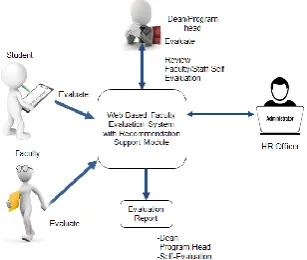
The researcher used the paradigm shown in the Figure 1 below to showcase the
proposed output of the
was necessary for the researchers to visualize the path where the study would be heading to.
Fig. 1. Conceptual framework of the system
The benefits of using the said system far outweigh the benefits of using traditional evaluations. The main concept of the Web-Based System is to make the evaluation accurate, simple, and efficient as compared to the conventional system of evaluation which is time consuming, bulky and slow processing of data, thus making this a plausible concern.
III. METHDOLOGY
A. Research Design
This study used the descriptive type of research with the developmental approach. Polit & Hungler [9] defined descriptive research as a method that describes characteristics and what exists. This helps to uncover new facts and meaning. Its purpose is to uncover, depict and report parts of a circumstance as it normally happens. This involves the collection of data that will provide individual, groups, situations through data gathering instruments such as questionnaire and checklists.
On the other hand, Richey [10] define developmental method as the systematic study of designing, developing, and evaluating programs, processes and products that must met criteria of internal consistency and effectiveness.
This method was considered appropriate since the present study involve evaluation system process which is analyzed and described. The system is then evaluated in terms of its acceptability.
B. Respondents of the Study
The respondents of the study were divided into two groups which consist of sixty five (65) faculty members and three hundred fourteen (314) students from different colleges in the University. Survey questionnaires were distributed to the respondents to gather data for the existing problems, and then the respondents tested and evaluated the system.
C. Analytic Hierarchy Process Algorithm
The AHP algorithm was developed by Saaty [11], which allows the decision-maker to present the relations between several criteria in complicated circumstances. The process entails the decision-maker to create a hierarchical structure for the criteria presented, which are evident in a certain
problem, provides verdicts about the significance of every ones of these criteria and offers a preference value for each alternative decision with respect to each reflected criteria. This method gives organized and prioritized level orders indicating the overall inclination for each of the decision alternatives. The Analytic Hierarchy Process is an example of a heuristic algorithm [12]. This means that it gives good probable yet not necessarily the ideal solutions to a given problem that might be used to quantify accurately the decency of alternatives provided.
The step by step procedure of the analytic hierarchy process algorithm is discussed below:
First Step. Identify your main objective and the needed criteria as well as the sub-criteria that are related to a specified problem. Create a hierarchical structure placing your objective at the top level, then the main criteria at the second level, the third level is the sub-criteria (if there is any) and the alternatives should be located at the lowest level.
Second Step. Determine the weights for the identified criteria by making a single pair-wise comparison matrix for the criteria. Then multiply the values in each row together and calculate the nth root of the acquired product. The steps are as follows:
a)Assumes „n‟ as criteria to be equated, the pair-wise comparison of criterion „x‟ with respect to criterion „y‟ produces an element axy in the square matrix
A1cxc. In the pair-wise comparison matrix, axy = 1
and axy = 1/ axy.
b)Next, calculate the normalized weight (nw) by calculating the geometric mean of rows in the comparison matrix.
c)And construct matrix A3 and A4 such that A3 = A1 x A2 and A4 + A3/A2 where, A2 = [W1, W2, …, Wx,
…, Wc]T.
d) Find for the maximum given value, ƛmax which is the average of matrix A4.
e)Calculate the consistency index, CI = (ƛmax – n)/(n – 1). The smaller the value of CI, the smaller is also the deviation from the consistency.
f) Obtain the random index (RI) value for the given number of criteria as used in recommendation support.
g)Lastly, compute the consistency ratio (CR) value where CR = CI/RI. Now if the CR value is equivalent to 0.10 or less, then it is considered to be acceptable as it should
the knowledge of the decision maker about the problem under being solve [13].
Third Step. The last part is to obtain the composite weights for the alternatives by getting the product of the normalized weight of every criterion with the corresponding normalized weightage value for each alternative and computing the summation of all criteria for each alternative. D. Ascertainment of Objective Decision-Making
The main goal of the study was to evaluate the performance of faculty members in instruction. This evaluation serves as basis for inputs to further enhance and fortify professional and career development of employees. This could also serve as a basis for giving rewards and incentives.
The researchers focused on the existing criteria used in performance evaluation of faculty members namely Commitment; Knowledge of Subject Matter; Teaching for Independent Learning; and Management of Learning. The details of these criteria are explained further below:
a) Commitment: This refers to a faculty member‟s deep sense of responsibility to render service for the development of the students‟ well-being and for advancement of his/her discipline.
b) Knowledge of Subject Matter: This includes faculty member‟s scholarship and expertise in his/her chosen field of discipline.
c) Teaching for Independent Learning: This pertains to the faculty members‟ ability to organize teaching-learning processes to enable students to maximize their learning potentials. d) Management of Learning: This refers to the
faculty members‟ ability to create and manage conducive learning environment and at the same time guide, monitor and evaluate student learning.
[image:4.595.316.538.54.208.2]The hierarchical structure that was created for the evaluation of faculty member‟s performance in the University is shown in Figure 2. The top level of the structure is the main goal of performance evaluation of faculty members. The second level consists of all relevant criteria to be used for the evaluation and the lowest levels are the sub-criteria of every criterion respectively.
Fig. 2. Hierarchy of the faculty evaluation
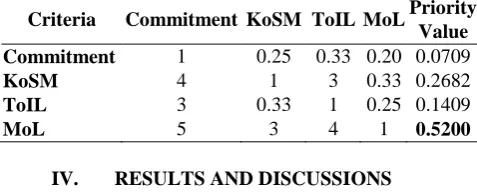
The students and teachers evaluate their teachers and peers respectively with the concept of pair-wise comparison of AHP. The radical root method of AHP algorithm is used to determine the priority values of different criteria based on the students and teachers. The Table 1 below shows the pair-wise comparison matrix arrived out of the decision of a specific respondent. Then the overall priority values of the various criteria are aggregated and come to be the achieved ratings of a faculty being evaluated.
Table 1. Pair-wise comparison matrix for computing the priority value of the all criteria.
Criteria Commitment KoSM ToIL MoL Priority Value Commitment 1 0.25 0.33 0.20 0.0709
KoSM 4 1 3 0.33 0.2682
ToIL 3 0.33 1 0.25 0.1409
MoL 5 3 4 1 0.5200
IV. RESULTS AND DISCUSSIONS
[image:4.595.309.548.380.476.2]Fig. 3. Detailed of responses on the problems encountered
Figure 3 shows that problems really exist in the existing faculty evaluation process of Eastern Samar State University Guiuan Campus. Of the 379 respondents from both faculty and students the data revealed above the statistics on the problems encountered in faculty evaluation.
[image:5.595.307.547.403.613.2]The Table 2 below represents the contents of the newly proposed system for Eastern Samar State University Guiuan Campus. Based from the assessment of the respondents, the criterion “The system contains the necessary information for the Faculty Evaluation” got the weighted average of 4.65 which has the highest rank from all the criteria and were interpreted as Strongly Acceptable (SA); the next criterion “The system is easy to access” received a weighted average of 4.55 with an interpretation Strongly Acceptable (SA); next to that is the criterion “The necessary information are well presented and organized” with a weighted average of 4.6 and has the equivalent interpretation as Strongly Acceptable (SA); and the last criterion “The system is secure and reliable for the conduct of evaluation process” received a weighted average of 4.55 with an interpretation as Strongly Acceptable (SA). The overall mean of the four criterions according to the contents of the system is 4.57 which were interpreted as Strongly Acceptable (SA). The result of the assessment only means that the respondents “Strongly Accepts” the contents of the system.
Table 2. Assessment of the Respondents on the Contents of the System.
Contents of the
System Faculty Students Mean INTP
N 1. The system
contains the necessary
information for the Faculty Evaluation.
4.5 4.8 4.65 SA
2. The system is easy
to access. 4.7 4.4 4.55 SA
3. The necessary
information is well 4.5 4.7 4.6 SA
presented and organized. 4. The system is secure and reliable for the conduct of evaluation process.
4.6 4.4 4.5 SA
Overall Mean 4.57 SA
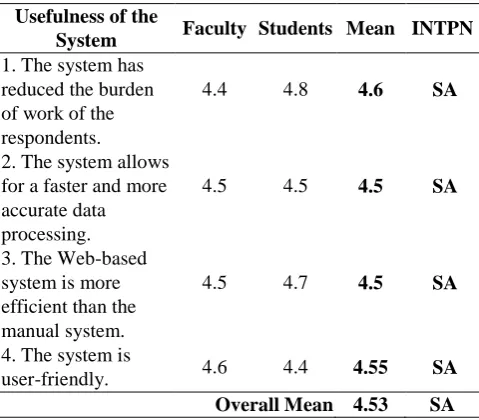
Table 3 represents the results of the assessment of the respondents on the usefulness of the system. Based from the assessment, the criterion “The system has reduced the burden of work of the respondents” received an average mean of 4.6 with an equivalent interpretation as Strongly Acceptable (SA). The next two criterions “The system allows for a faster and more accurate data processing” and “The Web-based system is more efficient than the manual system” received the same average mean of 4.5 with an equivalent interpretation as Strongly Acceptable (SA), and the last criterion “The system is user-friendly” received an average mean of 4.55 with an equivalent interpretation as Strongly Acceptable (SA). The overall mean of the four criteria is 4.53 with an equivalent interpretation as Strongly Acceptable (SA) and which only means that the respondents have a high approval to the system according to its usefulness.
Table 3. Assessment of the Respondents on the Usefulness of the System.
Usefulness of the
System Faculty Students Mean INTPN 1. The system has
reduced the burden of work of the respondents.
4.4 4.8 4.6 SA
2. The system allows for a faster and more accurate data processing.
4.5 4.5 4.5 SA
3. The Web-based system is more efficient than the manual system.
4.5 4.7 4.5 SA
4. The system is
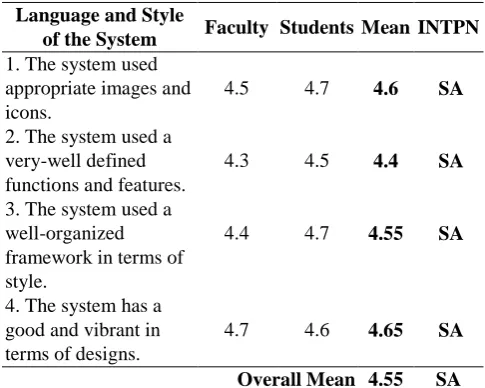
user-friendly. 4.6 4.4 4.55 SA Overall Mean 4.53 SA Table 4 represents the results of the assessment of the respondents on the language and style of the system. The criterion “The system used appropriate images and icons” received an average mean of 4.6 with an equivalent interpretation as Strongly Acceptable (SA), and then the next criterion “The system used a very-well defined functions and features” received an average mean of 4.4 with an equivalent interpretation as Strongly Acceptable (SA). The third criterion “The system used a well-organized framework in terms of style” received an average mean of 4.55 with an equivalent interpretation as Strongly Acceptable (SA), and the last
[image:5.595.50.287.647.783.2]designs” received an average mean of 4.65 with an equivalent interpretation as Strongly Acceptable (SA). The overall mean of the four criteria is 4.55 with an equivalent interpretation as Strongly Acceptable (SA) which only means that the respondents have a high approval of the newly proposed system according to its language and style. Table 4. Assessment of the Respondents on the Language
and Style of the System.
Language and Style
of the System Faculty Students Mean INTPN 1. The system used
appropriate images and icons.
4.5 4.7 4.6 SA 2. The system used a
very-well defined functions and features.
4.3 4.5 4.4 SA 3. The system used a
well-organized framework in terms of style.
4.4 4.7 4.55 SA
4. The system has a good and vibrant in terms of designs.
4.7 4.6 4.65 SA
Overall Mean 4.55 SA
[image:6.595.48.289.498.628.2]Table 5 revealed that the overall mean generated was 4.5 with its descriptive equivalent as Strongly Acceptable (SA). This means that the Web-based Faculty Evaluation with Recommendation Support Module using Analytic Hierarchy Process Algorithm exceeded the expected good quality of its operation. The respondents of the study generally believed that the developed system was strongly acceptable to be used by University.
Table 5. Summary of Results of the Assessment
Criteria Faculty Students Mean INTP N 1. Contents of the
System. 4.6 4.6 4.6 SA
2. Usefulness of the
System 4.5 4.6 4.4 SA
3. Language and
Style of the System. 4.5 4.6 4.6 SA Overall Mean 4.5 SA
V. CONCLUSION
Based from the analysis of the results of the study, it can be safely concluded that this system is working properly and meets the user‟s requirements based on the results discussed. The problems, which existed in the manual process of evaluating faculty members, have been reduced to a large extent. The use of ICT technology solutions such as using the proposed system in faculty evaluation makes the human resource department more effective and efficient. Lastly, the web-based faculty evaluation with recommendation support module using analytic hierarchy process algorithm was evaluated by the respondents to be strongly acceptable.
ACKNOWLEDGMENT
We would like to extend our deepest gratitude to the individuals who have shared their insightful and fruitful ideas, spared some of their time to contribute data or information that lead to the success of this paper. This paper would not be possible without the support of Eastern Samar State University – Guiuan Campus and its administration.
REFERENCES
1. H. C. Lucas, “Information Technology: Strategic Decision making for Managers,” Wiley, John & Sons, Incorporate.
ISBN: 978-0-471-65293-9, pp. 312-315, September 2005.
2. P. L. T. Garcia, L. P. R. Hibas, and A. R. Quizon, “Online Faculty Evaluation System for Laguna College of Business and Arts,” Ani: Letran Calamba Research Report 2.1, pp. 1-1, 2015 3. A. J. Shinkfield, and D. L. Stufflebeam, “Evaluation theory, models and applications,” San Francisco, CA:Jossey-Bass, 2010.
4. A. M. Thawabieh, “Students Evaluation of Faculty”, Tafila Technical University, Jordan, International Education Studies; vol. 10, No. 2; 2017.
5. C. B. Terry, K. H. Heitner, L. A. Miller, and C. Hollis, “Predictive Relationships Between Students‟ Evaluation Ratings and Course Satisfaction”, American Journal of Pharmaceutical Education, vol. 81(3), pp. 53-55, April 2017.
6. S. Maryana, E. Kurina, and A. Ruyani. “Web-based
application on employee performance assessment using exponential comparison method” Retrieved from the World
Wide Web: http://iopscience.iop.org/1757-
99X/166/1/012019, October 25, 2018.
7. S. Setyowati, “Analisa Evaluasi Kinerja Pegawai untuk Promosi Jabatan Menggunakan Model Hybrid Gap Analysis – AHP,” Seminar Nasional Aplikasi Teknologi Informasi, Yogyakarta, June 15, 2013.
8. M. Colan, J. Stoklasa, and J. Talasova. "On Academic Faculty Evaluation Systems – morethan just simpl benchmarking,”
International Journal for Process Management and
Benchmarking, vol. 4, No. 4, pp. 439-440, 2014.
9. D. F. Polit, and B. P. Hungler, “Nursing Research Principles and Methods (6th ed.),” Philadelphia, Lippin Cott, 1999. 10. R. C. Richey. “Developmental Research: The Difinition and
Scope,” Retrieved October 25, 2018 from the World Wide Web: http://eric,ed.gov/?id=ED373753.
11. T. L. Saaty, “The Analytic Hierarchy Process,” McGraw-Hill Company, New York, USA, 1980.
12. J. H. Moore, and L. R. Weatherford, “Decision Modeling with Microsoft Excel, 6th Edition,” University of Wyoming, 2001. 13. E. Triantaphyllou, and S. H. Mann, “Using the analytical