Int. J. Electrochem. Sci., 10 (2015) 7159 - 7165
International Journal of
ELECTROCHEMICAL
SCIENCE
www.electrochemsci.org
Short Communication
BSCF Based Nanocomposite Cathodes Fabricated by
Ion-impregnating Method for Solid Oxide Fuel Cells
Fuxiang Wei1,2,*, Jiaqiang Jiang2, Genxi Yu2, Jinling Yang2, Shenghai Lu2 1
Postdoctoral Research Station of Mechanical Engineering, China University of Mining and Technology, Xuzhou, Jiangsu 221008, P. R. China
2
School of Materials Science & Engineering, China University of Mining and Technology, Xuzhou, Jiangsu 221008, P. R. China
*
E-mail: [email protected]
Received: 23 April 2015 / Accepted: 15 June 2015 / Published: 28 July 2015
By steeping nano-particles Sm0.2Ce0.8O1.9 (SDC) in Ba0.5Sr0.5Co0.8Fe0.2O3−δ (BSCF) matrix material, low temperature BSCF-SDC nano-composite cathode of SOFC is prepared. The ion impregnation of the SDC phase significantly enhances the electrocatalytic activity of BSCF electrodes in O2 reduction reaction, and the ion-impregnated BSCF–SDC composite cathodes shows excellent performance. The area specific resistance (ASR) is only 0.214 Ωcm2
at 600 °C for an ion-impregnated BSCF–SDC cathode. The single cell with SDC heated at 800 °C has the best electrochemical properties, and the maximum power densities are 290 mWcm−2, 504 mWcm−2 and 793 mWcm−2 at 500 °C, 550 °C and 600 °C, respectively. The results demonstrate that the combination of BSCF mixed conducting structure with high ionic conducting SDC phase is a valid method to improve the electrode performance. The nano-composite cathode prepared by impregnation method has displayed good electrochemistry catalytic activity.
Keywords: BSCF–SDC cathode; Ion-impregnation; Impedance spectroscopy; Solid oxide fuel cell
1. INTRODUCTION
technique for low temperature SOFC. To solve the problem, optimizing the microstructure of cathode is a key method to improve the electric catalytic activity of cathode at medium and low temperature [1-4].
In recent years, the perovskite-type materials carrying the electron-ion mixed conducting (MIEC) property have attracted extensive attention of domestic and overseas science researchers because it can be used as SOFC cathode, oxygen separation membrane, and catalyst [1, 5-8]. When the MIEC, a cathode material working under medium and low temperature with great development potential, is used as SOFC cathode, it can extend the electrode reaction zone from electrode or electrolyte interface to the entire three-dimensional porous cathode to greatly improve the electrode catalyzing property [9]. The perovskite oxide Ba0.5Sr0.5Co0.8Fe0.2O3−δ (BSCF) is a cathode material widely applied in medium and low temperature SOFC. The perovskite oxide Ba0.5Sr0.5Co0.8Fe0.2O3−δ (BSCF) owns both oxygen ion-electron mixed conducting property and oxygen catalytic activity [10, 11]. However, the overpotential of cathode increases rapidly with temperature decreasing, which strongly limits the performance of SOFCs [12, 13]. Therefore, researching and developing cathode material of high performance is an important method for improving the performance of medium and low temperature SOFC.
In recent years, nano-scale material has attracted much attention of the SOFC researchers for their unique properties. Nano oxide material displays higher surface vacancy concentration and higher ion, electron electric conductivity when used as electrode [9, 14, 15]. Therefore, nano-structured electrode can provide superior catalytic performance. By drawing on the experience of the impregnation method in heterogeneous catalysis, the nano particles can be prepared on the porous cathode framework in ion impregnation method. To implement the impregnation method, calcinate a kind of material to form a framework of sufficient intensity on the electrolyte first, and ensure that an unblocked conduction passageway is formed due to the good connection of particles. And then, steep the precursor solution of another material to the framework and dissolve the nitrate at relatively low temperature to deposit the particles to the surface of the framework. The deposited particles are generally nano-scale and this is helpful for the improvement of catalytic activity and triple phase boundaries (TPBs) amount [16]. For example, infiltrating yttria-doped ceria (YDC) into the strontium-doped LaMnO3+yttria-stabilized zirconia (LSM+YSZ) composite cathode leads to a decrease of the polarization resistance by over 50% [17]. The PrBaCo2O5+x (PBC) impregnated electrode has an interfacial polarization resistance of as low as 0.082 Ωcm2 at 600 °C, much lower than that of pure PBC electrode (0.86 Ωcm2
) [18].
2. EXPERIMENT
In this thesis, we prepared BSCF powder in the glycine-nitrate method: nitrate precursors Ba(NO3)2, Sr(NO3)2, Co(NO3)2.6H2O and Fe(NO3)3.9H2O, are dissolved in the distilled water in the metal ion molar ratio required by the products. Add glycine (the molar weight of the glycine is a half of the molar weight of the nitrate ions in the solution) and fully mix the solution. Heat the solution with a heater, and the solution gradually concentrates and turns thick, and autoignites. Pale yellow powder will be obtained. Calcinate the powder at 900 °C for two hours.
To prepare symmetrical cells: press the SDC powder to disks with 10 mm in diameter, and calcinate the disks at 1400 °C for five hours to compact electrolyte substrates. BSCF-SDC combined electrode is made from BSCF matrix and SDC particles. BSCF matrix is made by screen printing technique and SDC particles are made by ion impregnation technique. Add a certain amount of organic bond to the grinded BSCF powder, and mix them to get slurry. Print them on both sides of the SDC matrix to form symmetrical electrodes by using the screening printing method. Calcinate the electrode slices at 1100 °C for two hours to get porous electrode matrix. The thickness of each electrode matrix on both sides is about 30 μm. Drip 0.1 mol L-1 SDC solution to the BSCF electrode matrix, dried and heated at 600 °C for 2 hours. The procedure was repeated to increase the SDC loadings. The mass difference before and after each impregnation procedure is the mass of the impregnated material, and the mass ratio was expressed as the mass ratio of the impregnated oxides to the backbones. The anode material of anode-supported single cells is NiO–SDC, and the electrolyte is SDC. BSCF-SDC cathode material is prepared on the SDC matrix in the ion impregnation method listed above.
Observe the microstructure of BSCF-SDC electrode by scanning electron microscope (SEM, FEI XL30). Area specific resistance (ASR) was determined on symmetric cells with two-electrode configuration using an AC impedance spectroscopy (ZAHNER IM6e). The frequency ranged from 10−2 to 106 Hz with an amplitude of 10 mV. When measuring single cells, use the H2 containing 3% H2O as fuel and use the air as oxidizing agent.
3. RESULTS AND DISCUSSION 3.1. Microstructure characterization
[image:3.596.137.461.587.715.2]
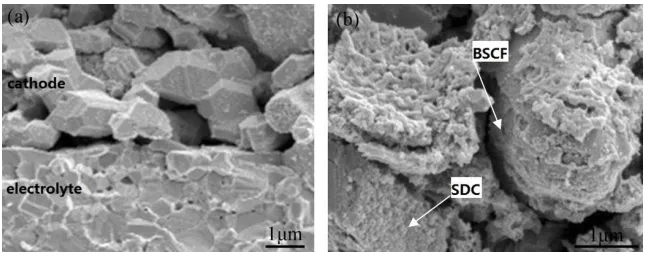
Fig. 1a is the fracture surface picture of symmetrical cells. The internal microstructure of the electrode can be clearly analyzed in the figure. The BSCF framework has not been impregnated and the BSCF framework was sintered at 1100 °C. From Fig. 1a, we can find that the SDC electrolyte on the lower part is basically compact while the BSCF on the upper part is of porous structure and the average diameter of the particles is between 1 to 2 μm. This porous structure provides sufficient air transmission passageway and greatly increases the surface area of the cathode to impregnate more SDC. Fig. 1b shows BSCF covered with small SDC grains. After the SDC are impregnated, a layer of tiny SDC particles are covered the BSCF. Nano-scale SDC particles have excellent catalytic action on the electrode and can effectively extend the triple phase boundary (TPB). This is a major cause for the improvement of impregnated electrode performance.
3.2. Effect of SDC loading
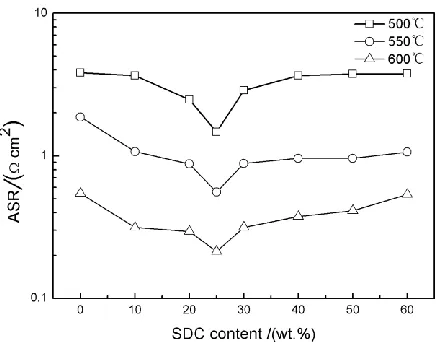
The development of a series of new cathodes by impregnating a mixed conducting phase (BSCF) with an ionic conducting phase (SDC) results in a significant improvement of the electrochemical properties. The content SDC has great effect on the electrochemistry property of combined electrode. When SDC particles are scattered on the BSCF matrix, the connectivity is not very good, and the advantage on electrochemistry cannot be well performed. When the SDC content increases, the connectivity gets better. When the SDC particles are connected, more passageways will be provided for the conduction of oxygen ion in electrode. However, when the SDC content is over high, the electrochemistry performance gets lower. This is because too many SDC particles will cause aggregation and get the conductivity lower. Therefore, the best impregnation amount exists when increasing the SDC content, the simulated result in document [3] has proved this rule. Fig. 2 displays the interfacial polarization resistance measured at 500 °C, 550 °C, and 600 °C respectively for cathodes impregnated with (0-60) wt.% SDC. As can be seen from the overall trend, when the impregnation rate is 25%, the polarization resistance of composite electrode is the smallest. The polarization resistance increases whether the impregnation rate is less or greater than 25%. The resistance at 600 °C decreases from 0.546 Ωcm2
to the lowest of 0.214 Ωcm2 when the loading increases from 0 to 25 wt.%, and the polarization resistance will be increased to 0.542 Ωcm2 when the impregnation rate is 30%. The polarization resistance of the ion-impregnated BSCF-SDC (25 wt.%) cathode is approximate 39% of pure BSCF cathode. Fig. 2 shows that the optimized loading for SDC infiltrated electrode is about 25 wt.%. Wei et al. reported that the interfacial impedance came to 1.9 Ωcm2
at 500 °C when 30 wt.% SDC was added to form BSCF-SDC composite cathode by the mechanical mixing method [19]. In this experiment, the 25 wt.% SDC was added to form BSCF-SDC composite cathode by the ion-impregnation method, the interfacial impedance is 1.86 Ωcm2 at 500 °C, indicating the activity of nano-sized SDC particles is improved.
pathways and promotes the synergistic process involving the injection of mobile charged oxygen species into ionic carriers.
Figure 2. Area specific resistance (ASR) of the composite cathode as a function of the weight fraction of SDC
3.3. Single cell performances
This thesis prepared anode-supported single cells and studied their electrochemistry performance by using the SDC thin film as electrolyte layer and the impregnated SDC-BSC composite material as cathode. Fig. 3(a-d) displays the electrochemistry performance of single cells. The heat processing temperatures of impregnated SDC are respectively 700 °C, 800 °C, and 900 °C. As the anode and the electrolyte are the same, the polarization resistance difference in Fig. 3a is mainly from the cathode. When the heat processing temperature of SDC is increased from 700 °C to 800 °C, the resistance is slightly smaller. Therefore, it can be speculated that improving the heat processing temperature of SDC, the connection among electrode, electrolyte, and SDC particles will be increased. The ASR becomes larger when the SDC is heated to 900 °C. This might be because increased SDC grains are filled into the BSCF pores, where the effect of TBPs becomes more important than the interfacial bonding.
[image:5.596.182.401.121.292.2]
at 500 °C, 550 °C and 600 °C respectively. This performance is remarkably higher than that of BSCF-SDC prepared as cell cathodes by the mechanical mixing method [20].
Figure 3. Electrochemical performance of single cells with impregnated SDC: a) Impedance spectra under open circuit conditions; b-d) Cell voltages (solid symbols) and power densities (open symbols) as function of current density of anode-supported cell using the impregnated cathodes with SDC heated to (b) 700 °C, (c) 800 °C and (d) 900 °C respectively.
This indicates that the nano SDC particles impregnated in the BSCF matrix have obvious electro-catalysis function on the BSCF electrode. It is seen from the macro-photograph of the impregnated electrode in Fig. 1b that infiltrated SDC particle is made up of many nano-level grains, which cover the BSCF cathode backbone. The SDC ion conductive phase impregnated on the matrix surface can greatly enlarge the surface of electrode and can help the improvement of catalytic activity and TPB amount [21]. Rising of sintering temperature increases the integration between the electrode and the electrolyte, and enhances the integration intensity between the SDC and BSCF particles. Therefore, higher sintering temperature improves the electrochemistry activity of electrode. When SDC heat processing temperature comes to 900 °C, the impregnated SDC nano-particles become big, and their resistance becomes larger [22]. Ion impregnation method is a very feasible method for preparing composite cathode.
4. CONCLUSIONS
[image:6.596.126.478.136.408.2]
lowered by impregnating the ion conductive phase to the ion-electron mixed conductive phase. For example, the cathode polarization resistance is 0.546 Ωcm2 at 600 °C for pure BSCF cathode, but 0.214 Ωcm2
for BSCF–SDC. Besides, the performance of the cells is also measured and compared at various temperatures with humidified hydrogen as fuel and air as oxidant. The power densities increase with SDC heating temperature from 700 °C to 800 °C. Nevertheless, further increasing the heating temperature causes a slight decrease of power densities when SDC is heated to 900 °C. The maximum power densities of the cell with SDC heated to 800 °C are 290 mWcm−2, 504 mWcm−2, 793 mWcm−2 at 500 °C, 550 °C and 600 °C respectively. For solid fuel cells, the BSCF-SDC composite cathode prepared by impregnation method is very promising cathode material.
ACKNOWLEDGEMENTS
This work was supported by "the Fundamental Research Funds for the Central Universities" (2012QNA05).
References
1. A. Behrouzifar, A.A. Asadi, T. Mohammadi, A. Pak, Ceram. Int. 38 (2012) 4797 2. H. Dhingra, B.A. Peppley, J. Power Sources 239 (2013) 527
3. E.F. Hardjo, D.S. Monder, K. Karan, J. Electrochem. Soc. 161 (2013) F83
4. M. Balaguer, V.B. Vert, L. Navarrete, J.M. Serra, J. Power Sources 223 (2013) 214
5. S. Baumann, J.M. Serra, M.P. Lobera, S. Escolástico, F. Schulze-Küppers, W.A. Meulenberg, J. Membr. Sci. 377 (2011) 198
6. E. Bucher, A. Egger, P. Ried, W. Sitte, P. Holtappels, Solid State Ionics 179 (2008) 1032
7. A. Ghadimi, M.A. Alaee, A. Behrouzifar, A.A. Asadi, T. Mohammadi, Desalination 270 (2011) 64 8. P. Haworth, S. Smart, J. Glasscock, J.C. Diniz da Costa, Sep. Purif. Technol. 94 (2012) 16
9. Z. Jiang, C. Xia, F. Chen, Electrochim. Acta 55 (2010) 3595
10.A.A. Yaremchenko, C. Buysse, V. Middelkoop, F. Snijkers, A. Buekenhoudt, J.R. Frade, A.V. Kovalevsky, J. Membr. Sci. 428 (2013) 123
11.A.V. Kovalevsky, A.A. Yaremchenko, V.A. Kolotygin, A.L. Shaula, V.V. Kharton, F.M.M. Snijkers A. Buekenhoudt, J. R. Frade, E. N. Naumovich, J. Membr. Sci. 380 (2011) 68 12.D. Chen, Z. Shao, Int. J. Hydrogen Energy 36 (2011) 6948
13.Z. Duan, M. Yang, A. Yan, Z. Hou, Y. Dong, Y. Chong M. Cheng, W. Yang, J. Power Sources 160 (2006) 57
14.T. Klemensø, C. Chatzichristodoulou, J. Nielsen, F. Bozza, K. Thydén, R. Kiebach S. Ramousse, Solid State Ionics 224 (2006) 21 (2012)
15.J. Li, S. Wang, Z. Wang, R. Liu, X. Ye, X. Sun, T.Wen, Z.Wen, J. Power Sources 188 (2009) 453 16.X. Xu, C. Cao, C. Xia, D. Peng, Ceram. Int. 35 (2009) 2213
17.T.Z. Sholklapper, H. Kurokawa, C. Jacobson, S. Visco, L. De Jonghe, Nano Lett. 7 (2007) 2136 18.Y. Wang, H. Zhang, F. Chen, C. Xia, J. Power Sources 203 (2012) 34
19. B. Wei, Z. Lü, X. Huang, S. Li, G. Ai, Z. Liu, W. Su, Materials Letters, 60 (2006) 3642-46 20. Y. Zhang, J. Liu, X. Huang, Z. Lu, W. Su, Solid State Ionics, 179 (2008) 250-55
21. X. Ding, W. Zhu, X. Gao, G. Hua, J. Li, Fuel Processing Technology, 135 (2015) 14-19 22. L. Zhang, F. Zhao, R. Peng, C. Xia, Solid State Ionics, 179 (2008) 1553-56.