Theses Thesis/Dissertation Collections
6-1-2013
A Context-based framework for mobile
applications
Omkar Kolangade
Follow this and additional works at:http://scholarworks.rit.edu/theses
This Thesis is brought to you for free and open access by the Thesis/Dissertation Collections at RIT Scholar Works. It has been accepted for inclusion in Theses by an authorized administrator of RIT Scholar Works. For more information, please [email protected].
Recommended Citation
Applications
by
Omkar Kolangade
A Thesis Submitted
in
Partial Fulfillment of the
Requirements for the Degree of
Master of Science
in
Computer Science
Supervised by
Dr. Rajendra K. Raj
Department of Computer Science
B. Thomas Golisano College of Computing and Information Sciences
Rochester Institute of Technology
Rochester, New York
The thesis “A Context-based Framework for Mobile Applications” by Omkar Kolan-gade has been examined and approved by the following Examination Committee:
Dr. Rajendra K. Raj Professor
Thesis Committee Chair
Dr. Sumita Mishra Assistant Professor
Dedication
Acknowledgments
I would like to thank my committee chair Dr. R. K. Raj for the support and guidance he has given me not only when I was working on my thesis but throughout my Masters program. I would also like to thank my friend Mihir Chitnis for providing me valuable
Abstract
A Context-based Framework for Mobile Applications
Omkar Kolangade
Supervising Professor: Dr. Rajendra K. Raj
Mobile applications have become commonplace in the past few years. In domains such as healthcare, app user experience becomes even more critical. If healthcare apps are not user friendly, patients simply stop using them, or worse still, they may use these apps with disastrous consequences. One approach to improving app user experience is to keep track of mobile context, which is any information that can be used to characterize the situation of an entity, where an entity can be a person, place, or object.
Contents
Dedication. . . iii
Acknowledgments . . . iv
Abstract . . . v
1 Introduction. . . 1
1.1 Introduction . . . 1
1.2 Background . . . 2
1.2.1 Smart Mobile Devices and Mobile Operating Systems . . . 2
1.2.2 Context-based Systems . . . 3
1.2.3 Medical Information Systems . . . 3
1.2.4 User Experience and Privacy in Medical Information Systems . . . 4
1.2.5 Patient Alerts and Information . . . 5
1.2.6 Mobile Device Sensors . . . 6
1.3 Related Work . . . 7
1.4 Problem and Hypothesis . . . 7
1.4.1 Problem . . . 7
1.4.2 Hypothesis . . . 7
2 Design and Implementation . . . 8
2.1 Approach . . . 8
2.1.1 Advantages of an Independent Solution . . . 9
2.2 Design . . . 10
2.2.1 Mobile Application . . . 10
2.2.2 Doctor’s Portal . . . 11
2.2.3 Central Server . . . 12
2.2.4 Databases . . . 12
2.3 System Flow . . . 15
2.4 Comparison With Existing Work . . . 16
2.5 Prototype Mobile App Implementation . . . 17
2.5.1 Android Operating System . . . 18
2.5.2 Application Design on Android Operating System . . . 19
2.6 Production System Implementation Guidelines . . . 21
2.6.1 Central Server . . . 21
2.6.2 Databases . . . 21
2.6.3 Mobile Application . . . 22
3 Analysis . . . 25
3.1 Approach . . . 25
3.2 Analysis . . . 26
3.2.1 Implicit Context Sensing . . . 27
3.2.2 Providing Right Information at the Right Time . . . 27
3.2.3 Context-awareness Reduces User Input Requirement . . . 27
3.2.4 Context-awareness Reduces the Complexity of Interactive Systems 27 3.3 Hypothesis Evaluation . . . 28
4 Conclusions . . . 29
4.1 Current Status . . . 29
4.1.1 Limitations . . . 29
4.1.2 System Design to Prototype . . . 30
4.2 Future Work . . . 31
4.2.1 Additional Sensors . . . 31
4.2.2 Cross-platform Service . . . 32
4.2.3 Generic Application of the Context-based System . . . 32
4.2.4 Context Management Mobile Library . . . 32
4.3 Conclusion . . . 33
Bibliography . . . 34
A Prototype Application . . . 36
A.1 Source Code . . . 36
List of Tables
List of Figures
1.1 A Typical Context-Based System Structure . . . 4
2.1 Position of the system . . . 9
2.2 Possible Bluetooth node placement in a small hospital . . . 14
2.3 Context Based Information System Structure . . . 16
2.4 Android Operating System Architecture (Source: Google) . . . 18
2.5 Patient Alert System Flow Chart . . . 24
A.1 Health Alerts . . . 37
Chapter 1
Introduction
1.1
Introduction
Medical Information Systems, just like any other information systems are adjusting to the new paradigm that is mobile computing. Traditional desktop-based systems have effec-tively facilitated the transition from paper-based systems to electronic ones. But they have certain inherent limitations due to the lack of mobility. Mobile computing, however, has changed the scenario by allowing medical entities to access medical information systems whenever, from wherever they are. While this has certainly enhanced the features and ca-pabilities of such systems, certain issues that have plagued medical information systems since their inception, continue to exist.
Lack of awareness and privacy concerns are the main factors hindering the successful adoption and implementation of Medical Information Systems. As a patient, the concerns regarding the extent of personal medical data being available to doctors, nurses, technicians and other entities, is a serious one [4]. Moreover, many medical information systems rely on accurate data input from the patient’s side (via logging applications) for analysis. The timing of the input is an important factor in medical data logging. For example, a patient on heavy medication at home might be required to note down symptoms thrice a day at specific intervals.
policies and regulations concerning medical data. The system can help the patients in un-derstanding the existing medical information systems clearly and enable them to interact with them as expected by the designers of the medical information systems.
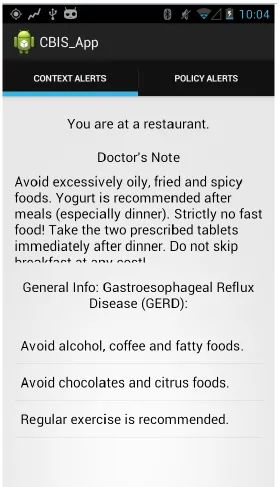
Such a system also provides important contextual health alerts at relevant times. The doctor, while initiating the patient into the system can enable relevant contexts for the pa-tient. For example, a patient undergoing treatment for a gastrointestinal ailment will be reminded of the doctor’s advice when they enter a restaurant. It is possible to turn off all the alerts and notifications in the information system, if the user chooses to do so.
1.2
Background
1.2.1
Smart Mobile Devices and Mobile Operating Systems
Context-based mobile applications have been around since the last decade. The importance of contexts other than location has also been discussed [15]. With the development of iOS and Android mobile operating systems and the smart-phones that support them, the creation of context-based applications has become more streamlined. This is mainly due to the APIs provided by the mobile operating systems to access the different types of sensors in the smart devices such as accelerometers, light sensors, GPS co-ordinates etc. Also, these operating systems and smart devices have allowed for the development of complex, purpose-built mobile applications that leverage the connectivity and the processing power of the devices. Coupled with web-services and/or cloud computing, the mobile devices have become the user interaction points of systems akin to their desktop counterparts in the past years.
can be achieved by using the new computing paradigms.
1.2.2
Context-based Systems
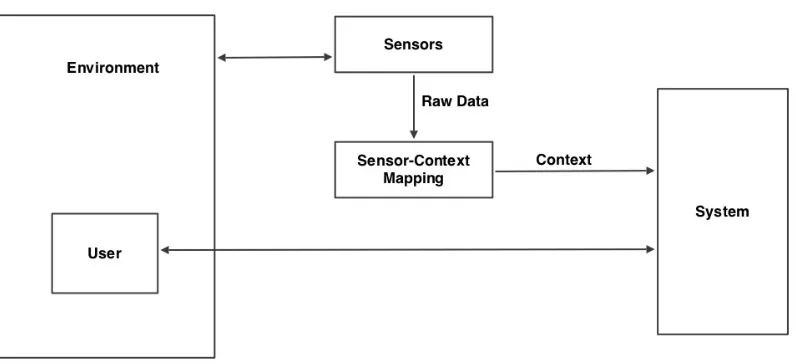
Dey and Abowd define context as ‘any information that can be used to characterize the situation of an entity where the entity is a person, place or object that is considered relevant to the interaction between a user and an application’ [1]. Systems that take context into account in their user interaction or processing logic can be called context-based systems. Context-based systems have been investigated since more than a decade now [1]. Change in environment is an inherent characteristic of mobile computing and hence context-based systems have been investigated and developed for and around mobile devices. With the advent of smart personal mobile devices, more and more environment sensors have been incorporated into the devices. Moreover, the vendors of these devices have actively devel-oped and opened up the application program interfaces (APIs) to these sensors allowing third-party developers to create context-based applications.
The primary appeal of context-based systems is the advanced automation features the systems can potentially provide. In any form of computing, actions that require the system to take input from the user to determine the solution, direction or action, can be partially or completely eliminated with the use of contexts. This is especially true in mobile comput-ing systems where the inherent portable nature of mobile devices allows a great number of contexts to exist. Moreover, with the advancement in the rapidly-evolving field of mobile computing, new sensors are being integrated into the mobile devices. This has and will continue to create new contexts either on its own or by the combination of the new sensors with the existing ones.
1.2.3
Medical Information Systems
Figure 1.1: A Typical Context-Based System Structure
with Electronic Medical Records such as HIPAA compliance. These systems are typically implemented as client-server systems although there has been research into implementing them in the cloud while maintaining the security constraints [17].
Medical Information Systems are designed and implemented primarily for the creation, storage and management of Electronic Medical Records. Traditionally, all these tasks have been performed by healthcare providers and technicians. After a few years, web portals were developed to give patients direct access to their data using a web browser. With the advent of smart mobile devices like smart-phones and tablets and their widespread use in daily life, these systems now have mobile applications that allow patients to provide and view their personal medical data using their smart mobile devices [11].
1.2.4
User Experience and Privacy in Medical Information Systems
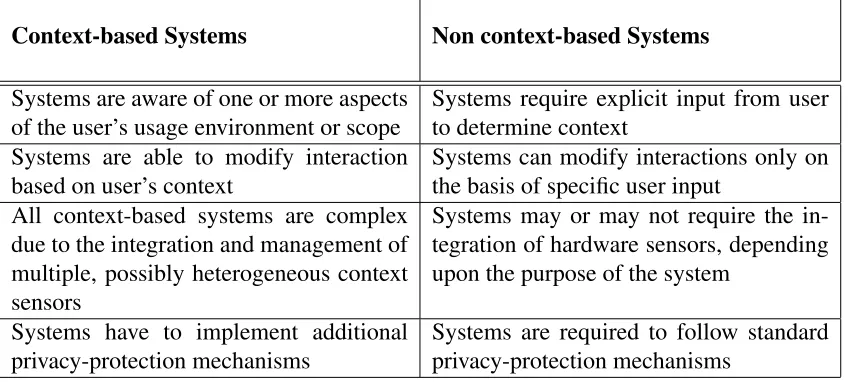
Table 1.1: A brief comparison between context-based and non context-based systems
Context-based Systems Non context-based Systems
Systems are aware of one or more aspects of the user’s usage environment or scope
Systems require explicit input from user to determine context
Systems are able to modify interaction based on user’s context
Systems can modify interactions only on the basis of specific user input
All context-based systems are complex due to the integration and management of multiple, possibly heterogeneous context sensors
Systems may or may not require the in-tegration of hardware sensors, depending upon the purpose of the system
Systems have to implement additional privacy-protection mechanisms
Systems are required to follow standard privacy-protection mechanisms
where the use of Medical Information Systems in mandatory, the improper use of the sys-tems leads to bad data.
Patients are not always aware of the extent to which their medical data is required to be shared with the other entities of the Medical Information Systems and prefer granular access control to their data [4].
1.2.5
Patient Alerts and Information
1.2.6
Mobile Device Sensors
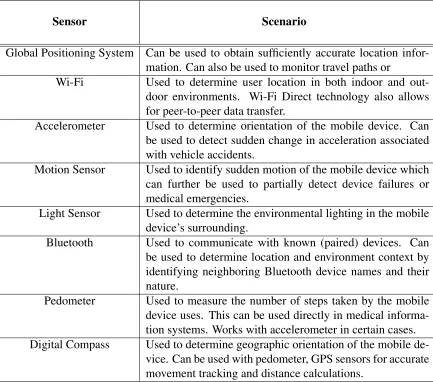
[image:17.612.94.527.213.595.2]Today’s mobile devices have multiple sensors that can be used to determine user context either single-handedly or by a combination of sensor data. Table 1.2 describes the possible usage scenarios for different mobile device sensors.
Table 1.2: Possible mobile device sensor usage scenarios
Sensor Scenario
Global Positioning System Can be used to obtain sufficiently accurate location infor-mation. Can also be used to monitor travel paths or
Wi-Fi Used to determine user location in both indoor and out-door environments. Wi-Fi Direct technology also allows for peer-to-peer data transfer.
Accelerometer Used to determine orientation of the mobile device. Can be used to detect sudden change in acceleration associated with vehicle accidents.
Motion Sensor Used to identify sudden motion of the mobile device which can further be used to partially detect device failures or medical emergencies.
Light Sensor Used to determine the environmental lighting in the mobile device’s surrounding.
Bluetooth Used to communicate with known (paired) devices. Can be used to determine location and environment context by identifying neighboring Bluetooth device names and their nature.
Pedometer Used to measure the number of steps taken by the mobile device uses. This can be used directly in medical informa-tion systems. Works with accelerometer in certain cases. Digital Compass Used to determine geographic orientation of the mobile
1.3
Related Work
Context-based medical information systems have been proposed for specific purposes within the medical domain. Fenza et al. [9] describe an integrated environment that provides healthcare services approximately matching the user’s context. Their work determines the user context by a robust theoretical approach.
Skov et al. [16] describe a mobile, context-aware hospital ward system for nurses. As nurses move from ward to ward, the context-aware mobile device they carry understands the change in physical location and only displays information related to the patients in that particular ward.
Most of the existing work in the field of context-based medical systems has been as-sociated with medical contexts and specific medical systems as opposed to the proposed context-based information system that focuses on mobile contexts and is expected to work with any underlying medical information system that has a mobile application.
1.4
Problem and Hypothesis
1.4.1
Problem
In a given information system that has mobile applications as user interaction points, it is not always possible to address the user experience and awareness aspects of the systems directly. This may be due to some other constraints the system is bound by.
1.4.2
Hypothesis
Chapter 2
Design and Implementation
2.1
Approach
By employing the context-aware nature of smart mobile devices, the user interaction with an existing information system can be improved [1, 2, 6, 7, 10, 13]. The context-aware information system provides relevant information of the existing information system to the user at the right time thereby improving the user’s understanding of the system and increas-ing the chances that the users interact with system as they are supposed to. A context-based information system is designed and a mobile application created to improve the user ex-perience of an existing Medical Information System. A real-world Medical Information System is not used as it is not feasible to get access to the inner workings of such a system. A similar system is implemented to simulate the interaction with the user.
The system is designed to do the following:
• Provide the user with the right medical information at the right location.
• Provide the user with context-based alerts pertaining to the right medical context.
2.1.1
Advantages of an Independent Solution
[image:20.612.202.414.416.649.2]While it has been explained why existing medical information systems find it difficult to simply integrate mobile contexts, an independent solution that does this has certain advan-tages. An independent solution here refers to the information system on top of the medical information system. The proposed system can be implemented over any medical infor-mation system that has a mobile application end-point for users. Also, for the system to be most effective, there will have to be a tight coupling of certain features or APIs of the medical information system with the proposed system’s mobile application. This enables the system designers to gain a better insight into the workings of multiple, possibly differ-ent information systems. As a result, the proposed, context-based information system can continuously evolve and incorporate advanced features and context-based capabilities and in turn prompt the medical information systems to enable or support these features. There might be legal issues with feature replication across different medical information systems; especially if patents are involved in the system design.
2.2
Design
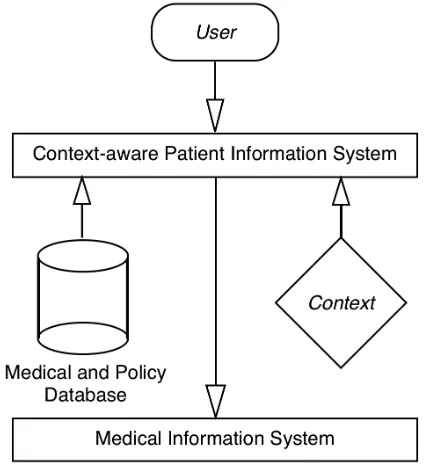
The context-based patient information system adds context-awareness on top of existing Medical Information Systems, thereby improving the user experience of the system. The working of the system is described below followed by the components of the context-based information system.
2.2.1
Mobile Application
The mobile application runs on the patient’s smart-phone. It will constantly monitor the mobile context of the patient. As soon as there is a match between the current mobile context and the medical context specified by the doctor, the application will display appro-priate information. The server will push the relevant context data to the application. The application will have to run continuously and will require user permission for access to location and other sensors to be effective. It uses the Global Positioning System, Bluetooth and WiFi sensors to determine contexts. The contexts are designed to be used as follows
-Global Positioning System (GPS)
The GPS co-ordinates are the best location indicators on a mobile device. A GPS system has the ability to determine the position of a mobile device accurately within a few me-ters. However, since the GPS system depends upon communication with GPS satellites, determining position in indoor locations can be difficult.
Bluetooth
can easily help the mobile device understand that it is likely in a doctor’s office. It is worth noting that in such cases, device pairing is not required. This minimizes the initial setup requirements.
Wi-Fi
Wi-Fi networks have become very common for daily use at not only large organizations but also at home. The use of Wi-Fi for determining location in indoor environments has existed since quite some time [12]. This is especially useful when GPS signals are weak or unavailable. Also, just the SSID of the Wi-Fi network can be used to determine the location of the mobile device. A very practical use case scenario for this type of context determination is to partially check whether a user is at their home. Since home Wi-Fi names are typically (but not always) unique.
2.2.2
Doctor’s Portal
Doctors access the system by using a web portal. They register patients into the system using the portal and also specify the appropriate medical contexts. The portal is hosted on the central server.
The doctor’s portal is a accessed via HTTPS links and has a simple, web-page layout with a navigation menu for the doctor to initialize new patients into the system, remove existing ones and modify medical contexts for patients. The portal has a drop-down list of medical contexts that can also be specified in a text field for the same. The text field has an auto-complete feature for ease of use.
Patient Registration
the system assumes that the patient will use just one mobile device as their primary device.
2.2.3
Central Server
The central server is the main backend entity of the system and is responsible for providing medical and policy information to the patients. All nodes in the system are connected to the central server. The server is accessible over the web for communication with the mobile application. The central server’s responsibilities are
-• Hosting the doctor’s portal
• Database connectivity
• Communication with the mobile application
In the current version of the system, the central server mainly pushes mobile context infor-mation to the mobile application. The doctor can update a patient’s inforinfor-mation, in case the medical context needs to be changed or the patient is no longer required to be in the system. The updated context(s) are pushed to the mobile application. In case the patient is no longer required to use the application, the application locks and asks the patient to contact their doctor. This is generally expected to be done on the patient’s final follow-up visit unless the doctor sees it fit to do so at an earlier stage.
2.2.4
Databases
-Medical Domain Database
The medical domain database contains a list of medical ailments mapped to the appropriate mobile-contexts. The database is maintained by a team of medical and mobile experts. When a doctor initiates a patient into the system, she specifies appropriate medical contexts for the patient. The appropriate mobile context, for those medical contexts, are sent to the mobile application on the patient’s smartphone. This allows the smartphone to trigger alerts only on the specified events. This design saves battery life by simply ignoring non-specified mobile context.
The medical domain database also contains policy information pertaining to specific roles in the medical domain. The sources of the information are the laws and the directives specified by the government.
Backend Database
The backend database stores the records for mobile contexts that are bound to patients and the doctor’s customized notes provided while initiating the patient into the system. As of now, that is the only purpose of the backend database. If the system is to include additional features such as mobile context mining and logging, this database cab be used to provide the functionality. It is important to note that the database does not store the medical contexts bound to a patient. This prevents the database from being a source of medical information leaks. The backend database also maintains the system activity log records.
Mobile Context - Medical Context Binding
possible understanding of the patient’s medical condition and would hence know which mobile contexts, or their combinations, need to be monitored on the mobile device.
2.2.5
System Nodes
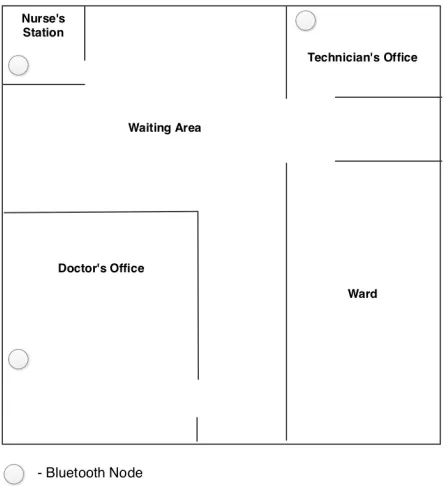
A Bluetooth 4.0 Low Energy (BLE) based system node is placed at all the physical loca-tions of the entities of the Medical Information System. For example, a typical Medical Information System has entities like doctors, nurses and technicians. Nodes are therefore be placed in the doctor’s office, technician’s office and near the nurse’s station. The nodes periodically check for a paired device. Every node in the system is connected to the central server.
[image:25.612.199.423.408.651.2]Since the mobile application only requires the Bluetooth device names around it to de-termine the context, pairing is not required. The systems assumes that Bluetooth nodes corresponding to different medical entities in a hospital are placed at a sufficient distance from each other so as to avoid a range overlap.
2.3
System Flow
When a patient visits a doctor for the first time, the doctor will register the patient into the context-based information system and ask them to download and install the mobile appli-cation. The doctor has a web-based portal for the patient-registration procedure. At the same time, the doctor will enable the relevant medical contexts for the user. For example, for a patient with a gastrointestinal ailment, the doctor will enable the appropriate contexts. The server will be connected to a database of appropriate mobile context mappings to the medical contexts. In the above example, as the doctor specifies the gastrointestinal ailment and adds specific comments, the server will query the database to learn that the mobile context ‘restaurants’ needs to be activated for the patient’s mobile device. This will result in the mobile application on the patient’s smart-phone giving an alert to the patient as they walk into a restaurant. The alert will contain the doctor’s specific comments. If the patient is required to enter their meal details into a Medical Information System, they will be prompted to do so as they walk out of the restaurant.
Whenever the patient interacts with a doctor, nurse or a technician, relevant medical information will be shown to the patient. This information will be in the central server’s database. In the above example, when the patient goes to a technician for a blood or stool test, information regarding why the test is being carried out and the most important test result will be shown to the patient by the mobile application.
Also, the mobile application will contact the server to obtain the appropriate privacy policies concerning Electronic Medical Records. In the above example, the application will inform the patient that they are expected to make certain information available to the technician such as name, blood group etc. This way, when the patient is expected to inter-act with the Medical Information System, they will be completely aware of the system’s expectations.
Figure 2.3: Context Based Information System Structure
2.4
Comparison With Existing Work
2.5
Prototype Mobile App Implementation
The mobile application is implemented on an HTC smart-phone running the Jelly Bean (4.0) version of the Android operating system. The communication with the server is simu-lated by using hard-coded variables and the nodes are simusimu-lated on one or more computers since the focus of the implementation is not on implementing a web service or establish-ing network connections. Geo-location, Bluetooth and Wi-Fi network based contexts are implemented and drive alert events in the application. The user interface elements of the prototype application are sufficient enough to display the relevant information. A produc-tion enterprise applicaproduc-tion will need to implement a more appropriate a user interface. It is important to note that the prototype application or even the production application for that matter will require the user to allow access to all the required sensors. The privacy and security concerns arising are most likely to prevent general distribution of the application of commercial application stores. The application will have to be classified as an enterprise application to be approved for limited distribution.
The server simulation involves providing appropriate mobile contexts to the applica-tion. This is done by manipulating pre-defined variables in the application’s code. Node simulation involves a Bluetooth client in the proximity of the smart-phone. The client can be any Bluetooth-enabled device. Both context-based and policy alerts are implemented.
2.5.1
Android Operating System
[image:29.612.125.495.235.500.2]The Android operating system has evolved from the Android Project which was taken over by Google shortly after its inception. Android is a Linux kernel based operating system which supports most, but not all, the features of the Linux kernel version 3.0. It has been developed by the Open Handset Alliance which is a consortium of mobile or mobile-related companies. Android is specifically developed for running on mobile phones.
Figure 2.4: Android Operating System Architecture (Source: Google)
also has wrapper libraries for some services such as location service that use and manage multiple sensors to determine a user’s location and detect changes as well.
One of the main advantages of Android over other mobile operating systems is that it is open source. This allows us to customize components of the operating system system itself, if required. While the system’s mobile application does not require any operating system customization, the option might be useful if purpose-built hardware devices are used instead of general purpose, commercial mobile devices.
2.5.2
Application Design on Android Operating System
The Android application is implemented as a multi-tab application. The main activity is responsible for the user-interface elements while each tab has it’s own thread for execut-ing tasks. This design conforms to Google’s design guidelines for Android applications. The design allows for asynchronous process execution which is particularly useful for this application as both the context-based alerts module and the policy awareness module can coexist and run independently. Also, the multi-tab design allows the context-based alerts module to continue to present alerts even if the patient is in the vicinity of a Bluetooth node and receiving policy-based alerts.
be used due to design or policy restrictions.
The prototype application uses Wi-Fi network name (if available) to aid in determining the location of the device. TheWifiManagerclass has agetConnectionInfo()method which provides complete connection details for the current Wi-Fi network. The application just makes use of the Service Set Identifier (SSID) of the network and compares it with a known Wi-Fi network SSID.
The Bluetooth chip in the device is used by working with the the BluetoothAdapter
2.6
Production System Implementation Guidelines
2.6.1
Central Server
The system’s server side can be implemented by a central-server or a distributed system design. The later design is recommended only when the usage of the system becomes large enough to justify the scalability-complexity trade-off. If the system is expected to be deployed across a broad geographical region or even worldwide, a cloud-based server is recommended.
The server can be implemented using any off-the-shelf server engine technology such as NGINX [14] or Node.js [8] to name a few. Security mechanisms, database I/O optimiza-tion, encryption and other system enhancements can be implemented as per the system administrator’s requirements. The data format for transfer between the doctor’s portal and the mobile application can be either XML or JSON. JSON is recommended as both the An-droid and iOS mobile operating systems have stable, ready-to-use JSON parsing libraries. A possible serverside stack can look like this
-• Amazon AWS
• Node.js
• Express.js
• MongoDB or CouchDB
Both Node.js and NGINX server-side technologies have robust Javascript callback mech-anisms that are well-suited to handle multiple, asynchronous requests over the Internet. Express.js can be used to power the doctor’s portal and other web-based features of the system should the requirements change in that direction.
2.6.2
Databases
the relatively simple integration with a new server technology such as Node.js. One of the key design issues is indexing as in the deployed system, the number of retrievals for the Medical-Policy database will be significantly greater than the number of insertions. Traditional relational databases have tried-and-tested indexing but newer non-relational databases such as MongoDB also support indexing. Schema design considerations should focus on how to efficiently map medical contexts to possibly multiple mobile contexts.
2.6.3
Mobile Application
The mobile application should have multiple views, regardless of the operating system it is built on. This is to provide a clear distinction between the context-based and the policy-based alerts in the system. Typically, both Android and iOS mobile operating systems advocate and implement multi-threaded applications. The main thread of the application should handle the user interface elements of the application only.
While using the Bluetooth APIs, care must be taken to actively manage the device scanning process as this process tends to affect battery life significantly. Similarly, event listeners corresponding to different sensors in the device should be handled in all the life-cycle methods of the application. This enables or prevents the sensors from being active and reporting data when the application is ‘minimized’ or interrupted by other device functions. Care must be taken to not store any contextual information, obtained through sensors, on the device. The only contextual information already present in the application should be the information obtained from the central server. Sensor data logging, while appealing as it can allow for creative expansion of the system, is a serious privacy issue.
Chapter 3
Analysis
3.1
Approach
3.2
Analysis
[image:37.612.90.516.327.591.2]User experience studies and context-based system research has focused on evaluating sys-tems that could potentially incorporate context-awareness to improve user experience of the system. But as Figure 2.1 illustrates, the context-based information system works along-side an existing information system. However, to the end user, the features and the benefits of the context-based system appear to be a part of the same underlying information system. Table 3.1 summarizes the design features of the proposed system based on experimental and theoretical research. Explanations of the recommendations and their impact on system design follow.
Table 3.1: Research recommendations and corresponding system design features
Research Recommendations System Design
Users have much to gain from im-plicitly sensed contexts in mobile applications [1].
The mobile application senses contexts contin-uously.
Providing right information to the user at the right time [10].
The system generates and displays alerts to the user only when the mobile context matches the pre-defined medical context. Only that informa-tion which corresponds to the medical context is shown to the user.
Context-awareness reduces the re-quirement for user input [13].
The system automatically takes into account the location, time and other mobile contexts. This process is continuous and requires no user input or control.
Context-awareness reduces the complexity of interactive systems [6].
3.2.1
Implicit Context Sensing
The mobile application in the context-based information system keeps monitoring device sensors for contextual information. This happens even when the application is not active on the mobile device. Once the user installs the application and provides appropriate details, the application does not require any user input.
3.2.2
Providing Right Information at the Right Time
The mobile application alerts are triggered only when the mobile context of the user and the medical context match. Also, policy based alerts are triggered only when the user is in the proximity of a Bluetooth node. The use of multiple contexts is required to determine the right time for the alert.
3.2.3
Context-awareness Reduces User Input Requirement
Since the system is designed to work on top of an existing medical information system, the contextual information generated by the system can be used in the medical information sys-tem. This, however, may depend upon the design and restrictions of the underlying medical information system. Certain cases are easily possible. For example, if a medical informa-tion system mobile applicainforma-tion requires the patient to track the approximate distance they walked each day, an API access to the context-based information system can update or log this information into the medical application directly.
3.2.4
Context-awareness Reduces the Complexity of Interactive
Sys-tems
3.3
Hypothesis Evaluation
Since the design of the proposed context-based information system follows research rec-ommendations on improving the user experience of information systems, the results of the analysis are promising. The mobile application is a vital part of the underlying information system and the proposed system uses mobile context to enhance its user experience. The nature of the context-based information is such that with tight integration with the under-lying information system, the systems will effectively appear as one to the end user.
In theory, it can be said that the system clearly enhances the user experience by using context. However, the scope of this thesis did not allow for the building of a complete pro-totype system to conduct user experience tests. For a better and comprehensive analysis of the hypothesis, a prototype system needs to be deployed on top of a participating informa-tion system. Also, user experience tests need to be carried out on the informainforma-tion system on its own to obtain the user experience metric; this metric will be used for comparison with the metric obtained from the usability tests carried out on the system with the addition of the context-based information system.
Chapter 4
Conclusions
4.1
Current Status
The context-aware patient information system described can be implemented on any cur-rent medical information system. The system proposed is flexible as specific implemen-tation details and the addition of security features is left to the system administrator. The current implementation is for the Android mobile operating system only.
4.1.1
Limitations
The proposed system has been designed to primarily enhance the user experience and awareness of an underlying information system. While doing so, many aspects of soft-ware design like security and portability were not the prime area of focus. Some of the key limitations of the system in its current state are
-Limited Security Mechanisms
Platform Dependence
The mobile application has been developed for the Android mobile operating system only. While a similar application can be developed for the other popular operating systems such as iOS and Blackberry OS 10, it would still require the availability of equivalent mobile de-vice sensor APIs for true cross-platform homogeneity of the mobile application. Also, the platform’s vendor platform must be able to classify the system’s application as an enterprise application for controlled deployment. Due to the application’s requirement of access to as many sensors as possible, the application is not likely to be approved on the commercial ‘app stores’.
Dependence on Sensor Availability
Since the system is primarily context-based, lack of context availability effectively dis-ables the system. While the system has been designed to use multiple sensors (wherever possible) to determine contexts such as location, the possibility of multiple sensors being unavailable is not an unlikely one. The lack of a particular sensor can have variable impact on the system depending on what other sensors are available. One way of preventing the application from working in a semi-correct state is to specify mobile device requirements beforehand and perform the appropriate sensor checks from within the application on the first instance of the user running it.
4.1.2
System Design to Prototype
information system. A prototype-level or open mobile application of the underlying infor-mation system is necessary for thorough testing.
4.2
Future Work
The information system described in this work is based on the context-aware nature of to-day’s most popular mobile operating systems and the devices they power. In the current system, even if a patient is reminded to make a log entry into an EMR system, they still have to do it themselves. A tight coupling between medical information systems and a context-based Information System can lead to features like auto-logging of relevant data.
4.2.1
Additional Sensors
4.2.2
Cross-platform Service
The mobile application can be implemented on other mobile operating systems such as iOS and Blackberry OS 10. Mobile operating system vendors actively make new context-based sensor APIs available for developers to encourage the development of context-context-based applications. New technologies such as Google Glass, Near Field Communication (NFC) can be used to provide mobile contexts. Also, the context-based alert system could be implemented as an Android service instead of an application. This would allow existing application to use the context-based alerts. However, the user interface for the contexts and alerts will have to be provided by the application.
4.2.3
Generic Application of the Context-based System
Apart from the medical domain, such a context based information system can be imple-mented for commercial information systems such as news alert or tourist information sys-tems. The users can themselves provide relevant contexts that will be enabled on the mo-bile application allowing alerts to be triggered for relevant contexts and Point-Of-Interests (POIs). The important point to note here is that the underlying system must have a mobile application for the system to work.
If the underlying information system is not bound by stringent privacy-protection stan-dards and other relevant legal policies, the system can natively implement one or more features of the context-based information system.
4.2.4
Context Management Mobile Library
context. This pattern can be compiled into an API call accessible directly to the appli-cation. Not that context here refers to mobile context and not the Context class in the android.content package in Android.
For example - A mobile application wants to check all its neighboring Bluetooth de-vices to determine if there are any known ones. This is to guage the familiarity of the en-vironment the user is in. Currently, this task can be easily accomplished using the Android Bluetooth API. But if such functionality could be implemented by a single API method such as “isBluetoothEnvironmentKnown()”, it would certainly make it easier and encour-age developers to incorporate mobile context into their applications. A collection of such methods for different sensors to obtain the user’s mobile context can be the crux of a context management mobile library.
4.3
Conclusion
Bibliography
[1] Gregory D. Abowd, Anind K. Dey, Peter J. Brown, Nigel Davies, Mark Smith, and Pete Steggles. Towards a better understanding of context and context-awareness. In
Proceedings of the 1st international symposium on Handheld and Ubiquitous
Com-puting, HUC ’99, pages 304–307, London, UK, UK, 1999. Springer-Verlag.
[2] Leon Barnard, Ji Soo Yi, Julie A. Jacko, and Andrew Sears. Capturing the effects of context on human performance in mobile computing systems. Personal Ubiquitous Comput., 11(2):81–96, January 2007.
[3] Howard L. Bleich and Warner V. Slack. Reflections on electronic medical records: When doctors will use them and when they will not. International Journal of Medical Informatics, 79(1):1 – 4, 2010.
[4] Kelly Caine and Rima Hanania. Patients want granular privacy control over health in-formation in electronic medical records.Journal of the American Medical Informatics Association, 20(1):7–15, January 2013.
[5] Alvin T. S. Chan, Hong Va Leong, Joseph Chan, Alan Hon, Larry Lau, and Leo Li. Bluepoint: a bluetooth-based architecture for location-positioning services. In
Proceedings of the 2003 ACM symposium on Applied computing, SAC ’03, pages 990–995, New York, NY, USA, 2003. ACM.
[6] Keith Cheverst, Keith Mitchell, and Nigel Davies. Exploring context-aware informa-tion push. Personal Ubiquitous Comput., 6(4):276–281, January 2002.
[7] Constantinos K. Coursaris and Dan J. Kim. A meta-analytical review of empirical mobile usability studies. J. Usability Studies, 6(3):11:117–11:171, May 2011. [8] Ryan Dahl. Node.js, 2009. [Online; accessed 23-May-2013].
[10] Gerhard Fischer. Context-aware systems: the ’right’ information, at the ’right’ time, in the ’right’ place, in the ’right’ way, to the ’right’ person. In Proceedings of the International Working Conference on Advanced Visual Interfaces, AVI ’12, pages 287–294, New York, NY, USA, 2012. ACM.
[11] Hyrax Inc. My Medical for iPhone/iPad, 2009. [Online; accessed 20-April-2013]. [12] S. Johnson. A framework for mobile context-aware applications. BT Technology
Journal, 25(2):106–111, 2007. Copyright - Springer Science+Business Media, Inc. 2007; Document feature - ; Diagrams; Maps; Photographs; Last updated - 2012-07-24; DOI - 1295553401; 36213271; 53283; BTTJ; SPVLBTTJ105502533.
[13] S. Kurkovsky. Using principles of pervasive computing to design m-commerce ap-plications. In Information Technology: Coding and Computing, 2005. ITCC 2005. International Conference on, volume 2, pages 59–64 Vol. 2, 2005.
[14] NGINX. NGINX, 2011. [Online; accessed 23-May-2013].
[15] Albrecht Schmidt, Michael Beigl, and Hans w. Gellersen. There is more to context than location. Computers and Graphics, 23:893–901, 1998.
[16] B. Skov and Th. Hoegh. Supporting information access in a hospital ward by a context-aware mobile electronic patient record. Personal Ubiquitous Comput., 10(4):205–214, March 2006.
Appendix A
Prototype Application
A.1
Source Code
A.2
Screenshots