https://doi.org/10.1080/19942060.2017.1343751
Computational fluid dynamics-based hull form optimization using
approximation method
Shenglong Zhang a, Baoji Zhangb, Tahsin Tezdogan c, Leping Xuaand Yuyang Laid
aMerchant Marine College, Shanghai Maritime University, Shanghai, China;bCollege of Ocean Environment and Engineering, Shanghai Maritime University, Shanghai, China;cDepartment of Naval Architecture & Ocean and Marine Engineering, University of Strathclyde, Glasgow, UK;dTechnique Department, Beijing Soyotec Co., Ltd., Beijing, China
ABSTRACT
With the rapid development of the computational technology, computational fluid dynamics (CFD) tools have been widely used to evaluate the ship hydrodynamic performances in the hull forms opti-mization. However, it is very time consuming since a great number of the CFD simulations need to be performed for one single optimization. It is of great importance to find a high-effective method to replace the calculation of the CFD tools. In this study, a CFD-based hull form optimization loop has been developed by integrating an approximate method to optimize hull form for reducing the total resistance in calm water. In order to improve the optimization accuracy of particle swarm opti-mization (PSO) algorithm, an improved PSO (IPSO) algorithm is presented where the inertia weight coefficient and search method are designed based on random inertia weight and convergence eval-uation, respectively. To improve the prediction accuracy of total resistance, a data prediction method based on IPSO-Elman neural network (NN) is proposed. Herein, IPSO algorithm is used to train the weight coefficients and self-feedback gain coefficient of ElmanNN. In order to build IPSO-ElmanNN model, optimal Latin hypercube design (Opt LHD) is used to design the sampling hull forms, and the total resistance (objective function) of these hull forms are calculated by Reynolds averaged Navier–Stokes (RANS) method. For the purpose of this article, this optimization framework has been employed to optimize two ships, namely, the DTMB5512 and WIGLEY III, and these hull forms are changed by arbitrary shape deformation (ASD) technique. The results show that the optimization framework developed in this study can be used to optimize hull forms with significantly reduced computational effort.
ARTICLE HISTORY Received 27 November 2016 Accepted 14 June 2017
KEYWORDS
Hull forms optimization; approximate method; IPSO-Elman neural network; optimal Latin hypercube design; arbitrary shape deformation
1. Introduction
In recent years, hull form optimization has gained great interest for the purpose of minimizing the total resistance which results in minimizing the running cost. At the end of the 1990s, the optimization theory was introduced into the field of hull form design by potential flow theory. Dawson method was used to calculate the sum of flat fric-tion resistance and wave-making resistance which was as the objective function to design the ship-type (Kim, 1995). Wave-making resistance was calculated by poten-tial flow method, and optimal design of hull form was carried out with adjoint optimization method (Huan & Huang,1998). Rankine source was used to calculate the wave resistance and viscous resistance of Series60, and the hull form with the lowest resistance was obtained by nonlinear programing method (Zhang & Zhang,2015).
With the rapid development of computational fluid dynamics (CFD) technique and optimization technique, hull forms design based on simulation-based design
CONTACT Shenglong Zhang [email protected]
(SBD) technique has become the main trend in the twenty-first century (Kim & Yang, 2010; Tahara, Peri, Campana, & Stern,2008). The CFD tools have become the main method for calculating the hull resistance and simulating the flow field, but its calculation time is rather long. In order to promote the application of SBD tech-nique to the practical engineering, and to reduce the computational time of a typical CFD work, the appli-cation of approximate technique has become the key to the development in ship-type optimization. By pro-cessing of approximate technique, the original complex problem is turned into a relatively small approximate sub-problem, and the optimal solution of the original prob-lem is obtained by successive approximation. The issue of predictions using the approximate model has been high-lighted by some designers not only in the engineering (Chang, Feng, Liu, Zhan, & Cheng,2012; Kamiński,2015; Qian, Mao, Wang, & Yun, 2012) but also in the real-life (Chau & Wu,2010; Wang, Kwokwing, Xu, & Chen,
© 2017 The Author(s). Published by Informa UK Limited, trading as Taylor & Francis Group
2015; Wu, Chau, & Li,2009). In recent years, one of the approximate techniques widely used is the neural net-work, which is a kind of information processing method developed according to the enlightenment of biological nervous system. On account of the computer simulation, it can predict and analysis the data by learning, control and identification. Now, it has been applied into differ-ent kinds of optimization problems (Hu & Balakrishnan, 2005; Liu & Luo, 2005; Liu, Tian, Liang, & Li, 2015; Puig, Witczak, Nejjari, Quevedo, & Korbicz,2007; Zhang, 2016). The ElmanNN is a typical multi-layer dynamic recurrent neural network, and it has a stronger global sta-bility and a characteristic of time-varying since adding the contest nodes to the hidden nodes of feed-forward network as time delay operator (Ding, Jia, Su, Xu, & Zhang, 2008). Besides, ElmanNN has been compared with BPNN which is derived from data prediction (Ding et al.,2008; Zhang, Hao, Kong, & Li,2013; Zhou, Yang, & Yang,2011), and they all found that the predicting preci-sion and convergence rate of ElmanNN are much higher than BPNN. Li and Liang (2007) carried out a compar-ison of ElmanNN and RBFNN for flood freeway speed limitation and assumed that the ElmanNN has stronger adaptation and better generalization ability and can build the approximate model more accurately. On the basis of the local feedback network function, the ElmanNN can process the data more precision for nonlinear prob-lem (Liu et al., 2015), which is of great important for the hull resistance prediction. Up to now, hull resistance has been predicted by using radial basis function (RBF) (Huang, Wang, & Yang,2015; Huang & Yang,2016), arti-ficial neural networks (Couser, Mason, Mason, Smith, & Konsky,2004), Holtrop and Mennen’s method (Ortigosa, López, & García, 2009), genetic neural network (Chen & Ye,2009), and BP neural network (Hou, Liu, & Liang, 2016). However, there are few literatures have been pub-lished for predicting hull resistance using ElmanNN. In the light of these considerations, an ElmanNN has been used into the hull form optimization in this study to approximately calculate the total resistance values.
Particle swarm optimization (PSO), a kind of intelli-gent optimization algorithm, was developed by Kennedy and Eberhart in1995(Kennedy & Eberhart,1995). It has obtained a lot of interest in diverse optimization prob-lems because of the advantages of fast convergence, easy implementation and simple calculation rules. Although PSO algorithm has become a relative mature method, it is easy to fall into the local optimal solution. Therefore, many researchers have put forward a variety of improve-ment measures to prove that the new methods are supe-rior to traditional PSO algorithm. The hybridized tech-nique named PSO-GA algorithm was presented by taking
the advantages of both PSO and GA algorithm for solv-ing the nonlinear design optimization problems (Garg, 2016; Nik, Nejad, & Zakeri, 2016). The weighted par-ticle for incorporation into the parpar-ticle swarm opti-mization, and the enhanced particle swarm optimizer incorporating a weighted particle (EPSOWP) was devel-oped to improve the evolutionary performance for a set of benchmark function (Li, Wang, Hsu, & Chen, 2014). Based on the random linear combination between the local best position and the global best position, the particle swarm without velocity equation (PSWV) algorithm was studied by Tungadio, Jordaan, and Siti (2016). A novel multi-sub-swarm particles warm opti-mization (MSSPSO) was used to find multi-solutions for multilayer ensemble pruning model by Zhang and Chau (2009). In this model, the MSSPSO algorithm was used to generate a different pruning based on previous ora-cle output for each layer. A more fast and accurate input variable selection (IVS) algorithm has been developed by Taormina and Chau (2015) integrating binary-coded dis-crete fully informed particle swarm optimization (BFIPS) and extreme learning machines (ELM). As we all know, the evaluation of the convergence is one of the most important factors for the PSO algorithm. If the conver-gence is decreased, the converconver-gence rate of this algorithm will be affected heavily (Han, Li, & Wei, 2006). How-ever, the article above did not mention how to evaluate the premature convergence. In this paper, an improved PSO (IPSO) algorithm has been developed by integrating the randomly distributed inertia weight coefficient and the evaluation of premature convergence. The perfor-mance of this new method has been evaluated by employ-ing them in the optimization of the four mathematical functions.
The aim of present work is to describe a practical ship hull form optimization loop using the IPSO-ElmanNN method. An arbitrary shape deformation (ASD) tech-nique is used to alter the geometry of hull. Total resistance in calm water is selected as the objective function, and optimization is carried out at design speed. The IPSO-Elman algorithm is proposed to approximately calcu-late the total resistance, and the hull form is optimized using an IPSO algorithm. Finally, two ships are presented and discussed: namely, the David Taylor Model Basin (DTMB) model5512 (a ship model of the US Navy Com-batant) and the WIGLEY III (a mathematical ship form widely used on the international) ships.
2. Optimizers
2.1. Particle swarm optimization (PSO) algorithm
On the D-dimensional space, the i-th particle velocity and position can be written asVi= (vi,1vi,2vi,3 . . . vi,d) andXi =(xi,1xi,2xi,3 . . . xi,d) , respectively.pbestis used to denote the local best solution and gbest is used to denote the global optimal solution. In each of iteration, the particle updates itself by tracking pbest and gbest. After finding these two optimal values, the velocity and position of each particle is updated using the following formulas:
vi,j(t+1)=ωvi,j(t)+c1r1[pi,j−xi,j(t)] +c2r2[pg,j−xi,j(t)] (1)
xi,j(t+1)=xi,j(t)+vi,j(t+1) j=1, 2,. . .,d (2)
whereωis the inertia weight coefficient,c1andc2are the acceleration coefficients with positive values called cogni-tive and social parameters, respeccogni-tively.r1andr2are the random variables between 0 and 1. Generally, the range of the total number of particlesN,c1andc2are reported as follows: 20≤N≤40;c1+c2≤4 (Azimifar & Payan, 2016).
2.2. Improved particle swarm optimization (IPSO) algorithm
The inertia weight coefficientωis a parameter to influ-ence the trade-off between global and local searches within the solution domain. In order to improve the precision of the PSO algorithm, the adjustment of ω will become very important. Largeω can avoid getting into local optimal solution, and small one can effectively accelerate convergence speed of iteration. It can be cal-culated by constant method, linear decrement method,
self-adaptation method and so on. In this paper,ωis sub-ject to a random distribution, so that it can overcome the instability caused by the linear decline of the two aspects.
The formula ofωcan be written as:
ω=ψ+σ ∗N(0, 1) (3)
ψ =ψmin+(ψmax−ψmin)∗rand(0, 1) (4) whereψ is the mean value of random weight,σ is the variance of random weight.N(0,1) is the random vari-able of standard normal distribution. ψmin is the min-imum value of random weight. ψmax is the maximum value of random weight.rand(0,1) is the random variable between 0 and 1.
The convergent degree of PSO algorithm can be obtained from (Wang, Ma, Wang, & Wang,2011):
= |fg−favg| (5)
where is the evaluation index of convergent degree, the smaller theis, the better convergent it will be.fgis the fitness of the optimal particle,favg is the fitness aver-age which is calculated by the particles with better fitness thanfavg (fitness average of the whole particles) which can be got fromfavg =1/n
n
i=1fi,fiis thei-th particle fitness,nis the size of the particle swarm.
The particle tends to premature convergence ifis less than thresholddand the optimal solution and the expected optimal solution fd is not obtained. Consider the minimization problem:
< d (6)
fg>fd (7)
At this time, partially inactive particles are modified by Gaussian mutation to early jump out of local optimum and quickly find the global optimal solution. The formal can be written as:
fg−fi
fg−favg ≤θ (8)
whereθ is the threshold, fori-thparticle satisfying the inequality (8), the mutation is carried out with random one-dimensional location:
x(idk+1) =x(idk)+ηξ (9)
whereη is the coefficient of variation,ξ is the random variable in accordance withN(0,1) distribution.
The general flow chart of IPSO algorithm is as follows:
(2) Update the velocities and positions of particles according to Equations (1) and (2).
(3) Update the inertia weight coefficientωusing Equa-tions (3) and (4).
(4) Calculate the fitnessfi.
(5) Update the individual extremumpbestand the group extremumgbest.
(6) Determine whether the premature convergence is produced by Equations (6) and (7). If the answer is yes, the population needs to mutate by Equations (8) and (9). If not, repeat the steps 2–6 until the stopping criterion is met.
(7) Output the global optimal result.
2.3. Verification and validation for the IPSO algorithm
To verify the applicability of the IPSO algorithm, four functions are studied, as shown in Equations (10–13). PSO and IPSO algorithm are used to find the minimum value of four functions respectively. The parameters of two algorithms are shown in Table1.
f1(x)=
D−1
i=1
(100(xi+1−xi2)2+(xi−1)2) (10)
f2(x)=0.5+
sin2Di=1xi2
−0.5
1.0+0.001Di=1xi2 2
(11)
f3(x)=
D
i=1
(x2i −10 cos(2πxi)+10) (12)
f4(x)= 1
4000 D
i=1
x2i − D
i=1cos
xi √ i
+1 (13)
After the completion of optimization, the results are tabulated in Table 2. The optimization results of the IPSO algorithm can get the global optimal solution for four functions, while PSO algorithm and IPSO algorithm with self-adaptive weight and experimental design by Li (2012) were trapped in a local optimum. It can be seen that the IPSO algorithm developed in this paper has very high-precision results in the optimization.
[image:4.610.315.552.68.131.2]Figure1shows a comparison of the iterative processes of the optimization using the PSO and IPSO algorithms
Table 1.Parameters.
Method N c1 c2 ω ψmax ψmin d θ η
PSO 40 2 2 0.5 – – – – –
[image:4.610.75.296.341.530.2]IPSO 40 2 2 – 0.8 0.5 1e−4 0.2 0.1
Table 2.Optimization results of different algorithms.
D
Minimum
value PSO IPSO IPSO (Li,2012)
f1(x) (Rosenbrock) 10 0 5.3067 0 4.855
f2(x) (Schaffer) 10 0 0.009716 0 0.0097
f3(x) (Rastrigrin) 10 0 16.9250 0 3.669
f4(x) (Griewank) 10 0 1.0277 0 0.0694
individually. As can be seen from the figure, in 1000 iter-ations, the IPSO algorithm can give a better fitness value which is near to the global optimal solution at the initial stage of optimization compared to the PSO algorithm. Although the mutation operation is added in the IPSO algorithm, the convergence speed of this algorithm is still not affected. The improving of the convergence speed is mainly because the weight coefficient is not a fixed value but a random distribution value. At the early stage of opti-mization, if the particle is near the global optimum, it can automatically produce a relatively small value to accel-erate the convergence speed. If the optimization has got into local extremum at the early stage of optimization, the constantly change of the weight coefficient and the con-vergence evaluation algorithm can help to overstep the local extremum.
3. Geometry reconstruction
Based on B-spline technique, arbitrary shape deforma-tion (ASD) technique is a method to change the shape of different models by Sculptor tool (Sun, Song, & An, 2010). It requires that the ASD volume is set up out-side the body with many control points and connections. When the control points are moved, the shape of the relevant areas can be changed. The new surface can be achieved by the movements of control points, in which the continuity of 3-order can be maintained. This can insure the smoothness of the new model even under the conditions of large deformations. This direct defor-mation method can make it easy for the change of the complex geometric. Taking a cylinder as an example, the deformation process can be written as follows:
(1) Build an ASD volume around the cylinder with many control points and connections between them, as shown in Figure2. The deformation volume can be finer or coarser, depending on the shape change control desired.
[image:4.610.58.296.696.733.2]Figure 1.Convergence history of the different algorithms (a)f1(x), (b)f2(x), (c)f3(x), (d)f4(x).
Figure 2.Geometry deformation using two parameters.
(3) Freeze the ASD volume, and change control parameters by the movements of the points accord-ing to the requirements of the designers.
(4) Get new geometry in term of geometry generation algorithm with modified control points.
4. Calculation of total resistance based on CFD
4.1. Mesh generation and boundary conditions
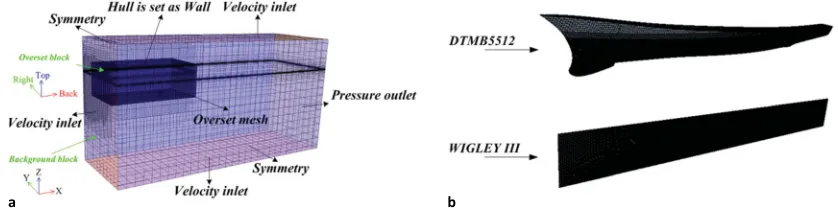
[image:5.610.82.274.565.660.2]Figure 3.Grid division of computational domain and hull (a) Mesh of the computational domain, (b) Computational mesh on the ship geometries.
can be calculated (Zhao, Gao, & Xia,2011). In this arti-cle, an overset mesh is used to divide the computational domain with linear interpolation, as shown in Figure3. Figure3(a) shows the mesh of the whole physical model, and the refined mesh is adopted near the free surface. Figure3(b) shows the mesh of hull surface.
Figure3(a) also shows the boundary conditions of the computational domain. In the light of the requirement of the overset mesh, the whole model needs two individual blocks which are named as background block and over-set block. Background block is only a cuboid, and overover-set block is a model with Boolean subtraction between the cuboid and the hull. For the background block, the length in front, back, top, bottom and left of the hull are taken as 1.5Lpp(Lpp is the length between perpendiculars of hull), 6Lpp, 1Lpp, 4Lppand 3Lpp, respectively. For the overset block, the length in front, back and left of the hull are taken as 1Lpp, 1.5Lppand 2Lpp, respectively.
(1) Background block: front, top and bottom bound-aries are selected as velocity inlet. Back boundary is selected as pressure outlet and both sides of tank are selected as symmetry plane.
(2) Overset block: the right side of the cuboid is set as the symmetry plane and the rest of surface is set as overset mesh. A no-slip boundary condition is set for the hull geometry.
4.2. Calculation methods
In this study, Star-CCM+is used as a RANS solver. Based on the user manual of the software (CD-Adapco,2014), the hull is set as the fixed model and floating on the water under design draft. The total resistance in calm water is calculated by using RANS equations (Ferziger & Peric, 2002) based on the SIMPLE (Patankar & Spald-ing, 1972) algorithm. The RNG k-ε model (Yakhot & Orszag,1986) is selected as turbulence model. A Volume of Fluid (VOF) model (Hirt & Nichols,1981) is selected to model and position the free surface. The whole compu-tational domain is discretized by finite volume method.
The second-order upwind difference scheme is adopted for the convection term and the centric difference scheme for the dissipation term. The ship speed is taken as the initial velocity to start the iterative calculation.
5. The establishment of approximation method for CFD data
5.1. Optimal Latin Hypercube Design (Opt LHD)
There are a variety of experimental designs, such as cen-tral composite, orthogonal design, full factorial design and so on. Among them, the random Latin hypercube design algorithm is improved to obtain better uniform, space-filling and equilibrium, which is known as optimal Latin hypercube design (Opt LHD) algorithm (Morris & Mitchell,1995). Matrix generating step is as follows:
mtest points,nfactors constitute then*mmatrix:
x=[x1,x2,x3,. . . .,xm] (14)
Analyze thei-th test point:
xTi =[xi1,xi2,xi3,. . . .,xin] (15)
The Latin hypercube design algorithm is used to gen-erate an initial design matrix according to the formula (15), and then update the design matrix through ele-ment exchange. Finally, optimal space filling is obtained by principle of max-min distance:
d(xi,xj)=dij=
n
k=1
|xik−xjk| t1t
(16)
wheret= 1 or 2, 1≤i,j≤m,i=j, the sampling point d(xi,xj) is the minimum distance betweenxiandxj.
Figure 4.Comparison of samples (a) Random latin hypercube design, (b) Optimal latin hypercube design (above: Present study, below: Wang & Lu,2015).
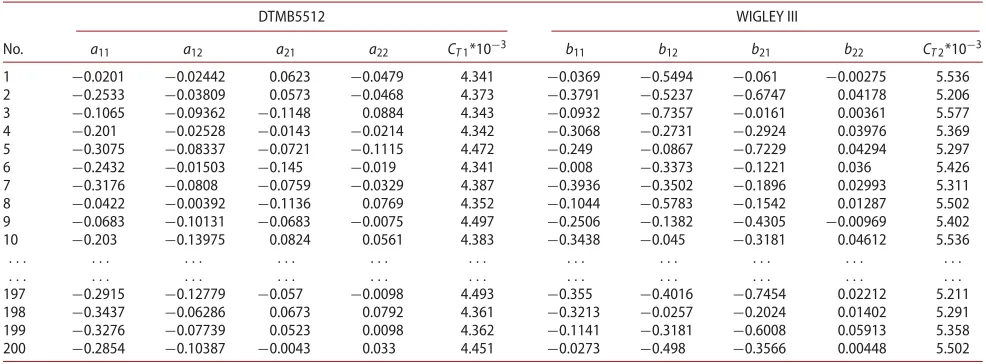
Based on the Opt LHD algorithm, 200 schemes are designed to calculate the total resistance, as shown in Table3. The space distributions of samples are shown in Figure5. The total resistanceRTis calculated by RANS-CFD method in Section 4. The total resistance coefficient CTcan be obtained using the following equation:
CT = RT
0.5ρvhull2 S (17)
whereρis the fluid density,vhullis the speed of hull,Sis the wetted surface area.
In the Table3:a11, a12,a21, and a22 are the design variables of the DTMB5512 ship, which have been listed in Section 6.CT1is the total resistance coefficient of the DTMB5512 ship.b11,b12,b21, andb22are the design vari-ables of the WIGLEY III ship, which have been listed in Section 6. CT2 is the total resistance coefficient of WIGLEY III ship.
5.2. Elman neural network
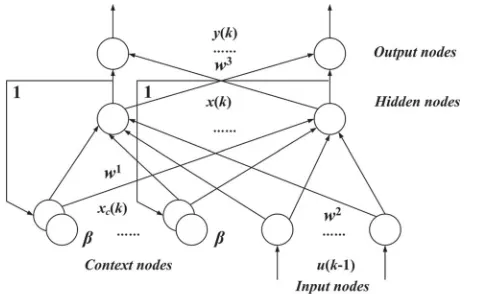
The ElmanNN was proposed by Elman in1990(Elman, 1990). Its main structure is feed forward connection, which includes the input nodes, hidden nodes, context nodes and output nodes, as shown in Figure6. The input nodes, hidden nodes and output nodes are similar to the
feed forward neural network. The input nodes unit only plays the role of signal transmission, and output nodes unit plays the role of the linear weighting. The context nodes are used to memory the previous output value of the hidden nodes and then return to the input.
Nonlinear state space equations of ElmanNN can be written as:
y(k)=g(w3x(k)) (18)
x(k)=f(w1xc(k)+w2u(k−1)) (19)
xc(k)=βxc(k−1)+x(k−1) (20)
wherew3represents the connection weight from the hid-den nodes to the output nodes,x(k) means the output of the hidden nodes.w1represents the connection weight from the context nodes to the hidden nodes, w2 rep-resents the connection weight from the input nodes to the hidden nodes.xc(k) means the output of the context nodes.β is the self-feedback gain coefficient.g(*) rep-resents the transfer function of the output nodes, f(*) represents the transfer function of the hidden nodes.
The error function can be written as:
E= 1
2(yd(k)−y(k))
T(yd(k)−y(k)) (21)
The dynamic learning algorithm can be summarized as follows:
w3ij=ϑ3δ0ixj(k), i=1, 2,. . .,m; j=1, 2,. . .,n (22)
w2jq=ϑ2δjhuq(k−1), j=1, 2,. . .,n; q=1, 2,. . .,r (23)
w1jl=ϑ1
m
i=1
δ0
iw3ij
∂xj(k)
∂w1jl ,
[image:7.610.59.552.553.735.2]j=1, 2,. . .,n; l=1, 2,. . .,n (24)
Table 3.Experiment samples.
DTMB5512 WIGLEY III
No. a11 a12 a21 a22 CT1*10−3 b11 b12 b21 b22 CT2*10−3
1 −0.0201 −0.02442 0.0623 −0.0479 4.341 −0.0369 −0.5494 −0.061 −0.00275 5.536 2 −0.2533 −0.03809 0.0573 −0.0468 4.373 −0.3791 −0.5237 −0.6747 0.04178 5.206 3 −0.1065 −0.09362 −0.1148 0.0884 4.343 −0.0932 −0.7357 −0.0161 0.00361 5.577 4 −0.201 −0.02528 −0.0143 −0.0214 4.342 −0.3068 −0.2731 −0.2924 0.03976 5.369 5 −0.3075 −0.08337 −0.0721 −0.1115 4.472 −0.249 −0.0867 −0.7229 0.04294 5.297 6 −0.2432 −0.01503 −0.145 −0.019 4.341 −0.008 −0.3373 −0.1221 0.036 5.426 7 −0.3176 −0.0808 −0.0759 −0.0329 4.387 −0.3936 −0.3502 −0.1896 0.02993 5.311 8 −0.0422 −0.00392 −0.1136 0.0769 4.352 −0.1044 −0.5783 −0.1542 0.01287 5.502 9 −0.0683 −0.10131 −0.0683 −0.0075 4.497 −0.2506 −0.1382 −0.4305 −0.00969 5.402 10 −0.203 −0.13975 0.0824 0.0561 4.383 −0.3438 −0.045 −0.3181 0.04612 5.536
. . . . . . . . . . . . . . . . . . . . . . . . . . . . . . . . .
. . . . . . . . . . . . . . . . . . . . . . . . . . . . . . . . .
Figure 5.Space distributions of samples (a) DTMB5512, (b) WIGLEYIII.
Figure 6.The framework of ElmanNN (above: Present study, below: Wang et al.,2011).
whereϑ3,ϑ2andϑ1are the learning step.
δ0
i =(yd,i(k)−y(k))gi(·) (25)
δh j =
m
i=1
(δ0
iw3ij)fj(·) (26)
∂xj(k)
∂w1jl =fj
(·)x
l(k−1)+β
∂xj(k−1)
∂w1jl (27)
5.3. IPSO-Elman neural network
The IPSO-ElmanNN can be expressed as follows:
(1) First, the samples are trained according to the input and output. Secondly, the note numbers of the input nodes, hidden nodes and output nodes are designed. Finally, the topology structure of ElmanNN is defined.
(2) Define the parameters of IPSO algorithm, which includes the population size, number of iterations, inertia factor and acceleration coefficients.
(3) Define the evaluation function of particles. The mean square error functionGis used as the fitness evaluation function of the particles. The position of the particle with the lowest fitness is the optimal solution of the model when the iteration is stopped. The fitness function can be defined by the following equation:
G= 1
N N
i=1
(yi(Elman)−yi(CFD))2 (28)
[image:8.610.62.301.392.539.2]Figure 7.Prediction results ofCT1for DTMB5512ship (a) The prediction of theCT1using ElmanNN, (b) The prediction of theCT1using IPSO-ElmanNN.
(4) The velocities and positions of a set of particles are initialized randomly.
(5) Update the velocities and positions of particles and inertia weight coefficientω.
(6) Calculate the fitness using the formula (28).
(7) Update the individual extremumpbestand the group extremum gbest according to the fitness of the particles.
(8) Update the solution, and adjust the weightsw1,w2, w3, and self-feedback gain coefficientβ.
(9) Evaluate whether the premature convergence is pro-duced. If the answer is yes, mutate the popula-tion. If not, repeat the steps 5–9 until the final end is met.
(10) The optimal result is used to train the weights and self-feedback gain coefficient, and then output pre-diction results of hull resistance.
5.4. Verification and validation for IPSO-ElmanNN
In order to test the effect of the IPSO-ElmanNN, ElmanNN and IPSO-ElmanNN prediction models are
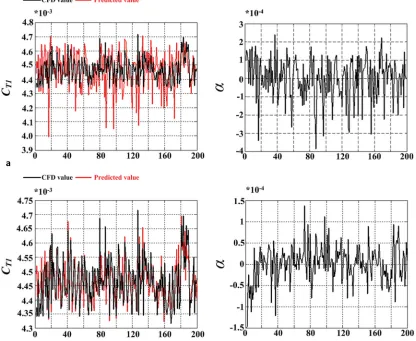
implemented in MATLAB (R2016a) with the samples from Table3. Two algorithms are then used to predict the total resistance subsequently. The cell numbers of input nodes, hidden nodes and output nodes are 4, 12 and 1, respectively. Figures7and8show the predictions results of the total resistance coefficients for two ships in ques-tion. α is the deviation between the ElmanNN//IPSO-ElmanNN and the CFD methods. Table 4 shows the average error results of these predictions.
Figure 8.Prediction results ofCT2for WIGLEYIIIship (a) The prediction of theCT2using ElmanNN, (b) The prediction of theCT2using IPSO-ElmanNN.
Table 4.Result of the total resistance coefficient prediction based on the different algorithms.
Average Error (%) for 200 sampling hull forms
Training algorithms DTMB5512 WIGLEY III
ElmanNN 8.89*10−5 1.41*10−4
IPSO-ElmanNN 3.2*10−5 4.7*10−5
that the number of samples is not adequate. The network training results can be improved effectively by increasing the number of training samples.
6. Hull form optimization problems
6.1. Optimize processes
In this paper, optimization process is shown in Figure9, including the following five steps:
(1) Change design variables using the IPSO algorithm. (2) On the basis of a set of design variables, change hull
form shape using the ASD technique.
(3) Calculate the displacement of each new hull and compare with the constraint. If the condition is met,
[image:10.610.98.516.589.711.2]Figure 10.Modified region of hull forms.
continue to calculate, otherwise return to step 1 to recalculate the new hull.
(4) Calculate the total resistance in calm water using IPSO-ElmanNN, and then save the result.
(5) Repeat steps 1–4 until the stopping criterion is met. Then the new hull can be output. The whole work is completed on the ISIGHT platform (Wang, Mo, & Zhang,2011).
6.2. Geometry
In this paper, the DTMB5512 and WIGLEY III ships are selected as optimization models. The modified area have been shown in Figure10. The major characteristics are shown in Table5.
6.3. Optimization strategy
[image:11.610.313.549.490.592.2]The objective function is the total resistance coefficients CT1(DTMB5512) andCT2(WIGLEY III) in calm water at design speed. The displacement constraint has been
Table 5.Major characteristics of two ships.
Hull forms DTMB5512 WIGLEY III
Design speedFr 0.28 0.3
Length between perpendicularsLpp(m) 3.048 3
Draftd(m) 0.132 0.1875
BreathB(m) 0.409 0.3
Displacement(kg) 86.4 78
Block CoefficientCB 0.507 0.4622
defined in formula (29) (only for DTMB5512). The design variables,a11,a12,a21anda22(DTMB5512) and
b11,b12,b21 andb22(WIGLEY III) have been shown in Table6.
new−org
org
≤0.01 (29)
where new represents the variable of new hull, and org represents the variable of parent hull.
In the Table6:No.1 toNo.6 are the positions of design variables, as shown in Figure11.
6.4. Results and discussion
[image:11.610.79.540.496.712.2]Since the calculation of the total resistance costs less than two minute under the help of the IPSO-ElmanNN, the optimization efficiency has been greatly improved compared with CFD runs optimization loop. After the completion of the optimization, the excellent hull forms
Table 6.Control parameters of two ships.
Hull forms
Design variables No.
Moving
directions Constraints DTMB5512 a11 1 X −0.4≤a11≤0
a12 1 Z −0.15≤a12≤0.02
a21 2 Y −0.15≤a21≤0.1
a22 3 Y −0.13≤a22≤0.1
WIGLEY III b11 4 X −0.4≤b11≤0
b12 5 Y −0.8≤b12≤0
b21 6 Y −0.8≤b21≤0
b22 4 Z −0.012≤b22≤0.06
[image:11.610.60.296.518.591.2]Table 7.Resistance results of the optimized hulls.
Method Parent hulls Optimized hulls Fr CTorg/CTopt
IPSO-ElmanNN+IPSO DTMB5512 Optimized hull-A 0.28 1.0591 WIGLEY III Optimized hull-B 0.3 1.05468
with lower total resistance are obtained. The work is car-ried out on the Intel Corei5-5200U CPU @2.2 GHz, and the CFD runs in this paper are using the ARCHIE-WeSt Height Performance Computer (http://www.archie-west. ac.uk). Table 7shows the comparison of the obtained optimization results. The results clearly state that the total resistance of the optimized hull-A is decreased by 5.58%, and the optimized hull-B is decreased by 5.19%. Follow-ing this, further calculations are carried out for other speeds and comparison is made against the parent hull by RANS-CFD results and the EFD data obtained from Iowa Institute of Hydraulic Research (Gui, Longo, & Stern, 2001a,2001b; Longo & Stern,2005) and Delft University
of Technology (1992), as shown in Figure 12. For the optimized hull-A,CT1decreases at all speeds especially in design speed and high speed, and for the optimized hull-B,CT2decreases at all speeds especially in the design speed.
Figure13shows the comparison of the hull lines for parent hull and optimized hulls. Figure 14 shows the comparison of longitudinal wave cut for parent hull and optimized hulls along they/Lpp=0.082 plan (z repre-sents the height of free surface). It can be found that the amplitude of waves has been reduced which indi-cates the reduction in total resistance for the optimized hulls.
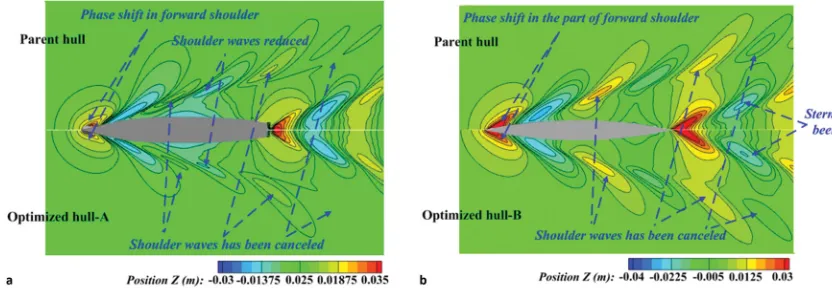
[image:12.610.85.524.300.424.2]Figure15presents the wave patterns for the parent hull and the optimized hulls. As the change of the bow shape for both of the ships, the wave patterns in the forward shoulder have been reduced significant, while the change of the shoulder waves and the stern waves are not very
Figure 12.The total resistance coefficients for a range ofFrnumbers (a) DTMB5512, (b) WIGLEYIII.
Figure 13.Comparison of hull lines (a) DTMB5512, (b) WIGLEYIII.
[image:12.610.76.528.353.714.2]Figure 15.Comparison of the wave patterns around the vessels (a) DTMB5512, (b) WIGLEYIII.
Figure 16.Comparison of the static pressure on the ship surfaces (a) DTMB5512, (b) WIGLEYIII.
significant. Figure16is the comparison of the static pres-sure on hull surface. The new hull forms have changed the pressure distribution near the bow, and wave-resistance has been decreased which ends the decrease of the total resistance.
7. Conclusion
(1) In order to overcome the shortcomings of the PSO algorithm, an IPSO algorithm has been proposed with random weighting method and the evaluation of convergence. Through the test of four mathe-matical functions, it can be concluded that IPSO algorithm developed in this paper can effectively improve the optimization accuracy.
(2) ElmanNN parameters are trained by IPSO algorithm, and IPSO-ElmanNN prediction model is proposed.
Then ElmanNN and IPSO-ElmanNN are carried out on the prediction of the hull resistance. The results indicate that the IPSO-ElmanNN has the advantages of precision and stability.
(3) Aiming to deal with the challenge of larger surface variation, the ASD technique is used to change the shape of geometry. The new model can be quickly obtained while ensuring the smoothness of surfaces. Because of less design variables, it also can improve the efficiency of ship-type optimization.
(4) In terms of hull form optimization problem,
IPSO-ElmanNN-based approximate optimization
[image:13.610.134.469.230.474.2](5) Since the optimization loop in this paper is devel-oped for single objective function (minimum total resistance in calm water), and the seakeeping per-formances are not taken into account. To obtain a hull form with a better performance, future work will force on the multi-objective optimization including rapidity, seakeeping and manipulation.
Disclosure statement
No potential conflict of interest was reported by the authors.
Funding
The study in this paper was supported by the grants of the National Science Foundation of China, (No. 51009087) and the grants from the National Science Foundation of Shanghai (No.14ZR1419500). Results were obtained using the EPSRC
funded ARCHIE-WeSt High Performance Computer (www.
archie-west.ac.uk). EPSRC grant no. EP/K000586/1.
ORCID
Shenglong Zhang http://orcid.org/0000-0002-9348-4395
Tahsin Tezdogan http://orcid.org/0000-0002-7032-3038
References
Azimifar, A., & Payan, S. (2016). Enhancement of heat
trans-fer of confined enclosures with free convection using blocks
with PSO algorithm. Applied Thermal Engineering, 101,
79–91.doi:10.1016/j.applthermaleng.2015.11.122
CD-Adapco. (2014). User guide STAR-CCM+Version 9.0.2.
Chang, H. C., Feng, B. W., Liu, Z. Y., Zhan, C. S., & Cheng, X.
D. (2012). Research on application of approximate model in
hull form optimization.Shipbuilding of China,53(1), 88–98.
(In Chinese).
Chau, K. W., & Wu, C. L. (2010). A hybrid model
cou-pled with singular spectrum analysis for daily rainfall
prediction. Journal of Hydroinformatics, 12(4), 458–473.
doi:10.2166/hydro.2010.032
Chen, A. G., & Ye, J. W. (2009).Research on the genetic
neu-ral network for the computation of ship resistance. Interna-tional conference on computaInterna-tional intelligence and natural computing, Japan.
Couser, P., Mason, A., Mason, G., Smith, C. R., & Konsky,
B. R. V. (2004).Artificial neural networks for hull resistance
prediction.. At Siguenza, Spain: Compit.
Ding, S. F., Jia, W. K., Su, C. Y., Xu, X. Z., & Zhang, L. W.
(2008). PCA-Based elman neural network algorithm.Tien
Tzu Hsueh Pao/Acta Electronica Sinica,5370(2), 315–321.
doi:10.1007/978-3-540-92137-0_35
Elman, J. L. (1990). Finding structure in time.Cognitive Science,
14(2), 179–211.
Ferziger, J. H., & Peric, M. (2002).Computational methods for
fluid dynamics(3rd ed.). Berlin, Gsssermany: Springer.
Garg, H. (2016). A hybrid PSO-GA algorithm for constrained
optimization problems.Applied Mathematics and
Computa-tion,274(11), 292–305.doi:10.1016/j.amc. 2015.11.001
Gui, L., Longo, J., & Stern, F. (2001a). Biases of PIV
measure-ment of turbulent flow and the masked correlation-based
interrogation algorithm.Experiments in Fluids,30(1), 27–35.
doi:10.1007/s003480000131
Gui, L., Longo, J., & Stern, F. (2001b). Towing tank PIV
measurement system, data and uncertainty assessment for
DTMB model 5512.Experiments in Fluids,31(3), 336–346.
doi:10.1007/s003480100293
Han, J. H., Li, Z. R., & Wei, Z. C. (2006). Adaptive particle
swarm optimization algorithm and simulation.Journal of
System Simulation,18(10), 2969–2971. (In Chinese).
Hirt, C. W., & Nichols, B. D. (1981). Volume of fluid method for
the dynamics of free boundaries.Journal of Computational
Physics,39(1), 20–225.doi:10.1016/0021-9991(81)90145-5
Hou, Y. H., Liu, F., & Liang, X. (2016). Minimum resistance
hull form optimization design based on IPSO-BP
neu-ral network.Journal of Shanghai Jiaotong University,50(8),
1193–1199. (In Chinese).
Hu, Z., & Balakrishnan, S. N. (2005). Parameter estimation in
nonlinear systems using hopfield neural networks.Journal of
Aircraft,42(1), 41–53.doi:10.2514/1.3210
Huan, J., & Huang, T. T. (1998).Sensitivity analysis methods for
shape optimization in nonlinear free surface flow. Proceedings 3rd osaka colloquium on advanced CFD applications to ship flow and hull form design, Japan.
Huang, F., Wang, L., & Yang, C. (2015).Hull form optimization
for reduced drag and improved seakeeping using a surrogate-based method. International Society of Offshore and Polar Engineers.
Huang, F. X., & Yang, C. (2016). Hull form optimization of a
cargo ship for reduced drag.Journal of Hydrodynamics Series
B,28(2), 173–183.doi:10.1016/S1001-6058(16)60619-4
Journée, J. M. J. (1992). Experiments and calculations on 4
wigley hull forms in head waves. Holand: Delft University of Technology.
Kamiński, B. (2015). A method for the updating of
stochas-tic kriging metamodels. European Journal of Operational
Research,247(3), 859–866.doi:10.1016/j.ejor.2015.06.070
Kennedy, J., & Eberhart, R. C. (1995). Particle swarm
opti-mization. Proceedings of the 1995 IEEE international con-ferenceon neural networks, Australia.
Kim, H., & Yang, C. (2010). A new surface modification
approach for CFD-based hull form optimization.Journal of
Hydrodynamics, Series B,22(5), 520–525. doi:10.1016/S1001-6058(09)60246-8
Kim, K. J. (1995).Ship flow calculations and resistance
mini-mization. Swedish: Chalmers University of Technology.
Li, N. J., Wang, W. J., Hsu, J., & Chen, C. (2014). Enhanced
parti-cle swarm optimizer incorporating a weighted partiparti-cle.
Neu-rocomputing, 124(2014), 218–227. doi:10.1016/j.neucom. 2013.07.005
Li, S. Z. (2012). Research on hull form design optimization
based on SBD technique. Wuhan: China Ship Research and Development Academy. (In Chinese).
Li, Z., & Liang, X. R. (2007). Control for freeway speed
limita-tion based on elman neural network.Microcomputer
Infor-mation,23(28), 27–29. (In Chinese).
Liu, H., Tian, H. Q., Liang, X. F., & Li, F. Y. (2015). Wind
speed forecasting approach using secondary decomposition
algorithm and elman neural networks.Applied Energy,157,
183–194.doi:10.1016/j.apenergy.2015.08.014
Liu, Z., & Luo, Z. (2005). Alertness states classification by SOM
and LVQ neural networks.Proceedings of World Academy of
fromhttps://hal.inria.fr/inria-00000662/file/IjIT2004_khaled. pdf
Longo, J., & Stern, F. (2005). Uncertainty assessment for towing
tank tests with example for surface combatant DTMB model
5415.Journal of Ship Research,49(1), 55–68. Retrieved from
http://www.ivt.ntnu.no/imt/courses/tmr7/resources/ Stern_uncertainty_anal_JSR.pdf
Morris, M. D., & Mitchell, T. J. (1995). Exploratory designs
for computational experiments.Journal of Statistical
Plan-ning and Inference,43, 381–402.doi:10.1016/0378-3758(94) 00035-T
Nik, A. A., Nejad, F. M., & Zakeri, H. (2016). Hybrid PSO
and GA approach for optimizing surveyed asphalt
pave-ment inspection units in massive network.Automation in
Construction,71, 325–345.doi:10.1016/j.autcon.2016.08.004
Ortigosa, I., López, R., & García, J. (2009). Prediction of
total resistance coefficients using neural networks.Journal
of Maritime Research,6, 15–26. Retrieved fromhttps://www. researchgate.net/publication/228658884
Patankar, S. V., & Spalding, D. B. (1972). A calculation
pro-cedure for heat, mass and momentum transfer in
three-dimensional parabolic flows.International Journal of Heat
and Mass Transfer, 15(10), 1787–1806. doi:10.1016/0017-9310(72)90054-3
Puig, V., Witczak, M., Nejjari, F., Quevedo, J., & Korbicz, J.
(2007). A GMDH neural network-based approach to passive
robust fault detection using a constraint satisfaction
back-ward test.Engineering Applications of Artificial Intelligence,
20(7), 886–897.doi:10.1016/j.engappai.2006.12.005
Qian, J. K., Mao, X. F., Wang, X. Y., & Yun, Q. Q. (2012).
Ship hull automated optimization of minimum resistance via
CFD and RSM technique.Journal of Ship Mechanics,16(1),
36–43. (In Chinese).
Shen, C., Song, R., Li, J., Zhang, X. M., Tang, J., Shi, Y. B.,. . .Cao, H. L. (2015). Temperature drift modeling of MEMS gyroscope based on genetic-elman neural network. Mechanical Systems and Signal Processing, 72, 897–905.
doi:10.1016/j.ymssp.2015.11.004
Song, Z. Z., & Zhao, Y. Q. (2016). Suspension test system
based on modified elman neural network.China Mechanical
Engineering,27(1), 1–6. (In Chinese).
Sun, Z. X., Song, J. J., & An, Y. R. (2010).
Optimiza-tion of the head shape of the CRH3 high speed train. Science China Technological Sciences, 53(12), 3356–3364.
doi:10.1007/s11431-010-4163-5
Tahara, Y., Peri, D., Campana, E. F., & Stern, F. (2008).
Compu-tational fluid dynamics-based multi-objective optimization of a surface combatant using a global optimization method. Journal of Marine Science and Technology, 13(2), 95–116.
doi:10.1007/s00773-007-0264-7
Taormina, R., & Chau, K. W. (2015). Data-driven input
vari-able selection for rainfall-runoff modeling using binary-coded particle swarm optimization and extreme
learn-ing machines. Journal of Hydrology, 529(3), 1617–1632.
doi:10.1016/j.jhydrol.2015.08.022
Tungadio, D. H., Jordaan, J. A., & Siti, M. W. (2016). Power
sys-tem state estimation solution using modified models of PSO
algorithm: Comparative study.Measurement,92, 508–523.
doi:10.1016/j.measurement.2016.06.052
Wang, D. F., & Lu, F. (2015). Body-in-white lightweight
based on multidisciplinary design optimization.Journal of
Jilin University (Engineering and Technology Edition),45(1), 29–37. (In Chinese).
Wang, W., Mo, R., & Zhang, Y. (2011). Multi-objective
aerodynamic optimization design method of compressor
rotor based on isight.Procedia Engineering,15, 3699–3703.
doi:10.1016/j.proeng.2011.08.693
Wang, W. C., Kwokwing, C., Xu, D. M., & Chen, X. Y.
(2015). Improving forecasting accuracy of annual runoff
time series using ARIMA based on EEMD
decomposi-tion.Water Resources Management,29(8), 2655–2675.doi:
10.1007/s11269-015-0962-6
Wang, X., Ma, L., Wang, B., & Wang, T. (2011).
Applica-tion of evoluApplica-tionary elman neural network in real-time data
forecasting.Electric Power Automation Equipment,31(12),
77–81. (In Chinese).
Wu, C. L., Chau, K. W., & Li, Y. S. (2009). Methods to improve
neural network performance in daily flows prediction.
Jour-nal of Hydrology,372(1-4), 80–93.doi:10.1016/j.jhydrol.2009. 03.038
Yakhot, V., & Orszag, S. A. (1986). Renormalization group
analysis of turbulence. I. Basic theory.Journal of Scientific
Computing,1(1), 3–51.doi: 10.1007/BF01061452
Zhang, B. J., & Zhang, Z. X. (2015). Research on
theoret-ical optimization and experimental verification of min-imum resistance hull form based on rankine source
method. International Journal of Naval Architecture and
Ocean Engineering,7(5), 785–794. doi:10.1515/ijnaoe-2015-0055
Zhang, H. L., Hao, Z. D., Kong, X. M., & Li, W. (2013).
Esti-mation of calorific value of coals using BP and elman
neu-ral networks.Advanced Materials Research,781-784, 39–44.
doi:10.4028/www.scientific.net/AMR.781-784.39
Zhang, J., & Chau, K. W. (2009). Multilayer ensemble
prun-ing via novel multi-sub-swarm particle swarm
optimiza-tion.Journal of Universal Computer Science,15(4), 840–858.
Retrieved from https://www.researchgate.net/publication/
220349014
Zhang, Y. H. (2016). Application of BP neural network
in structural damage diagnosis of bridge behind
abut-ment. Applied Mechanics and Materials, 847, 440–444.
doi:10.4028/www.scientific.net/AMM.847.440
Zhao, F. M., Gao, C. J., & Xia, Q. (2011). Overlap grid research
on the application of ship CFD.Journal of Ship Mechanics,
15(4), 332–341. (In Chinese).
Zhou, C., Ding, L. Y., & He, R. (2013). PSO-based Elman neural
network model for predictive control of air chamber pressure
in slurry shield tunneling under Yangtze river.Automation
in Construction,36(15), 208–217.doi:10.1016/j.autcon.2013. 03.001
Zhou, J. P., Yang, P., & Yang, N. (2011). Comparison and
application of BP and elman network in fault diagnosis of
condenser.East China Electric Power,39(5), 822–824. (In